

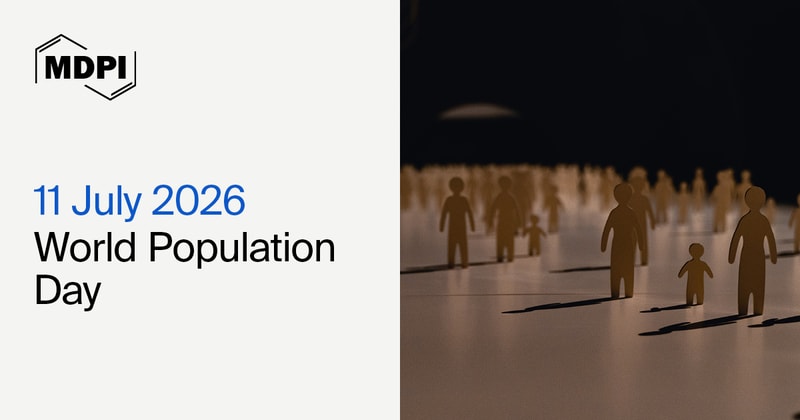
World Population Day, 11 July 2026
World Population Day, on 11 July, is a global observance dedicated to raising awareness of the opportunities and challenges associated with population trends and their impact on sustainable development. Population dynamics influence every aspect of society, from health, education, and employment to economic growth, social inclusion, and public policy.
As countries navigate demographic shifts, urbanization, ageing populations, migration, and changing family structures, interdisciplinary research plays a vital role in informing evidence-based solutions and fostering resilient, inclusive societies.
In recognition of World Population Day, we invite you to explore selected articles, Special Issues, and journals spanning fields such as Social Sciences, Arts and Humanities, and Business and Economics. By sharing this knowledge, we aim to foster informed dialogue and inspire collaborative action to address global population challenges, promote health and well-being, advance gender equality, and support sustainable development for present and future generations.

 |
 |
 |
 |
 |
 |
 |
 |
 |
 |
 |
 |

“An Age Grouping Framework for Multi-Population Mortality Modeling”
by Cezar A. Câmpeanu and Yechao Meng
Risks 2026, 14(3), 59; https://doi.org/10.3390/risks14030059
“Realty Citizenship, Running Partners, and Alternate Loves: A Prolegomenon to Future Work on the Unhoused in San Antonio, TX”
by Alfred Montoya
Humans 2026, 6(1), 6; https://doi.org/10.3390/humans6010006
“Why Aren’t You Married Yet? Effects of Influences to Marry Early on Personal and Relational Well-Being”
by Brandon K. Burr, Emma Christensen, Clint Broadbent, Brian Camp, Aimee Kieffer, KeriLyn Nash, Jarrett Harmon and Bobby Kern
Fam. Sci. 2026, 2(1), 5; https://doi.org/10.3390/famsci2010005
“Shrinking China: Policy, Social Changes, and Fertility Decline”
by C. Cindy Fan
Populations 2026, 2(1), 3; https://doi.org/10.3390/populations2010003
“Machine Learning-Based Prediction and Analysis of Chinese Youth Marriage Decision”
by Jinshuo Zhang, Chang Lu, Xiaofang Wang, Dongyang Guo, Chao Bi and Xingda Ju
Behav. Sci. 2025, 15(12), 1750; https://doi.org/10.3390/bs15121750
“Livelihood Strategies for Adolescent Girls Transitioning out of Residential Childcare Facilities: A Zimbabwean Perspective”
by Sipho Sibanda and Pamhidzayi Berejena Mhongera
Societies 2025, 15(11), 293; https://doi.org/10.3390/soc15110293
“Declining Aspirations for Marriage and Parenthood Among Young Women and Men in China”
by Sampson Lee Blair, Timothy J. Madigan and Sha Luo
Fam. Sci. 2025, 1(1), 5; https://doi.org/10.3390/famsci1010005
“Replanting the Birthing Trees: A Call to Transform Intergenerational Trauma into Cycles of Healing and Nurturing”
by Catherine Chamberlain, Jacynta Krakouer, Paul Gray, Madeleine Lyon, Shakira Onwuka, Ee Pin Chang, Lesley Nelson, Valda Duffield, Janine Mohamed, Shaydeen Stocker, Yalmay Yunupingu et al.
Genealogy 2025, 9(2), 52; https://doi.org/10.3390/genealogy9020052

| “The Future of Work and the Multigenerational Workplaces and Workforce” Guest Editors: Dr. Subas Dhakal, Prof. Dr. John Burgess and Dr. Alan Nankervis Submission deadline: 31 August 2026 |
“Migration in Anthropological Perspective” Guest Editor: Dr. Kevin M. Kelly Submission deadline: 30 September 2026 |
 |
 |