You are currently viewing a new version of our website. To view the old version click .

Foods, Volume 11, Issue 9

May-1 2022 - 197 articles

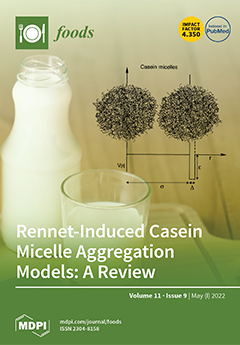
Cover Story: The enzymatic coagulation of milk conventionally occurs in two phases: the casein micelles hydrolysis phase and a subsequent aggregation phase. However, currently, more and more researchers consider that aggregation consists of two sub-stages: formation of micellar aggregates to form a primary para-κ-casein network and subsequent hardening of the primary three-dimensional network. To clarify this controversy, the best-known descriptive models of rennet-induced aggregation have been reviewed, finding that more recent models could differentiate the aggregation stage from the hardening stage. This segmentation is important because it would allow better control of this type of coagulation to optimize cheese quality and yield. View this paper
  • Issues are regarded as officially published after their release is announced to the table of contents alert mailing list .
  • You may sign up for email alerts to receive table of contents of newly released issues.
  • PDF is the official format for papers published in both, html and pdf forms. To view the papers in pdf format, click on the "PDF Full-text" link, and use the free Adobe Reader to open them.

Articles (197)

  • Article
  • Open Access
7 Citations
3,472 Views
13 Pages

7 May 2022

Wine lees are a by-product that represents a 25% of the total winery waste. Although lees are rich in antioxidant compounds and dietary fiber, they have no added value and are considered a residue. The aim of this study was to evaluate the effect of...

  • Article
  • Open Access
26 Citations
3,974 Views
17 Pages

7 May 2022

In the present study, p-hydroxybenzoic acid-grafted chitosan (PA-g-CS) conjugates with different grafting degrees were synthesized by a free radical-regulated grafting approach. The conjugates were further developed into films by casting, and their c...

  • Article
  • Open Access
28 Citations
5,405 Views
18 Pages

Higher Yield and Polyphenol Content in Olive Pomace Extracts Using 2-Methyloxolane as Bio-Based Solvent

  • Christian Cravotto,
  • Anne Sylvie Fabiano-Tixier,
  • Ombéline Claux,
  • Vincent Rapinel,
  • Valérie Tomao,
  • Panagiotis Stathopoulos,
  • Alexios Leandros Skaltsounis,
  • Silvia Tabasso,
  • Laurence Jacques and
  • Farid Chemat

7 May 2022

Despite its severe toxicity and negative environmental impact, hexane remain the solvent of choice for the extraction of vegetable oils. This is in contrast with the constantly growing demand for sustainable and green extraction processes. In recent...

  • Article
  • Open Access
34 Citations
10,200 Views
13 Pages

Consumers’ Understanding of Ultra-Processed Foods

  • Juliana Sarmiento-Santos,
  • Melissa B. N. Souza,
  • Lydia S. Araujo,
  • Juliana M. V. Pion,
  • Rosemary A. Carvalho and
  • Fernanda M. Vanin

7 May 2022

Food classification systems have been proposed to improve food quality criteria. Among these systems, “processing level” has been used as a criterion. NOVA classification, as the denotation “ultra-processed” food (UPF), has be...

  • Article
  • Open Access
13 Citations
6,707 Views
15 Pages

7 May 2022

Research on the nutrient content of cereal grains during germination is becoming a hot topic; however, studies on germinated maize are still scarce. This study aimed to provide a technical reference and theoretical basis for the development of functi...

  • Article
  • Open Access
22 Citations
3,474 Views
15 Pages

6 May 2022

The addition of food-derived antihypertensive peptides to the diet is considered a reasonable antihypertension strategy. However, data about the stability of antihypertensive peptides in different food processing conditions are limited. In this study...

  • Article
  • Open Access
10 Citations
2,839 Views
12 Pages

CsCuAOs and CsAMADH1 Are Required for Putrescine-Derived γ-Aminobutyric Acid Accumulation in Tea

  • Kexin Zhang,
  • Yu Duan,
  • Yu Cao,
  • Yiwen Chen,
  • Zhongwei Zou,
  • Fang Li,
  • Qiang Shen,
  • Xiaowei Yang,
  • Yuanchun Ma and
  • Wanping Fang
  • + 1 author

6 May 2022

Polyamines are a potential source of γ-aminobutyric acid (GABA) in plants under abiotic stress. However, studies on GABA enrichment in tea mostly focus on the GABA shunt, while the correlation between polyamine degradation and GABA formation in...

  • Article
  • Open Access
23 Citations
3,828 Views
10 Pages

Content Variations in Oleocanthalic Acid and Other Phenolic Compounds in Extra-Virgin Olive Oil during Storage

  • Jasmine Esposito Salsano,
  • Maria Digiacomo,
  • Doretta Cuffaro,
  • Simone Bertini and
  • Marco Macchia

6 May 2022

The health benefits of extra-virgin olive oil (EVOO) are strictly linked to the presence of phenolic compounds, which exhibit numerous nutraceutical properties. In EVOO, the most important class of phenolic compounds is represented by secoiridoids (o...

  • Article
  • Open Access
36 Citations
5,286 Views
19 Pages

Phytochemical Analysis, α-Glucosidase and α-Amylase Inhibitory Activities and Acute Toxicity Studies of Extracts from Pomegranate (Punica granatum) Bark, a Valuable Agro-Industrial By-Product

  • Nassima Laaraj,
  • Mohamed Bouhrim,
  • Loubna Kharchoufa,
  • Salima Tiji,
  • Hasnae Bendaha,
  • Mohamed Addi,
  • Samantha Drouet,
  • Christophe Hano,
  • Jose Manuel Lorenzo and
  • Mohamed Bnouham
  • + 1 author

6 May 2022

Punica granatum is a tree of the Punicaceae family which is widespread all over the world with several types of varieties. Its fruit juice is highly prized, whereas the bark, rich in in phytochemicals such as flavonoids, hydrolysable tannins, phenoli...

  • Article
  • Open Access
16 Citations
6,934 Views
26 Pages

Optimization of Astaxanthin Recovery in the Downstream Process of Haematococcus pluvialis

  • Inga K. Koopmann,
  • Simone Möller,
  • Clemens Elle,
  • Stefan Hindersin,
  • Annemarie Kramer and
  • Antje Labes

6 May 2022

Astaxanthin derived from Haematococcus pluvialis is a valuable metabolite applied in a wide range of products. Its extraction depends on a sophisticated series of downstream process steps, including harvesting, disruption, drying, and extraction, of...

of 20

Get Alerted

Add your email address to receive forthcoming issues of this journal.

XFacebookLinkedIn
Foods - ISSN 2304-8158