

You are currently viewing a new version of our website. To view the old version click .

Plants, Volume 10, Issue 10

October 2021 - 255 articles

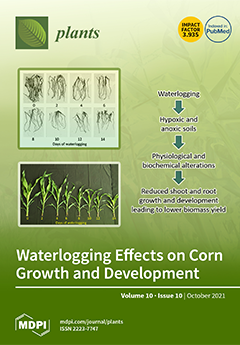
Cover Story: Waterlogging restricts about 10–12% of agricultural lands from reaching their true genetic potential globally. Functional relationships of corn growth to waterlogging are needed to develop management tools. Our study shows that waterlogging treatments caused soil oxygen levels to decline rapidly, reaching zero around eight days. The hypoxic and anoxic soils caused cascaded physiological processes, leading to restricted corn shoot and root growth under waterlogged conditions. Plant height and leaf numbers were least affected while plant component dry biomass accumulations declined exponentially as waterlogging duration was prolonged. The identified waterlogging-specific indices for growth and developmental processes should be helpful for modeling corn simulation models to improve management practices. View this paper
  • Issues are regarded as officially published after their release is announced to the table of contents alert mailing list .
  • You may sign up for email alerts to receive table of contents of newly released issues.
  • PDF is the official format for papers published in both, html and pdf forms. To view the papers in pdf format, click on the "PDF Full-text" link, and use the free Adobe Reader to open them.

Articles (255)

  • Article
  • Open Access
6 Citations
3,597 Views
16 Pages

Growth, Yield, and Bunch Quality of “Superior Seedless” Vines Grown on Different Rootstocks Change in Response to Salt Stress

  • Lo’ay A. A.,
  • Dina A. Ghazi,
  • Nadi Awad Al-Harbi,
  • Salem Mesfir Al-Qahtani,
  • Sabry Hassan and
  • Mohamed A. Abdein

19 October 2021

The growth and quality of vines are negatively affected by soil salinity if enough salts accumulate in the root zone. As part of the current study, we estimated the remediating effects of rootstocks under salinity. For this reason, “superior seedless...

  • Feature Paper
  • Article
  • Open Access
9 Citations
3,906 Views
24 Pages

Nutrient Status of Cucumber Plants Affects Powdery Mildew (Podosphaera xanthii)

  • Yigal Elad,
  • Dor Barnea,
  • Dalia Rav-David and
  • Uri Yermiyahu

19 October 2021

We examined the effects of applications of N, P, K, Mg, and Ca through an irrigation solution and spraying K, Ca, and Mg salts on cucumber powdery mildew (CPM, Podosphaera xanthii) in potted plants and under commercial-like conditions. Spraying CaCl2...

  • Article
  • Open Access
12 Citations
3,751 Views
14 Pages

Bioactive Compounds in Sarcocornia and Arthrocnemum, Two Wild Halophilic Genera from the Iberian Peninsula

  • Irene Sánchez-Gavilán,
  • Esteban Ramírez Chueca and
  • Vicenta de la Fuente García

19 October 2021

(1) Background: this study describes bioactive compounds in the following halophytes: Sarcocornia (S. alpini, S. pruinosa, and S. perennis) and Arthrocnemum (A. macrostachyum). The material comes from: coastal marshes in Tinto River, Guadiana River,...

  • Article
  • Open Access
5 Citations
2,567 Views
10 Pages

Cytotoxic and Genotoxic Evaluation of the Aqueous and Hydroalcoholic Leaf and Bark Extracts of Crataegus oxyacantha in Murine Model

  • Fany Renata Aguilera-Rodríguez,
  • Ana Lourdes Zamora-Perez,
  • Clara Luz Galván-Moreno,
  • Rosalinda Gutiérrez-Hernández,
  • Claudia Araceli Reyes Estrada,
  • Edgar L. Esparza-Ibarra and
  • Blanca Patricia Lazalde-Ramos

19 October 2021

Crataegus oxyacantha has been mainly used in traditional medicine for the treatment of cardiovascular diseases. However, its safety profile has not been fully established, since only the genotoxic effects of C. oxyacantha fruit have been described. T...

  • Article
  • Open Access
8 Citations
2,856 Views
14 Pages

Developing Novel Rice Genotypes Harboring Specific QTL Alleles Associated with High Grain Yield under Water Shortage Stress

  • Mohamed Abdelrahman,
  • Mahmoud E. Selim,
  • Mahmoud A. ElSayed,
  • Megahed H. Ammar,
  • Fatma A. Hussein,
  • Neama K. ElKholy,
  • Essam A. ElShamey,
  • Naeem Khan and
  • Kotb A. Attia

19 October 2021

Rice is considered a strategic crop for many countries around the world, being the main cash crop for farmers. Water shortage stress occurrence as a result of climate change is among the main threats challenging rice breeders in the last few decades....

  • Review
  • Open Access
31 Citations
6,556 Views
34 Pages

19 October 2021

Interest in canola (Brassica napus L.). In response to this interest, scientists have been tasked with altering and optimizing the protein production chain to ensure canola proteins are safe for consumption and economical to produce. Specifically, th...

  • Feature Paper
  • Article
  • Open Access
1 Citations
3,265 Views
14 Pages

19 October 2021

Elucidating the origin of flowers has been a challenge in botany for a long time. One of the central questions surrounding the origin of flowers is how to interpret the carpel, especially the relationship between the phyllome part (carpel wall) and t...

  • Article
  • Open Access
19 Citations
3,741 Views
11 Pages

Chemical Composition of Ambrosia trifida L. and Its Allelopathic Influence on Crops

  • Jovana Šućur,
  • Bojan Konstantinović,
  • Marina Crnković,
  • Vojislava Bursić,
  • Nataša Samardžić,
  • Đorđe Malenčić,
  • Dejan Prvulović,
  • Milena Popov and
  • Gorica Vuković

19 October 2021

Phytotoxic substances released by invasive plants have been reported to have anti-pathogen, anti-herbivore, and allelopathic activity. The aim of this study was to determine the allelopathic influence of the Ambrosia trifida L. on oxidative stress pa...

  • Article
  • Open Access
2 Citations
2,675 Views
12 Pages

Wheat Leaf Antioxidative Status—Variety-Specific Mechanisms of Zinc Tolerance during Biofortification

  • Ivna Štolfa Čamagajevac,
  • Rosemary Vuković,
  • Kristina Vuković,
  • Ana Vuković,
  • Vladimir Ivezić,
  • Tanja Žuna Pfeiffer,
  • Ljiljana Krstin and
  • Zdenko Lončarić

19 October 2021

In this study, we evaluated the leaf antioxidative responses of three wheat varieties (Srpanjka, Divana, and Simonida) treated with two different forms of zinc (Zn), Zn-sulfate and Zn-EDTA, in concentrations commonly used in agronomic biofortificatio...

  • Feature Paper
  • Article
  • Open Access
62 Citations
4,165 Views
16 Pages

Supplemental Selenium and Boron Mitigate Salt-Induced Oxidative Damages in Glycine max L.

  • Mira Rahman,
  • Khussboo Rahman,
  • Khadeja Sultana Sathi,
  • Md. Mahabub Alam,
  • Kamrun Nahar,
  • Masayuki Fujita and
  • Mirza Hasanuzzaman

19 October 2021

The present investigation was executed with an aim to evaluate the role of exogenous selenium (Se) and boron (B) in mitigating different levels of salt stress by enhancing the reactive oxygen species (ROS) scavenging, antioxidant defense and glyoxala...

of 26

Get Alerted

Add your email address to receive forthcoming issues of this journal.

XFacebookLinkedIn
Plants - ISSN 2223-7747