




Next Issue
Volume 16, February
Previous Issue
Volume 15, December


Biosensors, Volume 16, Issue 1 (January 2026) – 67 articles
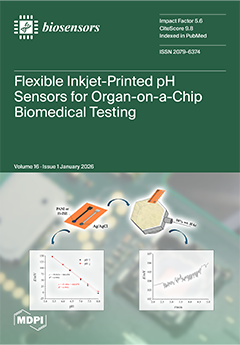
Cover Story (view full-size image): Presented here are flexible, miniaturized inkjet-printed pH sensors designed for lung-on-a-chip integration to enable the study of inhalation products, drug delivery, aerosol–tissue interactions and accompanying pH fluctuations. PVC-based ISE membranes and polyaniline were evaluated on flexible substrates, including screen-printed carbon and inkjet-printed graphene electrodes. A biocompatible polyaniline-modified graphene electrode, paired with an inkjet-printed Ag/AgCl reference electrode, exhibited Nernstian sensitivity (58.8 mV/pH), good reproducibility, reversibility and stability. It was integrated into a lung model with an electrospun polycaprolactone membrane and alginate to mimic the alveolar barrier and mucosal environment. System permeability was assessed by monitoring pH changes induced by introducing an acidic aerosol. View this paper
  • Issues are regarded as officially published after their release is announced to the table of contents alert mailing list.
  • You may sign up for e-mail alerts to receive table of contents of newly released issues.
  • PDF is the official format for papers published in both, html and pdf forms. To view the papers in pdf format, click on the "PDF Full-text" link, and use the free Adobe Reader to open them.
Order results
Result details
Section
Select all
Export citation of selected articles as:
32 pages, 6247 KB  
Review
Combined Use of Microwave Sensing Technologies and Artificial Intelligence for Biomedical Monitoring and Imaging
by Andrea Martínez-Lozano, Alejandro Buitrago-Bernal, Langis Roy, José María Vicente-Samper and Carlos G. Juan
Biosensors 2026, 16(1), 67; https://doi.org/10.3390/bios16010067 - 22 Jan 2026
Viewed by 284
Abstract
Microwave sensing technology is rapidly advancing and increasingly finding its way into biomedical applications, promising significant improvements for medical care. Concurrently, the rise of artificial intelligence (AI) is enabling significant enhancements in the biomedical domain. Close scrutiny of the recent literature reveals intense [...] Read more.
Microwave sensing technology is rapidly advancing and increasingly finding its way into biomedical applications, promising significant improvements for medical care. Concurrently, the rise of artificial intelligence (AI) is enabling significant enhancements in the biomedical domain. Close scrutiny of the recent literature reveals intense activity in both fields, with particularly impactful outcomes deriving from the combined use of advanced microwave techniques and AI for biomedical monitoring. In this review, an up-to-date compilation, from the perspective of the authors, of the most significant works published on these topics in recent years is given, focusing on their integration and current challenges. With the objective of analyzing the current landscape, we survey and compare state-of-the-art biosensors and imaging systems at all healthcare levels, from outpatient contexts to specialized medical equipment and laboratory analysis tools. We also delve into the relevant applications of AI in medicine for processing microwave-derived data. As our core focus, we analyze the synergistic integration of AI in the design of microwave devices and the processing of the acquired data, which have shown notable performances, opening new avenues for compact, affordable, and multi-functional medical devices. We conclude by synthesizing the prevailing technical, algorithmic, and translational challenges that must be addressed to realize this potential. Full article
(This article belongs to the Special Issue AI-Enabled Biosensor Technologies for Boosting Medical Applications)
Show Figures

Figure 1

37 pages, 6663 KB  
Review
Smart Biosensing Nanomaterials for Alzheimer’s Disease: Advances in Design and Drug Delivery Strategies to Overcome the Blood–Brain Barrier
by Manickam Rajkumar, Furong Tian, Bilal Javed, Bhupendra G. Prajapati, Paramasivam Deepak, Koyeli Girigoswami and Natchimuthu Karmegam
Biosensors 2026, 16(1), 66; https://doi.org/10.3390/bios16010066 - 21 Jan 2026
Viewed by 285
Abstract
Alzheimer’s disease (AD) is a progressive neurodegenerative disorder marked by persistent memory impairment and complex molecular and cellular pathological changes in the brain. Current treatments, including acetylcholinesterase inhibitors and memantine, only help with symptoms for a short time and do not stop the [...] Read more.
Alzheimer’s disease (AD) is a progressive neurodegenerative disorder marked by persistent memory impairment and complex molecular and cellular pathological changes in the brain. Current treatments, including acetylcholinesterase inhibitors and memantine, only help with symptoms for a short time and do not stop the disease from getting worse. This is mainly because these drugs do not reach the brain well and are quickly removed from the body. The blood–brain barrier (BBB) restricts the entry of most drugs into the central nervous system; therefore, new methods of drug delivery are needed. Nanotechnology-based drug delivery systems (NTDDS) are widely studied as a potential approach to address existing therapeutic limitations. Smart biosensing nanoparticles composed of polymers, lipids, and metals can be engineered to enhance drug stability, improve drug availability, and target specific brain regions. These smart nanoparticles can cross the BBB via receptor-mediated transcytosis and other transport routes, making them a promising option for treating AD. Additionally, multifunctional nanocarriers enable controlled drug release and offer theranostic capabilities, supporting real-time tracking of AD treatment responses to facilitate more precise and personalized interventions. Despite these advantages, challenges related to long-term safety, manufacturing scalability, and regulatory approval remain. This review discusses current AD therapies, drug-delivery strategies, recent advances in nanoparticle platforms, and prospects for translating nanomedicine into effective, disease-modifying treatments for AD. Full article
(This article belongs to the Special Issue Advanced Microfluidic Devices and MEMS in Biosensing Applications)
Show Figures

Figure 1

19 pages, 4331 KB  
Article
Regulation of Synaptic Plasticity and Adaptive Convergence Under Rhythmic Stimulation of an In Vitro Hippocampal Neuronal Network of Cultured Cells
by Shutong Sun, Longhui Jiang, Yaoyao Liu, Li Shang, Chengji Lu, Shangchen Li, Kui Zhang, Mixia Wang, Xinxia Cai and Jinping Luo
Biosensors 2026, 16(1), 65; https://doi.org/10.3390/bios16010065 - 19 Jan 2026
Viewed by 300
Abstract
Synaptic plasticity constitutes a fundamental mechanism of neural systems. Rhythmic activities (e.g., θ and γ oscillations) play a critical role in modulating network plasticity efficiency in biological neural systems. However, the rules governing plasticity and adaptive regulation of in vitro cultured networks under [...] Read more.
Synaptic plasticity constitutes a fundamental mechanism of neural systems. Rhythmic activities (e.g., θ and γ oscillations) play a critical role in modulating network plasticity efficiency in biological neural systems. However, the rules governing plasticity and adaptive regulation of in vitro cultured networks under structured electrical stimulation remain insufficiently characterized. To quantitatively investigate these regulatory effects within a highly controlled and low-interference environment, we utilized primary mice hippocampal neurons cultured on multielectrode arrays (MEAs) and executed two dedicated sets of experiments. (1) Spatiotemporal electrical stimulation paradigms, combined with connectivity analysis, revealed pronounced regulation effects of network plasticity. (2) Physiologically inspired rhythmic stimulation (θ: 7.8 Hz, γ: 40 Hz) with varying pulse repetitions was then applied. Although both rhythms induced distinct frequency-dependent plasticity modulation, the disparity between their modulatory effects progressively diminished with increasing stimulation pulse numbers, suggesting an intrinsic adaptive regulatory mechanism. Collectively, our findings characterize the effects of plasticity regulation and reveal the mechanisms underlying adaptive convergence in in vitro neuronal systems. These results advance the understanding of network plasticity, providing a technical foundation for functional shaping and modulation of in vitro neural networks while supporting future explorations into learning-oriented modulation. Full article
(This article belongs to the Section Biosensors and Healthcare)
Show Figures

Figure 1

28 pages, 1138 KB  
Review
Yeast Biosensors for the Safety of Fermented Beverages
by Sílvia Afonso, Ivo Oliveira and Alice Vilela
Biosensors 2026, 16(1), 64; https://doi.org/10.3390/bios16010064 - 16 Jan 2026
Viewed by 749
Abstract
Yeast biosensors represent a promising biotechnological innovation for ensuring the safety and quality of fermented beverages such as beer, wine, and kombucha. These biosensors employ genetically engineered yeast strains to detect specific contaminants, spoilage organisms, or hazardous compounds during fermentation or the final [...] Read more.
Yeast biosensors represent a promising biotechnological innovation for ensuring the safety and quality of fermented beverages such as beer, wine, and kombucha. These biosensors employ genetically engineered yeast strains to detect specific contaminants, spoilage organisms, or hazardous compounds during fermentation or the final product. By integrating synthetic biology tools, researchers have developed yeast strains that can sense and respond to the presence of heavy metals (e.g., lead or arsenic), mycotoxins, ethanol levels, or unwanted microbial metabolites. When a target compound is detected, the biosensor yeast activates a reporter system, such as fluorescence, color change, or electrical signal, providing a rapid, visible, and cost-effective means of monitoring safety parameters. These biosensors offer several advantages: they can operate in real time, are relatively low-cost compared to conventional chemical analysis methods, and can be integrated directly into the fermentation system. Furthermore, as Saccharomyces cerevisiae is generally recognized as safe (GRAS), its use as a sensing platform aligns well with existing practices in beverage production. Yeast biosensors are being investigated for the early detection of contamination by spoilage microbes, such as Brettanomyces and lactic acid bacteria. These contaminants can alter the flavor profile and shorten the product’s shelf life. By providing timely feedback, these biosensor systems allow producers to intervene early, thereby reducing waste and enhancing consumer safety. In this work, we review the development and application of yeast-based biosensors as potential safeguards in fermented beverage production, with the overarching goal of contributing to the manufacture of safer and higher-quality products. Nevertheless, despite their substantial conceptual promise and encouraging experimental results, yeast biosensors remain confined mainly to laboratory-scale studies. A clear gap persists between their demonstrated potential and widespread industrial implementation, underscoring the need for further research focused on robustness, scalability, and regulatory integration. Full article
(This article belongs to the Special Issue Microbial Biosensor: From Design to Applications—2nd Edition)
Show Figures

Graphical abstract

12 pages, 1660 KB  
Article
Long-Term Stable Biosensing Using Multiscale Biostructure-Preserving Metal Thin Films
by Kenshin Takemura, Taisei Motomura and Yuko Takagi
Biosensors 2026, 16(1), 63; https://doi.org/10.3390/bios16010063 - 16 Jan 2026
Viewed by 206
Abstract
Microparticle detection technology uses materials that can specifically recognize complex biostructures, such as antibodies and aptamers, as trapping agents. The development of antibody production technology and simplification of sensing signal output methods have facilitated commercialization of disposable biosensors, making rapid diagnosis possible. Although [...] Read more.
Microparticle detection technology uses materials that can specifically recognize complex biostructures, such as antibodies and aptamers, as trapping agents. The development of antibody production technology and simplification of sensing signal output methods have facilitated commercialization of disposable biosensors, making rapid diagnosis possible. Although this contributed to the early resolution of pandemics, traditional biosensors face issues with sensitivity, durability, and rapid response times. We aimed to fabricate microspaces using metallic materials to further enhance durability of mold fabrication technologies, such as molecular imprinting. Low-damage metal deposition was performed on target protozoa and Norovirus-like particles (NoV-LPs) to produce thin metallic films that adhere to the material. The procedure for fitting the object into the bio structured space formed on the thin metal film took less than a minute, and sensitivity was 10 fg/mL for NoV-LPs. Furthermore, because it was a metal film, no decrease in reactivity was observed even when the same substrate was stored at room temperature and reused repeatedly after fabrication. These findings underscore the potential of integrating stable metallic structures with bio-recognition elements to significantly enhance robustness and reliability of environmental monitoring. This contributes to public health strategies aimed at early detection and containment of infectious diseases. Full article
(This article belongs to the Special Issue Advanced Electrochemical Biosensors and Their Applications)
Show Figures

Figure 1

28 pages, 1779 KB  
Review
Two-Dimensional Carbon-Based Electrochemical Sensors for Pesticide Detection: Recent Advances and Environmental Monitoring Applications
by K. Imran, Al Amin, Gajapaneni Venkata Prasad, Y. Veera Manohara Reddy, Lestari Intan Gita, Jeyaraj Wilson and Tae Hyun Kim
Biosensors 2026, 16(1), 62; https://doi.org/10.3390/bios16010062 - 14 Jan 2026
Viewed by 468
Abstract
Pesticides have been widely applied in agricultural practices over the past decades to protect crops from pests and other harmful organisms. However, their extensive use results in the contamination of soil, water, and agricultural products, posing significant risks to human and environmental health. [...] Read more.
Pesticides have been widely applied in agricultural practices over the past decades to protect crops from pests and other harmful organisms. However, their extensive use results in the contamination of soil, water, and agricultural products, posing significant risks to human and environmental health. Exposure to pesticides can lead to skin irritation, respiratory disorders, and various chronic health problems. Moreover, pesticides frequently enter surface water bodies such as rivers and lakes through agricultural runoff and leaching processes. Therefore, developing effective analytical methods for the rapid and sensitive detection of pesticides in food and water is of great importance. Electrochemical sensing techniques have shown remarkable progress in pesticide analysis due to their high sensitivity, simplicity, and potential for on-site monitoring. Two-dimensional (2D) carbon nanomaterials have emerged as efficient electrocatalysts for the precise and selective detection of pesticides, owing to their large surface area, excellent electrical conductivity, and unique structural features. In this review, we summarize recent advancements in the electrochemical detection of pesticides using 2D carbon-based materials. Comprehensive information on electrode fabrication, sensing mechanisms, analytical performance—including sensing range and limit of detection—and the versatility of 2D carbon composites for pesticide detection is provided. Challenges and future perspectives in developing highly sensitive and selective electrochemical sensing platforms are also discussed, highlighting their potential for simultaneous pesticide monitoring in food and environmental samples. Carbon-based electrochemical sensors have been the subject of many investigations, but their practical application in actual environmental and food samples is still restricted because of matrix effects, operational instability, and repeatability issues. In order to close the gap between laboratory research and real-world applications, this review critically examines sensor performance in real-sample conditions and offers innovative approaches for in situ pesticide monitoring. Full article
Show Figures

Figure 1

22 pages, 9753 KB  
Article
A Luminol-Based, Peroxide-Free Fenton Chemiluminescence System Driven by Cu(I)-Polyethylenimine-Lipoic Acid Nanoflowers for Ultrasensitive SARS-CoV-2 Immunoassay
by Mahmoud El-Maghrabey, Ali Abdel-Hakim, Yuta Matsumoto, Rania El-Shaheny, Heba M. Hashem, Naotaka Kuroda and Naoya Kishikawa
Biosensors 2026, 16(1), 61; https://doi.org/10.3390/bios16010061 - 14 Jan 2026
Viewed by 283
Abstract
The reliance on unstable hydrogen peroxide (H2O2) adversely affects the robustness and simplicity of chemiluminescence (CL)-based immunoassays. We report a novel external H2O2-free Fenton CL system integrated into a highly sensitive non-enzymatic immunoassay for the [...] Read more.
The reliance on unstable hydrogen peroxide (H2O2) adversely affects the robustness and simplicity of chemiluminescence (CL)-based immunoassays. We report a novel external H2O2-free Fenton CL system integrated into a highly sensitive non-enzymatic immunoassay for the detection of SARS-CoV-2 nucleoprotein, utilizing cuprous–polyethylenimine–lipoic acid nanoflowers (Cu(I)-PEI-LA-Ab NF) as a non-enzymatic tag. The signaling polymer (PEI-LA) was synthesized via EDC/NHS coupling, which conjugated approximately 550 LA units to the PEI backbone. This polymer formed antibody-conjugated NF with various metal ions, and the Cu(I)-based variant was selected for its intense and sustained CL with luminol. The mechanism relies on an in situ Fenton reaction, in which dissolved oxygen is reduced by Cu(I) to H2O2, which reacts with oxidized Cu(II), producing hydroxyl radicals that oxidize luminol. Direct calibration of the SARS-CoV-2 nucleoprotein fixed on microplate wells demonstrated excellent linearity in the range of 0.01–3.13 ng/mL (LOD = 3 pg/mL). In a final competitive immunoassay format for samples spiked with the antigen, a decreasing CL signal that correlated with increasing antigen concentration was obtained in the range of 0.1–20.0 ng/mL, achieving excellent recoveries that were favorable compared with those of the sandwich ELISA kit, establishing this H2O2-independent platform as a powerful and robust tool for clinical diagnostics. Full article
(This article belongs to the Special Issue Signal Amplification in Biosensing)
Show Figures

Figure 1

24 pages, 10991 KB  
Article
Surface-Imprinted Polymer Coupled with Diffraction Gratings for Low-Cost, Label-Free and Differential E. coli Detection
by Dua Özsoylu, Elke Börmann-El-Kholy, Rabia N. Kaya, Patrick Wagner and Michael J. Schöning
Biosensors 2026, 16(1), 60; https://doi.org/10.3390/bios16010060 - 13 Jan 2026
Viewed by 394
Abstract
Surface-imprinted polymer (SIP)-based biomimetic sensors are promising for direct whole-bacteria detection; however, the commonly used fabrication approach (micro-contact imprinting) often suffers from limited imprint density, heterogeneous template distribution, and poor reproducibility. Here, we introduce a photolithography-defined master stamp featuring E. coli mimics, enabling [...] Read more.
Surface-imprinted polymer (SIP)-based biomimetic sensors are promising for direct whole-bacteria detection; however, the commonly used fabrication approach (micro-contact imprinting) often suffers from limited imprint density, heterogeneous template distribution, and poor reproducibility. Here, we introduce a photolithography-defined master stamp featuring E. coli mimics, enabling high-density, well-oriented cavity arrays (3 × 10⁷ imprints/cm2). Crucially, the cavity arrangement is engineered such that the SIP layer functions simultaneously as the bioreceptor and as a diffraction grating, enabling label-free optical quantification by reflectance changes without additional transduction layers. Finite-difference time-domain (FDTD) simulations are used to model and visualize the optical response upon bacterial binding. Proof-of-concept experiments using a differential two-well configuration confirm concentration-dependent detection of E. coli in PBS, demonstrating a sensitive, low-cost, and scalable sensing concept that can be readily extended to other bacterial targets by redesigning the photolithographic master. Full article
(This article belongs to the Special Issue Recent Advances in Molecularly Imprinted-Polymer-Based Biosensors)
Show Figures

Figure 1

18 pages, 3696 KB  
Article
Real-Time Monitoring of Microbial Contamination and Stress Biomarkers with Liquid Crystal-Based Immunosensors for Food Safety Assessment
by Maria Simone Soares, Andreia C. M. Rodrigues, Sílvia. F. S. Pires, Amadeu M. V. M. Soares, Ana P. L. Costa, Jan Nedoma, Pedro L. Almeida, Nuno Santos and Carlos Marques
Biosensors 2026, 16(1), 59; https://doi.org/10.3390/bios16010059 - 13 Jan 2026
Viewed by 286
Abstract
Aquaculture is a crucial global food production sector that faces challenges in water quality management, food safety, and stress-related health concerns in aquatic species. Cortisol, a key stress biomarker in fish, and Escherichia coli (E. coli) contamination in bivalve mollusks are [...] Read more.
Aquaculture is a crucial global food production sector that faces challenges in water quality management, food safety, and stress-related health concerns in aquatic species. Cortisol, a key stress biomarker in fish, and Escherichia coli (E. coli) contamination in bivalve mollusks are critical indicators that require sensitive and real-time detection methods. Liquid crystal (LC)-based immunosensors have emerged as a promising solution for detecting biological analytes due to their high sensitivity, rapid response, and label-free optical detection capabilities. Therefore, this study explores the development and application of LC-based immunosensors for the detection of cortisol in artificial and real recirculating aquaculture system (RAS) samples, as well as E. coli in real contaminated water and clam samples during the depuration processes of bivalve mollusks. The biosensors exhibited the capacity to detect cortisol with a response time in seconds and a limit of detection (LOD) of 0.1 ng/mL. Furthermore, they demonstrated specificity to cortisol when tested against different interfering substances, including testosterone, glucose, and cholesterol. Furthermore, it was possible to correlate cortisol concentrations in different filtration stages and track E. coli contamination during depuration. The results confirm the feasibility of LC-based immunosensors as a user-friendly, portable, and efficient diagnostic tool for aquaculture applications. Full article
(This article belongs to the Special Issue Advances in Miniaturized Optical Components for Biosensing)
Show Figures

Figure 1

45 pages, 9328 KB  
Review
Advancements in Machine Learning-Assisted Flexible Electronics: Technologies, Applications, and Future Prospects
by Hao Su, Hongcun Wang, Dandan Sang, Santosh Kumar, Dao Xiao, Jing Sun and Qinglin Wang
Biosensors 2026, 16(1), 58; https://doi.org/10.3390/bios16010058 - 13 Jan 2026
Viewed by 295
Abstract
The integration of flexible electronics and machine learning (ML) algorithms has become a revolutionary force driving the field of intelligent sensing, giving rise to a new generation of intelligent devices and systems. This article provides a systematic review of core technologies and practical [...] Read more.
The integration of flexible electronics and machine learning (ML) algorithms has become a revolutionary force driving the field of intelligent sensing, giving rise to a new generation of intelligent devices and systems. This article provides a systematic review of core technologies and practical applications of ML in flexible electronics. It focuses on analyzing the theoretical frameworks of algorithms such as the Long Short-Term Memory Network (LSTM), Convolutional Neural Network (CNN), and Reinforcement Learning (RL) in the intelligent processing of sensor signals (IPSS), multimodal feature extraction (MFE), process defect and anomaly detection (PDAD), and data compression and edge computing (DCEC). This study explores the performance advantages of these technologies in optimizing signal analysis accuracy, compensating for interference in high-noise environments, optimizing manufacturing process parameters, etc., and empirically analyzes their potential applications in wearable health monitoring systems, intelligent control of soft robots, performance optimization of self-powered devices, and intelligent perception of epidermal electronic systems. Full article
Show Figures

Figure 1

20 pages, 4646 KB  
Article
Portable Dual-Mode Biosensor for Quantitative Determination of Salmonella in Lateral Flow Assays Using Machine Learning and Smartphone-Assisted Operation
by Jully Blackshare, Brianna Corman, Bartek Rajwa, J. Paul Robinson and Euiwon Bae
Biosensors 2026, 16(1), 57; https://doi.org/10.3390/bios16010057 - 13 Jan 2026
Viewed by 347
Abstract
Foodborne pathogens remain a major global concern, demanding rapid, accessible, and determination technologies. Conventional methods, such as culture assays and polymerase chain reaction, offer high accuracy but are time-consuming for on-site testing. This study presents a portable, smartphone-assisted dual-mode biosensor that combines colorimetric [...] Read more.
Foodborne pathogens remain a major global concern, demanding rapid, accessible, and determination technologies. Conventional methods, such as culture assays and polymerase chain reaction, offer high accuracy but are time-consuming for on-site testing. This study presents a portable, smartphone-assisted dual-mode biosensor that combines colorimetric and photothermal speckle imaging for improved sensitivity in lateral flow assays (LFAs). The prototype device, built using low-cost components ($500), uses a Raspberry Pi for illumination control, image acquisition, and machine learning-based signal analysis. Colorimetric features were derived from normalized RGB intensities, while photothermal responses were obtained from speckle fluctuation metrics during periodic plasmonic heating. Multivariate linear regression, with and without LASSO regularization, was used to predict Salmonella concentrations. The comparison revealed that regularization did not significantly improve predictive accuracy indicating that the unregularized linear model is sufficient and that the extracted features are robust without complex penalization. The fused model achieved the best performance (R2 = 0.91) and consistently predicted concentrations down to a limit of detection (LOD) of 104 CFU/mL, which is one order of magnitude improvement of visual and benchtop measurements from previous work. Blind testing confirmed robustness but also revealed difficulty distinguishing between negative and 103 CFU/mL samples. This work demonstrates a low-cost, field-deployable biosensing platform capable of quantitative pathogen detection, establishing a foundation for the future deployment of smartphone-assisted, machine learning-enabled diagnostic tools for broader monitoring applications. Full article
(This article belongs to the Special Issue Microbial Biosensor: From Design to Applications—2nd Edition)
Show Figures

Figure 1

23 pages, 4752 KB  
Article
Modulation-Based Feature Extraction for Robust Sleep Stage Classification Across Apnea-Based Cohorts
by Unaza Tallal, Rupesh Agrawal and Shruti Kshirsagar
Biosensors 2026, 16(1), 56; https://doi.org/10.3390/bios16010056 - 13 Jan 2026
Viewed by 394
Abstract
Automated sleep staging remains challenging due to the transitional nature of certain sleep stages, particularly N1. In this paper, we explore modulation spectrograms for automatic sleep staging to capture the transitional nature of sleep stages and compare them with conventional benchmark features, such [...] Read more.
Automated sleep staging remains challenging due to the transitional nature of certain sleep stages, particularly N1. In this paper, we explore modulation spectrograms for automatic sleep staging to capture the transitional nature of sleep stages and compare them with conventional benchmark features, such as the Short-Time Fourier Transform (STFT) and the Continuous Wavelet Transform (CWT). We utilized a single-channel EEG (C4–M1) from the DREAMT dataset with subject-independent validation. We stratify participants by the Apnea–Hypopnea Index (AHI) into Normal, Mild, Moderate, and Severe groups to assess clinical generalizability. Our modulation-based framework significantly outperforms STFT and CWT in the Mild and Severe cohorts, while maintaining comparable high performance in the Normal and Moderate AHI groups. Notably, the proposed framework maintained robust performance in severe apnea cohorts, effectively mitigating the degradation observed in standard time–frequency baselines. These findings demonstrate the effectiveness of modulation spectrograms for sleep staging while emphasizing the importance of medical stratification for reliable outcomes in clinical populations. Full article
(This article belongs to the Section Biosensors and Healthcare)
Show Figures

Figure 1

17 pages, 2455 KB  
Article
Enhanced Magnesium Ion Sensing Using Polyurethane Membranes Modified with ĸ-Carrageenan and D2EHPA: A Potentiometric Approach
by Faridah Hanum, Salfauqi Nurman, Nurhayati, Nasrullah Idris, Rinaldi Idroes and Eka Safitri
Biosensors 2026, 16(1), 55; https://doi.org/10.3390/bios16010055 - 12 Jan 2026
Viewed by 361
Abstract
Magnesium (Mg2+) ions require sensitive and selective detection due to their low concentrations and coexistence with similar ions in matrices. This study developed a potentiometric ISE using a new modified polyurethane membrane. The membrane’s negative surface charge facilitates selective interaction with [...] Read more.
Magnesium (Mg2+) ions require sensitive and selective detection due to their low concentrations and coexistence with similar ions in matrices. This study developed a potentiometric ISE using a new modified polyurethane membrane. The membrane’s negative surface charge facilitates selective interaction with Mg2+ ion. Optimal performance was obtained at 0.0061% (w/w) κ-carrageenan and 0.0006% (w/w) D2EHPA. The ISE exhibited a near-Nernstian response of 29.49 ± 0.01 mV/decade across a 10−9–10−4 M concentration range (R2 = 0.992), with a detection limit of 1.25 × 10⁻¹⁰ M and a response time of 200 s. It remained stable in the pH range 6–8 for one month and demonstrated high selectivity over K+, Na+, and Ca2+ (Kij < 1). The repeatability and reproducibility tests yielded standard deviations of 0.15 and 0.39, while recovery rates confirmed analytical reliability. The water contact angle analysis showed a reduction from ~80° to ~69° after membrane conditioning, indicating increased hydrophilicity and improved interfacial for ion diffusion. FTIR analysis confirmed successful modification by reduced O–H peak intensity, while XRD verified the amorphous structure. SEM revealed a dense top layer with concave morphology, favorable for minimizing leakage and ensuring efficient ion transport within the sensing system. Full article
(This article belongs to the Section Biosensor Materials)
Show Figures

Figure 1

16 pages, 7964 KB  
Article
Metallic Flexible NiTi Wire Microcrack Transducer for Label-Free Impedimetric Sensing of Escherichia coli
by Gizem Özlü Türk and Mehmet Çağrı Soylu
Biosensors 2026, 16(1), 54; https://doi.org/10.3390/bios16010054 - 10 Jan 2026
Viewed by 365
Abstract
Flexible biosensors offer rapid and low-cost diagnostics but are often limited by the mechanical and electrochemical instability of polymer-based designs in biological media. Here, we introduce a metallic flexible microcrack transducer that exploits the intrinsic deformability of superelastic nickel–titanium (NiTi) for label-free impedimetric [...] Read more.
Flexible biosensors offer rapid and low-cost diagnostics but are often limited by the mechanical and electrochemical instability of polymer-based designs in biological media. Here, we introduce a metallic flexible microcrack transducer that exploits the intrinsic deformability of superelastic nickel–titanium (NiTi) for label-free impedimetric detection. Mechanical bending of NiTi wires spontaneously generates martensitic-phase microcracks whose metal–gap–metal geometry forms the active transduction sites, where functional interfacial layers and captured analytes modulate the local dielectric environment and govern the impedance response. Our approach imparts a novel dielectric character to the alloy, enabling its unexplored application in the megahertz (MHz) frequency domain (0.01–10 MHz) where native NiTi is merely conductive. Functionalization with Escherichia coli (E. coli)-specific antibodies renders these microdomains biologically active. This effectively transforms the mechanically induced microcracks into tunable impedance elements driven by analyte binding. The γ-bent NiTi sensors achieved stable and quantitative detection of E. coli ATCC 25922 in sterile human urine, with a detection limit of 64 colony forming units (CFU) mL−1 within 45 min, without redox mediators, external labels, or amplification steps. This work pioneers the use of martensitic microcrack networks, mimicking self-healing behavior in a superelastic alloy as functional transduction elements, defining a new class of metallic flexible biosensors that integrate mechanical robustness, analytical reliability, and scalability for point-of-care biosensing. Full article
(This article belongs to the Special Issue Functional Materials for Biosensing Applications (2nd Edition))
Show Figures

Graphical abstract

35 pages, 7707 KB  
Review
Functionalized Metal–Organic Frameworks Integrated with Plasmonic Nanoparticles: From Synthesis to Applications
by Songsong Huang, Qian Chen, Yanjun Li, Liyang Duan, Xuexing Zhao, Yanli Lu and Zetao Chen
Biosensors 2026, 16(1), 53; https://doi.org/10.3390/bios16010053 - 10 Jan 2026
Viewed by 413
Abstract
Plasmonic nanoparticles (NPs) exhibit exceptional optical and electromagnetic (EM) properties that are, however, confined to their near–field region, limiting effective interactions with non-adsorbed species. Metal–organic frameworks (MOFs), renowned for their high surface area and tunable pores, provide an ideal complement through surface enrichment [...] Read more.
Plasmonic nanoparticles (NPs) exhibit exceptional optical and electromagnetic (EM) properties that are, however, confined to their near–field region, limiting effective interactions with non-adsorbed species. Metal–organic frameworks (MOFs), renowned for their high surface area and tunable pores, provide an ideal complement through surface enrichment and subsequent molecular enrichment within their pores. The integration of plasmonic NPs with MOFs into nanohybrids overcomes this spatial constraint. This architectural synergy creates a synergistic effect, yielding properties superior to either component alone. This review summarizes recent advances in NP–MOF nanohybrids, with a focus on synthesis strategies for diverse architectures and their emergent functionalities. We highlight how this synergistic effect enables breakthrough applications in chemical sensing, cancer therapy, and catalysis. Finally, we conclude our discussion and present a critical outlook that explores the challenges and future opportunities in the design and applications of NP–MOF nanohybrids. Full article
(This article belongs to the Special Issue Material-Based Biosensors and Biosensing Strategies)
Show Figures

Figure 1

23 pages, 2629 KB  
Article
A Hybrid CNN-SVM Approach for ECG-Based Multi-Class Differential Diagnosis of PTSD, Depression, and Panic Attack
by Parisa Ebrahimpour Moghaddam Tasouj, Gökhan Soysal, Osman Eroğul and Sinan Yetkin
Biosensors 2026, 16(1), 52; https://doi.org/10.3390/bios16010052 - 10 Jan 2026
Viewed by 351
Abstract
Background: PTSD diagnosis is challenging. Symptoms overlap with depression and panic attacks. This causes misdiagnosis and delayed treatment. Current methods lack objective biomarkers. This study presents a hybrid AI framework. It combines CNNs and SVMs. The system detects PTSD from ECG signals. Methods: [...] Read more.
Background: PTSD diagnosis is challenging. Symptoms overlap with depression and panic attacks. This causes misdiagnosis and delayed treatment. Current methods lack objective biomarkers. This study presents a hybrid AI framework. It combines CNNs and SVMs. The system detects PTSD from ECG signals. Methods: ECG data from 79 participants were analyzed. Four groups were included. PTSD patients numbered 20. Depression patients numbered 20. Panic attack patients numbered 19. Healthy controls numbered 20. Wavelet transform created scalograms. Three CNN models were tested. AlexNet, GoogLeNet, and ResNet50 were used. Deep features were extracted. SVMs classified the features. Five-fold validation was performed. Statistical tests confirmed significance. Results: Hybrid models performed robustly. ResNet50 + SVM and AlexNet + SVM achieved statistically equivalent results with accuracies of 97.05% and 97.26%, respectively. AUC reached 1.00 for multi-class tasks. PTSD detection was highly accurate. The system distinguished PTSD from other disorders. Hybrid models beat standalone CNNs. SVM integration improved results significantly. Conclusions: This is the first ECG-based AI for PTSD diagnosis. The hybrid approach achieves clinical-level accuracy. PTSD is distinguished from depression and panic attacks. Objective biomarkers support psychiatric assessment. Early intervention becomes possible. Full article
(This article belongs to the Section Biosensors and Healthcare)
Show Figures

Figure 1

17 pages, 2536 KB  
Article
A Portable Dual-Mode Microfluidic Device Integrating RT-qPCR and RT-LAMP for Rapid Nucleic Acid Detection in Point-of-Care Testing
by Baihui Zhang, Xiao Li, Mengjie Huang, Maojie Jiang, Leilei Du, Peng Yin, Xuan Fang, Xiangyu Jiang, Feihu Qi, Yanna Lin and Fuqiang Ma
Biosensors 2026, 16(1), 51; https://doi.org/10.3390/bios16010051 - 8 Jan 2026
Viewed by 613
Abstract
Point-of-care testing (POCT) has emerged as a vital diagnostic approach in emergency medicine, primary care, and resource-limited environments because of its convenience, affordability, and capacity to provide immediate results. Here, we present a multifunctional portable nucleic acid detection platform integrating reverse transcription polymerase [...] Read more.
Point-of-care testing (POCT) has emerged as a vital diagnostic approach in emergency medicine, primary care, and resource-limited environments because of its convenience, affordability, and capacity to provide immediate results. Here, we present a multifunctional portable nucleic acid detection platform integrating reverse transcription polymerase chain reaction (RT-qPCR) and reverse transcription loop-mediated isothermal amplification (RT-LAMP) within a unified microfluidic device. The system leverages Tesla-valve-based passive flow control to enhance reaction efficiency and operational simplicity. A four-channel optical detection unit allows for multiplex fluorescence quantification (CY5, FAM, VIC, ROX) and has high sensitivity and reproducibility for RT-LAMP. The compact design reduces the overall size by approximately 90% compared with conventional qPCR instruments. For RT-PCR, the system achieves a detection limit of 2.0 copies μL−1 and improves analytical efficiency by 27%. For RT-LAMP, the detection limit reaches 2.95 copies μL−1 with a 14% enhancement in analytical efficiency. Compared with commercial qPCR instruments, the device maintains equivalent quantitative accuracy despite significant miniaturization, ensuring reliable performance in decentralized testing. Furthermore, the total RT-LAMP assay time is reduced from more than two hours to 42 min, enabling truly rapid molecular diagnostics. This dual-mode platform offers a flexible, scalable strategy for bridging laboratory-grade molecular assays with real-time POCT applications, supporting early disease detection and epidemic surveillance. Full article
(This article belongs to the Section Nano- and Micro-Technologies in Biosensors)
Show Figures

Figure 1

14 pages, 3031 KB  
Article
Highly Sensitive Detection and Discrimination of Cell Suspension Based on a Metamaterials-Based Biosensor Chip
by Kanglong Chen, Xiaofang Zhao, Jie Sun, Qian Wang, Qinggang Ge, Liang Hu and Jun Yang
Biosensors 2026, 16(1), 50; https://doi.org/10.3390/bios16010050 - 8 Jan 2026
Viewed by 361
Abstract
Metamaterials (MMs)-based terahertz (THz) biosensors hold promise for clinical diagnosis, featuring label-free operation, simple, rapid detection, low cost, and multi-cell-type discrimination. However, liquid around cells causes severe interference to sensitive detection. Most existing MMs-based cell biosensors detect dead cells without culture medium (losing [...] Read more.
Metamaterials (MMs)-based terahertz (THz) biosensors hold promise for clinical diagnosis, featuring label-free operation, simple, rapid detection, low cost, and multi-cell-type discrimination. However, liquid around cells causes severe interference to sensitive detection. Most existing MMs-based cell biosensors detect dead cells without culture medium (losing original morphology), hindering stable, sensitive multi-cell discrimination. Here, a terahertz biosensor composed of a microcavity and MMs can be used to detect and discriminate multiple cell types within suspension. Its detection mechanism relies on cellular size (radius)/density in suspension, which induces effective permittivity (εeff) differences. By designing MMs’ split rings with luxuriant gaps, the biosensor achieves a theoretical sensitivity of ~328 GHz/RIU, enabling sensitive responses to suspended cells. It shows a robust, increasing frequency shift (610–660 GHz) over 72 h of cell apoptosis. Moreover, it discriminates nerve cells, glioblastoma (GBM) cells, and their 1:1 mixture with obviously distinct frequency responses (~650, ~630, ~620 GHz), which suggests effective and reliable multi-cell-type recognition. Overall, this study and its measurement method should pave the way for metamaterial-based terahertz biosensors for living cell detection and discrimination, and this technology may inspire further innovations in tumor investigation and treatment. Full article
Show Figures

Figure 1

18 pages, 2644 KB  
Article
Microfluidic Chamber Design for Organ-on-a-Chip: A Computational Fluid Dynamics Study of Pillar Geometry and Pulsatile Perfusion
by Andi Liao, Jiwen Xiong, Zhirong Tong, Lin Zhou and Jinlong Liu
Biosensors 2026, 16(1), 49; https://doi.org/10.3390/bios16010049 - 8 Jan 2026
Viewed by 451
Abstract
Organ-on-a-Chip (OOC) platforms are microfluidic systems that recreate key features of human organ physiology in vitro via controlled perfusion. Fluid mechanical stimuli strongly influence cell morphology and function, making this important for cardiovascular OOC applications exposed to pulsatile blood flow. However, many existing [...] Read more.
Organ-on-a-Chip (OOC) platforms are microfluidic systems that recreate key features of human organ physiology in vitro via controlled perfusion. Fluid mechanical stimuli strongly influence cell morphology and function, making this important for cardiovascular OOC applications exposed to pulsatile blood flow. However, many existing OOC devices employ relatively simple chamber geometries and steady inflow assumptions, which may cause non-uniform shear exposure to cells, create stagnant regions with prolonged residence time, and overlook the specific effects of pulsatile perfusion. Here, we used computational fluid dynamics (CFD) to investigate how chamber geometry and inflow conditions shape the near-wall flow environment on a cell culture surface at a matched cycle-averaged volumetric flow rate. Numerical results demonstrated that pillarized chambers markedly reduced relative residence time (RRT) versus the flat chamber, and the small pillar configuration produced the most uniform time-averaged wall shear stress (TAWSS) distribution among the tested designs. Phase-resolved analysis further showed that wall shear stress varies with waveform phase, indicating that steady inflow may not capture features of pulsatile perfusion. These findings provide practical guidance for pillar geometries and perfusion conditions to create more controlled and physiologically relevant microenvironments in OOC platforms, thus improving the reliability of cell experimental readouts. Full article
(This article belongs to the Special Issue Microfluidics for Biomedical Applications (3rd Edition))
Show Figures

Figure 1

20 pages, 719 KB  
Systematic Review
Hemozoin as a Diagnostic Biomarker: A Scoping Review of Next-Generation Malaria Detection Technologies
by Afiat Berbudi, Shafia Khairani, Alexander Kwarteng and Ngozi Mirabel Otuonye
Biosensors 2026, 16(1), 48; https://doi.org/10.3390/bios16010048 - 7 Jan 2026
Viewed by 441
Abstract
Accurate malaria diagnosis is essential for effective case management and transmission control; however, the sensitivity, operational requirements, and field applicability of current conventional methods are limited. Hemozoin, an optically and magnetically active crystalline biomarker produced by Plasmodium species, offers a reagent-free target for [...] Read more.
Accurate malaria diagnosis is essential for effective case management and transmission control; however, the sensitivity, operational requirements, and field applicability of current conventional methods are limited. Hemozoin, an optically and magnetically active crystalline biomarker produced by Plasmodium species, offers a reagent-free target for next-generation diagnostics. This scoping review, following PRISMA-ScR and Joanna Briggs Institute guidance, synthesizes recent advances in hemozoin-based detection technologies and maps the current landscape. Twenty-four studies were reviewed, spanning eight major technology classes: magneto-optical platforms, magnetophoretic microdevices, photoacoustic detection, Raman/SERS spectroscopy, optical and hyperspectral imaging, NMR relaxometry, smartphone-based microscopy, and flow cytometry. Magneto-optical systems—including Hz-MOD, Gazelle™, and RMOD—demonstrated the highest operational readiness, with robust specificity but reduced sensitivity at low parasitemia. Photoacoustic Cytophone studies demonstrated promising sensitivity and noninvasive in vivo detection. Raman/SERS platforms achieved sub-100 infected cell/mL analytical sensitivity but remain laboratory-bound. Microfluidic and smartphone-based tools offer emerging, potentially low-cost alternatives. Across modalities, performance varied by parasite stage, with reduced detection of early ring forms. In conclusion, hemozoin-targeted diagnostics represent a rapidly evolving field with multiple viable translational pathways. While magneto-optical devices are closest to field deployment, further clinical validation, improved low-density detection, and standardized comparison across platforms are needed to support future adoption in malaria-endemic settings. Full article
(This article belongs to the Section Biosensors and Healthcare)
Show Figures

Figure 1

35 pages, 4434 KB  
Article
A Hybrid Closed-Loop Blood Glucose Control Algorithm with a Safety Limiter Based on Deep Reinforcement Learning and Model Predictive Control
by Shanyong Huang, Yusheng Fu, Shaowei Kong, Yuyang Liu and Jian Yan
Biosensors 2026, 16(1), 47; https://doi.org/10.3390/bios16010047 - 6 Jan 2026
Viewed by 509
Abstract
Due to the complexity of blood glucose dynamics and the high variability of the physiological structure of diabetic patients, implementing a safe and effective insulin dosage control algorithm to keep the blood glucose of diabetic patients within the normal range (70–180 mg/dL) is [...] Read more.
Due to the complexity of blood glucose dynamics and the high variability of the physiological structure of diabetic patients, implementing a safe and effective insulin dosage control algorithm to keep the blood glucose of diabetic patients within the normal range (70–180 mg/dL) is currently a challenging task in the field of diabetes treatment. Deep reinforcement learning (DRL) has proven its potential in diabetes treatment in previous work, thanks to its strong advantages in solving complex dynamic and uncertain problems. It can address the challenges faced by traditional control algorithms, such as the need for patients to manually estimate carbohydrate intake before meals, the requirement to establish complex dynamic models, and the need for professional prior knowledge. However, reinforcement learning is essentially a highly exploratory trial-and-error learning strategy, which is contrary to the high-safety requirements of clinical practice. Therefore, achieving safer control has always been a major challenge for the clinical application of DRL. This paper addresses this challenge by combining the advantages of DRL and the traditional control algorithm—model predictive control (MPC). Specifically, by using the blood glucose and insulin data generated during the interaction between DRL and patients in the learning process to learn a blood glucose prediction model, the problem of MPC needing to establish a patient’s blood glucose dynamic model is solved. Then, MPC is used for forward-looking prediction and simulation of blood glucose, and a safety controller is introduced to avoid unsafe actions, thus restricting DRL control to a safer range. Experiments on the UVA/Padova glucose kinetics simulator approved by the US Food and Drug Administration (FDA) show that the time proportion of adult patients within the healthy blood glucose range under the control of the model proposed in this paper reaches 72.51%, an increase of 2.54% compared with the baseline model, and the proportion of severe hyperglycemia and hypoglycemia events is not increased, taking an important step towards the safe control of blood glucose. Full article
Show Figures

Figure 1

37 pages, 7246 KB  
Review
Wearable Sensing Systems for Multi-Modal Body Fluid Monitoring: Sensing-Combination Strategy, Platform-Integration Mechanism, and Data-Processing Pattern
by Manqi Peng, Yuntong Ning, Jiarui Zhang, Yuhang He, Zigan Xu, Ding Li, Yi Yang and Tian-Ling Ren
Biosensors 2026, 16(1), 46; https://doi.org/10.3390/bios16010046 - 6 Jan 2026
Viewed by 776
Abstract
Wearable multi-modal body fluid monitoring enables continuous, non-invasive, and context-aware assessment of human physiology. By integrating biochemical and physical information across multiple modalities, wearable systems overcome the limitations of single-marker sensing and provide a more holistic view of dynamic health states. This review [...] Read more.
Wearable multi-modal body fluid monitoring enables continuous, non-invasive, and context-aware assessment of human physiology. By integrating biochemical and physical information across multiple modalities, wearable systems overcome the limitations of single-marker sensing and provide a more holistic view of dynamic health states. This review offers a system-level overview of recent advances in multi-modal body fluid monitoring, structured into three hierarchical dimensions. We first examine sensing-combination strategies such as multi-marker analysis within single fluids, coupling biochemical signals with bioelectrical, mechanical, or thermal parameters, and emerging multi-fluid acquisition to improve analytical accuracy and physiological relevance. Next, we discuss platform-integration mechanisms based on biochemical, physical, and hybrid sensing principles, along with monolithic and modular architectures enabled by flexible electronics, microfluidics, microneedles, and smart textiles. Finally, the data-processing patterns are analyzed, involving cross-modal calibration, machine learning inference, and multi-level data fusion to enhance data reliability and support personalized and predictive healthcare. Beyond summarizing technical advances, this review establishes a comprehensive framework that moves beyond isolated signal acquisition or simple metric aggregation toward holistic physiological interpretation. It guides the development of next-generation wearable multi-modal body fluid monitoring systems that overcome the challenges of high integration, miniaturization, and personalized medical applications. Full article
(This article belongs to the Special Issue Biosensors for Personalized Treatment)
Show Figures

Figure 1

10 pages, 1501 KB  
Communication
Magnetic Detection of Cancer Cells Using Tumor-Homing Peptide-Modified Magnetic Nanoparticles
by Shengli Zhou, Yuji Furutani, Kei Yamashita, Sakuya Kako, Kazunori Watanabe, Toshihiko Kiwa and Takashi Ohtsuki
Biosensors 2026, 16(1), 45; https://doi.org/10.3390/bios16010045 - 5 Jan 2026
Viewed by 435
Abstract
Magnetic nanoparticles (MNPs) provide a platform for target detection because of their magnetic responsiveness to alternating magnetic fields (AMFs). We developed a detection method using MNPs modified with tumor-homing peptides (THPs), PL1 and PL3, which selectively bind to protein components enriched in malignant [...] Read more.
Magnetic nanoparticles (MNPs) provide a platform for target detection because of their magnetic responsiveness to alternating magnetic fields (AMFs). We developed a detection method using MNPs modified with tumor-homing peptides (THPs), PL1 and PL3, which selectively bind to protein components enriched in malignant tissues. THP-MNPs were synthesized using maleimide-PEG-NHS linkers and characterized using transmission electron microscopy. Human glioblastoma cancer U87MG and normal tissue-derived HEK293 cells were incubated with THP-MNPs, and the magnetic signals were measured using a high-temperature superconducting quantum interference device (SQUID) magnetometer under an AMF (1.06 kHz). Dark-field microscopy confirmed the preferential binding of THP-MNPs to U87MG cells. In the absence of cells, THP-MNPs exhibited AMF-dependent signal enhancement, which correlated with particle size reduction due to THP release. This increase was completely suppressed in the presence of U87MG cells, indicating a strong THP-mediated interaction. PL3-MNPs exhibited superior discrimination between malignant and non-malignant cells. These results demonstrate that SQUID-based magnetic measurements using THP-MNPs enable rapid and label-free cancer cell detection. Full article
(This article belongs to the Special Issue Biosensing Applications for Cell Monitoring—2nd Edition)
Show Figures

Figure 1

33 pages, 1944 KB  
Review
Electrochemical Detection of Cancer Biomarkers: From Molecular Sensing to Clinical Translation
by Ahmed Nadeem-Tariq, John Russell Rafanan, Nicole Kang, Sunny Zhang, Hemalatha Kanniyappan and Aftab Merchant
Biosensors 2026, 16(1), 44; https://doi.org/10.3390/bios16010044 - 4 Jan 2026
Viewed by 786
Abstract
Early cancer detection is crucial for improving survival rates and treatment outcomes. Electrochemical biosensors have emerged as powerful tools for early cancer detection due to their high sensitivity, specificity, and rapid detection capabilities. This review explores recent advancements (2015–2025) in electrochemical biosensors for [...] Read more.
Early cancer detection is crucial for improving survival rates and treatment outcomes. Electrochemical biosensors have emerged as powerful tools for early cancer detection due to their high sensitivity, specificity, and rapid detection capabilities. This review explores recent advancements (2015–2025) in electrochemical biosensors for cancer biomarker detection, their working principles, novel nanomaterial-based enhancements, challenges, and prospects for clinical applications. Specifically, we highlight the electrochemical detection of protein biomarkers (e.g., CEA, PSA, CRP), nucleic acid markers (ctDNA, miRNA, methylation patterns), and metabolic indicators, emphasizing their clinical relevance in early diagnosis and monitoring. Unlike previous reviews which focus on either biomarker classes or sensor platforms, this review uniquely integrates both factors. This review provides a novel perspective on how next-generation electrochemical biosensors can bridge the gap between laboratory development and real-world cancer diagnostics. Full article
(This article belongs to the Special Issue Recent Developments in Nanomaterial-Based Electrochemical Biosensors)
Show Figures

Figure 1

15 pages, 1464 KB  
Review
Convergent Sensing: Integrating Biometric and Environmental Monitoring in Next-Generation Wearables
by Maria Guarnaccia, Antonio Gianmaria Spampinato, Enrico Alessi and Sebastiano Cavallaro
Biosensors 2026, 16(1), 43; https://doi.org/10.3390/bios16010043 - 4 Jan 2026
Viewed by 604
Abstract
The convergence of biometric and environmental sensing represents a transformative advancement in wearable technology, moving beyond single-parameter tracking towards a holistic, context-aware paradigm for health monitoring. This review comprehensively examines the landscape of multi-modal wearable devices that simultaneously capture physiological data, such as [...] Read more.
The convergence of biometric and environmental sensing represents a transformative advancement in wearable technology, moving beyond single-parameter tracking towards a holistic, context-aware paradigm for health monitoring. This review comprehensively examines the landscape of multi-modal wearable devices that simultaneously capture physiological data, such as electrodermal activity (EDA), electrocardiogram (ECG), heart rate variability (HRV), and body temperature, alongside environmental exposures, including air quality, ambient temperature, and atmospheric pressure. We analyze the fundamental sensing technologies, data fusion methodologies, and the critical importance of contextualizing physiological signals within an individual’s environment to disambiguate health states. A detailed survey of existing commercial and research-grade devices highlights a growing, yet still limited, integration of these domains. As a central case study, we present an integrated prototype, which exemplifies this approach by fusing data from inertial, environmental, and physiological sensors to generate intuitive, composite indices for stress, fitness, and comfort, visualized via a polar graph. Finally, we discuss the significant challenges and future directions for this field, including clinical validation, data security, and power management, underscoring the potential of convergent sensing to revolutionize personalized, predictive healthcare. Full article
(This article belongs to the Special Issue Wearable Sensors and Systems for Continuous Health Monitoring)
Show Figures

Figure 1

19 pages, 8646 KB  
Article
Engineered PVA Hydrogel as a Universal Platform for Developing Stable and Sensitive Microbial BOD-Biosensors
by Anastasia Medvedeva, Aleksandra Titova, Anna Kharkova, Roman Perchikov, George Gurkin, Lydmila Asulyan, Leonid Perelomov, Maria Gertsen and Vyacheslav Arlyapov
Biosensors 2026, 16(1), 42; https://doi.org/10.3390/bios16010042 - 4 Jan 2026
Viewed by 473
Abstract
Polyvinyl alcohol (PVA) hydrogels modified through radical polymerization under UV irradiation and Ce4+ ion treatment were investigated as a potential platform for developing highly sensitive biosensors for rapid biochemical oxygen demand analysis in water. These modifications enhance PVA physicochemical properties, including mechanical [...] Read more.
Polyvinyl alcohol (PVA) hydrogels modified through radical polymerization under UV irradiation and Ce4+ ion treatment were investigated as a potential platform for developing highly sensitive biosensors for rapid biochemical oxygen demand analysis in water. These modifications enhance PVA physicochemical properties, including mechanical strength, stability, and biocompatibility, making it promising for immobilizing microorganisms in bioanalytical systems. A dual-mediator biosensor system using ferrocene (FC) and neutral red (NR) was developed with yeast Blastobotrys adeninivorans immobilized in modified PVA. The FC+NR–B. adeninivorans–PVA–Ce4+ system exhibited high sensitivity (linear range of 0.1–3.81 mgO2/dm3), selectivity, and operational stability (up to 37 days service life), outperforming existing analogs. Testing with wastewater confirmed strong correlation with standard BOD5, highlighting the potential for monitoring water quality. The described radical modification method is a simple and effective approach for creating sensitive and stable biosensors. It opens up new possibilities for environmental monitoring technology. Full article
Show Figures

Figure 1

19 pages, 3767 KB  
Article
MagSculptor: A Microfluidic Platform for High-Resolution Magnetic Fractionation of Low-Expression Cell Subtypes
by Zhenwei Liang, Yujiao Wang, Xuanhe Zhang, Yiqing Chen, Guoxu Yu, Xiaolei Guo, Yuan Ma and Jiadao Wang
Biosensors 2026, 16(1), 41; https://doi.org/10.3390/bios16010041 - 4 Jan 2026
Viewed by 367
Abstract
Heterogeneous expression of a single surface protein within one cell population can drive major functional differences, yet low-expression subtypes remain difficult to isolate. Conventional tube-based immunomagnetic separation collapses all labelled cells into one positive fraction and thus cannot resolve small differences in marker [...] Read more.
Heterogeneous expression of a single surface protein within one cell population can drive major functional differences, yet low-expression subtypes remain difficult to isolate. Conventional tube-based immunomagnetic separation collapses all labelled cells into one positive fraction and thus cannot resolve small differences in marker abundance. Here, we present MagSculptor, a microfluidic platform for high-resolution magnetic fractionation of low-expression EpCAM-defined subtypes within one immunomagnetically labelled population at a time. Arrays of soft-magnetic strips create localized high-gradient zones that map modest differences in bead loading onto distinct capture positions, yielding High (H), Medium (M), Low (L), and Negative (N) fractions. Finite element method simulations of coupled magnetic and hydrodynamic fields quantify the field gradients and define an operating window. Experimentally, epithelial cancer cell lines processed sequentially under identical settings show reproducible subtype partitioning. In a low-EpCAM model (MDA-MB-231), conventional flow cytometry, under standard EpCAM staining conditions, did not yield a robust EpCAM-positive gate, whereas MagSculptor still revealed graded subpopulations. Western blotting confirms a monotonic decrease in EpCAM abundance from H to N, and doxorubicin assays show distinct in vitro drug sensitivities, while viability remains above 95%. MagSculptor thus helps extend immunomagnetic separation from binary enrichment to multi-level isolation of low-expression subtypes and provides a convenient front-end for downstream functional and molecular analyses. Full article
Show Figures

Figure 1

21 pages, 1819 KB  
Article
Deep Convolutional Neural Network-Based Detection of Gait Abnormalities in Parkinson’s Disease Using Fewer Plantar Sensors in a Smart Insole
by Eun-Seo Park, Xianghong Liu, Han-Jeong Hwang and Chang-Hee Han
Biosensors 2026, 16(1), 40; https://doi.org/10.3390/bios16010040 - 4 Jan 2026
Viewed by 404
Abstract
Early diagnosis of Parkinson’s disease (PD) is crucial for slowing its progression. Gait analysis is increasingly used to detect early symptoms, with smart insoles emerging as a cost-effective and convenient tool for daily monitoring. However, smart insoles have practical limitations, including durability concerns, [...] Read more.
Early diagnosis of Parkinson’s disease (PD) is crucial for slowing its progression. Gait analysis is increasingly used to detect early symptoms, with smart insoles emerging as a cost-effective and convenient tool for daily monitoring. However, smart insoles have practical limitations, including durability concerns, limited battery life, and difficulties in minimizing the number of sensors. In this study, we designed a novel deep convolutional neural network model for accurately detecting abnormal gaits in patients with PD using a reduced number of sensors embedded in smart insoles. The proposed convolutional neural network (CNN) model was trained on a gait dataset collected from a total of 29 participants, including 13 healthy individuals, 9 elderly individuals, and 7 patients with Parkinson’s disease (PD). Instead of combining plantar pressure data from both feet, the model processes each foot independently through sequential layers to better capture gait asymmetries. The proposed CNN model achieved a classification accuracy of 90.35% using only 8 of the 32 plantar pressure sensors in the smart insole, outperforming a conventional CNN model by approximately 10%. The experimental results demonstrate the potential of our CNN model for effectively detecting abnormal gait patterns in patients with PD while minimizing sensor requirements, enhancing the practicality and efficiency of smart insoles for real-world use. Full article
(This article belongs to the Special Issue Wearable Sensors and Systems for Continuous Health Monitoring)
Show Figures

Figure 1

24 pages, 876 KB  
Review
Evolution of Biosensors and Current State-of-the-Art Applications in Diabetes Control
by Yahya Waly, Abdullah Hussain, Abdulrahman Al-Majmuei, Mohammad Alatoom, Ahmed J. Alaraibi, Ahmed Alaysereen and G. Roshan Deen
Biosensors 2026, 16(1), 39; https://doi.org/10.3390/bios16010039 - 3 Jan 2026
Viewed by 850
Abstract
Diabetes is a chronic metabolic disorder that poses a growing global health challenge, currently affecting nearly 500 million people. Over the past four decades, the rising prevalence of diabetes has highlighted the urgent need for innovations in monitoring and management. Traditional enzymatic methods, [...] Read more.
Diabetes is a chronic metabolic disorder that poses a growing global health challenge, currently affecting nearly 500 million people. Over the past four decades, the rising prevalence of diabetes has highlighted the urgent need for innovations in monitoring and management. Traditional enzymatic methods, including those using glucose oxidase, glucose dehydrogenase, and hexokinase, are widely adopted due to their specificity and relative ease of use. However, they are hindered by issues of instability, environmental sensitivity, and interference from other biomolecules. Non-enzymatic sensors, which employ metals and nanomaterials for the direct oxidation of glucose, offer an attractive alternative. These platforms demonstrate higher sensitivity and cost-effectiveness, though they remain under refinement for routine use. Non-invasive glucose detection represents a futuristic leap in diabetes care. By leveraging alternative biofluids such as saliva, tears, sweat, and breath, these methods promise enhanced patient comfort and compliance. Nonetheless, their limited sensitivity continues to challenge widespread adoption. Looking forward, the integration of nanotechnology, wearable biosensors, and artificial intelligence paves the way for personalized, affordable, and patient-centered diabetes management, marking a transformative era in healthcare. This review explores the evolution of glucose monitoring, from early chemical assays to advanced state-of-the-art nanotechnology-based approaches. Full article
(This article belongs to the Section Biosensors and Healthcare)
Show Figures

Figure 1

16 pages, 1219 KB  
Article
Flexible Inkjet-Printed pH Sensors for Application in Organ-on-a-Chip Biomedical Testing
by Željka Boček, Donna Danijela Dragun, Laeticia Offner, Sara Krivačić, Ernest Meštrović and Petar Kassal
Biosensors 2026, 16(1), 38; https://doi.org/10.3390/bios16010038 - 3 Jan 2026
Viewed by 577
Abstract
Reliable models of the lung environment are important for research on inhalation products, drug delivery, and how aerosols interact with tissue. pH fluctuations frequently accompany real physiological processes in pulmonary environments, so monitoring pH changes in lung-on-a-chip devices is of considerable relevance. Presented [...] Read more.
Reliable models of the lung environment are important for research on inhalation products, drug delivery, and how aerosols interact with tissue. pH fluctuations frequently accompany real physiological processes in pulmonary environments, so monitoring pH changes in lung-on-a-chip devices is of considerable relevance. Presented here are flexible, miniaturized, inkjet-printed pH sensors that have been developed with the aim of integration into lung-on-a-chip systems. Different types of functional pH-sensitive materials were tested: hydrogen-selective plasticized PVC membranes and polyaniline (both electrodeposited and dropcast). Their deposition and performance were evaluated on different flexible conducting substrates, including screen-printed carbon electrodes (SPE) and inkjet-printed graphene electrodes (IJP-Gr). Finally, a biocompatible dropcast polyaniline-modified IJP was selected and paired with an inkjet-printed Ag/AgCl quasireference electrode. The printed potentiometric device showed Nernstian sensitivity (58.8 mV/pH) with good reproducibility, reversibility, and potential stability. The optimized system was integrated with a developed lung-on-a-chip model with an electrospun polycaprolactone membrane and alginate, simulating the alveolar barrier and the natural mucosal environment, respectively. The permeability of the system was studied by monitoring the pH changes upon the introduction of a 10 wt.% acetic acid aerosol. Overall, the presented approach shows that electrospun-hydrogel materials together with integrated microsensors can help create improved models for studying aerosol transport, diffusion, and chemically changing environments that are relevant for inhalation therapy and respiratory research. These results show that our system can combine mechanical behavior with chemical sensing in one platform, which may be useful for future development of lung-on-a-chip technologies. Full article
Show Figures

Graphical abstract

Previous Issue
Next Issue
Back to TopTop
