Convergent Sensing: Integrating Biometric and Environmental Monitoring in Next-Generation Wearables



Abstract
1. Introduction
2. Fundamental Sensing Technologies
2.1. Biometric Sensing Modalities
2.2. Environmental Sensing Technologies
2.3. Activity Monitoring Technologies
3. Existing Multi-Sensor Wearable Devices
An Exemplary Implementation of Convergent Sensing
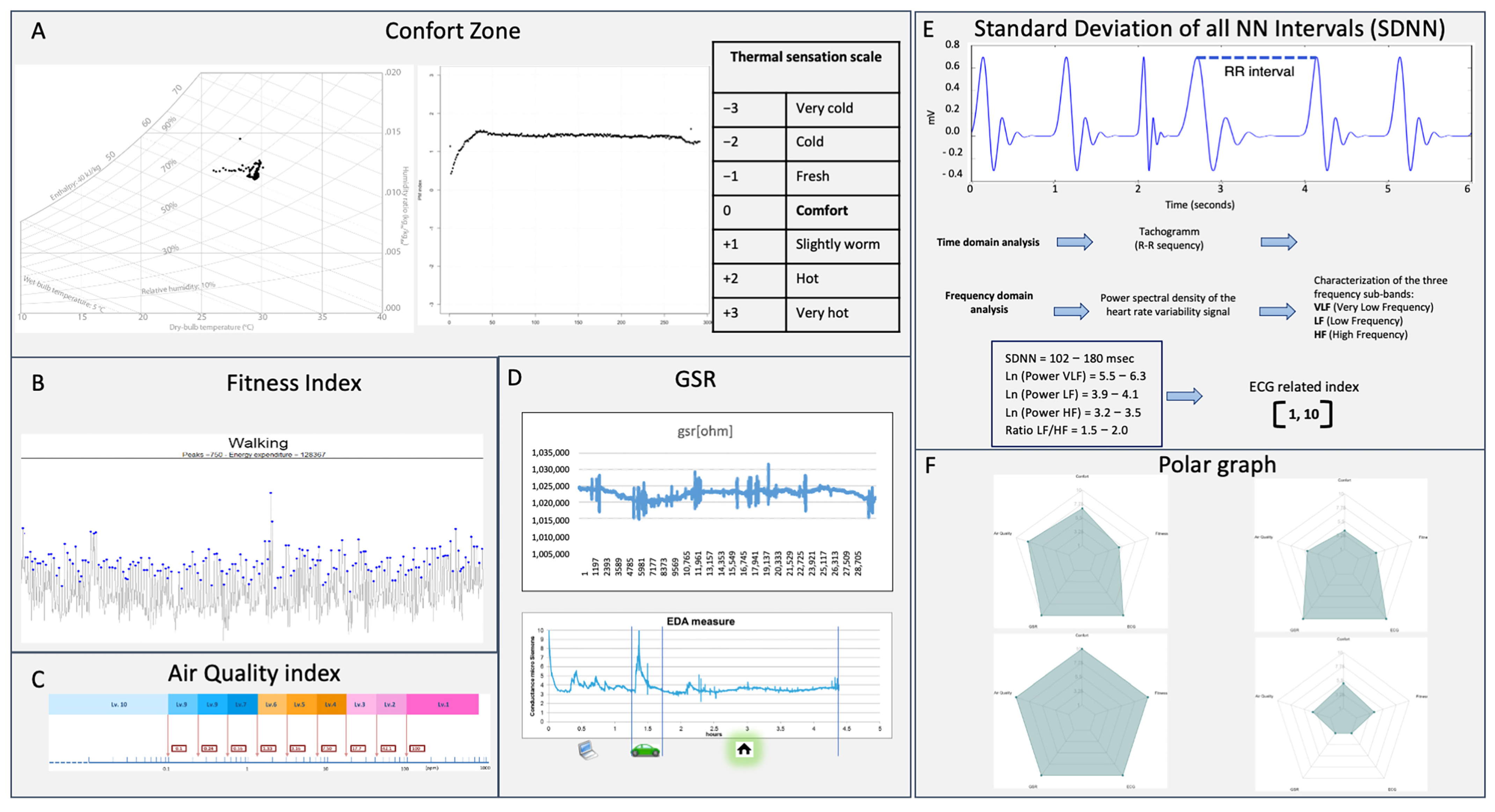
- Activity monitoring combined with machine learning enables precise physical activity classification and accurate energy expenditure estimation.
- Environmental sensors facilitate real-time thermal comfort assessment using the Predicted Mean Vote (PMV) model, significantly improving the interpretation of skin temperature variations and thermoregulatory responses.
- VOC sensors provide continuous air quality assessment, enabling robust correlation between environmental exposures and physiological stress responses.
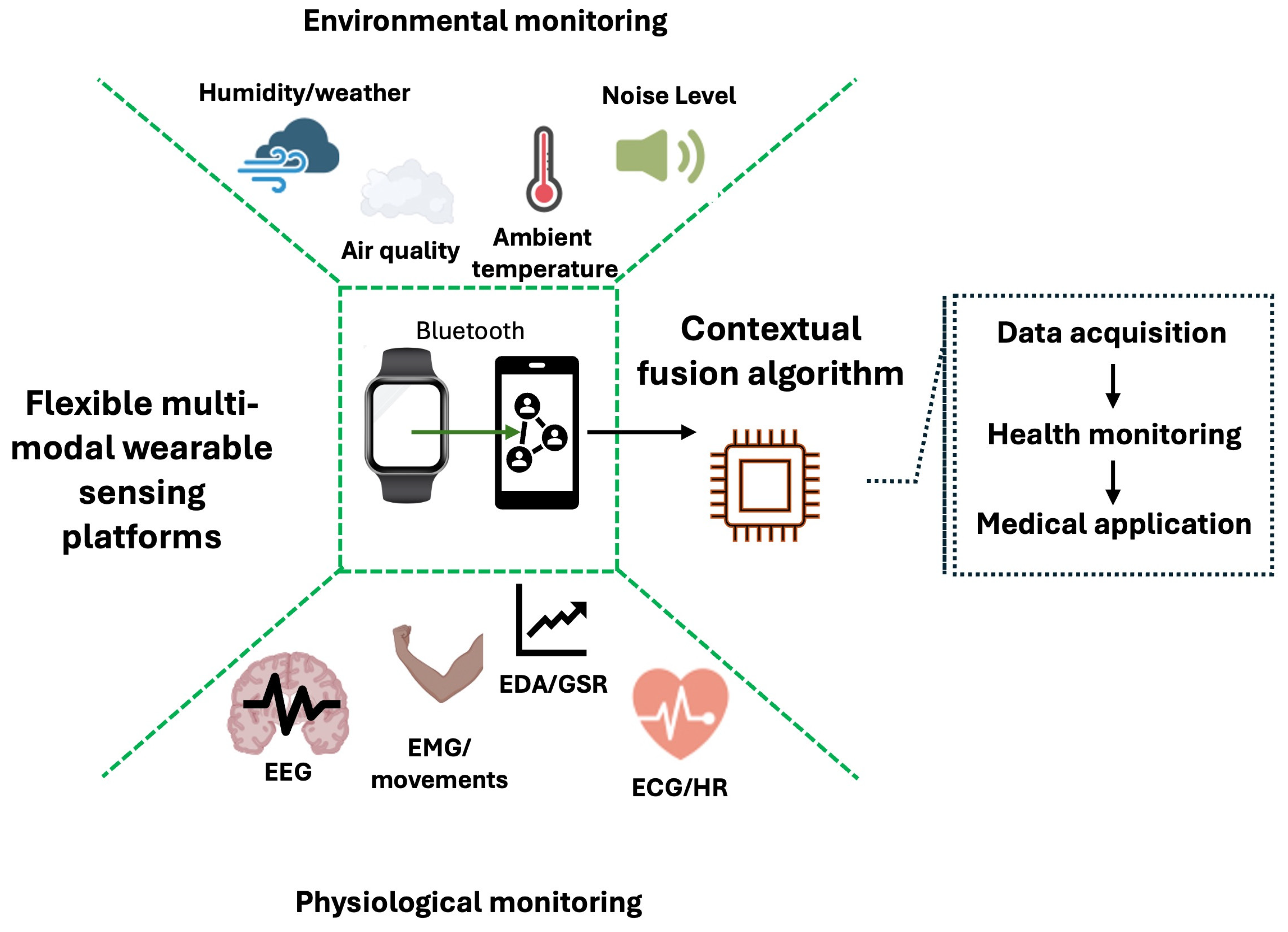
- Integrated biometric sensors (ECG, EDA and BIA) offer comprehensive physiological profiling when contextualized with environmental and activity data.
4. Discussion
- 1.
- Development of standardized validation frameworks for multi-modal health indices.
- 2.
- Advancement in ultra-low-power sensor technology and energy-efficient communication protocols.
- 3.
- Creation of large, annotated multi-modal datasets for ML algorithm training.
- 4.
- Implementation of closed-loop systems that deliver personalized interventions based on integrated monitoring.
- 5.
- Establishment of ethical guidelines and regulatory pathways for convergent devices.
5. Conclusions
Author Contributions
Funding
Institutional Review Board Statement
Informed Consent Statement
Data Availability Statement
Acknowledgments
Conflicts of Interest
Abbreviations
| BAEP | Brainstem auditory evoked potential |
| BCG | Ballistocardiography |
| BIA | Bioelectrical impedance analysis |
| COPD | Chronic Obstructive Pulmonary Disease |
| ECG | Electrocardiogram |
| EDA | Electrodermal activity |
| EMG | Electromyography |
| EEG | Electroencephalography |
| GCG | Gyrocardiogram |
| GSR | Galvanic Skin Response |
| IMU | Inertial Measurement Unit |
| MEP | Motor evoked potential |
| NIRS | Near-infrared spectroscopy |
| HRV | Heart Rate Variability |
| PIDs | Photoionization detectors |
| PMV | Predicted Mean Vote |
| PPG | Photoplethysmography |
| SCG | Seismocardiography |
| SDNN | Standard Deviation of all NN Intervals |
| SSEP | Somatosensory evoked potential |
| VEP | Visual evoked potential |
| VOC | Volatile Organic Compound |
| WBANs | Wireless Body Area Networks |
References
- Guk, K.; Han, G.; Lim, J.; Jeong, K.; Kang, T.; Lim, E.K.; Jung, J. Evolution of Wearable Devices with Real-Time Disease Monitoring for Personalized Healthcare. Nanomaterials 2019, 9, 813. [Google Scholar] [CrossRef] [PubMed]
- Aftab, S.; Koyyada, G.; Rubab, N.; Assiri, M.A.; Truong, N.T.N. Advances in wearable nanomaterial-based sensors for environmental and health monitoring: A comprehensive review. J. Environ. Chem. Eng. 2025, 13, 115788. [Google Scholar] [CrossRef]
- Pinheiro, G.P.M.; Miranda, R.K.; Praciano, B.J.G.; Santos, G.A.; Mendonca, F.L.L.; Javidi, E.; da Costa, J.P.J.; de Sousa, R.T., Jr. Multi-Sensor Wearable Health Device Framework for Real-Time Monitoring of Elderly Patients Using a Mobile Application and High-Resolution Parameter Estimation. Front. Hum. Neurosci. 2021, 15, 750591. [Google Scholar] [CrossRef] [PubMed]
- Salamone, F.; Masullo, M.; Sibilio, S. Wearable Devices for Environmental Monitoring in the Built Environment: A Systematic Review. Sensors 2021, 21, 4727. [Google Scholar] [CrossRef]
- Salamone, F.; Sibilio, S.; Masullo, M. Integrated Approach for Human Wellbeing and Environmental Assessment Based on a Wearable IoT System: A Pilot Case Study in Singapore. Sensors 2024, 24, 6126. [Google Scholar] [CrossRef]
- Yasmeen, S.; Li, B.; Du, C.; Liu, H.; Baghaei, A. Exploring the Interconnection of Sleep Quality, Indoor Environmental Factors, and Energy Efficiency: Strategies for Sustainable Sleep Environments. Indoor Air 2025, 2025, 8245786. [Google Scholar] [CrossRef]
- Paradiso, R.; Faetti, T.; Werner, S. Wearable monitoring systems for psychological and physiological state assessment in a naturalistic environment. Annu. Int. Conf. IEEE Eng. Med. Biol. Soc. 2011, 2011, 2250–2253. [Google Scholar] [CrossRef] [PubMed]
- Rahmani, M.H.; Symons, M.; Sobhani, O.; Berkvens, R.; Weyn, M. EmoWear: Wearable Physiological and Motion Dataset for Emotion Recognition and Context Awareness. Sci. Data 2024, 11, 648. [Google Scholar] [CrossRef]
- Hong, H.; Dai, L.; Zheng, X. Advances in Wearable Sensors for Learning Analytics: Trends, Challenges, and Prospects. Sensors 2025, 25, 2714. [Google Scholar] [CrossRef] [PubMed]
- Xing, Y.; Yang, Y.; Yang, K.; Lu, A.; Xing, L.; Mackie, K.; Guo, F. Intelligent sensing devices and systems for personalized mental health. Med-X 2025, 3, 10. [Google Scholar] [CrossRef]
- Vo, D.K.; Trinh, K.T.L. Advances in Wearable Biosensors for Healthcare: Current Trends, Applications, and Future Perspectives. Biosensors 2024, 14, 560. [Google Scholar] [CrossRef]
- Song, S.; Zhang, M.; Gong, X.; Shi, S.; Fang, J.; Wang, X. Advances in Wearable Sensors for Health Management: From Advanced Materials to Intelligent Systems. Adv. Funct. Mater. 2025, 2025, e18767. [Google Scholar] [CrossRef]
- Prance, H. Sensor Developments for Electrophysiological Monitoring in Healthcare. In Applied Biomedical Engineering; IntechOpen: London, UK, 2011. [Google Scholar]
- Rihet, M.; Sarthou, G.; Clodic, A.; Roy, R.N. Electrophysiological Measures for Human–Robot Collaboration Quality Assessment. In Discovering the Frontiers of Human-Robot Interaction; Springer: Berlin/Heidelberg, Germany, 2024; pp. 363–380. [Google Scholar]
- Zhang, Z.; Beligiannis, G.; Curiac, D.-I. Deep learning-based ECG signal processing algorithms and their applications in cardiac health monitoring. In Proceedings of the Fourth International Conference on Advanced Algorithms and Signal Image Processing (AASIP 2024), Kuala Lumpur, Malaysia, 28–30 June 2024. [Google Scholar]
- Yang, X.; Chai, Y. ECG Signal Processing and Automatic Classification Algorithms. Int. J. Crowd Sci. 2024, 8, 122–129. [Google Scholar] [CrossRef]
- Nardelli, M.; Greco, A.; Sebastiani, L.; Scilingo, E.P. ComEDA: A new tool for stress assessment based on electrodermal activity. Comput. Biol. Med. 2022, 150, 106144. [Google Scholar] [CrossRef]
- Ding, R.; Hovine, C.; Callemeyn, P.; Kraft, M.; Bertrand, A. A wireless, scalable and modular EEG sensor network platform for unobtrusive brain recordings. IEEE Sens. J. 2025, 25, 22580–22590. [Google Scholar] [CrossRef]
- Bai, H.; Yang, S.; Xiang, Z.; Li, C.; Yao, Y.; Li, X.; Yu, X. A wireless EEG device using Bluetooth for brain activity measurement. In Proceedings of the International Conference on Future of Medicine and Biological Information Engineering (MBIE 2024); SPIE: Bellingham, WA, USA, 2024. [Google Scholar]
- Shin, S.; Kang, M.; Jung, J.; Kim, Y.T. Development of Miniaturized Wearable Wristband Type Surface EMG Measurement System for Biometric Authentication. Electronics 2021, 10, 923. [Google Scholar] [CrossRef]
- Tang, X.; Zhang, X.; Wang, X.; Cheng, X.; Liu, H.; Jin, H. Design and Research of a Wearable Portable Electromyography Monitoring System. In Proceedings of the 2024 International Conference on Smart Healthcare and Wearable Intelligent Devices, Guangzhou, China, 18–20 October 2024; pp. 192–198. [Google Scholar]
- Kinney, G.A.; Slimp, J.C. Intraoperative neurophysiological monitoring technology: Recent advances and evolving uses. Expert Rev. Med. Devices 2014, 4, 33–41. [Google Scholar] [CrossRef] [PubMed]
- Greer, D.G.; Donofrio, P.D. Electrophysiological Evaluations. In Clinical Neurotoxicology; Elsevier: Amsterdam, The Netherlands, 2009; pp. 201–212. [Google Scholar]
- Lepore, M.; Delfino, I. Optical Sensors Technology and Applications. Sensors 2022, 22, 7905. [Google Scholar] [CrossRef]
- Kim, K.B.; Baek, H.J. Photoplethysmography in Wearable Devices: A Comprehensive Review of Technological Advances, Current Challenges, and Future Directions. Electronics 2023, 12, 2923. [Google Scholar] [CrossRef]
- Draghici, A.E.; Potart, D.; Hollmann, J.L.; Pera, V.; Fang, Q.; DiMarzio, C.; Taylor, J.A.; Niedre, M.J.; Shefelbine, S.J. Near infrared spectroscopy for measuring changes in bone hemoglobin content after exercise in individuals with spinal cord injury. J. Orthop. Res. 2017, 36, 183–191. [Google Scholar] [CrossRef] [PubMed]
- Beć, K.B.; Grabska, J.; Huck, C.W. Principles and Applications of Miniaturized Near-Infrared (NIR) Spectrometers. Chem.–A Eur. J. 2020, 27, 1514–1532. [Google Scholar] [CrossRef]
- Beć, K.B.; Grabska, J.; Huck, C.W. Miniaturized near-infrared spectroscopy in current analytical chemistry: From natural products to forensics. In Molecular and Laser Spectroscopy; Gupta, V.P., Ed.; Elsevier: Amsterdam, The Netherlands, 2022; pp. 141–188. [Google Scholar] [CrossRef]
- Amini, M.; Hisdal, J.; Kalvøy, H. Applications of bioimpedance measurement techniques in tissue engineering. J. Electr. Bioimpedance 2018, 9, 142–158. [Google Scholar] [CrossRef]
- Rabelo, I.F.; Farrell, S.; Reid, K.F.; Dos Santos, V.R.; Antunes, M.; Batista, V.C.; Bauermann-Vieira, A.; Gobbo, L.A. Bioelectrical impedance vectors analysis (BIVA) in older adults according to level of physical activity and muscle strength: A comparison of classic and specific approaches. Front. Aging 2025, 6, 1535876. [Google Scholar] [CrossRef] [PubMed]
- Hashizume, N.; Sakamoto, S.; Yoshida, M.; Kurahachi, T.; Tsuruhisa, S.; Higashidate, N.; Masui, D.; Koga, Y.; Kaji, T. Correlation Between Age and Body Composition Values Using Bioelectrical Impedance Analysis in Young Children. Cureus 2025, 17, e84192. [Google Scholar] [CrossRef]
- Sumbel, L.; Wats, A.; Salameh, M.; Appachi, E.; Bhalala, U. Thoracic Fluid Content (TFC) Measurement Using Impedance Cardiography Predicts Outcomes in Critically Ill Children. Front. Pediatr. 2021, 8, 564902. [Google Scholar] [CrossRef] [PubMed]
- Diarah, R.S.; Osueke, C.; Adekunle, A.; Adebayo, S.; Banji Aaron, A.; Olawale Joshua, O. Types of Temperature Sensors. In Wireless Sensor Networks-Design, Applications and Challenges; IntechOpen: London, UK, 2023. [Google Scholar]
- Madhvapathy, S.R.; Arafa, H.M.; Patel, M.; Winograd, J.; Kong, J.; Zhu, J.; Xu, S.; Rogers, J.A. Advanced thermal sensing techniques for characterizing the physical properties of skin. Appl. Phys. Rev. 2022, 9, 041307. [Google Scholar] [CrossRef]
- Sempionatto, J.R.; Lasalde-Ramírez, J.A.; Mahato, K.; Wang, J.; Gao, W. Wearable chemical sensors for biomarker discovery in the omics era. Nat. Rev. Chem. 2022, 6, 899–915. [Google Scholar] [CrossRef] [PubMed]
- Sim, D.; Brothers, M.C.; Slocik, J.M.; Islam, A.E.; Maruyama, B.; Grigsby, C.C.; Naik, R.R.; Kim, S.S. Biomarkers and Detection Platforms for Human Health and Performance Monitoring. Adv. Sci. 2022, 9, 2104426. [Google Scholar] [CrossRef]
- Wu, X.; Zhao, X.; Chen, W.; Chen, Q.; Kong, L.; Li, P. A systematic review of continuous glucose monitoring sensors: Principles, core technologies and performance evaluation. Sens. Actuators Rep. 2025, 10, 100361. [Google Scholar] [CrossRef]
- Kim, S.; Malik, J.; Seo, J.M.; Cho, Y.M.; Bien, F. Subcutaneously implantable electromagnetic biosensor system for continuous glucose monitoring. Sci. Rep. 2022, 12, 17395. [Google Scholar] [CrossRef]
- Yulianti, E.S.; Intan, N.; Rahman, S.F.; Basari. Sweat sensing in wearable sensor: A review of the future non-invasive technology for real-time health monitoring system. In Proceedings of the the 6th Biomedical Engineering’s Recent Progress in Biomaterials, Drugs Development, and Medical Devices: Proceedings of the 6th International Symposium of Biomedical Engineering (ISBE) 2021, Depok, Indonesia, 7–8 July 2021. [Google Scholar]
- Shinde, S.; Kim, K.H.; Park, S.Y.; Kim, J.H.; Kim, J.; Joe, D.J.; Lee, H.E. Wearable sweat-sensing patches for non-invasive and continuous health tracking. Sens. Actuators Rep. 2025, 9, 100265. [Google Scholar] [CrossRef]
- El-Adawi, E.; Essa, E.; Handosa, M.; Elmougy, S. Wireless body area sensor networks based human activity recognition using deep learning. Sci. Rep. 2024, 14, 2702. [Google Scholar] [CrossRef]
- Hasan, K.; Biswas, K.; Ahmed, K.; Nafi, N.S.; Islam, M.S. A comprehensive review of wireless body area network. J. Netw. Comput. Appl. 2019, 143, 178–198. [Google Scholar] [CrossRef]
- Ali, S.M.; Noghanian, S.; Khan, Z.U.; Alzahrani, S.; Alharbi, S.; Alhartomi, M.; Alsulami, R. Wearable and Flexible Sensor Devices: Recent Advances in Designs, Fabrication Methods, and Applications. Sensors 2025, 25, 1377. [Google Scholar] [CrossRef] [PubMed]
- Brasier, N.; Niederberger, C.; Zanella, M.; Othman, A.; Schlapbach, R.; Kunz, L.; Dittmann, A.; Reeve, K.; Prummer, M.; Goldhahn, J. The molecular signature of heat stress in sweat reveals non-invasive biomarker candidates for health monitoring. Commun. Biol. 2025, 8, 650. [Google Scholar] [CrossRef]
- Narayana, T.L.; Venkatesh, C.; Kiran, A.; Babu, J.C.; Kumar, A.; Khan, S.B.; Almusharraf, A.; Quasim, M.T. Advances in real time smart monitoring of environmental parameters using IoT and sensors. Heliyon 2024, 10, e28195. [Google Scholar] [CrossRef] [PubMed]
- Manivannan, A.; Chin, W.C.B.; Barrat, A.; Bouffanais, R. On the Challenges and Potential of Using Barometric Sensors to Track Human Activity. Sensors 2020, 20, 6786. [Google Scholar] [CrossRef]
- Roy, R.; D’Angiulli, A. Air pollution and neurological diseases, current state highlights. Front. Neurosci. 2024, 18, 1351721. [Google Scholar] [CrossRef]
- Momin, M.A.; Toda, M.; Wang, Z.; Yamazaki, M.; Moorthi, K.; Kawaguchi, Y.; Ono, T. Investigation towards nanomechanical sensor array for real-time detection of complex gases. Microsyst. Nanoeng. 2025, 11, 53. [Google Scholar] [CrossRef]
- Kang, S.; Yuan, R.; Pannone, A.; Li, Y.-S.; Ravichandran, H.; Kim, S.H.; Das, S.; Esker, P.D.; Qu, X.; Castro, J.; et al. Detection and Monitoring of Volatile Organic Compounds (VOCs) via the Use of Engineered Chemical Sensors: An Underexplored Tool for Safeguarding Crop Health and Quality. Phytofrontiers™ 2025. [Google Scholar] [CrossRef]
- Jiao, B.; Zhang, S.; Bei, Y.; Bu, G.; Yuan, L.; Zhu, Y.; Yang, Q.; Xu, T.; Zhou, L.; Liu, Q.; et al. A detection model for cognitive dysfunction based on volatile organic compounds from a large Chinese community cohort. Alzheimer’s Dement. 2023, 19, 4852–4862. [Google Scholar] [CrossRef]
- Singh, S.; S, S.; Varma, P.; Sreelekha, G.; Adak, C.; Shukla, R.P.; Kamble, V.B. Metal oxide-based gas sensor array for VOCs determination in complex mixtures using machine learning. Microchim. Acta 2024, 191, 196. [Google Scholar] [CrossRef] [PubMed]
- Oswin, H.P.; Glachant, L.; Lekamge, S.A.; Alinaghipour, B.; Khan, S.B.; Morawska, L. Using indoor CO2 concentration thresholds to understand and improve the air quality of public buildings: A practical approach. Energy Build. 2025, 347, 116254. [Google Scholar] [CrossRef]
- Pham, D.L.; Le, K.-M.; Truong, D.D.K.; Le, H.T.T.; Trinh, T.H.K. Environmental allergen reduction in asthma management: An overview. Front. Allergy 2023, 4, 1229238. [Google Scholar] [CrossRef] [PubMed]
- van Duijnhoven, J.; Hartmeyer, S.L.; Didikoglu, A.; Stefani, O.; Houser, K.W.; Kalavally, V.; Spitschan, M. Measuring light exposure in daily life: A review of wearable light loggers. Build. Environ. 2025, 274, 112771. [Google Scholar] [CrossRef]
- Arguelles-Prieto, R.; Bonmati-Carrion, M.-A.; Rol, M.A.; Madrid, J.A. Determining Light Intensity, Timing and Type of Visible and Circadian Light From an Ambulatory Circadian Monitoring Device. Front. Physiol. 2019, 10, 822. [Google Scholar] [CrossRef]
- He, M.; Chen, H.; Li, S.; Ru, T.; Chen, Q.; Zhou, G. Evening prolonged relatively low melanopic equivalent daylight illuminance light exposure increases arousal before and during sleep without altering sleep structure. J. Sleep Res. 2023, 33, e14113. [Google Scholar] [CrossRef]
- Trinh, V.Q.; Bodrogi, P.; Khanh, T.Q. Determination and Measurement of Melanopic Equivalent Daylight (D65) Illuminance (mEDI) in the Context of Smart and Integrative Lighting. Sensors 2023, 23, 5000. [Google Scholar] [CrossRef]
- Zhang, J.; Yan, H.; Wang, D. Effects of Acoustic Environment Types on Stress Relief in Urban Parks. Int. J. Environ. Res. Public Health 2023, 20, 1082. [Google Scholar] [CrossRef] [PubMed]
- Hahad, O.; Gilan, D.; Michal, M.; Tüscher, O.; Chalabi, J.; Schuster, A.K.; Keller, K.; Hobohm, L.; Schmitt, V.H.; König, J.; et al. Noise annoyance and cardiovascular disease risk: Results from a 10-year follow-up study. Sci. Rep. 2024, 14, 5619. [Google Scholar] [CrossRef] [PubMed]
- Krittanawong, C.; Qadeer, Y.K.; Hayes, R.B.; Wang, Z.; Virani, S.; Zeller, M.; Dadvand, P.; Lavie, C.J. Noise Exposure and Cardiovascular Health. Curr. Probl. Cardiol. 2023, 48, 101938. [Google Scholar] [CrossRef]
- Ajdari, B.; Salimi, N.; Strambini, L.; Cepolina, E.M. Noise pollution monitoring at pedestrian level by autonomous vehicles in urban areas. Sci. Total Environ. 2025, 992, 179945. [Google Scholar] [CrossRef]
- Kalia, A.; Boyer, M.; Fagherazzi, G.; Bélisle-Pipon, J.-C.; Bensoussan, Y. Master protocols in vocal biomarker development to reduce variability and advance clinical precision: A narrative review. Front. Digit. Health 2025, 7, 1619183. [Google Scholar] [CrossRef]
- Lentz-Nielsen, N.; Maaløe, L.; Madeleine, P.; Blomberg, S.N. Voice as a Health Indicator: The Use of Sound Analysis and AI for Monitoring Respiratory Function. BioMedInformatics 2025, 5, 31. [Google Scholar] [CrossRef]
- Wang, X.; Yu, H.; Kold, S.; Rahbek, O.; Bai, S. Wearable sensors for activity monitoring and motion control: A review. Biomim. Intell. Robot. 2023, 3, 100089. [Google Scholar] [CrossRef]
- Huang, X.; Xue, Y.; Ren, S.; Wang, F. Sensor-Based Wearable Systems for Monitoring Human Motion and Posture: A Review. Sensors 2023, 23, 9047. [Google Scholar] [CrossRef] [PubMed]
- Mohameed, H.; Usmonova, U.; Ugli, K.Q.S. Wearable-sensor fusion for ubiquitous human health monitoring. TPM–Test. Psychom. Methodol. Appl. Psychol. 2025, 32, 305–313. [Google Scholar]
- Wang, J.; Nouraie, S.M.; Kelly, N.J.; Chan, S.Y. Deep learning predicts cardiac output from seismocardiographic signals in heart failure. Am. J. Cardiol. 2025, 259, 97–104. [Google Scholar] [CrossRef]
- Singha, S.; Singh, M.J.; Sharma, L.N.; Dandapat, S. Cardio-Mechanical Signal Based Respiration Monitoring with an Inertial Measurement Unit. In Proceedings of the 2024 IEEE Silchar Subsection Conference (SILCON 2024), Agartala, India, 15–17 November 2024; pp. 1–6. [Google Scholar]
- Rai, D.; Thakkar, H.K.; Rajput, S.S.; Santamaria, J.; Bhatt, C.; Roca, F. A Comprehensive Review on Seismocardiogram: Current Advancements on Acquisition. Mathematics 2021, 9, 2243. [Google Scholar] [CrossRef]
- Li, Y.X.; Huang, J.L.; Yao, X.Y.; Mu, S.Q.; Zong, S.X.; Shen, Y.F. A ballistocardiogram dataset with reference sensor signals in long-term natural sleep environments. Sci. Data 2024, 11, 1091. [Google Scholar] [CrossRef]
- Gu, C.; Lin, W.; He, X.; Zhang, L.; Zhang, M. IMU-based motion capture system for rehabilitation applications: A systematic review. Biomim. Intell. Robot. 2023, 3, 100097. [Google Scholar] [CrossRef]
- Kanjo, E.; Younis, E.M.; Ang, C.S. Deep learning analysis of mobile physiological, environmental and location sensor data for emotion detection. Inf. Fusion 2019, 49, 46–56. [Google Scholar] [CrossRef]
- Rhudy, M.B.; Dolan, S.K.; Mello, C.; Greenauer, N. Indoor and Outdoor Classification Using Light Measurements and Machine Learning. Appl. Artif. Intell. 2021, 36, 2012001. [Google Scholar] [CrossRef]
- Prieto-Avalos, G.; Cruz-Ramos, N.A.; Alor-Hernández, G.; Sánchez-Cervantes, J.L.; Rodríguez-Mazahua, L.; Guarneros-Nolasco, L.R. Wearable Devices for Physical Monitoring of Heart: A Review. Biosensors 2022, 12, 292. [Google Scholar] [CrossRef]
- Osa-Sanchez, A.; Ramos-Martinez-de-Soria, J.; Mendez-Zorrilla, A.; Ruiz, I.O.; Garcia-Zapirain, B. Wearable Sensors and Artificial Intelligence for Sleep Apnea Detection: A Systematic Review. J. Med. Syst. 2025, 49, 66. [Google Scholar] [CrossRef]
- Scardulla, F.; Cosoli, G.; Spinsante, S.; Poli, A.; Iadarola, G.; Pernice, R.; Busacca, A.; Pasta, S.; Scalise, L.; D’Acquisto, L. Photoplethysmograhic sensors, potential and limitations: Is it time for regulation? A comprehensive review. Measurement 2023, 218, 113150. [Google Scholar] [CrossRef]
- Miller, K.; Baugh, C.W.; Chai, P.R.; Hasdianda, M.A.; Divatia, S.; Jambaulikar, G.D.; Boyer, E.W. Deployment of a wearable biosensor system in the emergency department: A technical feasibility study. Proc. Annu. Hawaii Int. Conf. Syst. Sci. 2021, 2021, 3567–3572. [Google Scholar]
- Leenen, J.P.L.; Leerentveld, C.; van Dijk, J.D.; van Westreenen, H.L.; Schoonhoven, L.; Patijn, G.A. Current Evidence for Continuous Vital Signs Monitoring by Wearable Wireless Devices in Hospitalized Adults. J. Med. Internet Res. 2020, 22, e18636. [Google Scholar] [CrossRef] [PubMed]
- Bignami, E.G.; Fornaciari, A.; Fedele, S.; Madeo, M.; Panizzi, M.; Marconi, F.; Cerdelli, E.; Bellini, V. Wearable Devices in Healthcare Beyond the One-Size-Fits All Paradigm. Sensors 2025, 25, 6472. [Google Scholar] [CrossRef] [PubMed]
- Campanella, S.; Altaleb, A.; Belli, A.; Pierleoni, P.; Palma, L. A Method for Stress Detection Using Empatica E4 Bracelet and Machine-Learning Techniques. Sensors 2023, 23, 3565. [Google Scholar] [CrossRef] [PubMed]
- Jaldin, C.; Jonasson, C.; Fagrell, T.; Robertson, A.; Krekmanova, L. Sensors: Future tools for detecting young patient’s stress during a dental invasive versus a non-invasive dental treatment-a pilot study. Eur. Arch. Paediatr. Dent. 2025, 26, 183–189. [Google Scholar] [CrossRef]
- Gruden, T.; Stojmenova, K.; Sodnik, J.; Jakus, G. Assessing Drivers’ Physiological Responses Using Consumer Grade Devices. Appl. Sci. 2019, 9, 5353. [Google Scholar] [CrossRef]
- Medarević, J.; Miljković, N.; Pečečnik, K.S.; Sodnik, J. Distress detection in VR environment using Empatica E4 wristband and Bittium Faros 360. Front. Physiol. 2025, 16, 1480018. [Google Scholar] [CrossRef]
- Serrano-Salomón, V.; Westbrook, M.; Pérez, N.; Pecenka, J.; Khalili, A.; Sankhyan, S.; Miller, S.; Mishra, S.; Sullivan, E. Supporting knowledge justice through community science air quality monitoring and a reciprocal reporting process. J. Environ. Manag. 2024, 372, 123414. [Google Scholar] [CrossRef]
- Crnosija, N.; Zamora, M.L.; Rule, A.M.; Payne-Sturges, D. Laboratory Chamber Evaluation of Flow Air Quality Sensor PM2.5 and PM10 Measurements. Int. J. Environ. Res. Public Health 2022, 19, 7340. [Google Scholar] [CrossRef] [PubMed]
- Masri, S.; Cox, K.; Flores, L.; Rea, J.; Wu, J. Community-Engaged Use of Low-Cost Sensors to Assess the Spatial Distribution of PM2.5 Concentrations across Disadvantaged Communities: Results from a Pilot Study in Santa Ana, CA. Atmosphere 2022, 13, 304. [Google Scholar] [CrossRef]
- Santos, T.F.; Fontes Galvão, F.M.; Neto, L.O.; Nascimento, J.H.O. Emerging Technologies in Wearable Sweat Sensors for Next-Generation Real-Time Health Monitoring. ACS Mater. Lett. 2025, 7, 3341–3362. [Google Scholar] [CrossRef]
- Del-Valle-Soto, C.; Briseño, R.A.; Valdivia, L.J.; Nolazco-Flores, J.A. Unveiling wearables: Exploring the global landscape of biometric applications and vital signs and behavioral impact. BioData Min. 2024, 17, 15. [Google Scholar] [CrossRef]
- Novak, R.; Robinson, J.A.; Kanduč, T.; Sarigiannis, D.; Džeroski, S.; Kocman, D. Empowering Participatory Research in Urban Health: Wearable Biometric and Environmental Sensors for Activity Recognition. Sensors 2023, 23, 9890. [Google Scholar] [CrossRef]
- Shajari, S.; Kuruvinashetti, K.; Komeili, A.; Sundararaj, U. The Emergence of AI-Based Wearable Sensors for Digital Health Technology: A Review. Sensors 2023, 23, 9498. [Google Scholar] [CrossRef] [PubMed]
- Heikenfeld, J.; Jajack, A.; Rogers, J.; Gutruf, P.; Tian, L.; Pan, T.; Li, R.; Khine, M.; Kim, J.; Wang, J.; et al. Wearable sensors: Modalities, challenges, and prospects. Lab Chip 2018, 18, 217–248. [Google Scholar] [CrossRef]
- Gao, M.; Yao, Y.; Wang, Y.; Wang, B.; Wang, P.; Wang, Y.; Dai, J.; Liu, S.; Torres, J.F.; Cheng, W.; et al. Wearable power management system enables uninterrupted battery-free data-intensive sensing and transmission. Nano Energy 2023, 107, 108107. [Google Scholar] [CrossRef]
- Kanoun, O.; Bradai, S.; Khriji, S.; Bouattour, G.; El Houssaini, D.; Ben Ammar, M.; Naifar, S.; Bouhamed, A.; Derbel, F.; Viehweger, C. Energy-Aware System Design for Autonomous Wireless Sensor Nodes: A Comprehensive Review. Sensors 2021, 21, 548. [Google Scholar] [CrossRef]
- Martínez-García, M.; Hernández-Lemus, E. Data Integration Challenges for Machine Learning in Precision Medicine. Front. Med. 2022, 8, 784455. [Google Scholar] [CrossRef]
- Sel, K.; Hawkins-Daarud, A.; Chaudhuri, A.; Osman, D.; Bahai, A.; Paydarfar, D.; Willcox, K.; Chung, C.; Jafari, R. Survey and perspective on verification, validation, and uncertainty quantification of digital twins for precision medicine. npj Digit. Med. 2025, 8, 40. [Google Scholar] [CrossRef] [PubMed]
- Kang, W.; Zhang, X.; Zhang, J.; Chen, X.; Huang, H.; He, B.; Qin, W.; Zhu, H. Multimodal data generative fusion method for complex system health condition estimation. Sci. Rep. 2025, 15, 20026. [Google Scholar] [CrossRef] [PubMed]
- Sapienza, S.; Tsurkalenko, O.; Giraitis, M.; Mejia, A.C.; Zelimkhanov, G.; Schwaninger, I.; Klucken, J. Assessing the clinical utility of inertial sensors for home monitoring in Parkinson’s disease: A comprehensive review. npj Park. Dis. 2024, 10, 161. [Google Scholar] [CrossRef] [PubMed]
- Nasef, D.; Nasef, D.; Sher, M.; Toma, M. A Standardized Validation Framework for Clinically Actionable Healthcare Machine Learning with Knee Osteoarthritis Grading as a Case Study. Algorithms 2025, 18, 343. [Google Scholar] [CrossRef]
- Ardic, N.; Dinc, R. Emerging trends in multi-modal artificial intelligence for clinical decision support: A narrative review. Health Inform. J. 2025, 31, 14604582251366141. [Google Scholar] [CrossRef] [PubMed]
- Al-Rami Al-Ghamdi, B.A.M. Analyzing the impact of data visualization applications for diagnosing the health conditions through hesitant fuzzy-based hybrid medical expert system. Ain Shams Eng. J. 2024, 15, 102705. [Google Scholar] [CrossRef]
- Blasch, E.; Pham, T.; Chong, C.-Y.; Koch, W.; Leung, H.; Braines, D.; Abdelzaher, T. Machine Learning/Artificial Intelligence for Sensor Data Fusion–Opportunities and Challenges. IEEE Aerosp. Electron. Syst. Mag. 2021, 36, 80–93. [Google Scholar] [CrossRef]
- Zonayed, M.; Tasnim, R.; Jhara, S.S.; Mimona, M.A.; Hussein, M.R.; Mobarak, M.H.; Salma, U. Machine learning and IoT in healthcare: Recent advancements, challenges & future direction. Adv. Biomark. Sci. Technol. 2025, 7, 335–364. [Google Scholar] [CrossRef]
- Madhusudhanan, S.; Jose, A.C. Privacy preservation techniques through data lifecycle: A comprehensive literature survey. Comput. Secur. 2025, 155, 104473. [Google Scholar] [CrossRef]
- Ren, M.; Du, N. Wearable Technology: Merging Computer Processing with Sensor Technology for Health Monitoring. Sens. Mater. 2025, 37, 4587. [Google Scholar] [CrossRef]
- Adibi, S.; Rajabifard, A.; Shojaei, D.; Wickramasinghe, N. Enhancing Healthcare through Sensor-Enabled Digital Twins in Smart Environments: A Comprehensive Analysis. Sensors 2024, 24, 2793. [Google Scholar] [CrossRef]
- Elfouly, T.; Alouani, A. A Comprehensive Survey on Wearable Computing for Mental and Physical Health Monitoring. Electronics 2025, 14, 3443. [Google Scholar] [CrossRef]
- De la Torre, K.; Min, S.; Lee, H.; Kang, D. The Application of Preventive Medicine in the Future Digital Health Era. J. Med. Internet Res. 2025, 27, e59165. [Google Scholar] [CrossRef] [PubMed]
- Canali, S.; Schiaffonati, V.; Aliverti, A. Challenges and recommendations for wearable devices in digital health: Data quality, interoperability, health equity, fairness. PLoS Digit. Health 2022, 1, e0000104. [Google Scholar] [CrossRef] [PubMed]



| Environmental Factor | Sensing Technology | Relevant Biometric Parameters | Clinical Significance |
|---|---|---|---|
| Thermal Environment | Temperature/ Humidity Sensors | Skin temperature, Heart rate, EDA, Peripheral blood flow | Distinguishes thermoregulatory stress from pathological tachycardia; identifies heat/cold stress conditions |
| Air Quality | VOC, PM2.5, NO2, O3 Sensors | Respiratory rate, HRV, SpO2, Cough frequency, Inflammatory markers | Identifies environmental triggers for asthma/COPD exacerbations; links pollution exposure to cardiovascular events |
| Atmospheric Pressure | Barometric Pressure Sensors | Heart rate, Blood pressure, Cerebral blood flow, Headache occurrence | Correlates pressure changes with migraine attacks, joint pain, and cardiovascular symptoms |
| Light Exposure | UV/VIS Light Sensors | Sleep quality, Melatonin rhythm, Activity patterns, Cognitive performance | Links circadian disruption to metabolic syndrome, cardiovascular risk, and mood disorders |
| Noise Pollution | Sound Pressure Sensors | HRV, Blood pressure, Stress hormones, Sleep architecture | Quantifies the cardiovascular impact of environmental noise; identifies noise-induced sleep disruption |
| Altitude/ Hypoxia | Barometric Pressure, GPS | SpO2, Heart rate, Respiratory rate, Exercise capacity | Monitors acclimatization status; detects early signs of altitude sickness |
| Chemical Exposures | Specific Gas Sensors | Respiratory function, Inflammatory markers, Liver enzymes | Identifies occupational and environmental chemical exposures; monitors individual susceptibility |
| Device Category | Example Devices | Biometric Sensors | Environmental Sensors | Key Applications | Limitations |
|---|---|---|---|---|---|
| Consumer Fitness | Apple Watch Series, Fitbit Sense, Garmin Venu | ECG, PPG, HRV, Accelerometer, Temperature, Respiration Rate, SpO2 | Indirect only (via smartphone or inference) | Fitness tracking, wellness monitoring, activity and sleep assessment | Not medical-grade; physiological and contextual data often inferred rather than directly measured |
| Clinical Monitoring | VitalConnect VitalPatch, Corsano CardioWatch 287-2, Masimo Radius VSM, Philips Biosensor BX100 | ECG, Accelerometer, Respiration Rate, Temperature, SpO2 (device-dependent) | None | Remote patient monitoring, clinical trials, hospital and step-down surveillance | No direct environmental context; typically confined to clinical or regulated settings |
| Research Platforms | Empatica EmbracePlus, Shimmer3R GSR+ | EDA, PPG, Accelerometer, Temperature, optional EEG/EMG modules | None | Psychophysiology research, stress and affective computing, sleep and behavior studies | Environmental exposure must be measured separately; not designed for routine clinical deployment |
| Environmental Focus | Atmo Atmotube PRO, Plume Labs Flow | None | VOC, PM1/2.5/10, NO2, CO2, Temperature, Humidity, Pressure | Personal air quality monitoring, exposure and pollution assessment | No physiological monitoring; limited insight into health impact without biosignals |
| Convergent Prototypes | STMicroelectronics Platform, Research prototypes | ECG, EDA, PPG, BIA, Temperature, Accelerometer | VOC, Temperature, Humidity, Pressure, Light | Comprehensive health-environment interaction studies | Limited availability; early development stage; validation ongoing |
Disclaimer/Publisher’s Note: The statements, opinions and data contained in all publications are solely those of the individual author(s) and contributor(s) and not of MDPI and/or the editor(s). MDPI and/or the editor(s) disclaim responsibility for any injury to people or property resulting from any ideas, methods, instructions or products referred to in the content. |
© 2026 by the authors. Licensee MDPI, Basel, Switzerland. This article is an open access article distributed under the terms and conditions of the Creative Commons Attribution (CC BY) license.
Share and Cite
Guarnaccia, M.; Spampinato, A.G.; Alessi, E.; Cavallaro, S. Convergent Sensing: Integrating Biometric and Environmental Monitoring in Next-Generation Wearables. Biosensors 2026, 16, 43. https://doi.org/10.3390/bios16010043
Guarnaccia M, Spampinato AG, Alessi E, Cavallaro S. Convergent Sensing: Integrating Biometric and Environmental Monitoring in Next-Generation Wearables. Biosensors. 2026; 16(1):43. https://doi.org/10.3390/bios16010043
Chicago/Turabian StyleGuarnaccia, Maria, Antonio Gianmaria Spampinato, Enrico Alessi, and Sebastiano Cavallaro. 2026. "Convergent Sensing: Integrating Biometric and Environmental Monitoring in Next-Generation Wearables" Biosensors 16, no. 1: 43. https://doi.org/10.3390/bios16010043
APA StyleGuarnaccia, M., Spampinato, A. G., Alessi, E., & Cavallaro, S. (2026). Convergent Sensing: Integrating Biometric and Environmental Monitoring in Next-Generation Wearables. Biosensors, 16(1), 43. https://doi.org/10.3390/bios16010043