



Biosensors, Volume 15, Issue 12 (December 2025) – 59 articles
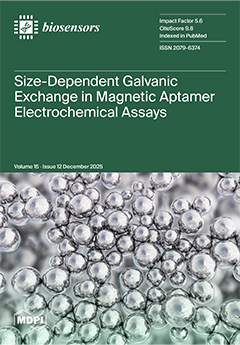
Cover Story (view full-size image):
This study investigates how silver nanoparticle size and magnetic bead size influence silver–gold galvanic exchange in magnetic aptamer-based electrochemical assays. Our results demonstrated that both parameters strongly affect charge-transfer efficiency, signal saturation, and assay reproducibility. An optimal configuration of 50 nm silver nanoparticles with 1 µm magnetic beads provided balanced surface accessibility and efficient electron transfer, leading to enhanced sensitivity and robust assay performance. These results highlight nanoscale design principles for improved magnetic electrochemical biosensors. View this paper
- Issues are regarded as officially published after their release is announced to the table of contents alert mailing list.
- You may sign up for e-mail alerts to receive table of contents of newly released issues.
- PDF is the official format for papers published in both, html and pdf forms. To view the papers in pdf format, click on the "PDF Full-text" link, and use the free Adobe Reader to open them.
Previous Issue
Next Issue
