Article

Highly Sensitive Detection and Discrimination of Cell Suspension Based on a Metamaterials-Based Biosensor Chip


1
Hangzhou International Innovation Institute, Beihang University, Hangzhou 311115, China
2
Department of Neurosurgery, Peking University Third Hospital, Beijing 100191, China
3
Center for Precision Neurosurgery and Oncology, Peking University Health Science Center, Beijing 100191, China
4
Beijing Advanced Innovation Center for Biomedical Engineering, School of Biological Science and Medical Engineering, Beihang University, Beijing 100191, China
*
Authors to whom correspondence should be addressed.
These authors contributed equally to this work.
Biosensors 2026, 16(1), 50; https://doi.org/10.3390/bios16010050
Submission received: 13 November 2025 / Revised: 21 December 2025 / Accepted: 3 January 2026 / Published: 8 January 2026

Abstract

Metamaterials (MMs)-based terahertz (THz) biosensors hold promise for clinical diagnosis, featuring label-free operation, simple, rapid detection, low cost, and multi-cell-type discrimination. However, liquid around cells causes severe interference to sensitive detection. Most existing MMs-based cell biosensors detect dead cells without culture medium (losing original morphology), hindering stable, sensitive multi-cell discrimination. Here, a terahertz biosensor composed of a microcavity and MMs can be used to detect and discriminate multiple cell types within suspension. Its detection mechanism relies on cellular size (radius)/density in suspension, which induces effective permittivity (εeff) differences. By designing MMs’ split rings with luxuriant gaps, the biosensor achieves a theoretical sensitivity of ~328 GHz/RIU, enabling sensitive responses to suspended cells. It shows a robust, increasing frequency shift (610–660 GHz) over 72 h of cell apoptosis. Moreover, it discriminates nerve cells, glioblastoma (GBM) cells, and their 1:1 mixture with obviously distinct frequency responses (~650, ~630, ~620 GHz), which suggests effective and reliable multi-cell-type recognition. Overall, this study and its measurement method should pave the way for metamaterial-based terahertz biosensors for living cell detection and discrimination, and this technology may inspire further innovations in tumor investigation and treatment.

1. Introduction

Gliomas are the most common and deadliest type of primary intracranial tumor [1]. Glioblastoma (GBM) is the most common and dangerous adult glioma. It is classified as grade IV by the World Health Organization (WHO), with the highest risk of death. It is reported that only about 5% of patients with GBM can survive for about five years [2]. Common first-line treatments include chemotherapy, radiotherapy, and surgical resection, during which image-guided strategies are often applied to distinguish normal and cancerous tissues. However, the margin between normal and cancerous tissue is not clear even under the most advanced imaging systems, which makes it very difficult to effectively and completely remove the cancerous tissue. Tissue biopsy is the gold standard for identifying cancerous tissue. However, it usually takes several days, which is not suitable for instant surgery or radiography therapy. Other quick techniques for the discrimination of multi-cell types, including flow cytometry and magnetic absorption, require fluorescent or immunolabelling techniques, which are expensive, time-consuming, and laborious [3,4]. The fast and effective approach for the quick recognition of cancerous cells, especially neurons, is still in pursuit. Fortunately, biosensors based on MMs working in the terahertz (THz) regime meet this requirement.
Metamaterial-based THz biosensors have caught researchers’ attention due to their great potential in biological research [5,6,7,8,9,10,11,12]. In recent years, many MMs-based THz biosensors have been reported. A novel biosensor based on electromagnetic-induced transparency-like (EIT-like) metamaterial has been employed to detect different densities and apoptosis of oral cancer cells [6]. An EIT metamaterial biosensor has been used for the detection and quick molecular typing of glioma cells [7]. A biosensor based on plasmonic toroidal meta-surface has been proposed for rapid detection and distinction of lung cancer cells [9]. An optically controlled terahertz ultrafast meta-surface has been used as a sensor to achieve high precision for monitoring the cancerous process of gastric cells [10]. In these reports, it takes time for cells to seed on the surface of biosensors, and cells often die during the test. Thus, the measurement results may lose biological significance and cannot realize fast, in-time detection. Another way to detect cells is to deposit cell suspension on the surface of MMs, dry it in a nitrogen environment, and test [12]. Similarly, cells also die during the test, but this method can test cells quickly and in time.
Here, we propose a microcavity and MMs combined biosensor to detect cells in a living state. The MMs consist of a cross and four split rings with luxuriant gaps. The microcavity forms a liquid pool, and the cell suspension is shifted into the pool; then it is integrated with MMs to form a biosensor chip. The MMs can generate a dipole resonance at 1.71 THz, and the theoretical sensitivity of the biosensor is 328 GHz/RIU (RIU, refractive index unit). The effective permittivity of the cell suspension has been theoretically analyzed by Maxwell–Garnett theory, and theoretical inference supports our study. The biosensor has been fabricated and employed to detect GBM cell apoptosis and discriminate between different types of cells. In cell apoptosis detection, the measurement results of the biosensor agree with the commercial method and follow the theoretical inference. More critically, the biosensor has successfully discriminated different types of cells—nerve cells, GBM cells, and mixed cells. Also, the theoretical inference supports the measurement results. Successfully detecting GBM cell apoptosis can help investigate tumor cell apoptosis and distinguish different types of cells, which is beneficial to finding tumor margins and diagnosis, demonstrating significant promise in tumor investigation and treatment via this biosensor, which is low-cost, simple, and fast.

2. Design and Theoretical Foundation

2.1. Biosensor Chip Design

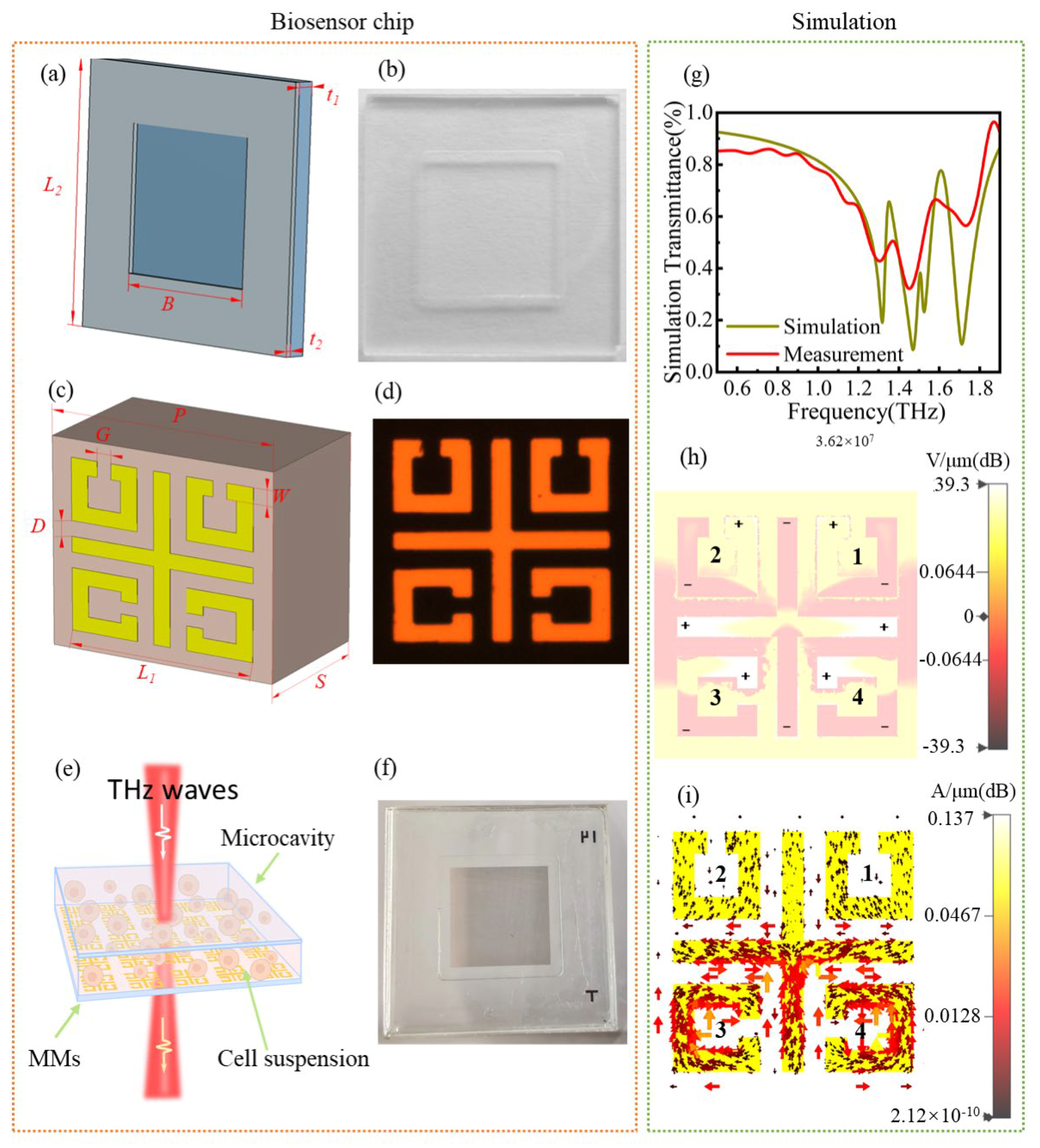
The biosensor consists of a microcavity and MMs, as shown in Figure 1. The liquid analyte is shifted into the microcavity by pipette (Eppendorf, Hamburg, Germany) and then assembled with MMs. The atmospheric pressure can make two polished quartz plates bind with each other, which can avoid liquid leaking [13,14,15,16]. Figure 1a,b show the sketch map and picture of the microcavity, respectively. The parameters are as follows: t1 = 1 mm, B = 10 mm, L2 = 18 mm. The depth of the pool is t2 = 300 μm, which ensures that THz waves can propagate through the liquid, even if the analyte is a polar liquid like water [17,18,19].
The unit cell of MMs is shown in Figure 1c. The substrate is quartz with a thickness of S = 1000 μm; the metal is gold with a thickness of 200 nm, and the parameters are as follows: P = 80 μm, W = 6 μm, D = 9 μm, L = 66 μm, D = 6 μm, G = 5 μm. The split rings and cross-combined structure are named SRCCS, and Figure 1d shows the scanning electron microscope of a single unit cell. Figure 1e,f show the schematic diagram and picture of the biosensor chip. This structure was reported in a previous work; the resonance at 1.47 THz was selected as the characteristic peak [12]. This study selects the resonance at 1.71 THz as the characteristic peak. Figure 1g shows the transmittance curves. The envelope of the measurements follows the simulation very well, except that a resonance peak at ~1.51 THz with a high Q-factor was not detected. The substrate thickness will limit the scanning time to detect this sharp resonance peak [20,21]. Fortunately, this resonance peak will not impact our biosensor experiment. Figure 1h shows that the normalized electric field will reveal the physical mechanism. The split rings are named ring1, ring2, ring3, and ring4 in an anticlockwise direction. The normalized electric field indicates that there are six pairs of dipoles. The weak dipoles are on ring1 and ring2, the stronger two are on ring3 and ring4, and the strongest is on the cross. The electric field direction of the incident THz wave is in the y-direction, and the structure is symmetric according to the y-axis. Coincidentally, these dipole distributions are symmetric according to the y-axis at 1.71 THz. Though the electric field distribution seems complicated, on the whole, it excites a dipole resonance [22,23,24]. The surface current distribution will further confirm that. The corresponding surface current in Figure 1i indicates that the dipoles in split rings are magnetic dipoles, thanks to the current in each near split ring being in the opposite direction. The neighboring magnetic dipole is always in the opposite direction [20]. The surface current along the upper y-axis and right x-axis (and along the lower y-axis and left x-axis) also excites two magnetic dipoles [9,25,26]. Hence, the magnetic dipole excites the resonance at 1.71 THz.
The theoretical sensitivity of biosensors based on this structure has been numerically calculated. The calculation method is described in our previous work [12]. The numerical calculation of the minimum thickness of the analyte layer to ensure the MMs perform best as a sensor is about 15 μm, and the theoretical sensitivity is 328 GHz/RIU. That means when the thickness of the analyte ≥ 15 μm, the biosensor can achieve the best performance.

2.2. Theoretical Foundation for Cell Detection in Suspension

The cell suspension contains cells and the host medium—phosphate-buffered saline (PBS). The radius of Na+, K+, HPO42−, and H2PO4 in PBS solution is on the hundred-nanometer scale, which is far away compared to the cell radius [27]. Thus, only cells and water are counted in the effective dielectric constant εeff calculation. The εeff can be described as follows [28]:
ε eff   =   ε c V   +   1     V ε w   =   ε w   +   ( ε c     ε w ) V
Here, εw and εc are the dielectric constants of water and the cell, respectively. V is the volume fraction, V = (4π/3)Nd3, N is the cell number, and d is the cell radius.
In the frequency range from 0.5 THz to 3 THz, the permittivity of water and cell satisfies the relationship εc < 4.5 < εw < 5.5 [29,30,31]. Therefore, εc < εw. According to Equation (1), we can theoretically infer the following: (a) When the density increases, εeff of cell suspension will decrease for the same cell type. (b) For the different types of cells under the same density, the suspension within cells whose diameter is bigger will have a lower εeff. The permittivity change will result in vibration of the transmission curve of MMs.

3. Method

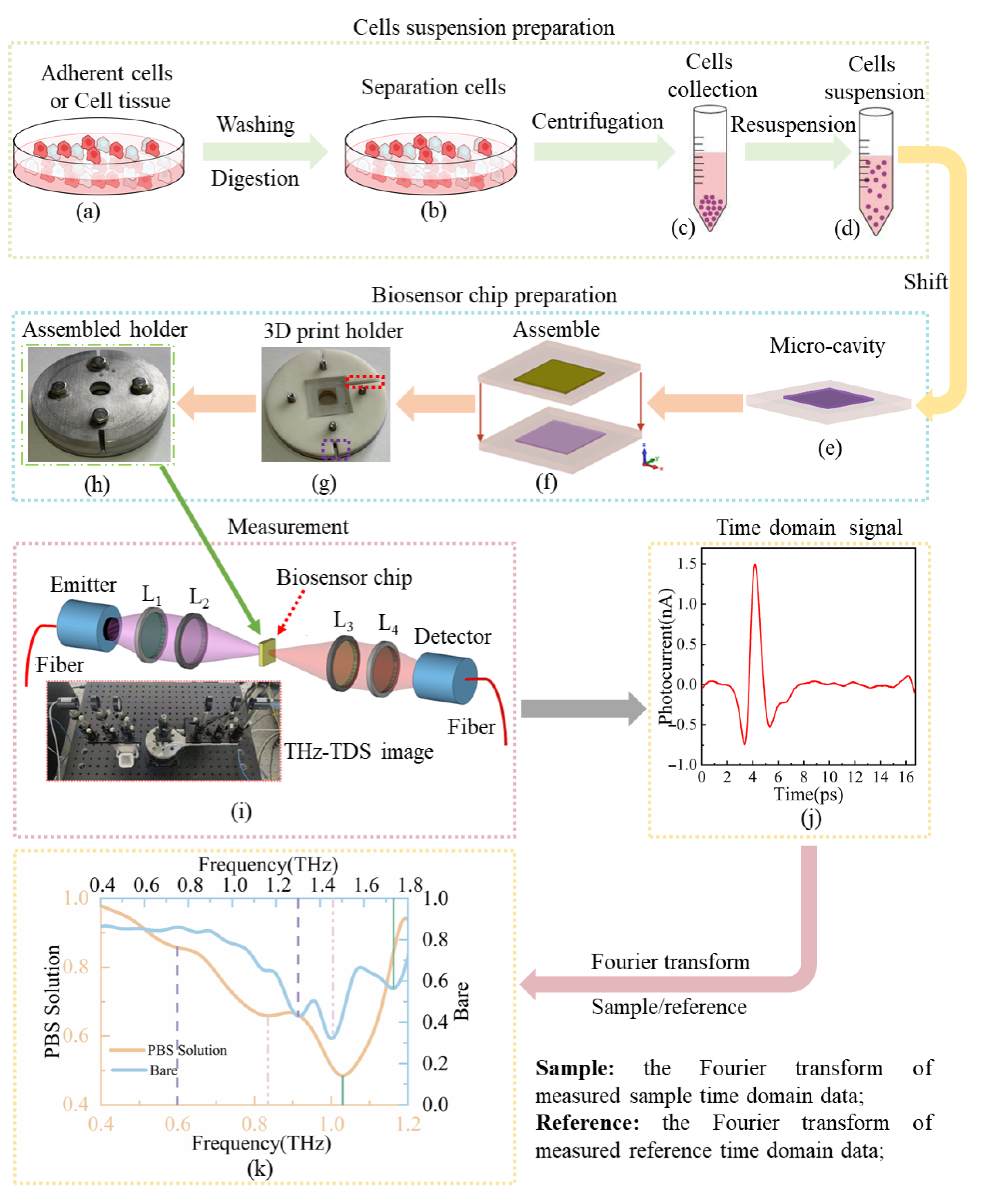
In this study, the cell suspensions were shifted to the microcavity of the biosensor chip. The experimental workflow for cell suspension, biosensor chip preparation, and measurement is shown in Figure 2. The details are described as follows:

3.1. GBM Cell Preparation

The GBM cells (Peking Union Medical College) are cultured by the traditional method [32]. Once GBM cells are cultured, they are washed with PBS, as shown in Figure 2a. After that, the adherent cells are digested by 0.25% trypsin–EDTA (HyClone, GE Healthcare, Logan, UT, USA), and the digested cells are centrifuged and collected, as shown in Figure 2b,c. Finally, the collected GBM cells are rewashed with PBS, and then prepared into a GBM cell suspension with a density of 1 × 10⁵ cells/mL, as shown in Figure 2d.

3.2. Nerve Cell Preparation

The nerve cells are harvested from ICR mice (Peking University Health Science Center). The ICR mice are killed and dissected, and the brain tissue is taken (Details regarding animal ethics approval are provided in the Supplementary Document). The brain tissue is washed with PBS and digested with 0.25% trypsin–EDTA. After that, the digested nerve cells are centrifuged and collected. Then, the cells are rewashed with PBS. Finally, the nerve cells are prepared into a nerve cell suspension with a density of 1 × 10⁵ cells/mL. The graphical workflow maps of these steps are shown in Figure 2a–d.

3.3. Biosensor Chip Preparation

The biosensor chip consisted of MMs, a microcavity, and a holder. Firstly, the microcavity, metamaterials, and holder were rinsed with deionized water and then re-rinsed with 75% alcohol. Subsequently, they were dried in a nitrogen environment. The dry holder (Figure 2g) was placed on the experimental table in a dust-free environment. The purple-marked gap served as a directional indicator, while the red-marked channel was designed to drain excess suspension that overflowed during the assembly of the microcavity with metamaterials. Subsequently, the microcavity was placed into the holder, and the suspension was pipetted into the microcavity. Critically, an excess volume of suspension was used to ensure that the biosensor chip cavity was completely filled when the metamaterials were laminated onto the microcavity. Overflowing suspension was channeled through the drainage pathway, preventing contamination of the biosensor chip surface, which may disturb the measurement results. Finally, the holder cover was assembled (Figure 2h).
The terahertz time-domain spectroscopy (THz-TDS, the details of the THz-TDS system are provided in the Supplementary Document) is employed to measure the biosensor [12,33], as shown in Figure 2i. Finally, the domain waveform is obtained, as shown in Figure 2j. Due to the modulator function of the PBS solution, the resonance peak frequencies of the PBS solution measured by the biosensor chip are 0.6, 0.84, and 1.03 THz, while the corresponding frequencies of bare MMs are 1.3, 1.46, and 1.73 THz, respectively, as shown in Figure 2k. The reason that the resonance amplitude of the PBS solution at 0.6 and 0.84 THz can be almost neglected is that the image part of the PBS solution’s εeff is relatively high, which means that most of the THz wave energy in that frequency range (below 1 THz) is absorbed by the solution. The resonance at these specific frequencies cannot be excited effectively [29,34]. Hence, the resonance at 1.71 THz is selected as the characteristic peak.

4. Measurement and Discussion

The biosensor is employed to detect GBM cell apoptosis and distinguish different cell types. Theoretical inference and commercial methods support our measurement results. In this study, all measurements were performed with at least three independent replicates.

4.1. Sensitive Detection of GBM Cell Apoptosis

In cancer treatment, one of the key indicators is cell apoptosis [1]. Anti-cancer drugs temozolomide (TMZ) can promote cancer cell apoptosis. The cell’s apoptosis is detected by our biosensor and commercial method.

4.1.1. Cell Counting Kit-8 Method

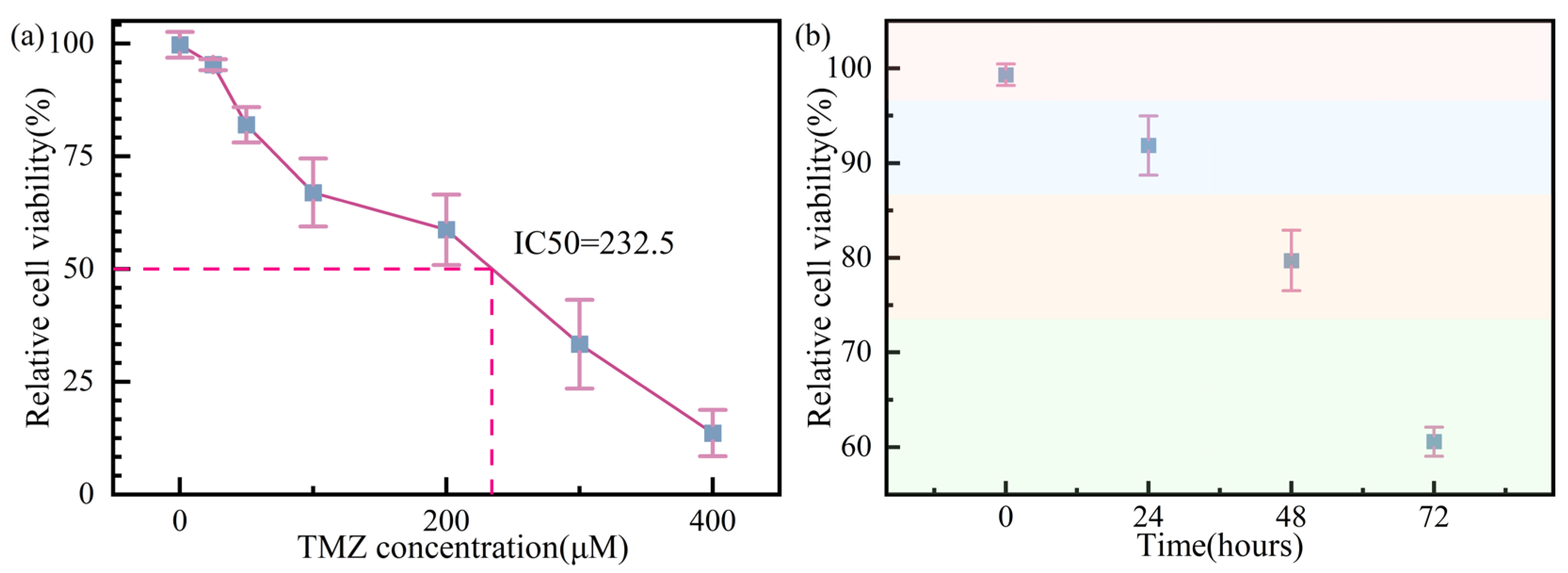
The GBM cell apoptosis is detected by a commercial method. GBM cells were seeded into 96-well plates [35]. Subsequently, different quantities of TMZ are added to the cells to confirm the appropriate concentration of TMZ (Sigma, St. Louis, MO, USA). Figure 3a shows that when the quantity reaches ~200 μM, the relative cell viability is 50%, which means that 200 μM TMZ is the appropriate concentration [36]. After that, TMZ acts on GBM cells at different times, 0, 24, 48, and 72 h, and the results are shown in Figure 3b. The relative cell viability percentages for 0, 24, 48, and 72 h are ~100%, ~91%, ~79%, and ~60%, respectively.

4.1.2. Biosensor Chip Detection Method

Cells have to be labeled and time-consuming in the CCK-8 method, while the biosensor has the advantage of being label-free, fast, and simple. The biosensor chip was employed to detect GBM cell suspensions with different TMZ administration times. The process of GBM cell suspension is shown in Figure 2a–d. Notably, apoptotic cells are significantly more fragile than viable cells; during the aforementioned processing steps (rinsing, digestion, centrifugation, collection, re-rinsing), most apoptotic cells ruptured, with their cell membranes and cytoplasm washed away. Hence, the suspension primarily contained viable cells, with only a small fraction of apoptotic cells remaining. Cell suspensions were not incubated in the microcavity for the entire 72 h duration; rather, suspensions were freshly prepared and measured at each time point. In addition, measurements were performed immediately after suspension preparation to avoid errors caused by temporal variations in the analyte.
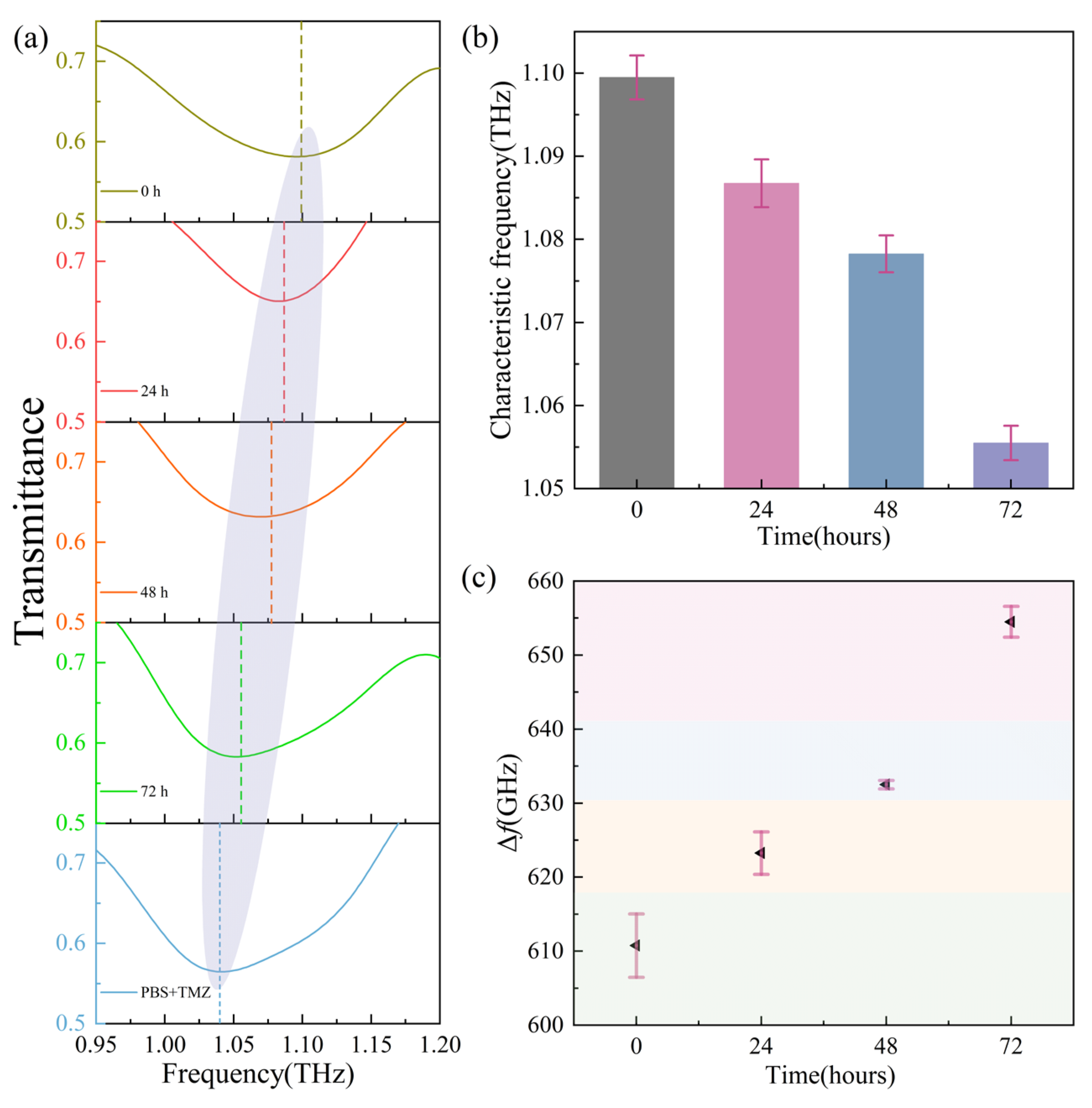
Figure 4a presents the transmission curves of PBS with TMZ and GBM cells under different TMZ action times. The characteristic resonance peak significantly redshifts with the increase in action time. The average value of resonance frequencies extracted from Figure 4a is shown in Figure 4b. The corresponding resonance frequencies of PBS + TMZ, 0, 24, 48, and 72 h are ~1.03, ~1.1, ~1.09, ~1.08, and ~1.06 THz, respectively. The standard deviation method (SD) was employed to quantify measurement errors; the corresponding error bars for the average characteristic frequency of PBS + TMZ at 0, 24, 48, and 72 h are ~±0.26%, ~±0.29%, ~±0.22%, and ~±0.21%, respectively. Figure 4c shows the corresponding Δf values at 0, 24, 48, and 72 h are ~610, ~620, ~630, and ~660 GHz, respectively. The error bars (SD) are ~± 0.43%, ~± 0.29%, ~±0.1%, and ~±0.21%, respectively. From the Δf values and error bars, we can infer that the measurement results are reliable.
Once the suspension was prepared, the cell number in the suspension was quantified using a cell counter (NucleoCounter® NC-200™, ChemoMetec A/S, Allerød, Denmark), with at least three independent replicate measurements. In addition, the density of the GBM cell suspension can be inferred according to Figure 3b. The cell density deduced via the cellular viability method matched the cell counter measurements.
Equation (1) reveals the relationship between density and effective dielectric constant εeff. For the same type of cell (each cell size is almost the same), as the density increases, N increases, then V increases, which will lead to a decrease in εeff. The resonance frequency is given by the following:
f = 1 2 π LC
Here, L is the inductance, and C is the capacitance. In our measurement, changes in εeff will lead to changes in the C of the biosensor, resulting in transmission spectrum vibration [12]. According to Equations (1) and (2), the characteristic frequency redshifts as the density decreases. The data in Table 1 follow the theoretical inference.
Comparing the measurement results of commercial method and the biosensor, the two results present a relatively good agreement. Moreover, the results also agree with theoretical inference, making the results believable. Our biosensor has successfully detected the GBM cell apoptosis.

4.2. Cell Discrimination

To diagnose tumors, it is essential to distinguish between tumor cells and normal cells, including those that are mixed. The biosensor is used to determine different types of cells. The details of the cell suspension are as follows: (a) In the GBM cell suspension (GCS), there are 1 × 10⁵ GBM cells per milliliter. (b) In the nerve cell suspension (NCS), there are 1 × 10⁵ nerve cells per milliliter; (c) In the mixed cell suspension (MCS), there are 5 × 10⁴ nerve cells and 5 × 10⁴ GBM cells per milliliter, and the total cell number is 1 × 10⁵. The density of the three types of cell suspension is 1 × 10⁵ cells/mL.
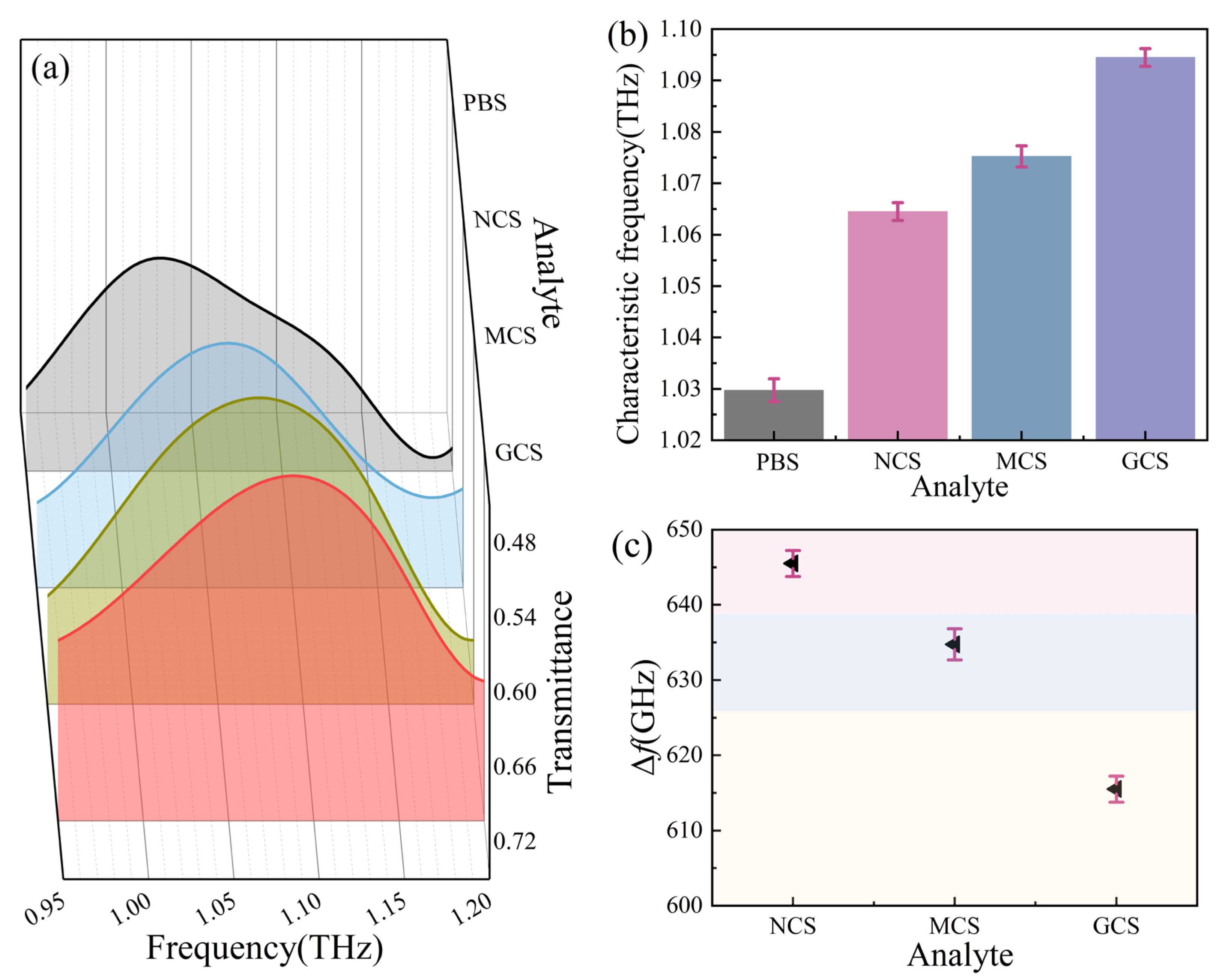
Figure 5a shows the measurement transmission spectra of these cell suspensions in a 3D plot. There is a significant frequency shift between each curve. The characteristic frequencies are extracted and shown in Figure 5b. The average characteristic frequencies of PBS, NCS, MCS, and GCS are ~1.03 ~1.06, ~1.08, and ~1.09 THz, respectively. The corresponding error bars (SD) for PBS, NCS, MCS, and GCS are ~±0.22%, ~±0.17%, ~±0.20%, and ~±0.17%, respectively. The Δf between NCS and GCS is ~30 GHz, which means nerve and GBM cells have been distinguished. Tumor cells at the margin may intermingle with nerve cells; thus, identifying the tumor margin has great significance in tumor resection. Figure 5c shows that the Δf values among NCS, MCS, GCS, and bare MMs are ~650, ~630, and 620 GHz, respectively. The corresponding error bars (SD) are ~±0.17%, ~± 0.21%, and ~±0.17%, respectively. The Δf points with the error bar do not overlap, meaning that the three cell types have been distinguished.
Table 2 presents the cell’s average radius and resonance frequency. The εc and cell’s radius affect εeff. Based on the inherent biological characteristics of nerve cells and GBM cells, it is well-established that the average radius of nerve cells is smaller than that of GBM cells Based on the inherent biological characteristics of nerve cells and glioblastoma multiforme (GBM) cells, it is well-established that the average radius of nerve cells is smaller than that of GBM cells [37,38,39]. Here, d1 denotes the average radius of nerve cells, while d3 denotes that of GBM cells. According to the aforementioned cellular characteristics, the relationship d ¯ 1 < d3 can be inferred. The mixed cell suspension contained equal numbers of nerve cells and GBM cells, thus the average radius of the mixed suspension (d2) can be approximated by the formula d ¯ 2 ≈ (d1 + d3)/2. Therefore, direct measurement of the cellular radii was not required, and the quantitative relationship among the three parameters can be deduced as follows: d1 < d2 < d3, which results in VNC < VMC < VGC. The complex permittivity of the cell is given by [40]:
ε c   =   ε men Ψ
Ψ = γ 3 + 2 ( ε i ε mem ε i + 2 ε mem ) γ 3 ( ε i ε mem ε i + 2 ε mem )
Here, γ = d/(dTm), d is the radius of the cell, Tm is the thickness of the cell membrane, and εi and εmem are the complex permittivity of the cytoplasm and the membrane, respectively. As for εiεmem, and Tm, there is little difference between nerve cells and GBM cells. Thus, in Equation (4), ΨNCΨMGΨGC. Therefore, Equation (3) tells us that εNCεMCεGC. The critical factor influencing the εeff is volume fraction V = (3/4) πd3. From Equation (1), εeff = εw + (εcεw)V, with the V increase, εeff will decrease due to (εcεw) < 0. The decrease of εeff will result in characteristic peak resonance frequency increase, which means that for the same density of cell suspension, the effective permittivity will decrease with increasing cell diameter. The data in Table 2 support the theoretical inference. The measurement results indicate that the biosensor has successfully detected different types of cells.

5. Application Prospect

The experiments for detecting GBM cell apoptosis and discriminating cell types have been successfully conducted, with encouraging results, including suppression of the proliferation and spreading of tumor cells and promotion of healthy cell proliferation, also helping the immune system to remove defective cells [11,12,13,14]. The biosensor provides a low-cost and simple way to detect cancer cell apoptosis.
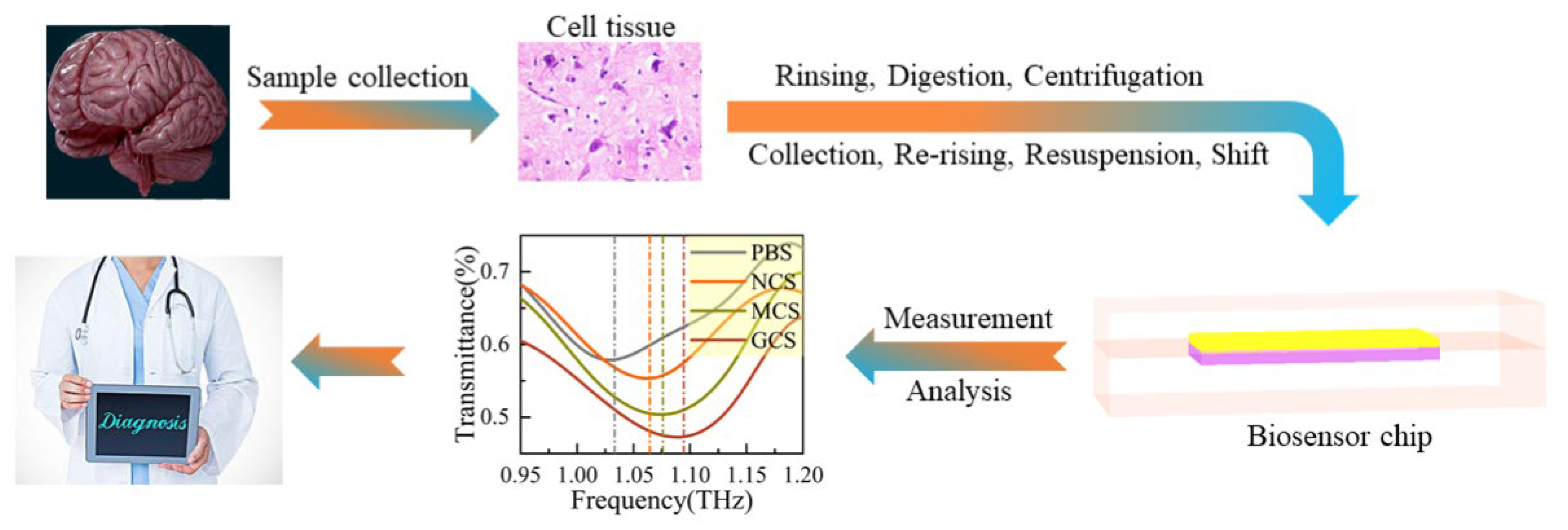
Chemotherapy, radiotherapy, and surgical resection are the main approaches for cancer treatment [14,15,16]. The first two modalities can induce apoptosis in patients, while the latter involves the surgical removal of tumors from the patient’s body. Tumor cells at the tumor margin are often intermingled with surrounding healthy cells. Therefore, a rapid, accurate, and simple method for detecting mixed cells (a mixture of healthy cells and tumor cells) is in urgent demand for tumor surgical resection. In this study, the proposed biosensor has been proven capable of successfully detecting and distinguishing between healthy and tumor cells. Figure 6 illustrates the process for locating the tumor margin: First, tissue specimens were harvested. Subsequently, the tissue was processed through a stepwise protocol involving rinsing, enzymatic digestion, centrifugation, cell collection, and re-rinsing; finally, a cell suspension with a concentration of approximately 1 × 10⁵ cells/mL was prepared. The suspension is then transferred to the biosensor for testing. This method offers the advantages of label-free detection and operational simplicity. Furthermore, the testing time for the cell suspension is no more than 10 min. Cell discrimination using our biosensor can significantly facilitate the surgical resection of tumors.

6. Conclusions

In this study, the apoptosis of GBM cells and discrimination of different types of cells by a THz biosensor based on MMs-microcavity have been reported. The microcavity is designed as a liquid pool to keep cells alive during the test. Through the design of luxuriant gaps in the structure of the biosensor, the sensitivity is significantly improved, which can fulfill the detection and discrimination of multiple cell types within suspension. The theoretical sensitivity of the biosensor is relatively high (328 GHz/RIU) and robust (error variance < 1%) compared with reported studies10,38,39, which means the proposed MMs are promising for cell-based sensing applications. Thus, the cell-based biosensor can be used for long-term cell apoptosis measurement (72 h) while maintaining cell viability, which may be applied in tumor cell apoptosis. Moreover, the NCS, MCS, and GCS cell suspensions have been successfully distinguished using this biosensor with distinct frequency differences (~650, ~630, and ~620 GHz for NCS, MCS, and GCS, respectively), which is promising to be used as a real-time detection in surgical tumor resection to find the margin of the tumor. Overall, this biosensor supplies a new way to realize fast, low-cost, and in-time cell type recognition. The key advantage of this detection is that the cells remain alive, allowing the biological significance to be retained and studied further simultaneously via other techniques.

Supplementary Materials

The following supporting information can be downloaded at: https://www.mdpi.com/article/10.3390/bios16010050/s1, Figure S1. The schematic of the image optical modulation angle resolved THz-TDS. References [12,33,41,42,43] are cited in the supplementary materials.

Author Contributions

Conceptualization, K.C., J.Y., Q.G. and L.H.; data curation, K.C., X.Z. and J.S.; formal analysis, K.C. and Q.W.; funding acquisition, K.C.; investigation, K.C., J.Y., Q.G. and L.H.; methodology, K.C., X.Z. and J.S.; project administration, K.C., J.Y., Q.G. and L.H.; resources, X.Z., J.S., Q.W., J.Y. and L.H.; supervision, Q.G., J.Y. and L.H.; validation, K.C. and Q.W.; visualization, K.C. and Q.W.; writing—original draft preparation, K.C., X.Z. and J.S.; writing—review and editing, Q.G., J.Y. and L.H. All authors have read and agreed to the published version of the manuscript.

Funding

This research was supported by the Postdoctoral Research Funding of Hangzhou International Innovation Institute of Beihang University (Grant No. 2025BKZ033) and the Beijing Municipal Science and Technology Commission, Administrative Commission of Zhongguancun Science Park (No. Z251100006925005).

Institutional Review Board Statement

Not applicable.

Informed Consent Statement

Not applicable.

Data Availability Statement

Data can be accessed upon reasonable request from the corresponding author at klchen@buaa.edu.cn.

Acknowledgments

The authors have reviewed and edited the output and take full responsibility for the content of this publication. The authors thank Xianlong Wei of the Key Laboratory for the Physics and Chemistry of Nanodevices, School of Electronics, Peking University, for fruitful discussions and encouragement.

Conflicts of Interest

The authors declare no conflicts of interest.

Abbreviations

The following abbreviations are used in this manuscript:
CCK-8Cell Counting Kit-8
PBSPhosphate-buffered saline
Eq.Equation
GBMGlioblastoma
GCSGBM cell suspension
MCSMixed cell suspension
MMMetamaterial
NCSNerve cells suspension
RIURefractive index unit
SDStandard deviation
TMZTemozolomide
WHOWorld Health Organization

References

  1. Raizer, J.; Parsa, A. (Eds.) Current Understanding and Treatment of Gliomas; Cancer Treatment and Research; Springer International Publishing: Cham, Switzerland, 2015; Volume 163, ISBN 978-3-319-12047-8. [Google Scholar]
  2. Bush, N.A.O.; Chang, S.M.; Berger, M.S. Current and Future Strategies for Treatment of Glioma. Neurosurg. Rev. 2017, 40, 1–14. [Google Scholar] [CrossRef]
  3. Sgonc, R.; Wick, G. Methods for the Detection of Apoptosis. Int. Arch. Allergy Immunol. 1994, 105, 327–332. [Google Scholar] [CrossRef] [PubMed]
  4. Tkach, A.V.; Ivanova, L.A.; Statsenko, I.V. Methods of detection and quantitative evaluation of apoptosis (review of literature). Meditsina Tr. Promyshlennaia Ekol. 2008, 12, 28–35. [Google Scholar]
  5. Romano, S.; Zito, G.; Torino, S.; Calafiore, G.; Penzo, E.; Coppola, G.; Cabrini, S.; Rendina, I.; Mocella, V. Label-Free Sensing of Ultralow-Weight Molecules with All-Dielectric Metasurfaces Supporting Bound States in the Continuum. Photon. Res. 2018, 6, 726. [Google Scholar] [CrossRef]
  6. Yan, X.; Yang, M.; Zhang, Z.; Liang, L.; Wei, D.; Wang, M.; Zhang, M.; Wang, T.; Liu, L.; Xie, J.; et al. The Terahertz Electromagnetically Induced Transparency-like Metamaterials for Sensitive Biosensors in the Detection of Cancer Cells. Biosens. Bioelectron. 2019, 126, 485–492. [Google Scholar] [CrossRef]
  7. Zhang, J.; Mu, N.; Liu, L.; Xie, J.; Feng, H.; Yao, J.; Chen, T.; Zhu, W. Highly Sensitive Detection of Malignant Glioma Cells Using Metamaterial-Inspired THz Biosensor Based on Electromagnetically Induced Transparency. Biosens. Bioelectron. 2021, 185, 113241. [Google Scholar] [CrossRef]
  8. Liu, Y.; Sun, T.; Xu, Y.; Wu, X.; Bai, Z.; Sun, Y.; Li, H.; Zhang, H.; Chen, K.; Ruan, C.; et al. Active Tunable THz Metamaterial Array Implemented in CMOS Technology. J. Phys. D Appl. Phys. 2021, 54, 085107. [Google Scholar] [CrossRef]
  9. Zhang, C.; Xue, T.; Zhang, J.; Liu, L.; Xie, J.; Wang, G.; Yao, J.; Zhu, W.; Ye, X. Terahertz Toroidal Metasurface Biosensor for Sensitive Distinction of Lung Cancer Cells. Nanophotonics 2021, 11, 101–109. [Google Scholar] [CrossRef]
  10. Lou, J.; Jiao, Y.; Yang, R.; Huang, Y.; Xu, X.; Zhang, L.; Ma, Z.; Yu, Y.; Peng, W.; Yuan, Y.; et al. Calibration-Free, High-Precision, and Robust Terahertz Ultrafast Metasurfaces for Monitoring Gastric Cancers. Proc. Natl. Acad. Sci. USA 2022, 119, e2209218119. [Google Scholar] [CrossRef] [PubMed]
  11. Ahmadivand, A.; Gerislioglu, B.; Ahuja, R.; Kumar Mishra, Y. Terahertz Plasmonics: The Rise of Toroidal Metadevices towards Immunobiosensings. Mater. Today 2020, 32, 108–130. [Google Scholar] [CrossRef]
  12. Chen, K.; Ruan, C.; Zhan, F.; Song, X.; Fahad, A.K.; Zhang, T.; Shi, W. Ultra-Sensitive Terahertz Metamaterials Biosensor Based on Luxuriant Gaps Structure. iScience 2023, 26, 105781. [Google Scholar] [CrossRef]
  13. Funano, S.; Ota, N.; Tanaka, Y. A Simple and Reversible Glass–Glass Bonding Method to Construct a Microfluidic Device and Its Application for Cell Recovery. Lab. Chip 2021, 21, 2244–2254. [Google Scholar] [CrossRef] [PubMed]
  14. Howlader, M.M.R.; Suehara, S.; Suga, T. Room Temperature Wafer Level Glass/Glass Bonding. Sens. Actuators A Phys. 2006, 127, 31–36. [Google Scholar] [CrossRef]
  15. Ito, T.; Sobue, K.; Ohya, S. Water Glass Bonding for Micro-Total Analysis System. Sens. Actuators B Chem. 2002, 81, 187–195. [Google Scholar] [CrossRef]
  16. Satoh, A. Water Glass Bonding. Sens. Actuators A Phys. 1999, 72, 160–168. [Google Scholar] [CrossRef]
  17. Nazarov, M.M.; Cherkasova, O.P.; Shkurinov, A.P. A Comprehensive Study of Albumin Solutions in the Extended Terahertz Frequency Range. J. Infrared Millim. Terahertz Waves 2018, 39, 840–853. [Google Scholar] [CrossRef]
  18. Penkov, N.; Yashin, V.; Fesenko, E.; Manokhin, A.; Fesenko, E. A Study of the Effect of a Protein on the Structure of Water in Solution Using Terahertz Time-Domain Spectroscopy. Appl. Spectrosc. 2018, 72, 257–267. [Google Scholar] [CrossRef]
  19. Hu, F.; Guo, E.; Xu, X.; Li, P.; Xu, X.; Yin, S.; Wang, Y.; Chen, T.; Yin, X.; Zhang, W. Real-Timely Monitoring the Interaction between Bovine Serum Albumin and Drugs in Aqueous with Terahertz Metamaterial Biosensor. Opt. Commun. 2017, 388, 62–67. [Google Scholar] [CrossRef]
  20. Cao, W.; Singh, R.; Al-Naib, I.A.I.; He, M.; Taylor, A.J.; Zhang, W. Low-Loss Ultra-High-Q Dark Mode Plasmonic Fano Metamaterials. Opt. Lett. 2012, 37, 3366. [Google Scholar] [CrossRef]
  21. Chen, K.; Wen, L.; Zhang, T.; Wu, X.; Fahad, A.K.; Ruan, C. The Covert Transmittance Enhancement Effect of Terahertz Metamaterials Coupling with Vapor. Sens. Actuators A Phys. 2023, 351, 114147. [Google Scholar] [CrossRef]
  22. Cho, D.J.; Wang, F.; Zhang, X.; Shen, Y.R. Contribution of the Electric Quadrupole Resonance in Optical Metamaterials. Phys. Rev. B 2008, 78, 121101. [Google Scholar] [CrossRef]
  23. Pors, A.; Nielsen, M.G.; Valle, G.D.; Willatzen, M.; Albrektsen, O.; Bozhevolnyi, S.I. Plasmonic Metamaterial Wave Retarders in Reflection by Orthogonally Oriented Detuned Electrical Dipoles. Opt. Lett. 2011, 36, 1626. [Google Scholar] [CrossRef] [PubMed]
  24. Hu, F.; Xu, N.; Wang, W.; Wang, Y.; Zhang, W.; Han, J.; Zhang, W. A Dynamically Tunable Terahertz Metamaterial Absorber Based on an Electrostatic MEMS Actuator and Electrical Dipole Resonator Array. J. Micromech. Microeng. 2016, 26, 025006. [Google Scholar] [CrossRef]
  25. Chen, H.-T.; O’Hara, J.F.; Taylor, A.J.; Averitt, R.D.; Highstrete, C.; Lee, M.; Padilla, W.J. Complementary Planar Terahertz Metamaterials. Opt. Express 2007, 15, 1084. [Google Scholar] [CrossRef]
  26. Padilla, W.J.; Aronsson, M.T.; Highstrete, C.; Lee, M.; Taylor, A.J.; Averitt, R.D. Electrically Resonant Terahertz Metamaterials: Theoretical and Experimental Investigations. Phys. Rev. B 2007, 75, 041102. [Google Scholar] [CrossRef]
  27. Franken, G.; Douven, P.; Debets, J.; Joosten, E.A.J. Conventional Dorsal Root Ganglion Stimulation in an Experimental Model of Painful Diabetic Peripheral Neuropathy: A Quantitative Immunocytochemical Analysis of Intracellular γ-Aminobutyric Acid in Dorsal Root Ganglion Neurons. Neuromodulation Technol. Neural Interface 2021, 24, 639–645. [Google Scholar] [CrossRef]
  28. Mavrona, E.; Appugliese, F.; Andberger, J.; Keller, J.; Franckié, M.; Scalari, G.; Faist, J. Terahertz Refractive Index Matching Solution. Opt. Express 2019, 27, 14536. [Google Scholar] [CrossRef] [PubMed]
  29. Jepsen, P.U.; Cooke, D.G.; Koch, M. Terahertz Spectroscopy and Imaging—Modern Techniques and Applications: THz Spectroscopy and Imaging—Modern Techniques and Applications. Laser Photon. Rev. 2011, 5, 124–166. [Google Scholar] [CrossRef]
  30. Cao, Y.; Chen, J.; Zhang, G.; Fan, S.; Ge, W.; Hu, W.; Huang, P.; Hou, D.; Zheng, S. Characterization and Discrimination of Human Colorectal Cancer Cells Using Terahertz Spectroscopy. Spectrochim. Acta Part. A Mol. Biomol. Spectrosc. 2021, 256, 119713. [Google Scholar] [CrossRef]
  31. Vinh, N.Q.; Allen, S.J.; Plaxco, K.W. Dielectric Spectroscopy of Proteins as a Quantitative Experimental Test of Computational Models of Their Low-Frequency Harmonic Motions. J. Am. Chem. Soc. 2011, 133, 8942–8947. [Google Scholar] [CrossRef]
  32. Langdon, S.P. Cancer Cell Culture; Humana Press: Totowa, NJ, USA, 2003; Volume 88, ISBN 978-1-59259-406-1. [Google Scholar]
  33. Yang, P.-D.; Ouyang, C.; Hong, T.-S.; Zhang, W.-H.; Miao, J.-G.; Wu, X.-J. Study of phase transition of single crystal and polycrystalline vanadium dioxide nanofilms by using continuous laser pump-terahertz probe technique. Acta Phys. Sin. 2020, 69, 204205. [Google Scholar] [CrossRef]
  34. Ebrahimi, A.; Withayachumnankul, W.; Al-Sarawi, S.; Abbott, D. High-Sensitivity Metamaterial-Inspired Sensor for Microfluidic Dielectric Characterization. IEEE Sens. J. 2014, 14, 1345–1351. [Google Scholar] [CrossRef]
  35. Kueng, W.; Silber, E.; Eppenberger, U. Quantification of Ceils Cultured on 96-Well Plates. Anal. Biochem. 1989, 182, 16–19. [Google Scholar] [CrossRef] [PubMed]
  36. Ding, C.; Yi, X.; Chen, X.; Wu, Z.; You, H.; Chen, X.; Zhang, G.; Sun, Y.; Bu, X.; Wu, X.; et al. Warburg Effect-Promoted Exosomal Circ_0072083 Releasing up-Regulates NANGO Expression through Multiple Pathways and Enhances Temozolomide Resistance in Glioma. J. Exp. Clin. Cancer Res. 2021, 40, 164. [Google Scholar] [CrossRef]
  37. Banker, G.; Goslin, K. Culturing Nerve Cells; MIT Press: Cambridge, MA, USA, 1998; ISBN 0-262-02438-1. [Google Scholar]
  38. Lee, E.; Yong, R.L.; Paddison, P.; Zhu, J. Comparison of Glioblastoma (GBM) Molecular Classification Methods. Semin. Cancer Biol. 2018, 53, 201–211. [Google Scholar] [CrossRef] [PubMed]
  39. Stoyanov, G.S.; Dzhenkov, D.; Ghenev, P.; Iliev, B.; Enchev, Y.; Tonchev, A.B. Cell Biology of Glioblastoma Multiforme: From Basic Science to Diagnosis and Treatment. Med. Oncol. 2018, 35, 27. [Google Scholar] [CrossRef]
  40. Morgan, H.; Sun, T.; Holmes, D.; Gawad, S.; Green, N.G. Single Cell Dielectric Spectroscopy. J. Phys. D Appl. Phys. 2007, 40, 61–70. [Google Scholar] [CrossRef]
  41. National Research Council (U.S.). Guide for the Care and Use of Laboratory Animals, 8th ed.; National Academies Press: Washington, DC, USA, 2011; ISBN 978-0-309-15400-0. [Google Scholar]
  42. Leary, S.L. (Ed.) AVMA Guidelines for the Euthanasia of Animals: 2020 Edition; American Veterinary Medical Association: Schaumburg, IL, USA, 2020; ISBN 978-1-882691-09-8. [Google Scholar]
  43. Xiong, H.; Sun, H.; Zhou, J.; Li, H.; Zhang, H.; Liu, S.; Cai, J.; Feng, L.; Miao, J.; Chen, S.; et al. Terahertz Anisotropy in Fascia and Lean Meat Tissues. Biomed. Opt. Express 2022, 13, 2605–2615. [Google Scholar] [CrossRef] [PubMed]
Figure 1. Components of the biosensor chip. The sketch map (a) and picture (c) of the microcavity. The sketch map (b) and fabrication (d) of the unit cell in MMs. The sketch map of terahertz waves passing through the bio-chip (e) and the picture of the bio-chip (f) The image of the integrated microcavity and metamaterials integration. (g) Simulation and measurement of transmittance curves. Electric field distribution (h) and surface current distribution (i) at 1.71 THz.
Biosensors 16 00050 g001
Figure 2. The flow of cell suspension, biosensor preparation, biosensor measurement, and the comparison of measurements for bare MMs and the PBS solution. (a) Cells cultured in a culture dish. (b) Digested cells (or cell tissue). (c) Collected cells. (d) Prepared cell suspension. (e) Schematic diagram of the microcavity loaded with cell suspension. (f) Schematic diagram of microcavity and metamaterials integration. (g) Integrated microcavity-metamaterials assembly mounted on the holder (the purple-marked gap served as a directional indicator, while the red-marked channel was designed to drain excess suspension overflowing during the assembly of the microcavity with metamaterials). (h) The assembled biosensor chip. (i) Schematic diagram and image of the THz-TDS system. (j) Time-domain curve of terahertz signals. (k) Transmittance of the biosensor chip with and without PBS.
Biosensors 16 00050 g002
Figure 3. GBM cell apoptosis detection by the CCK-8 method. (a) The relative cell viability relationship of TMZ density. (b) The relative GBM cell viability under different TMZ action time conditions, detected by the CCK-8 method.
Biosensors 16 00050 g003
Figure 4. GBM cell apoptosis detection by biosensor chip. (a) The transmission curves of PBS + TMZ and different TMZ action times on GBM suspensions. (b) The average characteristic peak resonance frequencies with error bar extracted from (a). (c) The error bar and Δf.
Biosensors 16 00050 g004
Figure 5. The measurement results of cell discrimination. (a) The transmission curves of different types of cell suspensions under a 1 × 10⁵ cells/mL density condition. (b) The average characteristic peak resonance frequency with error bars extracted from (a). (c) The error bar and Δf.
Biosensors 16 00050 g005
Figure 6. Application prospect.
Biosensors 16 00050 g006
Table 1. The relationship between GBM cells suspension density, TMZ action time, and characteristic resonance frequency.
Action Time (Hours)0244872
Density (cells/mL)~1 × 105~9 × 10⁴~8 × 10⁴~6 × 10⁴
Resonance frequency (THz)~1.1~1.09~1.08~1.06
Table 2. The relationship between cell diameter and characteristic peak frequency.
AnalyteNerve CellNerve & GBM CellGBM Cell
Cell’s radius (μm) d ¯ 1 d ¯ 2 d ¯ 3
V (μm3) V ¯ NC V ¯ MC V ¯ GC
Resonance frequency (THz)~1.06~1.08~1.09
Disclaimer/Publisher’s Note: The statements, opinions and data contained in all publications are solely those of the individual author(s) and contributor(s) and not of MDPI and/or the editor(s). MDPI and/or the editor(s) disclaim responsibility for any injury to people or property resulting from any ideas, methods, instructions or products referred to in the content.