You are currently viewing a new version of our website. To view the old version click .

Microorganisms, Volume 8, Issue 5

May 2020 - 171 articles

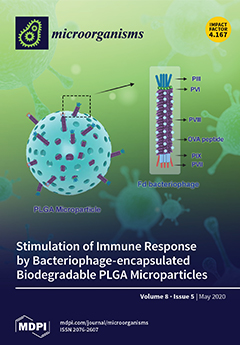
Cover Story: Filamentous bacteriophages are promising immunogenic carriers for antigen delivery. Their use is based on the modification of phage display technology; in particular, multiple copies of exogenous peptides (or polypeptides) can be covalently linked to viral capsid proteins and expressed on the phage coat. This study, for the first time, proposes the use of polymeric poly (lactic-co-glycolic acid) (PLGA) microparticles (MPs), to encapsulate fd bacteriophage displaying antigenic peptides and to demonstrate the immunogenicity of the encapsulated bacteriophages after their release by MPs. Our results show that PLGA MPs-encapsulated bacteriophages are stable and retain their immunogenic properties, demonstrating that microparticles can represent an important tool for the development of bacteriophage-based immunotherapeutic platforms. View this paper
  • Issues are regarded as officially published after their release is announced to the table of contents alert mailing list .
  • You may sign up for email alerts to receive table of contents of newly released issues.
  • PDF is the official format for papers published in both, html and pdf forms. To view the papers in pdf format, click on the "PDF Full-text" link, and use the free Adobe Reader to open them.

Articles (171)

  • Article
  • Open Access
24 Citations
4,830 Views
12 Pages

Evaluation of Product Distribution in Chemostat and Batch Fermentation in Lactic Acid-Producing Komagataella phaffii Strains Utilizing Glycerol as Substrate

  • Nadielle Tamires Moreira Melo,
  • Gabriela Coimbra Pontes,
  • Dielle Pierotti Procópio,
  • Gabriel Caetano de Gois e Cunha,
  • Kevy Pontes Eliodório,
  • Hugo Costa Paes,
  • Thiago Olitta Basso and
  • Nádia Skorupa Parachin

Lactic acid is the monomeric unit of polylactide (PLA), a bioplastic widely used in the packaging, automotive, food, and pharmaceutical industries. Previously, the yeast Komagataella phaffii was genetically modified for the production of lactate from...

  • Article
  • Open Access
7 Citations
4,841 Views
16 Pages

Many Shiga toxin-producing Escherichia coli (STEC) strains, including the serogroups of O157 and most of the top six non-O157 serotypes, are frequently associated with foodborne outbreaks. Therefore, they have been extensively studied using next-gene...

  • Article
  • Open Access
27 Citations
5,133 Views
16 Pages

Detection of Canine Vector-Borne Filariasis and Their Wolbachia Endosymbionts in French Guiana

  • Younes Laidoudi,
  • Jean-Lou Marié,
  • Djamel Tahir,
  • Stéphanie Watier-Grillot,
  • Oleg Mediannikov and
  • Bernard Davoust

In French Guiana, canine heartworm disease is well known, but the diversity of filarial parasites of dogs remains largely unknown. A total of 98 canine blood samples from Cayenne and Kourou were assessed by a blood wet mount preparation, heartworm an...

  • Article
  • Open Access
7 Citations
5,228 Views
19 Pages

Insight into the Lifestyle of Amoeba Willaertia magna during Bioreactor Growth Using Transcriptomics and Proteomics

  • Issam Hasni,
  • Philippe Decloquement,
  • Sandrine Demanèche,
  • Rayane Mouh Mameri,
  • Olivier Abbe,
  • Philippe Colson and
  • Bernard La Scola

Willaertia magna C2c maky is a thermophilic free-living amoeba strain that showed ability to eliminate Legionella pneumophila, a pathogenic bacterium living in the aquatic environment. The amoeba industry has proposed the use of Willaertia magna as a...

  • Article
  • Open Access
37 Citations
5,171 Views
18 Pages

In this study, hydrogenotrophic methanogenic mixed cultures taken from 13 lab-scale ex-situ biogas upgrading systems under different temperature (20–70 °C), pH (6.0–8.5), and CO (0–10%, v/v) variables were systematically investi...

  • Brief Report
  • Open Access
6 Citations
3,731 Views
9 Pages

Endogenous alcohol produced by the gut microbiome is transported via the bloodstream to the liver for detoxification. Gut dysbiosis can result in chronic excess alcohol production that contributes to the development of hepatic steatosis. The aim of t...

  • Review
  • Open Access
9 Citations
5,218 Views
15 Pages

The Type III Secretion System (T3SS) is a multimeric protein complex composed of over 20 different proteins, utilized by Gram-negative bacteria to infect eukaryotic host cells. The T3SS has been implicated as a virulence factor by which pathogens cau...

  • Article
  • Open Access
35 Citations
7,064 Views
16 Pages

Comparative Genomics of the Rhodococcus Genus Shows Wide Distribution of Biodegradation Traits

  • Daniel Garrido-Sanz,
  • Miguel Redondo-Nieto,
  • Marta Martín and
  • Rafael Rivilla

The genus Rhodococcus exhibits great potential for bioremediation applications due to its huge metabolic diversity, including biotransformation of aromatic and aliphatic compounds. Comparative genomic studies of this genus are limited to a small numb...

  • Article
  • Open Access
17 Citations
5,833 Views
15 Pages

The Crimean-Congo Hemorrhagic Fever Virus NSm Protein Is Dispensable for Growth In Vitro and Disease in Ifnar-/- Mice

  • Stephen R. Welch,
  • Florine E. M. Scholte,
  • Jessica R. Spengler,
  • Jana M. Ritter,
  • JoAnn D. Coleman-McCray,
  • Jessica R. Harmon,
  • Stuart T. Nichol,
  • Sherif R. Zaki,
  • Christina F. Spiropoulou and
  • Eric Bergeron

Crimean-Congo hemorrhagic fever virus (CCHFV) is a tri-segmented, tick-borne nairovirus that causes disease of ranging severity in humans. The CCHFV M segment encodes a complex glycoprotein precursor (GPC) that undergoes extensive endoproteolytic cle...

  • Article
  • Open Access
7 Citations
5,688 Views
15 Pages

Determination of Loline Alkaloids and Mycelial Biomass in Endophyte-Infected Schedonorus pratensis by Near-Infrared Spectroscopy and Chemometrics

  • Giovanni Cagnano,
  • Beatriz R. Vázquez-de-Aldana,
  • Torben Asp,
  • Niels Roulund,
  • Christian S. Jensen and
  • Milton Carlos Soto-Barajas

Near infrared spectroscopy (NIRS) is an accurate, fast and nondestructive technique whose use in predicting forage quality has become increasingly relevant in recent decades. Epichloë-infected grass varieties are commonly used in areas with high...

of 18

Get Alerted

Add your email address to receive forthcoming issues of this journal.

XFacebookLinkedIn
Microorganisms - ISSN 2076-2607