

You are currently viewing a new version of our website. To view the old version click .

Cancers, Volume 15, Issue 10

May-2 2023 - 206 articles

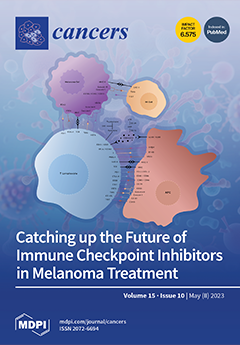
Cover Story: The quest for more augmented and durable responses to melanoma immunotherapy has fueled recent efforts toward identifying novel immune checkpoint (IC) molecules that could be potentially targeted. The dynamic crosstalk between melanoma and immune effector cells is based on a complex network of many implicated IC molecules beyond PD-1 and CTLA-4, including LAG-3, TIGIT, TIM-3, VISTA, IDO1-2/TDO, CD27/70, CD39/73, HVEM/BTLA/CD160 and B7-H3. This paper explores all emerging IC molecules with emphasis on their co-inhibitory or co-stimulatory properties, with the aim of presenting all currently available clinical and preclinical data on their therapeutic potential. Understanding these IC-mediated pathways presents a unique opportunity to get a step closer to realizing “personalized immunotherapy”. View this paper
  • Issues are regarded as officially published after their release is announced to the table of contents alert mailing list .
  • You may sign up for email alerts to receive table of contents of newly released issues.
  • PDF is the official format for papers published in both, html and pdf forms. To view the papers in pdf format, click on the "PDF Full-text" link, and use the free Adobe Reader to open them.

Articles (206)

  • Article
  • Open Access
12 Citations
3,915 Views
22 Pages

A Reconstructed Human Melanoma-in-Skin Model to Study Immune Modulatory and Angiogenic Mechanisms Facilitating Initial Melanoma Growth and Invasion

  • Elisabetta Michielon,
  • Marta López González,
  • Dorian A. Stolk,
  • Joeke G. C. Stolwijk,
  • Sanne Roffel,
  • Taco Waaijman,
  • Sinéad M. Lougheed,
  • Tanja D. de Gruijl and
  • Susan Gibbs

20 May 2023

Invasion, immune modulation, and angiogenesis are crucial in melanoma progression. Studies based on animals or two-dimensional cultures poorly recapitulate the tumor-microenvironmental cross-talk found in humans. This highlights a need for more physi...

  • Article
  • Open Access
2 Citations
3,615 Views
17 Pages

Evaluation of the Elements of Short Hairpin RNAs in Developing shRNA-Containing CAR T Cells

  • Ryan Urak,
  • Brenna Gittins,
  • Citradewi Soemardy,
  • Nicole Grepo,
  • Lior Goldberg,
  • Madeleine Maker,
  • Galina Shevchenko,
  • Alicia Davis,
  • Shirley Li and
  • Tristan Scott
  • + 3 authors

20 May 2023

Short hairpin RNAs (shRNAs) have emerged as a powerful tool for gene knockdown in various cellular systems, including chimeric antigen receptor (CAR) T cells. However, the elements of shRNAs that are crucial for their efficacy in developing shRNA-con...

  • Article
  • Open Access
14 Citations
3,091 Views
10 Pages

Practical Utility of Liquid Biopsies for Evaluating Genomic Alterations in Castration-Resistant Prostate Cancer

  • Seung-Hwan Jeong,
  • Dongsoo Kyung,
  • Hyeong Dong Yuk,
  • Chang Wook Jeong,
  • Wookjae Lee,
  • Jung-Ki Yoon,
  • Hwang-Phill Kim,
  • Duhee Bang,
  • Tae-You Kim and
  • Yoojoo Lim
  • + 1 author

20 May 2023

Traditional tissue-based assessments of genomic alterations in castration-resistant prostate cancer (CRPC) can be challenging. To evaluate the real-world clinical utility of liquid biopsies for the evaluation of genomic alterations in CRPC, we preemp...

  • Article
  • Open Access
8 Citations
2,565 Views
14 Pages

Clinical Meaning of Stromal Tumor Infiltrating Lymphocytes (sTIL) in Early Luminal B Breast Cancer

  • Esmeralda García-Torralba,
  • Miguel Pérez Ramos,
  • Alejandra Ivars Rubio,
  • Esther Navarro-Manzano,
  • Noel Blaya Boluda,
  • Pilar de la Morena Barrio,
  • Elisa García-Garre,
  • Francisco Martínez Díaz,
  • Asunción Chaves-Benito and
  • Elena García-Martínez
  • + 1 author

20 May 2023

Luminal breast cancer (BC) is associated with less immune activation, and the significance of stromal lymphocytic infiltration (sTIL) is more uncertain than in other BC subtypes. The aim of this study was to investigate the predictive and prognostic...

  • Review
  • Open Access
17 Citations
3,398 Views
28 Pages

Role of Estrogen Receptor β, G-Protein Coupled Estrogen Receptor and Estrogen-Related Receptors in Endometrial and Ovarian Cancer

  • Susanne Schüler-Toprak,
  • Maciej Skrzypczak,
  • Carsten Gründker,
  • Olaf Ortmann and
  • Oliver Treeck

20 May 2023

Ovarian and endometrial cancers are affected by estrogens and their receptors. It has been long known that in different types of cancers, estrogens activate tumor cell proliferation via estrogen receptor α (ERα). In contrast, the role of ERs discover...

  • Article
  • Open Access
8 Citations
4,955 Views
11 Pages

The Prognostic Relevance of MRI Characteristics in Myxofibrosarcoma Patients Treated with Neoadjuvant Radiotherapy

  • Stefan G. van Ravensteijn,
  • Maikel J. L. Nederkoorn,
  • Tom C. P. Wal,
  • Yvonne M. H. Versleijen-Jonkers,
  • Pètra M. Braam,
  • Uta E. Flucke,
  • Johannes J. Bonenkamp,
  • Bart H. W. Schreuder,
  • Carla M. L. van Herpen and
  • Johannes H. W. de Wilt
  • + 2 authors

19 May 2023

To improve local control, neoadjuvant radiotherapy (nRT) followed by surgery is the standard of care in myxofibrosarcoma (MFS) because of its infiltrative growth pattern. Nevertheless, local recurrence rates are high. Data on prognostic factors for p...

  • Article
  • Open Access
1 Citations
2,068 Views
11 Pages

Antithrombotic Therapy Increases the Risk of Bleeding after Endoscopic Submucosal Dissection for Early Gastric Cancer: A Propensity Score-Matched Analysis

  • Tae-Se Kim,
  • Byung-Hoon Min,
  • Sun-Young Baek,
  • Kyunga Kim,
  • Yang-Won Min,
  • Hyuk Lee,
  • Jun-Haeng Lee,
  • Poong-Lyul Rhee and
  • Jae J. Kim

19 May 2023

Whether antithrombotic agent (ATA) usage increases the risk of gastric post-endoscopic submucosal dissection (ESD) bleeding remains controversial. The aim of this study was to elucidate the effects of usage, type, and cessation timing of ATA on post-...

  • Article
  • Open Access
11 Citations
3,060 Views
18 Pages

Mass Spectrometry Imaging Reveals Abnormalities in Cardiolipin Composition and Distribution in Astrocytoma Tumor Tissues

  • Anna C. Krieger,
  • Luis A. Macias,
  • J. Clay Goodman,
  • Jennifer S. Brodbelt and
  • Livia S. Eberlin

19 May 2023

Cardiolipin (CL) is a mitochondrial lipid with diverse roles in cellular respiration, signaling, and organelle membrane structure. CL content and composition are essential for proper mitochondrial function. Deranged mitochondrial energy production an...

  • Article
  • Open Access
6 Citations
3,392 Views
20 Pages

Effects of Co-Culture EBV-miR-BART1-3p on Proliferation and Invasion of Gastric Cancer Cells Based on Exosomes

  • Mengyao Lin,
  • Shun Hu,
  • Tianyi Zhang,
  • Jiezhen Li,
  • Feng Gao,
  • Zhenzhen Zhang,
  • Ke Zheng,
  • Guoping Li,
  • Caihong Ren and
  • Xiangna Chen
  • + 2 authors

19 May 2023

Aim: EBV encodes at least 44 miRNAs involved in immune regulation and disease progression. Exosomes can be used as carriers of EBV-miRNA-BART intercellular transmission and affect the biological behavior of cells. We characterized exosomes and establ...

  • Article
  • Open Access
4 Citations
3,341 Views
11 Pages

Impact of Postoperative Changes in Brain Anatomy on Target Volume Delineation for High-Grade Glioma

  • Cas Stefaan Dejonckheere,
  • Anja Thelen,
  • Birgit Simon,
  • Susanne Greschus,
  • Mümtaz Ali Köksal,
  • Leonard Christopher Schmeel,
  • Timo Wilhelm-Buchstab and
  • Christina Leitzen

19 May 2023

High-grade glioma has a poor prognosis, and radiation therapy plays a crucial role in its management. Every step of treatment planning should thus be optimised to maximise survival chances and minimise radiation-induced toxicity. Here, we compare str...

of 21

Get Alerted

Add your email address to receive forthcoming issues of this journal.

XFacebookLinkedIn
Cancers - ISSN 2072-6694