You are currently viewing a new version of our website. To view the old version click .

Cancers, Volume 11, Issue 10

October 2019 - 215 articles

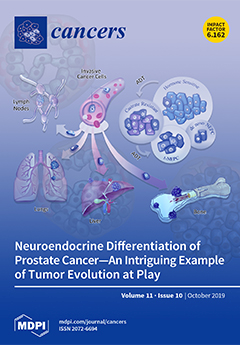
Cover Story: Despite advancements in therapy, the development of castrate resistance in prostate cancer (PCa) remains a major clinical hurdle. An emerging and increasingly appreciated impediment in the treatment of advanced PCa is the development of neuroendocrine differentiation (NED), also known as treatment-induced neuroendocrine prostate cancer (t-NEPC) that is aggressive and lacks therapeutic approaches. It is believed that androgen deprivation therapy may be a predominant mediator in the development of the t-NEPC phenotype. Intriguingly, although classical NEPC is rare in the clinic, it is estimated that ~30% of PCa patients develop t-NEPC. It is therefore crucial to identify the molecular and cellular mechanisms, including the role of tumor microenvironment (TME) that orchestrates t-NEPC, with the goal of developing novel and specific treatment modalities against this aggressive form of the disease. View this paper
  • Issues are regarded as officially published after their release is announced to the table of contents alert mailing list .
  • You may sign up for email alerts to receive table of contents of newly released issues.
  • PDF is the official format for papers published in both, html and pdf forms. To view the papers in pdf format, click on the "PDF Full-text" link, and use the free Adobe Reader to open them.

Articles (215)

  • Feature Paper
  • Review
  • Open Access
9 Citations
5,117 Views
14 Pages

Exploiting ING2 Epigenetic Modulation as a Therapeutic Opportunity for Non-Small Cell Lung Cancer

  • Alice Blondel,
  • Amine Benberghout,
  • Rémy Pedeux and
  • Charles Ricordel

21 October 2019

Non-small cell lung cancer (NSCLC) has been the leading cause of cancer-related death worldwide, over the last few decades. Survival remains extremely poor in the metastatic setting and, consequently, innovative therapeutic strategies are urgently ne...

  • Article
  • Open Access
10 Citations
4,305 Views
13 Pages

21 October 2019

Although cytoplasmic AMP-activated protein kinase (AMPK) has been known as a tumor-suppressor protein, nuclear AMPK is suggested to support clear cell renal cell carcinoma (ccRCC). In addition, pAMPK interacts with TGF-β/SMAD, which is one of th...

  • Article
  • Open Access
11 Citations
4,103 Views
26 Pages

The Brain Penetrating and Dual TORC1/TORC2 Inhibitor, RES529, Elicits Anti-Glioma Activity and Enhances the Therapeutic Effects of Anti-Angiogenetic Compounds in Preclinical Murine Models

  • Giovanni Luca Gravina,
  • Andrea Mancini,
  • Alessandro Colapietro,
  • Simona Delle Monache,
  • Roberta Sferra,
  • Simona Pompili,
  • Flora Vitale,
  • Stefano Martellucci,
  • Francesco Marampon and
  • Vincenzo Mattei
  • + 3 authors

21 October 2019

Background. Glioblastoma multiforme (GBM) is a devastating disease showing a very poor prognosis. New therapeutic approaches are needed to improve survival and quality of life. GBM is a highly vascularized tumor and as such, chemotherapy and anti-ang...

  • Feature Paper
  • Review
  • Open Access
60 Citations
5,445 Views
22 Pages

The Microenvironment of Pituitary Tumors—Biological and Therapeutic Implications

  • Mirela Diana Ilie,
  • Alexandre Vasiljevic,
  • Gérald Raverot and
  • Philippe Bertolino

21 October 2019

The tumor microenvironment (TME) includes resident and infiltrative non-tumor cells, as well as blood and lymph vessels, extracellular matrix molecules, and numerous soluble factors, such as cytokines and chemokines. While the TME is now considered t...

  • Article
  • Open Access
27 Citations
5,274 Views
25 Pages

A Novel Predictor Tool of Biochemical Recurrence after Radical Prostatectomy Based on a Five-MicroRNA Tissue Signature

  • Zhongwei Zhao,
  • Sabine Weickmann,
  • Monika Jung,
  • Michael Lein,
  • Ergin Kilic,
  • Carsten Stephan,
  • Andreas Erbersdobler,
  • Annika Fendler and
  • Klaus Jung

21 October 2019

Within five to ten years after radical prostatectomy (RP), approximately 15–34% of prostate cancer (PCa) patients experience biochemical recurrence (BCR), which is defined as recurrence of serum levels of prostate-specific antigen >0.2 &micr...

  • Article
  • Open Access
11 Citations
6,623 Views
14 Pages

21 October 2019

The identification of biomarker signatures is important for cancer diagnosis and prognosis. However, the detection of clinical reliable signatures is influenced by limited data availability, which may restrict statistical power. Moreover, methods for...

  • Article
  • Open Access
18 Citations
4,529 Views
16 Pages

Constitutive or Induced HIF-2 Addiction is Involved in Resistance to Anti-EGFR Treatment and Radiation Therapy in HNSCC

  • Pierre Coliat,
  • Ludivine Ramolu,
  • Jérémie Jégu,
  • Christian Gaiddon,
  • Alain C. Jung and
  • Erwan Pencreach

21 October 2019

Background: management of head and neck squamous cell carcinomas (HNSCC) include anti-Epidermal Growth Factor Receptor (EGFR) antibodies and radiotherapy, but resistance emerges in most patients. RAS mutations lead to primary resistance to EGFR block...

  • Review
  • Open Access
29 Citations
5,716 Views
17 Pages

Productive Cross-Talk with the Microenvironment: A Critical Step in Ovarian Cancer Metastasis

  • Mohamed A. Abd El Aziz,
  • Komal Agarwal,
  • Subramanyam Dasari and
  • Anirban K. Mitra

21 October 2019

Most ovarian cancer patients present with disseminated disease at the time of their diagnosis, which is one of the main reasons for their poor prognosis. Metastasis is a multi-step process and a clear understanding of the mechanism of regulation of t...

  • Article
  • Open Access
25 Citations
4,575 Views
11 Pages

Plasma Metabolomics Identifies Lipid and Amino Acid Markers of Weight Loss in Patients with Upper Gastrointestinal Cancer

  • Janice Miller,
  • Ahmed Alshehri,
  • Michael I. Ramage,
  • Nathan A. Stephens,
  • Alexander B. Mullen,
  • Marie Boyd,
  • James A. Ross,
  • Stephen J. Wigmore,
  • David G. Watson and
  • Richard J.E. Skipworth

19 October 2019

Cachexia is a multifactorial wasting syndrome associated with high morbidity and mortality in patients with cancer. Diagnosis can be difficult and, in the clinical situation, usually relies upon reported weight loss. The ‘omics’ technolog...

  • Review
  • Open Access
64 Citations
8,863 Views
22 Pages

19 October 2019

Unlike bulk-cell analysis, single-cell approaches have the advantage of assessing cellular heterogeneity that governs key aspects of tumor biology. Yet, their applications to circulating tumor cells (CTCs) are relatively limited, due mainly to the te...

of 22

Get Alerted

Add your email address to receive forthcoming issues of this journal.

XFacebookLinkedIn
Cancers - ISSN 2072-6694