



Skip Content
You are currently on the new version of our website. Access the old version .

Toxins, Volume 10, Issue 4

2018 April - 41 articles

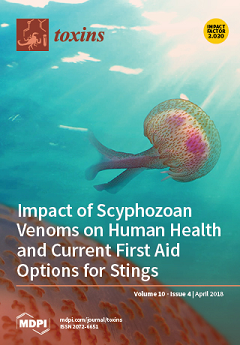
Cover Story: Male specimen of the mauve stinger Pelagia noctiluca (Cnidaria: Scyphozoa) photographed in the sea offshore Capo Milazzo (Sicily, Italy) during summer 2016. A detail of the umbrella with the stinging nematocyst buttons is shown (lower left). P. noctiluca is the most venomous autochthonous jellyfish of the Mediterranean Sea, and is responsible for the majority of jellyfish stings along the south Italian coasts. (Photo by Dr. Carmelo Isgró) View the paper here.
  • Issues are regarded as officially published after their release is announced to the table of contents alert mailing list .
  • You may sign up for email alerts to receive table of contents of newly released issues.
  • PDF is the official format for papers published in both, html and pdf forms. To view the papers in pdf format, click on the "PDF Full-text" link, and use the free Adobe Reader to open them.

Articles (41)

  • Review
  • Open Access
22 Citations
11,211 Views
29 Pages

Therapeutic Approaches of Botulinum Toxin in Gynecology

  • Marius Alexandru Moga,
  • Oana Gabriela Dimienescu,
  • Andreea Bălan,
  • Ioan Scârneciu,
  • Barna Barabaș and
  • Liana Pleș

21 April 2018

Botulinum toxins (BoNTs) are produced by several anaerobic species of the genus Clostridium and, although they were originally considered lethal toxins, today they find their usefulness in the treatment of a wide range of pathologies in various medic...

  • Feature Paper
  • Review
  • Open Access
94 Citations
17,086 Views
24 Pages

21 April 2018

Many issues and complications in treating snakebite are a result of poor human social, economic and clinical intervention and management. As such, there is scope for significant improvements for reducing incidence and increasing patient outcomes. Sna...

  • Feature Paper
  • Article
  • Open Access
15 Citations
8,317 Views
15 Pages

Electromyographic and Joint Kinematic Patterns in Runner’s Dystonia

  • Omar F. Ahmad,
  • Pritha Ghosh,
  • Christopher Stanley,
  • Barbara Karp,
  • Mark Hallett,
  • Codrin Lungu and
  • Katharine Alter

20 April 2018

Runner’s dystonia (RD) is a task-specific focal dystonia of the lower limbs that occurs when running. In this retrospective case series, we present surface electromyography (EMG) and joint kinematic data from thirteen patients with RD who under...

  • Review
  • Open Access
49 Citations
10,509 Views
28 Pages

20 April 2018

The Solid Phase Adsorption Toxin Tracking (SPATT) technology, first introduced in 2004, uses porous synthetic resins capable of passively adsorbing toxins produced by harmful microalgae or cyanobacteria and dissolved in the water. This method allows...

  • Article
  • Open Access
14 Citations
7,431 Views
16 Pages

Analysis of the Relationship between Alternative Respiration and Sterigmatocystin Formation in Aspergillus nidulans

  • Ákos P. Molnár,
  • Zoltán Németh,
  • Erzsébet Fekete,
  • Michel Flipphi,
  • Nancy P. Keller and
  • Levente Karaffa

20 April 2018

Aspergillus nidulans has one gene for alternative oxidase (EC 1.10.3.11). To investigate the relationship between this mitochondrial terminal oxidase and the formation of the mycotoxin sterigmatocystin, the encoding aodA gene was both deleted and ove...

  • Review
  • Open Access
21 Citations
5,197 Views
11 Pages

Analgesic Effects of Botulinum Toxin in Children with CP

  • Josephine Sandahl Michelsen,
  • Gitte Normann and
  • Christian Wong

19 April 2018

Experiencing pain is the greatest contributor to a reduced quality of life in children with cerebral palsy (CP). The presence of pain is quite common (~60%) and increases with age. This leads to missed school days, less participation, and reduced amb...

  • Feature Paper
  • Review
  • Open Access
205 Citations
18,740 Views
20 Pages

Epidemiology of Helicobacter pylori and CagA-Positive Infections and Global Variations in Gastric Cancer

  • Jin Young Park,
  • David Forman,
  • Langgeng Agung Waskito,
  • Yoshio Yamaoka and
  • Jean E. Crabtree

19 April 2018

Gastric cancer is a major health burden and is the fifth most common malignancy and the third most common cause of death from cancer worldwide. Development of gastric cancer involves several aspects, including host genetics, environmental factors, an...

  • Article
  • Open Access
38 Citations
8,390 Views
8 Pages

Lumbar Sympathetic Block with Botulinum Toxin Type A and Type B for the Complex Regional Pain Syndrome

  • Yongki Lee,
  • Chul Joong Lee,
  • Eunjoo Choi,
  • Pyung Bok Lee,
  • Ho-Jin Lee and
  • Francis Sahngun Nahm

19 April 2018

A lumbar sympathetic ganglion block (LSB) is a therapeutic method for complex regional pain syndrome (CRPS) affecting the lower limbs. Recently, LSB with botulinum toxin type A and B was introduced as a novel method to achieve longer duration of anal...

  • Article
  • Open Access
9 Citations
5,079 Views
15 Pages

19 April 2018

A visual immunoaffinity test column (IATC) assay was developed to detect fumonisins in cereal samples for spot tests without the need for special instruments. The developed IATC assay had equivalent recognition capability for fumonisin B1 (FB1), fumo...

  • Editorial
  • Open Access
10 Citations
4,210 Views
4 Pages

18 April 2018

Ribosome inactivating proteins (RIPs) form a vast family of hundreds of toxins from plants, fungi, algae, and bacteria. RIP activities have also been detected in animal tissues. They exert an N-glycosydase catalytic activity that is targeted to a sin...

  • Article
  • Open Access
42 Citations
7,691 Views
16 Pages

Analogs of the Scorpion Venom Peptide Stigmurin: Structural Assessment, Toxicity, and Increased Antimicrobial Activity

  • Adriana M. S. Parente,
  • Alessandra Daniele-Silva,
  • Allanny A. Furtado,
  • Menilla A. Melo,
  • Ariane F. Lacerda,
  • Moacir Queiroz,
  • Cláudia Moreno,
  • Elizabeth Santos,
  • Hugo A. O. Rocha and
  • Matheus De F. Fernandes-Pedrosa
  • + 4 authors

18 April 2018

Scorpion venom is a rich source of biologically active components and various peptides with high-potential therapeutic use that have been characterized for their antimicrobial and antiproliferative activities. Stigmurin is a peptide identified from t...

  • Article
  • Open Access
39 Citations
8,562 Views
15 Pages

Alpha-Toxin Contributes to Biofilm Formation among Staphylococcus aureus Wound Isolates

  • Michele J. Anderson,
  • Emily Schaaf,
  • Laura M. Breshears,
  • Heidi W. Wallis,
  • James R. Johnson,
  • Christine Tkaczyk,
  • Bret R. Sellman,
  • Jisun Sun and
  • Marnie L. Peterson

16 April 2018

Biofilms complicate treatment of Staphylococcus aureus (SA) wound infections. Previously, we determined alpha-toxin (AT)-promoted SA biofilm formation on mucosal tissue. Therefore, we evaluated SA wound isolates for AT production and biofilm formatio...

  • Article
  • Open Access
25 Citations
6,490 Views
15 Pages

Antivenom Production against Bothrops jararaca and Bothrops erythromelas Snake Venoms Using Cross-Linked Chitosan Nanoparticles as an Immunoadjuvant

  • Karla Samara Rocha Soares,
  • Fiamma Gláucia-Silva,
  • Alessandra Daniele-Silva,
  • Manoela Torres-Rêgo,
  • Nathália Kelly de Araújo,
  • Yamara Arruda Silva de Menezes,
  • Igor Zumba Damasceno,
  • Denise Vilarinho Tambourgi,
  • Arnóbio Antônio Da Silva-Júnior and
  • Matheus De Freitas Fernandes-Pedrosa

16 April 2018

In Brazil, envenomation by snakes of the genus Bothrops is clinically relevant, particularly for the species Bothrops jararaca and B. erythromelas. The most effective treatment for envenomation by snakes is the administration of antivenoms associated...

  • Article
  • Open Access
10 Citations
6,132 Views
16 Pages

16 April 2018

The emergence of super-toxigenic strains by recombination is a risk from an intensive use of intraspecific aflatoxin (AF) biocontrol agents (BCAs). Periodical alternation with interspecific-BCAs will be safer since they preclude recombination. We are...

  • Feature Paper
  • Review
  • Open Access
74 Citations
9,651 Views
12 Pages

13 April 2018

Uremic retention solutes (URS) are associated with cardiovascular complications and poor survival in chronic kidney disease. The better understanding of the origin of a certain number of these toxins enabled the development of new strategies to reduc...

  • Article
  • Open Access
180 Citations
27,742 Views
24 Pages

Temperature Effects Explain Continental Scale Distribution of Cyanobacterial Toxins

  • Evanthia Mantzouki,
  • Miquel Lürling,
  • Jutta Fastner,
  • Lisette De Senerpont Domis,
  • Elżbieta Wilk-Woźniak,
  • Judita Koreivienė,
  • Laura Seelen,
  • Sven Teurlincx,
  • Yvon Verstijnen and
  • Bas W. Ibelings
  • + 185 authors

13 April 2018

Insight into how environmental change determines the production and distribution of cyanobacterial toxins is necessary for risk assessment. Management guidelines currently focus on hepatotoxins (microcystins). Increasing attention is given to other c...

  • Feature Paper
  • Article
  • Open Access
21 Citations
9,267 Views
16 Pages

12 April 2018

Botulinum neurotoxins (BoNTs) are a family of highly dangerous bacterial toxins, with seven major serotypes (BoNT/A-G). Members of BoNTs, BoNT/A1 and BoNT/B1, have been utilized to treat an increasing number of medical conditions. The clinical trials...

  • Article
  • Open Access
37 Citations
6,000 Views
11 Pages

Bavachinin Induces Oxidative Damage in HepaRG Cells through p38/JNK MAPK Pathways

  • Shan Wang,
  • Min Wang,
  • Min Wang,
  • Yu Tian,
  • Xiao Sun,
  • Guibo Sun and
  • Xiaobo Sun

12 April 2018

Drug-induced liver injury is one of the main causes of drug non-approval and drug withdrawal by the Food and Drug Administration (FDA). Bavachinin (BVC) is a natural product derived from the fruit of the traditional Chinese herb Fructus Psoraleae (FP...

  • Article
  • Open Access
21 Citations
7,443 Views
14 Pages

Bovine Peripheral Blood Mononuclear Cells Are More Sensitive to Deoxynivalenol Than Those Derived from Poultry and Swine

  • Barbara Novak,
  • Eleni Vatzia,
  • Alexandra Springler,
  • Alix Pierron,
  • Wilhelm Gerner,
  • Nicole Reisinger,
  • Sabine Hessenberger,
  • Gerd Schatzmayr and
  • Elisabeth Mayer

11 April 2018

Deoxynivalenol (DON) is one of the most prevalent mycotoxins, contaminating cereals and cereal-derived products. Its derivative deepoxy-deoxynivalenol (DOM-1) is produced by certain bacteria, which either occur naturally or are supplemented in feed a...

  • Review
  • Open Access
172 Citations
19,624 Views
16 Pages

Colibactin: More Than a New Bacterial Toxin

  • Tiphanie Faïs,
  • Julien Delmas,
  • Nicolas Barnich,
  • Richard Bonnet and
  • Guillaume Dalmasso

10 April 2018

Cyclomodulins are bacterial toxins that interfere with the eukaryotic cell cycle. A new cyclomodulin called colibactin, which is synthetized by the pks genomic island, was discovered in 2006. Despite many efforts, colibactin has not yet been purified...

  • Article
  • Open Access
18 Citations
6,087 Views
23 Pages

Oral and Intravenous Fumonisin Exposure in Pigs—A Single-Dose Treatment Experiment Evaluating Toxicokinetics and Detoxification

  • Hanna Schertz,
  • Jeannette Kluess,
  • Jana Frahm,
  • Dian Schatzmayr,
  • Ilse Dohnal,
  • Gerlinde Bichl,
  • Heidi Schwartz-Zimmermann,
  • Gerhard Breves and
  • Sven Dänicke

5 April 2018

We examined the toxicokinetics of fumonisin B1 (FB1) and its main metabolites after single dose application intravenously (iv) of 139 nmol FB1 or hydrolyzed FB1 (HFB1)/kg bodyweight (BW) in barrows (BW: 34.4 kg ± 2.7 kg), as well as the toxicokinetic...

  • Article
  • Open Access
47 Citations
7,272 Views
18 Pages

The Effects of Deoxynivalenol and Zearalenone on the Pig Large Intestine. A Light and Electron Microscopy Study

  • Barbara Przybylska-Gornowicz,
  • Bogdan Lewczuk,
  • Magdalena Prusik,
  • Maria Hanuszewska,
  • Marcela Petrusewicz-Kosińska,
  • Magdalena Gajęcka,
  • Łukasz Zielonka and
  • Maciej Gajęcki

4 April 2018

The contamination of feed with mycotoxins results in reduced growth, feed refusal, immunosuppression, and health problems. Deoxynivalenol (DON) and zearalenone (ZEN) are among the most important mycotoxins. The aim of the study was to examine the eff...

  • Feature Paper
  • Opinion
  • Open Access
80 Citations
9,961 Views
17 Pages

The Mycotox Charter: Increasing Awareness of, and Concerted Action for, Minimizing Mycotoxin Exposure Worldwide

  • Antonio F. Logrieco,
  • J. David Miller,
  • Mari Eskola,
  • Rudolf Krska,
  • Amare Ayalew,
  • Ranajit Bandyopadhyay,
  • Paola Battilani,
  • Deepak Bhatnagar,
  • Sofia Chulze and
  • John F. Leslie
  • + 8 authors

4 April 2018

Mycotoxins are major food contaminants affecting global food security, especially in low and middle-income countries. The European Union (EU) funded project, MycoKey, focuses on “Integrated and innovative key actions for mycotoxin management in...

  • Article
  • Open Access
36 Citations
7,733 Views
15 Pages

Toxic Cyanobacteria in Svalbard: Chemical Diversity of Microcystins Detected Using a Liquid Chromatography Mass Spectrometry Precursor Ion Screening Method

  • Julia Kleinteich,
  • Jonathan Puddick,
  • Susanna A. Wood,
  • Falk Hildebrand,
  • H. Dail Laughinghouse IV,
  • David A. Pearce,
  • Daniel R. Dietrich and
  • Annick Wilmotte

3 April 2018

Cyanobacteria synthesize a large variety of secondary metabolites including toxins. Microcystins (MCs) with hepato- and neurotoxic potential are well studied in bloom-forming planktonic species of temperate and tropical regions. Cyanobacterial biofil...

  • Article
  • Open Access
9 Citations
6,519 Views
16 Pages

2 April 2018

Lake Lesser Prespa and its adjacent pond, Vromolimni in Greece, is a shallow freshwater system and a highly protected area hosting an exceptional biodiversity. The occurrence of microcystins (MCs) producing cyanobacterial blooms in these waters durin...

  • Feature Paper
  • Review
  • Open Access
40 Citations
8,710 Views
12 Pages

Botulinum Toxin Type A—A Modulator of Spinal Neuron–Glia Interactions under Neuropathic Pain Conditions

  • Ewelina Rojewska,
  • Anna Piotrowska,
  • Katarzyna Popiolek-Barczyk and
  • Joanna Mika

2 April 2018

Neuropathic pain represents a significant clinical problem because it is a chronic condition often refractory to available therapy. Therefore, there is still a strong need for new analgesics. Botulinum neurotoxin A (BoNT/A) is used to treat a variety...

  • Article
  • Open Access
24 Citations
6,746 Views
10 Pages

2 April 2018

Atopic dermatitis (AD) is a chronic inflammatory skin disease characterized by highly pruritic, erythematous, and eczematous skin plaques. We previously reported that phospholipase A2 (PLA2) derived from bee venom alleviates AD-like skin lesions indu...

  • Feature Paper
  • Article
  • Open Access
25 Citations
7,346 Views
20 Pages

Camelid Single-Domain Antibodies (VHHs) against Crotoxin: A Basis for Developing Modular Building Blocks for the Enhancement of Treatment or Diagnosis of Crotalic Envenoming

  • Marcos B. Luiz,
  • Soraya S. Pereira,
  • Nidiane D. R. Prado,
  • Naan R. Gonçalves,
  • Anderson M. Kayano,
  • Leandro S. Moreira-Dill,
  • Juliana C. Sobrinho,
  • Fernando B. Zanchi,
  • André L. Fuly and
  • Carla F. C. Fernandes
  • + 4 authors

29 March 2018

Toxic effects triggered by crotalic envenoming are mainly related to crotoxin (CTX), composed of a phospholipase A2 (CB) and a subunit with no toxic activity (CA). Camelids produce immunoglobulins G devoid of light chains, in which the antigen recogn...

  • Feature Paper
  • Review
  • Open Access
16 Citations
5,872 Views
17 Pages

29 March 2018

This review explores current evidence to demonstrate that botulinum neurotoxins (BoNTs) exert antipruritic effects. Both experimental and clinical conditions in which botulinum neurotoxins have been applied for pruritus relief will be presented and s...

  • Article
  • Open Access
10 Citations
7,263 Views
12 Pages

“Appropriate Treatment” and Therapeutic Window in Spasticity Treatment with IncobotulinumtoxinA: From 100 to 1000 Units

  • Giancarlo Ianieri,
  • Riccardo Marvulli,
  • Giulia Alessia Gallo,
  • Pietro Fiore and
  • Marisa Megna

28 March 2018

Many neurological diseases (ischemic and hemorrhagic stroke, multiple sclerosis, infant cerebral palsy, spinal cord injuries, traumatic brain injury, and other cerebrovascular disorders) may cause muscle spasticity. Different therapeutic strategies h...

  • Article
  • Open Access
33 Citations
9,420 Views
20 Pages

28 March 2018

Paralytic shellfish poisoning (PSP) is caused by a group of marine toxins with saxitoxin (STX) as the reference compound. Symptoms in humans after consumption of contaminated shellfish vary from slight neurological and gastrointestinal effects to fat...

  • Article
  • Open Access
8 Citations
4,814 Views
16 Pages

Characterization of Human Type C Enterotoxin Produced by Clinical S. epidermidis Isolates

  • Chimène Nanoukon,
  • Dissou Affolabi,
  • Daniel Keller,
  • Rodrigue Tollo,
  • Philippe Riegel,
  • Lamine Baba-Moussa and
  • Gilles Prévost

27 March 2018

Staphylococcal Enterotoxins (SEs) are superantigens (SAg) originally produced by S. aureus, but their presence in coagulase negative staphylococci (CNS) has long been suspected. This study aims to better characterize a novel C-like enterotoxin expres...

  • Article
  • Open Access
31 Citations
5,532 Views
15 Pages

26 March 2018

T-2 toxin is a secondary metabolite of some Fusarium species. It is well-known that this substance can harmfully impact living organisms. Among others, thanks to the ability of crossing the blood–brain barrier, T-2 toxin can affect the central nervou...

  • Article
  • Open Access
14 Citations
6,690 Views
16 Pages

OTA Prevention and Detoxification by Actinobacterial Strains and Activated Carbon Fibers: Preliminary Results

  • Rhoda El Khoury,
  • Elodie Choque,
  • Anthony El Khoury,
  • Selma P. Snini,
  • Robbie Cairns,
  • Caroline Andriantsiferana and
  • Florence Mathieu

24 March 2018

Ochratoxin A (OTA) is a mycotoxin produced by several species of Aspergillus and Penicillium that contaminate food and feed raw materials. To reduce OTA contamination, we first tested in vitro, actinobacterial strains as potential biocontrol agents a...

  • Feature Paper
  • Perspective
  • Open Access
42 Citations
8,113 Views
16 Pages

23 March 2018

At the interface between agriculture and nutrition, the aflatoxin contamination of food and feed touches on agriculture, health, and trade. For more than three decades now, the problem of aflatoxin has been researched in Africa. The interest of devel...

  • Review
  • Open Access
51 Citations
9,130 Views
21 Pages

Impact of Scyphozoan Venoms on Human Health and Current First Aid Options for Stings

  • Alessia Remigante,
  • Roberta Costa,
  • Rossana Morabito,
  • Giuseppa La Spada,
  • Angela Marino and
  • Silvia Dossena

23 March 2018

Cnidaria include the most venomous animals of the world. Among Cnidaria, Scyphozoa (true jellyfish) are ubiquitous, abundant, and often come into accidental contact with humans and, therefore, represent a threat for public health and safety. The veno...

  • Feature Paper
  • Article
  • Open Access
14 Citations
6,781 Views
13 Pages

A Study and Review of Effects of Botulinum Toxins on Mast Cell Dependent and Independent Pruritus

  • Roshni Ramachandran,
  • Marc J. Marino,
  • Snighdha Paul,
  • Zhenping Wang,
  • Nicholas L. Mascarenhas,
  • Sabine Pellett,
  • Eric A. Johnson,
  • Anna DiNardo and
  • Tony L. Yaksh

23 March 2018

Pruriceptive itch originates following activation of peripheral sensory nerve terminals when pruritogens come in contact with the skin. The ability of botulinum neurotoxins (BoNTs) to attenuate transmitter release from afferent terminals provides a r...

  • Feature Paper
  • Article
  • Open Access
44 Citations
14,970 Views
23 Pages

Phenotypic Variation in Mojave Rattlesnake (Crotalus scutulatus) Venom Is Driven by Four Toxin Families

  • Jason L. Strickland,
  • Andrew J. Mason,
  • Darin R. Rokyta and
  • Christopher L. Parkinson

23 March 2018

Phenotypic diversity generated through altered gene expression is a primary mechanism facilitating evolutionary response in natural systems. By linking the phenotype to genotype through transcriptomics, it is possible to determine what changes are oc...

  • Feature Paper
  • Article
  • Open Access
9 Citations
5,280 Views
14 Pages

21 March 2018

Cosmopolitan Gram-negative cyanobacteria may affect human and animal health by contaminating terrestrial, marine and freshwater environments with toxins, such as lipopolysaccharide (LPS). The cyanobacterial genus Scytonema (S) produces several toxins...

  • Article
  • Open Access
46 Citations
7,884 Views
16 Pages

Histopathological Injuries, Ultrastructural Changes, and Depressed TLR Expression in the Small Intestine of Broiler Chickens with Aflatoxin B1

  • Fengyuan Wang,
  • Zhicai Zuo,
  • Kejie Chen,
  • Caixia Gao,
  • Zhuangzhi Yang,
  • Song Zhao,
  • Jianzhen Li,
  • Hetao Song,
  • Xi Peng and
  • Bo Jing
  • + 5 authors

21 March 2018

To explore AFB1-induced damage of the small intestine, the changes in structure and expression of TLRs (Toll-like Receptors) in the small intestine of chickens were systematically investigated. Ninety healthy neonatal Cobb chickens were randomized in...

Get Alerted

Add your email address to receive forthcoming issues of this journal.

XFacebookLinkedIn
Toxins - ISSN 2072-6651