

You are currently viewing a new version of our website. To view the old version click .

Toxins, Volume 10, Issue 5

May 2018 - 43 articles

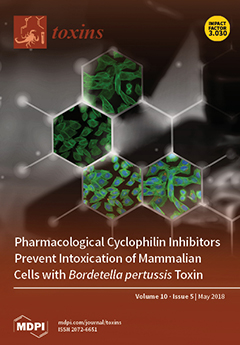
Cover Story: The cyclophilin inhibitor cyclosporine A protects cells from intoxication with pertussis toxin by reducing the amount of the enzymatic subunit PTS1 of this toxin in the cytosol of target cells demonstrated by fluorescence microscopy. Thereby, the ADP-ribosylation of inhibitory alpha subunits of trimeric G proteins by PTS1 is reduced and the subsequent disturbed signaling causing the severe symptoms of whooping cough averted. Thus, cyclophilin inhibitors might represent promising starting points for development of novel therapeutic strategies against whooping cough. Blue = nucleus, Green = F-actin, Red = PTS1. View the paper here.
  • Issues are regarded as officially published after their release is announced to the table of contents alert mailing list .
  • You may sign up for email alerts to receive table of contents of newly released issues.
  • PDF is the official format for papers published in both, html and pdf forms. To view the papers in pdf format, click on the "PDF Full-text" link, and use the free Adobe Reader to open them.

Articles (43)

  • Review
  • Open Access
193 Citations
25,118 Views
21 Pages

Mechanisms of Action and Cell Death Associated with Clostridium perfringens Toxins

  • Mauricio A. Navarro,
  • Bruce A. McClane and
  • Francisco A. Uzal

22 May 2018

Clostridium perfringens uses its large arsenal of protein toxins to produce histotoxic, neurologic and intestinal infections in humans and animals. The major toxins involved in diseases are alpha (CPA), beta (CPB), epsilon (ETX), iota (ITX), enteroto...

  • Article
  • Open Access
8 Citations
4,745 Views
12 Pages

Domain II of Pseudomonas Exotoxin Is Critical for Efficacy of Bolus Doses in a Xenograft Model of Acute Lymphoblastic Leukemia

  • Fabian Müller,
  • Tyler Cunningham,
  • Richard Beers,
  • Tapan K. Bera,
  • Alan S. Wayne and
  • Ira Pastan

21 May 2018

Moxetumomab pasudotox is a fusion protein of a CD22-targeting antibody and Pseudomonas exotoxin. Minutes of exposure to Moxetumomab achieves similar cell killing than hours of exposure to a novel deimmunized variant against some acute lymphoblastic l...

  • Article
  • Open Access
21 Citations
5,224 Views
9 Pages

Development of a Highly Sensitive FcMito qPCR Assay for the Quantification of the Toxigenic Fungal Plant Pathogen Fusarium culmorum

  • Katarzyna Bilska,
  • Tomasz Kulik,
  • Anna Ostrowska-Kołodziejczak,
  • Maciej Buśko,
  • Matias Pasquali,
  • Marco Beyer,
  • Anna Baturo-Cieśniewska,
  • Marcin Juda,
  • Dariusz Załuski and
  • Kinga Treder
  • + 2 authors

21 May 2018

Fusarium culmorum is a ubiquitous, soil-borne fungus (ascomycete) causing foot and root rot and Fusarium head blight on cereals. It is responsible for yield and quality losses as well as grain contamination with mycotoxins, which are a potential heal...

  • Article
  • Open Access
7 Citations
4,677 Views
11 Pages

Acid Sphingomyelinase Promotes Cellular Internalization of Clostridium perfringens Iota-Toxin

  • Masahiro Nagahama,
  • Masaya Takehara,
  • Kazuaki Miyamoto,
  • Kazumi Ishidoh and
  • Keiko Kobayashi

20 May 2018

Clostridium perfringens iota-toxin is a binary actin-ADP-ribosylating toxin composed of the enzymatic component Ia and receptor binding component Ib. Ib binds to a cell surface receptor, forms Ib oligomer in lipid rafts, and associates with Ia. The I...

  • Article
  • Open Access
18 Citations
5,615 Views
16 Pages

Is 3-Carboxy-4-methyl-5-propyl-2-furanpropionate (CMPF) a Clinically Relevant Uremic Toxin in Haemodialysis Patients?

  • Mathilde Luce,
  • Anais Bouchara,
  • Myriam Pastural,
  • Samuel Granjon,
  • Jean Christophe Szelag,
  • Maurice Laville,
  • Walid Arkouche,
  • Denis Fouque,
  • Christophe O. Soulage and
  • Laetitia Koppe

18 May 2018

3-Carboxy-4-methyl-5-propyl-2-furanpropionate (CMPF) is a metabolite of furan fatty acid and a marker of fish oil intake. CMPF is described as a protein-bound uremic toxin and interacts with free oxygen radicals, which can induce cell damages. Howeve...

  • Article
  • Open Access
4 Citations
5,379 Views
12 Pages

18 May 2018

To test if arginine and ornithine, both components of the Krebs-Henseleit cycle, or zeolite, a potential ammonium absorber, can modulate the excretion of harmful bacterial metabolites, intestinal microbial protein fermentation was stimulated by feedi...

  • Article
  • Open Access
27 Citations
9,672 Views
12 Pages

Transcriptomic Analysis of Pseudoscorpion Venom Reveals a Unique Cocktail Dominated by Enzymes and Protease Inhibitors

  • Carlos E. Santibáñez-López,
  • Andrew Z. Ontano,
  • Mark S. Harvey and
  • Prashant P. Sharma

18 May 2018

Transcriptomic and genomic analyses have illuminated the diversity of venoms in three of the four venomous arachnid orders (scorpions, spiders, and ticks). To date, no venom gland transcriptome analysis has been available for pseudoscorpions, the fou...

  • Review
  • Open Access
99 Citations
11,365 Views
27 Pages

The Expanding Therapeutic Utility of Botulinum Neurotoxins

  • Elena Fonfria,
  • Jacquie Maignel,
  • Stephane Lezmi,
  • Vincent Martin,
  • Andrew Splevins,
  • Saif Shubber,
  • Mikhail Kalinichev,
  • Keith Foster,
  • Philippe Picaut and
  • Johannes Krupp

18 May 2018

Botulinum neurotoxin (BoNT) is a major therapeutic agent that is licensed in neurological indications, such as dystonia and spasticity. The BoNT family, which is produced in nature by clostridial bacteria, comprises several pharmacologically distinct...

  • Review
  • Open Access
113 Citations
8,630 Views
18 Pages

Role of Uremic Toxins for Kidney, Cardiovascular, and Bone Dysfunction

  • Hideki Fujii,
  • Shunsuke Goto and
  • Masafumi Fukagawa

16 May 2018

With decreasing kidney function, cardiovascular disease (CVD) and mineral bone disorders frequently emerge in patients with chronic kidney disease (CKD). For these patients, in addition to the traditional risk factors, non-traditional CKD-specific ri...

  • Article
  • Open Access
11 Citations
6,841 Views
12 Pages

Botulinum Toxin Type A Injection for Cervical Dystonia in Adults with Dyskinetic Cerebral Palsy

  • You Gyoung Yi,
  • Keewon Kim,
  • Youbin Yi,
  • Young-Ah Choi,
  • Ja-Ho Leigh and
  • Moon Suk Bang

16 May 2018

We aimed to evaluate the efficacy and safety of injecting botulinum toxin A (BoNT-A) into the neck muscles to treat cervical dystonia (CD) in patients with dyskinetic cerebral palsy (CP). This was a randomized, double-blinded, placebo-controlled tria...

of 5

Get Alerted

Add your email address to receive forthcoming issues of this journal.

XFacebookLinkedIn
Toxins - ISSN 2072-6651