
You are currently viewing a new version of our website. To view the old version click .

Marine Drugs, Volume 23, Issue 5

May 2025 - 42 articles

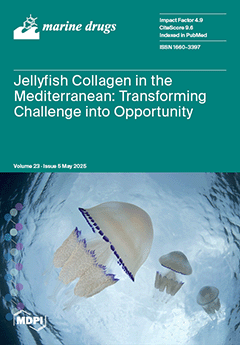
Cover Story: Jellyfish blooms are becoming increasingly frequent in the Mediterranean Sea, primarily driven by anthropogenic stressors such as climate change. Although often considered a nuisance due to their ecological and socio-economic impacts, jellyfish are gaining recognition as a valuable marine resource. In particular, jellyfish collagen has emerged as a promising biomaterial, offering high biocompatibility, low immunogenicity, and reduced zoonotic risk compared to conventional mammalian sources. This review aims to summarize and discuss current research on jellyfish collagen in the Mediterranean Sea, highlighting its versatility and potential as an alternative collagen source, while also exploring its exploitation. To the best of our knowledge, this is the first detailed review focused on the valorization of jellyfish in the Mediterranean, emphasizing their innovative use. View this paper
  • Issues are regarded as officially published after their release is announced to the table of contents alert mailing list .
  • You may sign up for email alerts to receive table of contents of newly released issues.
  • PDF is the official format for papers published in both, html and pdf forms. To view the papers in pdf format, click on the "PDF Full-text" link, and use the free Adobe Reader to open them.

Articles (42)

  • Review
  • Open Access
3 Citations
2,694 Views
17 Pages

Deep Eutectic Systems: A Game Changer for Marine Bioactives Recovery

  • Sandro Amador,
  • Alice Martins,
  • Margarida Matias,
  • Rui Pedrosa and
  • Susete Pinteus

16 May 2025

The extraction of bioactive compounds from marine natural products has gained increasing attention due to their diverse applications, such as in pharmaceuticals, nutraceuticals, and cosmetics. Yet, low extraction yields and toxicity associated with c...

  • Review
  • Open Access
1,708 Views
22 Pages

Sesquiterpenes from Brown Algae

  • Irene Moreno-Gutiérrez,
  • Sonia Berenguel-Gómez,
  • Manuel Muñoz-Dorado,
  • Míriam Álvarez-Corral and
  • Ignacio Rodríguez-García

15 May 2025

Algae are the group that has managed to generate the largest number of compounds and secondary metabolites with different properties, many of them only present in the aquatic kingdom. Among them, brown algae are one of the main producers within marin...

  • Article
  • Open Access
1 Citations
1,829 Views
33 Pages

Novel Anti-MRSA Peptide from Mangrove-Derived Virgibacillus chiguensis FN33 Supported by Genomics and Molecular Dynamics

  • Namfa Sermkaew,
  • Apichart Atipairin,
  • Phetcharat Boonruamkaew,
  • Sucheewin Krobthong,
  • Chanat Aonbangkhen,
  • Jumpei Uchiyama,
  • Yodying Yingchutrakul and
  • Nuttapon Songnaka

14 May 2025

Antimicrobial resistance (AMR) is a global health threat, with methicillin-resistant Staphylococcus aureus (MRSA) being one of the major resistant pathogens. This study reports the isolation of a novel mangrove-derived bacterium, Virgibacillus chigue...

  • Article
  • Open Access
2 Citations
2,027 Views
25 Pages

Biochemical Composition and Alkaline Extraction Optimization of Soluble Bioactive Compounds from the Green Algae Caulerpa cylindraceae

  • Amani Tahar,
  • Haïfa Zghida,
  • Débora Tomazi Pereira,
  • Nathalie Korbee,
  • Helen Treichel,
  • Félix L. Figueroa and
  • Lotfi Achour

14 May 2025

There is a growing interest in studying the bioactive compounds of invasive green macroalga Caulerpa cylindracea due to their potential biotechnological applications. Algal samples were collected from two sites and seasons. Elemental analysis showed...

  • Review
  • Open Access
11 Citations
3,555 Views
35 Pages

13 May 2025

The ocean is an extraordinary natural source of a wide range of bioactive compounds. These compounds, including proteins, phenolics, polysaccharides, pigments, vitamins, and fatty acids, possess unique biological properties that are increasingly bein...

  • Review
  • Open Access
3 Citations
1,222 Views
23 Pages

Antioxidant and Anti-Inflammatory Properties of Four Native Mediterranean Seagrasses: A Review of Bioactive Potential and Ecological Context

  • Marzia Vasarri,
  • Lucia De Marchi,
  • Carlo Pretti,
  • Emanuela Barletta and
  • Donatella Degl’Innocenti

12 May 2025

This review provides current knowledge of the potential benefits of native Mediterranean seagrasses for human health, specifically focusing on their anti-inflammatory and antioxidant properties. The four main species examined—Posidonia oceanica...

  • Article
  • Open Access
1,021 Views
11 Pages

A VioA Variant Activates Antibiotic Streptogramins in the Heterologous Host Streptomyces sp. OUC20-O

  • Jie Shan,
  • Liangguang Yue,
  • Luyao Xu,
  • Runyi Wang,
  • Qingzhou Meng,
  • Jun Feng,
  • Joon-Hee Lee,
  • Ming Lu and
  • Huayue Li

11 May 2025

Heterologous expression of the G231L variant of VioA into 16 strains of marine-derived Streptomyces, combined with bioactivity tracking, leads to the activation of seven antibiotic streptogramins (1–7) in Streptomyces sp. OUC20-O. Among these,...

  • Article
  • Open Access
3 Citations
1,058 Views
13 Pages

11 May 2025

Evaluating the effects of nanoparticles on biomass growth and astaxanthin accumulation in Haematococcus lacustris is crucial for optimizing the production of astaxanthin, a valuable carotenoid with numerous industrial applications. Identifying the li...

  • Article
  • Open Access
3 Citations
1,354 Views
22 Pages

Metabolic Responses of Pyropia haitanensis to Dehydration-Rehydration Cycles Revealed by Metabolomics

  • Jian Wen,
  • Jianzhi Shi,
  • Muhan Meng,
  • Kai Xu,
  • Yan Xu,
  • Dehua Ji,
  • Wenlei Wang and
  • Chaotian Xie

8 May 2025

Pyropia haitanensis (T.J. Chang and B.F. Zheng) undergoes periodic dehydration and rehydration cycles, necessitating robust adaptive mechanisms. Despite extensive research on its physiological responses to desiccation stress, the comprehensive metabo...

  • Article
  • Open Access
1,576 Views
18 Pages

Whole-Genome Sequence Analysis, Probiotic Potential, and Safety Assessment of the Marine Bacterium Paraliobacillus zengyii CGMCC1.16464

  • Qianjin Fan,
  • Mengqi Jiao,
  • Haoyue Huangfu,
  • Lan Chen,
  • Beijie Li,
  • Zhijie Cao,
  • Xuelian Luo and
  • Jianguo Xu

7 May 2025

Paraliobacillus zengyii CGMCC1.16464 (P. zengyii) is a novel antiviral probiotic candidate strain. To ensure its safety as a potential probiotic, a safety evaluation was conducted in this study. The safety and functional potential of P. zengyii were...

of 5

Get Alerted

Add your email address to receive forthcoming issues of this journal.

XFacebookLinkedIn
Mar. Drugs - ISSN 1660-3397