

You are currently viewing a new version of our website. To view the old version click .

Marine Drugs, Volume 17, Issue 1

January 2019 - 72 articles

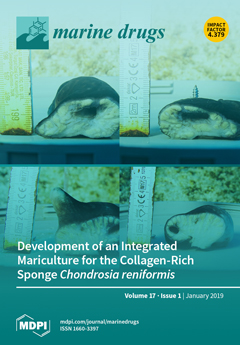
Cover Story: Novel methods were tested to culture the collagen-rich sponge Chondrosia reniformis in the proximity of floating fish cages. Attachment methods, plate materials, and plate orientation were compared. After three consecutive experiments, a culture protocol was established resulting in 86% survival and 170% growth for C. reniformis. Survival and growth of cultured explants near the fish farm polluted with organic waste was almost twice that at the pristine control site. This successful step towards production of sponge collagen in integrated aquacultures also reveals C. reniformis as a potential candidate for bioremediation of waters polluted with organic waste. View this paper.
  • Issues are regarded as officially published after their release is announced to the table of contents alert mailing list .
  • You may sign up for email alerts to receive table of contents of newly released issues.
  • PDF is the official format for papers published in both, html and pdf forms. To view the papers in pdf format, click on the "PDF Full-text" link, and use the free Adobe Reader to open them.

Articles (72)

  • Article
  • Open Access
19 Citations
4,967 Views
18 Pages

10 January 2019

The Maillard reaction products (MRPs) of half-fin anchovy hydrolysates and glucose, named as HAHp(9.0)-G MRPs, were fractionated by size exclusion chromatography into three major fractions (F1–F3). F2, which demonstrated the strongest antibacte...

  • Article
  • Open Access
18 Citations
8,379 Views
18 Pages

From Aggregates to Porous Three-Dimensional Scaffolds through a Mechanochemical Approach to Design Photosensitive Chitosan Derivatives

  • Kseniia N. Bardakova,
  • Tatiana A. Akopova,
  • Alexander V. Kurkov,
  • Galina P. Goncharuk,
  • Denis V. Butnaru,
  • Vitaliy F. Burdukovskii,
  • Artem A. Antoshin,
  • Ivan A. Farion,
  • Tatiana M. Zharikova and
  • Anatoliy B. Shekhter
  • + 3 authors

10 January 2019

The crustacean processing industry produces large quantities of waste by-products (up to 70%). Such wastes could be used as raw materials for producing chitosan, a polysaccharide with a unique set of biochemical properties. However, the preparation m...

  • Article
  • Open Access
9 Citations
5,588 Views
14 Pages

Comparative Analyses of Metabolomic Fingerprints and Cytotoxic Activities of Soft Corals from the Colombian Caribbean

  • Liliana Santacruz,
  • Olivier P. Thomas,
  • Carmenza Duque,
  • Mónica Puyana and
  • Edisson Tello

9 January 2019

Soft corals (Cnidaria, Anthozoa, Octocorallia) are a diverse group of marine invertebrates that inhabit various marine environments in tropical and subtropical areas. Several species are recognized as prolific sources of compounds with a wide array o...

  • Article
  • Open Access
14 Citations
4,646 Views
13 Pages

Asperlin Stimulates Energy Expenditure and Modulates Gut Microbiota in HFD-Fed Mice

  • Chongming Wu,
  • Yue Zhou,
  • Guihong Qi,
  • Dong Liu,
  • Xiaoxue Cao,
  • Jiaqi Yu,
  • Rong Zhang,
  • Wenhan Lin and
  • Peng Guo

9 January 2019

Asperlin is a marine-derived, natural product with antifungal, anti-inflammatory and anti-atherosclerotic activities. In the present study, we showed that asperlin effectively prevented the development of obesity in high-fat diet (HFD)-fed mice. Oral...

  • Article
  • Open Access
30 Citations
6,743 Views
14 Pages

Differences between Motile and Nonmotile Cells of Haematococcus pluvialis in the Production of Astaxanthin at Different Light Intensities

  • Feng Li,
  • Minggang Cai,
  • Mingwei Lin,
  • Xianghu Huang,
  • Jun Wang,
  • Hongwei Ke,
  • Xuehong Zheng,
  • Ding Chen,
  • Chunhui Wang and
  • Shaoting Wu
  • + 1 author

9 January 2019

Haematococcus pluvialis, as the best natural resource of astaxanthin, is widely used in nutraceuticals, aquaculture, and cosmetic industries. The purpose of this work was to compare the differences in astaxanthin accumulation between motile and nonmo...

  • Article
  • Open Access
74 Citations
6,803 Views
13 Pages

Collagen Extraction Optimization from the Skin of the Small-Spotted Catshark (S. canicula) by Response Surface Methodology

  • María Blanco,
  • José Antonio Vázquez,
  • Ricardo I. Pérez-Martín and
  • Carmen G. Sotelo

9 January 2019

The small-spotted catshark is one of the most abundant elasmobranchs in the Northeastern Atlantic Ocean. Although its landings are devoted for human consumption, in general this species has low commercial value with high discard rates, reaching 100%...

  • Article
  • Open Access
55 Citations
5,885 Views
12 Pages

8 January 2019

Chitooligosaccharides (COS), the hydrolyzed products of chitin and chitosan, can be obtained by various methods. In this study, water-soluble COS were prepared from α- and β-chitosan by microwave-assisted degradation and their immunostimul...

  • Article
  • Open Access
119 Citations
16,169 Views
12 Pages

Fish Collagen Surgical Compress Repairing Characteristics on Wound Healing Process In Vivo

  • Jingjing Chen,
  • Kaili Gao,
  • Shu Liu,
  • Shujun Wang,
  • Jeevithan Elango,
  • Bin Bao,
  • Jun Dong,
  • Ning Liu and
  • Wenhui Wu

8 January 2019

The development of biomaterials with the potential to accelerate wound healing is a great challenge in biomedicine. In this study, four types of samples including pepsin soluble collagen sponge (PCS), acid soluble collagen sponge (ACS), bovine collag...

  • Article
  • Open Access
15 Citations
4,669 Views
13 Pages

Structural Elucidation of a Novel Lipooligosaccharide from the Cold-Adapted Bacterium OMVs Producer Shewanella sp. HM13

  • Angela Casillo,
  • Rossella Di Guida,
  • Sara Carillo,
  • Chen Chen,
  • Kouhei Kamasaka,
  • Jun Kawamoto,
  • Tatsuo Kurihara and
  • Maria Michela Corsaro

8 January 2019

Shewanella sp. HM13 is a cold-adapted Gram-negative bacterium isolated from the intestine of a horse mackerel. It produces a large amount of outer membrane vesicles (OMVs), which are particles released in the medium where the bacterium is cultured. T...

  • Article
  • Open Access
60 Citations
5,009 Views
15 Pages

New 1,2,4-Oxadiazole Nortopsentin Derivatives with Cytotoxic Activity

  • Stella Cascioferro,
  • Alessandro Attanzio,
  • Veronica Di Sarno,
  • Simona Musella,
  • Luisa Tesoriere,
  • Girolamo Cirrincione,
  • Patrizia Diana and
  • Barbara Parrino

8 January 2019

New analogs of nortopsentin, a natural 2,4-bis(3′-indolyl)imidazole alkaloid, in which the central imidazole ring of the natural lead was replaced by a 1,2,4-oxadiazole moiety, and in which a 7-azaindole portion substituted the original indole...

of 8

Get Alerted

Add your email address to receive forthcoming issues of this journal.

XFacebookLinkedIn
Mar. Drugs - ISSN 1660-3397