You are currently viewing a new version of our website. To view the old version click .

Marine Drugs, Volume 17, Issue 1

January 2019 - 72 articles

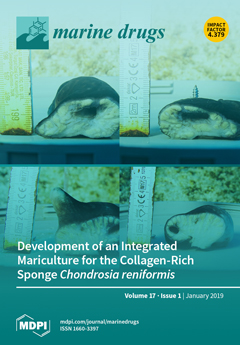
Cover Story: Novel methods were tested to culture the collagen-rich sponge Chondrosia reniformis in the proximity of floating fish cages. Attachment methods, plate materials, and plate orientation were compared. After three consecutive experiments, a culture protocol was established resulting in 86% survival and 170% growth for C. reniformis. Survival and growth of cultured explants near the fish farm polluted with organic waste was almost twice that at the pristine control site. This successful step towards production of sponge collagen in integrated aquacultures also reveals C. reniformis as a potential candidate for bioremediation of waters polluted with organic waste. View this paper.
  • Issues are regarded as officially published after their release is announced to the table of contents alert mailing list .
  • You may sign up for email alerts to receive table of contents of newly released issues.
  • PDF is the official format for papers published in both, html and pdf forms. To view the papers in pdf format, click on the "PDF Full-text" link, and use the free Adobe Reader to open them.

Articles (72)

  • Article
  • Open Access
16 Citations
4,615 Views
11 Pages

Tetracenomycin X Exerts Antitumour Activity in Lung Cancer Cells through the Downregulation of Cyclin D1

  • Xinran Qiao,
  • Maoluo Gan,
  • Chen Wang,
  • Bin Liu,
  • Yue Shang,
  • Yi Li and
  • Shuzhen Chen

18 January 2019

Tetracenomycin X (Tcm X) has been reported to have antitumour activity in various cancers, but there have not been any studies on its activity with respect to lung cancer to date. Therefore, this study aims to investigate the anti-lung cancer activit...

  • Article
  • Open Access
18 Citations
4,473 Views
14 Pages

Protective Effect of Low Molecular Weight Seleno-Aminopolysaccharide on the Intestinal Mucosal Oxidative Damage

  • Zheng-Shun Wen,
  • Zhen Tang,
  • Li Ma,
  • Tian-Long Zhu,
  • You-Ming Wang,
  • Xing-Wei Xiang and
  • Bin Zheng

18 January 2019

Low molecular weight seleno-aminopolysaccharide (LSA) is an organic selenium compound comprising selenium and low molecular weight aminopolysaccharide (LA), a low molecular weight natural linear polysaccharide derived from chitosan. LSA has been foun...

  • Article
  • Open Access
32 Citations
5,869 Views
12 Pages

Cytotoxic Nitrogenous Terpenoids from Two South China Sea Nudibranchs Phyllidiella pustulosa, Phyllidia coelestis, and Their Sponge-Prey Acanthella cavernosa

  • Qihao Wu,
  • Wen-Ting Chen,
  • Song-Wei Li,
  • Jian-Yu Ye,
  • Xia-Juan Huan,
  • Margherita Gavagnin,
  • Li-Gong Yao,
  • Hong Wang,
  • Ze-Hong Miao and
  • Xu-Wen Li
  • + 1 author

16 January 2019

A detailed chemical investigation of two South China Sea nudibranchs Phyllidiella pustulosa and Phyllidia coelestis, as well as their possible sponge-prey Acanthella cavernosa, led to the isolation of one new nitrogenous cadinane-type sesquiterpenoid...

  • Article
  • Open Access
14 Citations
4,467 Views
13 Pages

Clerodane Diterpenes from the Marine Sponge Raspailia bouryesnaultae Collected in South Brazil

  • Cintia Lhullier,
  • Eliane de Oliveira Tabalipa,
  • Fernanda Nienkötter Sardá,
  • Louis Pergaud Sandjo,
  • Naira Fernanda Zanchett Schneider,
  • João Luis Carraro,
  • Cláudia Maria Oliveira Simões and
  • Eloir Paulo Schenkel

16 January 2019

The marine sponge Raspailia bouryesnaultae, collected in South Brazil, was selected for detailed investigation considering the results of a screening that pointed to an in vitro antiproliferative effect against non-small cells of human lung cancer (A...

  • Article
  • Open Access
10 Citations
4,280 Views
10 Pages

Potent Cytotoxic Analogs of Amphidinolides from the Atlantic Octocoral Stragulum bicolor

  • Genoveffa Nuzzo,
  • Bruno de Araújo Gomes,
  • Carmela Gallo,
  • Pietro Amodeo,
  • Clementina Sansone,
  • Otília D. L. Pessoa,
  • Emiliano Manzo,
  • Rosa Maria Vitale,
  • Adrianna Ianora and
  • Evelyne A. Santos
  • + 2 authors

16 January 2019

Amphidinolides are cytotoxic macrolides produced by symbiotic unicellular microalgae of the genus Amphidinium. Here we describe the identification of four related molecules belonging to this macrolide family isolated from the invertebrate Stragulum b...

  • Article
  • Open Access
24 Citations
7,312 Views
16 Pages

Molecular Networking Reveals Two Distinct Chemotypes in Pyrroloiminoquinone-Producing Tsitsikamma favus Sponges

  • Jarmo-Charles J. Kalinski,
  • Samantha C. Waterworth,
  • Xavier Siwe Noundou,
  • Meesbah Jiwaji,
  • Shirley Parker-Nance,
  • Rui W. M. Krause,
  • Kerry L. McPhail and
  • Rosemary A. Dorrington

16 January 2019

The temperate marine sponge, Tsitsikamma favus, produces pyrroloiminoquinone alkaloids with potential as anticancer drug leads. We profiled the secondary metabolite reservoir of T. favus sponges using HR-ESI-LC-MS/MS-based molecular networking analys...

  • Communication
  • Open Access
11 Citations
5,718 Views
15 Pages

Pathway Analysis of Fucoidan Activity Using a Yeast Gene Deletion Library Screen

  • Monika Corban,
  • Mark Ambrose,
  • Joanne Pagnon,
  • Damien Stringer,
  • Sam Karpiniec,
  • Ahyoung Park,
  • Raj Eri,
  • J Helen Fitton and
  • Nuri Gueven

14 January 2019

Fucoidan, the sulfated fucose-rich polysaccharide derived from brown macroalgae, was reported to display some anti-cancer effects in in vitro and in vivo models that included apoptosis and cell cycle arrest. The proposed mechanisms of action involve...

  • Article
  • Open Access
79 Citations
8,767 Views
19 Pages

UVA and UVB Photoprotective Capabilities of Topical Formulations Containing Mycosporine-like Amino Acids (MAAs) through Different Biological Effective Protection Factors (BEPFs)

  • Francisca de la Coba,
  • José Aguilera,
  • Nathalie Korbee,
  • María Victoria de Gálvez,
  • Enrique Herrera-Ceballos,
  • Félix Álvarez-Gómez and
  • Félix L. Figueroa

14 January 2019

The safety and stability of synthetic UV-filters and the procedures for evaluating the photoprotective capability of commercial sunscreens are under continuous review. The influence of pH and temperature stressors on the stability of certain Mycospor...

  • Article
  • Open Access
13 Citations
4,442 Views
10 Pages

12 January 2019

Marine animals and plants provide abundant secondary metabolites with antitumor activity. Itampolin A is a brominated natural tyrosine secondary metabolite that is isolated from the sponge Iotrochota purpurea. Recently, we have achieved the first tot...

of 8

Get Alerted

Add your email address to receive forthcoming issues of this journal.

XFacebookLinkedIn
Mar. Drugs - ISSN 1660-3397