You are currently viewing a new version of our website. To view the old version click .

Diversity, Volume 14, Issue 1

January 2022 - 60 articles

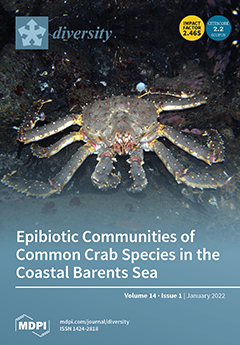
Cover Story: Although the Barents Sea is one of the most productive shelf regions of the Arctic, only a few large crustaceans occur here. Among them, the highest abundance and biomass are registered for the great spider crab, Hyas araneus, northern stone crab, Lithodes maja, and red king crab Paralithodes camtschaticus, with the latter being invasive for the Barents Sea. The calcified body surface of these decapods is a suitable substrate for many species of marine animals and plants. Studying epibiotic communities can contribute to basic knowledge on important aspects of the hosts’ biology, including molting and growth patterns, behavior, and migration activity, and can provide new information on the ecology of epibionts and symbionts, and biodiversity data in the region. View this paper
  • Issues are regarded as officially published after their release is announced to the table of contents alert mailing list .
  • You may sign up for email alerts to receive table of contents of newly released issues.
  • PDF is the official format for papers published in both, html and pdf forms. To view the papers in pdf format, click on the "PDF Full-text" link, and use the free Adobe Reader to open them.

Articles (60)

  • Article
  • Open Access
10 Citations
4,013 Views
15 Pages

Underwater Video as a Tool to Quantify Fish Density in Complex Coastal Habitats

  • Ronald Baker,
  • Dakota Bilbrey,
  • Aaron Bland,
  • Frank D’Alonzo,
  • Hannah Ehrmann,
  • Sharon Havard,
  • Zoe Porter,
  • Sarah Ramsden and
  • Alexandra R. Rodriguez

13 January 2022

Habitat loss is a serious issue threatening biodiversity across the planet, including coastal habitats that support important fish populations. Many coastal areas have been extensively modified by the construction of infrastructure such as ports, sea...

  • Article
  • Open Access
1 Citations
2,806 Views
15 Pages

12 January 2022

Seasonal variations in the picophytoplankton community structure (Synechococcus spp. and picoeukaryotes) were studied by flow cytometry in the coastal ecosystem of the subtropical western Pacific from October 2019 to September 2020. Synechococcus spp...

  • Article
  • Open Access
5 Citations
2,917 Views
12 Pages

12 January 2022

Traditionally, morphological characters are widely used to distinguish between interspecies and intraspecies. In addition to the size of morphological characters, shape has also been used as an indicator in the last decades. We evaluated the geometri...

  • Article
  • Open Access
4 Citations
2,715 Views
12 Pages

12 January 2022

Management of invasive alien species is a high priority for biodiversity conservation. Here, we studied the effects of glyphosate application, at 0.06 g/m2 concentration, on physiologically integrated basal and apical ramets of the invasive clonal pl...

  • Article
  • Open Access
11 Citations
4,366 Views
16 Pages

11 January 2022

We document diversity and its distribution within the hyperdiverse Monomorium nigrius Forel group of the Australian monsoonal tropics, an unrecognized global centre of ant diversity. The group includes a single described species, but several distinct...

  • Article
  • Open Access
2 Citations
2,897 Views
14 Pages

11 January 2022

Alongside the direct destruction of natural habitats and changes in land use, invasive species are considered one of the greatest threats to global biodiversity. Daisy fleabane Erigeron annuus (L.) Pers. is among the most widespread invasive plants i...

  • Article
  • Open Access
4 Citations
3,322 Views
10 Pages

Exploring the Genetic Diversity among Weedy Rice Accessions Differing in Herbicide Tolerance and Allelopathic Potential

  • Swati Shrestha,
  • Gourav Sharma,
  • Shandrea Stallworth,
  • Edilberto D. Redona and
  • Te Ming Tseng

11 January 2022

Increasing agricultural productivity is indispensable to meet future food demand. Crop improvement programs rely heavily on genetic diversity. The success of weeds in the ecosystem can be attributed to genetic diversity and plasticity. Weedy rice, a...

  • Viewpoint
  • Open Access
39 Citations
9,087 Views
22 Pages

Biodiversity Monitoring in Mediterranean Marine Protected Areas: Scientific and Methodological Challenges

  • Carlo Nike Bianchi,
  • Annalisa Azzola,
  • Silvia Cocito,
  • Carla Morri,
  • Alice Oprandi,
  • Andrea Peirano,
  • Sergio Sgorbini and
  • Monica Montefalcone

10 January 2022

Biodiversity is a portmanteau word to indicate the variety of life at all levels from genes to ecosystems, but it is often simplistically equated to species richness; the word ecodiversity has thus been coined to address habitat variety. Biodiversity...

  • Article
  • Open Access
5 Citations
4,436 Views
17 Pages

Phytoplankton Biodiversity in Two Tropical, High Mountain Lakes in Central Mexico

  • Estela Cuna,
  • Javier Alcocer,
  • Martha Gaytán and
  • Margarita Caballero

10 January 2022

Lakes El Sol and La Luna, inside the crater of the Nevado de Toluca volcano, Central Mexico, are the only two perennial high mountain lakes [HML] in the country. HML are considered among the most comparable ecosystems worldwide. These lakes are &ldqu...

  • Article
  • Open Access
5 Citations
5,705 Views
15 Pages

Ain’t Nothing like Family—Female Brown Bears Share Their Home Range with Relatives

  • Astrid Olejarz,
  • Jouni Aspi,
  • Ilpo Kojola,
  • Vesa Nivala,
  • Alina K. Niskanen and
  • Jenni Harmoinen

10 January 2022

Sociality in animal populations is a continuum, and interactions between conspecifics are meaningful for all vertebrates. Ignorance of social structures can lead to misunderstanding their ecology and, consequently, to unsuccessful species management....

of 6

Get Alerted

Add your email address to receive forthcoming issues of this journal.

XFacebookLinkedIn
Diversity - ISSN 1424-2818