You are currently viewing a new version of our website. To view the old version click .

International Journal of Molecular Sciences, Volume 23, Issue 10

May-2 2022 - 570 articles

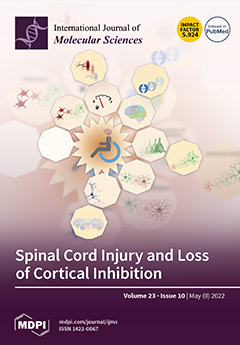
Cover Story: Altered cortical inhibition after a spinal cord injury is often studied with noninvasive approaches, such as transcranial magnetic stimulation. When present, disinhibition may contribute to the amelioration of motor recovery, but maladaptive disinhibition may lead to the aggravation of symptoms. Changes in cortical excitability result from a plethora of processes, such as inflammation, metabolic stress, plasticity, neurotransmitter modulation, etc., the individual effects of which may combine in complex and variable outcomes. Nevertheless, the loss of inhibition may become a valuable resource for rehabilitation therapy. Thus, a better understanding of the mechanisms and dynamics of cortical disinhibition after a spinal cord injury will help to improve therapeutic strategies through more targeted interventions. View this paper
  • Issues are regarded as officially published after their release is announced to the table of contents alert mailing list .
  • You may sign up for email alerts to receive table of contents of newly released issues.
  • PDF is the official format for papers published in both, html and pdf forms. To view the papers in pdf format, click on the "PDF Full-text" link, and use the free Adobe Reader to open them.

Articles (570)

  • Article
  • Open Access
6 Citations
3,016 Views
13 Pages

Fluctuations in Corneal Endothelial LAP2 Expression Levels Correlate with Passage Dependent Declines in Their Cell Proliferative Activity

  • Eleonora Maurizi,
  • Alessia Merra,
  • Davide Schiroli,
  • Benedetta Ghezzi,
  • Claudio Macaluso and
  • Graziella Pellegrini

The corneal endothelium is the inner corneal mono-layered epithelium, fundamental for preserving corneal hydration and transparency. However, molecular mechanisms that regulate corneal endothelial cells (CEnCs), in particular regarding their prolifer...

  • Article
  • Open Access
23 Citations
6,235 Views
20 Pages

NKG2C+ NK Cells for Immunotherapy of Glioblastoma Multiforme

  • Shafiq Murad,
  • Susanne Michen,
  • Alexander Becker,
  • Monika Füssel,
  • Gabriele Schackert,
  • Torsten Tonn,
  • Frank Momburg and
  • Achim Temme

In glioblastoma, non-classical human leucocyte antigen E (HLA-E) and HLA-G are frequently overexpressed. HLA-E loaded with peptides derived from HLA class I and from HLA-G contributes to inhibition of natural killer (NK) cells with expression of the...

  • Article
  • Open Access
11 Citations
4,085 Views
18 Pages

Characterisation of Extracellular Vesicles from Equine Mesenchymal Stem Cells

  • Robert Soukup,
  • Iris Gerner,
  • Sinan Gültekin,
  • Hayeon Baik,
  • Johannes Oesterreicher,
  • Johannes Grillari and
  • Florien Jenner

Extracellular vesicles (EVs) are nanosized lipid bilayer-encapsulated particles secreted by virtually all cell types. EVs play an essential role in cellular crosstalk in health and disease. The cellular origin of EVs determines their composition and...

  • Review
  • Open Access
2 Citations
4,120 Views
18 Pages

The formative period of adolescence plays a crucial role in the development of skills and abilities for adulthood. Adolescents who are affected by mental health conditions are at risk of suicide and social and academic impairments. Gene–environ...

  • Article
  • Open Access
9 Citations
3,374 Views
14 Pages

Inhibition of the papain-like protease (PLpro) of SARS-CoV-2 has been demonstrated to be a successful target to prevent the spreading of the coronavirus in the infected body. In this regard, covalent inhibitors, such as the recently proposed VIR251 l...

  • Article
  • Open Access
3 Citations
3,181 Views
15 Pages

The Effect of Activated FXIII, a Transglutaminase, on Vascular Smooth Muscle Cells

  • Réka Bogáti,
  • Éva Katona,
  • Amir H. Shemirani,
  • Enikő Balogh,
  • Helga Bárdos,
  • Viktória Jeney and
  • László Muszbek

Plasma factor XIII (pFXIII) is a heterotetramer of FXIII-A and FXIII-B subunits. The cellular form (cFXIII), a dimer of FXIII-A, is present in a number of cell types. Activated FXIII (FXIIIa), a transglutaminase, plays an important role in clot stabi...

  • Article
  • Open Access
4 Citations
2,871 Views
18 Pages

Physoxia Influences Global and Gene-Specific Methylation in Pluripotent Stem Cells

  • Fatma Dogan,
  • Rakad M. Kh Aljumaily,
  • Mark Kitchen and
  • Nicholas R. Forsyth

Pluripotent stem cells (PSC) possess unlimited proliferation, self-renewal, and a differentiation capacity spanning all germ layers. Appropriate culture conditions are important for the maintenance of self-renewal, pluripotency, proliferation, differ...

  • Article
  • Open Access
8 Citations
3,647 Views
21 Pages

Molecular and Physiological Responses of Citrus sinensis Leaves to Long-Term Low pH Revealed by RNA-Seq Integrated with Targeted Metabolomics

  • Ning-Wei Lai,
  • Zhi-Chao Zheng,
  • Dan Hua,
  • Jiang Zhang,
  • Huan-Huan Chen,
  • Xin Ye,
  • Zeng-Rong Huang,
  • Jiuxin Guo,
  • Lin-Tong Yang and
  • Li-Song Chen

Low pH-induced alterations in gene expression profiles and organic acids (OA) and free amino acid (FAA) abundances were investigated in sweet orange [Citrus sinensis (L.) Osbeck cv. Xuegan] leaves. We identified 503 downregulated and 349 upregulated...

  • Article
  • Open Access
4 Citations
2,953 Views
20 Pages

Theragnostic Efficacy of K18 Response in Alcohol Use Disorder with Clinically Significant Fibrosis Using Gut-Liver Axis

  • Manasa Sagaram,
  • Ranganathan Parthasarathy,
  • Sally L. Condon,
  • Charles F. Closson,
  • Maiying Kong,
  • Melanie L. Schwandt,
  • Loretta L. Jophlin,
  • Wenke Feng,
  • Ashutosh J. Barve and
  • Vatsalya Vatsalya

(1) Background: Fibrosis in early-stage alcohol-associated liver disease (ALD) is commonly under-diagnosed in routine clinical practice. This study characterized the liver-injury and cell death response in alcohol use disorder (AUD) patients with ALD...

  • Article
  • Open Access
9 Citations
3,681 Views
14 Pages

Analysis of Huntington’s Disease Modifiers Using the Hyperbolic Mapping of the Protein Interaction Network

  • Aimilia-Christina Vagiona,
  • Pablo Mier,
  • Spyros Petrakis and
  • Miguel A. Andrade-Navarro

Huntington’s disease (HD) is caused by the production of a mutant huntingtin (HTT) with an abnormally long poly-glutamine (polyQ) tract, forming aggregates and inclusions in neurons. Previous work by us and others has shown that an increase or...

of 57

Get Alerted

Add your email address to receive forthcoming issues of this journal.

XFacebookLinkedIn
Int. J. Mol. Sci. - ISSN 1422-0067