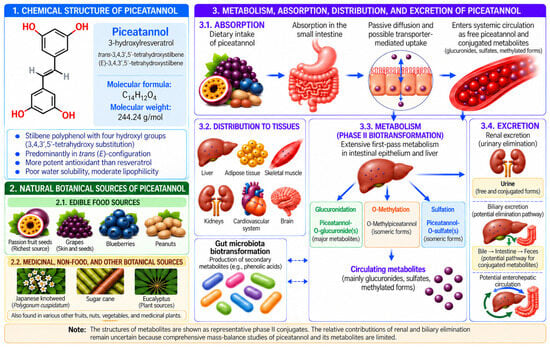
Background/Objectives: Obesity is a multifactorial chronic disease involving adipose tissue dysfunction, low-grade inflammation, oxidative stress, mitochondrial dysfunction, and insulin resistance, contributing to type 2 diabetes mellitus, metabolic dysfunction-associated steatotic liver disease, cardiovascular disease, and other complications. Piceatannol (3,3′,4,5′-tetrahydroxystilbene), a naturally occurring stilbene related to resveratrol, has attracted interest for its potential to modulate these interconnected processes. This narrative review critically synthesizes mechanistic, pharmacokinetic, preclinical, clinical, and translational evidence concerning piceatannol in adipose tissue dysfunction, metabolic inflammation, and insulin resistance and identifies major knowledge gaps and research priorities. Methods: PubMed/MEDLINE, Scopus, Web of Science Core Collection, and Google Scholar were searched from inception through 31 August 2026 for in vitro, animal, and human studies examining piceatannol in obesity, adipose tissue biology, inflammation, oxidative stress, glucose and lipid metabolism, insulin resistance, pharmacokinetics, and bioavailability. Evidence was synthesized using a structured narrative approach, with relevant SANRA quality-assessment domains considered during manuscript preparation and critical appraisal. Results: Piceatannol modulates multiple mechanisms implicated in obesity-associated metabolic dysfunction. In vitro studies demonstrate suppression of adipogenesis, attenuation of inflammatory and oxidative responses, and improvement in adipocyte metabolism and insulin signaling through pathways including AMPK, SIRT1, NF-κB, PI3K/Akt, MAPKs, and PPARγ. Selected animal studies have reported improvements in specific measures of weight gain, adiposity, hepatic lipid accumulation, glucose regulation, and inflammatory or oxidative markers; however, these findings vary across models and endpoints and have not been consistently replicated. A limited number of direct experimental comparisons have identified differences between piceatannol and resveratrol in selected biological endpoints. However, these findings are specific to the investigated models and experimental conditions and do not establish overall superiority in antioxidant, anti-inflammatory, or metabolic activity. No direct clinical comparisons are currently available to establish relative efficacy or safety. Preliminary randomized clinical studies using purified piceatannol have reported improvements in insulin resistance indices and blood pressure in selected populations, although findings remain inconsistent across metabolic outcomes. Studies involving piceatannol-rich passion fruit seed extracts have also reported beneficial effects on selected health-related outcomes; however, these effects cannot be attributed exclusively to piceatannol because of the presence of other bioactive constituents. Overall, human evidence remains limited by small sample sizes, heterogeneous study designs, and short intervention durations. Limited oral bioavailability and extensive phase II metabolism further constrain translation, while preliminary formulation studies suggest improvements in selected physicochemical or preclinical absorption parameters without establishing enhanced human systemic exposure, target-tissue delivery, or clinical efficacy. Conclusions: Piceatannol is a naturally occurring stilbene with experimentally observed biological activities relevant to several pathways implicated in obesity-associated metabolic dysfunction. Although cellular studies provide mechanistic and functional evidence, animal investigations remain relatively few and heterogeneous, with variable effects across metabolic outcomes. Preliminary human studies have reported changes in selected cardiometabolic and molecular biomarkers, but these findings do not establish clinically meaningful anti-obesity efficacy or superiority over resveratrol. Future research should prioritize standardized formulations, pharmacokinetic and dose–response characterization, independent preclinical replication, long-term safety evaluation, and adequately powered randomized controlled trials assessing clinically relevant metabolic outcomes.