Skip to Content
  • 4.8
    Impact Factor
  • 10.3
    CiteScore
  • 13 days
    Submission to First Decision
  • 3 days
    Acceptance to Publication

Nanomaterials

Nanomaterials is an international, interdisciplinary, peer-reviewed, open access journal published semimonthly online by MDPI, and that publishes reviews, regular research papers, communications, and short notes that are relevant to any field of study that involves nanomaterials with respect to their science and applications. The Spanish Carbon Group (GEC) and The Chinese Society of Micro-Nano Technology (CSMNT) are affiliated with Nanomaterials and their members receive discounts on the article processing charges.

Get Alerted

Add your email address to receive forthcoming issues of this journal.

All Articles (23,024)

  • Article
  • Open Access

Platinum (Pt) remains the standard counter electrode (CE) material for dye-sensitized solar cells (DSSCs), yet its high cost and corrosion in I−/I3− electrolyte continue to drive the search for low-cost, Earth-abundant alternatives. Here, SnO2/SnS2-modified MoS2 nanostructures are synthesized by a low-temperature hydrothermal method and spin-coated on fluorine-doped tin oxide glass as a Pt-free CE. The resulting SnO2/SnS2-modified MoS2 film consists of nanoparticles and nanosheets with a porous structure, which provides abundant diffusion channels and electrocatalytic active sites for the I−/I3− redox couple. Electrochemical measurements show that the SnO2/SnS2-modified MoS2 CE exhibits electrocatalytic activity close to that of a Pt CE. The DSSC assembled with the SnO2/SnS2-modified MoS2 CE achieves a champion power conversion efficiency of 6.21%, comparable to 6.43% for the Pt-based DSSC. The average efficiency of the corresponding ten DSSCs is 6.07 ± 0.13%. These results demonstrate that SnO2/SnS2-modified MoS2 is a promising Pt-free CE material for DSSCs.

Nanomaterials

23 November 2026

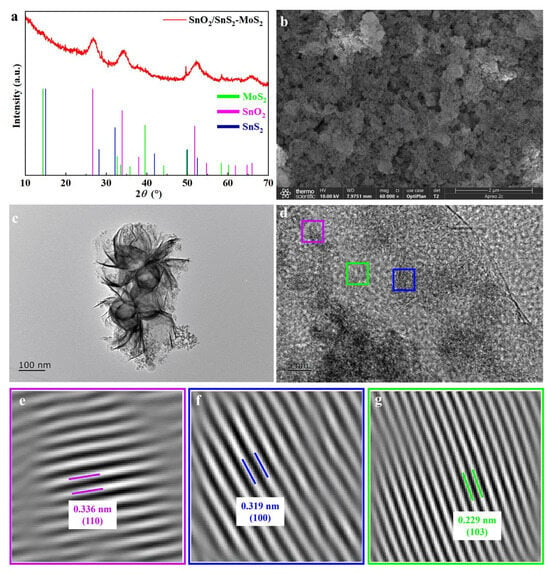
(a) XRD pattern of SnO2/SnS2-MoS2 powder. (b) SEM image of SnO2/SnS2-MoS2 film. (c) TEM and (d–g) HRTEM images of SnO2/SnS2-MoS2 powder. Colored frames in (d–g) indicate regions used for lattice spacing measurements.
  • Review
  • Open Access

Liquid–solid contact electrification (CE) is a ubiquitous natural phenomenon. Liquid–solid triboelectric nanogenerators (LS-TENGs), based on this effect, hold great significance for liquid information sensing and energy harvesting. Notably, liquid–solid CE can occur on the surfaces of various solid materials, including insulators, conductors, and semiconductors. Since the interaction mechanisms between liquids and different solids are fundamentally distinct, their working principles, output performance, and application directions also differ accordingly. In this review, we adopt a material-classified framework and provide a systematic overview for each type. For insulator-based LS-TENGs, we detail the research origins, electric double-layer formation models, and advances in design optimization. For conductor- and semiconductor-based LS-TENGs, we highlight the fundamental principles of the tribovoltaic effect and experimental verification results across different material systems. By summarizing internal working mechanisms and tracing the development trajectory of LS-TENGs across different material types, this review integrates scattered findings into a unified theoretical framework and offers a systematic cross-material perspective, aiming to provide guidance for applications such as blue energy harvesting and aquatic information sensing.

Nanomaterials

23 November 2026

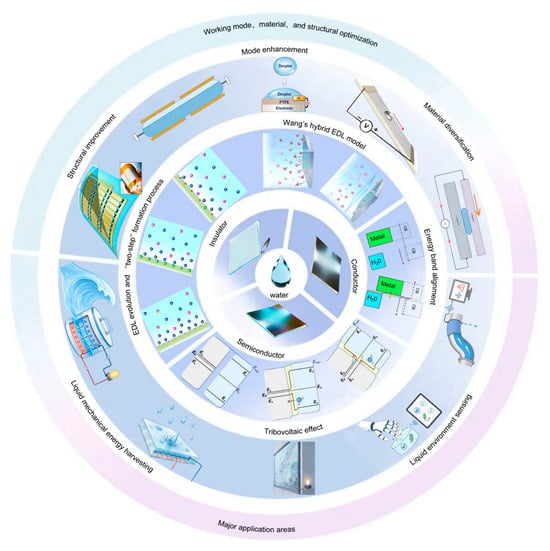
Unified framework of LS-TENGs, classified by solid materials from insulators and semiconductors to conductors, encompassing working mechanisms, device optimization, and applications [38,43,55,56,57,58,59,60]. Reproduced with permission from Zhan, F., ACS Nano; published by American Chemical Society, 2020. Reproduced with permission from Zhong, H., Adv. Funct. Mater.; published by Wiley, 2017. Reproduced with permission from Wang, Z., Chem. Soc. Rev.; published by Royal Society of Chemistry, 2024. Reproduced with permission from Zhao, X. J., ACS Nano.; published by American Chemical Society, 2018. Reproduced with permission from Lin, S., Chem. Rev.; published by American Chemical Society, 2022.
  • Article
  • Open Access

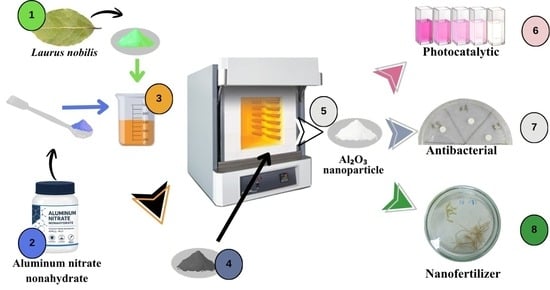
Urban green waste is mostly composted or used for energy, and its potential for material production remains largely untapped. Here, an aqueous extract of Laurus nobilis pruning waste was used to green-synthesize alumina nanoparticles (NPs), which were evaluated for dye decolorization, antibacterial activity and effects on bean seedlings. XRD indicated a cubic defect-spinel transition alumina tentatively consistent with η-Al2O3 (apparent Scherrer crystallite size, 7.31 nm), and SEM showed ~29 nm surface particles within micrometre-scale agglomerates. Under UV irradiation, 62.18% decolorization of Basic Fuchsin was observed after 180 min in the presence of the NPs; a catalyst-free UV control was not performed, so the contribution of direct photolysis could not be separated from nanoparticle-assisted removal, while no measurable net removal was observed in the parallel dark experiment; decolorization efficiency decreased to approximately 19% in the fifth cycle. The NPs showed no marked antibacterial activity against the tested strains at 12.5–50 mg/mL. In an exploratory assay with etiolated Phaseolus vulgaris seedlings, growth parameters showed no consistent dose-dependent trend, whereas pigment contents varied non-monotonically, peaking at 40 mg/L and declining at 160 mg/L. Bay laurel pruning waste can thus serve as a reaction medium for transition alumina synthesis, but the energy demand of calcination, catalyst deactivation and dose-dependent plant responses require further study.

Nanomaterials

23 November 2026

(a) XRD pattern of the synthesized cubic defect-spinel transition alumina and (b) the η-Al2O3 reference pattern (reference code 98-006-6558) used for comparison. Similarity to this reference does not independently distinguish η- from γ-like transition alumina.
  • Article
  • Open Access

Developing efficient Co3O4-based electrocatalysts for the oxygen evolution reaction (OER) requires effective regulation of both catalyst structure and surface electronic properties. Herein, a Ru- and La-modified Co3O4 nanocatalyst (RuLa-Co3O4) was prepared using ZIF-67 as the precursor through sequential La introduction during precursor formation and subsequent Ru incorporation by solution treatment and secondary annealing. Structural and spectroscopic characterization showed that precursor-level La modification influenced the morphological evolution of the derived Co3O4, while subsequent Ru treatment induced pronounced surface reconstruction and changes in the interfacial electronic environment. In 1.0 M KOH, RuLa-Co3O4 required an overpotential of 290 mV to reach 10 mA cm−2 and exhibited a Tafel slope of 79.13 mV dec−1 and a charge-transfer resistance of 8.9 Ω, outperforming the singly modified counterparts and commercial RuO2 under the same conditions. TMA+ probe experiments produced no appreciable activity suppression, suggesting that lattice-oxygen participation was not the dominant pathway. These results show that sequential La and Ru modification can effectively regulate the structural and interfacial properties of Co3O4 for enhanced OER performance.

Nanomaterials

23 November 2026

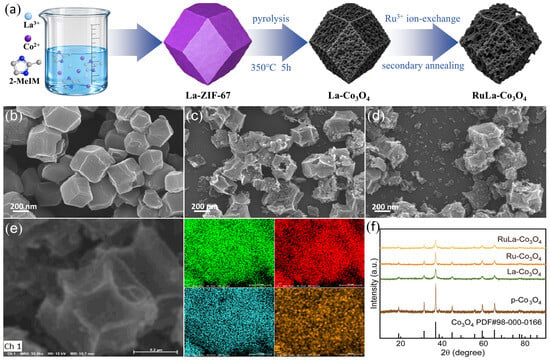
(a) Schematic illustration of the synthesis route to RuLa-Co3O4 nanocatalyst. SEM images of (b) La-ZIF-67, (c) La-Co3O4, and (d) RuLa-Co3O4. (e) EDS elemental mappings of Co, O, Ru, and La in RuLa-Co3O4. (f) XRD patterns of the synthesized catalysts.

Highly Accessed Articles

News & Conferences

Latest Issues

Open for Submission

Journal Sections

XFacebookLinkedIn
Nanomaterials - ISSN 2079-4991