
Skip to Content
  • 0.7
    Impact Factor
  • 1.2
    CiteScore
  • 30 days
    Submission to First Decision
  • 6 days
    Acceptance to Publication

Games

Games is a scholarly, peer-reviewed, open access journal of studies on game theory and its applications published bimonthly online by MDPI.

Get Alerted

Add your email address to receive forthcoming issues of this journal.

All Articles (892)

  • Article
  • Open Access

Bio-Inspired Resource-Constrained Potential Games for Task Allocation in Autonomous Multi-Agent Systems

  • Olga Torstensson,
  • Dmytro Prokopovych-Tkachenko and
  • Kamilya Kydykova
  • + 3 authors

Autonomous multi-agent systems must allocate tasks under limited energy, computation, memory, and communication. We model this problem as a finite task-allocation game with shared task rewards, congestion and agent-specific resource costs, in which bee-, fly-, and ant-inspired modules supply cost estimates, safety restrictions, and trace-based action preferences. Under frozen-context and separability assumptions, the game has an exact potential, pure Nash equilibria, and finite improvement paths; these properties follow from classical congestion- and potential-game results. The contribution lies in making their assumptions operational under resource limits: an uncertainty-gated update rule whose stopping certificate holds under deterministic, profile-dependent, or calibrated error bounds; an explicit protocol for occupancy information and single-agent updates; and bounds on how trace updating, information ageing and private-cost error shift the stationary law of trace-biased logit learning. Constructed examples show that equilibrium and efficiency differ; in one case, the price of anarchy is 1.25 over pure equilibria and 1.6875 over all Nash equilibria. In synthetic comparisons with 10–50 agents and five disturbance conditions, uncertainty-gated updates matched exact-information best response at about one-fifth of the evaluation cost of logit learning, and their certificate held whenever the error allowance covered the actual error and occupancy counts were current. Trace bias did not improve on uniform-reference logit with stale, informative or misleading traces, and all decentralised rules reached only 20–45% of the centralised welfare optimum because the equal-share incentive over-subscribes valuable tasks. Replacing the equal share with a marginal-contribution utility, which keeps an exact potential and needs the same occupancy counts, raised this to 84–86%, and a task-level locking variant of the update protocol kept the steady-state certification latency nearly constant up to 200 agents, whereas under token serialisation it grew linearly. Scripts, outputs, and checksums are provided for every reported result; hardware energy savings and real-world performance remain untested.

Games

23 November 2026

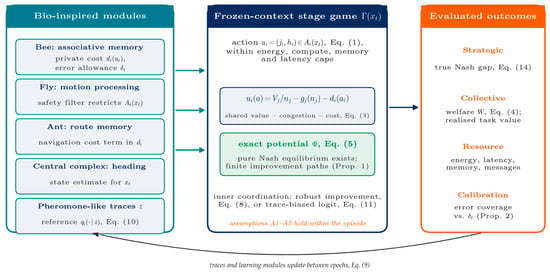
Layered structure of the proposed framework. Bio-inspired modules (left) supply cost estimates, error allowances, safety restrictions, and trace-derived references to the frozen-context stage game (centre), whose outcomes are evaluated separately (right). Traces and learning modules are updated only between physical epochs. The module examples in the left panel draw on Roper et al. (2017) and Ou et al. (2026) (bee), Schoepe et al. (2024) (fly), Gattaux et al. (2025) (ant), Stentiford et al. (2024) (central complex), and Hunt et al. (2019) (pheromone-like traces).
  • Feature Paper
  • Article
  • Open Access

This paper examines how internalized honesty and reputation can mitigate adverse selection when buyers lack an exogenous quality index. A privately informed seller probabilistically chooses whether to offer or withhold a product using a free-energy policy rule. Internalized norms enter as a prior policy bias, whereas reputation changes anticipated consequences. A buyer observing an offer updates beliefs about quality through Bayes’ rule and decides whether to purchase at an exogenous posted price. Seller payoffs specify reservation values, offering costs, and expected reputational losses. Seller policy incorporates the anticipated probability of purchase, and a behavioral consistency condition requires this anticipation to agree with the buyer’s optimal response. On the full-purchase branch, stronger honesty and reputation discourage lemon offers and increase the buyer’s posterior probability of high quality. I derive a threshold under which purchase after an offer is strategically consistent and high-quality trade occurs with positive probability. This is a result about posted-price trade rather than a complete Akerlof-type unraveling equilibrium. The framework shows how socially embedded behavior can generate informative seller actions without a physical quality index.

Games

12 November 2026

  • Article
  • Open Access

Cooperative games with transferable utility are a standard framework for modeling collaboration, fair division, cost sharing, and coalition formation. Computing central solution concepts such as the Shapley value, the core, the least core, and the nucleolus is often computationally difficult because a general game contains exponentially many coalitions. Recent work on extremal dividend structures, such as sunflower-dividend games, shows that restricting the Harsanyi dividend support to a structured set family can restore substantial algorithmic tractability. This paper introduces Frankl–Wilson dividend games, also called L-intersecting dividend games, a class of cooperative games in which the nonzero non-singleton Harsanyi dividends are supported on a structured intersection family. We distinguish two precise cases. In the uniform ordinary case, the dividend support is an r-uniform L-intersecting family: every two distinct dividend coalitions have an intersection size belonging to a fixed set L. In the modular Frankl–Wilson case, the dividend support satisfies prescribed intersection congruences modulo a prime p, together with the admissibility condition that coalition sizes avoid the allowed intersection residues modulo p. The algorithmic tools used in this paper are classical: the Shapley value is computed from Harsanyi dividends, and coalition-excess separation for non-negative dividends is performed via the standard maximum-weight closure construction. The paper does not propose a new Shapley algorithm, a new maximum-flow algorithm, or a new linear-programming method. Its main contribution is structural: it identifies Frankl–Wilson admissible dividend supports as a cooperative-game condition under which these classical procedures receive a polynomially compact input and therefore become polynomial-time algorithms in the number of players when the intersection complexity is fixed. We prove several results. First, for a modular Frankl–Wilson dividend game with residue set A and s = ∣A∣, the non-singleton dividend support has size at most ∑i=0sni, which is polynomial in n for fixed s. In the uniform ordinary case with ∣L∣ = s, the support size is at most ns. Second, when the dividend support is explicitly given, the Shapley value is computable in time polynomial in n, the support size, and the input bit length. Third, for non-negative dividends, core and least-core separation can be performed through a maximum-weight closure construction whose graph size is polynomial in the dividend support. Hence, for fixed intersection complexity s, the least core is polynomial-time computable under explicit support. Fourth, we state a conditional nucleolus result. If the fixed constraints in the lexicographic scheme have a polynomial-size explicit representation and a polynomial-time constrained K-best closure oracle is available, then the nucleolus is polynomial-time computable. Without these additional assumptions, nucleolus computation for general Frankl–Wilson dividend games remains open. Fifth, if a game’s Harsanyi dividends can be approximated in dividend mass by an L-intersecting or Frankl–Wilson-admissible subfamily, then its Shapley value can be approximated with additive error bounded by the omitted dividend mass. We also show that total dividend approximation error gives explicit approximate least-core and approximate-core stability bounds. Frankl–Wilson dividend games are closely related to several extremal dividend structures. Sunflower active coalitions with common kernel size κ form a {κ}-intersecting family; when the active coalitions are uniform, they fit the Type I case, and under additional modular admissibility conditions they may also fit Type II. Pairwise disjoint dividend coalitions correspond to L = {0}. Finite-geometric designs, block designs, and modular intersection families provide natural examples. The paper therefore extends the research program of using extremal set theory to create cooperative-game classes with exact or certified approximate tractability.

Games

4 November 2026

  • Feature Paper
  • Article
  • Open Access

Osaka’s public high school admissions system uses a common score-based priority order and schools’ preferences, while restricting each student to reporting a single school. We show that the Osaka mechanism is neither priority-stable nor preference-stable, is not strategy-proof for students, and can conceal substantial instability in the admission records. Allowing students to report more schools weakly reduces underlying instability and the number of manipulable students, while making more of the remaining blocking pairs visible. Simulations show that tight reporting compresses quantitative differences across mechanisms. In the unstructured environment, the Osaka mechanism occupies an intermediate position between serial dictatorship and deferred acceptance, but this position disappears in the structured environment. The results show the benefits of broader reporting and the limits of Osaka’s compromise between score-based priority and school discretion.

Games

3 November 2026

Highly Accessed Articles

News & Conferences

Latest Issues

Open for Submission

Journal Sections

XFacebookLinkedIn
Games - ISSN 2073-4336