


Abstract
Osaka’s public high school admissions system uses a common score-based priority order and schools’ preferences, while restricting each student to reporting a single school. We show that the Osaka mechanism is neither priority-stable nor preference-stable, is not strategy-proof for students, and can conceal substantial instability in the admission records. Allowing students to report more schools weakly reduces underlying instability and the number of manipulable students, while making more of the remaining blocking pairs visible. Simulations show that tight reporting compresses quantitative differences across mechanisms. In the unstructured environment, the Osaka mechanism occupies an intermediate position between serial dictatorship and deferred acceptance, but this position disappears in the structured environment. The results show the benefits of broader reporting and the limits of Osaka’s compromise between score-based priority and school discretion.
1. Introduction
Public high school admissions in Osaka constitute a large centralized matching problem involving tens of thousands of students each year.1 Standardized exam scores provide a common basis for ranking applicants, while schools retain limited discretion to select students in line with their own admission policies. At this scale, however, it is impractical for schools to review every applicant in detail. The design challenge is therefore to preserve a common score-based order while giving schools a limited role in student selection.
Osaka addresses this challenge through a two-stage admission procedure.2 Each student may apply to only one school. At each school, applicants are ranked by exam score, and only the highest-ranked applicants, up to 110% of the school’s capacity, enter the review pool. The school then fills 90% of its seats in score order and allocates the remaining 10% among the other applicants in the review pool according to its own preferences. School discretion is thus limited to applicants who pass the initial score-based screening.
The procedure gives a role to both the common priority order and schools’ preferences rather than relying exclusively on either ranking. It is intended to moderate the tension between score-based priority and school discretion. This raises the question: how does this design perform when students can report only a limited number of schools?
To address this question, we formulate a many-to-one matching model with two rankings: exam scores induce a common priority order, while each school has its own preferences over students. These rankings give rise to two notions of stability. Priority stability captures score-based fairness: no student should be denied a preferred school that has a vacant seat or admits a lower-priority student. Preference stability is the classical notion based on schools’ preferences. A matching is double-stable if it satisfies both. We also consider students’ incentives to misreport their preferences. The Osaka mechanism guarantees neither form of stability, is not strategy-proof for students, and may fail to select a double-stable matching even when one exists (Proposition 1). The use of both rankings therefore does not by itself reconcile the two stability requirements or eliminate incentives to misreport.
These stability notions are defined using students’ full preferences, whereas the admissions authority observes only the school each student reports. This information gap motivates our distinction between underlying and visible instability: a blocking pair is visible if the student reports the school involved. Under the Osaka mechanism, visible priority blocking at a school is bounded by the gap between its review cap and capacity, and visible double blocking cannot arise. Visible preference blocking, by contrast, remains unbounded (Proposition 2). The mechanism therefore does not eliminate instability; single-choice reporting filters which conflicts appear in the application records.
How does this picture change when students are allowed to report more schools? To answer this question, we embed the current Osaka mechanism in a K-choice family, , in which each student reports up to K schools while the school-side admission rule remains unchanged. As K increases, the number of unmatched students weakly decreases, and the underlying sets of priority, preference, and double blocking pairs weakly shrink, while the corresponding visible sets weakly expand (Proposition 3). Broader reporting therefore moves underlying and visible instability in opposite directions: it leaves fewer students unmatched and reduces underlying instability, but brings more of the remaining conflicts into view. Broader reporting also reduces manipulability: every problem at which is manipulable is also manipulable under for , while the converse need not hold (Proposition 4). Nevertheless, instability and manipulability can persist even with complete reporting (Proposition 5).
These results establish the direction of the changes, but not their magnitude. We complement the theory with simulations in both unstructured and structured environments. The simulations confirm these qualitative patterns and show that the gap between underlying and visible instability can be substantial under limited reporting. They also allow us to compare with the K-choice versions of serial dictatorship, , and student-proposing deferred acceptance, , under the same reporting limit.3
In the unstructured environment, where student preferences are randomly generated, tight reporting compresses quantitative differences across the three mechanisms. As students are allowed to report more schools, their outcomes diverge, and occupies an intermediate position between and : on average, it generates fewer preference blocking pairs than and fewer priority blocking pairs than . This stability compromise does not survive in the structured environment, where demand is shaped by geography and school quality. There, no longer lies between and along either stability dimension, a finding that persists throughout the parameter variations examined. Taken together, the results point to the value of broader reporting, but also reveal the limits of Osaka’s moderation: the stability compromise observed in the unstructured environment is not robust across market environments.
Institutional Background and Related Literature
Osaka’s current admissions system dates back to a reform implemented for the 2016 admissions cycle. Before the reform, admissions were based on students’ preferences and exam scores, while schools had no formal role in selecting among applicants. The reform altered this structure by allowing schools to select a limited number of students according to their own admission policies.4 The current Osaka mechanism thus retains its score-based structure while adding a limited school-side selection channel.
Another defining feature is that each student may apply to only one public high school. Under this restriction, the admissions authority observes each student’s demand only at the school they report. Osaka is now reconsidering this restriction and exploring the introduction of a second-choice option while retaining school discretion.5
This restriction connects the Osaka mechanism to the literature on limited reporting. In two-sided matching markets, truncation has been studied as a strategic restriction of submitted preferences (Coles & Shorrer, 2014; Ehlers, 2008; Roth & Rothblum, 1999). In school choice, related work examines institutional limits on how many schools students may list or apply to (Calsamiglia et al., 2010; Haeringer & Klijn, 2009). Such limits make submitted lists less informative and affect students’ reporting incentives. These concerns also arise in Japanese high school admissions, where limited application opportunities have been discussed as a source of unfairness and strategic application behavior (Aoi et al., 2021; Noda, 2025; Tanaka et al., 2020). Our analysis highlights a different implication of limited reporting: it affects what the admissions authority can observe. Substantial instability may persist in the matching while much of it remains hidden in the submitted applications.
School-choice models emphasize students’ priorities at schools (Abdulkadiroğlu & Sönmez, 2003; Balinski & Sönmez, 1999), whereas college-admissions models emphasize schools’ preferences over students (Gale & Shapley, 1962; Roth, 1985). Our model incorporates both: exam scores generate a common priority order, while schools have their own preferences over students.6 Because the two rankings need not select the same students, priority-based fairness and preference-based stability may conflict.
Westkamp (2013) studies a closely related problem in German university admissions, where different admission quotas use grade-based priorities and universities’ own selection criteria. He develops choice protocols and establishes conditions for a student-optimal, procedurally stable mechanism that is strategy-proof for students. When the review cap is nonbinding, Osaka’s within-school selection rule can be represented as a two-quota choice protocol. The notions of stability differ, however: his procedural stability evaluates blocking according to the ranking governing each quota, whereas our two stability notions evaluate the entire matching under each ranking, irrespective of the admission quota. Our research question also differs. Motivated by the proposed second-choice option, we study broader reporting while retaining Osaka’s school-side admission rule. The family allows us to examine how this change affects underlying and visible instability and students’ incentives to misreport.
- Roadmap. Section 2 sets up the many-to-one matching model, defines the stability and incentive notions, and introduces the benchmark mechanisms. Section 3 formalizes the Osaka mechanism and analyzes its stability, manipulability, visibility, and reporting-limit properties. Section 4 uses simulations to quantify these properties across reporting limits and market environments. Section 5 concludes. All proofs are collected in Appendix A.
2. The Model and Benchmark Mechanisms
This section sets up a many-to-one matching model with two rankings. We define the relevant stability and incentive notions and introduce serial dictatorship (SD) and deferred acceptance (DA) as benchmark mechanisms.
2.1. Environment and Stability
Let be the set of students and the set of schools. Each school has capacity . Each student has a strict preference over , where Ø denotes being unmatched. We write when s strictly prefers c to , and let denote the induced weak relation. Let denote the students’ preference profile.
Students are evaluated according to two distinct rankings. Standardized exam scores induce a common strict priority order ≻ on S, where means that s has a strictly higher score than . In addition, each school has a strict preference over feasible admission sets, which we assume to be responsive (Roth, 1985).7 Let denote the induced weak relation. Consistent with the admissions setting we study, we assume universal acceptability on the school side: for all and . Responsiveness and universal acceptability imply that is monotonic on feasible sets: if and , then . Let denote the schools’ preference profile.
A matching assigns each student to and each school to , such that and if and only if . Throughout, we restrict attention to individually rational matchings: for every .9
We distinguish three types of blocking pairs. Given a matching , a pair is a priority blocking pair (SBP) if and either or there exists with . Similarly, is a preference blocking pair (PBP) if and either or there exists with . Finally, is a double blocking pair (DBP) if and either or there exists such that and . Thus, when a school is full, a DBP requires the same admitted student to witness both the priority and preference components of blocking.
These blocking notions lead to three corresponding stability concepts.
Definition 1.
A matching μ is priority-stable if it is individually rational and admits no SBPs, preference-stable if it is individually rational and admits no PBPs, and double-stable if it is both priority-stable and preference-stable.
Priority stability captures score-based fairness (Abdulkadiroğlu & Sönmez, 2003; Balinski & Sönmez, 1999), whereas preference stability coincides with classical stability under schools’ preferences (Gale & Shapley, 1962; Roth, 1985). Double stability imposes both requirements.10 Since every DBP is both an SBP and a PBP, any priority-stable or preference-stable matching, and hence any double-stable matching, admits no DBPs.
2.2. Mechanisms and Incentives
A mechanism assigns a matching to each problem G. We write for student s’s assignment and for school c’s intake. We consider strategic deviations only by students. A mechanism is strategy-proof for students if, for every problem G, every student , and every misreport ,
We use two canonical strategy-proof mechanisms as benchmarks: serial dictatorship (SD) and student-proposing deferred acceptance (DA). They are defined as follows.
- The SD mechanism
- Step 1: The student with the highest priority is assigned to their most-preferred acceptable school; if no such school exists, they remain unmatched.
- Step : The student with the t-th highest priority is assigned to their most-preferred acceptable school with remaining capacity; if no such school exists, they remain unmatched. The mechanism terminates after all students have been processed.
- The student-proposing DA mechanism
- Step 1: Each student proposes to their most-preferred acceptable school. For each school c, let denote the set of students who propose to c in Step 1. School c tentatively accepts its most-preferred students in according to and rejects the rest.
- Step : Each student rejected in Step proposes to their most-preferred acceptable school that has not rejected them. For each school c, let denote the set consisting of its tentatively accepted students from Step together with the new proposers in Step t. School c tentatively accepts its most-preferred students in according to and rejects the rest. The mechanism terminates when no rejection occurs, at which point all tentative acceptances become final.
Both mechanisms are strategy-proof for students. Moreover, SD is priority-stable by construction, whereas DA is preference-stable by the standard deferred-acceptance argument. Neither mechanism combines the two rankings: SD depends only on ≻, while DA depends only on . This motivates the following distinction.
Definition 2.
A mechanism ϕ is extreme if either (i) schools’ preferences are irrelevant: for every problem and every , or (ii) the priority order is irrelevant: for every problem and every . A mechanism is moderate if it is not extreme.
Under Definition 2, SD and DA are extreme in opposite directions. The current Osaka mechanism, by contrast, is moderate: it uses both rankings under a single-choice reporting constraint. The next section examines the implications of this moderation for stability, incentives, and the structure of blocking pairs.
3. The Osaka Mechanism Under Limited Reporting
This section analyzes the Osaka mechanism and the role of limited reporting. We first examine the current single-choice mechanism and characterize the instability visible in the admission records. We then introduce a K-choice extension and study how broader reporting affects instability, visibility, and manipulability.
3.1. The Current Osaka Mechanism
For each school , let denote its review cap, its score quota, and its discretionary quota, where
Under the current mechanism, each student may apply to at most one school. Given a report profile , where , the mechanism proceeds as follows.
- The Osaka mechanism
- Step 1: Review and score-based admission. For each school c, let denote its set of applicants. School c retains the highest-priority applicants according to the common priority order ≻. Let denote the resulting review pool. Among the students in , school c admits the highest-priority students. Let denote the set of students admitted at this stage.
- Step 2: Discretionary admission. From the remaining reviewed applicants , school c admits its most-preferred students according to . Let denote the set of students admitted at this stage. The final intake of school c is
Let denote the matching induced by report profile m. For a problem G, write for the matching induced by truthful reports.11 By Definition 2, is moderate because its outcome can depend on both rankings. The following example illustrates how the mechanism operates and reveals several of its limitations.
Example 1.
Consider a market with and , where
Students’ preferences, schools’ preferences, and the common priority order are as follows:
Under truthful reporting, students apply to a, whereas apply to b. At school a, all three applicants are reviewed; receives the score seat, while receives the discretionary seat because a prefers to . At school b, both applicants are reviewed; receives the score seat and the discretionary seat. Hence,
The resulting matching is neither priority-stable nor preference-stable. In particular, is a double blocking pair: prefers b to being unmatched, has higher priority than , and is preferred by b to . The mechanism is also manipulable: by applying to b rather than a, obtains a score seat at b, which they strictly prefer to being unmatched. Moreover, although a double-stable matching exists, the mechanism does not select one. The matching that assigns and to a, assigns and to b, and leaves unmatched is double-stable.
The example illustrates three distinct limitations of the Osaka mechanism. These are not peculiar to this particular market but reflect general properties of the mechanism.
Proposition 1.
The current Osaka mechanism guarantees neither priority stability nor preference stability and is not strategy-proof for students. Even when a double-stable matching exists, need not select one.
Despite these limitations, the Osaka mechanism has remained in use for about a decade. One possible explanation lies in the distinction between the underlying instability of the resulting matching and the instability revealed by the admission records. We turn to this distinction next.
3.2. Visibility Under Single-Choice Reporting
Under single-choice reporting, the admissions authority observes each student’s demand only at the school they report. Whether a student–school pair blocks a matching, however, depends on students’ preferences, schools’ preferences, and the common priority order. The admission records may therefore reveal only part of the underlying instability.
We formalize this distinction through the notion of visibility. Given a report profile m, a blocking pair under is visible if . A visible SBP, PBP, or DBP is a visible blocking pair of the corresponding type. Example 1 illustrates the distinction. The resulting matching contains exactly one blocking pair, , which is a DBP. Since applies to a rather than b, this blocking pair is not visible. Thus, the matching is unstable even though no blocking pair is visible in the admission records.
More generally, the three types of blocking pairs exhibit distinct visibility properties under the current Osaka mechanism.
Proposition 2.
Under truthful reporting, the current Osaka mechanism satisfies the following properties:
- (i)
- For each school , the number of visible SBPs involving c is at most , and hence, the total number of visible SBPs is at most .
- (ii)
- No visible DBP can arise.
- (iii)
- Even with a fixed school set C and fixed policy parameters , the number of visible PBPs can be arbitrarily large as the number of students increases.
Proposition 2 shows that single-choice reporting selectively restricts the visibility of instability. Visible SBPs are bounded by the difference between the review caps and school capacities, and this bound can be attained (see Example A1 in Appendix A). No DBP can be visible, whereas visible PBPs can be arbitrarily numerous. The instability revealed by the admission records may therefore differ from the underlying instability of the matching. In particular, limited visible instability need not imply that the resulting matching is close to stable.
These results suggest that the reporting constraint shapes not only the resulting matching but also the relationship between underlying and visible instability. Allowing students to report more schools may change both the matching itself and which blocking relationships are revealed in the admission records. This raises a natural question: how do the matching and the visibility of instability change as the reporting constraint is relaxed?
3.3. Relaxing the Reporting Constraint
We extend the Osaka mechanism by allowing each student to report up to K schools while leaving the school-side admission rule unchanged. Fix . Each student may submit an ordered list of distinct acceptable schools, where . Let denote the report profile. Given m, the mechanism proceeds as follows.
- The K-choice Osaka mechanism
- Let denote the set of students who remain unmatched at the beginning of round r, with . In each round , every student with applies to . For each school , its round-r applicants are
- At the beginning of round r, school c’s remaining review capacity, score quota, and discretionary quota arewhere an empty sum is zero and the sets , , and are defined recursively below.
- Step 1: Review and score-based admission. School c ranks the students in according to the common priority order ≻ and reviews the top applicants, who form the review pool . It then admits the top students in according to ≻, forming .
- Step 2: Discretionary admission. School c admits the top students in according to , forming .
- Termination. Admissions are final. At the end of round r, the unmatched students are
- Each student proceeds to round if and . Unused review capacity and unfilled score and discretionary quotas carry over to the next round. The mechanism terminates after round K, or earlier if no unmatched student has another reported school. The final intake of school c is
For each student , let denote the truthful K-truncation of : the ordered list of their K most-preferred acceptable schools, or all acceptable schools if there are fewer than K. Let denote the outcome under the report profile . When , coincides with the current Osaka mechanism, whereas allows students to report all acceptable schools. Across the family , the common priority order, schools’ preferences, review capacities, score quotas, discretionary quotas, and the within-round admission rule remain unchanged; only the reporting limit varies.12
The following example illustrates how the extension operates as the reporting limit is relaxed.
Example 2.
Consider a market with and , where
Students’ preferences, schools’ preferences, and the common priority order are given by
Under , students apply to a, whereas applies to b. School a admits through the score channel and through the discretionary channel, while school b admits only . Hence,
Under , the first round is unchanged. In the second round, the unmatched students and apply to b. School b has two units of review capacity and one discretionary seat remaining. It reviews both students and admits , whom it prefers to . Hence,
Thus, the additional round allows , who remains unmatched under , to apply to and be admitted by their second-choice school b, while all first-round assignments are preserved.
The notion of visibility extends naturally to K-choice reporting. A blocking pair under is visible if c appears on student s’s submitted list . For , this definition coincides with that in Section 3.2. For each problem G, let , , and denote the sets of SBPs, PBPs, and DBPs under , respectively, and let , , and denote their visible subsets.
Example 2 also illustrates how broader reporting affects underlying and visible instability. Under , the SBPs are , while the PBPs and DBPs are both . Because and report only a, the only visible blocking pair is . Under , the SBPs are , while no PBP or DBP remains. Both SBPs are visible because reports both a and b. Thus, in this example, broader reporting reduces underlying instability while making more of the remaining instability visible. The following proposition establishes these set-inclusion relations generally.
Proposition 3.
Fix a problem G. Under truthful reporting, for every , the following statements hold.
- (i)
- For every school , . Moreover, every student assigned under receives the same assignment under . Hence, the number of unmatched students is weakly decreasing in K.
- (ii)
- For each , . Hence, the numbers of priority, preference, and double blocking pairs are weakly decreasing in K.
- (iii)
- For each , . Hence, the numbers of visible priority, preference, and double blocking pairs are weakly increasing in K.
Increasing the reporting limit from K to allows one additional round without changing the first K rounds. Students already admitted therefore keep their assignments, while previously unmatched students may obtain a school through an additional choice. This assignment-preservation property underlies Proposition 3: the underlying blocking sets weakly shrink, while their visible subsets weakly expand.
The same assignment-preservation property holds under the K-choice immediate acceptance mechanism ().13 We consider two variants: , which uses the common priority order ≻, and , which uses each school’s preference ranking . Proposition A1 in Appendix A shows that both variants satisfy the same three reporting-limit monotonicities as . By contrast, and need not preserve earlier assignments, and their visible blocking sets need not expand as the reporting limit increases; see Example A2 in Appendix A.
Remark 1 (Assignment preservation).
The three reporting-limit monotonicities hold for and both IA variants, reflecting their common assignment-preservation property. By contrast, and need not preserve earlier assignments.
The decline in total blocking does not reveal whether blocking falls only because vacant seats are filled, or whether fewer pairs also block at filled schools. We therefore distinguish blocking through vacant seats from blocking through displacement at filled schools. Let
denote the vacant-seat blocking pairs. For each , let
denote the displacement blocking pairs at filled schools.
The vacant-seat blocking sets weakly shrink as reporting expands: .14 By contrast, displacement blocking sets need not be nested: for each , neither
holds in general. Filling a vacant seat can leave a pair blocking through displacement: in Example 2, blocks through a vacancy under but remains an SBP through displacement of under . Displacement blocking pairs can also disappear. Example A3 in Appendix A establishes both directions of non-inclusion for all three blocking types.
Remark 2 (Composition of underlying blocking).
The total blocking sets weakly shrink as K increases, but individual displacement blocking pairs can emerge and disappear.
Next, we turn from instability to manipulability. For a problem G and a reporting limit , is manipulable at G if there exist a student and a feasible K-choice report such that
Thus, some student can profitably deviate from truthful K-choice reporting while all other students report truthfully.
Following Pathak and Sönmez (2013) and Chen and Kesten (2017), we compare mechanisms by the set of problems at which they are manipulable.
Proposition 4.
For any , is more manipulable than . That is, over the common domain of problems with at least L schools, every problem at which is manipulable is also manipulable under , while the converse fails for at least one problem.
Lemma A2 shows that any school obtainable through a deviation can also be obtained by reporting only that school as acceptable. Such a report is considered in the first round, when the other students’ applications are unchanged across reporting limits. Its outcome therefore does not depend on the reporting limit. Broader truthful reporting, however, may improve a student’s assignment. Thus, any student who can profitably manipulate under a longer reporting limit can also do so under a shorter one, while a previously profitable deviation may cease to be profitable as truthful assignments improve.
Example 2 illustrates this point. Under , remains unmatched when reporting truthfully but obtains b by reporting it instead of a. Under , they obtain b truthfully in the second round, so this deviation is no longer profitable. The proof of Proposition 4 also yields the following student-level implication.
Remark 3 (Manipulable students).
For a problem G, let denote the set of students who can profitably manipulate . Then, for every ,
Hence, the number of manipulable students is weakly decreasing in the reporting limit.
The preceding results show that relaxing the reporting limit weakly reduces both underlying instability and manipulability. This raises a natural question: can sufficiently broad reporting eliminate the failures identified for the current mechanism in Proposition 1? The answer is no. These failures can persist even when students can report all acceptable schools and the review constraint is nonbinding.
Proposition 5.
For every reporting limit , there exists a problem at which is neither priority-stable nor preference-stable, is manipulable, and fails to select a double-stable match even though one exists. Moreover, for every , such a problem can be constructed with
The theoretical results establish the effects of relaxing the reporting constraint and their limitations, but not their quantitative magnitude. They do not indicate how rapidly blocking pairs or manipulability decline as the reporting limit expands, how much of the remaining instability becomes visible, or how the Osaka mechanism compares with SD and DA under the same reporting limit. We therefore turn to simulations.
4. Simulation Analysis
This section uses simulations to quantify the effects established in Section 3 and to compare the Osaka mechanism with SD and DA under a common reporting limit. We examine how outcomes vary with the reporting limit and market environment, and then study how differences across the three mechanisms change with effective demand for public-school seats.
4.1. Simulation Design
Each simulated market consists of students and schools. Every school c has capacity , so aggregate capacity equals the number of students. This provides a balanced baseline in which differences across mechanisms are not driven by aggregate excess demand or excess capacity. To mirror the current Osaka system, we set the review cap to , the score quota to , and the discretionary quota to at every school. In all simulations, every school is acceptable to every student.
For each , every student truthfully reports their K most-preferred schools. We apply , , and to the same submitted lists.15 Within each simulated market, the three mechanisms face the same student preferences, school preferences, and common priority order. We also hold the underlying market fixed across values of K. Thus, variation across K isolates the effect of relaxing the reporting constraint, while comparisons at a given K isolate differences across allocation rules.
We evaluate each assignment along four dimensions. First, we count SBPs, PBPs, and DBPs under students’ full preferences. Second, we count the visible blocking pairs of each type, using the submitted lists to determine visibility. Third, we record the number of unmatched students. Finally, we measure strategic vulnerability by the number of students who can obtain a strictly preferred assignment through a unilateral misreport.
Directly checking all feasible reports is computationally costly. The following result reduces this problem to a sequence of single-school deviations.
Proposition 6.
Fix K and a mechanism , and let μ denote the assignment under truthful K-choice reporting. Student s is manipulable if and only if there exists a school such that and they are assigned to when reporting only as acceptable.
Proposition 6 implies that, for each school that a student prefers to their truthful assignment, it is enough to check whether reporting that school alone assigns them to it. The simulation therefore requires at most M counterfactual checks per student rather than a search over all feasible K-choice reports.
4.2. The Unstructured Environment
We begin with an unstructured environment in which students’ preferences, schools’ preferences, and the common priority order are generated independently from uniform draws and converted into strict rankings. With no common school-quality component or geographic sorting, student demand is dispersed across schools. This environment provides a benchmark in which the three rankings are otherwise unrelated.
Figure 1 reports average outcomes over 200 simulated markets as the reporting limit K varies from 1 to 10. Panels (a)–(f) report total and visible SBPs, PBPs, and DBPs, while panels (g) and (h) report manipulable and unmatched students. Three findings emerge.
Figure 1.
Outcomes in the unstructured environment. Panels (a–f) report total and visible SBPs, PBPs, and DBPs; panels (g,h) report manipulable and unmatched students. Theory guarantees zero visible SBPs under SD, visible PBPs under DA, and visible DBPs under both for all K, as well as zero visible DBPs under OS at . At , theory also guarantees zero total SBPs under SD, total PBPs under DA, and total DBPs and manipulable students under both. All mechanisms have zero unmatched students at . In all 200 simulated markets, DA also has exactly zero total PBPs, total DBPs, and manipulable and unmatched student counts at .
- F1.
- Tight reporting compresses quantitative differences across mechanisms. When students report only one school, differences across the three mechanisms are relatively small across most outcomes. As K increases, their outcomes diverge and the differences become more pronounced. Tight reporting therefore compresses the quantitative differences generated by the three mechanisms.
- F2.
- Broader reporting reduces underlying instability while increasing its visibility. As K increases, total SBPs, PBPs, and DBPs decline; fewer students remain unmatched; and visible blocking pairs generally increase before leveling off. For , these movements accord with Proposition 3. Although the corresponding monotonicity results do not generally hold for and , the same qualitative pattern emerges for all three mechanisms in this environment. Thus, tighter reporting is associated with greater underlying instability but reveals less of it in the admission records.
- F3.
- The Osaka mechanism occupies an intermediate position between SD and DA along the two stability dimensions. As reporting becomes broader, generates fewer SBPs than and fewer PBPs than , placing it between the two benchmark mechanisms along these dimensions. This intermediate position does not extend to double blocking or incentives: DBPs and manipulability remain substantial under , whereas both decline toward zero under and .
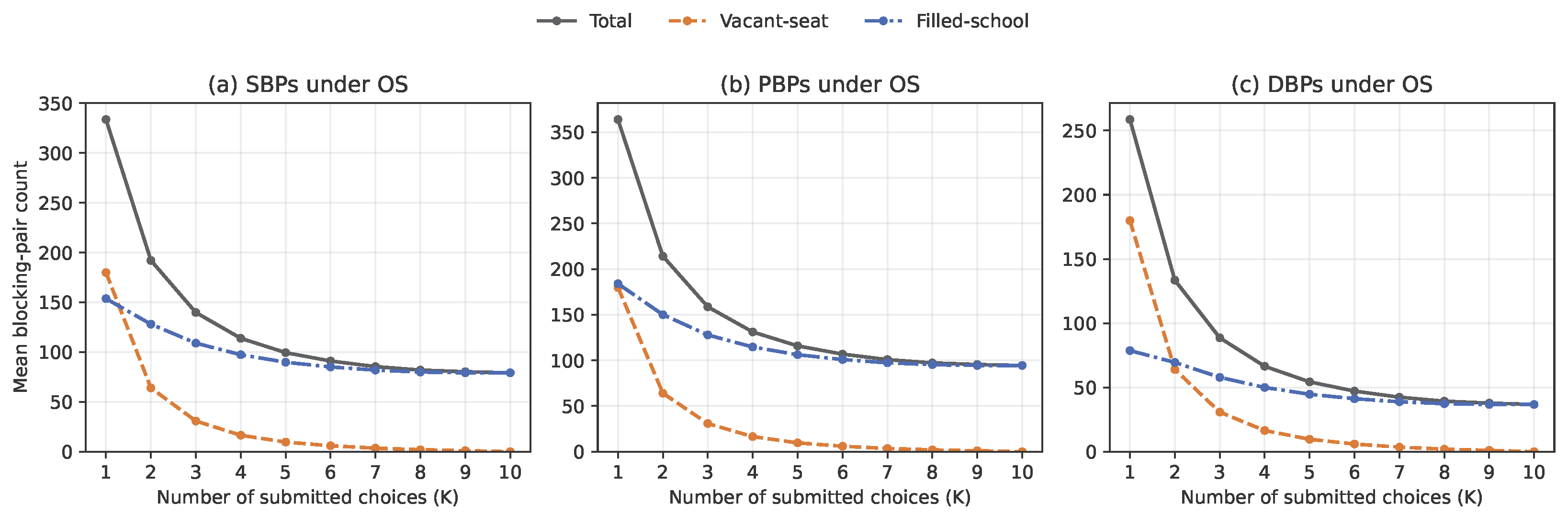
To examine how OS’s blocking changes with K, we use the decomposition in Section 3.3 into vacant-seat blocking, , and displacement blocking, . Figure A1 in Appendix A shows that the mean counts of both components decline as K increases. The decline in total blocking therefore includes a reduction in displacement blocking, not just vacant-seat blocking. This finding is consistent with Remark 2: a decline in mean displacement blocking counts does not imply that the corresponding sets are nested. With complete reporting, vacant-seat blocking is exactly zero, and all remaining blocking involves displacement at filled schools.
4.3. The Structured Environment
Student demand is now shaped by geography and school quality: students favor nearby schools, while elite schools enjoy a common quality advantage.16 The locations of students and schools are drawn independently and uniformly on the unit square, and denotes the Euclidean distance between student s and school c. Two schools are designated elite, with quality , while the remaining eight have quality . Student s’s utility from school c is
where the taste shocks are independent across student–school pairs. Students rank schools in decreasing order of . The parameters and control the weight on distance and the magnitude of taste shocks, respectively.
In the baseline, we set and . With equal taste shocks, the elite-school quality advantage offsets additional distance units, approximately 13.3% of the unit square’s side length. Since the taste-shock range of is smaller than the quality gap of 2, tastes cannot reverse the elite–regular ordering at equal distances but can generate different rankings of schools with the same quality.
Schools’ preferences are correlated with the common priority order. Let denote student s’s score-based priority, with N assigned to the highest-priority student and 1 to the lowest. School c evaluates student s according to
where the school-specific shocks are independent across student–school pairs. Schools rank students in decreasing order of . The parameter controls departures from the common priority order; when , every school’s ranking coincides with that order.
In the baseline, we set . School-specific evaluations can reverse two students’ relative order only if they are fewer than priority positions apart—fewer than 200 positions when . Thus, schools can reorder students who are close in priority, while larger priority differences are preserved.
Figure 2 reports average outcomes over 200 simulated markets under the baseline specification , as the reporting limit K varies from 1 to 10. Market size, capacities, and the policy parameters remain as specified in Section 4.1. Panels (a)–(f) report total and visible SBPs, PBPs, and DBPs, while panels (g) and (h) report manipulable and unmatched students. Two findings emerge.
Figure 2.
Outcomes in the structured baseline environment. Panels (a–f) report total and visible SBPs, PBPs, and DBPs; panels (g,h) report manipulable and unmatched students. Vertical scales differ across panels and from the corresponding panels in Figure 1. Theory guarantees zero visible SBPs under SD, visible PBPs under DA, and visible DBPs under both for all K, as well as zero visible DBPs under OS at . At , theory also guarantees zero total SBPs under SD, total PBPs under DA, and total DBPs and manipulable students under both. All mechanisms have zero unmatched students at .
- F4.
- The structured environment magnifies the consequences of limited reporting. Relative to the unstructured environment, total blocking pairs, manipulability, and the number of unmatched students are substantially higher, especially when reporting is tight. Broader reporting reduces all three, but substantial blocking and manipulability remain under even for large values of K. In particular, manipulability under falls sharply from to but changes little thereafter, even as the number of unmatched students continues to decline toward zero.
- F5.
- Osaka’s intermediate position disappears in the structured environment. The stability ordering observed in the unstructured environment no longer holds. For every , generates, on average, more SBPs than and more PBPs than . It therefore no longer lies between the two benchmark mechanisms along either stability dimension. The intermediate position observed in Section 4.2 is thus not robust to the structured environment considered here.
To examine whether F4 and F5 hold when parameter values change, we vary one parameter at a time: , , and , holding all others at baseline. This yields seven environments, including the baseline, each with 200 simulated markets.17 Figure A2 and Figure A3 and Table A1 in Appendix A confirm F5’s average ordering in all seven environments: for every , generates more SBPs than and more PBPs than . F4’s higher blocking and manipulability also persist across all seven environments under tight reporting (e.g., ).
With broader reporting, F4’s increase in blocking persists under OS but has exceptions under DA and SD. At , OS’s mean counts across the seven structured environments range from 458 to 513 SBPs and from 431 to 554 PBPs, compared with about 79 and 94, respectively, in the unstructured environment. The mean number of manipulable students ranges from 138 to 157, compared with about 18. At , however, DA generates fewer SBPs on average than its unstructured counterpart at , and SD generates slightly fewer PBPs at .18 These checks vary one parameter at a time; simultaneous parameter changes and weakly aligned school rankings remain unexplored.
4.4. Demand Comparative Statics
We finally examine whether differences across mechanisms depend on the level of demand relative to available capacity. This comparative static is also relevant to Osaka, where tuition-support policies may make private schools more attractive and thereby reduce demand for public-school seats.19 We take these demand changes as given and examine their implications for the three mechanisms.
We retain the structured environment of Section 4.3 and vary the number of students across . The number of schools and their capacities remain fixed at and , so aggregate capacity remains at 1000 seats. We simulate 200 markets at each demand level. For each simulated market, lower-demand markets are generated by randomly removing students from the corresponding 1000-student market. Priority ranks are recomputed among the retained students, and the scale of school-specific shocks is adjusted with N as in Section 4.3.
At each demand level, students truthfully report their top K schools. We consider two reporting limits: , corresponding to single-choice reporting, and , corresponding to complete reporting. Figure 3 reports total SBPs, PBPs, DBPs, and manipulable students under single-choice reporting.
Figure 3.
Outcomes under single-choice reporting (). The panels report total SBPs, PBPs, DBPs, and manipulable students as N varies from 400 to 1000. All reported means are strictly positive.
- F6.
- Single-choice reporting keeps mechanism differences compressed across demand levels. Lower demand reduces blocking and manipulability under all three mechanisms, but differences across mechanisms remain small throughout the demand range. Thus, the compression associated with single-choice reporting persists across substantial changes in demand relative to capacity.
Figure 4 repeats the demand comparison under complete reporting.
Figure 4.
Outcomes under complete reporting (). The panels report total SBPs, PBPs, DBPs, and manipulable students as N varies from 400 to 1000. At every demand level, SD’s SBP counts, DA’s PBP counts, and both mechanisms’ DBP and manipulable-student counts are exactly zero, as guaranteed by stability and strategy-proofness under complete reporting.
- F7.
- Under complete reporting, mechanism differences widen as demand approaches capacity. The three mechanisms diverge as demand approaches aggregate capacity. eliminates SBPs, while eliminates PBPs, and both eliminate DBPs and manipulability. By contrast, continues to generate all four types of distortion, with the differences becoming increasingly pronounced as demand rises.
5. Conclusions
This paper studies public high school choice in Osaka as a moderate mechanism operating under limited reporting. The analysis focuses on two features of the current system: the use of both exam scores and school discretion in admissions, and the restriction on how many schools students may report.
Single-choice reporting affects not only the resulting matching but also which conflicts are visible in the admission records. Under the current mechanism, substantial underlying instability may remain hidden even when visible instability is limited. As the reporting constraint is relaxed, the underlying sets of priority, preference, and double blocking pairs weakly shrink, while their visible counterparts weakly expand. Broader reporting also weakly reduces the set of manipulable students, although instability and manipulability can persist even with complete reporting. The simulations further show that tight reporting compresses quantitative differences across mechanisms.
Allowing both exam scores and school discretion to influence admissions does not by itself produce a robust compromise between the two stability criteria. In the unstructured environment, occupies an intermediate position between and : it generates fewer preference blocking pairs than and fewer priority blocking pairs than . This intermediate position disappears in the structured environment. The stability compromise observed under dispersed demand therefore depends on the market environment rather than on the use of both rankings alone.
These findings are directly relevant to Osaka’s ongoing reform. The results support expanding the number of schools that students may report: broader reporting reduces underlying instability, even though it makes more of the remaining conflicts visible. Support for broader reporting should not be interpreted as support for the current mechanism itself: its compromise between score-based priority and school discretion is not robust across market environments.
Author Contributions
Conceptualization, Y.F.; Methodology, Y.F.; Formal analysis Y.F.; Simulation design and coding, Y.F. and Z.L.; Writing—original draft, Y.F.; Writing—review and editing, Y.F. and Z.L.; Supervision, Y.F. All authors have read and agreed to the published version of the manuscript.
Funding
This research was partially supported by JSPS KAKENHI Grant Number 26K16326.
Institutional Review Board Statement
Not applicable.
Informed Consent Statement
Not applicable.
Data Availability Statement
The original contributions presented in this study are included in the article. Further inquiries can be directed to the corresponding author.
Conflicts of Interest
The authors declare no conflicts of interest.
Appendix A
Proof of Proposition 2.
Fix a problem G, let m be the truthful report profile, and write .
We first establish an observation used in parts (i) and (ii). Suppose that student s applies to school c but is not assigned to it. Then, c must be filled under . Suppose otherwise that . If , then implies . The score channel therefore admits students, leaving at least reviewed applicants for the discretionary channel. By universal acceptability on the school side, all discretionary seats are then filled, contradicting . Hence, . Since , every applicant is reviewed, and since the number of applicants is smaller than the total quota , the two admission channels together admit every applicant. In particular, s is assigned to c, again a contradiction. Thus, any school that rejects one of its applicants is filled.
For part (i), fix a school c and let
If , the desired bound is immediate since . Suppose, therefore, that , and take any . Visibility implies that s applies to c, while the fact that is an SBP implies that . By the observation above, c is filled, and hence, there exists such that . Since every admitted student belongs to , we have . Moreover, : otherwise, because the review pool consists of the highest-priority applicants, every student in , including t, would have higher priority than s, contradicting . Thus, every student in is reviewed but not admitted, so . Since c is filled,
Summing the school-level bounds over , the total number of visible SBPs is at most .
For part (ii), suppose, toward a contradiction, that is a visible DBP under . Then, s applies to c but is not assigned there. The observation above implies that c is filled, so there exists such that and . As in part (i), , while .
We claim that . If t is selected through the score channel, then , together with , would imply that s is also selected, a contradiction. Thus, , and because , we must have . Both s and t therefore belong to , from which discretionary admits are selected according to . Since t is selected and s is not, this implies , contradicting . Hence, no visible DBP can arise.
For part (iii), we construct a sequence of problems with a fixed school set and fixed policy parameters for which the number of visible PBPs becomes arbitrarily large. For every integer , let have student set ; school set ; and policy parameters , , and , so that . Every student ranks c above being unmatched and therefore reports c. Let the common priority order be
and let the school’s preference order be
Let denote the truthful report profile in , and write . The review pool is . The score seat is assigned to , and the discretionary seat to , whom school c prefers to . Consequently, , while every , , remains unmatched.
For each , student prefers c to being unmatched, and school c prefers to its admitted student . Thus, is a PBP, and it is visible because reports c. The problem therefore contains exactly visible PBPs. Since the school set and policy parameters are fixed while n is arbitrary, the number of visible PBPs can be made arbitrarily large. □
Example A1.
The bound in Proposition 2(i) is sharp. Consider a problem G with and , where
Students’ preferences, the school’s preference, and the common priority order are given by
Under truthful single-choice reporting, all three students apply to c and are included in its review pool. The score seat is assigned to , while the discretionary seat is assigned to according to . Hence,
The pair is a visible SBP: student reports c and remains unmatched, while . Since is the only rejected applicant, is the unique visible SBP. Thus, the number of visible SBPs involving c is , so the bound in Proposition 2(i) is attained.
Lemma A1.
Fix a problem G and . Under truthful reporting, the first K rounds of coincide with the K rounds of . In every round , the same students apply to, are reviewed by, and are admitted to the same schools.
Proof.
Let and . For every student s, the list is a prefix of . The two mechanisms therefore generate the same applications in round 1, and hence the same review and admission decisions.
Suppose inductively that they coincide through round , where . They then enter round r with the same unmatched students and, at every school, the same remaining review capacity, score quota, and discretionary quota. Since is a prefix of , every student eligible to apply in round r makes the same application under the two mechanisms. Each school therefore forms the same review pool and makes the same score and discretionary admissions. The result follows by induction. □
Proof of Proposition 3.
Fix a problem G and . Let and , and write and .
Part (i). By Lemma A1, the two mechanisms coincide through round K. Since admissions are final, the additional round under cannot alter any assignment made in the first K rounds; it can only assign students who remain unmatched under . Hence, for every , and every student assigned under receives the same assignment under . The number of unmatched students is therefore weakly decreasing in K.
Part (ii). Fix , and suppose that . We show that . First consider the student-side condition. Since blocks , we have . If s is assigned under , part (i) implies . If s is unmatched under , then under , they either remain unmatched or receive an acceptable school in round . In either case, .
The relevant school-side condition also persists. If , then , so c also has a vacancy under . Otherwise, let witness the relevant priority comparison, school-preference comparison, or both. If , the same student witnesses the condition under . If , then t is admitted in round . Since earlier admissions cannot be displaced, admitting t requires an unfilled seat at the end of round K; hence, .
Thus, every blocking pair of type T under is a blocking pair of the same type under . Therefore,
Part (iii). Fix , and suppose that is a visible blocking pair of type T under . Since c appears on , it also appears on , so visibility is preserved. The student-side condition is preserved as well. If s is assigned under , their assignment is unchanged by part (i). If they are unmatched under and becomes assigned under , they receive the -st school on their truthful list, whereas c appears among their first K choices. Hence, .
The school-side condition remains to be verified. If the condition under is witnessed by some , then by part (i), and the same student continues to witness the relevant comparison. Consider instead the vacancy case, . Because is visible and , student s applies to c in some round but is not admitted there. We claim that . If s were reviewed but not admitted, then
because the score and discretionary channels together admit every reviewed applicant whenever the review pool does not exceed the total remaining quota. Both remaining quotas would therefore be filled in round r. School c would then be full and, since admissions are final, would remain full thereafter, contradicting . Thus, .
Since , the round-r applicant set exceeds the remaining review capacity. Hence, , so the review capacity of c is exhausted in round r. Because review capacity is not replenished, the school cannot review, and hence cannot admit, any student in a later round. The additional round under therefore leaves its intake unchanged: . In particular, c remains underfilled under , so the vacancy condition persists. Thus, visibility and both sides of the blocking condition are preserved from to . Consequently,
The corresponding cardinality monotonicity statements follow immediately. □
Example A2.
The monotonicity of visible blocking pairs in Proposition 3 need not extend to or . For , define visibility as in Section 3.3: a blocking pair is visible if c appears on s’s submitted list. Let , , and denote the corresponding visible blocking sets. In both examples, every school has
All schools are acceptable to every student, and all students are acceptable to every school. The Osaka policy parameters do not affect or ; they are included only to embed the examples in the same institutional environment as the main analysis.
. Consider the problem G with and . Students’ preferences, school b’s preference, and the common priority order are given by
The preferences of schools a and c may be any strict orders over the students. For ,
The pair is a visible PBP: student reports b and remains unmatched, while school b prefers to its admitted student . For ,
Student , who is processed before and , obtains a seat at b after finding a full. School b now admits and , both of whom it prefers to . Hence, is no longer a PBP, although b remains on ’s submitted list. Therefore, .
. Consider the problem with and . Students’ preferences, schools’ preferences, and the common priority order are given by
School a’s preference may be any strict order over the students. For ,
The pair is a visible SBP: student reports b and remains unmatched, and they have higher common priority than the admitted student . For , students and , initially rejected by b, apply to c. School c rejects , who then applies to b and displaces . Student subsequently applies to c, where they displace . Hence,
Student still prefers b to their assignment at c, and b remains on their submitted list. However, b now admits and , both of whom have higher common priority than . Hence, is no longer an SBP. Therefore, .
Thus, extending submitted lists may eliminate a previously visible blocking pair under either extreme mechanism. Unlike the K-choice Osaka mechanism, and need not preserve the assignments obtained under the shorter reporting limit.
Example A3.
Blocking through displacement at filled schools need not be monotone in the reporting limit. Consider a problem G with and . Every school has , , and . Students’ preferences, school preferences, and the common priority order are given by
School d’s preference may be any strict order over the students. Under truthful single-choice reporting, apply to a, and apply to c, and applies to b. School a admits through the score channel and through the discretionary channel; school c admits through the score channel and through the discretionary channel; and school b admits through the score channel. Hence,
At this outcome, because prefers b to being unmatched and b has a vacant seat. Hence, for each . By contrast, c is filled, prefers c to being unmatched, and and . Hence, for each .
Under truthful two-choice reporting, the first round is unchanged. Students and then apply to b, which has two review slots and one discretionary seat remaining. Both are reviewed, and is admitted because . Student applies to d and is admitted. Hence,
School b is now filled by and , while remains unmatched. Since and , for each . By contrast, is now assigned to d, and , so for each such B. Therefore, for every ,
Consequently, we have and . Thus, blocking through displacement at filled schools need not be monotone in the reporting limit: displacement blocking can both emerge and disappear as the reporting limit expands.
Proposition A1.
Fix a problem G. Under truthful reporting, for every and each , the following statements hold.20
- (i)
- For every school , . Moreover, every student assigned under receives the same assignment under . Hence, the number of unmatched students is weakly decreasing in K.
- (ii)
- For each , . Hence, the numbers of priority, preference, and double blocking pairs are weakly decreasing in K.
- (iii)
- For each , . Hence, the numbers of visible priority, preference, and double blocking pairs are weakly increasing in K.
Proof.
We prove the result for ; the case of is addressed at the end of the proof.
Under truthful reporting, each student’s K-choice list is the prefix of their -choice list. Hence, the first K rounds of coincide with the K rounds of : in each round, the same unmatched students apply to the same schools and face the same remaining capacities, so the same admissions are made. Since admissions are final, every assignment made under is preserved under , and any additional assignments can occur only in Round . This proves (i).
For (ii), fix and suppose that . If s is assigned under , part (i) implies that their assignment is unchanged under , so implies . If s is unmatched under , then , together with individual rationality, implies . Thus, the student-side blocking condition holds under .
For the school-side blocking condition, if c has a vacant seat under , the vacancy itself satisfies the relevant condition for all three types of blocking pair. If c is full, part (i) and the capacity constraint imply
Hence, any witness under remains assigned to c under , preserving the priority comparison for an SBP, the school-preference comparison for a PBP, and both comparisons for a DBP. Therefore, , proving (ii).
For (iii), fix , and suppose that . Since the pair is visible, c appears among the first K schools on s’s truthful list. Since it is also blocking, s prefers c to their assignment under . Student s must therefore have reached and applied to c; otherwise, they would have been admitted earlier to a school that they prefer to c. Since s is not assigned to c, they must have been rejected there. Under immediate acceptance and universal acceptability, such a rejection implies that c fills its remaining capacity in that round. Since admissions are final, c is therefore full under . By part (i) and the capacity constraint, . Hence, the school-side blocking condition under continues to hold under , with the same witness in the displacement case.
For the student-side blocking condition, if s is assigned under , part (i) implies that their assignment is unchanged under . If s is unmatched, they either remain unmatched or are assigned to their -st choice. Since c appears among their first K choices, they continue to prefer c to their assignment under . Finally, c remains on their submitted list, so the pair remains visible. Therefore, , proving (iii).
The argument above does not depend on whether schools rank applicants by their preferences or by the common priority ≻. Applying the same Immediate Acceptance mechanism with ≻ in place of therefore yields (i)–(iii) for as well. □
Lemma A2.
Fix a problem G, , a student s, and a report profile of the other students. If s is assigned to school c under for some feasible K-choice report , then they are also assigned to c when reporting only c as acceptable.
Proof of Lemma A2.
Fix , and suppose that s is assigned to c under some feasible K-choice report . Let r be the round in which they are admitted. If , then c is first on , so replacing by leaves the first-round applications unchanged and hence leaves s’s admission to c unchanged.
Suppose . Under the report , student s applies to c in the first round, while all other first-round applications remain unchanged. If s is not reviewed, then at least other first-round applicants have higher priority than s. These same applicants are present under , so the first round exhausts c’s review capacity, making s’s admission in round r impossible.
If s is reviewed but rejected, the first-round review pool must contain more than students; otherwise, since and all students are acceptable to the school, every reviewed applicant would be admitted. Hence, after removing s, at least other first-round applicants remain. Since , under at least of these applicants are reviewed in the first round. The score seats are therefore filled, leaving at least reviewed applicants for the discretionary stage. By universal acceptability, all discretionary seats are filled as well. Thus, all admission seats are filled in the first round, making s’s admission in round r impossible.
Both cases contradict the assumption that s is admitted to c under . Therefore, they must be admitted to c when reporting only c. □
Proof of Proposition 4.
Fix . We first show that every problem at which is manipulable is also manipulable under . Suppose that is manipulable at some problem G. Then, for some student s and feasible L-choice report ,
By Lemma A2, reporting only c also assigns s to c under .
Consider the same single-school report under . Student s applies to c in the first round under both reporting limits, while every other student’s truthful K- and L-choice reports have the same first choice whenever their list is nonempty. Thus, the first-round applicant sets are identical. Since the within-round admission rule and all school-side policy parameters are unchanged, the first-round review and admission decisions are identical as well. Hence, reporting only c assigns s to c under .
It remains to be verified that this deviation is profitable. If s is assigned under truthful K-choice reporting, Proposition 3(i) preserves their assignment as the reporting limit increases from K to L. Hence, , and therefore, . If s is instead unmatched under , individual rationality gives . Since , transitivity implies . Thus, the same student s can profitably manipulate . Therefore, every problem at which is manipulable is also manipulable under .
Next, we show that the converse fails. Consider a problem with
where the d-schools are absent when . At every school, let , , and . Student s’s preference is
with the d-schools omitted when . For each , students and regard only as acceptable. Let the common priority order be
and let for every r. Complete the schools’ preferences arbitrarily subject to these rankings and universal acceptability.
Under truthful K-choice reporting, s reports . At , the first-round applicants are ; the score seat goes to and the discretionary seat to , so s is rejected. For each , students and apply to in the first round and fill its two seats before s reaches it in round r. Hence, . If s instead reports only b, they are its only first-round applicant and is admitted. Since , is manipulable at G.
Under truthful L-choice reporting, s’s list begins with . They are rejected from for the same reasons and admitted to b in round . Thus, .
It remains to be shown that is not manipulable at G. Each of and receives , their only acceptable school, and hence cannot profitably deviate. Student s can improve upon b only by obtaining some . Fix such a school. If s reports only , then are all reviewed in the first round. The score seat goes to because , while the discretionary seat goes to because . Thus, s is rejected. By Lemma A2, no other feasible L-choice report can assign s to . Since this holds for every , s has no profitable deviation. Therefore, is not manipulable at G, whereas is. Hence, is more manipulable than . □
Proof of Proposition 5.
For , Example 1 provides the required problem. We therefore fix any and construct a problem satisfying and for every school.
Let and , where the set of d-schools is empty when . Thus, . At every school , let , , and . Every is unacceptable to every student, while its preference over students is arbitrary. Students’ preferences over a and b, together with the school preferences and common priority, are
where a and b are acceptable to every student. Thus, .
Because the d-schools are unacceptable to every student, they are never reported and play no role in the outcome. In round 1, apply to a, which admits through the score channel and through the discretionary channel, while applies to b and receives its score seat. In round 2, and apply to b, whose remaining discretionary seat goes to . Hence,
This outcome is neither priority-stable nor preference-stable. Student prefers b to being unmatched, while b admits ; moreover, and . Thus, is a DBP and hence both an SBP and a PBP. The mechanism is also manipulable. Under truthful reporting, reports and remains unmatched. If they instead report only b, they apply there in round 1 together with . Since , they receive the score seat at b, which they strictly prefer to being unmatched.
Finally, both the SD mechanism based on the common priority ≻ and the student-proposing DA mechanism based on produce
Under either mechanism, and are assigned to a, while and are assigned to b; the d-schools are irrelevant because they are unacceptable to every student. By the characterization in Fang and Yasuda (2025a), is therefore the unique double-stable matching. Since , the K-choice Osaka mechanism does not select a double-stable match even though one exists.
Thus, for every , the same construction, augmented only by irrelevant schools, yields all four failures while satisfying and for every . Together with Example 1 for , this completes the proof. □
Proof of Proposition 6.
Fix K, a mechanism , and a student s. Throughout, all other students report truthfully; write . The “if” direction is immediate. If there exists a school such that and , then reporting only is a profitable deviation.
For the “only if” direction, suppose that s has a profitable deviation , and let
Then, and . Since reports may contain at most K schools, the singleton report is feasible. We show that it also assigns s to .
. Only students with higher priority than s can affect the availability of schools when s is considered, and their reports are unchanged. Since s obtains under , school has an available seat at their turn. They therefore obtain under the singleton report .
. Let be the outcome under , so that . The matching remains stable under . No blocking pair not involving s can be created, since all other reports and the matching are unchanged, nor can s belong to a blocking pair: under their singleton report, is their only acceptable school, and they are assigned to it.
Student-proposing DA selects the student-optimal stable matching for the submitted preferences. Its outcome under therefore assigns s a school weakly preferred to according to their singleton report. Since is their only acceptable school, they must be assigned to .
. By Lemma A2, since assigns s to , reporting only as acceptable also assigns their to , holding fixed.
For each of the three mechanisms, any profitable deviation assigning s to can therefore be replaced by the singleton report . This proves the “only if” direction and completes the proof. □
- Decomposition of Blocking under . We report the decomposition discussed in Section 4.2. Following Section 3.3, we distinguish vacant-seat blocking, , from displacement blocking at filled schools, , for each of the three blocking types.
Figure A1.
Decomposition of underlying blocking under in the unstructured environment. Panels (a–c) report SBPs, PBPs, and DBPs, respectively. Curves show mean total counts and their vacant-seat and displacement components across 200 simulated markets. At , vacant-seat counts are exactly zero, so total and displacement counts coincide.
- Sensitivity to the Structured-Environment Parameters. We report the sensitivity results discussed in Section 4.3. For each simulated market, the seven structured environments share the same locations, common priority order, and underlying draws. Taste and school-specific shocks are scaled by and , respectively. Within each environment, all mechanisms and reporting limits are evaluated on the same market.
Figure A2.
Sensitivity of total score-based blocking pairs. Panel (a) reports the baseline ; panels (b–g) vary the indicated parameter, holding the others at baseline. Curves show mean counts across 200 simulated markets. In all seven environments, generates more SBPs on average than for every , consistent with F5. At , SD’s SBP counts are exactly zero, as guaranteed by priority stability under complete reporting.
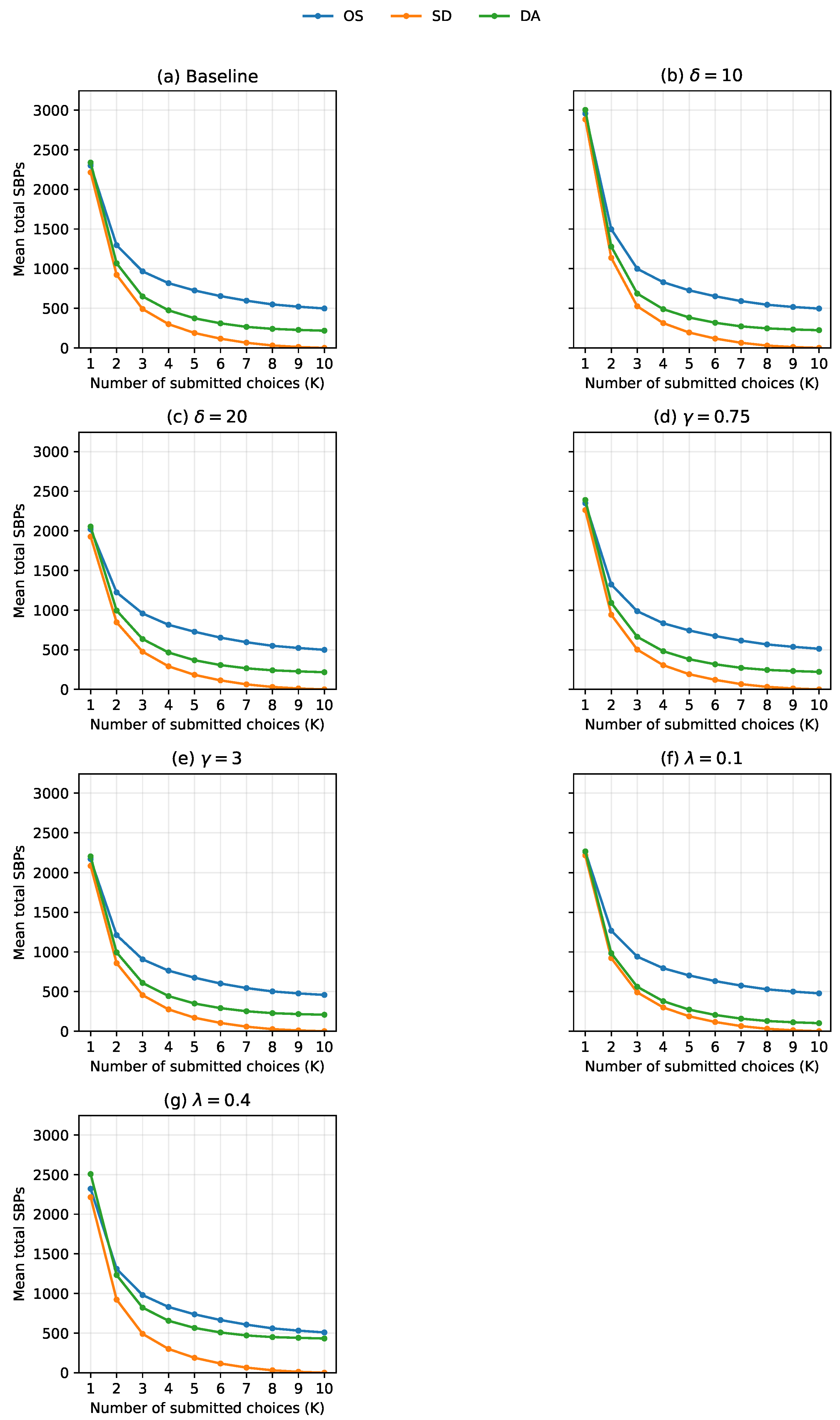
Figure A3.
Sensitivity of total preference-based blocking pairs. Panel (a) reports the baseline ; panels (b–g) vary the indicated parameter, holding the others at baseline. Curves show mean counts across 200 simulated markets. In all seven environments, generates more PBPs on average than for every , consistent with F5. At , DA’s PBP counts are exactly zero, as guaranteed by preference stability under complete reporting.
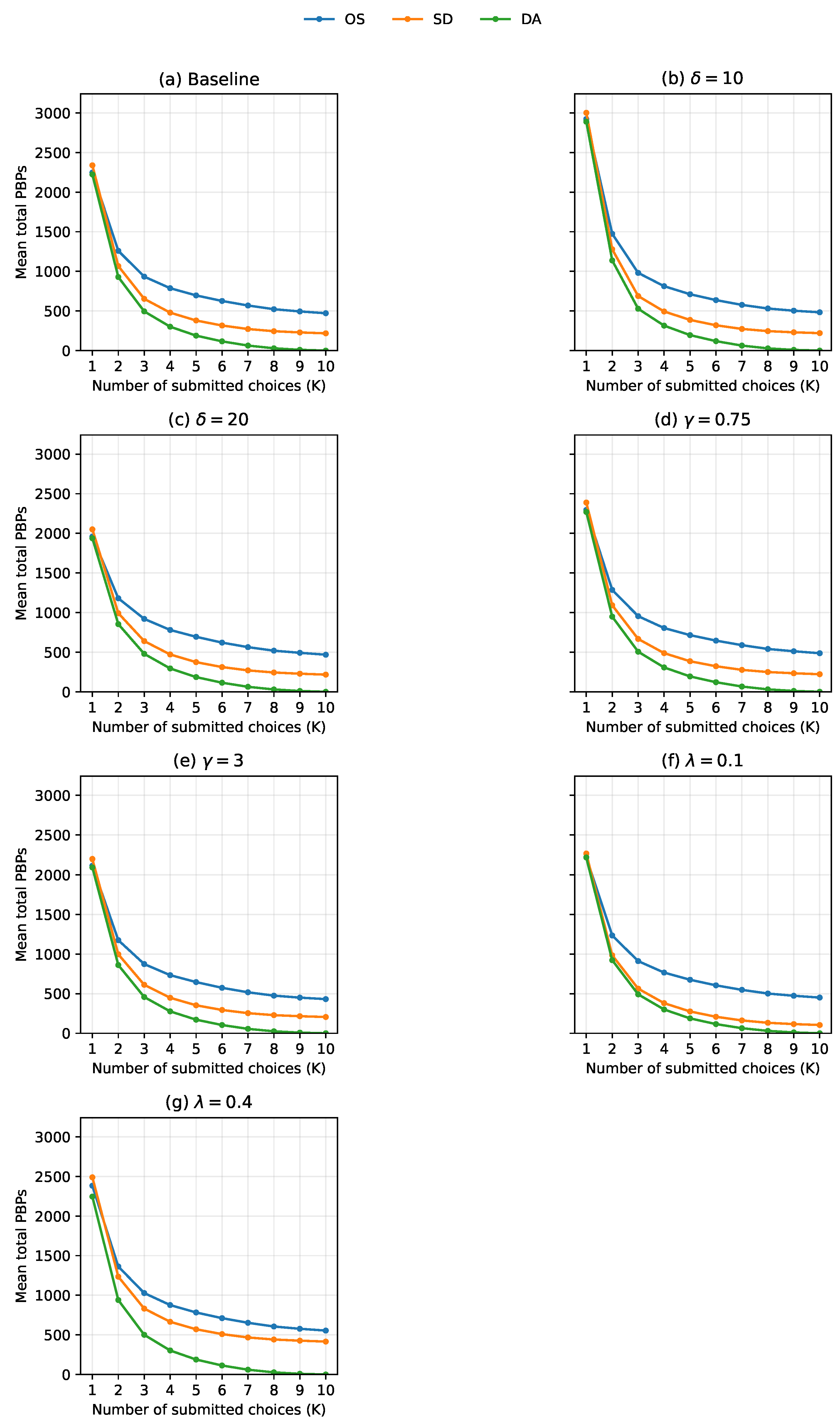
Table A1.
Sensitivity of manipulable students across mechanisms.
Notes
| 1 | For recent application numbers, see the https://www.pref.osaka.lg.jp/documents/35613/r08_kekka.pdf published by the Osaka Prefectural Board of Education (accessed 22 October 2026). |
| 2 | A formal definition of the current Osaka mechanism is provided in Section 3.1. |
| 3 | The mechanisms and apply the standard SD and DA mechanisms to reports containing at most K schools, with unlisted schools treated as unacceptable. |
| 4 | For details on the reform, see Section 1 of the https://www.pref.osaka.lg.jp/documents/112637/01_housin.pdf (2014, accessed 22 October 2026). |
| 5 | For details on the planned reform, whose implementation details remain under discussion, see Section 3 of the https://www.pref.osaka.lg.jp/documents/112637/r10kaizenhoushin.pdf (2025, accessed 22 October 2026). |
| 6 | Matching with multiple ordinal rankings has also been studied, primarily from a computational perspective; see, for example, Chen et al. (2018) and Miyazaki and Okamoto (2019). In our model, the rankings correspond to distinct institutional criteria in admissions. A related structure arises in Chinese college admissions, where exam scores determine the order of file transfers and colleges select among transferred applicants; see Fang and Lu (2026); Fang and Yasuda (2025a, 2025b). |
| 7 | A feasible admission set is any subset of S of size at most . Formally, responsiveness means that for any with and any , (i) if and only if , and (ii) if and only if . This rules out complementarities across students. |
| 8 | When the sets of students and schools and the capacity vector are clear from the context, we write for short. |
| 9 | Under universal acceptability, school individual rationality is automatic. |
| 10 | Unlike priority-stable and preference-stable matchings, a double-stable matching need not exist. A double-stable matching exists if and only if the SD and the student-proposing DA mechanisms yield the same outcome, in which case it is unique (Fang & Yasuda, 2025a). |
| 11 | We model the main public-school admissions procedure; “unmatched” refers to students not assigned through this procedure. These students may pursue private-school options or, if eligible, apply to public schools with remaining vacancies through supplementary admissions. The latter requires a new application and a separate selection process, which is outside the scope of our analysis. For eligibility and application requirements, see Section 8 of the https://www.pref.osaka.lg.jp/documents/118149/14_r08_niji_1.pdf (accessed 22 October 2026). |
| 12 | One could instead reserve part of the review capacity or admission quotas for later rounds. Doing so, however, would introduce an additional school-side rule governing how much capacity is reserved across rounds. Our extension is the minimal extension of the current mechanism in the sense that it changes only the reporting limit: the existing within-round admission rule is applied sequentially, with unused review capacity and unfilled quotas carried over to later rounds. |
| 13 | The IA mechanism is also known as the Boston mechanism; see Abdulkadiroğlu and Sönmez (2003) for a formal description. applies the standard IA mechanism to reports containing at most K schools, with unlisted schools treated as unacceptable. |
| 14 | To see this, take any . By Proposition 3(i), a vacancy at c under implies a vacancy under . If s is assigned under , their assignment is unchanged under , so . If s is unmatched under , then and individual rationality imply . Thus, in either case, . |
| 15 | The mechanisms and are the standard SD and student-proposing DA mechanisms applied to reports containing at most K schools, with unlisted schools treated as unacceptable. |
| 16 | Geographic and quality-based preference structures are common in computational studies of school choice; see (Abdulkadiroğlu et al., 2009; Erdil & Ergin, 2008; Lomakin et al., 2024). We adapt these standard ingredients to the dual-ranking structure of high school admissions in Osaka. |
| 17 | With equal taste shocks, the elite-school quality advantage offsets – additional distance units, depending on . The taste-shock settings span values below and above the quality gap of 2, allowing tastes to reverse the elite–regular ordering at equal distances when . With , increasing from 0.1 to 0.4 allows priority reversals between students fewer than 100 and fewer than 400 positions apart, respectively. These parameter values are not empirically calibrated to Osaka’s admissions market. |
| 18 | DA resolves competition using school preferences, while SD follows the common priority order. Closer alignment between these rankings at may reduce SBPs under DA and PBPs under SD as reporting constraints relax. |
| 19 | For details on Osaka’s tuition-support policy for private high schools, see https://www.pref.osaka.lg.jp/o180160/shigaku/shigakumushouka/shigaku_mushoka_r6.html (accessed on 22 October 2026). |
| 20 | Blocking pairs and their visible subsets are defined analogously to those under , with denoting the corresponding set of blocking pairs of type B under . |
References
- Abdulkadiroğlu, A., Pathak, P. A., & Roth, A. E. (2009). Strategy-proofness versus efficiency in matching with indifferences: Redesigning the NYC high school match. American Economic Review, 99(5), 1954–1978. [Google Scholar] [CrossRef] [Scilit]
- Abdulkadiroğlu, A., & Sönmez, T. (2003). School choice: A mechanism design approach. American Economic Review, 93, 729–747. [Google Scholar] [CrossRef] [Scilit]
- Aoi, N., Imamura, K., Odawara, Y., Kamada, Y., & Noda, S. (2021). Recommendations for redesigning public high school admissions: Inequities caused by single-choice applications and possible remedies. Policy report. University of Tokyo Market Design Center. Available online: https://www.mdc.e.u-tokyo.ac.jp/wp/wp-content/uploads/2021/10/utmd-highschool.pdf (accessed on 18 May 2026). (In Japanese)
- Balinski, M. L., & Sönmez, T. (1999). A tale of two mechanisms: Student placement. Journal of Economic Theory, 84, 73–94. [Google Scholar] [CrossRef] [Scilit]
- Calsamiglia, C., Haeringer, G., & Klijn, F. (2010). Constrained school choice: An experimental study. American Economic Review, 100(4), 1860–1874. [Google Scholar] [CrossRef] [Scilit]
- Chen, J., Niedermeier, R., & Skowron, P. (2018). Stable marriage with multi-modal preferences. In Proceedings of the 2018 ACM conference on economics and computation (EC 2018) (pp. 269–286). ACM. [Google Scholar]
- Chen, Y., & Kesten, O. (2017). Chinese college admissions and school choice reforms: A theoretical analysis. Journal of Political Economy, 125, 99–139. [Google Scholar] [CrossRef] [Scilit]
- Coles, P., & Shorrer, R. (2014). Optimal truncation in matching markets. Games and Economic Behavior, 87, 591–615. [Google Scholar] [CrossRef] [Scilit]
- Ehlers, L. (2008). Truncation strategies in matching markets. Mathematics of Operations Research, 33(2), 327–335. [Google Scholar] [CrossRef] [Scilit]
- Erdil, A., & Ergin, H. (2008). What’s the matter with tie-breaking? Improving efficiency in school choice. American Economic Review, 98(3), 669–689. [Google Scholar] [CrossRef] [Scilit]
- Fang, Y., & Lu, Z. (2026). Parallel versus sequential mechanisms in China: A structural and quantitative analysis. Available online: https://ssrn.com/abstract=6289701 (accessed on 18 May 2026).
- Fang, Y., & Yasuda, Y. (2025a). Double stability in two-sided matching: Priority and preference in harmony. Available online: https://www.mdc.e.u-tokyo.ac.jp/news/5400/ (accessed on 18 May 2026).
- Fang, Y., & Yasuda, Y. (2025b). Improving matching under information constraint: Chinese college admission reconsidered. Available online: https://ssrn.com/abstract=5320898 (accessed on 18 May 2026).
- Gale, D., & Shapley, L. S. (1962). College admissions and the stability of marriage. American Mathematical Monthly, 69, 9–15. [Google Scholar] [CrossRef] [Scilit]
- Haeringer, G., & Klijn, F. (2009). Constrained school choice. Journal of Economic Theory, 144(5), 1921–1947. [Google Scholar] [CrossRef] [Scilit]
- Lomakin, A., Minibaev, K., & Nesterov, A. (2024). Modifications of Boston, Taiwanese and Chinese mechanisms are not comparable via counting manipulating students. Economics Letters, 237, 111647. [Google Scholar] [CrossRef] [Scilit]
- Miyazaki, S., & Okamoto, K. (2019). Jointly stable matchings. Journal of Combinatorial Optimization, 38, 646–665. [Google Scholar] [CrossRef] [Scilit]
- Noda, S. (2025). Proposal to introduce the deferred acceptance algorithm for public high school admissions. Available online: https://www.cas.go.jp/jp/seisaku/digital_gyozaikaikaku/senryaku2/senryaku2_siryou9.pdf (accessed on 18 May 2026).
- Pathak, P. A., & Sönmez, T. (2013). School admissions reform in Chicago and England: Comparing mechanisms by their vulnerability to manipulation. American Economic Review, 103(1), 80–106. [Google Scholar] [CrossRef] [Scilit]
- Roth, A. E. (1985). The college admissions problem is not equivalent to the marriage problem. Journal of Economic Theory, 36, 277–288. [Google Scholar] [CrossRef] [Scilit]
- Roth, A. E., & Rothblum, U. G. (1999). Truncation strategies in matching markets: In search of advice for participants. Econometrica, 67(1), 21–43. [Google Scholar] [CrossRef] [Scilit]
- Tanaka, M., Narita, Y., & Moriguchi, C. (2020). Meritocracy and its discontent: Long-run effects of repeated school admission reforms (RIETI Discussion Paper Series, 20-E-002). Research Institute of Economy, Trade and Industry (RIETI). [Google Scholar]
- Westkamp, A. (2013). An analysis of the German university admissions system. Economic Theory, 53, 561–589. [Google Scholar] [CrossRef] [Scilit]
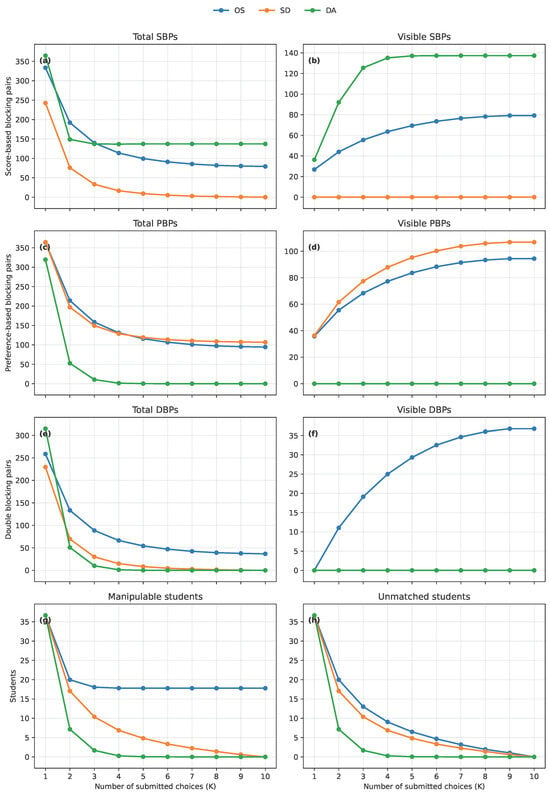
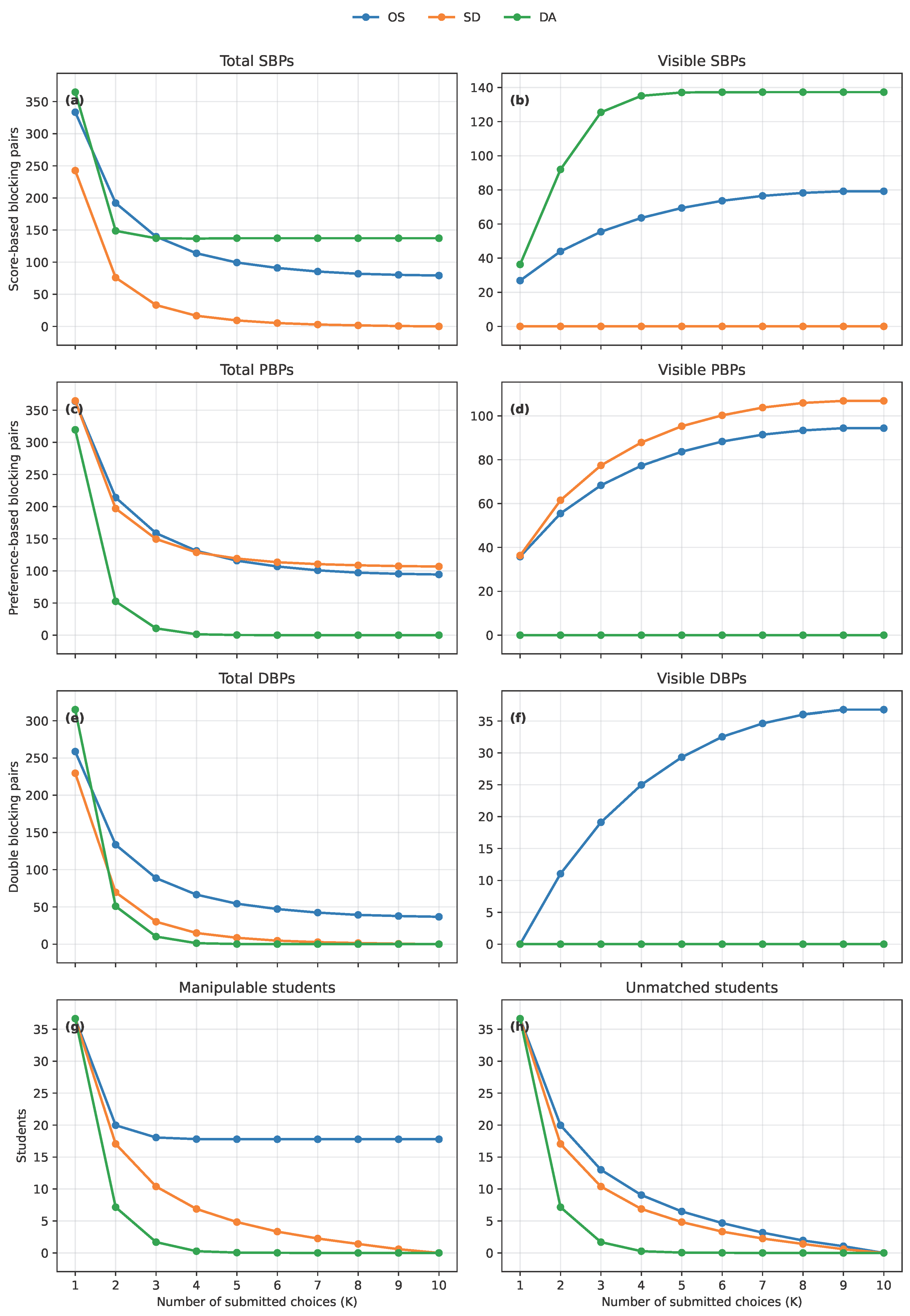
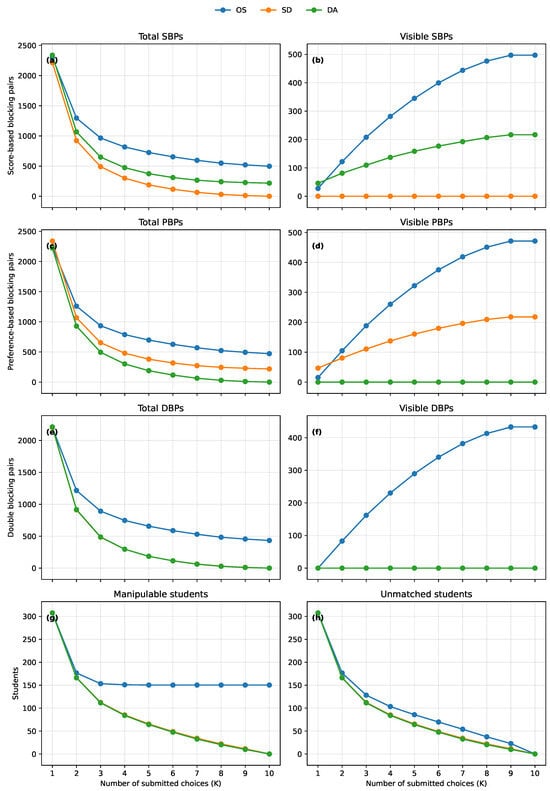
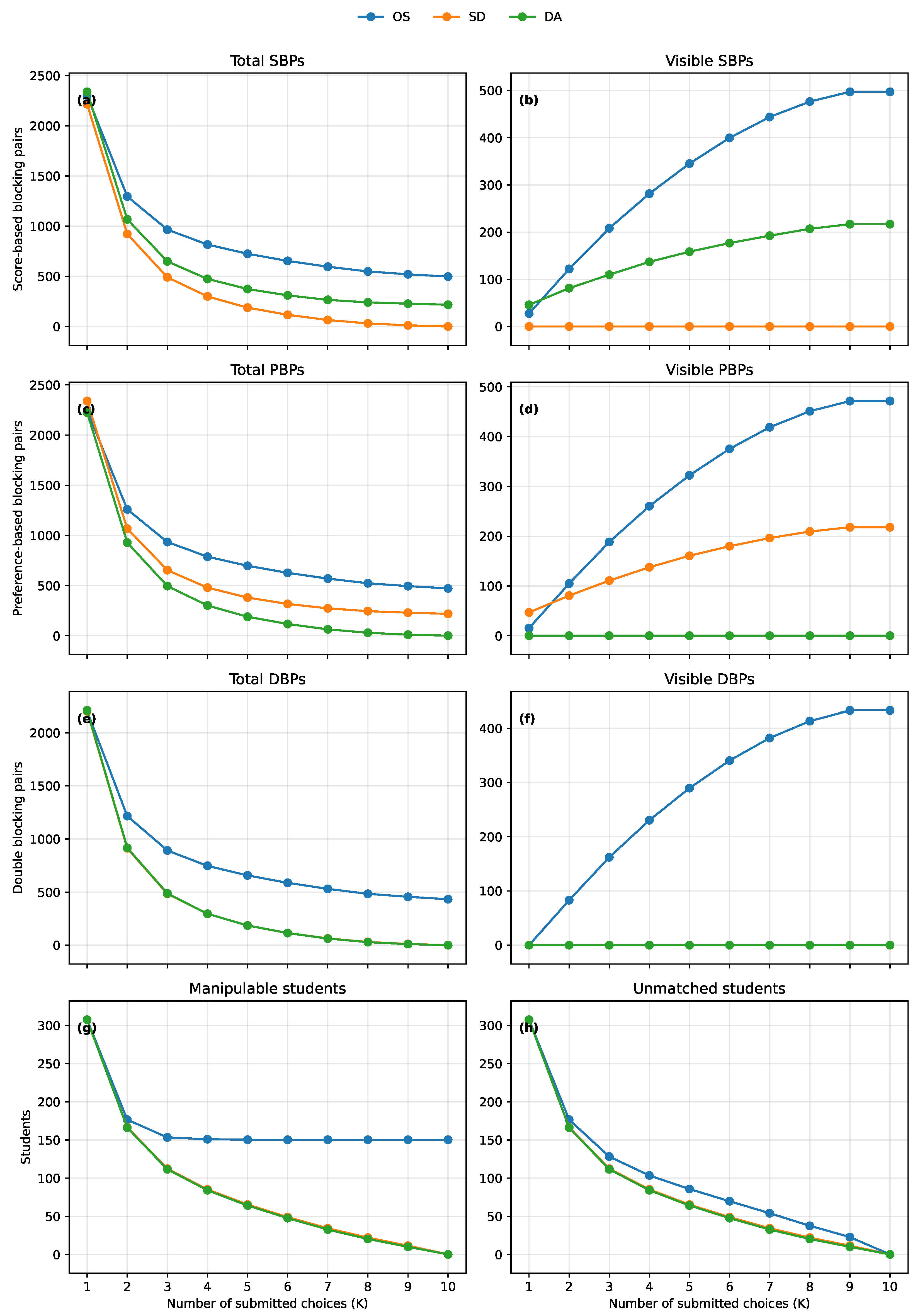
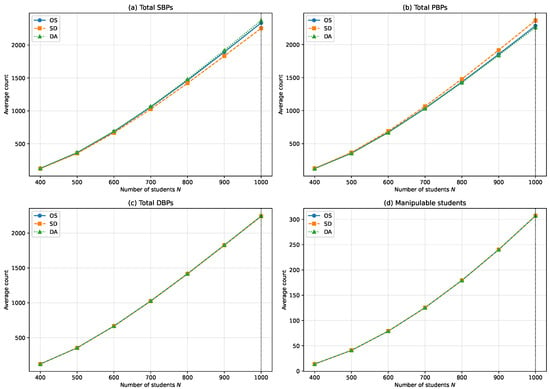
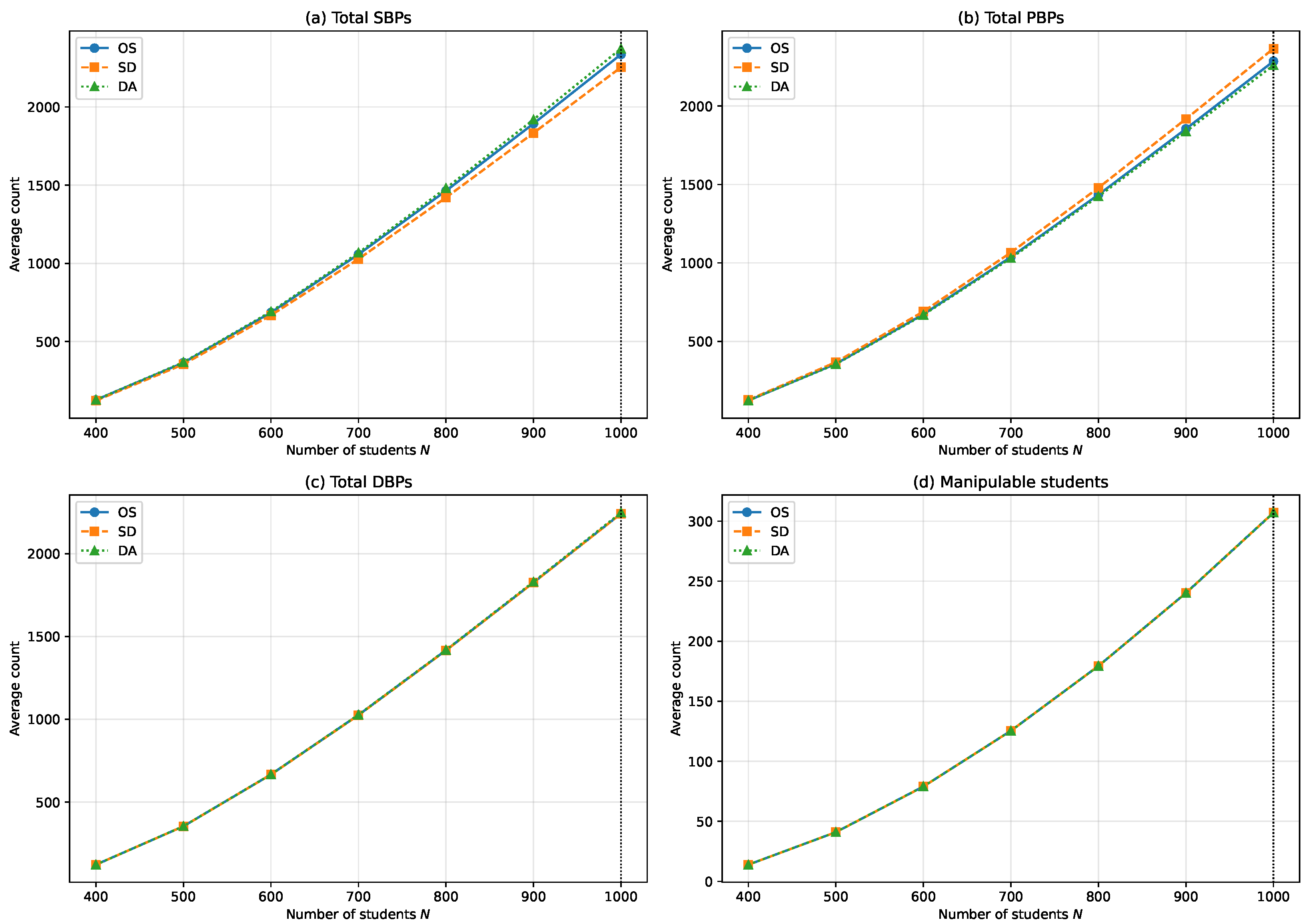
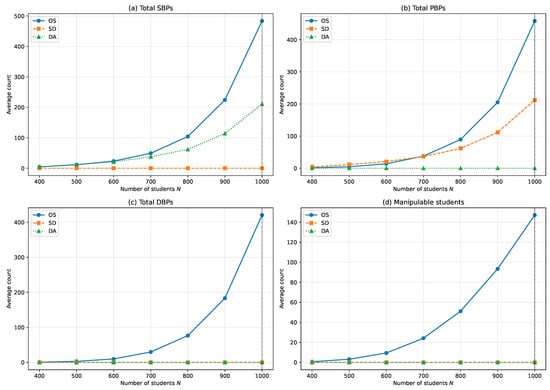
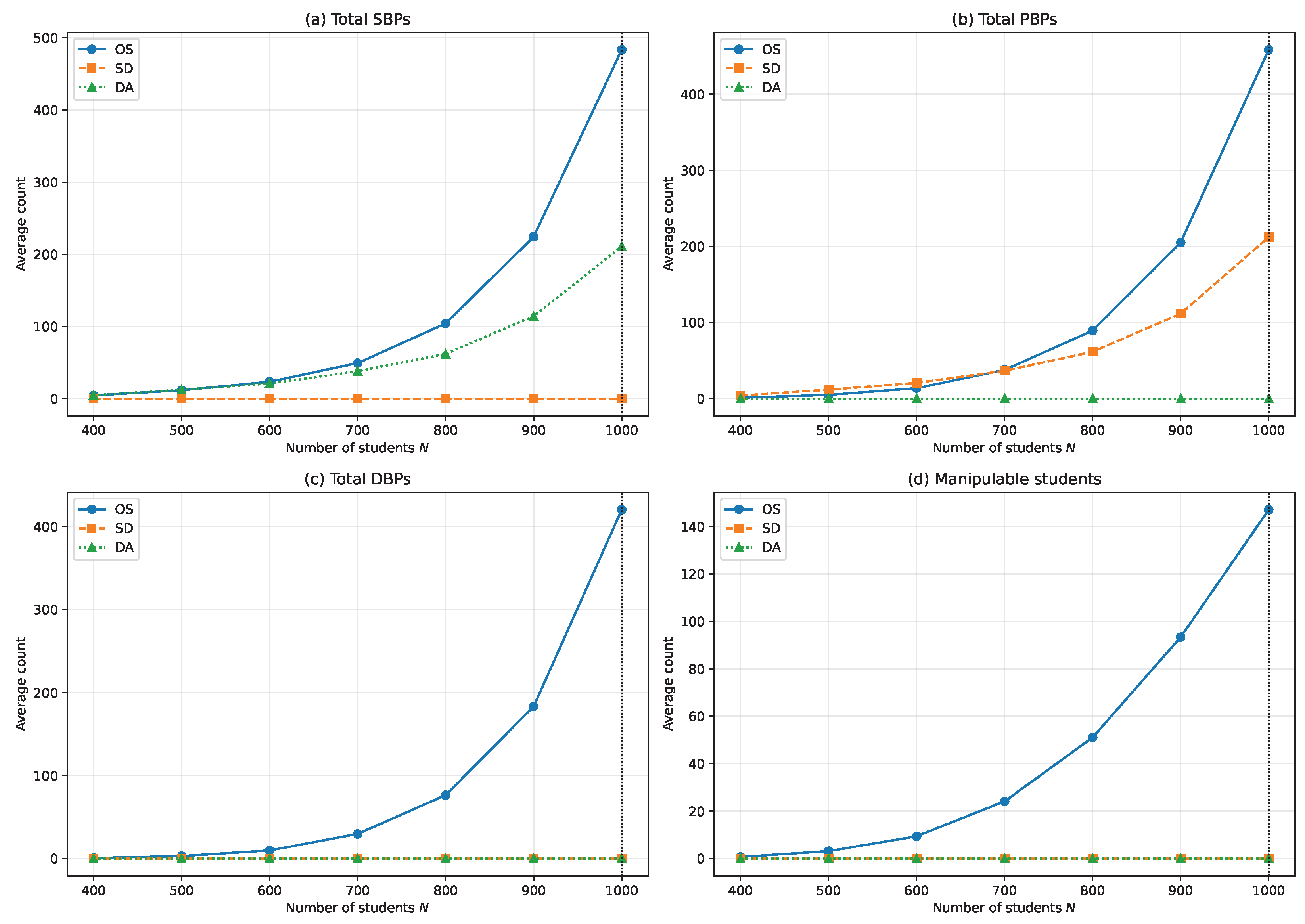
Disclaimer/Publisher’s Note: The statements, opinions and data contained in all publications are solely those of the individual author(s) and contributor(s) and not of MDPI and/or the editor(s). MDPI and/or the editor(s) disclaim responsibility for any injury to people or property resulting from any ideas, methods, instructions or products referred to in the content. |
© 2026 by the authors. Licensee MDPI, Basel, Switzerland. This article is an open access article distributed under the terms and conditions of the Creative Commons Attribution (CC BY) license.