
- Article

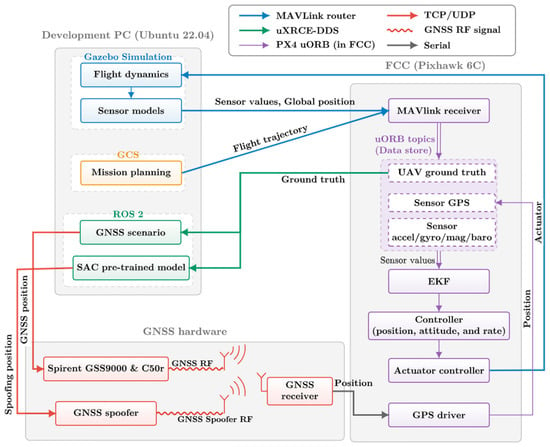
Global navigation satellite system (GNSS) spoofing has emerged as an effective countermeasure to address the growing threat posed by the malicious use of unmanned aerial vehicles (UAVs) against military and civilian infrastructure. Previous UAV redirection spoofing approaches relied on internal target information state or were limited to verification through software simulations. This study integrates a Zynq UltraScale+ radiofrequency (RF) system-on-chip multi-constellation GNSS spoofer with a soft actor–critic covert spoofing policy based on a dual-normalized innovation squared reward, providing an RF-level hardware-in-the-loop simulation closed-loop platform within an anechoic chamber and enabling real-time integration of an actual PX4-based Pixhawk flight control computer with a commercial GNSS receiver. Operating solely on external radar observations without internal-target UAV information, the policy redirects the UAV within a 20 m capture radius of the fake destination across three scenarios. During this process, the manipulated measurements do not violate the innovation gate of the extended Kalman filter (EKF) even when the GNSS spoofing signal deceives the receiver. Experiments confirmed that the EKF continues to fuse these spoofed signals with normal measurements, demonstrating that, in a physical hardware closed-loop environment, a learning-based covert spoofing policy can bypass flight control computer integrity checks and successfully redirect the UAV.
13 November 2026