
Skip to Content
  • 3.0
    Impact Factor
  • 4.7
    CiteScore
  • 25 days
    Submission to First Decision
  • 8 days
    Acceptance to Publication

Beverages

Beverages is an international, peer-reviewed, open access journal on beverage research and development published monthly online by MDPI.

Get Alerted

Add your email address to receive forthcoming issues of this journal.

All Articles (1,073)

  • Article
  • Open Access

Franchise coffee shops now offer an increasingly diverse beverage portfolio with substantial variation in nutritional composition. However, cross-brand comparisons remain difficult because products are commonly organized according to proprietary menu names and marketing concepts rather than standardized nutritional attributes. This study developed and applied a standardized beverage classification framework based primarily on beverage ingredients and preparation characteristics to examine nutritional variation both within and across beverage categories. Nutritional information for 3586 beverages from 31 major franchise coffee brands was obtained from official websites. Beverages were systematically assigned to 10 standardized categories according to their ingredients and preparation methods. Serving size and per-serving contents of energy, total sugar, protein, saturated fat, sodium, and caffeine were analyzed and compared across beverage categories and between matched hot and iced products. All nutritional variables differed significantly among beverage categories (all p < 0.001). However, substantial within-category variability was also observed. For example, total sugar content among coffee beverages ranged from 13.0 g/serving at the 25th percentile to 48.0 g/serving at the 90th percentile. The findings demonstrate substantial nutritional variation both between and within standardized beverage categories, indicating that beverages sharing similar ingredient and preparation characteristics do not necessarily have similar nutritional profiles. The proposed framework provides a transparent and reproducible taxonomy for organizing heterogeneous beverage products across brands and may facilitate nutritional surveillance and comparative research.

Beverages

2 November 2026
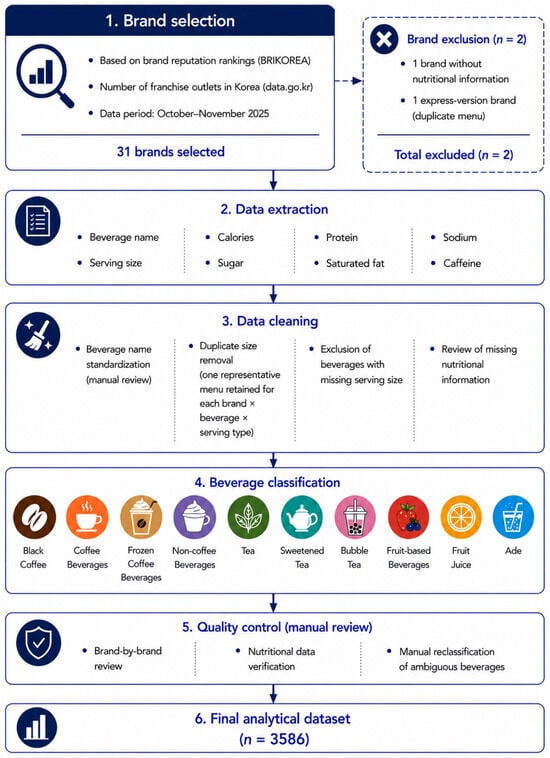
Flow chart of brand selection, beverage selection, data extraction, data cleaning, classification, and quality control used to construct the final analytical dataset.
  • Article
  • Open Access

Protected Designations of Origin (PDOs) are a cornerstone of the European wine sector, supporting quality, identity, and reputation. However, declining consumption and global competition threaten these systems, especially in mature markets. This pilot study explores how institutional design, production capacity, and strategic positioning influence regional wine competitiveness. Using a qualitative System Dynamics (SD) approach based on Causal Loop Diagram (CLD) analysis of literature and secondary data, it examines the hypothetical integration of the Franciacorta DOCG and the Oltrepò Pavese Metodo Classico DOC, two prominent Italian wine appellations in northern Lombardy, into a unified system named here “Grande Franciacorta”. The resulting CLD is hypothesis-generating and identifies hypothesized feedback mechanisms: reinforcing loops of branding, production capacity, and organizational capability, constrained by balancing loops of land availability, perceived exclusivity, and institutional resistance. It suggests that regulatory coordination alone may be insufficient and that early, coordinated investment in branding may be necessary to stimulate self-reinforcing growth, provided that governance aligns stakeholders, manages expansion, and preserves premium exclusivity. We did not run a stock-and-flow simulation or empirical test; the results are propositions for future quantitative assessment. The contribution shows how the timing of reputation-building and capacity expansion interacts with territorial and institutional constraints, with implications for geographical-indication policy and regional governance. The paper advances the policy debate on geographical indications by proposing a dynamic framework for adapting PDO systems to market shifts, with implications for regional governance and wine-sector development.

Beverages

1 November 2026

  • Review
  • Open Access

Driven by shifting cultural paradigms, increasing health consciousness, and evolving regulatory environments, the global market for non-alcoholic and low-alcohol (NoLo) beverages is experiencing rapid expansion. This review provides a comprehensive synthesis of the NoLo beverage sector by integrating public health implications, regulatory frameworks, technological developments and consumer behavioral dynamics. The epidemiological burden of conventional alcohol consumption is examined alongside the physiological rationale supporting the widely adopted 0.5% alcohol by volume (ABV) threshold. Furthermore, global regulatory fragmentations, such as strict UK labeling laws versus broader EU and US standards, are highlighted as major sources of trade barriers and consumer confusion. From a technological standpoint, physical dealcoholization processes (including reverse osmosis, spinning cone columns, vacuum evaporation, and dialysis) and biological approaches (such as arrested fermentation and maltose-negative yeast strains) are critically evaluated across wine, beer and spirit-free matrices. Focus is directed toward formulation challenges aimed at mitigating sensory deficits, including texture restoration using hydrocolloids, sweetness management and the replication of ethanol-induced trigeminal burn through pungent compounds. Finally, the public health debate surrounding substitution versus addition effects of NoLo products is addressed, alongside the risks associated with “alibi marketing,” concluding with the outline of future research priorities encompassing longitudinal epidemiological monitoring, neurochemical priming mechanisms and legal framework harmonization.

Beverages

30 October 2026

  • Article
  • Open Access

Aronia (Aronia melanocarpa, black chokeberry) is characterized by a very high content of polyphenolic compounds and relatively low concentrations of fermentable sugars, which limits its direct consumption and fermentation. However, the high levels of proanthocyanidins and anthocyanins present in aronia make this fruit attractive for the development of functional foods. One potential application is the production of grape must-based fermented beverages through the enrichment of white grape must with crushed aronia fruit. In this study, three experimental fermented beverages were produced by adding crushed aronia fruit at levels of 20%, 40% and 60% (w/w) to white grape must obtained from the Fetească regală variety. The objective of the study was to assess the sensory acceptability of these aronia-enriched fermented beverages. Sensory evaluation was performed using a quantitative profile method developed in our laboratory, complemented by the OIV score sheet commonly applied in wine competitions. Analysis of variance (ANOVA), principal component analysis (PCA) and cluster analysis were applied to the sensory data, and the results were visualized using radar plots and heatmaps. The results indicated that, although none of the samples achieved scores corresponding to high-quality wines, the fermented beverages containing 40–60% aronia fruit exhibited the highest overall acceptability, regardless of the yeast strain used. However, to avoid completely masking the grape aroma, the use of 40% aronia fruit is recommended. These findings suggest that high proportions of aronia fruit can be sensorially acceptable when incorporated into white grape must-based fermented beverages, supporting their potential for further development.

Beverages

26 October 2026

Featured Articles of Last Quarter

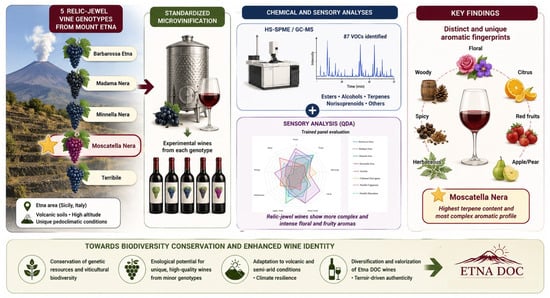
Quantitative volatile aroma composition for each class of substances in old-vine genotypes (Barbarossa Etna, Madama Nera, Minnella Nera, Moscatella Nera, and Terribile) and reference (Cabernet Sauvignon, Nerello Cappuccio, and Nerello Mascalese) wine samples. All values are expressed as mean ± standard deviation (n = 3). Different letters within each panel indicate significant differences among genotypes (Tukey’s HSD, p &lt; 0.05).

Highly Accessed Articles

News & Conferences

Latest Issues

Open for Submission

Journal Sections

XFacebookLinkedIn
Beverages - ISSN 2306-5710