
Skip to Content
You are currently on the new version of our website. Access the old version .

Photovoltaics

Photovoltaics is an international, peer-reviewed, open access journal covering fundamental studies, innovative design, practical deployment, and policy or environmental implications related to the general field of photovoltaics published quarterly online by MDPI.

Get Alerted

Add your email address to receive forthcoming issues of this journal.

All Articles (3)

  • Article
  • Open Access

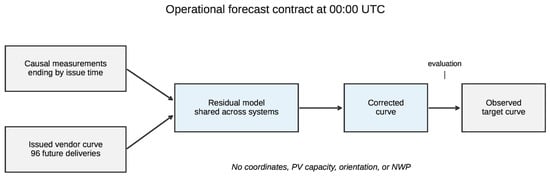
An energy manager may receive an issued photovoltaic forecast without plant metadata or forecast weather. This study evaluates a global residual correction of the complete issued trajectory using EMSx vendor forecasts and measurements from anonymized industrial systems. With calendar cutoffs common to all systems, residual LightGBM reduces the vendor mean absolute error on 1,392,864 test deliveries from 47 systems from 100.57 to 83.26 kWh, or 17.2%, and improves every system. An ablation attributes most of this gain to the shape of the issued profile. A model fitted without the evaluated system, without system identity, and with a scale derived from issued forecasts reduces the error by 18.8%, so the correction does not require a training history of the plant. Linear models for each delivery step and compact Transformer and BiLSTM residual models give smaller reductions. Without task training, Chronos-2 supplied with the issued trajectory reaches a slightly lower error than LightGBM on a shared subset of the test, whereas without the trajectory it is worse than the vendor. A partition that is chronological only within each system overstates the gain of such a global model: on identical deliveries issued before the end of its fitting data, the error falls by 53.4%, compared with 12.6% after the common cutoff. Rolling calibration of residual quantiles lowers the weighted interval score from 66.80 to 64.44 kWh and raises central 90% coverage from 0.826 to 0.915, with wider intervals.

Photovoltaics

13 November 2026

Predictor availability for one daily forecast origin. The predictors are known at issue; the separate audit of global fitting chronology is described in the text.
  • Review
  • Open Access

Satellite constellations, lunar infrastructure, high-power electric propulsion spacecraft, and deep-space missions increasingly require photovoltaics that combine high efficiency, low mass, and radiation tolerance. This review evaluates perovskite-based tandems at completed-stack and array levels rather than treating perovskite absorbers in isolation. Tandem-level irradiation studies span approximately 1% to above 94% retained efficiency under different test conditions, showing that bottom cells and recombination layers can control radiation survival. Using ASTM reference spectra, representative two-terminal bandgap pairs show a 2.0–9.9% AM0 shift in top-to-bottom photocurrent ratio and a 0.95–4.46% estimated penalty if AM1.5G-matched stacks are flown without retuning. An illustrative balance-of-array analysis gives crossover masses of 1.3–2.8 kg m−2 relative to a substrate-based III–V/Ge reference. Replacing that comparator with a measured thin-film IMM4J benchmark moves parity for the all-thin-film perovskite cases to below approximately 0.2 kg m−2 under a matched protective mass assumption. Because tandem-level retention endpoints do not identify separate sub-cell degradation functions, differential degradation is treated analytically as a buffered-versus-exposed current-matching problem rather than assigned architecture-specific integrated losses. The review concludes with mission-specific modeling, diagnostics, and qualification recommendations.

Photovoltaics

9 October 2026

News & Conferences

Latest Issues

Open for Submission

Journal Sections

XFacebookLinkedIn
Photovoltaics - ISSN 3043-1336