You are currently viewing a new version of our website. To view the old version click .

Diabetology, Volume 6, Issue 12

December 2025 - 20 articles

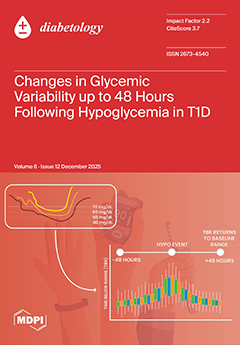
Cover Story: Even with advanced diabetes technologies such as automated insulin delivery (AID), hypoglycemia in Type 1 diabetes remains influenced by exercise and other real-world factors. Previous research has explored the relationship between glycemic variability (GV) and hypoglycemia, but typically over short time windows, leaving limited understanding of how GV evolves over longer periods before and after hypoglycemic events. Using data from the T1DEXI dataset, this study analyzes CGM data over a 96-hour window (−48 to +48 hours) surrounding hypoglycemia to characterize GV and time below range. We compare AID and non-AID users and assesses potential related factors, including exercise, hypoglycemia duration and severity, and gender. Our findings indicate that GV and time below range can remain disrupted for up to 48 hours following hypoglycemia in both AID and non-AID users. View this paper
  • Issues are regarded as officially published after their release is announced to the table of contents alert mailing list .
  • You may sign up for email alerts to receive table of contents of newly released issues.
  • PDF is the official format for papers published in both, html and pdf forms. To view the papers in pdf format, click on the "PDF Full-text" link, and use the free Adobe Reader to open them.

Articles (20)

  • Article
  • Open Access
592 Views
11 Pages

Perinatal Outcomes of Type 1 and Type 2 Diabetes in Pregnancy: A 10-Year Single-Centre Cohort Study

  • Paul Lawton,
  • Jean Lu,
  • Ryan Endall,
  • Jing Luo,
  • Rebecca Foskey,
  • Dev Kevat,
  • Peter S. Hamblin,
  • Joanne M. Said,
  • Glyn Teale and
  • Christopher J. Yates
  • + 1 author

Background/Objectives: Previous studies have examined perinatal outcomes in women with type 1 (T1DM) or type 2 diabetes (T2DM) in pregnancy compared with the general population, but few have directly assessed the impact of T1DM and T2DM on pregnancy...

  • Article
  • Open Access
450 Views
11 Pages

Diabetes Mellitus and the Increased Risk of Acute Kidney Injury Following Acute Coronary Syndrome

  • Muhammad Usman Shah,
  • Paul Edward Squires,
  • Claire Elizabeth Hills and
  • Kelvin Lee

Background/objectives: Diabetes mellitus (DM) increases susceptibility to both cardiovascular and renal complications. Acute kidney injury (AKI) in the setting of acute coronary syndrome (ACS) is a frequent manifestation of acute cardiorenal syndrome...

  • Article
  • Open Access
615 Views
18 Pages

Background: Metabolic syndrome (MetS) comprises a cluster of metabolic abnormalities that increase the risk of type 2 diabetes mellitus (T2DM) and cardiometabolic morbidity. Although widely recognized, evidence on its documentation and follow-up in p...

  • Article
  • Open Access
413 Views
12 Pages

Background/Objective: Type 2 diabetes mellitus (T2DM) is a known risk factor for cardiovascular disease (CVD); however, not all individuals with T2DM have the same CVD risk. Traditional glycemic cluster analyses of individuals with diabetes using the...

  • Article
  • Open Access
324 Views
10 Pages

Exploring the Relationship Between Health Biomarkers and Performance on a Novel Color Perimetry Device in Prediabetes and Type 2 Diabetes

  • Liam Burhans,
  • Bismark Owusu-Afriyie,
  • Christopher S. Wu,
  • Jennyffer D. Smith,
  • Daniel R. Coates and
  • Wendy W. Harrison

Background/Objectives: Type 2 diabetes (T2DM) is a leading cause of vision loss. Functional measurements (color vision and contrast sensitivity) are sensitive to early changes in eyes even before retinopathy is present. This study evaluates a novel c...

  • Article
  • Open Access
413 Views
11 Pages

A Real-World Comparison of Three Deep Learning Systems for Diabetic Retinopathy in Remote Australia

  • Jocelyn J. Drinkwater,
  • Qiang Li,
  • Kerry Woods,
  • Emma Douglas,
  • Mark Chia,
  • Yukun Zhou,
  • Steve Bartnik,
  • Yachana Shah,
  • Vaibhav Shah and
  • Pearse A. Keane
  • + 1 author

Background/objective: Deep learning systems (DLSs) may improve access to screening for diabetic retinopathy (DR), a leading cause of vision loss. Therefore, the aim was to prospectively compare the performance of three DLSs, Google ARDA, Thirona RetC...

  • Review
  • Open Access
886 Views
20 Pages

From Classic to Contemporary, Evolving Therapies in Diabetic Kidney Disease: The Point of View of the Nephrologist and the Diabetologist

  • Micaela Gentile,
  • Marta D’Angelo,
  • Maria Rosaria Varì,
  • Andrea Mario Bolla,
  • Maurizio Bianco and
  • Roberto Scarpioni

Diabetes mellitus represents a global health concern, which is expected to worsen over the years. The prevalence is estimated to increase up to 642 million people by 2040. Almost half of diabetic patients are at a high risk of developing kidney invol...

  • Article
  • Open Access
481 Views
11 Pages

Background/Objectives: Diabetic nephropathy is the leading cause of end-stage kidney disease (ESKD) worldwide. ESKD individuals with type 2 diabetes are known to have poor prognosis of survival. We aimed to investigate whether the recent mortality tr...

  • Brief Report
  • Open Access
359 Views
14 Pages

The Von Hippel–Lindau Protein (pVHL) Is Downregulated in the Pancreatic Islets of Mice with Type 2 Diabetes Induced by a High-Calorie Diet

  • Alma Nelly Diaz-Herreros,
  • Alberto Granados-Galeana,
  • Isaí Martínez-Torres,
  • Elba Reyes-Maldonado,
  • Erika Rosales-Cruz,
  • Fernando Gómez-Chávez,
  • Gabriel Betanzos-Cabrera,
  • Amaranta Sarai Valdez-Guerrero,
  • Juan Carlos Cancino-Diaz and
  • Mario Eugenio Cancino-Diaz

27 November 2025

Background/Objectives: Knock-out mice lacking von Hippel–Lindau protein (pVHL) in pancreatic beta cells exhibit glucose intolerance and low insulin production, indicating a possible association between pVHL and diabetes mellitus (DM). It is cur...

  • Article
  • Open Access
663 Views
18 Pages

Semaglutide Therapy and Cardiorenal Risk Management in Type 2 Diabetes: hsCRP as a Biomarker of Risk

  • Nikolay Krasimirov Kostadinov,
  • Tcvetelina Totomirova and
  • Boyan Ivanov Nonchev

25 November 2025

Background: Inflammation plays a key role in the pathogenesis of type 2 diabetes (T2D) and the associated cardiovascular complications. High-sensitivity C-reactive protein (hsCRP) is a widely used marker of systemic inflammation as well as a predicto...

of 2

Get Alerted

Add your email address to receive forthcoming issues of this journal.

XFacebookLinkedIn
Diabetology - ISSN 2673-4540