Article

Implementing the Physical Activity Vital Sign in a Pediatric Diabetes Center

1
Rory Meyers College of Nursing, New York University, 433 First Avenue, New York, NY 10010, USA
2
Pediatric Diabetes Center, NYU Langone Health, 135 East 31st Street, New York, NY 10016, USA
*
Author to whom correspondence should be addressed.
Diabetology 2025, 6(12), 157; https://doi.org/10.3390/diabetology6120157

Submission received: 16 October 2025 / Revised: 17 November 2025 / Accepted: 27 November 2025 / Published: 4 December 2025

Abstract

Aims: The purpose of this quality improvement (QI) initiative at a pediatric diabetes center was to integrate physical activity (PA) assessment into routine clinical care. This project had two aims: (1) to collect self-reported PA in youth and young adults with type 1 diabetes (T1D) and (2) to analyze levels of PA (none, some PA, at-goal PA, and at-goal vs. not-at-goal PA) and their relationship with demographics and clinical outcomes. PA goals were 60 min/day for youth and 150 min/week of moderate-to-vigorous aerobic PA for young adults. Methods: During clinical visits, a pediatric diabetes center used a three-question Physical Activity Vital Sign (PAVS) to assess and document PA, which was recorded as total minutes per week with intensity (light, moderate, and vigorous). We analyzed PAVS data from January 2020 to July 2022. Clinical variables were compared across the levels of PA. Results: This was a sample of 304 youth and young adults living with T1D: 87 young adults (29%) and 217 youth (71%), with a mean age of 14.2 (4.8) years. Half had an HbA1c between 7% (53.01 mmol/mol) and 9% (74.87 mmol/mol), and 56% used both continuous glucose monitoring and an insulin pump. Overall, 78% of the sample did not meet PA goals. LDL and blood pressure were significantly different across the two groups of PA achievement (not at goal vs. at goal). Only LDL levels remained significantly different across the three groups (none, some PA, and at-goal PA). Conclusions: Implementing PA assessment is feasible in a pediatric diabetes center. Next steps may include incorporating exercise prescriptions as part of routine clinical care.

Graphical Abstract

1. Introduction

It is well documented that for those living with type 1 diabetes (T1D), diabetes self-management includes intensive individualized insulin therapy to maintain glucose levels within the target range. Other clinical evaluations that are regularly assessed in those living with T1D include blood pressure (BP) management, retinopathy screening, and monitoring of healthy lipid levels to help identify and reduce diabetes complications [1]. Additionally, it is recommended for youth and young adults living with T1D to participate in age-appropriate levels of physical activity (PA). The goal for youth and young adults living with T1D, like the general population, is 60 min of daily PA for youth ages 6–17 [2] and 150 min per week of moderate intensity or 75 min of vigorous intensity PA for people ages 18 and above [3]. It is an important component of diabetes self-management and cardiovascular (CV) health for youth and young adults to engage in sufficient PA, along with eating a healthy diet [3]. It is important, however, to recognize that younger adults with lower CV disease risk factors typically face lower CV and all-cause mortality, and so the inclusion of education related to CV health and PA at the clinical visit may not be viewed as acutely urgent as the other diabetes self-management components mentioned [4]. However, youth and young adults require focused CV care and education necessary to establish healthy habits, specifically regarding PA, early in life. The American Heart Association (AHA) developed a model of CV health (Life’s Essential 8) that includes eight components—four health behaviors (adequate PA, adequate sleep, a healthy diet, and not smoking) and four health factors (body weight, lipids, glucose/hemoglobin A1c (HbA1c), and BP)—to shift the focus to positive health promotion across the lifespan [5]. The presence of diabetes itself is an independent risk factor for CV disease, highlighting the importance of managing all modifiable risk factors even early in life [1]. This model of CV health is an important message for youth and young adults living with T1D to receive.
Routine PA is key in the management of and reduction in cardiometabolic risk factors for youth and young adults living with T1D [6]. Although there is limited evidence that routine PA can positively impact glycemia, the evidence of its ability to improve metabolic (e.g., lipids) and psychological health is clear [7]. However, the relationship between PA and glycemia is complex, but using diabetes technology to help manage glucose levels is encouraged [2]. This includes devices to monitor glucose levels, such as continuous glucose monitoring (CGM) for real-time glucose levels and trends, and insulin pumps for subcutaneous insulin delivery [8]. Together, a hybrid closed-loop system can offer an even better way to keep glucose in the target range. The benefits of these technologies on glycemic outcomes have been well documented and can assist in managing glucose when incorporating PA [8].
The race/ethnicity and sex of youth and young adults may also impact T1D outcomes. There are differences in levels of glycemia among racial and ethnic subgroups. For example, elevated HbA1c levels in minority populations have been attributed to racial differences in mean glucose concentration overestimation as well as differences in clinical outcomes due to socioeconomic status, healthcare access, and technology use uptake [9,10]. The results from a systematic review of youth living with T1D report differential uptake and use of CGM, which may impact glycemic management [11]. Sex-related differences in glycemia during this time may be due to growth, changing hormones, insulin resistance, and increasing insulin requirements during puberty [12]. For young emerging adults (ages 18–26), this is the life stage where they become self-sufficient, assuming adult roles and responsibilities that set the foundation for their adult years [13]. During no other life stage do individuals experience more complex changes in developmental levels [13]. This period in their lives is critical for learning how to optimize CV health, especially with the additional risk conferred by T1D.
The diabetes specialty clinic office visit is an opportunity to address modifiable risk factors in youth and young adults living with T1D. Time restraints, workflows that do not include PA assessment, competing responsibilities, and additional needs of higher importance often limit providers from assessing PA levels of youth and young adults at the clinical visit. However, globally, physical inactivity is responsible for over 7% of all-cause and cardiovascular mortality [14]. Encouraging individuals to increase PA can help reduce this elevated risk, and healthcare providers are in a position to influence this process by routinely assessing and counseling patients on PA. The PA vital sign is one option that can be used in clinical care to assess current levels of patients’ self-reported PA. There are different versions of PA (or exercise) assessments for use in clinical care [15], and most will summarize the time spent in moderate-to-vigorous PA per week. Patients can be asked to fill out these brief, two- or three-question forms prior to an office visit (using their patient portal). Alternatively, a staff member can administer the questionnaires, such as the Medical Assistant, who can collect these data when taking vital signs during an office visit. The data can then be stored in the electronic health record for health care provider use.
The purpose of this quality improvement initiative at a pediatric diabetes center was to address this modifiable and important CV disease risk factor, PA, and to integrate PA assessment into routine clinical care. This project had two aims: to collect self-reported PA in youth and young adults living with T1D and to analyze levels of PA (none, some PA, and at-goal PA) and their relationship with clinical outcomes. This secondary data analysis of de-identified data was not considered human subject research and did not undergo a review from the Institutional Review Board.

2. Methods

Given that PA is a key component of diabetes self-management and education [3], the Hassenfeld Children’s Hospital at NYU Langone Health, Pediatric Diabetes Center (PDC), initiated PA screening of patients attending a clinical appointment.
The Physical Activity Vital Sign (PAVS) was chosen to assess and document patients’ PA at the clinical visit. The PAVS is a self-report assessment of a person’s PA and consists of three PA questions: (1) “On average, how many days per week do you perform PA or exercise?”; (2) “On average, how many total minutes of PA or exercise do you perform on those days?”; and (3) “Describe the intensity of your PA or exercise (casual walk = light, brisk walk = moderate, jogging = vigorous)”.3 For youth under 12, their parents received the questionnaire and were asked to answer the PA questions on behalf of their child. For those over 12, the parent and patient received the questionnaire, and either may have responded to report PA for the patient. For those 18 and older, the patient received the questionnaire to answer for themselves.
For this study, PAVS data of youth (ages 6 to <18 years) and young adults (ages 18–25 years), living with T1D and attending a provider appointment at the PDC from January 2020 to July 2022, were analyzed. American Diabetes Association (ADA) PA guidelines1 were used to determine if self-reported PA goals were being met. For youth ages 3 to 17 years old, the ADA recommendations are to participate in 60 min per day of moderate-to-vigorous aerobic PA. For people ages 18 years and older, the recommendation is to participate in 150 min per week of moderate-to-vigorous aerobic PA [3]. These guidelines are similar to the general population guidelines for Americans: a minimum of 60 min per day of moderate-to-vigorous aerobic PA for youth (age 6–17) and 150 min of moderate or 75 min of vigorous aerobic PA weekly for adults [16]. All de-identified clinical data were obtained from the electronic health record.

Statistical Analysis

Continuous variables were presented as means (SD) and categorical variables as counts (%). Group differences between the two PA attainments (‘not at goal’ vs. ‘at goal’) were assessed with independent-samples t-tests (or Welch’s t-test when homogeneity of variance assumption was violated) for continuous outcomes (BMI, HbA1c, HDL, LDL, systolic BP, and diastolic BP) and with Pearson’s Chi-square (χ2) or Fisher’s exact tests for categorical variables (demographics and diabetes technology use). BMI was reported and analyzed only among the young adult group aged 18–25 years because BMI evaluation for youth < 18 years requires age- and sex-specific percentile values, which were not available in this study.
PA attainment was further stratified into three PA levels (‘no PA’, ‘some PA’, and ‘at-goal PA’). Continuous outcomes were compared across these levels using one-way ANOVA, and post hoc pairwise comparisons were performed with Tukey’s honestly significant difference (HSD) test, with the adjusted p-values reported. Categorical outcomes were analyzed across PA levels with Pearson’s χ2 or Fisher’s exact tests, as appropriate.
Effect sizes were reported for hypothesis tests: Cohen’s d [17] for t-tests (0.20 = small, 0.50 = medium, and 0.80 = large), eta-squared (η2) [18] for ANOVA (0.01 = small, 0.06 = medium, and 0.14 = large), and Cramer’s V [17] (φc) for categorical analyses (0.10 = small, 0.30 = medium, and 0.50 = large).
Prior to analysis, normality [19] was assessed using skewness, with values around ±2 considered sufficiently normal for analyses. Pearson’s χ2 tests were used when all expected cell frequencies were ≥5 [20]; otherwise, Fisher’s exact tests were applied. Missing data were handled using an available-case approach. All analyses were conducted in R version 4.3.1 (RStudio, Boston, MA), using two-sided tests with a significance threshold of p < 0.05.

3. Results

3.1. Sample Characteristics

This analysis reviewed de-identified PAVS self-reports from 304 youth and young adults living with T1D: 87 young adults (29%) and 217 youth (71%), with a mean age of 14.2 (4.8) years, seen at the PDC between 13 January 2020 and 28 July 2022. Most patients included were White (55%). Half of the cohort had an HbA1c between 7% (53.01 mmol/mol) and 9% (74.87 mmol/mol). The majority had favorable lipid profiles: 62% had LDL < 100 mg/dL and nearly all had HDL > 35 mg/dL. Mean systolic and diastolic BP were 117.4 (9.3)/67.7 (8.6) mmHg.
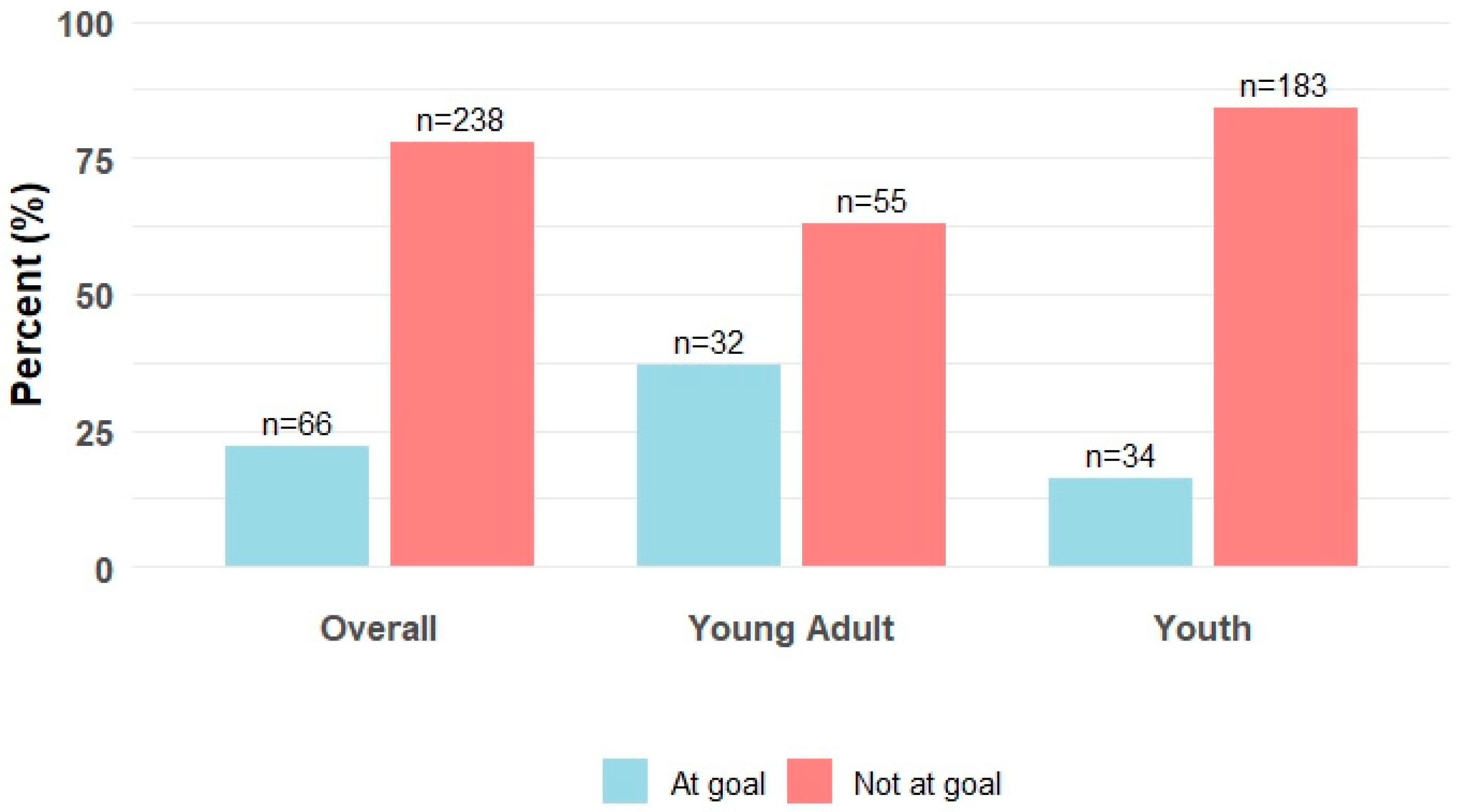
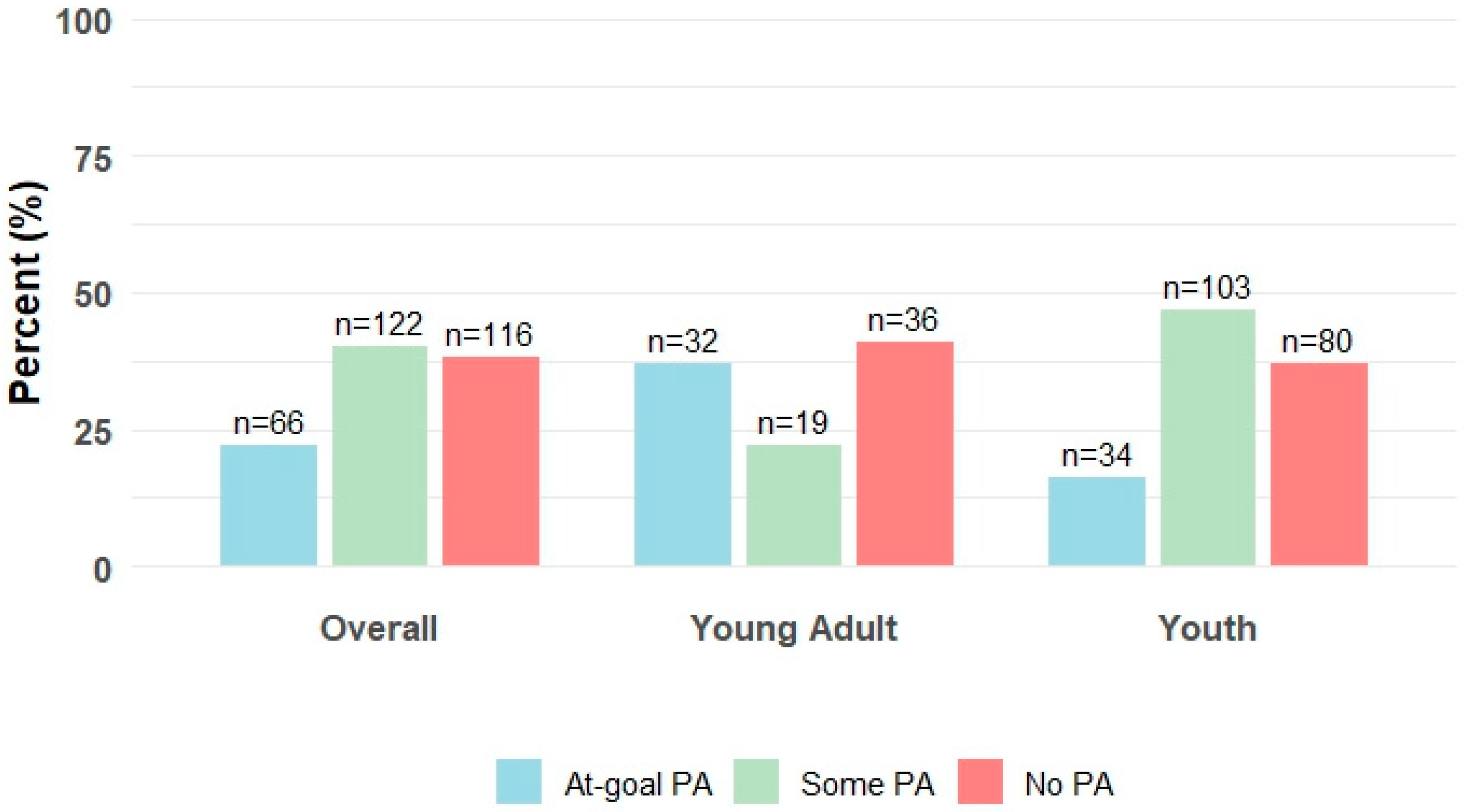
Regarding diabetes technology, 56% used both CGM and an insulin pump, whereas only ten youth and young adults (3%) used an insulin pump without CGM. Overall, 78% of the youth and young adults did not meet PA goals, and nearly half of those reported doing no moderate-to-vigorous PA (Figure 1 and Figure 2). Notably, young adults were more likely than youth to meet the PA goal (37% vs. 16%) (Table 1).

3.2. Comparing Clinical Factors Between “At-Goal” vs. “Not-at-Goal” PA Levels

Welch’s t-test revealed a statistically significant difference in LDL between the at-goal and not-at-goal groups (83.9 vs. 93.7 mg/dL; t83 = 2.22, p = 0.029), with a small-to-medium effect size (d = 0.35). Conversely, systolic BP was significantly higher among the at-goal group (t104 = −2.1, p = 0.039), with mean values of 119.6 mmHg for the at-goal group and 116.6 mmHg for the not-at-goal group; Cohen’s d of 0.32 indicated a small-to-medium effect. No significant differences emerged for HbA1c, HDL, diastolic BP, demographics, or diabetes technology use (all p > 0.05). Among young adults aged 18–25 years, BMI did not differ significantly between the at-goal and not-at-goal groups (p > 0.05) (see Table 2).

3.3. Comparing Clinical Factors Between Three PA Levels

ANOVAs comparing mean differences among the three PA levels (no PA, some PA, and at-goal PA) indicated that the groups differed only in LDL (F(2,284) = 3.3; p = 0.040; small effect: η2 = 0.02). Tukey’s HSD showed higher LDL in the some-PA group (94.3 mg/dL) than in the at-goal PA group (83.9 mg/dL; mean difference = 10.4 mg/dL; adjusted p = 0.039). The systolic BP difference observed in the binary comparison did not persist across the three groups (F(2,195) = 2.1; p = 0.130, η2 = 0.02). No additional health, demographic, or diabetes technology use variables differed significantly among PA levels (all p > 0.05). Among young adults aged 18–25 years, BMI did not differ significantly by PA levels (p > 0.05)(see Table 3).

4. Discussion

Given the importance of regular PA as a component of T1D self-management in youth and young adults, we implemented a PA screening protocol to be used with all patients seeking care at the PDC. Although several PDSA cycles were required before this quality improvement was successful, these data are now routinely being collected in all patients, and providers can now use this information to provide PA counseling. This is important given that only 22% of patients living with T1D seen during this period of time were exercising at recommended levels. Without routine screening of patients’ PA, addressing this important component would be challenging. Behavior modification goals discussed during clinical care should include achieving age-appropriate PA levels.
At-goal PA demonstrated beneficial levels in one CVD risk factor in this sample. LDL cholesterol was significantly lower (about 10 points) in those who reported PA levels at goal as compared to those with some PA but not at goal. Although all three groups had mean LDL levels below the recommended 100 mg/dL, the early benefit seen in these youth and young adults can result in better cardiovascular health later on in life [4]. In discussions with patients, diabetes providers can connect achievement of at-goal PA to improvements in their cardiovascular risk profile (e.g., lipids, body weight, and HbA1c), sending the message that these healthy behaviors have an impact on their health now and in the future. Conversely, systolic BP was slightly higher in the at-goal PA group as compared to those not at goal (by approximately 3 mmHg), but the difference is not clinically meaningful as all groups had mean levels below the recommended 120 mmHg [1]. However, hypertension is common among those living with T1D and is a major risk factor for CVD; therefore, BP warrants close monitoring across the lifespan [1].
The use of diabetes technology is an important component of diabetes self-management, especially when being physically active. Slightly over one-half of the youth and young adults in this sample used both a CGM and an insulin pump. It was not a goal of this project to compare diabetes technology use across different subgroups (such as age, race, ethnicity, or sex), so it is unknown whether there are any disparities in the use of these diabetes technologies. ADA guidelines recommend offering the use of CGM as early as possible or even at the diagnosis of T1D, while ensuring that patients and caregivers receive the necessary training to comfortably use the device [8]. The use of an insulin pump or the use of hybrid closed loop insulin therapy, if the patient is using a CGM and a pump, should also be considered, as the use of these diabetes technologies increases the time their glucose levels are in range and lowers HbA1c [8]. However, even adults with T1D who use diabetes technologies may still experience hypoglycemia during exercise, and not enough adults rely on their healthcare provider for guidance on self-management of exercise [21]. This speaks to the need to reinforce strategies to minimize PA-related hypoglycemia.
Although there are differences between T1D and type 2 diabetes (T2D), routine PA is an important lifestyle modification that can be used to manage both types of diabetes [22]. Discussing the guidelines for PA in T2D can be very straightforward for both the patient and the provider due to it being a highly accepted lifestyle modification for those living with T2D, but including PA in the routine education of youth and young adults living with T1D can be more complex due to the additional steps that must be taken to keep glucose in safe ranges before, during, and after PA [23].
Lastly, we found no differences in HbA1c between the groups, but it is unclear whether our sample size was too small to detect a difference. The relationship between PA and hemoglobin A1c is complex. There is evidence from a systematic review that PA is associated with a small reduction in HbA1c, but the type, duration, frequency, and intensity of PA varied across studies [24]. We also did not collect data on resistance training, which has been found to improve glycemia in adults with T1D [25]. Nonetheless, given the many benefits of PA, it is a healthy behavior that should be routinely assessed and encouraged, and its progress should be monitored.

Limitations and Strengths

This analysis was in a small sample of youth and young adults living with T1D and seeking care in one healthcare center, limiting the study’s scope and its generalizability. Our small sample size may have also limited our ability to find significant differences in outcome measures between the two and three PA groups. Additionally, BMI could only be analyzed in the young adult group (aged 18–25 years) because pediatric BMI requires age- and sex-specific percentile data, which were not available. Future research should incorporate complete pediatric BMI percentiles to more comprehensively assess weight-related differences across the full age range. Lastly, our data were cross-sectional, which did not allow us to establish causality between the factors and levels of PA. In the future, a prospective longitudinal multi-center study will allow researchers to establish a causal relationship between clinical factors and the levels of PA in this population and improve generalizability. However, the details provided in the implementation of this clinical practice change are a strength, allowing similar clinics to follow some of these steps to attempt to integrate the routine assessment of PA into their clinical care.

5. Conclusions

This quality improvement project has provided evidence that PA assessment can be incorporated into the electronic health record and clinical workflow of a busy urban academic pediatric diabetes center. In the future, next steps can include prompts for providers to counsel inactive patients and the use of remote patient monitoring (connecting PA monitors to the electronic health record) to provide objective PA data for review.

Author Contributions

Conceptualization: M.M.M., J.I., and J.H. Methodology: M.M.M., J.I., and J.H. Formal analysis and investigation: J.H. Data curation: J.I., J.H., and M.P.G. Writing: M.M.M. Review and editing: J.I., J.H., and M.P.G. All authors have read and agreed to the published version of the manuscript.

Funding

This research received no funding.

Institutional Review Board Statement

This is a secondary data analysis of de-identified electronic health record data. As per a self-certification, this was not human subject research and did not require consent from human subjects.

Informed Consent Statement

Not applicable.

Data Availability Statement

The raw data supporting the conclusions of this article will be made available by the authors on request.

Conflicts of Interest

The authors declare no conflicts of interest.

References

  1. American Diabetes Association Professional Practice Committee. 10. Cardiovascular Disease and Risk Management: Standards of Care in Diabetes—2025. Diabetes Care 2025, 48 (Suppl. S1), S207–S238. [Google Scholar] [CrossRef]
  2. American Diabetes Association Professional Practice Committee. 14. Children and Adolescents: Standards of Care in Diabetes-2025. Diabetes Care 2025, 48 (Suppl. S1), S283–S305. [Google Scholar] [CrossRef]
  3. American Diabetes Association Professional Practice Committee. 5. Facilitating Positive Health Behaviors and Well-Being to Improve Health Outcomes: Standards of Care in Diabetes—2025. Diabetes Care 2025, 48 (Suppl. S1), S86–S127. [Google Scholar] [CrossRef]
  4. Michos, E.D.; Khan, S.S. Further Understanding of Ideal Cardiovascular Health Score Metrics and Cardiovascular Disease. Expert Rev. Cardiovasc. Ther. 2021, 19, 607–617. [Google Scholar] [CrossRef]
  5. Lloyd-Jones, D.M.; Allen, N.B.; Anderson, C.A.; Black, T.; Brewer, L.C.; Foraker, R.E.; Grandner, M.A.; Lavretsky, H.; Perak, A.M.; Sharma, G.; et al. Life’s Essential 8: Updating and Enhancing the American Heart Association’s Construct of Cardiovascular Health: A Presidential Advisory From the American Heart Association. Circulation 2022, 146, e18–e43. [Google Scholar] [CrossRef]
  6. Adolfsson, P.; Taplin, C.E.; Zaharieva, D.P.; Pemberton, J.; Davis, E.A.; Riddell, M.C.; McGavock, J.; Moser, O.; Szadkowska, A.; Lopez, P.; et al. ISPAD Clinical Practice Consensus Guidelines 2022: Exercise in Children and Adolescents with Diabetes. Pediatr. Diabetes 2022, 23, 1341–1372. [Google Scholar] [CrossRef] [PubMed]
  7. Absil, H.; Baudet, L.; Robert, A.; Lysy, P.A. Benefits of Physical Activity in Children and Adolescents with Type 1 Diabetes: A Systematic Review. Diabetes Res. Clin. Pract. 2019, 156, 107810. [Google Scholar] [CrossRef] [PubMed]
  8. American Diabetes Association Professional Practice Committee. 7. Diabetes Technology: Standards of Care in Diabetes—2025. Diabetes Care 2025, 48 (Suppl. S1), S146–S166. [Google Scholar] [CrossRef] [PubMed]
  9. Bergenstal, R.M.; Gal, R.L.; Beck, R.W. Racial Differences in the Relationship of Glucose Concentrations and Hemoglobin A1c Levels. Ann. Intern. Med. 2018, 168, 232–233. [Google Scholar] [CrossRef]
  10. Liese, A.D.; Reboussin, B.A.; Kahkoska, A.R.; Frongillo, E.A.; Malik, F.S.; Imperatore, G.; Saydah, S.; Bellatorre, A.; Lawrence, J.M.; Dabelea, D.; et al. Inequalities in Glycemic Control in Youth with Type 1 Diabetes Over Time: Intersectionality Between Socioeconomic Position and Race and Ethnicity. Ann. Behav. Med. A Publ. Soc. Behav. Med. 2022, 56, 461–471. [Google Scholar] [CrossRef]
  11. Howard Dicks, J.; McCann, L.J.; Tolley, A.; Barrell, A.; Johnson, L.; Kuhn, I.; Ford, J. Equity of Continuous Glucose Monitoring in Children and Young People With Type 1 Diabetes: A Systematic Review. Pediatr. Diabetes 2025, 2025, 8875203. [Google Scholar] [CrossRef]
  12. Smigoc Schweiger, D.; Battelino, T.; Groselj, U. Sex-Related Differences in Cardiovascular Disease Risk Profile in Children and Adolescents with Type 1 Diabetes. Int. J. Mol. Sci. 2021, 22, 10192. [Google Scholar] [CrossRef]
  13. Wood, D.; Crapnell, T.; Lau, L.; Bennett, A.; Lotstein, D.; Ferris, M.; Kuo, A. Emerging Adulthood as a Critical Stage in the Life Course. In Handbook of Life Course Health Development; Halfon, N., Forrest, C.B., Lerner, R.M., Faustman, E.M., Eds.; Springer: Berlin/Heidelberg, Germany, 2018. Available online: http://www.ncbi.nlm.nih.gov/books/NBK543712/ (accessed on 25 April 2025).
  14. Katzmarzyk, P.T.; Friedenreich, C.; Shiroma, E.J.; Lee, I.M. Physical Inactivity and Non-Communicable Disease Burden in Low-Income, Middle-Income and High-Income Countries. Br. J. Sports Med. 2022, 56, 101–106. [Google Scholar] [CrossRef] [PubMed]
  15. Golightly, Y.M.; Allen, K.D.; Ambrose, K.R.; Stiller, J.L.; Evenson, K.R.; Voisin, C.; Hootman, J.M.; Callahan, L.F. Physical Activity as a Vital Sign: A Systematic Review. Prev. Chronic Dis. 2017, 14, E123. [Google Scholar] [CrossRef] [PubMed]
  16. Office of the Assistant Secretary for Health. Physical Activity Guidelines for Americans, 2nd ed.; Office of the Assistant Secretary for Health: Washington, DC, USA, 2018; 118p.
  17. Cohen, J. Statistical Power Analysis for the Behavioral Sciences, 2nd ed.; Routledge: Hillsdale, NJ, USA, 1988. [Google Scholar]
  18. Richardson, J.T.E. Eta Squared and Partial Eta Squared as Measures of Effect Size in Educational Research. Educ. Res. Rev. 2011, 6, 135–147. [Google Scholar] [CrossRef]
  19. Hair, J.F.; William, C.B.; Barry, J.B. Multivariate Data Analysis: A Global Perspective; Pearson Education: London, UK, 2010. [Google Scholar]
  20. Kim, H.-Y. Statistical Notes for Clinical Researchers: Chi-Squared Test and Fisher’s Exact Test. Restor. Dent. Endod. 2017, 42, 152–155. [Google Scholar] [CrossRef]
  21. Henske, J.; Albashaireh, A.; Turner, L.V.; Beach, G.; Riddell, M.C. Are Regular Aerobic Exercisers With Type 1 Diabetes Following Current Physical Activity Self-Management Guidelines? Insights From an Online Survey. Clin. Diabetes: A Publ. Am. Diabetes Assoc. 2025, 43, 378–387. [Google Scholar] [CrossRef]
  22. Krause, M.; De Vito, G. Type 1 and Type 2 Diabetes Mellitus: Commonalities, Differences and the Importance of Exercise and Nutrition. Nutrients 2023, 15, 4279. [Google Scholar] [CrossRef]
  23. Codella, R.; Terruzzi, I.; Luzi, L. Why Should People with Type 1 Diabetes Exercise Regularly? Acta Diabetol. 2017, 54, 615–630. [Google Scholar] [CrossRef]
  24. De Cock, D.; Schreurs, L.; Steenackers, N.; Pazmino, S.; Cools, W.; Eykerman, L.; Thiels, H.; Mathieu, C.; Van der Schueren, B. The Effect of Physical Activity on Glycaemic Control in People with Type 1 Diabetes Mellitus. Diabet. Med. 2024, 41, e15415. [Google Scholar] [CrossRef]
  25. Reddy, R.; Wittenberg, A.; Castle, J.R.; El Youssef, J.; Winters-Stone, K.; Gillingham, M.; Jacobs, P.G. Effect of Aerobic and Resistance Exercise on Glycemic Control in Adults With Type 1 Diabetes. Can. J. Diabetes 2019, 43, 406–414. [Google Scholar] [CrossRef] [PubMed]
Figure 1. Comparing two physical activity groups: at goal and not at goal.
Diabetology 06 00157 g001
Figure 2. Comparing three physical activity groups: at goal, some PA, and no PA.
Diabetology 06 00157 g002
Table 1. Baseline characteristics of participants diagnosed with type 1 diabetes, stratified by age group (young adults: 18–25 y; youth: 6 to <18 y), N = 304.
CharacteristicOverall
N = 304
Young Adult
N = 87
Youth
N = 217
N (%)N (%)N (%)
Demographic
Sex
Female145 (48)44 (51)101 (47)
Male159 (52)43 (49)116 (53)
Race
Non-White/Unknown136 (45)37 (43)99 (46)
White168 (55)50 (57)118 (54)
Age, Years, Mean (SD)14.23 (4.84)19.93 (1.85)11.94 (3.63)
Clinical
Height, Inches, Mean (SD)61.51 (7.71)66.68 (3.95)59.47 (7.88)
Weight, kg, (Mean (SD))56.56 (21.86)73.26 (17.13)50.07 (20.00)
BMI, kg/m2, (Mean (SD)) b-25.46 (5.12)-
Systolic BP a, mmHg, Mean (SD)117.44 (9.27)119.30 (10.06)116.01 (8.38)
Diastolic BP a, mmHg, Mean (SD)67.69 (8.62)70.43 (8.45)65.59 (8.18)
Elevated BP56 (19)27 (32)29 (14)
Normal BP208 (71)37 (44)171 (81)
Stage 1 Hypertension30 (10)20 (24)10 (5)
Stage 2 Hypertension1 (0)0 (0)1 (0)
HbA1c, %, Mean (SD)7.80 (1.54)7.66 (1.61)7.86 (1.51)
<788 (31)28 (35)60 (30)
7 ≤ & < 9141 (50)40 (50)101 (50)
≥954 (19)12 (15)42 (20)
HDL, mg/dL, Mean (SD)60.66 (13.88)59.84 (15.35)60.98 (13.30)
≤355 (2)1 (1)4 (2)
>35282 (98)79 (99)203 (98)
LDL, mg/dL, Mean (SD)91.55 (27.02)90.35 (31.01)92.01 (25.38)
<100178 (62)48 (60)130 (63)
100 ≤ & ≤ 12989 (31)24 (30)65 (31)
>13020 (7)8 (10)12 (6)
Physical Activity
PA Goal Attainment
Not at Goal238 (78)55 (63)183 (84)
At Goal66 (22)32 (37)34 (16)
PA Level
No PA116 (38)36 (41)80 (37)
Some PA122 (40)19 (22)103 (47)
At-Goal PA66 (22)32 (37)34 (16)
Technology Use
CGM Use208 (89)55 (86)153 (91)
Insulin Pump Use180 (77)52 (80)128 (76)
Tech Use
No Tech86 (28)27 (31)59 (27)
CGM Only38 (13)8 (9)30 (14)
PUMP Only10 (3)5 (6)5 (2)
Use Both170 (56)47 (54)123 (57)
Abbreviation: y, years; SD, standard deviation; BMI, body mass index; BP, blood pressure; PA, physical activity; CGM, continuous glucose monitoring; HbA1c, hemoglobin A1c; HDL, high-density lipoprotein; LDL, low-density lipoprotein. a Blood pressure data were only available for participants aged 13 years or older. b BMI was reported only for the young adult group aged 18–25 years. BMI assessment for the youth group aged <18 requires age- and sex-specific percentile values, which were not available in the dataset. Note: Due to missing data (either from unanswered questionnaire items or unavailable clinical measurements), percentages were derived only from participants with complete records.
Table 2. Comparative analysis by PA goal attainment group (not at goal vs. at goal), N = 304.
CharacteristicNot at Goal,
N = 238
At Goal,
N = 66
paEffect Size c
N (%)N (%)
Demographic
Sex 0.0960.09
Female120 (50)25 (38)
Male118 (50)41 (62)
Race 0.774<0.01
Underrepresented108 (45)28 (42)
White130 (55)38 (58)
Technology Use
CGM Use (Yes)165 (88) d43 (93)0.4250.02
PUMP Use (Yes) 145 (78)35 (76)0.989<0.01
Tech Use 0.584<0.01
No Tech64 (27)22 (33)
CGM Only29 (12)9 (14)
PUMP Use9 (4)1 (1)
Use Both136 (57)34 (52)
Clinical
BMI, kg/m2, (Mean (SD)) d25.39 (5.54)25.59 (4.38)0.8500.04
HbA1c, %, Mean (SD)7.80 (1.53)7.83 (1.56)0.8710.02
HDL, mg/dL, Mean (SD)60.37 (13.49)61.74 (15.32)0.5280.10
LDL, mg/dL, Mean (SD)93.65 (25.17)83.92 (31.95)0.0290.36
Systolic BP b, mmHg, Mean (SD)116.62 (9.36)119.58 (8.76)0.0390.32
Diastolic BP b, mmHg, Mean (SD)67.45 (7.76)68.33 (10.58)0.5760.10
Abbreviation: PA, physical activity; SD, standard deviation; CGM, continuous glucose monitoring; Pump, insulin pump; BMI, body mass index; HbA1c, hemoglobin A1c; HDL, high-density lipoprotein; LDL, low-density lipoprotein; BP, blood pressure. a p-values were derived from independent-samples t-test and Welch’s t-test for continuous variables, and χ2 and Fisher’s exact tests for categorical variables. b Systolic and diastolic blood pressure were analyzed only on data from participants aged 13 years or older. c Effect sizes were evaluated using Cohen’s d for continuous outcomes, d = 0.20 (small), d = 0.50 (medium), and d = 0.80 (large), and Cramér’s V for categorical outcomes, φc = 0.20 (small), φc = 0.50 (medium), and φc = 0.80 (large). Note: Due to missing data (either from unanswered questionnaire items or unavailable clinical measurements), percentages were derived only from participants with complete records of data on CGM use. d BMI was analyzed only for the young adult group aged 18–25 years (not at goal: n = 55, 63%; at goal: n = 32, 37%).
Table 3. Comparative analysis by PA level (no PA, some PA, and at-goal PA), N = 304.
CharacteristicNo PA,
N = 116
Some PA,
N = 122
At-Goal PA,
N = 66
p aEffect Size c
N (%)N (%)N (%)
Demographic
Sex 0.1590.07
Female61 (53)59 (48)25 (38)
Male55 (47)63 (52)41 (62)
Race
Underrepresented50 (43)58 (48)28 (42)0.720<0.01
White55 (47)63 (52)38 (58)
Technology use
CGM use (yes)85 (88)80 (89)43 (93)0.566<0.01
PUMP use (yes) 74 (75)71 (81)35 (76)0.613<0.01
Technology use
No tech25 (22)39 (32)22 (33)0.3570.03
CGM only17 (15)12 (10)9 (14)
PUMP only6 (5)3 (2)1 (1)
Use both68 (59)68 (56)34 (52)
Clinical
BMI, kg/m2, (mean (SD)) d25.22 (5.48)25.70 (5.77)25.59 (4.38)0.933<0.01
HbA1c, %, mean (SD)7.84 (1.53)7.76 (1.54)7.83 (1.56)0.912<0.01
HDL, mg/dL, mean (SD)58.71 (12.72)61.95 (14.06)61.74 (15.32)0.1710.01
LDL, mg/dL, mean (SD)92.99 (26.44)94.28 (23.99)83.92 (31.95)0.0400.02
Post Hoc Tukey HSD testMean diffp-Adjusted
LDL (some PA–at-goal PA)10.360.039
Systolic blood pressure b, mmHg, mean (SD)116.47 (9.49)116.76 (9.29)119.58 (8.76)0.1300.02
Diastolic blood pressure b, mmHg, mean (SD)67.67 (7.27)67.23 (8.29)68.33 (10.58)0.778<0.01
Abbreviation: PA, physical activity; SD, standard deviation; CGM, continuous glucose monitoring; Pump, insulin pump; HbA1c, hemoglobin A1c; HDL, high-density lipoprotein; LDL, low-density lipoprotein; BP, blood pressure; HSD, honestly significant difference; diff, difference. a Analysis of Variance (ANOVA) and the Kruskal–Wallis test were conducted for continuous variables. If the results were consistent between ANOVA and Kruskal–Wallis, ANOVA results were reported. Significant findings underwent post hoc Tukey’s HSD testing for pairwise comparisons, with adjusted p-values reported. Categorical variables were assessed using χ2 and Fisher’s exact tests. b Systolic and diastolic blood pressure were analyzed only on data from participants aged 13 years or older. c Effect sizes were evaluated using Eta-squared (η2) for continuous outcomes, η2 = 0.01 (small), η2 = 0.06 (medium), and η2 = 0.14 (large), and Cramér’s V for categorical outcomes, φc = 0.20 (small), φc = 0.50 (medium), and φc = 0.80 (large). d BMI was analyzed only for the young adult group aged 18–25 years (no PA: n = 36, 41%; some PA: n = 19, 22%; at-goal PA: n = 32, 37%). Note: Due to missing data (either from unanswered questionnaire items or unavailable clinical measurements), percentages were derived only from participants with complete records.
Disclaimer/Publisher’s Note: The statements, opinions and data contained in all publications are solely those of the individual author(s) and contributor(s) and not of MDPI and/or the editor(s). MDPI and/or the editor(s) disclaim responsibility for any injury to people or property resulting from any ideas, methods, instructions or products referred to in the content.