
You are currently viewing a new version of our website. To view the old version click .
Diabetology
  • Article
  • Open Access

8 December 2025

Knowledge and Self-Efficacy as Key Determinants of Transition Readiness in Adolescents with Type 1 Diabetes: Insights from Adolescents, Parents, and Clinicians

,
,
,
,
,
,
,
,
and
1
Department of Paediatric Diabetes and Endocrinology, Royal North Shore Hospital, Sydney, NSW 2065, Australia
2
School of Women’s and Children’s Health, University of New South Wales, Sydney, NSW 2033, Australia
3
School of Medicine, Western Sydney University, Penrith, NSW 2751, Australia
4
Northern Clinical School, University of Sydney, Sydney, NSW 2050, Australia
This article belongs to the Special Issue Healthy Habits of Diabetes: Prevention, Intervention and Management Strategies

Abstract

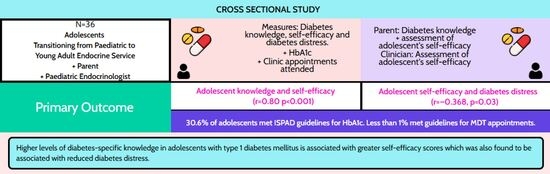
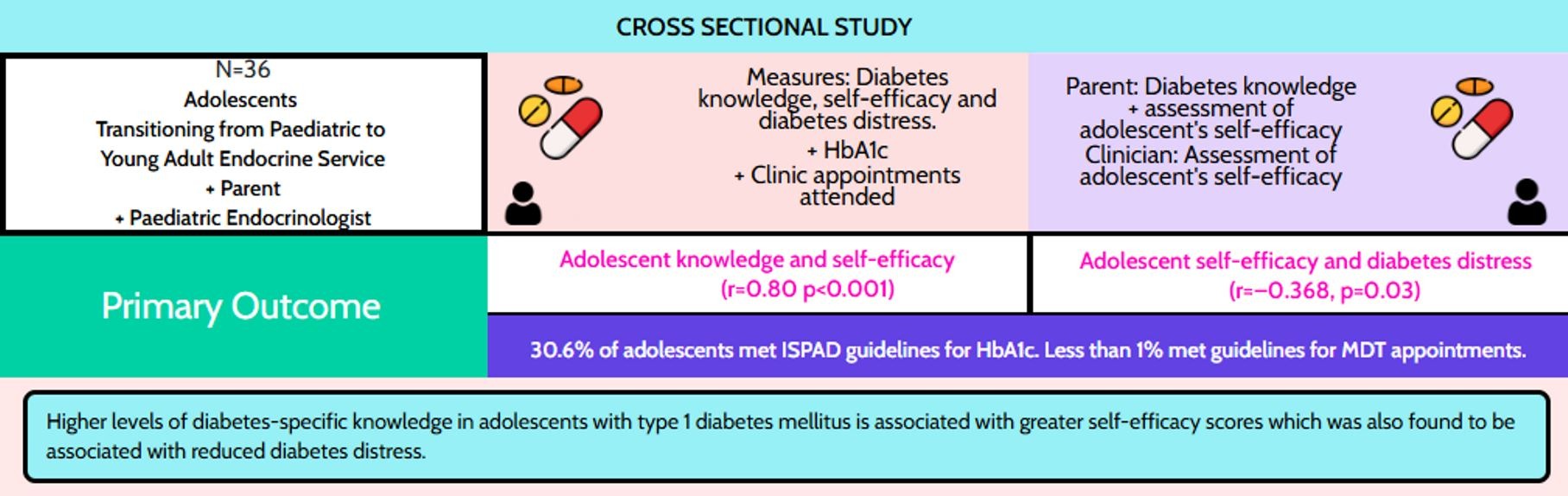
Aim: Assess transition readiness of adolescents with Type 1 Diabetes (T1D) from adolescent, parental, and clinician perspectives. Methods: Cross-sectional study (n = 36, 20 Male/16 Female, 16–18 years, June 2023–June 2024, metropolitan paediatric centre). Adolescents had diabetes knowledge, self-efficacy, and diabetes distress measured. Parents had an assessment of knowledge, diabetes-related distress, and estimated the adolescent’s self-efficacy. Clinicians estimated adolescent self-efficacy. Results: Median HbA1c was 7.4% (IQR 6.6–8.4). One adolescent met the guidelines for multidisciplinary team (MDT) appointments. Paired sample t-tests showed that adolescents’ knowledge was comparable to parent levels (t(24) = −1.69, p = 0.10). Adolescents’ knowledge was strongly associated with higher self-efficacy (r = 0.80 p < 0.001). Higher adolescent self-efficacy was associated with lower adolescent distress (r = −0.368, p = 0.03). Adolescent distress was lower than parent distress (t(24) = −3.13, p = 0.005). Although adolescent self-efficacy was strongly correlated with parent and clinician evaluation (r = 0.76, p < 0.001; r = 0.80, p < 0.001), adolescents reported higher self-efficacy than estimates by parents (t(24) = 4.76, p < 0.001) or clinicians (t(24) = 8.39, p < 0.001). Parent knowledge was moderately correlated with adolescent self-efficacy (r = 0.62, p = 0.001). Conclusions: Diabetes knowledge may confer greater self-efficacy and reduce diabetes distress in adolescents. Distress levels are higher in parents than in adolescents. Engagement with MDT is poor. Transition efforts should focus on parents and adolescents while increasing engagement with MDT.

1. Introduction

In healthcare, transition describes the purposeful process of planning and moving from paediatric to adult services [1]. There is no definitive method of assessing a young person’s readiness for this move. Transition typically takes place during adolescence, which is a time of significant physical, cognitive, and psychosocial development [2]. Although reports within the literature vary, it is thought that 21–71% of young adults with Type 1 Diabetes (T1D) do not attend clinic appointments regularly [3]. Reasons may include academic and mental health burdens, and doubts about the value of clinic attendance [3,4,5,6]. Even if the young person goes to a clinic, they may have poor health outcomes related to the inability to self-manage their condition [7].
T1D is a particularly pertinent example, as it is life-long and requires intensive efforts on the part of the adolescent and their family to monitor glucose levels and administer insulin appropriately. The pressure to achieve optimal glucose levels is significant, as this provides a lifelong reduction in risk of developing micro- and macrovascular disease [8,9,10,11,12,13,14,15]. Unfortunately, across all age groups, adolescents are currently the farthest from achieving optimal blood glucose levels, with respect to international targets [16,17,18]. Some of the elements contributing to challenges with insulin therapy regimens may include developmental and hormonal changes during puberty, and challenges that can arise from interactions between biological, psychological, and social factors.
In adolescence, the emotional, limbic brain develops earlier than the frontal lobes, which are responsible for planning, organisation, critical thinking, health literacy, and self-efficacy. The frontal lobes may not fully develop until 25 years of age [19]. This mismatch in neurological development may result in emotional outbursts, impulsivity, and risk-taking behaviours [19]. Successful management of diabetes and the ability to meet glycaemic targets require complex decision making, and for these reasons, adolescents are less likely to adhere to recommended diabetes care [4,5]. Compounding these issues, adolescents commonly experience insulin resistance due to puberty and an increase in body mass, further reducing the likelihood of optimal glucose levels [4,5].
It is important to note that adolescents with T1D have a notably higher prevalence of psychiatric disorders compared to the general population, including depression, anxiety, disordered eating, body dysmorphia, attention deficit hyperactivity disorder (ADHD), and personality and substance use disorders [20,21]. Psychosocial challenges may also arise around managing T1D as adolescents begin to seek independence and test boundaries. Adults may perceive these behaviours and communication as impulsive, avoidant, or combative. This can lead to family conflict, parental anxiety, and communication breakdown, when evidence would suggest that empathetic, warm, and supportive parenting assists with improved diabetes management [4,5,6,20,22]. The International Society for Paediatric and Adolescent Diabetes (ISPAD) recommends annual psychosocial assessment, with referral to appropriate services [4].

2. Key Outcomes Assessed: Knowledge, Self-Efficacy, and Diabetes Distress

Effective and sustainable management of diabetes requires sound diabetes knowledge on the part of the adolescent if transition to adult services is to be successful. International guidelines recommend that transition processes should include education on diabetes self-management, health complications, differences between paediatric and adult services, and healthcare navigation [4]. In a study of 2933 adolescents with T1D [23], diabetes knowledge scores were higher among those with a lower glycosylated haemoglobin (HbA1c). They also found that parental diabetes knowledge scores were correlated with adolescent knowledge scores and lower HbA1c [23]. Therefore, it is plausible that increased knowledge improves diabetes self-management in T1D and transition outcomes.
To successfully implement this knowledge, an adequate level of self-efficacy is key. Self-efficacy was first defined by Albert Bandura [24] as an individual’s perspective on “how well one can execute courses of action required to deal with prospective situations”. Prior research in adolescents with T1D has shown that higher levels of self-efficacy were associated with improved glycaemic and health outcomes, quality of life, and management of T1D [7,25,26]. Greater self-efficacy has been found to be associated with increased resilience and the ability to cope with diabetes [20]. As adolescent autonomy evolves, they move towards self-management and away from parental management of diabetes. Therefore, self-efficacy is integral to building an adolescent’s confidence when moving into adult services.
Key stakeholders, such as parents and clinicians, may have differing perspectives on supporting the adolescent during transition; this can be referred to as a “triadic relationship” [20]. It has been found that adolescents demonstrate higher self-efficacy when communication is person-centred, autonomy-supportive, accounts for levels of competency, and healthcare is shared between the adolescent and their parent [5,6,27]. Young people with T1D and their families may also experience notable communication difficulties with healthcare providers, often stemming from a discrepancy in perceived priorities [4]. Specifically, if a clinician does not perceive their adolescent as capable of self-management or falsely assumes levels of competency, the adolescent and family members may feel inadequately supported by their treating team.
Diabetes distress (DD) has been widely researched within the transition literature, where approximately 30% of adolescents present with DD [28]. DD refers to the feelings of frustration, anger, hopelessness, and anxiety that result from managing diabetes and the associated self-care demands [28]. DD is intensified by a lack of understanding or unhelpful interactions with family, friends, and clinicians, and the overwhelming burden of managing the condition [29]. DD can lead to negative consequences, such as decreased diabetes care, lack of self-care, difficulties achieving optimal glucose targets, and decreased quality of life [28].
A systematic review of 22 studies revealed that studies tend to focus on parental anxiety and depression [29]. However, it does not specify if this is related to DD. Current evidence has shown that increased parental DD is associated with greater levels of depression in children and negatively affects family dynamics [30]. Parental DD can influence family unity, leading to adverse outcomes for the adolescent, such as increased parental negativity and hostility [20]. Family cohesion is a key factor in optimising diabetes care and ensuring a smooth transition to adulthood. Efforts to reduce parental DD may therefore potentially empower adolescents to manage their diabetes care successfully.
Taken together, diabetes knowledge, self-efficacy, and DD are important and necessary to consider when attempting to determine if a young person is ready for transition to adult services. To the best of our knowledge, there is limited research addressing all three factors concurrently and from the differing perspectives of adolescents, parents, and clinicians.

3. Evaluating the Transition Process at Royal North Shore Hospital

The paediatric diabetes service at Royal North Shore Hospital, Sydney, Australia, consists of Paediatric Endocrinologists, Diabetes Educators, an Advanced Accredited Practicing Dietitian, and a Clinical Psychologist. The department has a structured transition process underpinned by the Transition Care Network guidelines [31]. This includes annual transition appointments from the age of 14 years until transferring care to the young adult team.
ISPAD guidelines also recommend that children and adolescents with diabetes require three monthly appointments with a diabetes specialist, including an analysis of their glucose profile, insulin titration, a physical examination, a nutritional assessment, and staging of growth and development [32]. In addition, an annual review by the diabetes team to assess knowledge levels and psychosocial status [32]. However, review of our retrospective records showed that adolescents were missing appointments for further support and education; occasionally, adolescents were lost to follow-up [33]. There is accordingly a pressing need for the analysis of the transition process.
The aim of this research is as follows:
(1)
To assess current levels of engagement with the MDT.
(2)
To determine the associations between knowledge, self-efficacy, and DD.
(3)
To assess adolescent clinical status and areas for improving our service in supporting knowledge, self-efficacy, and DD relating to T1D, as assessed on adolescent, parent, and clinician evaluations prior to transition to young adult services.
The hypotheses of the study are as follows:
  • A significant difference will exist in perceived levels of knowledge and self-efficacy between adolescent and parent evaluations.
  • A significant difference will exist in perceived levels of self-efficacy regarding diabetes management between adolescent and clinician evaluations.
  • Adolescent evaluations of perceived levels of DD will have a significant and positive association with parent evaluations.
  • Higher perceived levels of knowledge will be associated with greater levels of self-efficacy in adolescents.
  • Perceived levels of self-efficacy will have a positive association with DD in adolescents.

4. Methods

The study was approved by the NSLHD Research Ethics Committee (2022/ETH02412) and was carried out in accordance with the principles of the Declaration of Helsinki, the International Council for Harmonisation of Good Clinical Practice guidelines, and applicable laws and regulations. The study protocol was published prior to the commencement of the study (clinicaltrials.gov NCT06113588).

4.1. Inclusion Criteria

  • Adolescents who have an existing diagnosis of T1D aged 16 to 19 years and are currently attending the Royal North Shore Paediatric Diabetes and Endocrinology Department.
  • A family member or caregiver of the adolescent with Type 1 Diabetes mellitus.
  • A clinician who is a member of the adolescent’s treating-diabetes team within the Paediatric Diabetes or the Young Adult diabetes team.

4.2. Procedure

All participants were provided with questionnaires via a QR code using Northern Sydney Local Health District (NSLHD) Research Electronic Data Capture (REDCap). REDCap is a secure web platform used by NSLHD to develop and store information from online databases and surveys. Prior to participation, all participants were informed of the nature of the study, what their participation would involve, and were asked to provide informed consent. Participation was voluntary, and participants were informed they could withdraw at any time. Participants were asked to complete questionnaires, which included (1) demographics, (2) the modified Readiness of Emerging Adults with Diabetes Diagnosed in Youth (READDY) tool, (3) the diabetes knowledge questionnaire, and (4) the Problem Areas in Diabetes (PAID) scale.
Data were collected when adolescents attended their clinic appointments. This study employed convenience sampling, where any participant who met the inclusion criteria and attended their appointment was asked by the research team if they were interested in participating.
Data collected from medical files was handled and stored in accordance with NSW Health Privacy Policy and Health Records and Information Privacy Legislation. This included HbA1c, frequency of clinic visits over the preceding 12 months, which members of the multidisciplinary team (MDT) were seen, number of missed appointments over the preceding 12 months, and comorbidities. Data were collected between 9/06/2023 to 9/06/2024. Participant time was not compensated.
Measures
Questionnaires were provided for participants. These consisted of the following:

4.2.1. Knowledge

The diabetes knowledge questionnaire is a novel questionnaire that can be used in an Australian context, with reference to other preceding diabetes knowledge questionnaires, comprising assessments of general diabetes knowledge, life skills relating to diabetes, insulin dosing, and insulin administration. More specifically, we assessed knowledge of glucose monitoring, including Continuous Glucose Monitoring (CGM) devices and management of advanced hybrid closed loop pumps (AHCLP), in addition to troubleshooting and identifying where and how to source support. For context, 86% of our current cohort use CGM, and 64% of our cohort use AHCLP. The questionnaire also incorporated questions from the PedCarb Quiz [34] (which is a published, 72-item, carbohydrate-counting knowledge questionnaire, developed for an Australian context, for individuals with T1D, with demonstrated reliability.
This questionnaire consisted of four sections; examples include the following:
(1)
General diabetes knowledge: “What does glucagon do?” (19 items);
(2)
Life skills: “What should your glucose level be prior to driving a car?” (7 items);
(3)
Insulin administration: “What is a correction factor?” (14 items);
(4)
Insulin delivery (only for pump users): “What is a bolus?” (7 items).
There is a single correct answer per question, with no points deducted for incorrect answers. The total possible score is out of 47. This was completed independently by the adolescent and their parent. This questionnaire was piloted with a small cohort of young adults at Royal North Shore Hospital in February 2023.

4.2.2. Self-Efficacy

The modified READDY tool [35] is a validated transition readiness tool with diabetes-specific content that assesses self-efficacy. It has been used to identify barriers or areas for improvement in transition preparation for adolescents and emerging adults with T1D and to facilitate a discussion about needs. It comprises closed-ended response options on a Likert scale, coded as 1 (Haven’t thought about it), 2 (I plan to start), 3 (No, I still need lots of practice), 4 (Somewhat, but I need a little practice), and 5 (Yes, I can do this). The questionnaire used in this study is a modified version of the READDY tool, which has been adapted to be used in an Australian context and to consider both parent and clinician perspectives. This tool was answered separately by the adolescent, their parent, and their clinician. The items in this tool were organised into four topics:
(1)
Diabetes Knowledge: “knowing the facts about diabetes” (11 items).
(2)
Health System Navigation: “taking care of my own medical visits” (13 items).
(3)
Insulin Self-Management: “insulin and diabetes management (2 items) including insulin pump skills” (where relevant, with 6 items).
(4)
Health Behaviours: “skills for college and living independently” (11 items).
Mean scores for each of the four topics were calculated, and a total score was also calculated. Higher scores indicated more confidence in readiness for transition, and lower scores indicated lower confidence. The mean scores highlight priority areas for intervention.

4.2.3. Diabetes Distress

The Problem Areas in Diabetes is a modified 14-item (for adolescent; PAID-T) or 15-item (for family member; P-PAID-T) questionnaire, as used by Queensland Health to assess for diabetes distress. The PAID-T and P-PAID-T are rated on a 6-point Likert scale, where participants rate how much each item may be impacting them in their life, rather than whether the item is true for them. Total score is out of 84 (for adolescent) or 90 (for family member). Participants identified as having a high total score on the PAID questionnaire had a total score of > 30 for adolescents or > 40 for family members. The PAID-T has shown strong psychometrics, including good face validity and strong internal consistency and reliability [36,37].

4.3. Analysis Plan

Assumptions for paired sample t-tests indicated that (1) the dependent variable must be continuous, (2) the observations are independent of one another, (3) the dependent variable should be approximately normally distributed, and (4) the dependent variable should not contain any outliers. The first and second assumptions were met, as all variables were continuous and independent of one another. The Shapiro–Wilk Test of Normality and histograms were used to test if the dependent variables were normally distributed. Histograms indicated that adolescent knowledge had a slight negative skew, adolescent self-efficacy was negatively skewed, adolescent diabetes distress was slightly positively skewed, and parent diabetes distress was normally distributed. The Shapiro–Wilk Test of Normality confirmed that all were normally distributed; however, adolescent self-efficacy was not. Three univariate outliers were identified and retained, as this was less than 5% of the data [38]. All assumptions were met, and thus, subsequent analyses were carried out. Initially, Pearson’s correlational analyses were conducted to assess associations among key variables. Further, paired sample t-tests were used to determine mean differences between adolescent, parent, and clinician evaluations on key variables. These analyses were carried out using Statistical Package for the Social Sciences (SPSS; Version 27).

5. Results

5.1. Participants

A total of fifty adolescents met the inclusion criteria, three adolescents refused to complete the questionnaire without explanation, and we failed to capture six adolescents. Therefore, we enrolled forty-one adolescents in the study, and thirty-six completed the relevant questionnaires. Four responses were excluded due to incomplete data, and one respondent who was enrolled had a diagnosis of Maturity-Onset Diabetes of the Young 5 (MODY), rather than T1D, and was excluded. Participants’ characteristics are reported in Table 1.
Table 1. Demographics of participants.

5.2. Descriptive Statistics

A total of 228 appointments were made for our adolescent cohort within one year (see Table 2). Of this number, approximately 47.8% of appointments attended were with the endocrinologist, followed by the diabetes educator (40.4%), dietitian (6.1%), and clinical psychologist (5.7%). Approximately 24.6% of all appointments were missed.
Table 2. Total number of appointments attended with members of the paediatric diabetes Multidisciplinary Team in one year (n = 36).
The median HbA1c of our adolescents was 7.4% (IQR 6.6–8.4). Eleven (30.6%) of our adolescents met the Clinical Practice Consensus Guidelines (ISPAD) for HbA1c < 7% [18] and one adolescent met the ISPAD guidelines for annual MDT appointments [32]. The percentages of adolescents adhering to clinician-specific appointments were 80.6% with diabetes educators (n = 29), 38.9% with endocrinologists (n = 14), 33.3% with dietitians (n = 12), and 25% with clinical psychologists (n = 9).
Table 3 provides outcomes of key variables concerning diabetes knowledge, self-efficacy, and diabetes distress. In our cohort, 70% of parents and 50% of adolescents met the threshold for DD.
Table 3. Maximum values, means, and standard deviations of adolescents, parents, and clinicians’ evaluations of knowledge, self-efficacy, and diabetes distress.

5.3. Primary Analyses

There was no significant difference between total diabetes knowledge scores for adolescents (31.03 ± 5.25) and parents (31.64 ± 5.42) out of a maximum possible score of 47 (MD = −1.24; t(df)= −1.691, p = 0.104, see Table 3, Table 4 and Table 5). Specific knowledge gaps identified among adolescents and parents included challenges with carbohydrate counting, seeking emergency support, and managing pump failures. A significant and positive association was found regarding self-efficacy between adolescents and parents (r = 0.76, p < 0.001), as well as adolescents and clinicians (r = 0.80, p < 0.001), where adolescents scored highly compared to parents and clinicians (Table 4). With DD, no significant difference was observed between adolescents and parents. We also found a significant and positive correlation between knowledge levels and self-efficacy in adolescents (r = 0.80, p < 0.001). Higher levels of self-efficacy were associated with lower levels of DD in adolescents (r = −0.368, p = 0.03). Preliminary correlational analysis, including HbA1c with our key variables, was completed; however, these findings did not reach statistical significance.
Table 4. Correlational analyses of knowledge, self-efficacy, and distress regarding adolescent, parent, and clinician evaluations.
Table 5. Paired t-test results comparing adolescent, parent and clinician evaluations on self-efficacy and knowledge levels.
There was a significant association with the parent’s perception of their adolescent’s level of self-efficacy (MD = 16.480; t(df) = 4.755, p ≤ 0.001) and the clinician’s perception of the adolescent’s self-efficacy (MD = 26.788; t(df)= 8.386, p ≤ 0.001). Levels of DD were significantly higher for our parents than for our adolescents (MD = −10.76; t(df) = −3.132, p = 0.005).
There was no significant difference in knowledge levels between adolescents and parents (MD = −1.24; t(df)= −1.691, p = 0.104, see Table 5). There was a significant association with the parent’s perception of their adolescent’s level of self-efficacy (MD = 16.480; t(df) = 4.755, p ≤ 0.001) and the clinician’s perception of the adolescent’s self-efficacy (MD = 26.788; t(df) = 8.386, p ≤ 0.001). Levels of DD were significantly higher for our parents than for our adolescents (MD = −10.76; t(df) = −3.132, p = 0.005).

6. Discussion

To our knowledge, this study is the first report on the interactions between diabetes knowledge, distress, and self-efficacy informed by concurrent assessments from parents, clinicians, and the adolescents themselves. This is important to clinical practice because understanding these three areas (knowledge, distress, and self-efficacy) is critical to achieve effective communication between these three parties. We found that our adolescents’ knowledge levels had a strong and positive association with their self-efficacy, indicating that, within our cohort, those with greater knowledge were more confident in managing their diabetes. Furthermore, we found that greater adolescent self-efficacy was associated with reduced DD.
Overall, there was a high level of DD amongst our cohort, with 50% of adolescents and 70% of parents reaching the threshold defining diabetes distress. The lower levels of distress among adolescents compared to parents were an important and novel finding. To the best of our knowledge, this is the first study comparing distress between adolescents and parents concurrently. This indicates psychosocial assistance is needed for our parents, as well as adolescents, throughout the transition process.
Moreover, parental DD can impact adolescent autonomy and glycaemic control by shaping the emotional climate, dynamics, and communication patterns within the family. For example, when parents experience high levels of distress, they may become overly controlling or anxious, which leads to increased monitoring and hyperawareness of their adolescent’s management of their T1D. As a result, this can impact the adolescents’ development of self-management skills and emotional independence. This dynamic may potentially lead to further conflict, reduced motivation, and poorer glycaemic outcomes [5,6].
However, in our cohort, we found that there was poor engagement with the various MDT members who could provide such support to adolescents and parents in the transition process. In addition, we also found that the majority of our adolescents did not meet the recommended HbA1c target of <7% [18], indicating room for improvement.
Another novel finding of our study was that adolescents’ assessment of their levels of self-efficacy was higher than their parents’ estimates of adolescent self-efficacy. This is supported by the underpinning knowledge of adolescent neurodevelopment. Current literature tends to focus on parental self-efficacy and empowerment in order to improve the diabetes care in their adolescents [30]. Other studies focus on adolescents’ self-efficacy alone [7], but our study provides a paired assessment, and results highlight that parents may underestimate their adolescent’s confidence in managing their diabetes. The mismatch in diabetes management confidence between adolescents and parents may exacerbate existing family conflict, tension, and increase anxiety, with mental health consequences for both the adolescent and their family members [30]. There is also potential that adolescents may feel overly confident with their diabetes care and may not necessarily represent an accurate representation of their diabetes knowledge. Further investigation may be helpful to explore these nuances.
A strength of this study was also the consideration of clinicians’ perspectives on the adolescents’ ability to manage their diabetes. Interestingly, clinicians also assessed adolescents’ capacity to manage diabetes as significantly lower than both the adolescents themselves and their parents’ assessment. Given that the frequency of clinic attendance was suboptimal in our cohort, it will be important to determine in future studies if clinician estimates of adolescent self-efficacy improve with increased frequency of interaction between clinicians and adolescents. The use of tools to assess adolescent self-efficacy could be helpful as a formal part of the clinic workflow to allow education and discussions about diabetes care to be pitched correctly for the adolescent.
There are several limitations of the study to consider. We acknowledge that our sample was small; however, it reflected our current clinic cohort (82% of our adolescents were enrolled in the study). We used a purpose-built diabetes knowledge questionnaire, as existing questionnaires did not sufficiently test knowledge of more recent diabetes technologies. Therefore, our questionnaire had not been previously validated. All data collected was self-reported and, therefore, prone to potential underreporting of results and perceived social desirability bias. We did not receive all the data from parents, as some of our adolescents attended their clinic alone. Furthermore, the parent who completed the questionnaire may not have been the primary carer. We also did not consider some confounding variables in our analyses that may have impacted our results, including pre-existing mental health issues, comorbidities, time since diagnosis of T1D, and socioeconomic status. Data were gathered on clinic attendance immediately following COVID restrictions, and many families attending via telehealth did not arrange further follow-up through reception. Therefore, engagement with MDT may have been compromised in this manner.

7. Recommendations for Transition Service Delivery

Each adolescent has their own distinct challenges, both physiological and psychosocial, demonstrating the importance of a flexible and responsive transition process, fostering collaboration between all stakeholders [22]. A person-centred approach to education is required, with consideration for age, maturity, cultural background, levels of health literacy, lifestyle, and duration of diagnosis. The extent to which the burden of diabetes management is shared between the adolescent and their parent is a dynamic that must be reviewed at every clinic visit [4,20]. Appropriate transition of adolescents with T1D from paediatric to adult healthcare needs a holistic approach to the adolescent and family’s situation, thus addressing all these factors, including the adolescents’ developmental stages and circumstances [39].
When making treatment recommendations, healthcare providers should consider current levels of diabetes knowledge, perceived burden of treatment, the individual’s self-efficacy, availability of family and social support, and the presence of any significant mental health concerns. These factors considered together provide a holistic and collaborative approach to supporting adolescents and their families transitioning to young adult services.
Our data suggest that efforts to increase adolescents’ diabetes knowledge are important, as this may, in turn, increase self-efficacy, and higher levels of self-efficacy can result in lower levels of DD. To facilitate this, engagement with the MDT should be increased. Educational transition sessions should focus on gaps in knowledge, and our data shows that similar gaps were identified in diabetes knowledge in both the adolescent and their parents. Gaps in knowledge could be identified using knowledge questionnaires or through informed, person-centred, and nuanced conversations with both the adolescent and their family members.
It is evident that adolescents were not engaging with our MDT regularly and thus not meeting international guidelines. Without regular and consistent clinic attendance and engagement, it will be difficult to upskill adolescents in diabetes knowledge and subsequently increase their self-efficacy. Engaging with the MDT also allows diabetes teams to monitor levels of DD and psychosocial challenges. It is recommended that, as part of routine screening, both adolescent and parental distress should be measured during these transition visits, and education around the impact on glycaemic outcomes and autonomy development should be discussed with parents. To ensure this occurs, diabetes departments need to consider a more family-centred approach to care and a holistic approach to team engagement with consistent, regular psychosocial assessment on an annual basis or more frequently if required, in keeping with international guidelines [20].
Local transition protocols could implement family-based interventions that teach parents skills to support self-efficacy and shared decision making. In an attempt to reduce diabetes burden at each appointment, there will be discussions on the division of diabetes care between the adolescent and their family members, taking into account levels of self-efficacy. Transition processes require defined outcomes relevant to each adolescent’s circumstances, using communication that is supportive and empowers autonomy, as well as consideration for health literacy needs [23].
At a policy level, appropriate members of the MDT can facilitate structured family sessions to address difficult family dynamics, improve communication patterns, and foster adolescent competence. This may involve teaching parents’ skills to become more collaborative and supportive of self-efficacy to empower their adolescent, structured joint sessions, or parenting programmes, such as Tuning Into Teens [40]. Integrating these practices into established diabetes care standards has the potential to improve both psychosocial and clinical outcomes by aligning adolescent self-management goals with family support systems [5,6,32].
To review the RNSH transition process from another angle, we are also canvassing young adults who have recently transitioned and asking for their opinions on the relevancy, acceptability, and accessibility of information provided and clinic interactions. This will provide further information about the adequacy of the transition process in preparing the adolescent to move to the adult service.

Author Contributions

Conceptualisation, A.M., N.H.B., A.N., L.L., G.B., A.C., S.K., K.P., S.Y., K.A.R., A.W., O.N., L.B., D.W., S.D., D.C.D. and S.H.; methodology, A.M., N.H.B., A.N. and S.H.; software, J.H.; validation, A.M., N.H.B., A.N. and S.H.; formal analysis, N.H.B., J.H. and S.H.; investigation, A.M., N.H.B., A.N., L.L., G.B., A.C., S.K., K.P., S.Y., K.A.R., A.W., O.N., L.B., D.W., S.D., D.C.D. and S.H.; resources, S.H.; data curation, A.M., N.H.B. and J.H.; writing—original draft preparation, A.M., N.H.B., A.N. and SH.; writing—review and editing, A.M., N.H.B., A.N., L.L., G.B., A.C., S.K., K.P., S.Y., K.A.R., A.W., O.N., L.B., D.W., S.D., D.C.D. and S.H.; visualisation, A.M. and N.H.B.; supervision, S.H.; project administration, A.M., A.N. and S.H.; funding acquisition, S.H. All authors have read and agreed to the published version of the manuscript.

Funding

This research was funded by the 2022 Ramsay Grant (salary support for AM) and the RNSH Number 2 Trust Fund (salary support for A.N., Paediatric Endocrine Fellow).

Institutional Review Board Statement

The study was conducted in accordance with the Declaration of Helsinki and approved by the Ethics Committee of Northern Sydney Local Health District Research Governance Office (2022/ETH02412, date of approval 1 March 2023).

Data Availability Statement

The data presented in this study are available on request from the corresponding author due to privacy reasons.

Acknowledgments

We are grateful to the adolescents and families who participated in the study.

Conflicts of Interest

The authors declare no conflicts of interest. The funding bodies played no role in the choice of research project; design of the study; in the collection, analyses, or interpretation of data; in the writing of the manuscript; or in the decision to publish the results.

References

  1. Campbell, F.; Biggs, K.; Aldiss, S.K.; O’Neill, P.M.; Clowes, M.; McDonagh, J.; While, A.; Gibson, F. Transition of care for adolescents from paediatric services to adult health services. Cochrane Database Syst. Rev. 2016. [Google Scholar] [CrossRef]
  2. World Health Organisation. Adolescent Health. Available online: https://www.who.int/health-topics/adolescent-health/#tab=tab_1 (accessed on 29 November 2025).
  3. Hynes, L.; Byrne, M.; Dinneen, S.F.; McGuire, B.E.; O’Donnell, M.; Mc Sharry, J. Barriers and facilitators associated with attendance at hospital diabetes clinics among young adults (15–30 years) with type 1 diabetes mellitus: A systematic review. Pediatr. Diabetes 2016, 17, 509–518. [Google Scholar] [CrossRef] [PubMed]
  4. Gregory, J.W.; Cameron, F.J.; Joshi, K.; Eiswirth, M.; Garrett, C.; Garvey, K.; Agarwal, S.; Codner, E. ISPAD clinical practice consensus guidelines 2022: Diabetes in adolescence. Pediatr. Diabetes 2022, 23, 857. [Google Scholar] [CrossRef]
  5. Azar, S.; Maroun Abou Jaoude, N.; Kędzia, A.; Niechciał, E. Barriers to type 1 diabetes adherence in adolescents. J. Clin. Med. 2024, 13, 5669. [Google Scholar] [CrossRef]
  6. Liu, J.; Li, J.; Li, L.; Zeng, K. Impact of family environment on mental disorders and quality of life in children with type 1 diabetes mellitus: A cross-sectional study and intervention policy analysis. Front. Pediatr. 2025, 13, 1516411. [Google Scholar] [CrossRef]
  7. Iannotti, R.J.; Schneider, S.; Nansel, T.R.; Haynie, D.L.; Plotnick, L.P.; Clark, L.M.; Sobel, D.O.; Simons-Morton, B. Self-efficacy, outcome expectations, and diabetes self-management in adolescents with type 1 diabetes. J. Dev. Behav. Pediatr. 2006, 27, 98–105. [Google Scholar] [CrossRef] [PubMed]
  8. White, N.H.; Cleary, P.A.; Dahms, W.; Goldstein, D.; Malone, J.; Tamborlane, W.V.; Diabetes Control and Complications Trial (DCCT)/Epidemiology of Diabetes Interventions and Complications (EDIC) Research Group. Beneficial effects of intensive therapy of diabetes during adolescence: Outcomes after the conclusion of the Diabetes Control and Complications Trial (DCCT). J. Pediatr. 2001, 139, 804–812. [Google Scholar] [CrossRef] [PubMed]
  9. Samuelsson, U.; Steineck, I.; Gubbjornsdottir, S. A high mean-HbA1c value 3–15 months after diagnosis of type 1 diabetes in childhood is related to metabolic control, macroalbuminuria, and retinopathy in early adulthood--a pilot study using two nation-wide population based quality registries. Pediatr. Diabetes 2014, 15, 229–235. [Google Scholar] [CrossRef]
  10. Carlsen, S.; Skrivarhaug, T.; Thue, G.; Cooper, J.G.; Gøransson, L.; Løvaas, K.; Sandberg, S. Glycemic control and complications in patients with type 1 diabetes—A registry-based longitudinal study of adolescents and young adults. Pediatr. Diabetes 2017, 18, 188–195. [Google Scholar] [CrossRef]
  11. Lind, M.; Pivodic, A.; Svensson, A.M.; Ólafsdóttir, A.F.; Wedel, H.; Ludvigsson, J. HbA1c level as a risk factor for retinopathy and nephropathy in children and adults with type 1 diabetes: Swedish population based cohort study. BMJ 2019, 366, l4894. [Google Scholar] [CrossRef]
  12. Bjornstad, P.; Dart, A.; Donaghue, K.C.; Dost, A.; Feldman, E.L.; Tan, G.S.; Wadwa, R.P.; Zabeen, B.; Marcovecchio, M.L. ISPAD clinical practice consensus guidelines 2022: Microvascular and macrovascular complications in children and adolescents with diabetes. Pediatr. Diabetes 2022, 23, 1432–1450. [Google Scholar] [CrossRef] [PubMed]
  13. Nathan, D.M. Realising the long-term promise of insulin therapy: The DCCT/EDIC study. Diabetologia 2021, 64, 1049–1058. [Google Scholar] [CrossRef]
  14. Santiago, J.V. Lessons from the diabetes control and complications trial. Diabetes 1993, 42, 1549. [Google Scholar] [CrossRef]
  15. Diabetes Control and Complications Trial Research Group. The effect of intensive treatment of diabetes on the development and progression of long-term complications in insulin-dependent diabetes mellitus. N. Engl. J. Med. 1993, 329, 977–986. [Google Scholar] [CrossRef]
  16. Hofer, S.E.; Raile, K.; Fröhlich-Reiterer, E.; Kapellen, T.; Dost, A.; Rosenbauer, J.; Grulich-Henn, J.; Holl, R.W.; Austrian/German Diabetes Patienten Verlaufsdokumentation (DPV Initiative); German Competence Network for Diabetes Mellitus. Tracking of metabolic control from childhood to young adulthood in type 1 diabetes. J. Pediatr. 2014, 165, 956–961.e2. [Google Scholar] [CrossRef]
  17. Miller, K.M.; Foster, N.C.; Beck, R.W.; Bergenstal, R.M.; DuBose, S.N.; DiMeglio, L.A.; Maahs, D.M.; Tamborlane, W.V. Current state of type 1 diabetes treatment in the U.S.: Updated data from the T1D Exchange clinic registry. Diabetes Care 2015, 38, 971–978. [Google Scholar] [CrossRef]
  18. de Bock, M.; Codner, E.; Craig, M.E.; Huynh, T.; Maahs, D.M.; Mahmud, F.H.; Marcovecchio, L.; DiMeglio, L.A. ISPAD Clinical Practice Consensus Guidelines 2022: Glycemic targets and glucose monitoring for children, adolescents, and young people with diabetes. Pediatr. Diabetes 2022, 23, 1270. [Google Scholar] [CrossRef] [PubMed]
  19. Arain, M.; Haque, M.; Johal, L.; Mathur, P.; Nel, W.; Rais, A.; Sandhu, R.; Sharma, S. Maturation of the adolescent brain. Neuropsychiatr. Dis. Treat. 2013, 9, 449–461. [Google Scholar] [CrossRef]
  20. de Wit, M.; Gajewska, K.A.; Goethals, E.R.; McDarby, V.; Zhao, X.; Hapunda, G.; Delamater, A.M.; DiMeglio, L.A. ISPAD Clinical Practice Consensus Guidelines 2022: Psychological care of children, adolescents and young adults with diabetes. Pediatr. Diabetes 2022, 23, 1373–1389. [Google Scholar] [CrossRef]
  21. Reynolds, K.A.; Helgeson, V.S. Children with Diabetes Compared to Peers: Depressed? Distressed?: A Meta-Analytic Review. Ann. Behav. Med. 2011, 42, 29–41. [Google Scholar] [CrossRef] [PubMed]
  22. Olinder, A.L.; DeAbreu, M.; Greene, S.; Haugstvedt, A.; Lange, K.; Majaliwa, E.S.; Pais, V.; Pelicand, J.; Town, M.; Mahmud, F.H. ISPAD Clinical Practice Consensus Guidelines 2022: Diabetes education in children and adolescents. Pediatr. Diabetes 2022, 23, 1229. [Google Scholar] [CrossRef] [PubMed]
  23. Martin, D.; Elie, C.; Dossier, C.; Godot, C.; Gagnayre, R.; Choleau, C.; Cahané, M.; Robert, J.J.; Group, A.S. Diabetes knowledge in adolescents with type 1 diabetes and their parents and glycemic control. Pediatr. Diabetes 2017, 18, 559–565. [Google Scholar] [CrossRef] [PubMed]
  24. Bandura, A. Self-efficacy: Toward a unifying theory of behavioral change. Psychol. Rev. 1977, 84, 191. [Google Scholar] [CrossRef]
  25. Tabernero, C.; Rebollo-Román, Á.; Villaécija-Rodríguez, J.; Luque, B. Charting a path to health: The empowering influence of self-efficacy for the self-management of type 1 diabetes in children and adolescents. Int. J. Psychol. 2024, 59, 1121–1132. [Google Scholar] [CrossRef]
  26. Soufi, A.; Mok, E.; Henderson, M.; Dasgupta, K.; Rahme, E.; Nakhla, M. Association of stigma, diabetes distress and self-efficacy with quality of life in adolescents with type 1 diabetes preparing to transition to adult care. Diabet. Med. 2024, 41, e15159. [Google Scholar] [CrossRef]
  27. Helgeson, V.S.; Reynolds, K.A.; Siminerio, L.; Escobar, O.; Becker, D. Parent and adolescent distribution of responsibility for diabetes self-care: Links to health outcomes. J. Pediatr. Psychol. 2008, 33, 497–508. [Google Scholar] [CrossRef]
  28. Hagger, V.; Hendrieckx, C.; Sturt, J.; Skinner, T.C.; Speight, J. Diabetes distress among adolescents with type 1 diabetes: A systematic review. Curr. Diabetes Rep. 2016, 16, 9. [Google Scholar] [CrossRef]
  29. Chen, Z.; Wang, J.; Carru, C.; Coradduzza, D.; Li, Z. The prevalence of depression among parents of children/adolescents with type 1 diabetes: A systematic review and meta-analysis. Front. Endocrinol. 2023, 14, 1095729. [Google Scholar] [CrossRef]
  30. Bassi, G.; Mancinelli, E.; Di Riso, D.; Salcuni, S. Parental stress, anxiety and depression symptoms associated with self-efficacy in paediatric type 1 diabetes: A literature review. Int. J. Environ. Res. Public Health 2021, 18, 152. [Google Scholar] [CrossRef]
  31. A.C.I. Key Principles for Transition of Care. Available online: https://aci.health.nsw.gov.au/networks/transition-care/resources/key-principles (accessed on 20 December 2024).
  32. Limbert, C.; Tinti, D.; Malik, F.; Kosteria, I.; Messer, L.; Jalaludin, Y.M.; Benitez-Aguirre, P.; Biester, S.; Corathers, S.; von Sengbusch, S. ISPAD Clinical Practice Consensus Guidelines 2022: The delivery of ambulatory diabetes care to children and adolescents with diabetes. Pediatr. Diabetes 2022, 23, 1243–1269. [Google Scholar] [CrossRef] [PubMed]
  33. Nillsen, A.; Marshall, A.; Bui, N.H.; Youde, L.S.; Lim, L.; Macdonald, A.; Bowes, S.; Briggs, N.; Christie-David, D.; Duke, S.A.; et al. Poor Outcomes in Youth With Type 1 Diabetes Mellitus Before and After Transition at a Relatively Socioeconomically Advantaged Metropolitan Centre: Implications for Service Improvement. J. Paediatr. Child Health 2025, 61, 1362–1365. [Google Scholar] [CrossRef]
  34. Beal, J.; Farrent, S.; Farndale, L.; Bell, L. Reliability and Validity of a Carbohydrate-Counting Knowledge Questionnaire for Young Australians with Type 1 Diabetes. J. Nutr. Educ. Behav. 2021, 53, 614–618. [Google Scholar] [CrossRef]
  35. Corathers, S.D.; Yi-Frazier, J.P.; Kichler, J.C.; Gilliam, L.K.; Watts, G.; Houchen, A.; Beal, S. Development and implementation of the readiness assessment of emerging adults with type 1 diabetes diagnosed in youth (READDY) tool. Diabetes Spectr. 2020, 33, 99–103. [Google Scholar] [CrossRef] [PubMed]
  36. Weissberg-Benchell, J.; Antisdel-Lomaglio, J. Diabetes-specific emotional distress among adolescents: Feasibility, reliability, and validity of the problem areas in diabetes-teen version. Pediatr. Diabetes 2011, 12, 341–344. [Google Scholar] [CrossRef] [PubMed]
  37. Shapiro, J.B.; Vesco, A.T.; Weil, L.E.; Evans, M.A.; Hood, K.K.; Weissberg-Benchell, J. Psychometric properties of the problem areas in diabetes: Teen and parent of teen versions. J. Pediatr. Psychol. 2018, 43, 561–571. [Google Scholar] [CrossRef] [PubMed]
  38. Tabachnick, B.G.; Fidell, L.S. Using Multivariate Statistics, 7th ed.; Pearson: New York, NY, USA, 2018. [Google Scholar]
  39. Kime, N.; Bagnall, A.-M.; Day, R. A systematic review of transition models for young people with long-term conditions, including Type 1 diabetes. Diabet. Med. 2014, 31, 89. [Google Scholar]
  40. Kehoe, C.E.; Havighurst, S.S.; Harley, A.E. Tuning in to teens: Improving parent emotion socialization to reduce youth internalizing difficulties. Soc. Dev. 2014, 23, 413–431. [Google Scholar] [CrossRef]
Disclaimer/Publisher’s Note: The statements, opinions and data contained in all publications are solely those of the individual author(s) and contributor(s) and not of MDPI and/or the editor(s). MDPI and/or the editor(s) disclaim responsibility for any injury to people or property resulting from any ideas, methods, instructions or products referred to in the content.

Article Metrics

Citations

Article Access Statistics

Multiple requests from the same IP address are counted as one view.