
Article

Visual Acuity and Beyond: Sociodemographic Determinants of Quality of Life in Diabetic Retinopathy

1
Department of Optometry and Occupational Diseases, Faculty of Public Health, Medical University, 9000 Varna, Bulgaria
2
The University Specialized Eye Hospital, 9002 Varna, Bulgaria
3
Department of Ophthalmology and Visual Sciences, Faculty of Medicine, Medical University, 9000 Varna, Bulgaria
*
Author to whom correspondence should be addressed.
Diabetology 2025, 6(12), 153; https://doi.org/10.3390/diabetology6120153
Submission received: 11 October 2025 / Revised: 18 November 2025 / Accepted: 25 November 2025 / Published: 1 December 2025

Abstract

Background: Diabetic retinopathy (DR) is a leading cause of vision-related disability worldwide. Evidence on how clinical and sociodemographic factors jointly shape vision-related quality of life (VRQoL) in Eastern European settings remains limited. Methods: We conducted a cross-sectional study of 151 adults with ophthalmologically confirmed DR attending a tertiary ophthalmology clinic in Northeastern Bulgaria (June 2023–February 2025). Best-corrected visual acuity (BCVA; decimal, better-seeing eye), glycated hemoglobin (HbA1c; ordinal categories), duration of diabetes, age, sex, DR subtype, and education were recorded. VRQoL was assessed using the NEI VFQ-25 questionnaire. Non-parametric tests were applied as appropriate; multiple linear regression identified independent predictors of NEI VFQ-25 composite scores. Results: Median age was 62 years (IQR 12.5); 53.0% were female. NEI VFQ-25 median was 77.2 (IQR 37.8). BCVA correlated positively with VRQoL (Spearman’s ρ = 0.455, p < 0.001). VRQoL differed by educational level (Kruskal–Wallis χ2 = 37.3, p < 0.001, ε2 = 0.249), but not by sex (Mann–Whitney U = 2740, p = 0.711); a trend was observed across DR subtypes (H = 5.386, p = 0.067). The multivariable model was significant (F(7, 132) = 10.64, p < 0.001; adjusted R2 = 0.336). Higher VRQoL was independently associated with better BCVA (B = 35.38, 95% CI 25.81–44.95, p < 0.001), higher educational attainment (B = −10.15, 95% CI from −13.92 to −6.38, p < 0.001; coded such that lower education predicts lower scores), and DR subtype (B = 6.63, 95% CI 1.91–11.36, p = 0.007). Age, sex, HbA1c, and diabetes duration were not significant. Conclusions: In this Bulgarian cohort, functional vision (BCVA), education, and DR subtype are the principal determinants of VRQoL, highlighting the need for patient-centered strategies that integrate clinical and social factors.

Graphical Abstract

1. Introduction

Diabetic retinopathy (DR) remains one of the leading causes of vision-related disability among working-age adults worldwide, with prevalence rising in parallel with the global diabetes epidemic [1,2]. Beyond its clinical manifestations, DR imposes substantial functional, psychological, and socioeconomic burdens on affected individuals. As vision deteriorates, patients frequently experience reduced independence, difficulties with daily activities, and diminished work capacity, all of which contribute to impaired quality of life and long-term disability [3,4]. Recent advances in imaging and diagnostic technologies—including hyperspectral retinal imaging—continue to refine the detection and characterization of DR, underscoring the increasing importance of patient-centered outcome measures to complement objective clinical evaluation [5].
While the global epidemiology of DR is well documented, regional disparities in screening uptake, access to ophthalmological services, and socioeconomic determinants remain insufficiently understood, particularly in Eastern Europe. In Bulgaria—and more specifically in the Northeastern region—available data indicate a considerable clinical burden of DR, yet the functional impact on patients’ daily lives has been inadequately characterized. In these settings, structural inequities in education, healthcare access, and health literacy may further exacerbate the risk of vision-related disability [6].
Vision-related quality of life (VRQoL) has therefore become an essential domain of diabetes care research. The National Eye Institute Visual Function Questionnaire-25 (NEI VFQ-25) remains one of the most widely applied patient-reported outcome instruments and has been used across diverse ophthalmic conditions to quantify subjective functional impairment [7,8,9]. Previous research has demonstrated that visual acuity represents a key determinant of VRQoL, but growing evidence also highlights the contributions of psychosocial and sociodemographic factors—including education, social support, and socioeconomic status—suggesting that VRQoL is shaped by intersecting dimensions of clinical severity and lived experience [10,11].
Despite this, data from Eastern Europe remain scarce, and no prior studies have comprehensively evaluated how clinical, metabolic, and sociodemographic factors jointly influence VRQoL among patients with DR in Bulgaria. Furthermore, most existing research in the region focuses on epidemiology or screening outcomes rather than patient-reported disability. To address this gap, we designed the present study to evaluate the joint contribution of clinical, metabolic, and sociodemographic factors to VRQoL in Bulgarian patients with DR.
Based on prior evidence demonstrating the influence of visual acuity and sociodemographic context on VRQoL, we hypothesized that (1) better decimal BCVA would be independently associated with higher VRQoL and that (2) educational attainment would contribute additional explanatory value beyond clinical and metabolic factors. Unlike previous studies, which predominantly originate from Asian or Western European populations, our work addresses this question within an Eastern European context characterized by distinct social and healthcare disparities. This regional perspective fills an important gap in the literature and provides new insight into how clinical and social determinants jointly shape VRQoL in Bulgarian patients with diabetic retinopathy.

2. Materials and Methods

2.1. Study Design and Setting

This cross-sectional study was conducted between June 2023 and February 2025 at a tertiary-level ophthalmology clinic in Northeastern Bulgaria. Consecutive patients attending routine follow-up were screened for eligibility.

2.2. Participants

Inclusion criteria were as follows: age ≥ 18 years; diagnosis of type 1 or type 2 diabetes mellitus; and ophthalmologic confirmation of diabetic retinopathy (DR), categorized as non-proliferative DR (NPDR), proliferative DR (PDR), or diabetic macular edema (DME). All participants who met eligibility criteria and had confirmed NPDR, PDR, or DME were included. No patients were excluded based on DR subtype. Exclusion criteria applied only to non-diabetic ocular pathology or factors preventing reliable visual or retinal assessment. The distribution of diabetic retinopathy subtypes in the sample was as follows: NPDR (n = 82), PDR (n = 40), and DME (n = 29). Educational categories included: master’s degree (n = 8), bachelor’s degree (n = 33), secondary education (n = 88), primary education (n = 13), and no formal education (n = 9). Exclusion criteria comprised clinically significant cognitive impairment preventing questionnaire completion, concomitant ocular conditions likely to affect vision independently (e.g., advanced glaucoma, uveitis), and recent intraocular surgery (<3 months prior to inclusion). All participants provided written informed consent.

2.3. Measures

Sociodemographic and clinical variables were collected via structured face-to-face interviews and verified against medical records. Variables included age (years), sex (male/female), duration of diabetes (years since diagnosis), education level (primary, secondary, bachelor’s, master’s), frequency of ophthalmologic visits, and the most recent glycated hemoglobin obtained within three months of questionnaire administration.
Best-corrected visual acuity (BCVA) was measured monocularly by an experienced ophthalmologist using an illuminated Snellen chart at 6 m under photopic conditions following subjective refraction. BCVA was expressed in decimal notation, with higher values indicating better acuity; analyses used the BCVA of the better-seeing eye.
Vision-related quality of life (VRQoL) was assessed using the Bulgarian-translated version of the NEI VFQ-25 questionnaire, scored according to the standard algorithm. The Bulgarian-language version of the NEI VFQ-25 used in this study underwent a structured forward–backward translation procedure carried out by two independent bilingual ophthalmology specialists. Cognitive debriefing was subsequently performed with a pilot group of 10 diabetic patients to ensure clarity, cultural appropriateness, and conceptual equivalence of all items. Minor linguistic adjustments were made based on patient feedback, primarily to simplify phrasing and improve comprehension for individuals with lower educational levels. Internal consistency reliability in the current sample was acceptable (Cronbach’s α = 0.89 for the composite score).
For statistical purposes, HbA1c was categorized into ordinal groups and coded as follows: 1 ≤ 7.0%, 2 = 7.0–7.9%, 3 = 8.0–8.9%, 4 ≥ 9.0%.

2.4. Statistical Analysis

All analyses were conducted using IBM SPSS Statistics for Windows, version 19.0 (IBM Corp., Armonk, NY, USA). Data distributions were inspected visually (histograms, Q–Q plots) and tested with the Shapiro–Wilk test. Because several variables deviated from normality, non-parametric methods were applied where appropriate.
Associations between continuous/ordinal variables (e.g., NEI VFQ-25 composite score, BCVA, HbA1c) were examined using Spearman’s rank correlation (ρ). Group differences were evaluated with Mann–Whitney U (sex) and Kruskal–Wallis H (education, DR subtype) tests; when Kruskal–Wallis was significant, pairwise post hoc comparisons were performed with multiplicity adjustment (Bonferroni). Effect sizes were reported as rank-biserial correlation (r_rb) for Mann–Whitney U and epsilon-squared (ε2) for Kruskal–Wallis, accompanied by 95% confidence intervals where applicable.
A multiple linear regression model was fitted with NEI VFQ-25 composite score as the dependent variable. Covariates entered a priori were: BCVA of the better-seeing eye, age, sex, education level, HbA1c, duration of diabetes, and DR subtype. Categorical predictors were dummy-coded with the following reference categories: sex = female; education = primary; DR subtype = NPDR. Model assumptions were evaluated via residual diagnostics (Q–Q plots), assessment of heteroskedasticity (Breusch–Pagan test), and multicollinearity (variance inflation factors, VIF). Missing data were handled by listwise deletion; the final analytic sample was n = 151. Two-sided p < 0.05 was considered statistically significant.
No formal a priori sample size calculation was performed; the sample size was determined by feasibility and the number of eligible patients during the study period. For omnibus group comparisons (DR subtype and educational level), we additionally derived effect sizes (Cohen’s w) from the Kruskal–Wallis χ2 statistics and estimated post hoc (observed) power using α = 0.05.

2.5. Ethics and Transparency

The study protocol was approved by the Ethics Committee of the Medical University of Varna (protocol No. 129 (6 April 2023)), and all procedures adhered to the Declaration of Helsinki. No generative AI tools were used for study design, data collection, analysis, or interpretation. De-identified data and analysis materials are available from the corresponding author upon reasonable request (with deposition to an open repository planned upon acceptance).

3. Results

3.1. Sample Characteristics

A total of 151 patients with diabetic retinopathy were analyzed. The median age was 62 years (IQR 12.5). Females constituted 53.0% (n = 80) and males 47.0% (n = 71). The median duration of diabetes was 13 years (IQR 16). HbA1c was analyzed in ordinal categories (1 ≤ 7.0%, 2 = 7.0–7.9%, 3 = 8.0–8.9%, 4 ≥ 9.0%); the median category was 2 (IQR 2). The NEI VFQ-25 composite score showed a median of 77.2 (IQR 37.8), indicating wide dispersion in vision-related quality of life.

3.2. Correlation Analyses

Spearman’s rank correlation revealed a significant positive association between BCVA in the better-seeing eye and the NEI VFQ-25 composite score (ρ = 0.455, p < 0.001; n = 151), indicating that better acuity was associated with higher VRQoL (see Figure 1). No significant correlations were observed with age (ρ = −0.074, p = 0.367) or HbA1c (ρ = −0.037, p = 0.678).

3.3. Group Comparisons

  • By DR subtype: A trend toward lower VRQoL with more advanced DR was observed (Kruskal–Wallis H(2) = 5.386, p = 0.067), corresponding to a small effect size (ε2 ≈ 0.023). Additionally, BCVA differed significantly across DR subtypes. A Kruskal–Wallis test showed a large effect (χ2(2) = 47.4, p < 0.001, ε2 = 0.316). Post hoc Dwass–Steel–Critchlow–Fligner comparisons demonstrated significantly worse BCVA in PDR compared with NPDR (p < 0.001), in DME compared with NPDR (p < 0.001), and in DME compared with PDR (p = 0.009).
  • By gender: An independent-samples Mann–Whitney U test showed no significant difference between males and females (U = 2740, p = 0.711), with a negligible effect size (rank-biserial r = −0.035). Median (IQR) VFQ-25 scores were 72.4 (33.8) in males and 78.2 (38.8) in females.
  • By educational level: The Kruskal–Wallis test indicated a statistically significant difference across six education categories (master’s degree, bachelor’s degree, secondary, lower secondary, primary, no formal education; χ2(5) = 37.3, p < 0.001, ε2 = 0.249). Multiplicity-adjusted post hoc comparisons showed higher NEI VFQ-25 composite scores in participants with university education (master’s/bachelor’s) compared with those with secondary or lower educational attainment.
  • For the comparison across DR subtypes, the Kruskal–Wallis test yielded a small-to-moderate effect size (Cohen’s w = 0.19), with an estimated post hoc power of approximately 0.46 for the observed χ2 = 5.386 (df = 2, n = 151). By contrast, the effect of educational level on NEI VFQ-25 composite scores was large (w = 0.50) for χ2 = 37.3 (df = 4, n = 151), corresponding to very high observed power (>0.99).

3.4. Multivariate Regression Analysis

The multiple linear regression model was statistically significant (F(7, 132) = 10.64, p < 0.001), explaining 33.6% of the variance (adjusted R2 = 0.336). Independent predictors of higher VRQoL were BCVA (better-seeing eye; B = 35.38, 95% CI 25.81–44.95, p < 0.001), higher educational attainment (B = −10.15, 95% CI −13.92 to −6.38, p < 0.001; coded such that lower education predicts lower scores), and DR subtype (B = 6.63, 95% CI 1.91–11.36, p = 0.007). Age, sex, HbA1c, and duration of diabetes were not significant (all p > 0.05). After the listwise deletion of missing values, the regression analysis included 140 participants. Full coefficients with 95% CIs are reported in Table 1.

Model Diagnostics and Robustness

No multicollinearity was detected (all VIF < 2). Residual Q–Q plots suggested approximately normal residuals; residuals versus fitted plots showed no visible heteroskedasticity, and the Breusch–Pagan test was non-significant (p > 0.10).

4. Discussion

This study demonstrates that BCVA in the better-seeing eye is the strongest determinant of vision-related quality of life (VRQoL) among patients with diabetic retinopathy (DR), consistent with previous research emphasizing the central role of visual function in perceived disability and daily activity limitation [12,13]. In contrast, glycated hemoglobin, analyzed in ordinal categories, was not significantly associated with VRQoL. This may reflect reduced variability introduced by categorization or the fact that metabolic control influences long-term structural progression rather than moment-to-moment functional perception [14].
Educational attainment emerged as an independent predictor of VRQoL, supporting evidence that higher education enhances health literacy, diabetes self-management, and healthcare utilization [11,15,16]. The pronounced effect of education in this cohort highlights the broader contribution of social determinants to visual disability, particularly in regions with established disparities such as Northeastern Bulgaria.
Higher education may enhance VRQoL by improving health literacy and facilitating more consistent engagement with ophthalmic care. Similar associations between education and functional vision have been reported in other populations, and our findings extend this evidence to an Eastern European cohort. Although we did not measure access to care, insurance, or income directly, education likely reflects part of this broader socioeconomic gradient.
Unlike most prior NEI VFQ-25 studies conducted in Asian or Western European cohorts, our analysis provides region-specific evidence from an Eastern European setting, where patterns of healthcare access, educational attainment, and socioeconomic inequality differ substantially. These contextual differences likely contribute to the comparatively stronger impact of education observed in our sample and underline the importance of interpreting VRQoL outcomes within their local health-system environment.

4.1. Strengths and Limitations

Several methodological considerations must be acknowledged. First, the cross-sectional, single-center design precludes causal inference and may restrict generalizability. Patients recruited at tertiary ophthalmology clinics often have more advanced disease or better access to specialized care, raising the possibility of selection bias. Community-based and multi-center studies would improve external validity. Second, although the NEI VFQ-25 questionnaire is widely used, the legacy composite score exhibits known psychometric limitations, including multidimensionality and suboptimal targeting. While our use of this scoring system aligns with the predominant DR literature, domain-level findings should be interpreted with caution; future work may incorporate Rasch-refined scoring to enhance measurement precision [10].
Third, although BCVA strongly predicted VRQoL, it represents only one aspect of functional vision. Important dimensions—contrast sensitivity, low-luminance acuity, reading speed, visual field integrity, and binocular summation—were not captured and may better explain real-world disability [17]. Their absence may underestimate the complexity of functional impairment in DR.
The absence of a significant association between HbA1c and NEI VFQ-25 or BCVA likely reflects the limited variability of glycemic control in this cohort, as well as the use of categorical rather than continuous HbA1c values. Because HbA1c reflects long-term metabolic status rather than short-term functional vision, weaker correlations may be expected in tertiary-care populations.
Additionally, this study does not include retinal structural measures (e.g., OCT thickness), treatment variables (anti-VEGF or laser history), early lens or optic nerve changes, or psychosocial factors such as depression and social support. These variables, although clinically relevant, were beyond the scope of the routinely collected dataset in this real-world tertiary care setting. Their inclusion in future research would enable more comprehensive modeling of VRQoL.
Although psychosocial factors were not collected in this study, they are known to influence how patients experience visual impairment. Depression, perceived social support, and coping strategies may modify the functional impact of reduced visual acuity on VRQoL. Their absence represents a limitation, and future research incorporating standardized psychosocial measures will help clarify these interaction
Finally, although no fully validated Bulgarian NEI VFQ-25 questionnaire exists, we employed a rigorous forward–backward translation, cognitive debriefing with patients, and internal consistency testing (Cronbach’s α = 0.89), consistent with ISPOR guidelines. While the instrument showed good reliability, future work should incorporate Rasch-validated Bulgarian versions once available.
Overall, this study highlights the intertwined influence of clinical and social factors on VRQoL in DR. While BCVA remains the dominant predictor, the strong effect of education underscores the need for patient-centered approaches that integrate ophthalmologic care with targeted health education and psychosocial support.

4.2. Practical Implications

These findings emphasize the importance of complementing routine ophthalmic assessment with targeted educational support, particularly for patients with lower health literacy. Incorporating brief, structured counseling and psychosocial screening into DR care may help address broader functional limitations and improve vision-related quality of life.

5. Conclusions

This study demonstrates that both clinical and sociodemographic factors shape the vision-related quality of life in individuals with diabetic retinopathy. Best-corrected visual acuity in the better-seeing eye was the most robust predictor of functional outcomes, while educational attainment independently influenced perceived disability. Glycemic control, measured via categorized HbA1c levels, showed no significant association with subjective visual function. These findings emphasize the need for multidimensional, patient-centered approaches that integrate ophthalmologic care with health education and social support. Future research should explore longitudinal trajectories and interaction effects, particularly in underserved populations, where disparities may exacerbate the burden of visual impairment.

Author Contributions

Conceptualization, Z.Z. and E.H.; methodology, E.H.; software, E.H.; validation, Z.Z., M.R. and L.Z.; formal analysis, E.H.; investigation, G.V. and I.P.; resources, G.V.; data curation, E.H.; writing—original draft preparation, E.H.; writing—review and editing, Z.Z. and M.R.; visualization, E.H.; supervision, Z.Z.; project administration, E.H. All authors have read and agreed to the published version of the manuscript.

Funding

This study is financed by the European Union—NextGenerationEU through the National Recovery and Resilience Plan of the Republic of Bulgaria, project № BG-RRP-2.004-0009-C02.

Institutional Review Board Statement

This study was conducted in accordance with the Declaration of Helsinki and was approved by the Ethics Committee of the Medical University of Varna (protocol No. 129 (6 April 2023)).

Informed Consent Statement

Written informed consent was obtained from all participants prior to inclusion in the study. Participants were informed about the purpose of the research, data confidentiality, and their right to withdraw at any time. The study protocol was approved by the Ethics Committee of the Medical University of Varna (protocol No. 129 (6 April 2023)) and conducted in accordance with the Declaration of Helsinki.

Data Availability Statement

Due to privacy and ethical restrictions, the de-identified dataset generated and analyzed during the current study is available from the corresponding author upon reasonable request.

Acknowledgments

The authors gratefully acknowledge the clinical staff of the University Specialized Eye Hospital, Varna, Bulgaria, for their assistance with patient recruitment and data collection.

Conflicts of Interest

The authors declare no conflicts of interest.

Abbreviations

The following abbreviations are used in this manuscript:
DRDiabetic Retinopathy
VRQoLVision-Related Quality of Life
NEI VFQ-25National Eye Institute Visual Function Questionnaire-25
BCVABest-Corrected Visual Acuity
HbA1cGlycated Hemoglobin
NPDRNon-Proliferative Diabetic Retinopathy
PDRProliferative Diabetic Retinopathy
DMEDiabetic Macular Edema
IQRInterquartile Range
CIConfidence Interval
VIFVariance Inflation Factor

References

  1. Yau, J.W.Y.; Rogers, S.L.; Kawasaki, R.; Lamoureux, E.L.; Kowalski, J.W.; Bek, T.; Chen, S.-J.; Dekker, J.M.; Fletcher, A.; Grauslund, J.; et al. Global prevalence and major risk factors of diabetic retinopathy. Diabetes Care 2012, 35, 556–564. [Google Scholar] [CrossRef] [PubMed]
  2. Cheung, N.; Mitchell, P.; Wong, T.Y. Diabetic retinopathy. Lancet 2010, 376, 124–136. [Google Scholar] [CrossRef] [PubMed]
  3. Fenwick, E.K.; Xie, J.; Ratcliffe, J.; Pesudovs, K.; Finger, R.P.; Wong, T.Y.; Lamoureux, E.L. The Impact of Diabetic Retinopathy and Diabetic Macular Edema on Health-Related Quality of Life in Type 1 and Type 2 Diabetes. Invest. Ophthalmol. Vis. Sci. 2012, 53, 677–684. [Google Scholar] [CrossRef] [PubMed]
  4. Fenwick, E.K.; Pesudovs, K.; Khadka, J.; Dirani, M.; Rees, G.; Wong, T.Y.; Lamoureux, E.L. The impact of diabetic retinopathy on quality of life: Qualitative findings from an item bank development project. Qual. Life Res. 2014, 23, 749–759. [Google Scholar] [CrossRef]
  5. Wang, C.Y.; Mukundan, A.; Liu, Y.S.; Tsao, Y.M.; Lin, F.C.; Fan, W.S.; Wang, H.C. Optical identification of diabetic retinopathy using hyperspectral imaging. J. Pers. Med. 2023, 13, 939. [Google Scholar] [CrossRef] [PubMed]
  6. Zlatarova, Z.; Hristova, E.; Bliznakova, K.; Atanasova, V.; Yaneva, Z.; Koseva, D.; Zaduryan, L.; Vasileva, G.; Stefanova, D.; Dokova, K. Prevalence of Diabetic Retinopathy Among Diabetic Patients from Northeastern Bulgaria. Diagnostics 2024, 14, 2340. [Google Scholar] [CrossRef] [PubMed]
  7. Mangione, C.M.; Lee, P.P.; Gutierrez, P.R.; Spritzer, K.; Berry, S.; Hays, R.D. Development of the 25-list-item National Eye Institute Visual Function Questionnaire. Arch. Ophthalmol. 2001, 119, 1050–1058. [Google Scholar] [CrossRef] [PubMed]
  8. Finger, R.P.; Fenwick, E.; Marella, M.; Dirani, M.; Holz, F.G.; Chiang, P.P.-C.; Lamoureux, E.L. The impact of vision impairment on vision-specific quality of life in Germany. Investig. Opthalmol. Vis. Sci. 2011, 52, 3613–3619. [Google Scholar] [CrossRef] [PubMed]
  9. Riemsma, R.; Boogaart, A.; Rees, A. Systematic review of the reliability and validity of the NEI VFQ-25. Health Technol. Assess. 2003, 7, 36. [Google Scholar] [CrossRef]
  10. Lamoureux, E.L.; Tai, E.S.; Thumboo, J.; Wee, H.L.; Saw, S.M.; Wong, T.Y. Impact of diabetic retinopathy on vision-specific function. Br. J. Ophthalmol. 2010, 117, 757–765. [Google Scholar] [CrossRef] [PubMed]
  11. Fenwick, E.K.; Rees, G.; Pesudovs, K.; Dirani, M.; Kawasaki, R.; Wong, T.Y.; Lamoureux, E.L. Social and emotional impact of diabetic retinopathy. Ophthalmology 2012, 119, 2366–2373. [Google Scholar] [CrossRef] [PubMed]
  12. Muir, K.W.; Bosworth, H.B.; Lee, P.P. Predicting vision-related quality of life in patients with glaucoma. Arch. Ophthalmol. 2010, 128, 731–738. [Google Scholar] [CrossRef]
  13. Brown, M.M.; Brown, G.C.; Sharma, S. Utility values and diabetic retinopathy. Am. J. Ophthalmol. 1999, 128, 324–330. [Google Scholar] [CrossRef] [PubMed]
  14. van Nispen, R.M.; de Boer, M.R.; Hoeijmakers, J.G.; Ringens, P.J.; van Rens, G.H. Co-morbidity and visual acuity are risk factors for health-related quality of life decline: Five-month follow-up EQ-5D data of visually impaired older patients. Health Qual. Life Outcomes 2009, 7, 18. [Google Scholar] [CrossRef] [PubMed]
  15. Vujosevic, S.; Midena, E. Retinopathy in diabetes. In Textbook of Diabetes, 5th ed.; Holt, R.I.G., Cockram, C.S., Flyvbjerg, A., Goldstein, B.J., Eds.; Wiley-Blackwell: Hoboken, NJ, USA, 2017; pp. 723–738. [Google Scholar]
  16. Lamoureux, E.L.; Hassell, J.B.; Keeffe, J.E. The impact of diabetic retinopathy on participation in daily living. Arch. Ophthalmol. 2004, 122, 84–88. [Google Scholar] [CrossRef] [PubMed]
  17. Elliot, D.B.P.; Yang, K.C.H.O.; Whitaker, D. Visual acuity changes throughout adulthood in normal, healthy eyes: Seeing beyond 6/6. Optom. Vis. Sci. 1995, 72, 186–191. [Google Scholar] [CrossRef] [PubMed]
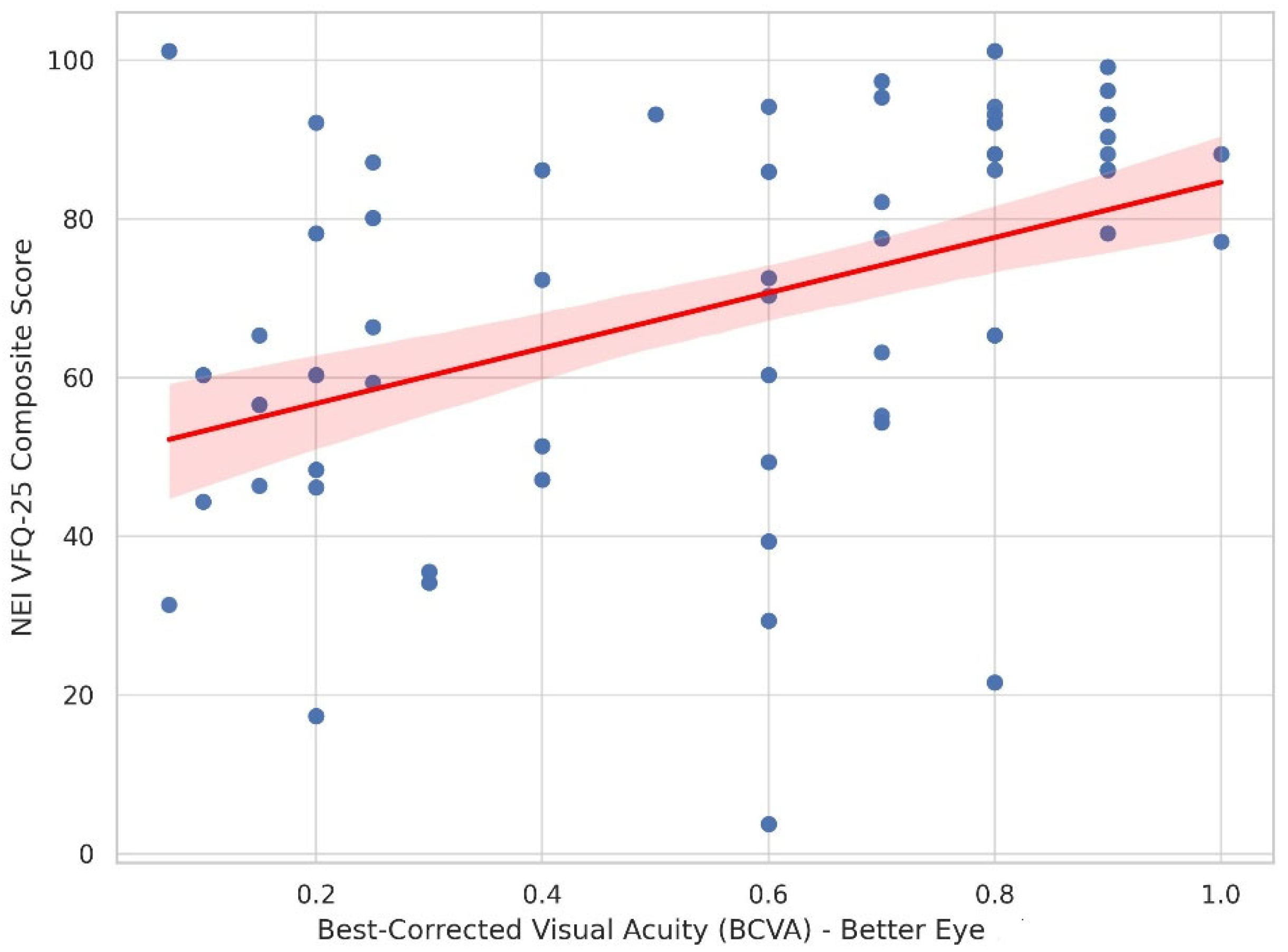
Figure 1. Scatter plot showing the positive association between BCVA (better-seeing eye) and NEI VFQ-25 composite scores; regression line with 95% CI displayed.
Diabetology 06 00153 g001
Table 1. Multiple linear regression predicting NEI VFQ-25 composite score (unstandardized coefficients B with 95% confidence intervals).
PredictorB (Unstandardized)95% CI Lower95% CI Upperp-Value
Better eye (BCVA)35.3825.8144.95<0.001
Education Level−10.15−13.92−6.38<0.001
DR Subtype6.631.9111.360.007
Age0.12−0.070.310.212
Sex (Male)−2.11−6.782.560.381
HbA1c (Categorical)−1.24−4.121.640.398
Duration of Diabetes−0.04−0.360.280.821
Disclaimer/Publisher’s Note: The statements, opinions and data contained in all publications are solely those of the individual author(s) and contributor(s) and not of MDPI and/or the editor(s). MDPI and/or the editor(s) disclaim responsibility for any injury to people or property resulting from any ideas, methods, instructions or products referred to in the content.