



Next Issue
Volume 7, March
Previous Issue
Volume 6, September


Polysaccharides, Volume 6, Issue 4 (December 2025) – 30 articles
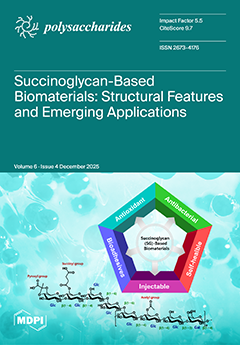
Cover Story (view full-size image): Succinoglycan (SG), an exopolysaccharide from Sinorhizobium meliloti, has gained attention as sustainable biomaterial due to its unique structure and tunable physicochemical properties. This review summarizes advances in SG biosynthesis, structural analysis, and chemical modifying, including oxidation, succinylation, and phenolic grafting. SG derivatives revealed improved rheological stability, antioxidant and antibacterial activities, and stimuli responsiveness. These SG modifications support the development of biodegradable multifunctional polymer platforms with enhanced barrier, mechanical, adhesive, and self-healing properties for applications ranging from food packaging films to drug delivery hydrogel. Overall, structural versatility and multifunctionality of SG suggest significant potential for future polysaccharide-based biomaterials. View this paper
  • Issues are regarded as officially published after their release is announced to the table of contents alert mailing list.
  • You may sign up for e-mail alerts to receive table of contents of newly released issues.
  • PDF is the official format for papers published in both, html and pdf forms. To view the papers in pdf format, click on the "PDF Full-text" link, and use the free Adobe Reader to open them.
Order results
Result details
Select all
Export citation of selected articles as:
23 pages, 7547 KB  
Article
Sustainable Production of Chitin from Supercritical CO2 Defatted Domestic Cricket (Acheta domesticus L.) Meal: One-Pot Preparation, Characterization, and Effects of Different Deep Eutectic Solvents
by Fredrick Nwude Eze, Rattana Muangrat, Wachira Jirarattanarangsri, Thanyaporn Siriwoharn and Yongyut Chalermchat
Polysaccharides 2025, 6(4), 115; https://doi.org/10.3390/polysaccharides6040115 - 16 Dec 2025
Viewed by 93
Abstract
Current resource and processing constraints on conventional chitin production call for novel sources and more sustainable methods for its production. Herein, domestic cricket (Acheta domesticus L.) meal obtained from supercritical CO2 oil extraction was investigated as a viable source of chitin [...] Read more.
Current resource and processing constraints on conventional chitin production call for novel sources and more sustainable methods for its production. Herein, domestic cricket (Acheta domesticus L.) meal obtained from supercritical CO2 oil extraction was investigated as a viable source of chitin via a one-pot approach using acidic (choline chloride: glycerol, CCG) and alkaline (potassium carbonate: glycerol, KG) deep eutectic solvents (DESs). The chitin samples obtained were compared with those obtained using conventional acid-alkaline extraction (CE) and commercial crab shell chitin (CS chitin) by robust characterization of their composition and physicochemical properties employing color, FTIR, XRD, XPS, and SEM analysis. The results showed that KG DES and recovered KG DES exhibited high demineralization and deproteinization capacity, producing chitin with high purity, α-chitin form, high acetylation degree (>77%), crystallinity (crystallinity index > 81%), and micro-fibrous morphology closely similar to those of CE chitin and CS chitin. Whereas CCG DES demonstrated excellent demineralization, it was less effective at deproteinization, leading to chitin with lower purity and crystalline properties. Together, the results demonstrated that cricket meal could be an alternative source of chitin, while KG DES one-pot extraction holds strong potential as a sustainable and eco-friendly approach for obtaining commercial-grade chitin. Full article
Show Figures

Graphical abstract

27 pages, 2211 KB  
Review
Changed Characteristics of Bacterial Cellulose Due to Its In Situ Biosynthesis as a Part of Composite Materials
by Elena Efremenko, Nikolay Stepanov, Aysel Aslanli, Olga Maslova, Ivan Chumachenko, Olga Senko and Amrik Bhattacharya
Polysaccharides 2025, 6(4), 114; https://doi.org/10.3390/polysaccharides6040114 - 14 Dec 2025
Viewed by 172
Abstract
In recent years, the sustained and even increasing interest in the development and application of novel composite materials based on the polysaccharide bacterial cellulose (BC) has been driven by the accumulation of experimental data and the emergence of analytical reviews that narratively summarize [...] Read more.
In recent years, the sustained and even increasing interest in the development and application of novel composite materials based on the polysaccharide bacterial cellulose (BC) has been driven by the accumulation of experimental data and the emergence of analytical reviews that narratively summarize these findings. This review presents a comparative and critical analysis of various approaches to the fabrication of BC-based composites. Among them, in situ biosynthesis is highlighted as the most promising strategy. In this approach, different additives are introduced directly into the culture medium of BC-producing microorganisms, enabling the formation of materials with different mechanical and physicochemical properties. Such a method also allows imparting to the composites a range of properties that BC itself does not possess, including antibacterial and enzymatic activity, as well as electrical conductivity. During the so-called “cell weaving” stage, performed by BC-producing microorganisms, diverse substances and microorganisms can be incorporated into the cultivation medium. By varying the concentrations of the introduced compounds, their ratios to the synthesized BC, and by employing different BC-producing strains and substrates, it becomes possible to regulate the characteristics of the resulting composites. Special attention is given to the role of various polysaccharides that are either introduced into the medium during BC biosynthesis or co-synthesized alongside BC within the same environment. Depending on the mode of incorporation of these additional polysaccharides, the resulting materials demonstrate variations in Young’s modulus and tensile strength. Nevertheless, they almost invariably exhibit a decreased degree of BC crystallinity within the composite structure and an enhanced water absorption capacity compared to the pure polymer. Full article
Show Figures

Graphical abstract

19 pages, 4756 KB  
Article
Sustainable Biodegradable Starch–Collagen Polymeric Systems: Preparation, Characterization, and Efficacy for Slow Release of Organic Nitrogen, Phosphorus, and Potassium
by Maíra L. S. Couto, Ingrid A. dos S. Matusinho, Patterson P. Souza, Luiz C. A. Oliveira and Patrícia S. de O. Patricio
Polysaccharides 2025, 6(4), 113; https://doi.org/10.3390/polysaccharides6040113 - 9 Dec 2025
Viewed by 225
Abstract
The use of biodegradable polymers in slow-release NPK fertilizers is gaining prominence for reducing overdosing, minimizing nutrient loss, and enhancing efficiency. This study prepared modified and unmodified thermoplastic starch (TPS) systems via extrusion, incorporating collagen and potassium phosphate. Controlled-release nutrient systems utilizing nitrogen [...] Read more.
The use of biodegradable polymers in slow-release NPK fertilizers is gaining prominence for reducing overdosing, minimizing nutrient loss, and enhancing efficiency. This study prepared modified and unmodified thermoplastic starch (TPS) systems via extrusion, incorporating collagen and potassium phosphate. Controlled-release nutrient systems utilizing nitrogen from an organic source were developed and characterized. The materials were characterized using Fourier-transform infrared spectroscopy (FTIR), X-ray diffraction (XRD), contact angle measurements, and biodegradability in the soil. The biodegradability of the polymeric matrix was evaluated through mass loss, with up to 78.9% degradation observed after 60 days for TPS-based systems containing collagen. Structural modifications in the TPS matrix led to changes in crystallinity and hydrophilicity, which directly influenced degradation rates. The nutrient release effect was assessed by monitoring the growth of chili pepper seedlings over 15 days. Seedlings grown in soil containing polymeric systems with 20% collagen or 6.2% urea reached average heights between 5.2 and 7.8 cm, compared to 5.0 cm for the unmodified TPS and 0 cm in treatments with pure urea, which caused seedling mortality. The polymeric systems containing collagen exhibited superior performance as a sustainable nitrogen source, ensuring a slower and more controlled release while yielding positive outcomes for early plant development. Full article
Show Figures

Graphical abstract

19 pages, 3204 KB  
Article
Effect of Glycerol and Isosorbide on Mechanical, Thermal, and Physicochemical Properties During Retrogradation of a Cassava Thermoplastic Starch
by Andrea Carolina Acosta-Tirado, Jairo Salcedo-Mendoza, Nicolas Martinez-Mera, Howard Ramírez-Malule and José Herminsul Mina Hernández
Polysaccharides 2025, 6(4), 112; https://doi.org/10.3390/polysaccharides6040112 - 8 Dec 2025
Viewed by 268
Abstract
The mechanical, thermal, physicochemical and structural properties of a thermoplastic cassava starch obtained by a twin-screw extrusion process were evaluated, using glycerol and isosorbide as plasticizers at different concentrations (30, 35 and 40% by weight) and storage times (1, 15 and 30 days) [...] Read more.
The mechanical, thermal, physicochemical and structural properties of a thermoplastic cassava starch obtained by a twin-screw extrusion process were evaluated, using glycerol and isosorbide as plasticizers at different concentrations (30, 35 and 40% by weight) and storage times (1, 15 and 30 days) under controlled conditions of relative humidity of 47 ± 2% and temperature of 25 ± 2 °C. The results obtained show a decrease in tensile strength and modulus of elasticity and an increase in elongation in the initial measurements, suggesting that, in both cases, a plasticization phenomenon via absorption of humidity predominated in short times, while at prolonged times, a rigidification of the material occurred due to the generation of a retrogradation process. Likewise, a higher tensile strength and lower elongation were found in the materials plasticized with isosorbide. Finally, it was observed that the retrogradation phenomenon was more evident in the thermoplastic starch samples made with glycerol, and that the starches plasticized with isosorbide had lower moisture absorption, higher crystallinity and a predominantly Eh-type crystalline pattern, related to greater stability over time. Full article
Show Figures

Figure 1

24 pages, 1866 KB  
Review
Chitosan and Alginate in Aquatic Vaccine Development
by Anastasia Zubareva, Elena Svirshchevskaya, Artem Nedoluzhko and Yury A. Skorik
Polysaccharides 2025, 6(4), 111; https://doi.org/10.3390/polysaccharides6040111 - 8 Dec 2025
Viewed by 423
Abstract
The global aquaculture industry faces a number of challenges, including the risk of infection spreading in closed aquatic ecosystems. Since 1942, vaccination has become a mainstream approach in fish cultivation. However, the immune system of cold-blooded organisms differs significantly from that of mammals, [...] Read more.
The global aquaculture industry faces a number of challenges, including the risk of infection spreading in closed aquatic ecosystems. Since 1942, vaccination has become a mainstream approach in fish cultivation. However, the immune system of cold-blooded organisms differs significantly from that of mammals, which must be taken into account when developing vaccines for aquaculture. Modern technology employs delivery systems for antigens to protect them from degradation in the water and the digestive tract. Packaging the antigen into a biodegradable structure protects the protein or target gene from degradation and enhances antigen delivery to immune cells. The combination of chitosan and alginate is widely used for the development of various types of nano- and microcarriers. New vaccines based on these polysaccharides are more effective, increasing survival rates in some fish species by up to 100% compared to 20% in the control group. However, the correlation between the observed effects and the physicochemical characteristics of the polysaccharides/carriers, and the mechanisms of their action, remains unclear. This review summarizes and analyzes the data on the use of chitosan and alginate in aquaculture vaccines. Particular focus is given to the physicochemical properties and sources of the polysaccharides, and their potential implementation in aquaculture vaccination practices. Full article
Show Figures

Graphical abstract

20 pages, 4002 KB  
Article
Influence of Chitosan on Fish Gelatin Hydrogel: Rheological Properties and Microstructure
by Svetlana Derkach, Nikolay Voron’ko, Vlada Bordiyan, Tatyana Dyakina, Liudmila Petrova, Yuliya Kuchina, Daria Kolotova, Alena Nikiforova and Yuriy Zuev
Polysaccharides 2025, 6(4), 110; https://doi.org/10.3390/polysaccharides6040110 - 6 Dec 2025
Viewed by 198
Abstract
Hydrogels based on gelatin–chitosan mixtures have great potential for practical application in the development of new materials in food technology and biomedicine. This study examines the effect of chitosan on the gelling properties, rheological, and structural characteristics of fish gelatin type A hydrogels [...] Read more.
Hydrogels based on gelatin–chitosan mixtures have great potential for practical application in the development of new materials in food technology and biomedicine. This study examines the effect of chitosan on the gelling properties, rheological, and structural characteristics of fish gelatin type A hydrogels in the acidic pH range of 3.2–3.9. It was shown that an increase in the chitosan-to-gelatin mass ratio up to 0.15 resulted in a growth in the hydrogel thermal stability and an increase in the elastic modulus, hardness, and yield stress. The structural strength of the fish gelatin–chitosan hydrogel increased due to the strengthening of the binding zones in the fish gelatin gel network in the presence of chitosan. According to scanning electron microscopy, the supramolecular microstructure of the gels demonstrated a significant compaction upon the addition of chitosan to fish gelatin. UV and IR spectroscopy data, as well as changes in zeta potential, showed the formation of supramolecular complexes of fish gelatin with chitosan as a result of hydrophobic interactions between biomacromolecules and the establishment of hydrogen bonds; in this case, electrostatic interactions between macromolecules of fish gelatin and chitosan are practically absent in the acidic pH region. The ability to form supramolecular complexes of different compositions at different mass ratios of polysaccharide-to-fish gelatin makes it possible to obtain hydrogels with high gelling properties, strength, elasticity, and thermal stability comparable to hydrogels of mammalian gelatin. Full article
Show Figures

Graphical abstract

27 pages, 12760 KB  
Article
Development and Evaluation of Modified Dioscorea hispida Starch as a Sustainable Super-Disintegrant for Immediate-Release Tablets
by Nuntachai Hanpramukkun, Thavisak Teruya, Ratana Charoenwattanasatien, Phakkhananan Pakawanit and Sucharat Limsitthichaikoon
Polysaccharides 2025, 6(4), 109; https://doi.org/10.3390/polysaccharides6040109 - 1 Dec 2025
Viewed by 379
Abstract
This study developed a sustainable super-disintegrant derived from Dioscorea hispida Dennst. var. hispida starch for use in immediate-release pharmaceutical tablets. Native starch (NS) was extracted and chemically modified via carboxymethylation to obtain carboxymethyl starch (CMS), followed by phosphate cross-linked to yield modified starch [...] Read more.
This study developed a sustainable super-disintegrant derived from Dioscorea hispida Dennst. var. hispida starch for use in immediate-release pharmaceutical tablets. Native starch (NS) was extracted and chemically modified via carboxymethylation to obtain carboxymethyl starch (CMS), followed by phosphate cross-linked to yield modified starch (MS). Physicochemical properties demonstrated that MS exhibited superior water uptake, swelling, and viscosity compared to NS and CMS. Scanning Electron Microscopy (SEM) revealed smaller and more uniform granules in MS, confirming enhanced structural modification. Preliminary tablet trials with dicalcium phosphate showed that 4% w/w MS achieved the fastest disintegration (16.5 s). In paracetamol tablets prepared by wet granulation, MS significantly improved hydration and disintegration performance relative to NS and CMS. Although commercial sodium starch glycolate (SSG) provided slightly faster disintegration, dissolution profiles of tablets containing MS and SSG were statistically equivalent (f1 = 7, f2 = 63), confirming comparable efficacy. Porosity analysis using synchrotron radiation X-ray tomography (SR-XTM) indicated that wet-granulated tablets possessed higher intra- and inter-granular porosity than direct compression tablets, facilitating rapid water penetration and disintegration. In contrast, denser direct compression tablets exhibited greater friability and lower mechanical integrity. Modified Dioscorea hispida starch demonstrated excellent disintegration efficiency, eco-friendliness, and local availability, presenting a promising natural alternative to synthetic super-disintegrants in immediate-release tablet formulations. Full article
Show Figures

Figure 1

36 pages, 1928 KB  
Review
Polysaccharide-Based Drug Delivery Systems in Pediatrics: Addressing Age-Specific Challenges and Therapeutic Applications
by Anđelka Račić, Biljana Gatarić, Valentina Topić Vučenović and Aneta Stojmenovski
Polysaccharides 2025, 6(4), 108; https://doi.org/10.3390/polysaccharides6040108 - 1 Dec 2025
Viewed by 616
Abstract
Pediatric drug delivery presents unique challenges due to physiological and pharmacological differences across age groups, requiring specialized formulation approaches beyond simple dose adjustments of adult medications. This review synthesizes recent advances in polysaccharide-based pediatric drug delivery and highlights novel findings that may accelerate [...] Read more.
Pediatric drug delivery presents unique challenges due to physiological and pharmacological differences across age groups, requiring specialized formulation approaches beyond simple dose adjustments of adult medications. This review synthesizes recent advances in polysaccharide-based pediatric drug delivery and highlights novel findings that may accelerate clinical translation. It summarizes how chitosan, alginate, hyaluronic acid, dextran, modified starches, and other polysaccharides are engineered into nanoparticles, hydrogels, films, and orodispersible/mini-tablet formulations to improve stability, bioavailability, taste masking, and controlled release across neonates to adolescents. These systems can accommodate developmental variations in absorption, distribution, metabolism, and excretion processes across pediatric subpopulations, with particular emphasis on oral and alternative administration routes. Evidence supporting unexpectedly high acceptability of mini-tablets, successful integration of modified polysaccharides in 3D-printed personalized low-dose therapies, and the emergence of blood–brain barrier-penetrating and RGD-functionalized polysaccharide nanocarriers for pediatric oncology are emphasized as novel, clinically relevant trends. This review also addresses regulatory considerations, safety profiles, and future perspectives. By integrating developmental insights with innovative formulation strategies, polysaccharide polymers offer promising solutions to improve medication adherence, safety, and efficacy across the pediatric age spectrum. Full article
(This article belongs to the Collection Current Opinion in Polysaccharides)
Show Figures

Figure 1

11 pages, 2498 KB  
Communication
GC-MS Analysis of Liposoluble Components from Six Kinds of Bast Fibers and Correlative Study on Their Antibacterial Activity
by Xiang Zhou, Xiangyuan Feng, Lifeng Cheng, Guoguo Xi, Yuqin Hu, Si Tan, Wei Zhou, Zishu Chen, Zhenghong Peng, Shengwen Duan and Qi Yang
Polysaccharides 2025, 6(4), 107; https://doi.org/10.3390/polysaccharides6040107 - 29 Nov 2025
Viewed by 180
Abstract
This study systematically investigated the liposoluble components and their potential correlation with antibacterial activity in six bast fiber varieties—Apocynum venetum, Corchorus capsularis, Hibiscus cannabinus, Linum usitatissimum, Cannabis sativa, and Boehmeria nivea—using gas chromatography-mass spectrometry (GC-MS). The [...] Read more.
This study systematically investigated the liposoluble components and their potential correlation with antibacterial activity in six bast fiber varieties—Apocynum venetum, Corchorus capsularis, Hibiscus cannabinus, Linum usitatissimum, Cannabis sativa, and Boehmeria nivea—using gas chromatography-mass spectrometry (GC-MS). The analysis identified a range of compounds including alkanes, phenols, sterols, esters, and triterpenoids, with notable compositional differences among the fibers. Tetracontane was predominant in A. venetum (40.39%) and H. cannabinus (22.47%), while γ-sitosterol was highest in C. capsularis (12.80%). L. usitatissimum was rich in n-hexadecanoic acid (9.16%), C. sativa in heptacosanal (8.96%), and B. nivea in both tetracontane (45.42%) and tetracosane (10.09%). Based on existing literature, components such as 2,4-di-tert-butylphenol, γ-sitosterol, n-hexadecanoic acid, lupeol, and betulin were inferred as key antibacterial constituents. A comprehensive review of reported antimicrobial activities revealed distinct antibacterial spectra and intensities across the varieties, aligning with their unique liposoluble profiles. This study provides a systematic chemical profile of bast fibers and offers a predictive assessment of their antibacterial potential. The findings lay a chemical foundation for future targeted research and development of antibacterial materials derived from specific bast fiber varieties. Full article
Show Figures

Figure 1

36 pages, 3238 KB  
Review
Advances in Succinoglycan-Based Biomaterials: Structural Features, Functional Derivatives, and Multifunctional Applications
by Kyungho Kim, Jae-pil Jeong and Seunho Jung
Polysaccharides 2025, 6(4), 106; https://doi.org/10.3390/polysaccharides6040106 - 28 Nov 2025
Viewed by 268
Abstract
Succinoglycan (SG), a rhizobial exopolysaccharide produced by Sinorhizobium meliloti, has attracted increasing attention as a sustainable biomaterial due to its unique molecular structure and versatile physicochemical properties. Over the past decade, an expanding number of studies have explored SG in biomedical, pharmaceutical, [...] Read more.
Succinoglycan (SG), a rhizobial exopolysaccharide produced by Sinorhizobium meliloti, has attracted increasing attention as a sustainable biomaterial due to its unique molecular structure and versatile physicochemical properties. Over the past decade, an expanding number of studies have explored SG in biomedical, pharmaceutical, and materials-science contexts; however, a comprehensive understanding linking its biosynthetic mechanisms, structural features, chemical modifications, and functional performances has not yet been systematically summarized. This review therefore aims to bridge this gap by providing an integrated overview of recent advances in SG research from biosynthesis and molecular design to emerging multifunctional applications, while highlighting the structure, property, and function correlations that underpin its material performance. This review summarizes recent advances in SG biosynthesis, structural characterization, chemical modification, and multifunctional applications. Progress in oxidation, succinylation, and phenolic grafting has yielded derivatives with remarkably enhanced rheological stability, antioxidant capacity, antibacterial activity, and multi-stimuli responsiveness. These developments have supported the creation of biodegradable and bioactive smart films possessing superior barrier, mechanical, and optical properties, thereby extending their potential use in bio-medical and biotechnological applications such as food packaging and wound dressings. In parallel, SG-based hydrogels exhibit self-healing, adhesive, and injectable characteristics with tunable multi-stimuli responsiveness, offering innovative platforms for con-trolled drug delivery and tissue engineering. Despite these advances, industrial translation remains hindered by challenges including the need for scalable fermentation, reproducible quality control, and standardized modification protocols to ensure batch-to-batch consistency. Overall, the structural tunability and multifunctionality of SG highlight its promise as a next-generation platform for polysaccharide-based biomaterials. Full article
(This article belongs to the Collection Current Opinion in Polysaccharides)
Show Figures

Figure 1

15 pages, 1795 KB  
Article
Optimization of Mono- and Disaccharide Extraction from Cocoa pod Husk
by Edna Elena Suárez-Patlán, Teodoro Espinosa-Solares, José Enrique Herbert-Pucheta, Holber Zuleta-Prada and Emanuel Hernández-Núñez
Polysaccharides 2025, 6(4), 105; https://doi.org/10.3390/polysaccharides6040105 - 25 Nov 2025
Viewed by 262
Abstract
Cocoa pod husk (CPH) is a potential material to produce value-added products. The objective of this study was to optimize the microwave-assisted hydrothermal pretreatment (MA-HTP) of CPH and CPH hemicellulose (HMC-CPH) using only water as the extraction medium, in combination with response surface [...] Read more.
Cocoa pod husk (CPH) is a potential material to produce value-added products. The objective of this study was to optimize the microwave-assisted hydrothermal pretreatment (MA-HTP) of CPH and CPH hemicellulose (HMC-CPH) using only water as the extraction medium, in combination with response surface analysis (RSA), Box–Behnken design (BBD), and proton nuclear magnetic resonance identification and quantification (1H NMR Qu) to provide an efficient protocol for the extraction of mono- and disaccharides, as a novel method for which no precedent was found. The methodology consisted of 15 CPH MA-HTPs and 15 HMC-CPH MA-HTPs (triplicate) designed by RSA-BBD; the experimental variables were time, temperature, and power, and the response was the concentration of extraction products. Glucose, sucrose, and fructose were identified as products of the extractions by 1H NMR. With 95% confidence, higher sucrose content was determined for CPH (45.62%) compared to HMC-CPH (17.34%), high fructose content for both CPH and HMC-CPH (37.88% and 35.37%, respectively), and minimal glucose concentrations were obtained in both CPH and HMC-CPH (4.57% and 0.93%, respectively). Using RSA-BBD, optimal temperature, power, and time points were predicted for glucose CPH: 135.4 °C, 180.6 W, and 5.8 min; sucrose: 154.3 °C, 256.3 W, and 20. 2 min; fructose 129.5 °C, 173.8 W, and 5.27 min. For HMC-CPH, the optimal conditions were as follows: glucose: 142.2 °C, 204.4 W, and 10.5 min; sucrose: 148.8 °C, 215.6 W, and 14.3 min; fructose: 151.6 °C, 231.6 W, and 13 min. Full article
(This article belongs to the Collection Bioactive Polysaccharides)
Show Figures

Graphical abstract

39 pages, 8342 KB  
Systematic Review
Hydroxypropyl Cellulose Research over Two Decades (2005–2024): A Systematic Review with Bibliometric Analysis and Translational Insights
by Derina Paramitasari, Okta Amelia, Karjawan Pudjianto, Musa Musa, Banon Rustiaty, Arni Supriyanti, Dyah Primarini Meidiawati, Okta Nama Putra, Yanuar Sigit Pramana, Yassaroh Yassaroh, Frita Yuliati, Jatmiko Eko Witoyo and Untia Kartika Sari
Polysaccharides 2025, 6(4), 104; https://doi.org/10.3390/polysaccharides6040104 - 14 Nov 2025
Viewed by 699
Abstract
Hydroxypropyl cellulose (HPC) is a versatile cellulose ether with two standardized forms: highly substituted (H-HPC), which is water-soluble and thermoresponsive, and low-substituted (L-HPC), which is insoluble but swellable. This systematic review with bibliometric analysis aimed to map the global HPC research landscape (2005–2024), [...] Read more.
Hydroxypropyl cellulose (HPC) is a versatile cellulose ether with two standardized forms: highly substituted (H-HPC), which is water-soluble and thermoresponsive, and low-substituted (L-HPC), which is insoluble but swellable. This systematic review with bibliometric analysis aimed to map the global HPC research landscape (2005–2024), focusing on publication trends, research impact, and thematic directions. Original research articles and conference proceedings indexed in Scopus were included, while reviews and non-research items were excluded. The database was searched on 7 July 2025 using predefined strategies and analyzed using Excel for descriptive statistics and VOSviewer for network visualization. Risk of bias assessment was not applicable; data accuracy was ensured through duplicate removal and the use of standardized bibliometric indicators. A total of 1273 H-HPC and 92 L-HPC publications were analyzed. H-HPC research dominates multidisciplinary applications in drug delivery, 3D printing, thermochromic, and energy materials, whereas L-HPC remains focused on pharmaceutical disintegration and binding. Nevertheless, the field is constrained by reliance on commercial grades and a narrow application focus, leaving broader material innovations underexplored. HPC is positioned as a strategic polysaccharide derivative with expanding translational potential. Future studies should emphasize greener synthesis, advanced functionalization, and industrial scale-up. Funding: Supported by BRIN. Systematic review registration: INPLASY202590019. Full article
Show Figures

Figure 1

21 pages, 7142 KB  
Article
Chemically Modified Starch Films with Menthol or Sulfobetaine as Antimicrobial Agents for Active Packaging Applications
by Pedro Francisco Muñoz-Gimena, Anselmo del Prado, Alejandro Aragón-Gutiérrez, Laura Peponi and Daniel López
Polysaccharides 2025, 6(4), 103; https://doi.org/10.3390/polysaccharides6040103 - 12 Nov 2025
Viewed by 494
Abstract
This study aims to develop a modified starch with menthol (M) or sulfobetaine (S) using 1,6-hexamethyl diisocyanate (HMDI) as a linker to create biodegradable antibacterial materials for active packaging applications. The modification of potato starch is performed in a two-step reaction. First, the [...] Read more.
This study aims to develop a modified starch with menthol (M) or sulfobetaine (S) using 1,6-hexamethyl diisocyanate (HMDI) as a linker to create biodegradable antibacterial materials for active packaging applications. The modification of potato starch is performed in a two-step reaction. First, the starch modifiers are synthesized through an equimolar reaction between HMDI and menthol or the sulfobetaine precursor. Next, the synthesized HMDI derivative is dissolved in a bio-based solvent (methyl-THF) with starch and K2CO3 (1:1 weight ratio) to chemically modify the starch. The chemical and thermal properties of the modified starch are analyzed. Starch films containing 25 wt.% glycerol and low amounts (0.5, 1, and 3% wt.) of M- or S-modified starch were successfully produced by extrusion. Although most film properties remain similar to the control, adding 3% of S-modified starch resulted in a 149% increase in Elastic Modulus and a 29% decrease in water vapor permeability. Additionally, just 0.5 wt.% of either M- or S-modified starch effectively inhibits S. aureus growth, indicating its potential as a bioactive compound for active packaging. Full article
Show Figures

Graphical abstract

29 pages, 4689 KB  
Article
The Effect of Chitosan Nanoparticle-Loaded Hydrogel and Lavandula Angustifolia Extract on Staphylococcus Aureus-Infected Wounds in a Rat Model: An Animal Study
by Farah Faraedon Mohidden Zardawi and Mohammed Qasim Yahya Malallah A. Al Atrakji
Polysaccharides 2025, 6(4), 102; https://doi.org/10.3390/polysaccharides6040102 - 11 Nov 2025
Viewed by 585
Abstract
Background: Chitosan and Lavandula angustifolia (lavender) exhibit antibacterial, antioxidant, and anti-inflammatory effects, making them potential candidates for managing infected wounds. This study investigated the therapeutic efficacy of a chitosan nanoparticle-loaded hydrogel, lavender extract, and their combination in treating Staphylococcus aureus-infected wounds in [...] Read more.
Background: Chitosan and Lavandula angustifolia (lavender) exhibit antibacterial, antioxidant, and anti-inflammatory effects, making them potential candidates for managing infected wounds. This study investigated the therapeutic efficacy of a chitosan nanoparticle-loaded hydrogel, lavender extract, and their combination in treating Staphylococcus aureus-infected wounds in rats. Methods: Forty-eight male Sprague-Dawley rats (250–350 g, 8–10 weeks) were divided into six groups: healthy control, infected untreated, Fucidin, lavender extract, chitosan hydrogel, and chitosan–lavender combination. Wound healing was evaluated on days 3, 7, and 14 using clinical assessment, histopathology, and biochemical markers. Non-parametric statistical tests were applied, with significance set at p < 0.05. Results: The chitosan–lavender group showed the most pronounced healing response, with significantly reduced WBC counts, lower levels of TNF-α, IL-6, and MDA, and enhanced SOD activity (p < 0.05). Histological analysis confirmed superior re-epithelialization, granulation tissue development, collagen deposition, and wound contraction in chitosan-based treatments, particularly their combination, compared to lavender or Fucidin alone (p < 0.001). Inflammatory infiltrates, angiogenesis, necrosis, and hemorrhage were also notably reduced across treated groups. Conclusion: Combining chitosan hydrogel with lavender extract exerts synergistic antibacterial and wound healing effects, offering a promising alternative therapy for infected wounds. Full article
(This article belongs to the Collection Bioactive Polysaccharides)
Show Figures

Graphical abstract

23 pages, 7124 KB  
Article
Design and Characterization of Yeast Protein–Polysaccharide Bioink Blends for 3D Printing
by Or Peleg-Evron, Noy Hen, Maya Davidovich-Pinhas, Shulamit Levenberg and Havazelet Bianco-Peled
Polysaccharides 2025, 6(4), 101; https://doi.org/10.3390/polysaccharides6040101 - 10 Nov 2025
Viewed by 731
Abstract
Yeast protein (YP) offers nutritional and sustainable benefits; however, its poor gelation properties limit its use in soft material formulations. This study investigates the rheological behavior and the formation of crosslinked networks using YP–polysaccharide mixtures for extrusion-based 3D printing. Binary bioink blends with [...] Read more.
Yeast protein (YP) offers nutritional and sustainable benefits; however, its poor gelation properties limit its use in soft material formulations. This study investigates the rheological behavior and the formation of crosslinked networks using YP–polysaccharide mixtures for extrusion-based 3D printing. Binary bioink blends with alginate (Alg) or xanthan gum (XG) showed enhanced viscosity and exhibited shear-thinning properties. However, a high concentration of Alg negatively affected the material’s thixotropic recovery. On the other hand, YP–XG bioink displayed more pronounced elastic behavior and demonstrated thixotropic recovery, though they lacked the capacity for ionic crosslinking. A triple bioink formulation consisting of 8% (w/v) YP, 2% (w/v) Alg, and 0.5% (w/v) XG effectively combined the advantages of both polysaccharides. Alg provided structural stability through calcium crosslinking, while XG offered rheological flexibility. These bioinks were successfully printed using embedded 3D printing and maintained their shape fidelity after printing. The crosslinked triple hydrogel exhibited good mechanical strength, volume retention after crosslinking, structural integrity under compression of up to 70%, and recovery after deformation that indicates high structural stability. This research presents an effective strategy to enhance the application of yeast-derived proteins in sustainable, animal-free 3D printed food products and other soft biomaterials. Full article
Show Figures

Graphical abstract

21 pages, 2221 KB  
Article
Understanding Forage Palm Mucilage Behavior: Harnessing Plackett–Burman Screening for Tailoring Formulation and Process
by Sander Moreira Rodrigues, Kaliston Aurélio Lomba, Tatiane Monteiro dos Santos, Gabrielly de Fátima Rodrigues das Neves, Maria Laura Gomes Vieira, Nathalia de Andrade Neves, César Alberto Roldan Cruz, Giselle Pereira Cardoso, Silvia Leticia Rivero Meza, Polyanna Mara de Oliveira, Larissa de Oliveira Ferreira Rocha, Monalisa Pereira Dutra Andrade, Vivian Machado Benassi, Tatiana Nunes Amaral, Irene Andressa, Maria Teresa Pedrosa Silva Clerici and Marcio Schmiele
Polysaccharides 2025, 6(4), 100; https://doi.org/10.3390/polysaccharides6040100 - 9 Nov 2025
Viewed by 493
Abstract
The rheological and textural behavior of a highly viscous solution containing forage palm mucilage (FPM) was investigated using the Plackett–Burman (PB) design and multivariate analysis. The influence of carbohydrates (xanthan gum (XG), carboxymethyl cellulose (CMC), and sucrose), proteins (soy, egg, and whey), and [...] Read more.
The rheological and textural behavior of a highly viscous solution containing forage palm mucilage (FPM) was investigated using the Plackett–Burman (PB) design and multivariate analysis. The influence of carbohydrates (xanthan gum (XG), carboxymethyl cellulose (CMC), and sucrose), proteins (soy, egg, and whey), and salts (NaCl and CaCl2), as well as pH and temperature, on FPM formulations was evaluated (α < 0.10 and R2 > 0.75). The flow curves indicate that gels fitted to the Ostwald-de Waele model and presented pseudoplastic behavior. Apparent viscosity at 10 s−1 showed results between 0.05 and 36.16 Pa·s, affected by XG, FPM and egg albumin. Hysteresis (–1138 to 3950 Pa·s) was reduced with increasing pH (p = 0.041), indicating the formation of more stable three-dimensional networks. Significant effects on firmness (0.114–0.434 N), consistency (1.286–3.397 N·s), cohesiveness (0.047–0.167 N), and viscosity index (0.067–0.810 N·s) were observed for sucrose, salts, and temperature (p < 0.100). Chemometric analysis confirmed the influence of these factors on the evaluated responses but revealed no correlation between rheological and textural parameters. Full article
Show Figures

Figure 1

17 pages, 2333 KB  
Article
Chondroitin 4-Sulfate Disaccharide-Based Inhibitors of Cathepsin S
by Alexis David, Roxane Domain, Florian Surback, Aude Vibert, Pierre Buisson, Martyna Maszota-Zieleniak, Ludovic Landemarre, Marie Schuler, Gilles Lalmanach, Sergey A. Samsonov, Chrystel Lopin-Bon and Fabien Lecaille
Polysaccharides 2025, 6(4), 99; https://doi.org/10.3390/polysaccharides6040099 - 5 Nov 2025
Viewed by 493
Abstract
Cathepsin S (Cat S) is a cysteine protease involved in several human diseases (i.e., autoimmune, inflammatory and cardiovascular disorders, cancer, and psoriasis) and is an important target in drug development. Emerging evidence highlights the potential of inhibiting Cat S by glycosaminoglycans, particularly chondroitin [...] Read more.
Cathepsin S (Cat S) is a cysteine protease involved in several human diseases (i.e., autoimmune, inflammatory and cardiovascular disorders, cancer, and psoriasis) and is an important target in drug development. Emerging evidence highlights the potential of inhibiting Cat S by glycosaminoglycans, particularly chondroitin sulfates (CSs), as a promising therapeutic strategy. Given the limited and heterogeneous GAG materials from animal sources, a series of synthetic biotinylated non- or sulfated chondroitin oligomers were synthesized and assessed for their ability to inhibit Cat S. The biotinylated disaccharide C4S displayed in vitro potent inhibitory activity toward Cat S with IC50 value in the micromolar range and showed selectivity over cathepsins K and L. Molecular modeling studies suggested that only C4S dp2 but not C6S, C4,6S or non-sulfated chondroitin binds selectively to the active site of Cat S. In addition, a synthetic multivalent C4S dp2 glycosylated BSA was shown to be more efficient towards Cat S inhibition (nanomolar range) than the monovalent parent C4S dp2. Our findings also indicated that this new neoglycoconjugate displayed selectivity for Cat S vs. cysteine cathepsins expressed by differentiated THP-1 cells. This study reports a new approach for designing selective and potent inhibitors of Cat S using multivalent C4S derivatives as a molecular scaffold. Full article
Show Figures

Graphical abstract

20 pages, 1635 KB  
Article
Characterization of Pectin Extracted from the Peel of Dragon Fruit (Selenicereus cf. guatemalensis ‘Queen Purple’)
by Victoria Carpio-Rivas, Rosendo Balois-Morales, Verónica Alhelí Ochoa-Jiménez, Juan Esteban Bello-Lara, Julio César Tafolla-Arellano and Guillermo Berumen-Varela
Polysaccharides 2025, 6(4), 98; https://doi.org/10.3390/polysaccharides6040098 - 3 Nov 2025
Viewed by 1076
Abstract
The dragon fruit (Selenicereus sp.) peel is a viable plant source for the extraction of polysaccharides such as pectin, the demand for which has increased significantly in the food and pharmaceutical industries. In Nayarit, Mexico, the Queen Purple variety of dragon fruit [...] Read more.
The dragon fruit (Selenicereus sp.) peel is a viable plant source for the extraction of polysaccharides such as pectin, the demand for which has increased significantly in the food and pharmaceutical industries. In Nayarit, Mexico, the Queen Purple variety of dragon fruit (Selenicereus cf. guatemalensis) is commonly cultivated. The peel is typically discarded, while only the pulp is utilized for direct consumption or processed into derivative products. The objective of this study was to characterize the properties of pectin extracted from the peel of dragon fruit (Selenicereus cf. guatemalensis ‘Queen Purple’). The yield, molecular weight, anhydrouronic acid content, betalain content, antioxidant capacity, and phenolic compounds were determined using gravimetric, volumetric, spectrophotometric, and colorimetric techniques, among others. Furthermore, the functional groups and degree of esterification of the pectin were identified using Fourier-transform infrared spectroscopy. The pectin presented a yield of 12.8%, esterification degree of 49.85%, molecular weight of 645 kDa, anhydrouronic acid, phenolic acid and betalain content of 98.27%, 195.7 mg EAG/100 gDW and 4.26 mg/100 gDW respectively and an antioxidant capacity of 149.6, 192.76 and 20.5 mg EAA/100 gDW by the DPPH, ABTS and FRAP methods respectively, classified as high-purity, low-methoxyl, intermediate-molecular-weight, with an important betalain content and antioxidant capacity. Based on these findings, the extracted pectin complies with the Food and Agriculture Organization specifications and shows promise as a functional ingredient in the food industry. Full article
Show Figures

Graphical abstract

25 pages, 1654 KB  
Review
Symbiotic Culture of Bacteria and Yeast (SCOBY) in the Food Sector as a Source of Polysaccharides and Other Applications in the Food Sector
by Rosa Maria Santiago-Santiago, Mariela R. Michel, Raúl Rodríguez-Herrera, Pedro Aguilar-Zárate, Juan Alberto Ascacio-Valdés and Adriana C. Flores-Gallegos
Polysaccharides 2025, 6(4), 97; https://doi.org/10.3390/polysaccharides6040097 - 21 Oct 2025
Viewed by 1733
Abstract
The SCOBY (Symbiotic Culture of Bacteria and Yeast) is a microbial consortium composed of a diverse range of bacteria and yeasts that coexist symbiotically. The most commonly identified microorganisms include Gluconobacter, Acetobacte, Saccharomyces and Zygosaccharomyces. Its primary objective is to utilize [...] Read more.
The SCOBY (Symbiotic Culture of Bacteria and Yeast) is a microbial consortium composed of a diverse range of bacteria and yeasts that coexist symbiotically. The most commonly identified microorganisms include Gluconobacter, Acetobacte, Saccharomyces and Zygosaccharomyces. Its primary objective is to utilize sucrose as a substrate. SCOBY requires specific conditions for its multiplication, such as temperature, pH, and a suitable carbon source. Through its microbial dynamics and proper management, this consortium develops functional properties that are beneficial to health. This microbial consortium has been the subject of numerous studies due to the wide range of benefits it can offer through fermentation-derived products. Among the most frequently mentioned are organic acids, phenolic compounds, and a high concentration of probiotics. Originally, the SCOBY was used as a started culture in the production of the beverage “Kombucha”. However, due to the growing public interest, its use has diversified into fruit-based, dairy-based, and cereal-based beverages. Furthermore, its application has expanded to unconventional substrates. Its potential uses in other fields, such as medicine, as well as its antimicrobial activity, should also be noted. Full article
Show Figures

Graphical abstract

2 pages, 155 KB  
Editorial
Updating the Scope of Polysaccharides
by Karin Stana Kleinschek
Polysaccharides 2025, 6(4), 96; https://doi.org/10.3390/polysaccharides6040096 - 21 Oct 2025
Viewed by 390
Abstract
Polysaccharides was launched in 2020, aiming to provide an advanced forum for studies related to polysaccharides and their derivatives, from basics to applications [...] Full article
17 pages, 3748 KB  
Article
Shedding Light on Carob Seeds: A Non-Destructive Approach to Assess Dehusking Efficiency Using Diffuse Reflectance Spectroscopy and Kubelka–Munk Theory
by Rui Guerra, António Brázio, Sandra Gonçalves, Anabela Romano and Bruno Medronho
Polysaccharides 2025, 6(4), 95; https://doi.org/10.3390/polysaccharides6040095 - 20 Oct 2025
Viewed by 745
Abstract
The carob tree (Ceratonia siliqua L.) is receiving growing attention for its agro-industrial potential, particularly due to its seeds, which are the source of locust bean gum (LBG), a galactomannan-rich polysaccharide with wide applications in food and pharmaceutical industries. Efficient dehusking of [...] Read more.
The carob tree (Ceratonia siliqua L.) is receiving growing attention for its agro-industrial potential, particularly due to its seeds, which are the source of locust bean gum (LBG), a galactomannan-rich polysaccharide with wide applications in food and pharmaceutical industries. Efficient dehusking of carob seeds is critical to maximize LBG purity and yield, yet current industrial methods pose environmental concerns and lack robust quality control tools. In this study, we demonstrate the use of Diffuse Reflectance Spectroscopy (DRS) and Kubelka–Munk (KM) modeling as a rapid, non-destructive technique to assess dehusking efficiency. By combining spectral data from four complementary spectrometers (450–1800 nm), we identified key reflectance and absorbance features capable of distinguishing raw, industrially treated, and laboratory-dehusked seeds. Notably, our laboratory-treated seeds exhibited a considerably lower reflectance in the NIR plateau (800–1400 nm) compared to raw and industry-treated seeds, and their KM-reconstructed skin showed enhanced absorption bands at 960, 1200, and 1400 nm, consistent with more complete husk removal and improved light penetration. Principal Component Analysis revealed tighter clustering and lower variability in lab-processed seeds, indicating superior process reproducibility. These results establish DRS as a scalable, green analytical tool to support quality control and optimization in carob processing. Full article
Show Figures

Figure 1

19 pages, 679 KB  
Review
Wheat Hydrocolloids and Their Importance for Brewing
by Kristina Habschied, Marija Kovačević Babić, Daniela Horvat, Krešimir Dvojković, Vinko Krstanović and Krešimir Mastanjević
Polysaccharides 2025, 6(4), 94; https://doi.org/10.3390/polysaccharides6040094 - 13 Oct 2025
Viewed by 861
Abstract
Wheat is often used as a raw material in the brewing of special styles of beer. Hydrocolloids naturally present in wheat are called pentosans. They constitute approximately 2% of wheat flour. Arabinoxylans (pentosanes) and β-glucan are common compounds in wheat and are mostly [...] Read more.
Wheat is often used as a raw material in the brewing of special styles of beer. Hydrocolloids naturally present in wheat are called pentosans. They constitute approximately 2% of wheat flour. Arabinoxylans (pentosanes) and β-glucan are common compounds in wheat and are mostly found in the cell wall. Hydrocolloids are commonly used to retain moisture in bread and baked goods. Besides the moisture content, they affect the texture and retrogradation enthalpy of starch molecules. In the baking industry, they can be useful and improve the dough properties, but in the brewing industry, they are commonly designated as problematic compounds. Namely, to a certain extent, they can improve the foam stability; however, they can hinder the filtration process. This review paper aims to give an overview of non-starch compounds and their properties and to emphasize the significance of these macromolecules in the malting and brewing industries, especially in wheat varieties. The objective of this review is to gather information by searching different databases with scientific papers to broaden knowledge on arabinoxylans and β-glucans in brewing. Full article
Show Figures

Figure 1

19 pages, 1457 KB  
Article
Development and Evaluation of Hyaluronic Acid-Chitosan Coated Liposomes for Enhanced Delivery of Resveratrol to Breast Cancer Cells
by Yin Yin Myat, Khin Khin Gyi, Pornthida Riangjanapatee, Chuda Chittasupho, Songyot Anuchapreeda and Siriporn Okonogi
Polysaccharides 2025, 6(4), 93; https://doi.org/10.3390/polysaccharides6040093 - 10 Oct 2025
Viewed by 1517
Abstract
Resveratrol (RES), a naturally occurring polyphenolic compound with well-documented anticancer potential, is limited in clinical application due to its poor aqueous solubility and low bioavailability. This study aimed to develop RES-loaded liposomes coated sequentially with chitosan (CS) and hyaluronic acid-chitosan (HA) (RES-HA-CS-Lip) to [...] Read more.
Resveratrol (RES), a naturally occurring polyphenolic compound with well-documented anticancer potential, is limited in clinical application due to its poor aqueous solubility and low bioavailability. This study aimed to develop RES-loaded liposomes coated sequentially with chitosan (CS) and hyaluronic acid-chitosan (HA) (RES-HA-CS-Lip) to enhance RES stability, delivery, and anticancer efficacy in breast cancer cells. HA-CS-coated liposomes were prepared using a thin-film hydration technique. Their physicochemical characteristics were thoroughly investigated through dynamic light scattering, transmission electron microscopy, Fourier transform infrared spectroscopy, and differential scanning calorimetry. The optimized RES-HA-CS-Lip exhibited spherical morphology with an average particle size of 212 nm, a narrow polydispersity index (<0.4), a zeta potential of +9.04 ± 1.0 mV, and high entrapment efficiency of 82.16%. Stability studies demonstrated superior retention of size, surface charge, and encapsulation efficiency over 28 days at both 4 °C and 25 °C. In vitro release profiles at physiological and acidic pH revealed sustained drug release, with enhanced release under acidic conditions mimicking the tumor microenvironment. Antioxidant activity, assessed via DPPH and ABTS radical-scavenging assays, indicated that RES retained its radical-scavenging potential upon encapsulation. Cytotoxicity assays demonstrated markedly improved anticancer activity against MCF-7 breast cancer cells, with an IC50 of 13.08 μg/mL at 48 h, while maintaining high biocompatibility toward normal HaCaT keratinocytes. RES-HA-CS-Lip demonstrated excellent stability against degradation and aggregation. Overall, these findings highlight HA-CS-coated liposomes as a promising polysaccharide-based nanocarrier that enhances stability, bioactivity, and therapeutic efficacy of RES, representing a potential strategy for targeted breast cancer therapy. Full article
Show Figures

Figure 1

22 pages, 2880 KB  
Article
Tailoring Rheological, Viscoelastic, and Starch Structural Properties in Plant-Based Beverages via Homolactic Fermentation of Quinoa and Chickpea Flour Blends
by John Hurtado-Murillo, Wendy Franco and Ingrid Contardo
Polysaccharides 2025, 6(4), 92; https://doi.org/10.3390/polysaccharides6040092 - 10 Oct 2025
Viewed by 1020
Abstract
This study investigated the effects of homolactic fermentation on the rheological, viscoelastic, and starch structural properties of quinoa–chickpea flour-based beverages. Three formulations with increasing proportions of chickpea flour (10, 25, and 50%) were fermented for 10 h with Lactobacillus acidophilus LA-5. Apparent viscosity, [...] Read more.
This study investigated the effects of homolactic fermentation on the rheological, viscoelastic, and starch structural properties of quinoa–chickpea flour-based beverages. Three formulations with increasing proportions of chickpea flour (10, 25, and 50%) were fermented for 10 h with Lactobacillus acidophilus LA-5. Apparent viscosity, deformation capacity, storage modulus (G′), and pasting behavior were measured along with FTIR-based analysis of the starch molecular structure. All fermented samples reached pH values < 4.5 and exhibited improved rheological properties with significant increases in viscosity and storage modulus (G′), particularly in the 50:50 blend. These enhancements were attributed to the synergistic effects of homolactic fermentation and inherent properties of chickpea starch, particularly its high amylose content, large granule size, and long amylopectin chains. FTIR analysis revealed that the short-range molecular order of starches was preserved after fermentation in all beverages, except for the 50:50 blend, as evidenced by the increased degree of order (DO) and double helix (DD) ratios. Overall, these findings demonstrate that integrating chickpea flour and controlled homolactic fermentation is an effective strategy for tailoring the viscosity and stability of plant-based probiotic beverages, providing a theoretical basis for the development of clean-label and functional fermented plant-based systems. Full article
Show Figures

Figure 1

23 pages, 4262 KB  
Article
Methylcellulose Bionanocomposite Films Incorporated with Zein Nanoparticles Containing Propolis and Curcumin for Functional Packaging
by Michael Ramos Nunes, Cleonice Gonçalves da Rosa, Gabriel Salvador, Sarah Cardoso de Oliveira Teixeira, Maria Clara Marinho da Costa, Aline da Rosa Almeida, Vanessa Valgas dos Santos, Ana Emília Siegloch, Fernando Domingo Zinger, Jaqueline Suave and Dachamir Hotza
Polysaccharides 2025, 6(4), 91; https://doi.org/10.3390/polysaccharides6040091 - 9 Oct 2025
Viewed by 649
Abstract
The increasing demand for sustainable alternatives to non-biodegradable plastic packaging is driving the development of active packaging based on biopolymers such as methylcellulose. In this study, innovative methylcellulose nanocomposite films incorporating zein nanoparticles loaded with propolis and curcumin were developed for active packaging [...] Read more.
The increasing demand for sustainable alternatives to non-biodegradable plastic packaging is driving the development of active packaging based on biopolymers such as methylcellulose. In this study, innovative methylcellulose nanocomposite films incorporating zein nanoparticles loaded with propolis and curcumin were developed for active packaging applications. The zein nanoparticles revealed excellent physicochemical properties, with a zeta potential above 30 mV, suggesting adequate stability. Transmission electron microscopy confirmed nanoparticles containing curcumin and propolis with uniform sizes ranging from approximately 130 to 140 nm with low polydispersity. Release studies revealed that approximately 25% of the curcumin and 35% of the propolis were released from the nanoparticles within 24 h. The release mechanism was best described by the Korsmeyer–Peppas model, suggesting a sustained release profile. The nanoparticles reduced the hydrophobicity and rigidity of the films, as evidenced by a lower elastic modulus and higher percentage elongation, thereby suggesting greater flexibility. Fourier Transform Infrared Spectroscopy (FTIR) analysis revealed the incorporation of bioactive compounds in the polymer matrix. Differential scanning calorimetry (DSC) revealed the thermal parameters of the synthesized films. Furthermore, the films exhibited antibacterial and antioxidant activities, making them highly suitable for use as biodegradable active packaging. Full article
Show Figures

Figure 1

17 pages, 2141 KB  
Article
Adsorption of Pharmaceutical Compounds from Water on Chitosan/Glutaraldehyde Hydrogels: Theoretical and Experimental Analysis
by Billy Alberto Ávila Camacho, Miguel Andrés Rojas Pabón, Norma Aurea Rangel Vázquez, Edgar A. Márquez Brazón, Hilda Elizabeth Reynel Ávila, Didilia Ileana Mendoza Castillo and Yectli A. Huerta
Polysaccharides 2025, 6(4), 90; https://doi.org/10.3390/polysaccharides6040090 - 9 Oct 2025
Viewed by 872
Abstract
Chitosan-based hydrogels are used in the adsorption of pharmaceutical compounds from water. The adsorption process of diclofenac and naproxen on chitosan hydrogels cross-linked with glutaraldehyde has been studied theoretically and experimentally. According to the thermodynamic properties, the adsorption processes were spontaneous and endothermic, [...] Read more.
Chitosan-based hydrogels are used in the adsorption of pharmaceutical compounds from water. The adsorption process of diclofenac and naproxen on chitosan hydrogels cross-linked with glutaraldehyde has been studied theoretically and experimentally. According to the thermodynamic properties, the adsorption processes were spontaneous and endothermic, due to the negative values of Gibbs free energy, and the enthalpies of formation were positive. Furthermore, the different systems were studied by electrostatic potential maps, where the functional groups (amino and hydroxyl) represented the active sites of the hydrogel. The maximum adsorption capacity obtained for diclofenac and naproxen was 108.85 and 97.22 mg/g, respectively, at a temperature of 308.15 K. On the other hand, the adsorbent was characterized by FTIR (Fourier Transform Infrared Spectroscopy) and XRD (X-ray Diffraction) before and after the adsorption of the drugs to confirm the binding of the adsorbates on the surface of the material. Full article
Show Figures

Graphical abstract

24 pages, 2513 KB  
Article
Gallic Acid Functionalization Improves the Pharmacological Profile of Fucoidan B: A Polysaccharide with Antioxidant Properties
by Joicy Ribeiro dos Santos, Diego Araujo Sabry, Guilherme Lanzi Sassaki and Hugo Alexandre Oliveira Rocha
Polysaccharides 2025, 6(4), 89; https://doi.org/10.3390/polysaccharides6040089 - 8 Oct 2025
Viewed by 844
Abstract
Fucoidan B (FucB) is a sulfated polysaccharide with recognized biological activity. In this study, FucB was chemically modified through redox conjugation with gallic acid (GA) to obtain FucB-GA, aiming to enhance its antioxidant properties. Structural characterization using FTIR, NMR, and electrophoresis confirmed the [...] Read more.
Fucoidan B (FucB) is a sulfated polysaccharide with recognized biological activity. In this study, FucB was chemically modified through redox conjugation with gallic acid (GA) to obtain FucB-GA, aiming to enhance its antioxidant properties. Structural characterization using FTIR, NMR, and electrophoresis confirmed the successful covalent binding of GA to FucB without major structural degradation. The conjugation increased the phenolic content and reduced crystallinity, as shown by XRD and SEM, indicating greater amorphous character, which can favor biological applications. Thermogravimetric analysis demonstrated enhanced thermal stability in FucB-GA. Antioxidant activity was evaluated through various in vitro assays. FucB-GA showed superoxide radical scavenging activity of 91.96%, copper chelating capacity of 43.2%, antioxidant capacity of 37 mg AEE/g, and reducing power of 94.22%, significantly higher results than FucB, while no sample chelated iron. Under the conditions analyzed, gallic acid alone showed minimal or no activity in most assays. These results suggest that conjugation with GA increases the antioxidant potential of FucB, while also improving the activity and bioavailability of GA, likely due to the increase in electron-donating and metal-binding groups. Overall, the study supports the development of FucB-GA as a promising antioxidant compound for pharmaceutical or nutraceutical applications. Full article
Show Figures

Graphical abstract

14 pages, 4747 KB  
Article
Control of Precipitation of Cellulose Solutions in N-Methylmorpholine-N-oxide by Introducing Polyacrylonitrile Additives
by Maria Mironova, Igor Makarov, Ekaterina Palchikova, Georgy Makarov, Markel Vinogradov, Maxim Orlov and Ivan Komarov
Polysaccharides 2025, 6(4), 88; https://doi.org/10.3390/polysaccharides6040088 - 8 Oct 2025
Viewed by 417
Abstract
The precipitation of cellulose and polyacrylonitrile and its copolymer (PAN) solutions is a well-known process that has been extensively described in numerous studies. It is suggested that “soft” precipitants (aqueous solutions of solvent, alcohols) be used in place of “rigid” ones (water) to [...] Read more.
The precipitation of cellulose and polyacrylonitrile and its copolymer (PAN) solutions is a well-known process that has been extensively described in numerous studies. It is suggested that “soft” precipitants (aqueous solutions of solvent, alcohols) be used in place of “rigid” ones (water) to control the rate at which solutions precipitate. Diffusion processes can also be controlled by lowering the temperature of the interacting system’s constituent parts. The appearance and structure of the resulting fibers (films) are directly correlated with the rate of coagulation. Adding a composite additive to the solution is an unusual method of altering the rate of polymer phase release. The introduced additive should dissolve in a common solvent, which will ensure the competition of precipitation between the polymer phases. It is shown that using optical methods it is possible to trace the evolution of the polymer phase precipitation and the formed morphology. For 12% solutions of cellulose, PAN and mixed systems in N-methylmorpholine-N-oxide (NMMO) the kinetics of the movement of isoconcentration planes was traced and the growth rates of the precipitated polymer zone were estimated. The introduction of PAN additives into cellulose enables the influence of diffusion processes and minimizes the formation of finger-like defects (vacuoles). When the PAN content in the system is 30% or more, the formation of defects in the precipitated solution is significantly suppressed, which is crucial for achieving a uniform morphology. Full article
Show Figures

Figure 1

13 pages, 3925 KB  
Article
Extraction, Quantification, and Characterization of Chitin from Marine Biofouling Organisms Amphipods (Jassa sp.) and Hydroids (Coryne sp.)
by Christopher Selvoski, Camila Flor Lobarbio, Matthew Plowman-Holmes, Peter Bell, Benie Chambers and Mathew Cumming
Polysaccharides 2025, 6(4), 87; https://doi.org/10.3390/polysaccharides6040087 - 3 Oct 2025
Viewed by 716
Abstract
As the demand for chitin grows, new chitin sources with unique physicochemical properties are required. Abundant biofouling species, such as amphipods and hydroids, have chitinous skeletal systems that can be utilized for chitin production. However, little is known about these chitin sources. This [...] Read more.
As the demand for chitin grows, new chitin sources with unique physicochemical properties are required. Abundant biofouling species, such as amphipods and hydroids, have chitinous skeletal systems that can be utilized for chitin production. However, little is known about these chitin sources. This study investigated the viability of amphipods (Jassa sp.) and hydroids (Coryne sp.) obtained from aquaculture biofouling assemblages as novel sources of chitin. Chitin was extracted from these sources and characterized in terms of its degree of acetylation (DA), crystallinity index (CrI), molecular weight (MW), thermal stability, and surface morphology. Physiochemical characteristics where then compared against commercially available shrimp chitin. Results show that a 32.75% chitin yield can be obtained from hydroids. The percentage DA for amphipod (AC) and hydroid (HC) chitin is 58.4–59.2% and 64.8–66.7%, respectively. AC is characterized as α-chitin with a low molecular weight (MW), while HC is medium-MW β-chitin. This finding is significant because it shows hydroids to be a new source of rare β-chitin. In addition, AC has higher thermal stability than HC. AC and HC greatly differ in terms of surface morphology. Therefore, the chitin biomaterials extracted from amphipods and hydroids have different but favorable properties that can be used for diverse applications. Full article
Show Figures

Figure 1

18 pages, 4156 KB  
Article
Tuning the Properties of Redox-Responsive Chitosan Networks Through Diacid Chain Length and EDC–Carboxylic Acid Molar Ratio
by Gabriel Lombardo, Andrés G. Salvay, María C. Pagliaricci, Norma B. D’Accorso, Ezequiel Rossi and María I. Errea
Polysaccharides 2025, 6(4), 86; https://doi.org/10.3390/polysaccharides6040086 - 29 Sep 2025
Viewed by 851
Abstract
In this work, redox-responsive chitosan derivatives were prepared by crosslinking with disulfide-bridged dicarboxylic acids. Taking into account that structural variations in diacids can lead to significant differences in properties, especially swelling capacity, this study aimed to evaluate the impact of increasing alkyl chain [...] Read more.
In this work, redox-responsive chitosan derivatives were prepared by crosslinking with disulfide-bridged dicarboxylic acids. Taking into account that structural variations in diacids can lead to significant differences in properties, especially swelling capacity, this study aimed to evaluate the impact of increasing alkyl chain length and hydrophobicity. Two dicarboxylic acids of different hydrophobic character and chain length were used: dithiodiglycolic acid (DTGA) and dithiopropionic acid (DTPA). The resulting materials were fully characterized. Despite their structural similarity, the derivatives exhibited distinct behaviors: DTGA derivatives formed stable hydrogels, whereas DTPA ones remained compact upon contact with water. These results were confirmed by swelling measurements and oscillatory rheology. The EDC:COOH molar ratio was also evaluated, revealing a strong effect on the degree of crosslinking. Moreover, DTGA systems prepared at a 1:1 ratio showed significantly higher swelling than those synthesized at 3:1. Regarding redox responsiveness, it was assessed by quantifying thiol content before and after reduction with sodium borohydride, and reversibility was assessed through reduction–oxidation cycles. Finally, preliminary experiments evaluated the materials’ ability to incorporate benzalkonium chloride as a model biocide, and their release was tested in the presence of thiosulfate-reducing bacteria, providing initial insight into their behavior in redox-responsive delivery systems. Full article
Show Figures

Figure 1

Previous Issue
Next Issue
Back to TopTop
