Article

Characterization of Pectin Extracted from the Peel of Dragon Fruit (Selenicereus cf. guatemalensis ‘Queen Purple’)


by
Victoria Carpio-Rivas
1,
Rosendo Balois-Morales
2,
Verónica Alhelí Ochoa-Jiménez
3,
Juan Esteban Bello-Lara
3,
Julio César Tafolla-Arellano
4 and
Guillermo Berumen-Varela
1,5,*
1
Programa de Doctorado en Ciencias Biológico-Agropecuarias, Universidad Autónoma de Nayarit, Carretera Tepic-Compostela, Km. 9, Xalisco 63780, Mexico
2
Unidad Académica de Agricultura, Universidad Autónoma de Nayarit, Km 9 Carretera Tepic-Compostela, Xalisco 63780, Mexico
3
Estancias Posdoctorales-Consejo Nacional de Humanidades, Ciencias y Tecnologías, Coordinación de Apoyos a Becarios e Investigadores, Dirección de Posgrado, Ciudad de Mexico 03940, Mexico
4
Laboratorio de Biotecnología y Biología Molecular, Departamento de Ciencias Básicas, Universidad Autónoma Agraria Antonio Narro, Calzada Antonio Narro, Saltillo 25315, Mexico
5
Unidad de Tecnología de Alimentos-Secretaría de Nvestigación y Posgrado, Universidad Autónoma de Nayarit, Ciudad de la Cultura SN, Tepic 63000, Mexico
*
Author to whom correspondence should be addressed.
Polysaccharides 2025, 6(4), 98; https://doi.org/10.3390/polysaccharides6040098
Submission received: 25 June 2025 / Revised: 7 August 2025 / Accepted: 10 October 2025 / Published: 3 November 2025

Abstract

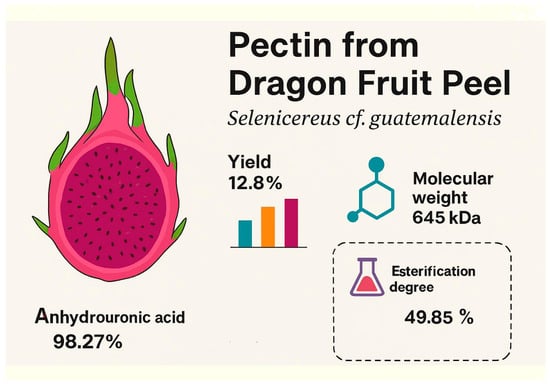
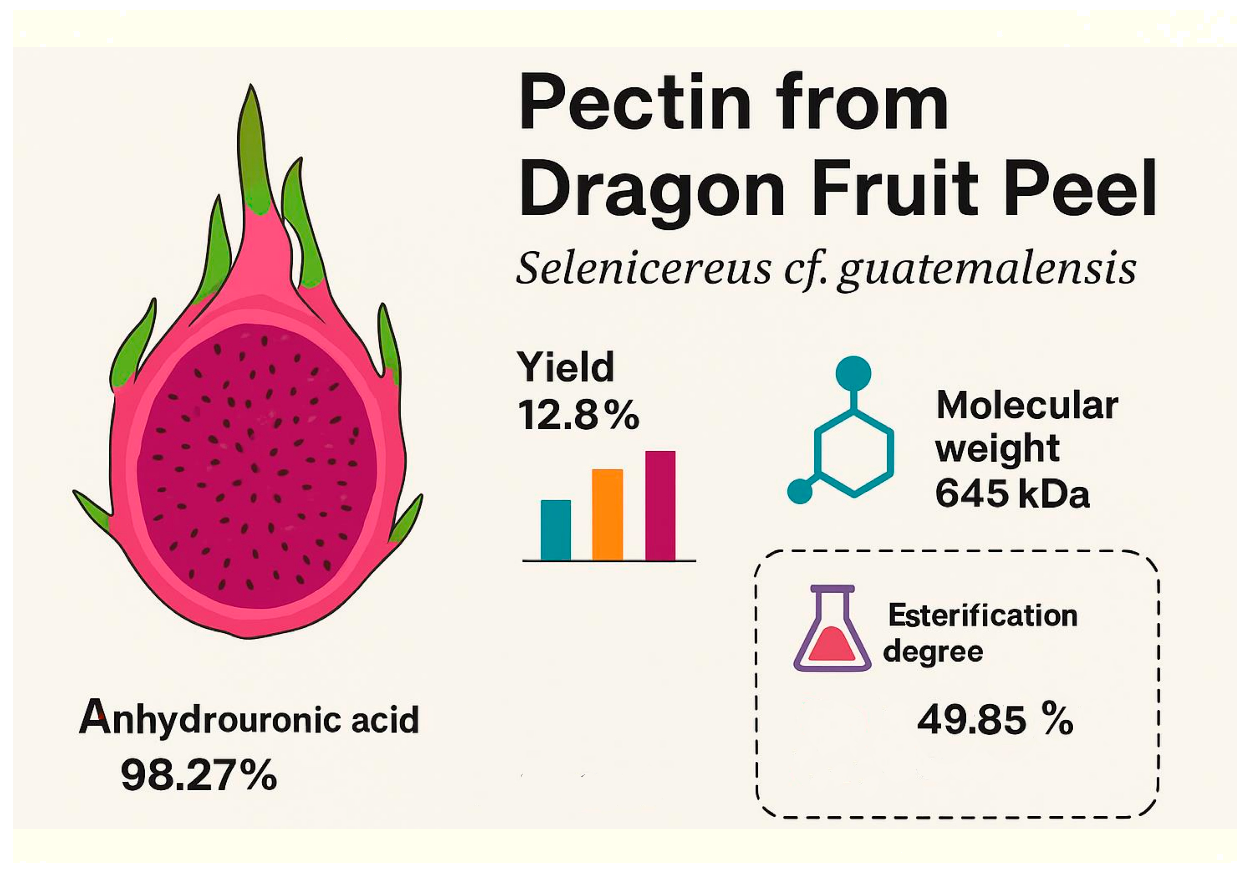
The dragon fruit (Selenicereus sp.) peel is a viable plant source for the extraction of polysaccharides such as pectin, the demand for which has increased significantly in the food and pharmaceutical industries. In Nayarit, Mexico, the Queen Purple variety of dragon fruit (Selenicereus cf. guatemalensis) is commonly cultivated. The peel is typically discarded, while only the pulp is utilized for direct consumption or processed into derivative products. The objective of this study was to characterize the properties of pectin extracted from the peel of dragon fruit (Selenicereus cf. guatemalensis ‘Queen Purple’). The yield, molecular weight, anhydrouronic acid content, betalain content, antioxidant capacity, and phenolic compounds were determined using gravimetric, volumetric, spectrophotometric, and colorimetric techniques, among others. Furthermore, the functional groups and degree of esterification of the pectin were identified using Fourier-transform infrared spectroscopy. The pectin presented a yield of 12.8%, esterification degree of 49.85%, molecular weight of 645 kDa, anhydrouronic acid, phenolic acid and betalain content of 98.27%, 195.7 mg EAG/100 gDW and 4.26 mg/100 gDW respectively and an antioxidant capacity of 149.6, 192.76 and 20.5 mg EAA/100 gDW by the DPPH, ABTS and FRAP methods respectively, classified as high-purity, low-methoxyl, intermediate-molecular-weight, with an important betalain content and antioxidant capacity. Based on these findings, the extracted pectin complies with the Food and Agriculture Organization specifications and shows promise as a functional ingredient in the food industry.

Graphical Abstract

1. Introduction

Pectin is a naturally occurring high-molecular-weight heteropolysaccharide composed of α-1,4-linked D-galacturonic acid chains, which is found in the middle lamella of plant cell walls [1]. Galacturonic acid is linked to neutral sugars such as D-galactose, L-arabinose, L-ramannose, D-apiosa, L-fucose, and D-xylose [2]. Pectins are classified by their methoxyl content or degree of esterification. The methoxyl content indicates the amount of methyl groups present in the pectin, which varies from 0.2% to 12% depending on the extraction source [3]. Pectins with less than 7% methoxyl are classified as low-methoxyl pectins (LMPs), and those with more than 7% as high-methoxyl pectins (HMPs) [4].
On the other hand, the degree of esterification (DE) indicates the amount of galacturonic acid units esterified with methyl, which is used to classify pectins as LMPs with DE ≤50% and HMPs with DE >50% [5].
Therefore, the degree of esterification, methoxyl content, galacturonic acid, and molecular weight are important characteristics that determine the properties and applications of pectins at the industrial level [6,7]. Given these properties, HMPs are used in the production of gelatins, sweets, and desserts due to their ability to form gels in solutions with a high concentration of soluble solids and an acidic medium (pH < 3.5). In contrast, LMPs are used in dietary and dairy products because they gel in the presence of divalent cations (calcium ions), and do not require sugar to gel [8].
Conventionally, pectin is extracted in aqueous medium, with or without the addition of strong mineral acids (hydrochloric acid, nitric acid, phosphoric acid and sulfuric acids) or organic acids (acetic, citric, malic, oxalic and tartaric acids) that lower the pH to 1.5–3.0. The process is typically carried out at temperatures ranging from 75 to 100 °C for 30 to 120 min [9]. Mineral acids have been linked to environmental damage, increased costs, as well as thermal degradation of pectin, which reduces its functional properties. As a result, attention has shifted toward “food-friendly” acids aligned with clean-label trends. Among these, citric acid is a chelating agent that has been shown to exhibit pectin yield equal to or greater than that obtained with mineral acids, with less degradation, resulting in a high molecular weight and degree of methoxylation [5].
Pectin has applications in food science, agriculture, and medicine because it is nontoxic to humans and has a low production cost [6]. In the food sector, it is used as a gelling, thickening, stabilizing, and emulsifying agent in the production of jams, jellies, ice cream, beverages, soft drinks, candies, and bakery fillings, among others [10,11,12].
Another application in food science is in the production of packaging materials and edible coatings due to its ability to form gels [13,14]. Currently, more than 80% of the pectin sold in local markets is extracted from citrus peels (lemon, lime, orange), while the remainder comes from apple pomace and sugar beet pulp. However, other research has focused on extracting pectin from plant-based by-products [15], which contributes to its valorization and offers a sustainable path, aligning with the principles of the circular economy, which promotes reuse and waste reduction for as long as possible [16]. One of the by-products used for pectin extraction is the peel of fruits such as passion fruit, kiwi, melon, watermelon, banana, pomegranate, pumpkin, papaya, among others [6]. The dragon fruit (Selenicereus sp.) is composed of approximately 30% peel and 70% pulp [17]. Several studies have reported that the dragon fruit contains polyphenols, flavonoids, and betacyanins, compounds that positively influence human health [18] with the highest amount of these compounds found in the fruit peel [19,20].
In Nayarit, Mexico, the ‘Queen Purple’ dragon fruit is cultivated; however, this cultivar has not been previously characterized. Figure 1 illustrates its key morphological traits, including a triangular stem with three concave ribs and a waxy green surface; one to two short spines per areole; a large, hermaphroditic, funnelform flower that blooms for only one night (self-pollinating but capable of cross-pollination); and a fruit with a reddish peel, intense purple pulp with small black seeds homogeneously distributed. These characteristics closely resemble the description of Selenicereus guatemalensis as reported by Andres-Orizano [21], Castañeda-Ceja [22], Castillo-Zapata [23] and Cerén-López [24], a species that remains one of the least studied within the genus. In this context, the investigation of new cultivars such as Selenicereus cf. guatemalensis ‘Queen Purple’ is particularly relevant, as the purple-fleshed of dragon fruits have demonstrated greater commercial value due to their high antioxidant capacity, elevated betacyanin content, and abundance of phenolic compound [25], with levels exceeding those found in red, yellow or green-skinned varieties. These bioactive properties, combined with their appealing appearance, flavor, and color, increase its export potential. However, up to date, no studies on the peel have been performed. Moreover, studying this cultivar provides an opportunity to explore additional bioactive compounds present in the pectin of the dragon fruit peel. Indeed, the peel is discarded during fresh consumption, contributing to waste generation and resource loss. Given that the peel might contain bioactive compounds with functional properties, its utilization represents a valuable opportunity for the development of high-value products. In this regard, the characterization of pectin extracted from dragon fruit peel enables the evaluation of its potential industrial applications, adding value to this by-product and supporting regional development.
Therefore, the aim of this study was to characterize the properties of pectin extracted from the peel of dragon fruit (Selenicereus cf. guatemalensis ‘Queen Purple’).

2. Materials and Methods

2.1. Plant Material

Dragon fruits (Selenicereus cf. guatemalensis ‘Queen Purple’) were harvested according to their color (70% red, 30% green) from Rancho las Pitahayas de Lupe Piña in Compostela, Nayarit (21°13′09.8″ N, 104°53′56.9″ W). The collected fruits were transported to the special analysis laboratory of the Food Technology Unit of the Autonomous University of Nayarit.

2.2. Pectin Extraction

The conventional method reported by Zegada [26] was used with some modifications. The peel of the dragon fruit was cut into pieces of approximately 2 × 2 cm, dried in a forced convection oven (Venticell, BMT Medical Technology, Czech Republic) for 24 h at 50 °C. Subsequently, the peel was pulverized using a high-speed CG-300 mill (Goldenwall, Wuxi, China), in three intervals of approximately 60 s each, until a homogeneous powder was obtained.
Finally, the powder was placed in a plastic bag with a hermetic seal and kept in a dry place at room temperature until use. For the extraction, 30 g of dragon powder, 1200 mL of water and citric acid food grade (necessary to adjust the pH between 2.0–2.5) were mixed at 50 °C for 2 h. Subsequently, the solution was filtered using a fine mesh fabric (organza type) placed over a stainless-steel strainer to retain solid residues. The filtrate was collected in a clean container and allowed to rest without agitation for 18 h under refrigeration (8–10 °C). After this time, the solution was separated by decantation. 96% ethanol food grade (COMEGSA, Guadalajara, Mexico) was added to the decanted liquid to precipitate the pectin in a 1:1 (v/v) ratio. The solution was left to stand for 12 h at 4 °C. After this time, the pectin was recovered by filtration through a fine mesh fabric and washed three times with 96% ethanol. It was then dried at 40 °C for 24 h in a forced convection Venticell oven (BMT Medical Technology, Zábrdovice, Czech Republic). Finally, it was pulverized and stored in a dry place at room temperature until use.

2.3. Chemical Structure Analysis by Fourier Transform Infrared Spectroscopy (FT-IR)

Pectin functional groups were identified using commercial citrus peel pectin (Sigma-Aldrich, St. Louis, MO, USA) as a reference using an Agilent Cary 630 FT-IR spectrometer (Agilent Technologies, Santa Clara, CA, USA). The degree of esterification of the extracted pectin was also determined from the bands of esterified and unesterified carboxyl groups. Approximately 5 mg of pectin was placed on the diamond crystal sampling area and secured using a press. Readings were performed using MicroLab software version 5.6 in the central infrared region (4000 to 400 cm−1), with a cycle of 32 scans at a resolution of 2 cm−1 in absorption mode at room temperature. The spectrum and the detected functional groups were analyzed using MicroLab software version 5.6, and the graph was created using R version 4.5.0.
Degree of esterification (DE). It was determined according to Equation (1) reported by Liew et al. [27]:
DE   ( % )   =   A 1745 A 1745 + A 1630 × 100
where A1745 and A1630 represent the absorbance intensities of the bands corresponding to the methyl-esterified and non-methyl-esterified carboxyl groups at 1745 cm−1 and 1630 cm−1, respectively.

2.4. Characterization of Pectin from Dragon Fruit Peel

The yield, moisture content, ash content, equivalent weight (EW), degree of esterification (DE), anhydrogalacturonic acid (AUA) content, molecular weight (Mw), betalain content, antioxidant capacity, and total phenols were calculated in dragon fruit peel pectin using a commercial citrus peel pectin (Sigma Aldrich) as a reference.

2.4.1. Pectin Yield

Pectin yield was calculated using Equation (2) [28]:
Pectin   yield   ( % )   =   W e i g h t   o f   d r i e d   p e c t i n   ( g ) W e i g h t   o f   d r i e d   d r a g o n   f r u i t s   p e e l   p o w d e r   ( g ) × 100

2.4.2. Moisture Content

It was determined following the method of the Association of Official Analytical Chemists (AOAC) [29]. The moisture content (%) was calculated with the following Equation (3):
Moisture   ( % )   =   I n i t i a l   w e i g h t   o f   p e c t i n   g d r i e d   w e i g h t   o f   p e c t i n   ( g ) I n i t i a l   w e i g h t   o f   p e c t i n   ( g ) × 100

2.4.3. Ash Content

It was determined by the AOAC standard [29]. The ash content was calculated according to Equation (4):
Ash   ( % )   =   W e i g h t   o f   t r a c e s   e x i t e d   a f t e r   b u r n i n g   ( g ) W e i g h t   o f   p e c t i n   g × 100

2.4.4. Equivalent Weight (EW)

It was analyzed following the method of Ranganna et al. [30] with some modifications. In total, 0.1 g of pectin, 1 mL of ethanol, 1 g of NaCl ACS grade (J.T Baker, Ciudad de Mexico, Mexico) and 20 mL of distilled water were mixed by stirring and 4 drops of phenol red were added as an indicator. The solution was titrated with 0.1 N NaOH solution of analytical grade (Hycel, Ciudad de Mexico, Mexico) until the color of the indicator changed to pink (pH 7.5). The neutralized solution was used to determine methoxyl. The following Equation (5) was used to calculate the EW:
EW   ( g / eq )   =   1000 × W e i g h t   o f   s a m p l e   g V o l u m e   o f   N a O H   m L × n o r m a l i t y   o f   N a O H

2.4.5. Methoxyl Content (MeO)

MeO was carried out following the method of Ranganna et al. [30] with some modifications. 5 mL of 0.25 N NaOH was added to the titrated solution from the EW experiment. The solution was then stirred and allowed to stand for 30 min at room temperature. 5 mL of 0.25 N HCl (J.T. Baker, Ciudad de Mexico, Mexico) was then added, and finally the solution was titrated with 0.1 N NaOH. The following Equation (6) was used to calculate the methoxyl content:
MeO   ( % )   =   V o l u m e   o f   N a O H   m L × n o r m a l i t y   o f   N a O H × 31 1000 × w e i g h t   o f   s a m p l e   g × 100
where 31 is the molecular weight of the methoxyl group.

2.4.6. Total Anhydrouronic Acid (AUA) Content

The AUA value of pectin was calculated using equivalent weight and methoxyl content determinations. Mohamed & Hasan [31] reported the following Formula (7) to calculate the anhydrouronic acid content:
AUA   ( % )   =   176 × 0.1   z   100 W × 1000 +   176 × 0.1   y × 100 W × 1000
where the molecular weight of AAU = 176, z is the mL of NaOH used in the determination of EW, and y is the mL of NaOH used in the determination of MeO; W is the weight of pectin in g.

2.4.7. Molecular Weight (Mw)

Mw was determined based on the inherent viscosity, which was calculated by measuring the apparent viscosity of pectin solutions in 0.1 M NaCl at concentrations of 0.1, 0.2, 0.3, 0.4 and 0.5% using a rotational NDJ-1 viscometer (TBTSCIETECH, Nanjing, China). Measurements were performed with rotor no. 1 (diameter: 25 mm, length: 50 mm), at 60 rpm and 25 °C [32]. Three viscosity measurements were made for each pectin concentration used. The equation of the straight line was determined, and the intercept (inherent viscosity) was substituted into the Mark–Houwink–Sakurada Equation (8), from which M was solved for its calculation.
η = K × M α
where η is the inherent viscosity, M is the molecular weight, K is a constant with a value of 4.36 × 10⁻⁵ L/g and α is a constant with a value of 0.78 in a 0.1 M NaCl solution with pH 7 [33].

2.5. Betalain Content

Extraction was performed following the method described by Sutor et al. [34]. Briefly, 0.025 g of pectin was mixed with 1 mL of 80% aqueous methanol acidified with 5% (v/v) acetic acid (J.T Baker, Ciudad de Mexico, Mexico) and the mixture was stirred for 2 h at 200 rpm. The mixture was then centrifuged at 4000 rpm for 10 min, and the resulting supernatant was transferred to a clean tube, which was designated as the extract. This extract was used to quantify betalains, antioxidant capacity, and total phenols. The absorbance was measured at 536 nm for betacyanins and 483 nm for betaxanthins using a UV spectrophotometer Multiskan GO (Thermo Scientific, Waltham, MA, USA). Betalain concentration was estimated by adding the individual concentration of betacyanin and betaxanthin, calculated using Equation (9) [35]:
B   =   A × F D × P M × V ε × w × 100
B is the betalain (betyanin or betaxanthin) concentration in mg/100 g, A is the absorption value, FD is the dilution factor, PM is the molecular weight (betanin: 550 g/mol, Indicaxanthin: 308 g/mol), V is the extract volume, ε is the molar extinction coefficient (betanin: 60,000 L/mol·cm, Indicaxanthin = 48,000 L/mol·cm), and W is the weight of pectin used in the test.

2.6. Antioxidant Capacity of Pectins

2,2′-diphenyl-1-picrylhydrazyl (DPPH). This was determined using the methodology reported by Brand-Williams et al. [36]. A DPPH solution (7.4 mg/100 mL; analytical grade, Sigma-Aldrich, St. Louis, MO, USA) was prepared in 80% absolute ethanol (Hycel, Ciudad de Mexico, Mexico) and stirred for 60 min. The solution was then adjusted to an absorbance of 0.70 (±0.02) at 520 nm using 80% absolute ethanol. 250 µL of the DPPH radical was mixed with 30 µL of the extract. The mixture was incubated in the dark for 30 min, and the absorbance was read using a spectrophotometer Multiskan GO at a wavelength of 520 nm. The antioxidant capacity of the sample was determined using a standard curve with ascorbic acid from 0 to 100 mg L−1 (Sigma-Aldrich, St. Louis, MO, USA). Results were expressed as mg ascorbic acid equivalents per 100 g of dry weight (mg EAA/100 gDW).
2,2′azinobis-(3-ethylbenzothiazoline)-6-sulfonic acid (ABTS•+). The radical cation was quantified according to the methodology described by Re et al. [37]. ABTS•+ was generated by mixing a 7 mM ABTS solution (Sigma-Aldrich, St. Louis, MO, USA) with a 2.45 mM potassium persulfate (K2S2O8) solution (J.T. Baker, Ciudad de Mexico, Mexico) in a 1:1 (v/v) ratio. The resulting mixture (ABTS•+ radical cation) was incubated for 16 h at 23 ± 1 °C with constant stirring in the dark and diluted with 20% ethanol until an absorbance of 0.70 (±0.02) at 734 nm was reached. In total, 10 μL of the extract was mixed with 490 μL of the ABTS•+ radical and allowed to react for 7 min. Subsequently, the absorbance was quantified at a wavelength of 734 nm. The antioxidant capacity of the sample was determined using a standard curve with ascorbic acid from 0 to 200 mg L−1 (analytical grade, Sigma-Aldrich, St. Louis, MO, USA). The results were expressed in mg ascorbic acid equivalents per 100 g of dry weight (mg EAA/100 gDW).
Ferric ion-reducing power (FRAP). The method described by Benzie and Strain [38] was used. The FRAP reagent was prepared by mixing 25 mL of sodium acetate buffer (0.3 M, pH 3.6; ACS grade, J.T. Baker, Ciudad de Mexico, Mexico), 2.5 mL of a TPTZ solution (10 mM in 40 mM HCl; analytical grade, Sigma-Aldrich, St. Louis, MO, USA), and 2.5 mL of FeCl3 solution (20 mM; ACS grade, J.T. Baker, Ciudad de Mexico, Mexico). For the assay, 250 µL of the FRAP reagent was mixed with 30 µL of the extract, incubated for 30 min in the dark, and the absorbance was subsequently read using a spectrophotometer Multiskan GO at 595 nm. The antioxidant capacity was determined using a standard curve with ascorbic acid from 0 to 100 mg L−1 (Sigma-Aldrich, St. Louis, MO, USA). The results were expressed as mg ascorbic acid equivalents per 100 g of dry weight (mg EAA/100 gDW). Likewise, for each of the three methods, the percentage of radical elimination of the samples was calculated, using the following Equation (10):
Radical   scavenging   ( % )   =   I n i t i a l   a b s o r b a n c e f i n a l   a b s o r b a n c e I n i t i a l   a b s o r b a n c e × 100

2.7. Total Phenol Content (TPC)

TPC was determined according to the method of Stintzing et al. [39]. In total, 50 µL of the extract and 250 µL of the Folin–Ciocalteu analytical grade (Merck, Darmstadt, Germany) reagent (1:10 v/v) were mixed and left to incubate for 5 min. Next, 200 µL of 7.5% (w/v) sodium carbonate ACS grade (J.T. Baker, Ciudad de Mexico, Mexico) were added and incubated in darkness at room temperature for 30 min. Finally, the absorbance was measured at a wavelength of 760 nm. The total phenol content was determined using a calibration curve with gallic acid from 0–100 mg L−1 (Sigma-Aldrich, St. Louis, MO, USA). The results obtained were expressed in mg equivalents of gallic acid per 100 g of dry weight (mg EAG/100 gDW).

2.8. Experimental Design and Statistical Analysis

Three replicates were performed for each assay. Measurements were taken at least five times. A t-test (p < 0.05) was performed to compare the mean of the variables associated with antioxidant activity (antioxidant capacity by DPPH, ABTS, and FRAP methods, betalain content, total phenolic content) between dragon fruit pectin and commercial citrus pectin (Sigma-Aldrich). A Pearson correlation analysis was also performed to determine the association between the response variables. Statistical analyses and graphs were performed using R version 4.5.0 using the agricolae, ggplot2, and corrplot packages.

3. Results

3.1. Chemical Structure Analysis by FT-IR

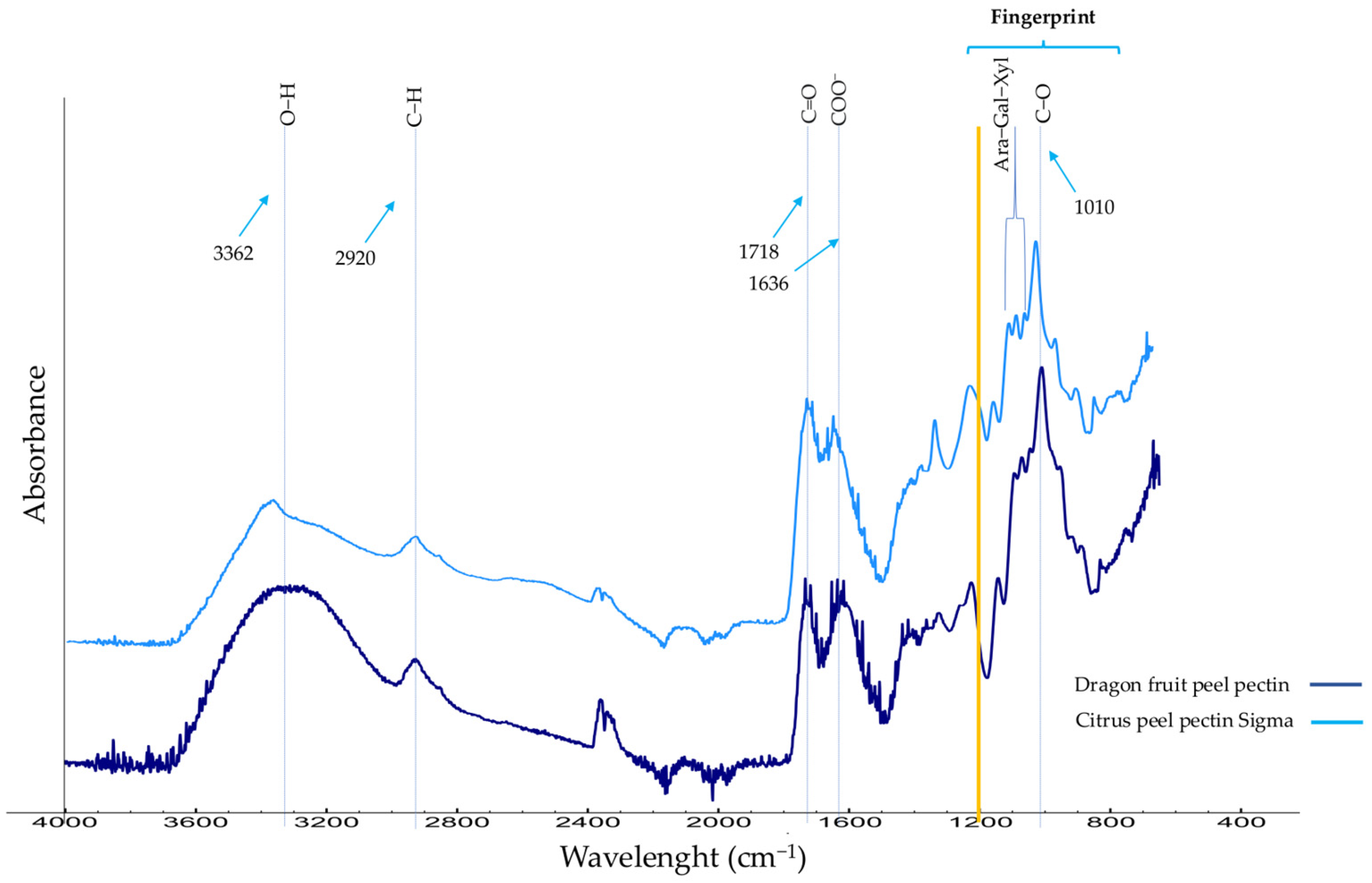
The structure of pectin is related to the origin, part of the plant and extraction conditions. Dried samples of pectin extracted from dragon fruit peel were analyzed by FT-IR (Sigma citrus peel pectin as reference), showing absorption bands between the range of 3600–3000, 3000–2800, 1760–1740, 1660–1630, 1410, 1300, 1050, and 800 cm−1 (Figure 2).
Absorption bands in the range of 900–1900 cm−1 are related to the presence of polygalacturonic acid. Furthermore, the spectral region between 1800–1500 cm−1 corresponds to the C=O double bond, associated with carboxylic acids and carboxylic esters, characteristic functional groups of pectin. The absorption bands around 3600–3000 cm−1 are attributed to the stretching vibrations of the hydroxyl (OH) groups, associated with intramolecular and intermolecular hydrogen bonds located in the main chain of the galacturonic acid polymer [40]. The absorption bands in the range of 3000–2800 cm−1 are mainly associated with the C–H stretching vibration in the methoxyl group (O–CH3) [41]. The peak at 1760–1740 cm−1 corresponds to the C=O stretching vibration of the methyl esterified carboxyl group, while the peak at 1660–1630 cm−1 is a band caused by the stretching vibration of the ionic carboxyl groups in pectin (COO) [42]. The intensity ratio between these latter peaks is used to determine the DE. A strong band of ionic carboxyl groups (COO) coupled with a weak band of methyl esterified carboxyl group (C=O) in pectin is attributed to a pectin with low methoxyl content and vice versa [43]. In this regard, dragon fruit pectin exhibits apparently similar absorptions in both bands, making it impossible to visually determine whether it is low- or high-methoxyl when observing the FTIR spectrum. Furthermore, the carboxylate groups display a weaker symmetrical stretching band near 1410 cm−1, which is observed in both the commercial pectin and dragon fruit spectra. The absorption peaks between 1300 and 1000 cm−1 are caused by the C-O stretching vibration [44]. The C-O stretching at 1050 cm−1 corresponded to β-glycosidic bonds [45]. The absorption peaks around 1200–1000 cm−1 are probably due to the superimposed stretching vibrations of the C-O-C and C-O-H bonds, suggesting the presence of sugars in the pyranose form [46]. Sugars such as arabinose, galactose and xylose are associated with bands at 1076 cm−1 and 1045 cm−1 [47]. The weak band at 1240 cm−1 is assigned to side chain vibrations [48]. The typical pectin fingerprint region is represented by absorption bands within the wavelength range of 1300–800 cm−1 [41]. The last bands of medium intensity below 920 cm−1 are mainly attributed to vibrations of the C-O-C bridges, also typical of polysaccharides [49].

3.2. Degree of Esterification (DE)

According to Equation (1) relating the bands at 1745 and 1630, for DE, dragon fruit peel pectin had a DE of 49.85%, classifying it as low-methoxyl. Research has reported DE values (evaluated by FTIR) lower than 29% in pectins extracted from dragon fruit Hylocereus polyrhizus fruit peels [50] and around 46% [14,51] from the peel of the dragon fruit Hylocereus undatus using the conventional method.
According to Shinde et al. [52], the degree of esterification is associated with the type of fruit, extraction conditions, among other factors. In this regard, Karim et al. [53] reported a DE that ranges from 18.3% to 58.06% in pectin extracted from lemon peel and from 15.5% to 50.2% in pectin extracted from mango peel under different conditions of temperature, time and pH. Likewise, Hosseinno et al. [54] reported DE that oscillates in a range of 17% and 30.5% in pectin extracted from orange peel varying conditions of time, temperature and liquid–solid ratio. In this regard, Karim [53] and Zaid [55] mentioned that the DE decreases with increasing temperature and time. Zaid [55] also reported a reduction in DE from 57% to 52% as the temperature increased from 60 to 80 °C, and a decrease from 60% to 40% when the extraction time was extended from 60 to 240 min. This decline is attributed to the hydrolysis of some methyl esters present in the pectin under prolonged heat exposure.
Similarly, the pH of the solution is another important factor influencing DE, studies have reported that DE increases as the pH rises. Karim et al. [53] reported an increase in DE from 15% to 58% when the pH increases from 1 to 3. In this sense, it is possible that the temperature of 50 °C used for extracting pectin from dragon fruit peel was not sufficient to promote extensive hydrolysis of the ester groups, resulting in a DE below 40%. This is consistent with the findings of Zaidel [50], who used a higher extraction temperature of 80 °C, obtaining a DE < 29%. According to Muhammad et al. [56], gelling properties are primarily determined by this parameter. Gelling is essential for regulating the texture and sensory perception of foods containing added pectin. Accordingly, dragon fruit peel pectin exhibits low-methoxyl content, enabling gel formation across a wide pH spectrum, independent of sugar presence, and requiring calcium ions for cross-linking [57].
In turn, this could be used in the production of products with little or no sugar content, such as products for dietary purposes or for diabetics.

3.3. Pectin Characterization

The yield, moisture content, ash, methoxyl, galacturonic acid and equivalent weight were quantified (Table 1).

3.3.1. Pectin Yield

The pectin yield from dragon fruit peel was 12.8%, this value is higher than that reported for other fruit peels such as pineapple (2.12%), apple (5.25%), pomegranate (10.95%) and banana (11.33%) [58,59,60,61]. It also exceeds the yields reported for dragon fruit peel by Nguyen and Pirak [4] as well as those reported by Chua et al. [17] who found pectin yields equal to or below 10%. This parameter has been related to the source, method and conditions of extraction, as well as the stage of fruit maturity [9]. Long extraction times, high temperatures and low pH have been reported to favor a higher pectin yield. Zaid et al. [55] reported an increase in yield from 17% to 24% as the extraction time was extended from 30 to 120 min, and a more pronounced increase from 6% to 52% as the temperature increased from 30 to 70 °C. Conversely, an increase in pH from 1 to 5 resulted in a decrease in yield from 26% to 21%. In this regard, Karim et al., [53] mentions that a pH of 2 is optimal to obtain a good performance. Likewise, Zaid et al. [55] reported an increase in performance when the solid liquid ratio (LSR) increases from 5 (v/w) to 15 (v/w), presenting a yield of 24% and 28%, respectively.
In this study, an extraction temperature of 50 °C was selected to prevent the degradation of antioxidant compounds, such as phenols and betacyanins. Although temperatures of 70 °C or higher may increase pectin yield, they also raise processing costs and reduce profitability. Regarding the ripeness of the fruits, samples were selected at the stage considered optimal for consumption, in order to approximate the characteristics of peel residues commonly found in the food industry, as their utilization represents the primary focus of this research.

3.3.2. Moisture Content

Dragon fruit peel pectin presented a moisture content of 9.90%, which is lower than that of commercial pectin (10.9%) (Table 1), as well as lower than the values reported by Muhammad et al. [62] (14.03%) in pectin extracted from dragon fruit (Hylocereus polyrhizus) peels. This value is likely influenced by the drying temperature and duration, as well as to the storage conditions of the pectin. However, according to the Food Chemical Codex (FCC) [63] the water content in the extracted pectin does not exceed the maximum allowable limit (12%), minimizing or preventing the growth of microorganisms that produce pectinase enzymes and thereby preserving the quality of the pectin.

3.3.3. Ash Content

The ash content of dragon fruit peel pectin was 8.26%, while in the commercial pectin it was 6.62%. These values are lower than those obtained by Muhammad et al. [62], who reported an ash content of 8.73% in pectin extracted from dragon fruit peel using a conventional extraction method. The ash content obtained in this study meets the specifications established by the FCC [63] for commercial pectins (less than 10%) and indicates that dragon fruit peel pectin has a low amount of minerals, which will allow the interaction of galacturonic acid chains and therefore the structuring of gels. Furthermore, this amount of ash guarantees the stability and conservation of the products in which pectin is used.

3.3.4. Equivalent Weight (EW)

The PE of the extracted pectin was 274.01 mg, a value lower than that reported by Nguyen and Pirak [4], who reported an EW ranging from 305.75 to 446.41 mg in pectin extracted from dragon fruit peels using citric acid under various conditions. According to Shinde et al. [52], the values of this parameter are related to the ripeness of the fruit, being lower in edible ripe fruits.
Reports mention that a weight in the range of 250 to 350 mg will form a gel in the presence of calcium or magnesium ions, regardless of whether sugar is present. This is beneficial in both sugary and dietary product production processes.

3.3.5. Methoxyl Content (MeO)

The methoxyl content of dragon fruit peel pectin was 5.99% compared to 7.18% in commercial citrus pectin. This value is similar to that obtained by Nguyen et al. (6.15%) in dragon fruit (Hylocereus undatus) peel pectin using the conventional method. However, it is higher than the values reported by Ismail et al. [64], who reported values ranging from 2.98% to 4.34% in pectin extracted from dragon fruit (Hylocereus polyrhizus) peel using the same method. According to Kute et al., [65] pectin can exhibit methoxyl contents ranging from 0.22% to 12.0%. Based on the classification proposed to Islam et al. [66] pectins with methoxyl content below 7% are considered low-methoxyl, while those with values between 8% and 12% are categorized as high-methoxyl. In this regard, the pectin extracted from dragon fruit peel, with a methoxyl content of 5.99%, is classified as low-methoxyl, which is consistent and agrees with the GE classification. As noted by Wongkaew et al. [67], the methoxyl content is a key factor influencing pectin’s setting time, its ability to bind with metal ions, its solubility in water, and its gelling capacity. Kumari et al., [68] reported that high-methoxyl pectins are generally more readily soluble in water than their low-methoxyl counterparts.

3.3.6. Total Anhydrouronic Acid (AUA) Content

The AUA content of dragon fruit peel pectin was 98.27% and that of the commercial standard was 57.20%. Other research reports AUA contents of 46.09% [41] and 47.10% [14] in pectin from dragon fruit peels Hylocereus undatus and Hylocereus polyrhizus, respectively. The AUA content can be affected by the extraction conditions, which include pH, time, extraction temperature, type of acid used and pectin/solvent ratio. According to Pérez et al. [69] the AUA content increases with decreasing pH. On the other hand, Hosseinni et al. [54] stated that the AUA content in pectin extracted from apple was higher with increasing extraction time; in this regard, Chan and Choo [70] found similar results when extracting pectin from cocoa shell where increasing the extraction time from 1.5 to 3 h caused a considerable increase in WUA, which is related to the increase in hydrolysis of pectin side chains due to the long extraction process. Likewise, Hosseinni et al. [54] observed that the percentage of AUA increased when a 30/1 (v/w) LSR was used compared to 20/1 (v/w), presenting values of around 80% and 70% of AUA respectively; however, the authors mention that the AUA content decreases from LSRs greater than 30/1 (v/w). Likewise, a low-methoxyl pectin has a lower amount of methyl groups in its structure, causing a higher content of free galacturonic acid in the molecule. In this regard, Mugampoza [71] reported AUA contents between 24.51 and 67.38% in banana fruits at different stages of ripeness, generally increasing with the ripening stage. In this sense, the peel used in the present investigation was obtained from fruits at consumption maturity, so pectins tend to be less methylated, being a possible reason why they present a higher content of galacturonic acid. The percentage of anhydrouronic acid (98.27%) in the extracted pectin is higher than that specified by FAO regulations, which state that pectin must have at least 65% AUA to be considered pure. Dragon fruit peel pectin may not contain starch, sugars, proteins, or peel residues that could have affected the AUA content. Therefore, the results suggest that dragon fruit pectin can form stable gels and emulsions.

3.3.7. Molecular Weight (Mw) of Pectins

The molecular weight of dragon fruit peel pectin was found to be 645 kDa, a value that is in the range of 90–1180 kDa for dragon fruit peel pectin reported in other research [56,72]. According to Wang et al. [46], molecular weight and other physicochemical properties are related to the source and extraction conditions. In this context, Li et al. [73] mentioned that higher molecular weight in pectins may imply lower molecular defragmentation due to the use of lower temperatures, while elevated temperatures can catalyze hydrolysis, leading to fragmentation of the pectin molecule and a subsequent decrease in molecular weight.
According to the reported molecular weight range for dragon fruit pectin in the literature, the molecular weight of pectin in this research can be classified as intermediate, presenting multiple advantages such as balance between its ability to form bonds and the flexibility necessary for a stable gel structure, good solubility in water and adequate viscosity so that the solutions are not too thick or fluid. Li et al. [73] mentioned that decreasing the weight increases the number of hydroxyl groups, which significantly contributes to the improvement of the hydroxyl radical (•OH) scavenging activity.

3.4. Betalain Content of Pectins

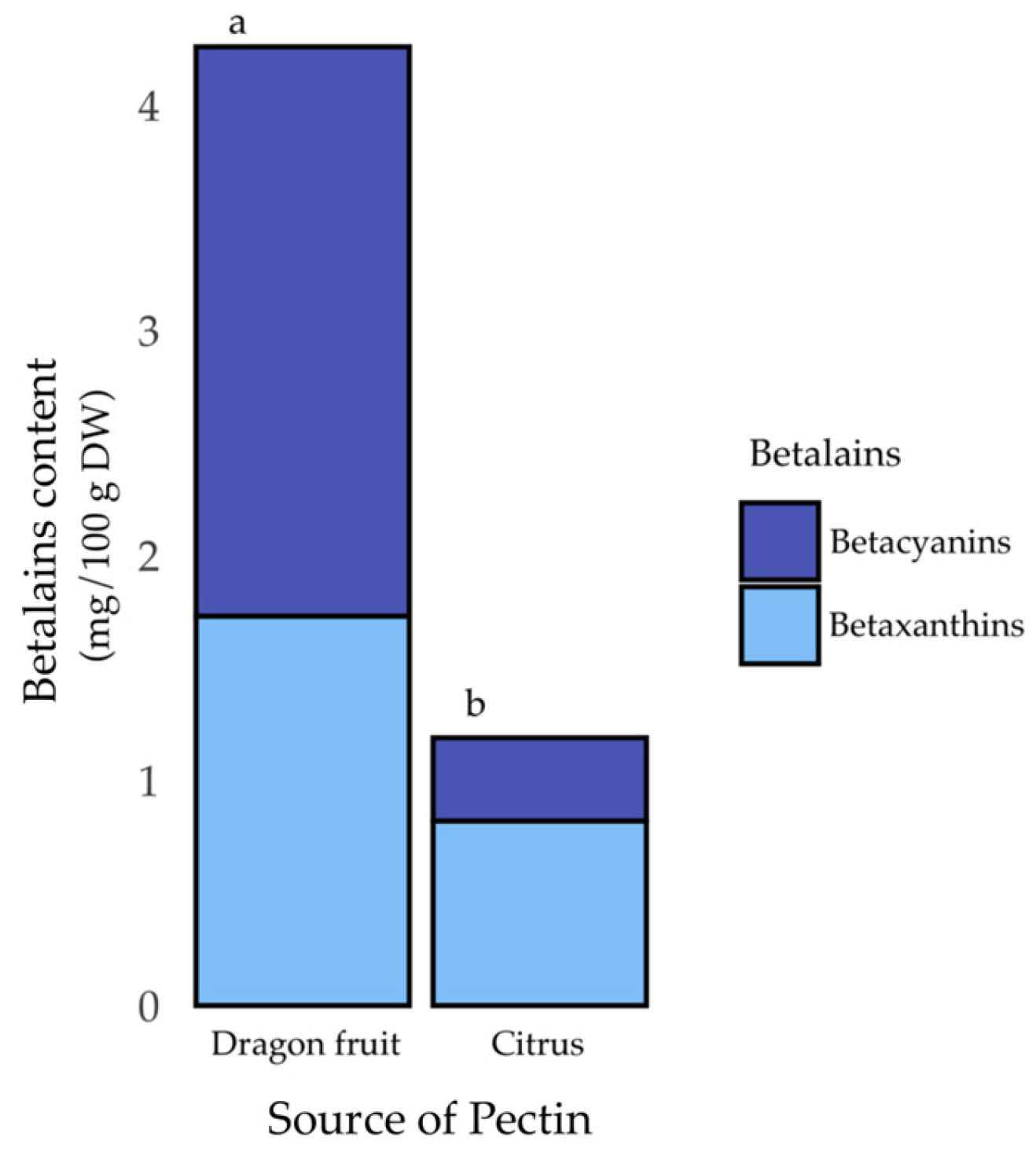
Betalains are the sum of betacyanins and betaxanthins, which were quantified in dragon fruit pectin (Figure 3). The betacyanin content of dragon fruit peel pectin was 2.53 mg betanin equivalents/100 gDW and that of betaxanthins was 1.73 mg indicaxanthin equivalents/100 gDW. These values are higher than those found in citrus pectin (p < 0.05) which presented 0.37 mg betanin equivalents/100 gDW and 0.82 mg indicaxanthin equivalents/100 gDW (p < 0.05). Xie et al. [74] reported in dragon fruit (Hylocereus megalanthus) fruit peel 3.5 and 2.0 mg/100 g of betacyanins and betaxanthins, respectively. Based on the above, it is possible to suggest that the pectin extraction method used in this research (temperature = 50 °C, pH = 2, time = 2 h) does not degrade these pigments.
There is little information on the betalain content of pectin. However, several authors report them as antioxidant agents [75,76]. In this context, betalains could enhance the functional value of foods by contributing antioxidant properties, potentially having beneficial effects by neutralizing free radicals that cause oxidative damage.

3.5. Antioxidant Capacity of Pectins

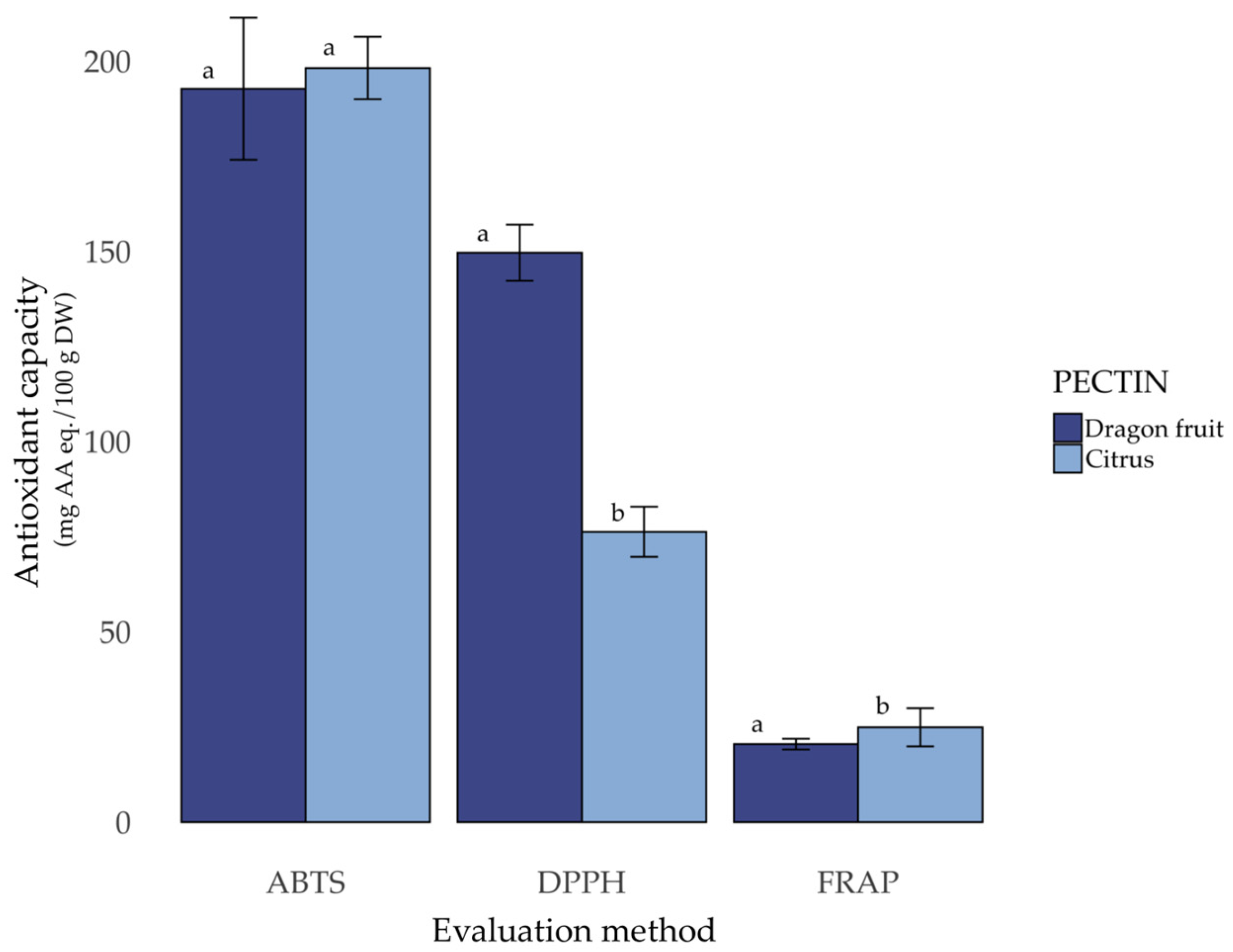
Dragon fruit pectin showed antioxidant capacities of 149.6, 192.76, and 20.5 mg EAA/100 gDW by the DPPH, ABTS, and FRAP methods, respectively (Figure 4). Dragon fruit pectin showed higher antioxidant capacities by the FRAP method compared to the control (p < 0.05), and similar antioxidant capacities by the ABTS and FRAP methods (p > 0.05), as shown in Figure 4. According to Jian et al. [14], the antioxidant properties of pectins are related to the free hydroxyl groups in the polysaccharide structure and residual phenolic compounds, as well as to the monosaccharides and betacyanins present. The antioxidant capacity is of utmost importance since it helps prevent oxidation of food products, which can lead to nutrient decomposition, loss of color, as well as changes in the flavor and texture of the products.
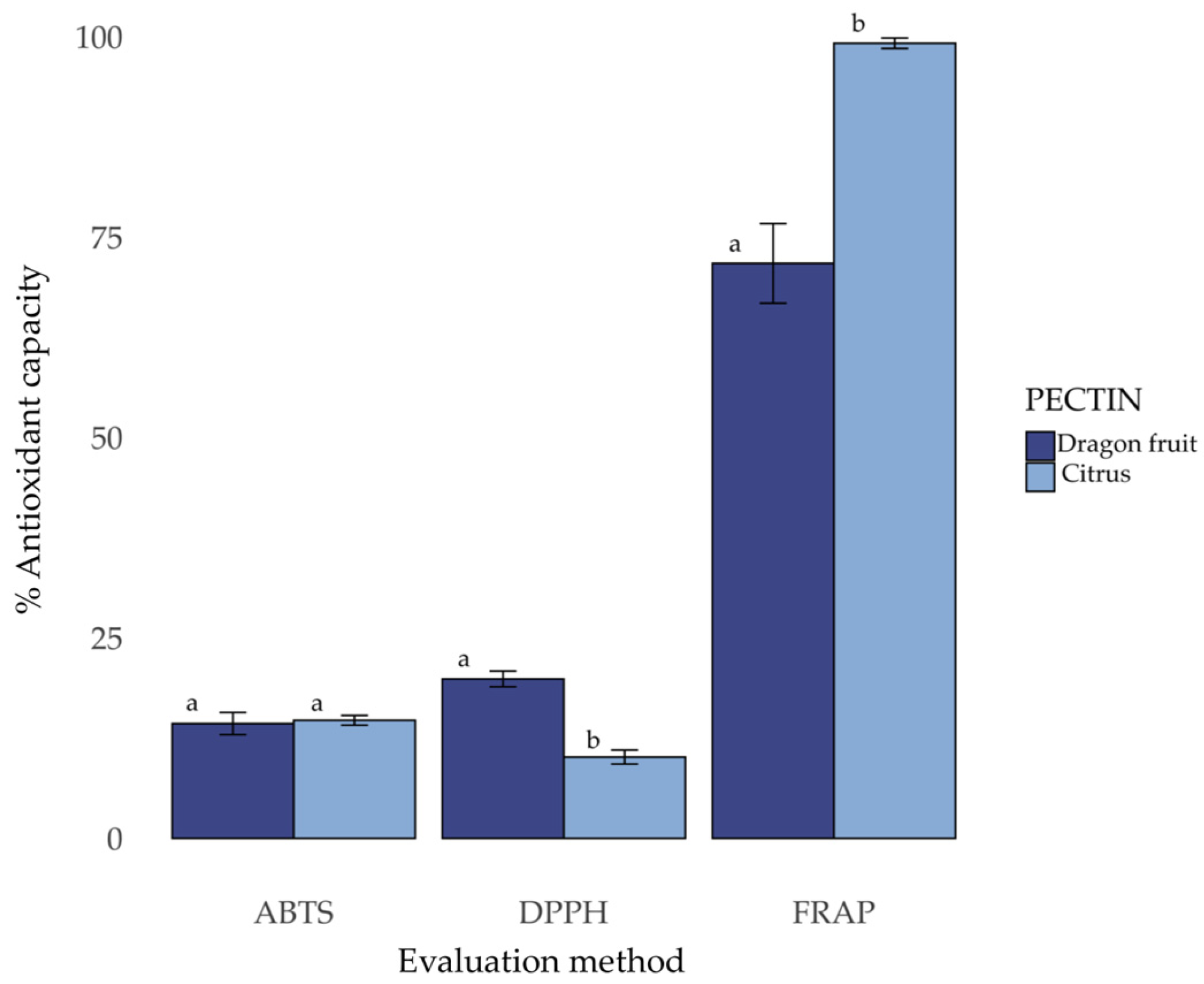
On the other hand, in terms of radical scavenging percentage, dragon fruit peel pectin showed 19.9, 14.3, 71.7% by the DPPH, ABTS and FRAP methods, respectively (Figure 5). Dragon fruit pectin exhibited a higher percentage of radical scavenging by the DPPH and FRAP methods compared to the control (p < 0.05) as shown in Figure 5.
The higher percentage of dragon fruit pectin using the DPPH method (p < 0.05) may be due to the presence of lipophilic compounds. Likewise, the higher percentage of citrus pectin using the FRAP method is possibly due to the presence of more effective iron-reducing antioxidant compounds, such as vitamin C, flavonoids, and phenolic acids. In this regard, Du et al. [51] reported ABTS radical scavenging percentages of around 20% for 0.5% pectin solutions extracted under conditions similar to those of this investigation. Likewise, Jiang et al. [14] reported values lower than 10% of radical scavenging by the DPPH and ABTS methods in pectin solutions extracted from dragon fruit (Hylocereus undatus) peel at a concentration of 1 mg/mL.

3.6. Total Phenol Content (TPC)

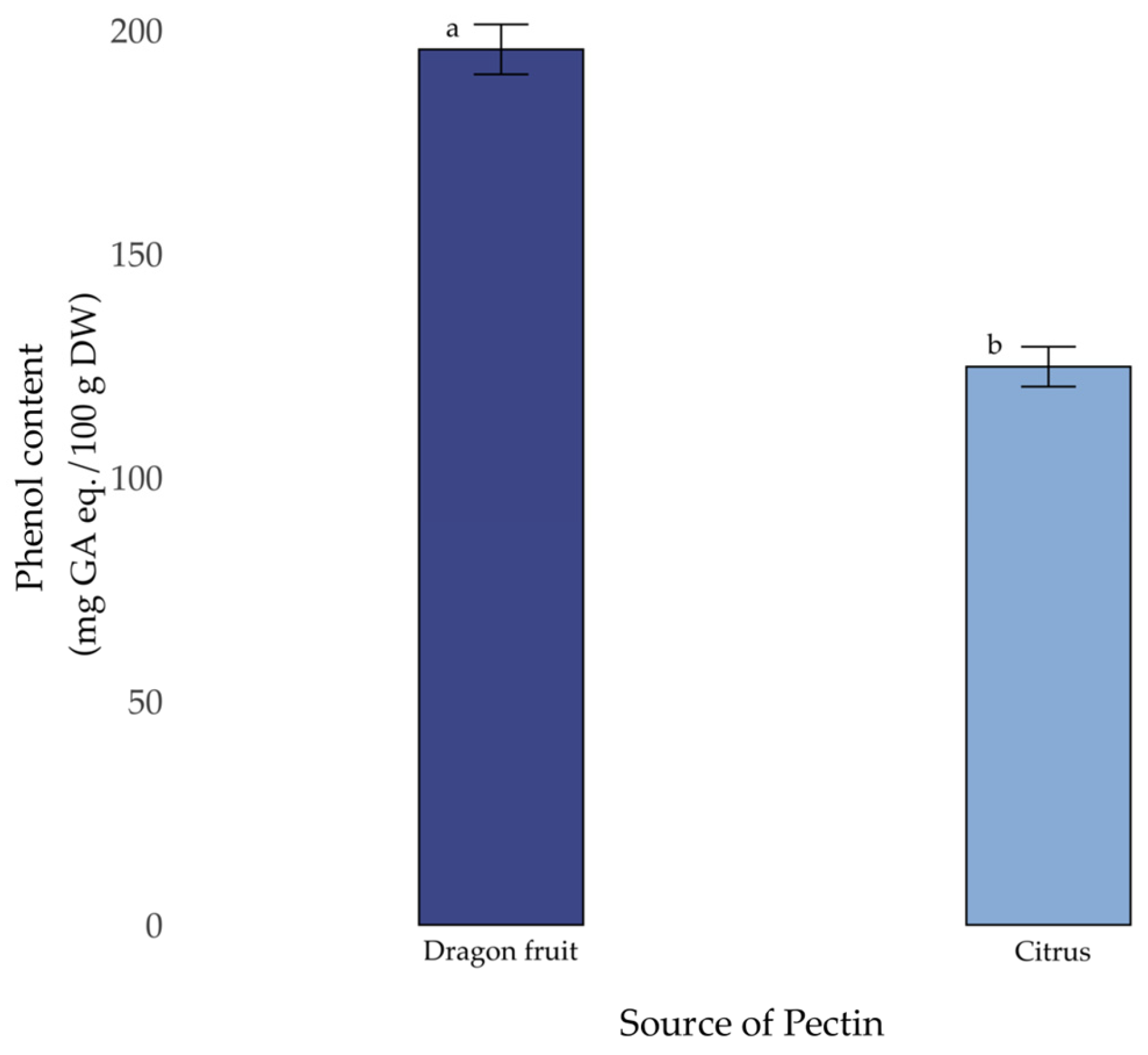
The phenol content of the pectin extracted from dragon fruit peel was 195.7 mg EAG/100 gDW and that of citrus pectin was 124.8 mg EAG/100 gDW (Figure 6). The phenol content of the pectin extracted from dragon fruit peel was 195.7 mg EAG/100 gDW and that of citrus pectin was 124.8 mg EAG/100 gDW. There are few reports on the phenolic content of dragon fruit pectin. Hernández-Ramos [77] reported a total phenol content in the dragon fruit (Hylocereus ocamponis) epicarp between 130 and 160 mg EAG/100 gDW, values that are similar to those of that research. This suggests that phenolic compounds are stable to thermal processes such as those used in this research for pectin extraction.
In addition to their antioxidant capacity, phenolic compounds can enhance the functional properties of pectins such as gelling, thickening, and emulsion stabilization while also exhibiting antimicrobial activity, metal-chelating abilities, and contributing to color preservation in the products to which they are added.

3.7. Correlation Analysis

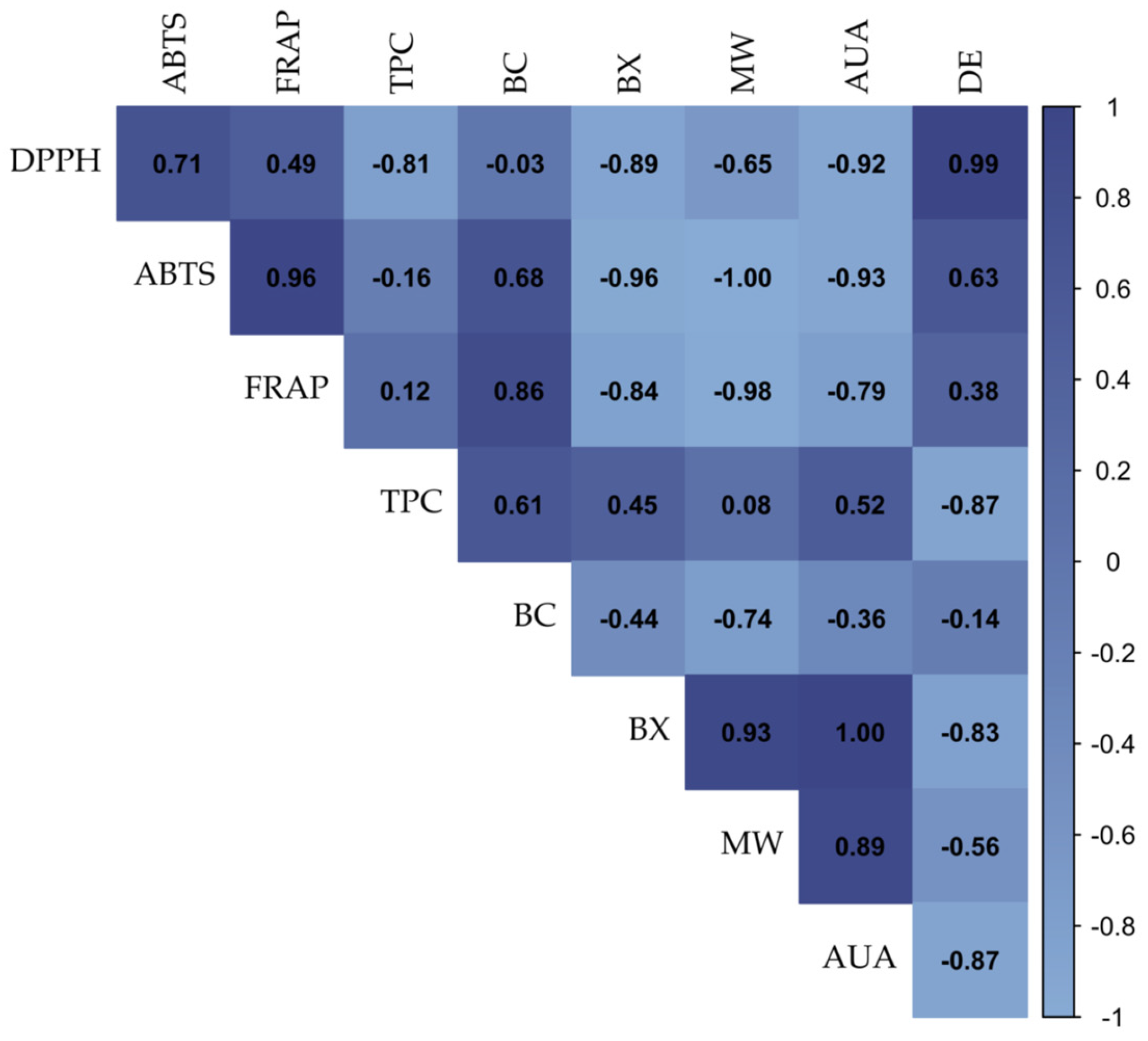
According to the correlation analysis, a positive correlation was observed between the three antioxidant capacity methods (Figure 7), with varying degrees of correlation likely due to the mechanism by which antioxidants reduce radicals, as well as their affinity for them. Likewise, betacyanin content exhibited a strong positive correlation with the FRAP (r = 0.86), ABTS (r = 0.68), and total phenolic content (r = 0.61). In contrast, total phenolic content showed a strong negative correlation with both the DPPH and ABTS assays (Figure 7). One possible explanation for this result is that betacyanins (which are not associated with the DPPH method) exhibit greater antioxidant capacity and effectiveness than certain phenolic compounds that may be present in the sample. Furthermore, a high inverse correlation (-) was observed between molecular weight and antioxidant capacity by ABTS (r = −1), FRAP (r = −0.98), BC (r = −0.74), and DPPH (r = −0.65). It is possible that during the extraction process, pectin hydrolysis caused an increase in free hydroxyl groups, contributing to the antioxidant capacity of the pectin extracted from the dragon fruit peel. On the other hand, the MW presents a strong inverse correlation (-) with the DE (r = −1) probably because esterification causes the breaking of bonds, giving shorter pectin chains, resulting in a lower molecular weight. The AUA content showed a negative correlation with betacyanins and a positive correlation with betaxanthins (Figure 7), possibly because betaxanthins are more stable than betacyanins under the extraction conditions used and therefore remain undegraded. Additionally, the DE of pectin may have promoted a structure capable of interacting with antioxidant compounds, as suggested by the observed positive correlation. Conversely, DE exhibited a negative correlation with AUA, likely because, as previously mentioned, a lower degree of esterification results in a higher content of free galacturonic acid within the molecule.

4. Conclusions

Pectin extracted from the peel of dragon fruit (Selenicereus cf. guatemalensis, ‘Queen Purple’) was classified as high-purity (AUA = 98.27%), low-methoxyl (DE = 49.85%), and intermediate-molecular-weight (645 kDa). Additionally, it contains betalains, has antioxidant capacity, and is rich in phenolic compounds. Finally, based on its physicochemical characteristics, the pectin meets FAO standards and shows a strong potential for application in the food industry.

Author Contributions

Conceptualization, R.B.-M.; writing—original draft, V.C.-R.; data curation, G.B.-V. and V.A.O.-J.; investigation: J.C.T.-A. and R.B.-M.; methodology: V.A.O.-J., J.E.B.-L. and V.C.-R.; project administration, G.B.-V.; resources, J.C.T.-A. and G.B.-V.; supervision, R.B.-M., V.A.O.-J. and G.B.-V.; formal analysis, J.C.T.-A., V.C.-R. and J.E.B.-L.; writing—review and editing, V.C.-R., J.E.B.-L. and G.B.-V. All authors have read and agreed to the published version of the manuscript.

Funding

This research was funded by the project entitled “Caracterización de pectina de cáscara de pitahaya (Hylocereus sp.) Queen Purple”, this project was carried out with resources from the Special tax allocated to the UAN 2025, and by the project of Ciencia Básica y/o Ciencia de Frontera Modalidad Paradigmas y Controversias de la Ciencia (319996): “Análisis integral de datos transcriptómicos y metabolómicos asociados a la calidad de los frutos de guanábana (Annona muricata L.) durante almacenamiento poscosecha”.

Data Availability Statement

The data presented in this study are available within the article.

Acknowledgments

The first author thanks the Doctoral Program in Agricultural Biological Sciences at the Universidad Autónoma de Nayarit and the Secretaría de Ciencia, Humanidades, Tecnología e Innovación (SECIHTI) for the scholarship granted for the Ph.D. studies (350640).

Conflicts of Interest

The authors declare no conflicts of interest.

Abbreviations

The following abbreviations are used in this manuscript:
ABTS2,2′azinobis-(3-ethylbenzothiazoline)-6-sulfonic acid
AOACAssociation of Official Analytical Chemists
AUAAnhydrogalacturonic acid content
BCBetacyanin Content
BXBetaxanthin Content
DEDegree of esterification
DPPH2,2′-diphenyl-1-picrylhydrazyl
EAA/100 gDWMg ascorbic acid equivalents per 100 g of dry weight
EAG/100 gDWMg equivalents of gallic acid per 100 g of dry weight
EWEquivalent weight
FCCFood Chemical Codex
FRAPFerric ion reducing power
HMPsHigh-methoxyl pectins
LMPsLow-methoxyl pectins
MeOMethoxyl content
MwMolecular weight
TPCTotal Phenol Content

References

  1. Liu, L.; Sui, Y.; Wang, T.; Li, X.; Chen, L.; Shi, M. Physicochemical and Antioxidant Properties of Pectin from Actinidia Arguta Sieb.et Zucc (A. arguta) Extracted by Ultrasonic. Front. Nutr. 2024, 11, 1349162. [Google Scholar] [CrossRef] [PubMed]
  2. Gawkowska, D.; Cybulska, J.; Zdunek, A. Structure-Related Gelling of Pectins and Linking with Other Natural Compounds: A Review. Polymers 2018, 10, 762. [Google Scholar] [CrossRef] [PubMed]
  3. Aina, V.O.; Barau, M.M.; Mamman, O.A.; Zakari, A.; Haruna, H.; Umar, M.S.H.; Abba, Y.B. Extraction and Characterization of Pectin from Peels of Lemon (Citrus limon), Grape Fruit (Citrus paradisi) and Sweet Orange (Citrus sinensis). Br. J. Pharmacol. Toxicol. 2012, 3, 259–262. [Google Scholar]
  4. Nguyen, B.M.N.; Pirak, T. Physicochemical Properties and Antioxidant Activities of White Dragon Fruit Peel Pectin Extracted with Conventional and Ultrasound-Assisted Extraction. Cogent Food Agric. 2019, 5, 1633076. [Google Scholar] [CrossRef]
  5. Yang, X.; Nisar, T.; Liang, D.; Hou, Y.; Sun, L.; Guo, Y. Low Methoxyl Pectin Gelation under Alkaline Conditions and Its Rheological Properties: Using NaOH as a pH Regulator. Food Hydrocoll. 2018, 79, 560–571. [Google Scholar] [CrossRef]
  6. Freitas, C.M.P.; Coimbra, J.S.R.; Souza, V.G.L.; Sousa, R.C.S. Structure and Applications of Pectin in Food, Biomedical, and Pharmaceutical Industry: A Review. Coatings 2021, 11, 922. [Google Scholar] [CrossRef]
  7. Chandel, V.; Biswas, D.; Roy, S.; Vaidya, D.; Verma, A.; Gupta, A. Current Advancements in Pectin: Extraction, Properties and Multifunctional Applications. Foods 2022, 11, 2683. [Google Scholar] [CrossRef]
  8. Picot-Allain, M.C.N.; Ramasawmy, B.; Emmambux, M.N. Extraction, Characterisation, and Application of Pectin from Tropical and Sub-Tropical Fruits: A Review. Food Rev. Int. 2022, 38, 282–312. [Google Scholar] [CrossRef]
  9. Wandee, Y.; Uttapap, D.; Mischnick, P.Y. Ash Content and Structural Composition of Pomelo Peel Pectins Extracted under Acidic and Alkaline Conditions. Food Hydrocoll. 2019, 87, 237–244. [Google Scholar] [CrossRef]
  10. Ma, X.; Chen, W.; Yan, T.; Wang, D.; Hou, F.; Miao, S.; Liu, D. Comparison of Citrus Pectin and Apple Pectin in Conjugation with Soy Protein Isolate (SPI) under Controlled Dry-Heating Conditions. Food Chem. 2020, 309, 125501. [Google Scholar] [CrossRef]
  11. Li, W.; Fan, Z.; Wu, Y.; Jiang, Z.; Shi, R. Eco-friendly Extraction and Physicochemical Properties of Pectin from Jackfruit Peel Waste with Subcritical Water. J. Sci. Food Agric. 2019, 99, 5283–5292. [Google Scholar] [CrossRef]
  12. Shafie, M.H.; Yusof, R.; Gan, C.-Y. Deep Eutectic Solvents (DES) Mediated Extraction of Pectin from Averrhoa Bilimbi: Optimization and Characterization Studies. Carbohydr. Polym. 2019, 216, 303–311. [Google Scholar] [CrossRef]
  13. Sakooei-Vayghan, R.; Peighambardoust, S.H.; Hesari, J.; Peressini, D. Effects of Osmotic Dehydration (with and without Sonication) and Pectin-Based Coating Pretreatments on Functional Properties and Color of Hot-Air Dried Apricot Cubes. Food Chem. 2020, 311, 125978. [Google Scholar] [CrossRef]
  14. Jiang, H.; Zhang, W.; Khan, M.R.; Ahmad, N.; Rhim, J.-W.; Jiang, W.; Roy, S. Film Properties of Pectin Obtained from Various Fruits’ (Lemon, Pomelo, Pitaya) Peels. J. Compos. Sci. 2023, 7, 366. [Google Scholar] [CrossRef]
  15. Coman, V.; Teleky, B.-E.; Mitrea, L.; Martău, G.A.; Szabo, K.; Călinoiu, L.-F.; Vodnar, D.C. Bioactive Potential of Fruit and Vegetable Wastes. In Advances in Food and Nutrition Research; Elsevier: Amsterdam, The Netherlands, 2020; Volume 91, pp. 157–225. ISBN 978-0-12-820470-2. [Google Scholar]
  16. Velenturf, A.P.M.; Purnell, P. Principles for a Sustainable Circular Economy. Sustain. Prod. Consum. 2021, 27, 1437–1457. [Google Scholar] [CrossRef]
  17. Chua, B.L.; Tang, S.F.; Ali, A.; Chow, Y.H. Optimisation of Pectin Production from Dragon Fruit Peels Waste: Drying, Extraction and Characterisation Studies. SN Appl. Sci. 2020, 2, 621. [Google Scholar] [CrossRef]
  18. Jalgaonkar, K.; Mahawar, M.K.; Bibwe, B.; Kannaujia, P. Postharvest Profile, Processing and Waste Utilization of Dragon Fruit (Hylocereus spp.): A Review. Food Rev. Int. 2022, 38, 733–759. [Google Scholar] [CrossRef]
  19. Bayram, B.; Ozkan, G.; Kostka, T.; Capanoglu, E.; Esatbeyoglu, T. Valorization and Application of Fruit and Vegetable Wastes and By-Products for Food Packaging Materials. Molecules 2021, 26, 4031. [Google Scholar] [CrossRef]
  20. Hernandez Ramos, L.; García-Mateos, R.; Castillo González, A.M.; Ybarra Moncada, M.C.; Nieto Angel, R. Fruits of the Pitahaya Hylocereus undatus and H. Ocamponis: Nutritional Components and Antioxidants. J. Appl. Bot. Food Qual. 2020, 2, 197–203. [Google Scholar] [CrossRef]
  21. Andrés Orizano, J.A. Especie de Origen Tropical y Sub Tropical: La Pitahaya (Hylocereus guatemalensis) y Sus Sistemas de Conducción. Bachelor’s Thesis, Universidad Nacional Agraria la Molina, Lima, Perú, 2025. [Google Scholar]
  22. Castañeda Ceja, R. Las Tres “P” de La Pitahaya, Polinización, Poda, Producción. Available online: https://es.slideshare.net/slideshow/curso-de-pitahaya-2020/239812720 (accessed on 28 July 2025).
  23. Castillo-Zapata, K.C.; Reyes-Diaz, J.D.; Cornelio-Santiago, H.P.; Espinoza-Espinoza, L.A.; Valdiviezo-Marcelo, J.; Ruiz-Flores, L.A. Efecto del secado con aire caliente en el contenido de fenólicos totales y capacidad antioxidante de la cáscara de pitahaya roja (Hylocereus guatemalensis). Rev. Investig. Univ. Cordon Bleu 2024, 11, 97–106. [Google Scholar] [CrossRef]
  24. Cerén López, J.G. Distribución, Etnobotánica Y Cultivo de Pitahaya (Selenicereus, Hylocereeae, Cactaceae) en el Salvador. Master’s Thesis, Colegio de Posgraduados, Montecillo, México, 2019. [Google Scholar]
  25. Carpio Rivas, V.; Balois Morales, R.; Ochoa Jiménez, V.A.; Bello Lara, J.E.; Berúmen Varela, G. Parámetros fisicoquímicos y capacidad antioxidante de frutos de pitahaya Queen Purple en almacenamiento poscosecha: Almacenamiento poscosecha en frutos de pitahaya. Rev. Bio Cienc. 2024, 11, e1654. [Google Scholar] [CrossRef]
  26. Zegada Franco, V.Y. Extracción de pectina de residuos de cáscara de naranja por hidrólisis ácida asistida por microondas (HMO). Investig. Desarro. 2015, 15, 65–76. [Google Scholar] [CrossRef][Green Version]
  27. Liew, S.Q.; Ngoh, G.C.; Yusoff, R.; Teoh, W.H. Sequential Ultrasound-Microwave Assisted Acid Extraction (UMAE) of Pectin from Pomelo Peels. Int. J. Biol. Macromol. 2016, 93, 426–435. [Google Scholar] [CrossRef] [PubMed]
  28. Dranca, F.; Vargas, M.; Oroian, M. Physicochemical Properties of Pectin from Malus Domestica ‘Fălticeni’ Apple Pomace as Affected by Non-Conventional Extraction Techniques. Food Hydrocoll. 2020, 100, 105383. [Google Scholar] [CrossRef]
  29. AOAC International. Official Methods of Analysis of AOAC International, 18th ed.; Horwitz, W., AOAC International, Eds.; AOAC International: Gaithersburg, MD, USA, 2006; ISBN 978-0-935584-77-6. [Google Scholar]
  30. Ranganna, S. Handbook of Analysis and Quality Control for Fruit and Vegetable Products; Tata McGraw Hill Publishing Company Limited: New Delhi, India, 1986; pp. 11–12. [Google Scholar]
  31. Mohamed, S.; Hasan, Z. Extraction and Characterisation of Pectin from Various Tropical Agrowastes. Asean Food J. 1995, 10, 43–50. [Google Scholar]
  32. Zioga, M.; Tsouko, E.; Maina, S.; Koutinas, A.; Mandala, I.; Evageliou, V. Physicochemical and Rheological Characteristics of Pectin Extracted from Renewable Orange Peel Employing Conventional and Green Technologies. Food Hydrocoll. 2022, 132, 107887. [Google Scholar] [CrossRef]
  33. Garnier, C.; Axelos, M.A.V.; Thibault, J.-F. Phase Diagrams of Pectin-Calcium Systems: Influence of pH, Ionic Strength, and Temperature on the Gelation of Pectins with Different Degrees of Methylation. Carbohydr. Res. 1993, 240, 219–232. [Google Scholar] [CrossRef]
  34. Sutor, K.; Wybraniec, S. Identification and Determination of Betacyanins in Fruit Extracts of Melocactus Species. J. Agric. Food Chem. 2020, 68, 11459–11467. [Google Scholar] [CrossRef]
  35. Sandate-Flores, L.; Rodríguez-Hernández, D.V.; Rostro-Alanis, M.; Melchor-Martínez, E.M.; Brambila-Paz, C.; Sosa-Hernández, J.E.; Parra-Saldívar, R.; Rodríguez-Rodríguez, J.; Iqbal, H.M.N. Evaluation of Three Methods for Betanin Quantification in Fruits from Cacti. MethodsX 2022, 9, 101746. [Google Scholar] [CrossRef]
  36. Brand-Williams, W.; Cuvelier, M.E.; Berset, C. Use of a Free Radical Method to Evaluate Antioxidant Activity. LWT-Food Sci. Technol. 1995, 28, 25–30. [Google Scholar] [CrossRef]
  37. Re, R.; Pellegrini, N.; Proteggente, A.; Pannala, A.; Yang, M.; Rice-Evans, C. Antioxidant Activity Applying an Improved ABTS Radical Cation Decolorization Assay. Free Radic. Biol. Med. 1999, 26, 1231–1237. [Google Scholar] [CrossRef]
  38. Benzie, I.F.F.; Strain, J.J. The Ferric Reducing Ability of Plasma (FRAP) as a Measure of “Antioxidant Power”: The FRAP Assay. Anal. Biochem. 1996, 239, 70–76. [Google Scholar] [CrossRef]
  39. Stintzing, F.C.; Herbach, K.M.; Mosshammer, M.R.; Carle, R.; Yi, W.; Sellappan, S.; Akoh, C.C.; Bunch, R.; Felker, P. Color, Betalain Pattern, and Antioxidant Properties of Cactus Pear (Opuntia spp.) Clones. J. Agric. Food Chem. 2005, 53, 442–451. [Google Scholar] [CrossRef]
  40. Olawuyi, I.F.; Kim, S.R.; Lee, W.Y. Application of Plant Mucilage Polysaccharides and Their Techno-Functional Properties’ Modification for Fresh Produce Preservation. Carbohydr. Polym. 2021, 272, 118371. [Google Scholar] [CrossRef]
  41. Zhang, X.; Chen, X.; Dai, J.; Cui, H.; Lin, L. Edible Films of Pectin Extracted from Dragon Fruit Peel: Effects of Boiling Water Treatment on Pectin and Film Properties. Food Hydrocoll. 2024, 147, 109324. [Google Scholar] [CrossRef]
  42. Dambuza, A.; Rungqu, P.; Oyedeji, A.O.; Miya, G.M.; Kuria, S.K.; Hosu, S.Y.; Oyedeji, O.O. Extraction, Characterization, and Antioxidant Activity of Pectin from Lemon Peels. Molecules 2024, 29, 3878. [Google Scholar] [CrossRef] [PubMed]
  43. Chatjigakis, A.K.; Pappas, C.; Proxenia, N.; Kalantzi, O.; Rodis, P.; Polissiou, M. FT-IR Spectroscopic Determination of the Degree of Esterification of Cell Wall Pectins from Stored Peaches and Correlation to Textural Changes. Carbohydr. Polym. 1998, 37, 395–408. [Google Scholar] [CrossRef]
  44. Wu, Z.; Qin, D.; Li, H.; Guo, D.; Cheng, H.; Sun, J.; Huang, M.; Ye, X.; Sun, B. Physicochemical and Functional Properties of Lycium Ruthenicum Pectin by Different Extraction Methods. Front. Nutr. 2022, 9, 946606. [Google Scholar] [CrossRef]
  45. Liu, X.; Renard, C.M.G.C.; Bureau, S.; Le Bourvellec, C. Revisiting the Contribution of ATR-FTIR Spectroscopy to Characterize Plant Cell Wall Polysaccharides. Carbohydr. Polym. 2021, 262, 117935. [Google Scholar] [CrossRef]
  46. Wang, Y.; Fang, Q.; Shu, C.; Zhang, T.; Cao, J. Non-Methylesterified Pectin from Pitaya (Hylocereus undatus) Fruit Peel: Optimization of Extraction and Nanostructural Characterization. Food Innov. Adv. 2024, 3, 181–190. [Google Scholar] [CrossRef]
  47. Baum, A.; Dominiak, M.; Vidal-Melgosa, S.; Willats, W.G.T.; Søndergaard, K.M.; Hansen, P.W.; Meyer, A.S.; Mikkelsen, J.D. Prediction of Pectin Yield and Quality by FTIR and Carbohydrate Microarray Analysis. Food Bioprocess Technol. 2017, 10, 143–154. [Google Scholar] [CrossRef]
  48. Kozioł, A.; Środa-Pomianek, K.; Górniak, A.; Wikiera, A.; Cyprych, K.; Malik, M. Structural Determination of Pectins by Spectroscopy Methods. Coatings 2022, 12, 546. [Google Scholar] [CrossRef]
  49. Shivamathi, C.S.; Gunaseelan, S.; Soosai, M.R.; Vignesh, N.S.; Varalakshmi, P.; Kumar, R.S.; Karthikumar, S.; Kumar, R.V.; Baskar, R.; Rigby, S.P.; et al. Process Optimization and Characterization of Pectin Derived from Underexploited Pineapple Peel Biowaste as a Value-Added Product. Food Hydrocoll. 2022, 123, 107141. [Google Scholar] [CrossRef]
  50. Zaidel, D.N.A.; Rashid, J.M.; Hamidon, N.H.; Salleh, L.M.; Kassim, A.S.M. Extraction and Characterization of Pectin from Dragon Fruit (Hylocereus polyrhizus) Peels. Chem. Eng. Trans. 2017, 56, 805–810. [Google Scholar] [CrossRef]
  51. Du, H.; Olawuyi, I.F.; Said, N.S.; Lee, W.-Y. Comparative Analysis of Physicochemical and Functional Properties of Pectin from Extracted Dragon Fruit Waste by Different Techniques. Polymers 2024, 16, 1097. [Google Scholar] [CrossRef] [PubMed]
  52. Shinde, G.B.; Swami, S.B.; Zambre, S.; Venkatesh, K.; Pardeshi, I.; Patange, S. Effect of Maturity Levels and Blanching Temperature on Extraction of Pectin from Jackfruit Rags and Study Its Properties. Int. J. Adv. Biochem. Res. 2024, 8, 867–879. [Google Scholar] [CrossRef]
  53. Karim, R.; Nahar, K.; Zohora, F.T.; Islam, M.; Bhuiyan, R.H.; Jahan, M.S.; Shaikh, A.A. Pectin from Lemon and Mango Peel: Extraction, Characterisation and Application in Biodegradable Film. Carbohydr. Polym. Technol. Appl. 2022, 4, 100258. [Google Scholar] [CrossRef]
  54. Hosseini, S.S. Aqueous Extraction of Pectin from Sour Orange Peel and Its Preliminary Physicochemical Properties. Int. J. Biol. Macromol. 2016, 82, 920–926. [Google Scholar] [CrossRef]
  55. Zaid, R.M.; Mishra, P.; Tabassum, S.; Wahid, Z.A.; Sakinah, A.M.M. High Methoxyl Pectin Extracts from Hylocereus polyrhizus’s Peels: Extraction Kinetics and Thermodynamic Studies. Int. J. Biol. Macromol. 2019, 141, 1147–1157. [Google Scholar] [CrossRef]
  56. Muhammad, K.; Zahari, N.I.M.; Gannasin, S.P.; Zahari, N.I.M.; Bakar, J. High Methoxyl Pectin from Dragon Fruit (Hylocereus polyrhizus) Peel. Food Hydrocoll. 2014, 42, 289–297. [Google Scholar] [CrossRef]
  57. Panwar, D.; Panesar, P.S.; Chopra, H.K. Green Extraction of Pectin from Citrus Limetta Peels Using Organic Acid and Its Characterization. Biomass Convers. Biorefinery 2024, 14, 159–171. [Google Scholar] [CrossRef]
  58. Rodsamran, P.; Sothornvit, R. Microwave Heating Extraction of Pectin from Lime Peel: Characterization and Properties Compared with the Conventional Heating Method. Food Chem. 2019, 278, 364–372. [Google Scholar] [CrossRef] [PubMed]
  59. Kumar, S.; Ozukum, R.; Mathad, G.M. Extraction, Characterization and Utilization of Pectin from Apple Peels. J. Pharmacogn. Phytochem. 2020, 9, 2599–2604. [Google Scholar] [CrossRef]
  60. Pereira, P.H.F.; Oliveira, T.Í.S.; Rosa, M.F.; Cavalcante, F.L.; Moates, G.K.; Wellner, N.; Waldron, K.W.; Azeredo, H.M.C. Pectin Extraction from Pomegranate Peels with Citric Acid. Int. J. Biol. Macromol. 2016, 88, 373–379. [Google Scholar] [CrossRef] [PubMed]
  61. Girma, E.; Worku, M.T. Extraction and Characterization of Pectin from Selected Fruit Peel Waste. Int. J. Sci. Res. Publ. 2016, 6, 447–454. [Google Scholar]
  62. Muhammad, N.W.F.; Nurrulhidayah, A.F.; Hamzah, M.S.; Rashidi, O.; Rohman, A. Physicochemical Properties of Dragon Fruit Peel Pectin and Citrus Peel Pectin: A Comparison. Food Res. 2020, 4, 266–273. [Google Scholar] [CrossRef]
  63. Food Chemical Codex, 5th ed.; National Academies Press: Washington, DC, USA, 2003.
  64. Ismail, N.S.M.; Ramli, N.; Hani, N.M.; Meon, Z. Extraction and Characterization of Pectin from Dragon Fruit (Hylocereus polyrhizus) Using Various Extraction Conditions. Sains Malays. 2012, 41, 41–45. [Google Scholar]
  65. Kute, A.B.; Mohapatra, D.; Kotwaliwale, N.; Giri, S.K.; Sawant, B.P. Characterization of Pectin Extracted from Orange Peel Powder Using Microwave-Assisted and Acid Extraction Methods. Agric. Res. 2020, 9, 241–248. [Google Scholar] [CrossRef]
  66. Islam, M.R.; Biswas, M.M.H.; Esham, M.K.H.; Roy, P.; Khan, R.; Hasan, S.M.K. Jackfruit (Artocarpus heterophyllus) by-Products a Novel Source of Pectin: Studies on Physicochemical Characterization and Its Application in Soup Formulation as a Thickener. Food Chem. Adv. 2023, 2, 100273. [Google Scholar] [CrossRef]
  67. Wongkaew, M.; Sommano, S.R.; Tangpao, T.; Rachtanapun, P.; Jantanasakulwong, K. Mango Peel Pectin by Microwave-Assisted Extraction and Its Use as Fat Replacement in Dried Chinese Sausage. Foods 2020, 9, 450. [Google Scholar] [CrossRef]
  68. Kumari, M.; Singh, S.; Chauhan, A.K. A Comparative Study of the Extraction of Pectin from Kinnow (Citrus reticulata) Peel Using Different Techniques. Food Bioprocess Technol. 2023, 16, 2272–2286. [Google Scholar] [CrossRef]
  69. Pérez, J.; Gómez, K.; Vega, L. Optimization and Preliminary Physicochemical Characterization of Pectin Extraction from Watermelon Rind (Citrullus lanatus) with Citric Acid. Int. J. Food Sci. 2022, 2022, 3068829. [Google Scholar] [CrossRef] [PubMed]
  70. Chan, S.Y.; Choo, W.S.; Young, D.J.; Loh, X.J. Pectin as a Rheology Modifier: Origin, Structure, Commercial Production and Rheology. Carbohydr. Polym. 2017, 161, 118–139. [Google Scholar] [CrossRef] [PubMed]
  71. Mugampoza, D.; Gafuma, S.; Kyosaba, P.; Namakajjo, R. Characterization of Pectin from Pulp and Peel of Ugandan Cooking Bananas at Different Stages of Ripening. J. Food Res. 2020, 9, 67. [Google Scholar] [CrossRef]
  72. Chen, H.; Liu, Y.; Zhang, J.; Jiang, Y.; Li, D. Pectin Extracted from Dragon Fruit Peel: An Exploration as a Natural Emulsifier. Int. J. Biol. Macromol. 2022, 221, 976–985. [Google Scholar] [CrossRef]
  73. Li, M.; Ma, F.; Li, R.; Ren, G.; Yan, D.; Zhang, H.; Zhu, X.; Wu, R.; Wu, J. Degradation of Tremella Fuciformis Polysaccharide by a Combined Ultrasound and Hydrogen Peroxide Treatment: Process Parameters, Structural Characteristics, and Antioxidant Activities. Int. J. Biol. Macromol. 2020, 160, 979–990. [Google Scholar] [CrossRef]
  74. Xie, F.; Hua, Q.; Chen, C.; Zhang, L.; Zhang, Z.; Chen, J.; Zhang, R.; Zhao, J.; Hu, G.; Zhao, J.; et al. Transcriptomics-Based Identification and Characterization of Glucosyltransferases Involved in Betalain Biosynthesis in Hylocereus Megalanthus. Plant Physiol. Biochem. 2020, 152, 112–124. [Google Scholar] [CrossRef]
  75. Dao, T.P.; Nguyen, L.P.U.; Le, D.T.; Tran, T.Y.N.; Huynh, P.X. Effects of Pectinase Treatment on the Quality of Red Dragon Fruit (Hylocereus polyrhizus) Juice. Int. Food Res. J. 2023, 30, 945–952. [Google Scholar] [CrossRef]
  76. Montalvo, E.O.; Prieto, A.C. La pitahaya (Hylocereus spp.) como alimento funcional: Fuente de nutrientes y fitoquímicos. Milen. Cienc. Y Arte 2023, 21, 5–8. [Google Scholar] [CrossRef]
  77. Hernández-Ramos, L. Integrated Postharvest of Pitahaya Fruits (Hylocereus ocamponis) Stored at Different Temperatures. J. Prof. Assoc. Cactus Dev. 2023, 25, 59–77. [Google Scholar] [CrossRef]
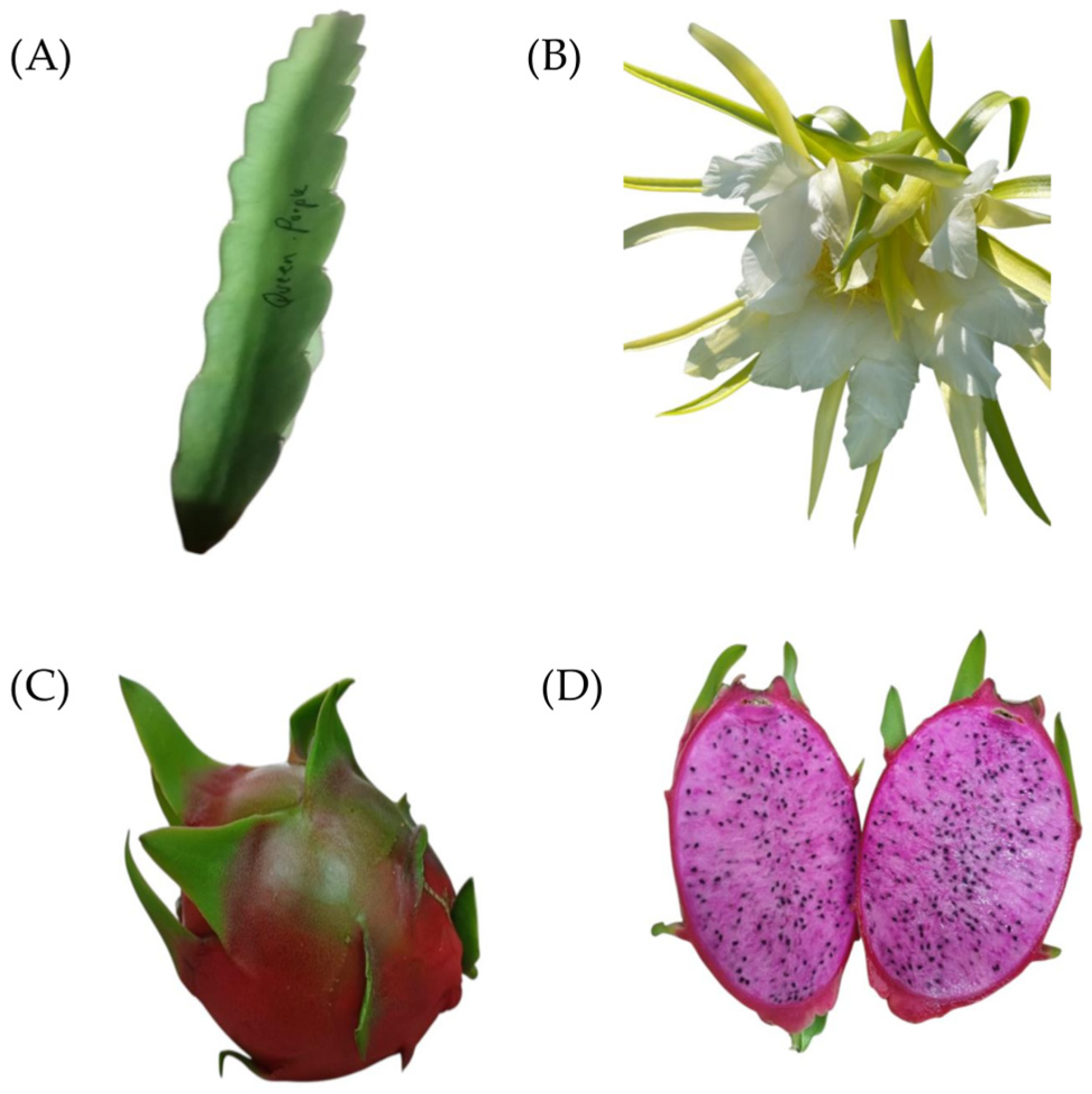
Figure 1. Morphological structures of Selenicereus cf. guatemalensis ‘Queen Purple’: (A) stem, (B) flower, (C) fruit showing the peel and (D) longitudinal section showing the purple pulp and seeds.
Polysaccharides 06 00098 g001
Figure 2. FT-IR spectrum of pectin extracted from the peel of dragon fruit (Selenicereus cf. guatemalensis, ‘Queen Purple’) and the reference pectin (Sigma-Aldrich citrus peel). The light blue arrows indicate the wavelengths corresponding to the main functional groups present in the pectin extracted from dragon fruit peel. The vertical yellow line marks the beginning of the fingerprint region (around 1200–800 cm−1). Ara means Arabinose, Gal means Galactose and Xyl means Xylose.
Polysaccharides 06 00098 g002
Figure 3. Betalains content (sum of betacyanins and betaxanthins) in pectin extracted from the peel of dragon fruit (Selenicereus cf. guatemalensis, ‘Queen Purple’) and the reference pectin (Sigma-Aldrich citrus peel). Different letters (a, b) indicate a significant difference between the betalain (betacyanin, betaxanthin) content of each type of pectin according to the t-test (p < 0.05).
Polysaccharides 06 00098 g003
Figure 4. Antioxidant capacity (DPPH, ABTS, and FRAP) of pectin extracted from the peel of dragon fruit (Selenicereus cf. guatemalensis ‘Queen Purple’) and the reference pectin (Sigma-Aldrich citrus peel). Different letters indicate a significant difference between the antioxidant capacity of the pectin for each method according to the t-test (p < 0.05). The vertical line above indicates the standard error.
Polysaccharides 06 00098 g004
Figure 5. Percentage of DPPH, ABTS, and FRAP antioxidant capacity of pectin extracted from the peel of dragon fruit (Selenicereus cf. guatemalensis, ‘Queen Purple’) and the reference pectin (Sigma-Aldrich citrus peel). Different letters indicate a significant difference between the percentage of the antioxidant capacity of the pectin for each method according to the t-test (p < 0.05). The vertical line above indicates the standard error.
Polysaccharides 06 00098 g005
Figure 6. Phenol content in pectin extracted from the peel of dragon fruit (Selenicereus cf. guatemalensis, ‘Queen Purple’) and in the reference pectin (Sigma-Aldrich citrus peel). Different letters indicate a significant difference between the phenol content of each pectin according to the t-test (p < 0.05). The vertical line above indicates the standard error.
Polysaccharides 06 00098 g006
Figure 7. Correlation matrix of antioxidant capacity, phenolic compounds, betalains, anhydrouronic acid and degree of esterification of pectin extracted from the peel of dragon fruit (Selenicereus cf. guatemalensis ‘Queen Purple’). The color scale (−1 to 1) indicates the correlation between the variables analyzed. Values greater than 0.5 indicate a high correlation between the variables. Values less than −0.5 indicate low correlation between the variables. DE = Degree of esterification; MeO = Methoxyl content; EW = Equivalent weight; AUA = Total anhydrouronic acid; Mw = Molecular Weight; BC = Betacyanin Content; BX = Betaxanthin Content; TPC = Total Phenol Content.
Polysaccharides 06 00098 g007
Table 1. Quality parameters analyzed in pectin extracted from the peel of dragon fruit (Selenicereus cf. guatemalensis, ‘Queen Purple’) and commercial pectin from Sigma Aldrich citrus peel. ---- means not determined.
ParameterDragon Fruit Peel PectinCitrus Peel Pectin
Yield (%)12.8----
Moisture Content (%)9.9010.90
Ash content (%)8.266.62
Equivalent weight (g/eq.)274.011072.12
Methoxyl content (%)5.997.18
Total anhydrouronic acid content (%)98.2757.20
Molecular Weight (kDa)645----
Disclaimer/Publisher’s Note: The statements, opinions and data contained in all publications are solely those of the individual author(s) and contributor(s) and not of MDPI and/or the editor(s). MDPI and/or the editor(s) disclaim responsibility for any injury to people or property resulting from any ideas, methods, instructions or products referred to in the content.