Article

Development and Evaluation of Modified Dioscorea hispida Starch as a Sustainable Super-Disintegrant for Immediate-Release Tablets


by
Nuntachai Hanpramukkun
1,
Thavisak Teruya
1,
Ratana Charoenwattanasatien
2,
Phakkhananan Pakawanit
2 and
Sucharat Limsitthichaikoon
1,*
1
Department of Pharmaceutical Technology, College of Pharmacy, Rangsit University, Pathum Thani 12000, Thailand
2
Synchrotron Light Research Institute, Nakhon Ratchasima 30000, Thailand
*
Author to whom correspondence should be addressed.
Polysaccharides 2025, 6(4), 109; https://doi.org/10.3390/polysaccharides6040109
Submission received: 28 October 2025 / Revised: 24 November 2025 / Accepted: 26 November 2025 / Published: 1 December 2025

Abstract

This study developed a sustainable super-disintegrant derived from Dioscorea hispida Dennst. var. hispida starch for use in immediate-release pharmaceutical tablets. Native starch (NS) was extracted and chemically modified via carboxymethylation to obtain carboxymethyl starch (CMS), followed by phosphate cross-linked to yield modified starch (MS). Physicochemical properties demonstrated that MS exhibited superior water uptake, swelling, and viscosity compared to NS and CMS. Scanning Electron Microscopy (SEM) revealed smaller and more uniform granules in MS, confirming enhanced structural modification. Preliminary tablet trials with dicalcium phosphate showed that 4% w/w MS achieved the fastest disintegration (16.5 s). In paracetamol tablets prepared by wet granulation, MS significantly improved hydration and disintegration performance relative to NS and CMS. Although commercial sodium starch glycolate (SSG) provided slightly faster disintegration, dissolution profiles of tablets containing MS and SSG were statistically equivalent (f1 = 7, f2 = 63), confirming comparable efficacy. Porosity analysis using synchrotron radiation X-ray tomography (SR-XTM) indicated that wet-granulated tablets possessed higher intra- and inter-granular porosity than direct compression tablets, facilitating rapid water penetration and disintegration. In contrast, denser direct compression tablets exhibited greater friability and lower mechanical integrity. Modified Dioscorea hispida starch demonstrated excellent disintegration efficiency, eco-friendliness, and local availability, presenting a promising natural alternative to synthetic super-disintegrants in immediate-release tablet formulations.

1. Introduction

The pharmaceutical industry employs a wide range of drug delivery systems, among which oral solid dosage forms, particularly tablets, remain the most dominant due to their ease of administration, accurate dosing, excellent stability, and strong patient compliance [1,2]. For immediate-release tablets, therapeutic efficacy depends on rapid disintegration of the dosage form into small particles, enabling prompt dissolution and absorption of the active pharmaceutical ingredient (API). This crucial step is primarily governed by disintegrants, specialized excipients designed to facilitate tablet breakup upon contact with physiological fluids [3,4,5]. The type and concentration of disintegrant play a decisive role in controlling disintegration time, dissolution rate, and ultimately drug bioavailability and clinical performance [6,7].
Currently, the pharmaceutical sector predominantly relies on synthetic super-disintegrants such as sodium starch glycolate (SSG), croscarmellose sodium, and crospovidone [3,8]. These excipients promote rapid tablet disintegration through mechanisms including extensive swelling, capillary wicking, and strain recovery upon hydration [9,10]. While highly effective, these synthetic polymers are typically imported, costly, and subject to supply chain limitations, posing challenges for local manufacturers [11,12]. This has generated increasing interest in developing sustainable, affordable, and locally available alternatives derived from natural polymers. Such efforts not only reduce dependency on imported excipients but also promote environmental sustainability and strengthen regional economies [13,14].
In this context, the present study investigates Dioscorea hispida Dennst. var. hispida starch (commonly known as wild yam starch) as a potential natural super-disintegrant. Dioscorea hispida, a member of the Dioscoreaceae family, is widely distributed in tropical regions and valued for its high starch yield and local availability [15,16]. Compared with conventional pharmaceutical starches such as corn, potato, and wheat, wild yam starch possesses distinctive physicochemical characteristics, including relatively high amylose content, small polygonal granules, low swelling power, and higher gelatinization temperatures [17,18,19]. These attributes contribute to its structural robustness and suitability as a natural excipient [20,21]. However, they also limit its hydration capacity and water solubility, making the native starch less effective as a tablet disintegrant [22,23,24]. To overcome these inherent limitations, this present study applies targeted chemical modification techniques to enhance the hydration behavior, swelling response, and overall functional performance of wild yam starch. By improving these key properties, the modified starch is proposed as a sustainable, locally sourced alternative super-disintegrant for immediate-release pharmaceutical formulations.
The primary objective of this research is to synthesize and thoroughly characterize modified Dioscorea hispida starch and to evaluate its functionality as a super-disintegrant in immediate-release tablet formulations. Its performance was directly compared with sodium starch glycolate, a widely recognized commercial benchmark. By developing a sustainable, cost-effective, and locally sourced excipient with comparable or superior efficiency, this research aims to reduce reliance on imported disintegrants, lower pharmaceutical production costs, improve medication accessibility, and add economic value to indigenous agricultural resources.

2. Materials and Methods

2.1. Materials

Native starch (NS) was extracted from the tubers of Dioscorea hispida (commonly known as “Kloy” yam) collected from Lamphun Province, Thailand. Paracetamol Ph Eur. powder (Lot No. 608809V058, Mallinckrodt, MO, USA) and sodium starch glycolate (SSG, EXPLOTAB™, JRS Pharma, Rosenberg Germany) were obtained for use in the study. Additional reagents, including stearic acid, sodium hydroxide, polyvinylpyrrolidone K90 (PVP K90), monochloroacetic acid, sodium trimetaphosphate, dicalcium phosphate (Emcompress®), magnesium stearate, talcum, 95% ethanol, methanol, silver nitrate crystals, acetic acid, and hydrochloric acid were procured from Aketong Chemipun (Bangkok, Thailand). All chemicals were of analytical grade and used as received, without further purification.

2.2. Starch Modification

2.2.1. Preparation of Natural Starch (NS)

Starch from Dioscorea hispida tubers was extracted using a multi-step process adapted from traditional detoxification practices to ensure removal of endogenous toxic constituents. Fresh tubers were peeled, thinly sliced, sun-dried, and dry-milled to reduce particle size and facilitate subsequent extraction [25]. The milled material was then subjected to a detoxification procedure to eliminate cyanogenic compounds and alkaloids naturally present in the tubers.
Detoxification was performed by repeatedly soaking the ground tuber material in water for 24 h, followed by decantation of the supernatant. This soaking–decantation cycle was repeated four times to maximize leaching of water-soluble toxins. The detoxified slurry was subsequently sieved and washed to remove residual soluble components. Qualitative analysis of resulting starch confirmed the absence of cyanogenic compounds and alkaloids, verifying its suitability for pharmaceutical use [25,26].
After detoxification, the material was soaked in water to further remove proteins and other non-starch impurities. The purified starch was then dried in a hot-air oven, re-milled, and passed through a fine mesh sieve to produce a uniform native starch (NS) powder. The final starch powder was sealed in airtight zip-lock bags and stored in a desiccator until use to prevent moisture uptake.

2.2.2. Preparation of Carboxymethyl Starch (CMS)

Carboxymethylation of wild yam starch was adapted from carboxymethylation method [27,28]. Briefly, methanol (508 g) and monochloroacetic acid (17.5 g) were mixed in a 2000 mL Erlenmeyer flask and stirred at 200 rpm at 50 °C. Native starch (218 g) was added, followed by the gradual addition of 80 mL of 50% sodium hydroxide solution, added in increments of 10 mL. The mixture was stirred for 24 h.
Neutralization was performed using concentrated acetic acid to adjust the pH to approximately 7. The precipitate was washed with 80% methanol (800 mL) repeatedly (at least four times) until no chloride ions were detected (tested using silver nitrate solution). A final wash with 100% methanol was performed. The precipitate was dried in a hot air oven at 50 °C for 24 h, sieved through a No. 40 mesh to obtain CMS powder. The CMS powder was sealed in the zip-lock bags and stored in a desiccator to protect it from moisture prior to use.

2.2.3. Preparation of Modified Starch (MS)

Cross-linking of CMS starch was performed based on the method of Kittipongpatana et al. (2013) [29]. Sodium trimetaphosphate (3.3 g) was dissolved in 330 mL of methanol. CMS powder (110 g) was added, and the pH was adjusted to 11.2 using 50% sodium hydroxide solution. The mixture was stirred at 200 rpm and maintained at 50 °C for 24 h.
After reaction completion, the pH was adjusted to 6.5 using 2N hydrochloric acid. The precipitate was washed with 80% methanol (800 mL) repeatedly (at least four times) until no phosphate was detected (tested using ammonium molybdate solution). A final wash with 100% methanol was performed. The precipitate was dried in a hot air oven at 50 °C for 24 h, sieved through a No. 40 mesh to obtain MS powder. The MS powder was sealed in the zip-lock bags and stored in a desiccator to protect it from moisture prior to use.

2.3. Physicochemical Properties and Characterization

2.3.1. Thermal Analysis

Differential scanning calorimetry (DSC) analysis was conducted using a DSC 8000 (PerkinElmer, Waltham, MA, USA). Samples were heated from 25 °C to 300 °C at 10 °C/min under a nitrogen atmosphere (20 mL/min).
Thermal gravimetric analysis (TGA) was performed using an STA 6000 (PerkinElmer, Waltham, MA, USA), with heating from 25 °C to 400 °C at 20 °C/min under nitrogen.
Powder X-ray diffraction (PXRD) patterns were recorded using a MiniFlex II diffractometer (Rikaku, Tokyo, Japan) with Cu Kα radiation (λ = 0.154 nm) over a 2θ range.

2.3.2. Fourier Transform Infrared Spectroscopy—Attenuated Total Reflectance (FTIR–ATR) Characterization

Functional groups of NS, CMS, and MS were analyzed using an FTIR-ATR spectrometer (PerkinElmer Inc., Spectrum One program, Waltham, MA, USA) across the 4000–400 cm−1 region.

2.3.3. Water Uptake and Bulk Swelling

Water uptake and bulk swelling were evaluated using a modified Nogami apparatus [28]. NS (0.1 g) was placed in a graduated pipette sealed with filter paper. Water absorption was recorded at intervals (5–30 min), and bulk swelling percentage was calculated using the formula:
B u l k   s w e l l i n g   % = h t h 0 h 0   ×   100
where h0 is the initial height and ht is the final height of the starch column

2.3.4. Sedimentation Volume

Starch samples (0.5 g) were dispersed in 50 mL of distilled water in a graduated cylinder. After standing for 24 h, sedimentation volume was calculated as the ratio of sediment height to total height [30].

2.3.5. Bulk Density and Tapped Density

Starch samples (3 g) were poured into a 10 mL cylinder, and bulk volume was recorded. After 100 tapping cycles, tapped volume was recorded, and compressibility index was calculated.

2.3.6. Viscosity

A 1% w/v starch dispersion was prepared, and viscosity was measured using a Brookfield viscometer (spindle No. 16, 100 rpm, Brookfield Model DV-II+ viscometer; Middleboro, MA, USA).

2.3.7. Morphology

The surface morphology of all starch powder samples was examined using scanning electron microscopy (SEM, FEI Quanta FEG 450, Thermo Fisher Scientific, Hillsboro, OR, USA). Each sample was mounted on aluminum stubs using double-sided adhesive tape and sputter-coated with a thin layer of gold under vacuum to improve electrical conductivity. SEM images were acquired at magnifications of 1000×, 2000×, and 5000× to assess surface texture, smoothness, and morphological uniformity.

2.4. Evaluation of Disintegrating Properties

2.4.1. Determination of Optimal Disintegrant Concentration

To determine the optimal concentration of disintegrant, tablets were prepared using dicalcium phosphate (Emcompress®) as an excipient base. Each tablet formulation contained 500 mg of the Emcompress®, magnesium stearate as a lubricant, and one of the disintegrants, native starch (NS), carboxymethyl starch (CMS), or modified starch (MS), incorporated at varying concentrations of 0%, 1%, 2%, 3%, 4%, and 5% w/w. The disintegration time of each formulation was systematically evaluated to identify the most effective disintegrant type and concentration for further application in tablet development.

2.4.2. Swelling Behavior of Starch Tablets

Starch tablets (0.5 g) were compressed in 2000 lb/in2 using a hydraulic press. Tablets were placed in distilled water (30 mL in a Petri dish and 80 mL in a beaker) at room temperature (25 ± 5 °C) and observed at 0, 10, 20, 30, 60, and 120 min for swelling behavior.

2.4.3. Efficacy of Disintegration in Paracetamol Tablets

Paracetamol tablet formulations were prepared using the wet granulation method to evaluate and compare the disintegration and dissolution behavior. Disintegrants were incorporated at an optimal concentration determined in Section 2.4.1. Four formulations were prepared, differing only in the type of disintegrant used as F1 (blank formula without adding disintegrant), F2 (native starch, NS), F3 (modified starch, MS), and F4 (sodium starch glycolate, SSG). The composition of the paracetamol tablets with different disintegrants at 4% concentration is shown in Table 1.
The physicochemical properties of model paracetamol tablets were evaluated by assessing their appearance, hardness, thickness, friability, weight variation, disintegration time, and dissolution rate. Tablet hardness was measured using a Monsanto Tablet Hardness Tester, with six tablets analyzed per batch. Thickness was determined using a Vernier caliper, while friability was assessed using a Roche Friabilator (type KF, K.S.L Engineering Co., Ltd., Bangkok, Thailand) in accordance with USP 34/NF 29 guidelines (USP, 2011). Weight variation was evaluated following USP 34/NF 29 guidelines (USP, 2011) using an analytical balance.
Disintegration time was measured using a USP disintegration apparatus in distilled water maintained at 35 ± 2 °C. Additionally, disintegration behavior was visually observed by placing tablets in 100 mL of distilled water within a beaker. Dissolution studies were conducted using a modified USP dissolution apparatus, employing phosphate buffer (pH 5.8) as the dissolution medium, with a paddle speed of 50 rpm and temperature maintained at 37 ± 2 °C. Samples were withdrawn at predetermined time intervals (5, 10, 15, 20, 30, 45, 60, 90, and 120 min) and analyzed spectrophotometrically at 243 nm using a UV-Vis spectrophotometer.

2.4.4. Tablet Morphology

The surface morphology of all tablet samples was analyzed using scanning electron microscopy (SEM, FEI Quanta FEG 450, Thermo Fisher Scientific, Hillsboro, OR, USA). Each tablet was sectioned into small pieces, and the cross-sectional surface was mounted facing upward on aluminum stubs using double-sided adhesive tape. The samples were then sputter-coated with a thin layer of gold under vacuum to enhance electrical conductivity. SEM images were captured at 500× magnifications to evaluate the surface texture, smoothness, and uniformity.
Synchrotron radiation X-ray tomographic microscopy (SR-XTM) at Beamline 1.2 W which operated at 1.2 GeV and 150 mA was carried out. To avoid movement of the sample during scanning, the sample was fixed into Kapton tape with a cotton pad before mounting on the goniometer stage. In this case, the 350 microns thickness of the aluminum foil with a mean energy of 11.5 keV were attenuated to minimize an artifact such as a ring artifact, etc. In addition, the 200 microns thickness of the YAG:Ce scintillator (Crytur Ltd., Turnov, Czech Republic), lens-coupled X-ray microscope (Optique Peter, Lentilly, France), and the sCMOs camera pco. edge 5.5, 2560 × 2160 pixels, 16 bits (Excelitas Technologies Corp., Pittsburgh, PA, USA) were employed to collect the X-ray radiographies from 0 to 180 with an angular increment of 0.1 degree. The data pre-processing, background normalization, and CT reconstruction were calculated by using Octopus Reconstruction software 8.9.1 (TESCAN, Gent, Belgium) [31]. After that, the reconstruction images of the sample were rendered in 3D tomographic reconstruction by using Drishti software 2.6.4 [32].

2.5. Statistical Analysis

All quantitative results are expressed as mean ± standard deviation (SD). Statistical differences among groups were evaluated using one-way analysis of variance (ANOVA) followed, when applicable, by the Least Significant Difference (LSD) post hoc test. The correlation between tablet porosity (measured by Octopus Analysis, TESCAN, Gent, Belgium, %) and disintegration time (s) was evaluated using Pearson correlation coefficient after confirming data normality with the Shapiro–Wilk test. Statistical analysis was conducted using GraphPad Prism version 8 (GraphPad Software, Boston, MA, USA) and SPSS version 13.0 for windows (SPSS Inc., Chicago, IL, USA). A two-tailed p-value < 0.05 was considered statistically significant. All graphical representations were generated using GraphPad Prism version 8.

3. Results and Discussion

The extraction of NS yielded 295.60 ± 5.60 g of dried starch powder, corresponding to an extraction efficiency of 65.68 ± 1.24% based on the weight of fresh tubers. This relatively high yield reflects the starch-rich composition of D. hispida tubers and supports its suitability as a sustainable source of natural polymer of pharmaceutical applications.
For chemical modification via carboxymethyl substitution, the extracted NS was reacted with monochloroacetic acid under alkaline conditions to produce CMS. The reaction resulted in 151.40 ± 2.46 g of CMS, representing a yield of 69.45 ± 1.13%, indicating efficient substitution of hydroxyl groups by carboxymethyl moieties. This substitution step was intended to enhance the hydrophilicity and swelling capacity of the starch granules, thereby improving their potential as a super-disintegrant.
Subsequently, the obtained CMS was subjected to cross-linking with sodium trimetaphosphate to further improve its structural stability and control its swelling behavior. The cross-linking process produced 87.62 ± 1.67 g of MS, corresponding to a final yield of 79.65 ± 1.52%. This step reinforced the polymer matrix by forming phosphate ester linkages between starch chains, thereby balancing the water uptake rate and maintaining granular integrity upon hydration.

3.1. Physicochemical Properties and Characterizations

The extracted Dioscorea hispida starch was characterized to assess its suitability as a pharmaceutical excipient. Safety verification included screening for plant-derived toxic constituents inherent to D. hispida [15,20,21]. Cyanogenic compounds and alkaloids as known toxicants naturally present in the tubers, were removed through a multi-step detoxification process involving repeated soaking and decantation [25]. Qualitative tests confirmed their absence in the final starch powder, indicating effective detoxification.
Physicochemical characterization focused on parameters relevant to excipient performance, including moisture content, pH, particle size distribution, swelling capacity, water uptake, and paste viscosity. These properties directly influence powder flowability, compressibility, and hydration behavior, which are critical for tablet disintegration performance.
While these evaluations establish the functional feasibility of the modified starches, we recognize that full compliance with pharmacopoeial specifications requires further analysis of safety-related attributes, such as heavy metal content, residual anions, microbial limits, and other impurities [33]. These assessments will be conducted in future studies to support the development of D. hispida starch as a safe and standardized pharmaceutical excipient.

3.1.1. DSC, TGA, XRD, and FTIR–ATR Characterizations

The thermal structural properties of the NS, MS, CMS, and composited excipients were characterized using DSC, TGA, PXRD, and FTIR-ATR.
To evaluate the thermal transition properties, DSC analysis was performed, with the resulting thermograms presented in Figure 1A. The NS thermogram displayed a sharp, well-defined endothermic peak at 154.3 °C, which corresponds to its gelatinization temperature (Tp). This peak represents the energy required to disrupt the semi-crystalline structure of the starch granules. In contrast, the modified starches, MS and CMS, exhibited lower gelatinization temperatures at 145.7 and 142.6 °C, respectively. This decrease in Tp indicates that the chemical modification processes have partially disrupted the intermolecular hydrogen bonds within the starch granules, resulting in a less stable crystalline structure that requires less thermal energy to gelatinize.
The thermal stability and degradation profiles of the samples were assessed using TGA, as shown in Figure 1B. NS and CMS displayed similar thermal degradation profiles with comparable onset decomposition temperatures. The MS showed enhanced thermal stability compared to both NS and CMS, indicated by a slower rate of weight loss and a higher onset decomposition temperature.
The crystalline characteristics of the starch samples were analyzed using PXRD, with diffractograms as shown in Figure 1C. NS exhibited a typical semi-crystalline A-type pattern [34], characterized by three clear peaks at 2θ values of 17.30°, 22.39°, and 34.41°. After chemical modification, the diffraction patterns changed markedly. The MS sample exhibited only two weakened peaks at 17.20° and 22.29°, with the 34.41° peak no longer present. Similarly, the CMS sample showed peaks at 17.32° and 34.36° but lacked the distinctive 22.39° peak seen in NS. The disappearance and broadening of these peaks indicate that the chemical modification disrupted the ordered crystalline regions of the starch, resulting in a more amorphous structure. This reduction in crystallinity aligns with the observed increases in water uptake, swelling, viscosity, and sedimentation volume. Amorphous starch typically exhibits greater molecular mobility and improved interaction with water, which explains the enhanced hydration and functional performance of the modified samples [34]. Together, these PXRD findings support the conclusion that chemical modification transforms wild yam starch into a more functionally efficient material for use as a disintegrant.
The presence of carbonyl and phosphate functional groups in the starch samples were evaluated using FTIR-ATR spectroscopy, as shown in Figure 1D. The introduction of carboxymethyl groups into the starch structure was confirmed by the appearance of a characteristic absorption band near 1610 cm−1, corresponding to the stretching vibration of ionized carboxy group [35,36]. This band indicates substitution of native hydroxyl groups with carboxymethyl moieties, consistent with previous reports [37,38].
Identifying phosphate groups in the MS was more challenging. Although starch phosphate esters typically exhibit an absorption in the 1240–1200 cm−1 region, this signal often overlaps with strong C-O stretching vibrations inherent to polysaccharide backbones [39,40,41]. As a result, relying solely on FTIR-ATR to confirm phosphate functionality may lead to ambiguous or unreliable interpretation.
Therefore, while FTIR-ATR provides useful qualitative evidence of carboxymethylation, more specific analytical techniques, such as qualitative phosphorus determination via wet chemical analysis or chromatographic methods, are recommended to accurately characterize phosphate content and bonding configuration in the modified starch [39].

3.1.2. Hydration Behavior

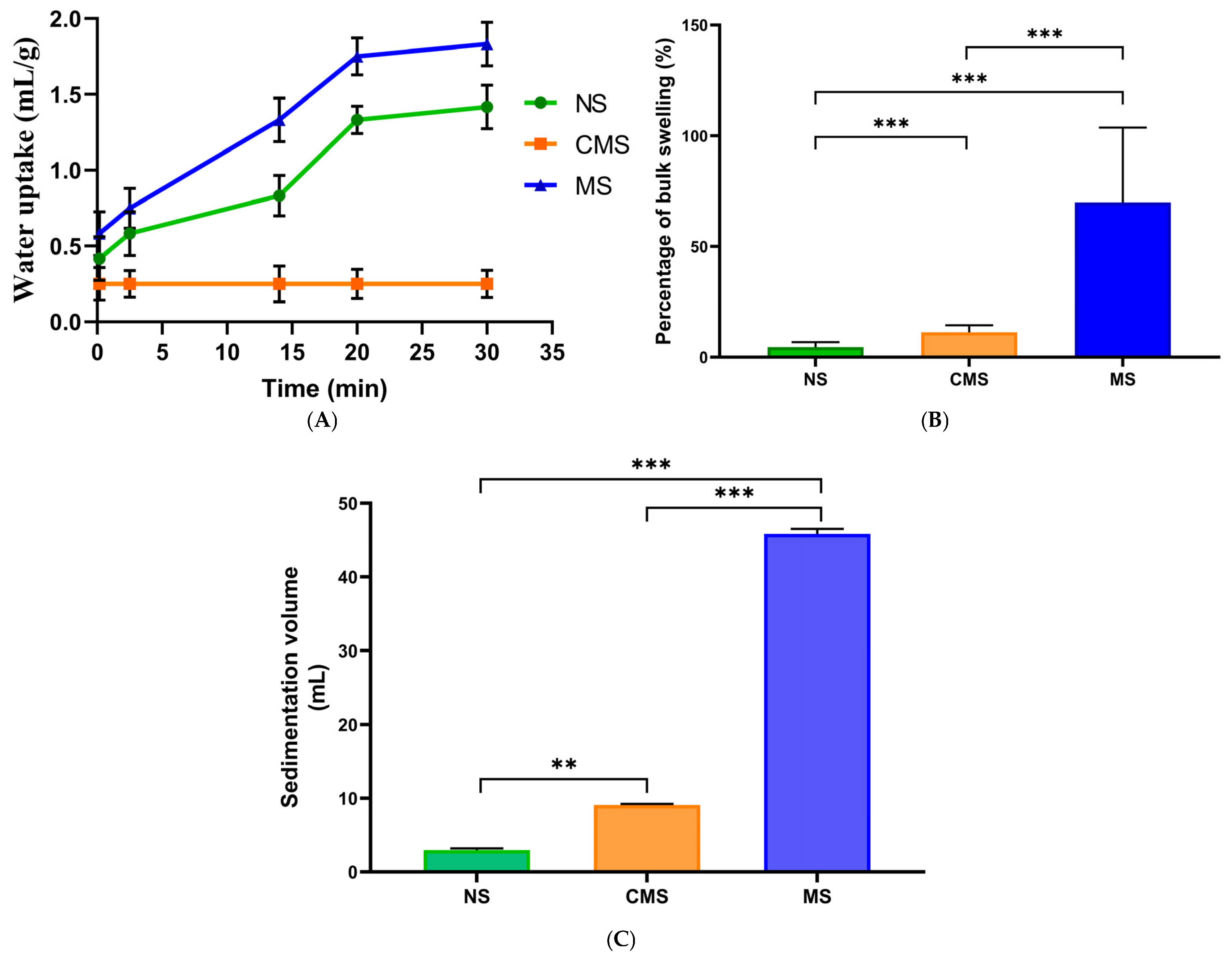
The hydration properties of the NS, CMS, and MS were evaluated through water uptake, swelling capacity, and sedimentation volume analyses (Figure 2). Significant differences (p < 0.05) were observed among the three samples, highlighting the effect of sequential carboxymethylation and cross-linking on the hydration behavior of D. hispida starches.
Among all samples, the MS exhibited the highest water uptake (Figure 2A) and bulk swelling volume (Figure 2B), followed by NS and CMS. The superior hydration of MS can be attributed to the synergistic effects of hydrophilic carboxymethyl groups and a three-dimensional phosphate cross-linked network. The introduction of carboxymethyl substituents enhances the affinity of starch for water molecules, while the phosphate cross-links maintain structural integrity, preventing particle dissolution and enabling substantial water entrapment within the intergranular spaces [42]. Furthermore, the smaller and more uniform granule size of MS increases the specific surface area available for water contact, accelerating hydration and promoting extensive swelling. These findings align with previous reports indicating that dual modification enhances both the rate and extent of water uptake due to increased porosity and surface hydrophilicity [43,44,45].
In contrast, CMS exhibited the lowest water uptake and swelling index despite the presence of hydrophilic carboxymethyl groups. This counterintuitive behavior is explained by rapid surface hydration forming a dense gel barrier that restricts further water diffusion into the granule core. Such surface gelation effects have also been reported in other carboxymethylated starches, where excessive substitution promotes surface viscosity and limits internal swelling [46,47,48]. Meanwhile, NS displayed moderate hydration and swelling, governed primarily by its native hydrogen bonding network, which allows limited water penetration without significant structural expansion.
Sedimentation volume analysis further corroborated these findings, with the order of MS exhibiting the highest sedimentation volume followed by CMS and NS, respectively, as shown in Figure 2C. The large sedimentation volume of MS reflects its enhanced water absorption and swelling ability, which produces voluminous, low-density floccules that resist compact packing upon setting. Conversely, CMS formed a more cohesive and compact sediment layer due to limited, whereas NS, composed of dense and poorly hydrated granules, yielded the smallest sediment bed with tightly packed particles. The positive correlation between index and sedimentation volume (r > 0.9) indicates starch samples with greater water retention also form less suspension, an expected outcome of enhanced interparticle repulsion and steric hindrance caused by hydration-induced expansion [49,50]. CMS, despite its higher hydrophilicity, suffers from surface gelation that limits its disintegration efficiency. These findings are consistent with prior studies indicating that the physicochemical balance between hydrophilicity and structural stability dictates the functional performance of modified starches in pharmaceutical systems [51,52].

3.1.3. Density Evaluation

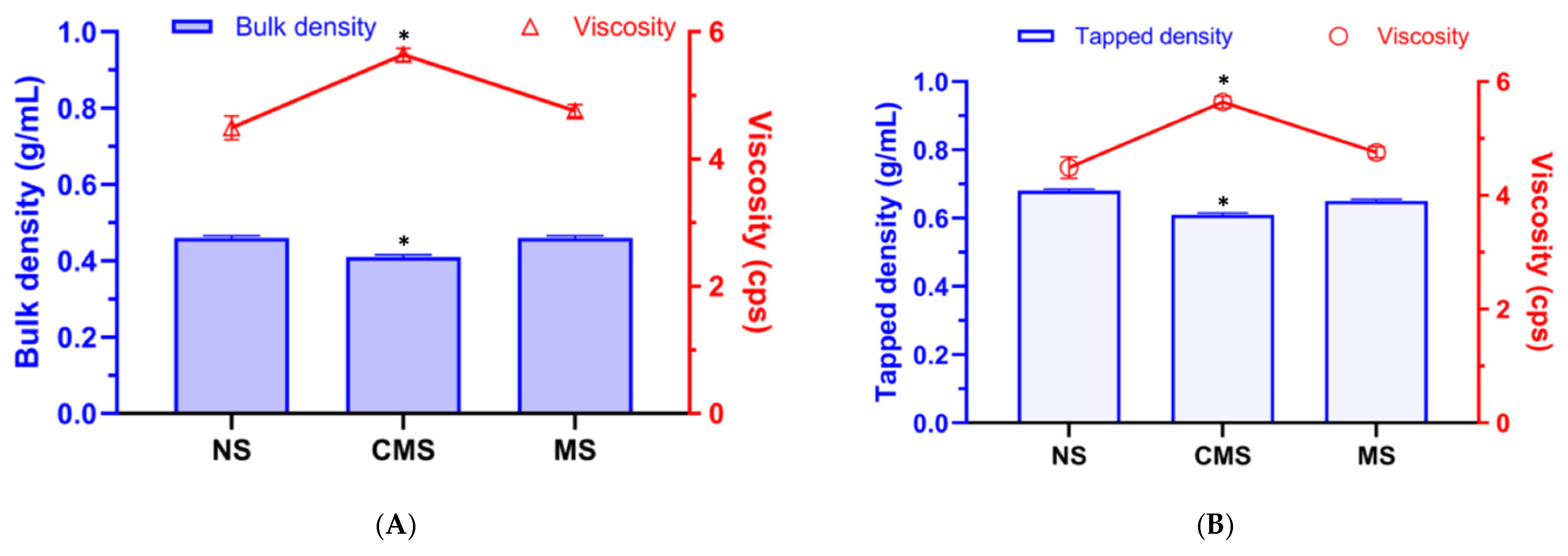
The bulk density and tapped density were measured for all starch samples, with the results presented in Figure 3A and Figure 3B, respectively. The values for the NS and MS were observed to be relative similar. This suggests that while the chemical modifications significantly altered the starches’ hydration properties (swelling, water uptake), they did not fundamentally change the particles’ packing behavior in their dry, powered state.
To quantify the flow properties, the percent compressibility (%, Carr’s index) was calculated from the density data [53]. The results showed a clear trend among the samples: NS (32.35%), CMS (31.15%), and MS (27.69%). According to the USP standards for power flow, all these samples fall into categories indicating poor flowability. A Carr’s index between 26 and 31% is classified as poor and a value between 32 and 37% is very poor. This indicates that MS has slightly better flow than CMS, and both modified starches have improved flow compared to the NS. However, none of the powers would be considered free flowing.
The poor flow characteristics have important consequences for manufacturing solid dosage forms like tablets. Powders with poor flow can lead to inconsistent die filling on a tablet press, resulting in variations in tablet weight and, consequently, inaccurate dosing. While their poor flow makes them unsuitable as a primary filler or binder at high concentrations, these starches can still be highly effective as disintegrants. To optimize their disintegrant properties without compromising the manufacturing process, it is recommended to use the lowest possible concentration that provides effective disintegration. Therefore, further formulation studies are essential to determine the optimal and most efficient usage level for these materials in a tablet formulation.

3.1.4. Viscosity of Starch Dispersions

A comparative study (Figure 3) of the viscosity of various modified yam starches against NS revealed distinct differences. The 1% NS solution exhibited low viscosity. This is attributed to the inherent hydrophobic nature of unmodified starch, which results in poor water solubility. Consequently, it forms a suspension in which the starch particles settle, leading to a low viscosity measurement [7]. In contrast, the 1%CMS demonstrated high viscosity. The modification process, involving the substitution of hydroxyl groups with hydrophilic carboxymethyl groups, significantly enhances its water solubility. This increased solubility allows the CMS to form a thick, viscous gel. The 1%MS is a further modification of CMS. The cross-linking process reduces the extent of gel formation compared to CMS, resulting in a lower viscosity for the 1%MS solution. This modification is specifically designed to create a high-efficiency disintegrant. By minimizing the formation of a viscous gel barrier, it facilitates water penetration into the tablet core. Therefore, the MS exhibits properties of a partially soluble super-disintegrant, according for its reduced viscosity compared to CMS.

3.1.5. Microscopic Morphology

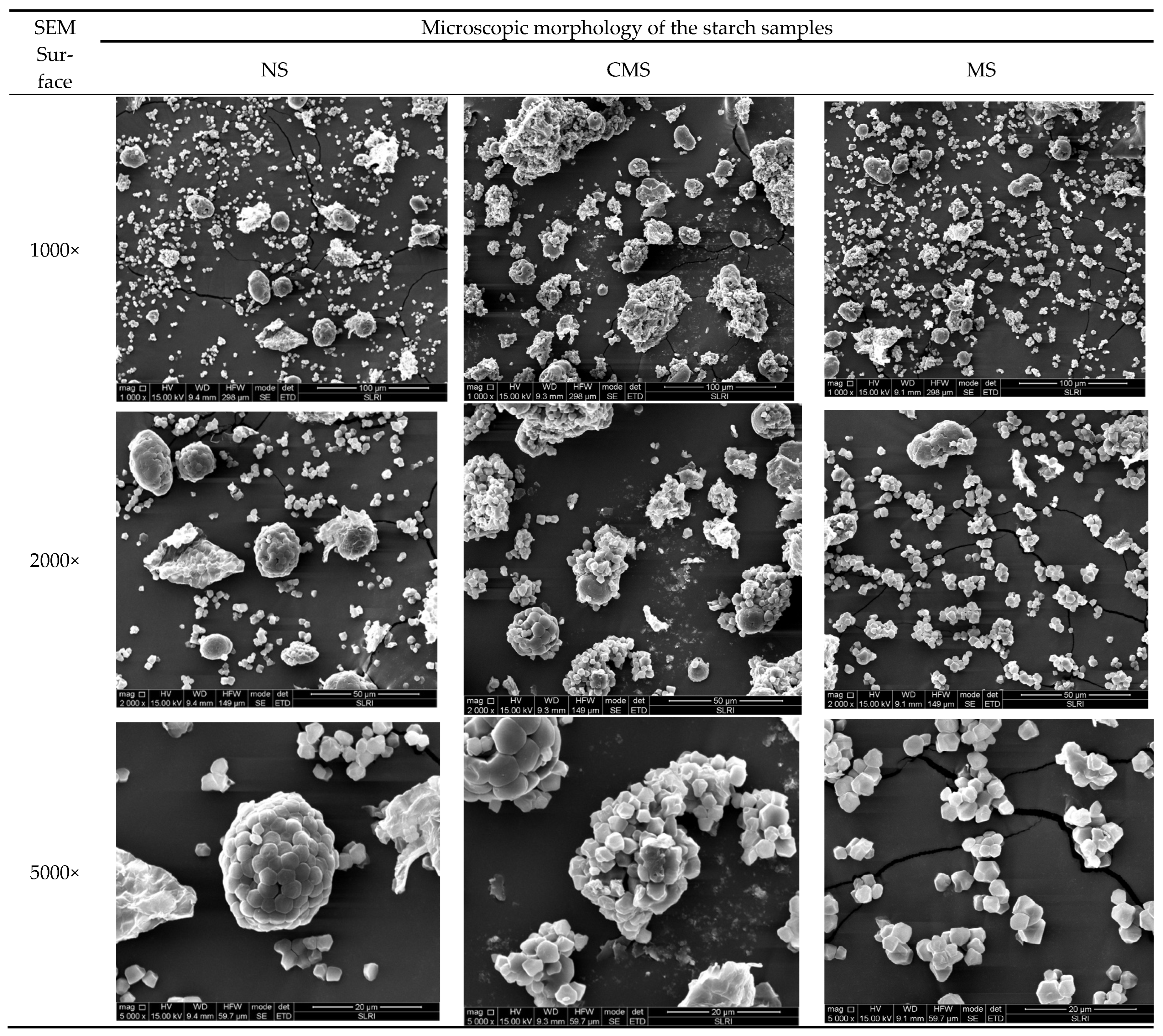
Microscopic morphology of the starch samples was examined using scanning electron microscopy (SEM) as shown in Figure 4. The starch granules appeared predominantly polygonal in shape across all samples. Among the three types, the MS exhibited the smallest particle size and the least degree of granule agglomeration, indicating improved dispersion. In contrast, both CMS and NS displayed similar granule sizes; however, CMS showed more pronounced granule clustering than NS, while NS presented a denser packed granule structure with some individual starch granules remaining unaggregated. These morphological differences suggest that the crosslinking process in MS not only reduced granule size but also enhanced particle separation, which may contribute to its superior disintegration behavior [23,54].

3.2. Evaluation of Disintegration in Tablet

3.2.1. Determination of the Amount of Disintegrating

To determine the most effective concentration for the starch-based disintegrants, a study was conducted using dicalcium phosphate (Emcompress®) as a model filler for tablets prepared by direct compression. The concentrations of disintegrants, NS, CMS, and MS, were varied at 0%, 1%, 2%, 3%, 4%, and 5% within the formulations.
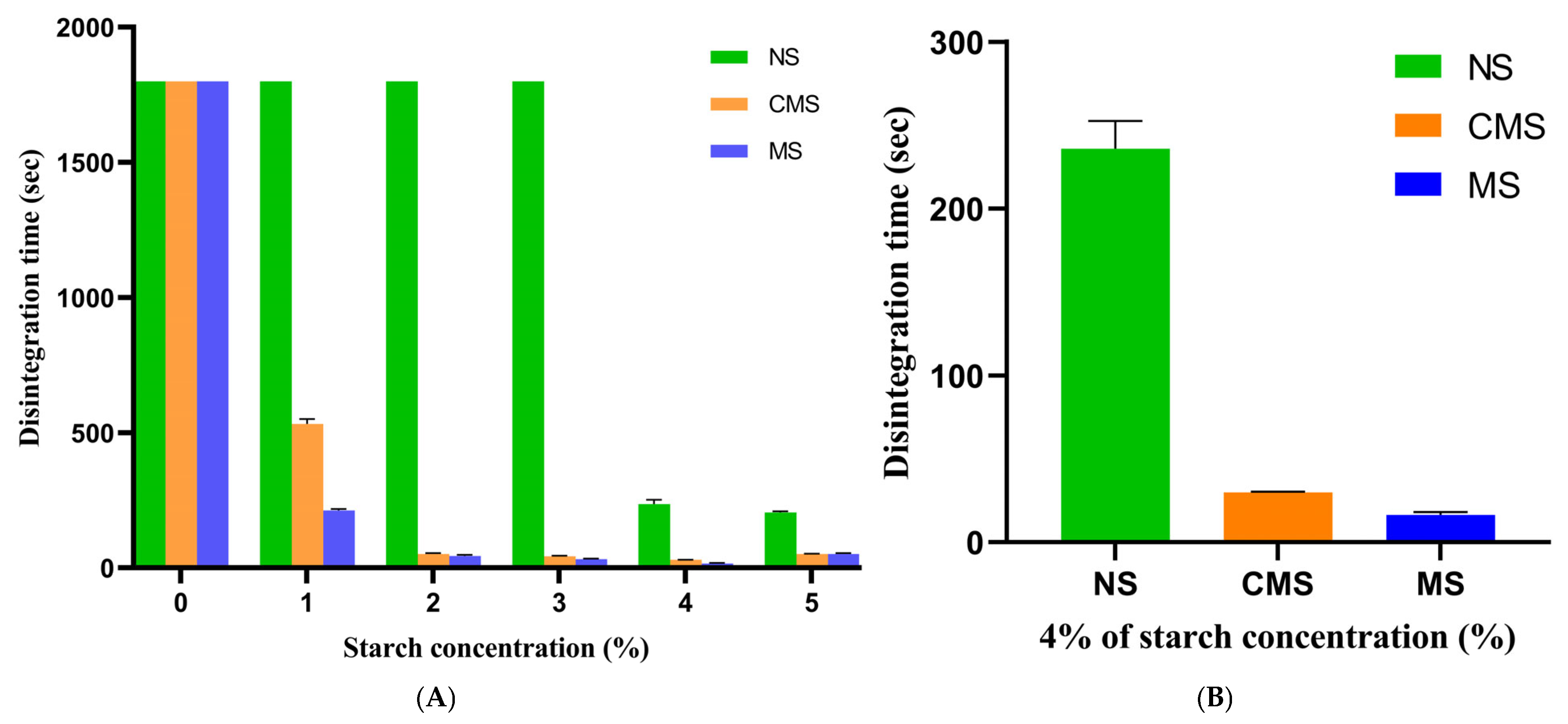
The analysis of tablet disintegration time for formulations containing NS revealed a distinct concentration-dependent effect, as shown in Figure 5. Increasing the concentration of NS from 0% up to 4% resulted in a dramatic and rapid reduction in tablet disintegration time. The time decreased sharply from over 1800 s (in the control formulation without disintegrant) to approximately 236.03 s at the 4% level. This demonstrates the powerful wicking and swelling action of the NS particles in breaking apart the tablet matrix. However, a further increase in the NS concentration from 4% to 5% yielded only a marginal improvement. The indicates that a performance plateau is reached around the 4% concentration, where an optimal network for water penetration and tablet rupture has been established.
Based on these findings, 4% NS was selected as the optimal concentration for use in subsequent studies. This decision is guided by the fundamental pharmaceutical principle of using the minimum effective concentration of an excipient. The significant reduction in disintegration time is achieved at 4%, and the minor benefit gained by increasing the concentration to 5% does not justify the use of additional material. Therefore, 4% represents the most efficient and effective concentration for this formulation.
The evaluation of CMS as a disintegrant revealed a potent and distinct concentration-dependent effect, as shown in Figure 5. CMS demonstrated high efficacy even at low concentrations. The addition of just 1% CMS drastically reduced the tablet disintegration time from over 1800 s to approximately 532.9 s. The performance continued to improve with increasing amounts, reaching a peak efficacy at a concentration of 4%, where the tablets disintegrated rapidly in just 30.03 s. Interestingly, a further increase in the CMS concentration from 4% to 5% did not improve performance. Instead, it had a counterproductive effect, with the disintegration time increasing to 51.5 s. This phenomenon is attributed to the gelling nature of CMS. At lower concentrations, CMS particles swell and wick water into the tablet, causing it to break apart effectively. However, at higher concentrations (like 5%), the CMS on the tablet’s surface hydrates very quickly, forming a viscous hydrogel layer. This gel layer acts as a barrier, impeding further water penetration into the tablet’s core [38]. This hindered hydration slows down the overall disintegration process.
Based on these results, 4% CMS was selected as the optimal concentration for use in further comparative studies. This concentration provides the fastest disintegration time, beyond which the performance diminishes due to the inhibitory gelling effect.
The performance of the MS was evaluated to determine its optimal concentration as a tablet disintegrant as shown in Figure 5. MS demonstrated exceptional disintegrant properties. At just 1%, it reduced the tablet disintegration time from over 1800 s to approximately 213.07 s. The performance peaked at a 4% concentration, achieving an extremely rapid disintegration time of only 16.5 s, highlighting its potential as a super-disintegrant.
Similarly to CMS, increasing the concentration further to 5% resulted in a longer disintegration time of 51.74 s. This is because, at a sufficiently high concentration, a portion of the MS can still form a viscous gel layer that slightly impedes the rapid ingress of water, thus slowing down the disintegration process. Based on its peak performance, 4% MS was selected as the optimal concentration for the final comparative analysis. A final comparison was conducted to evaluate the efficacy of the three starches at their optimal concentration of 4% as shown in Figure 5B.
The results clearly established a performance hierarchy among the tested disintegrants, among which the fastest is 4% MS as 16.5 s followed by 4% CMS as 30.0 s, and the slowest is 4% NS as 236.03 s. The MS formulation was unequivocally the most effective, disintegrating nearly twice as fast as the CMS formulation and over 14 times faster than the NS.
The superior performance of MS is attributed to its unique properties. It combines a very high swelling capacity with the formation of a low-viscosity gel. This allows MS to absorb water and swell powerfully to break the tablet apart (the primary mechanism), without creating a thick, impermeable gel barrier that would hinder further water penetration. In conclusion, this research has successfully developed and optimized a MS that functions as a high-efficiency, fast-acting disintegrant.
To validate these promising findings in a more practical application, the investigation had proceeded to incorporate the developed disintegrants into a formulation of paracetamol, which serves as a model for poorly water-soluble drugs.

3.2.2. Characteristics of Swelling in Starch Tablet

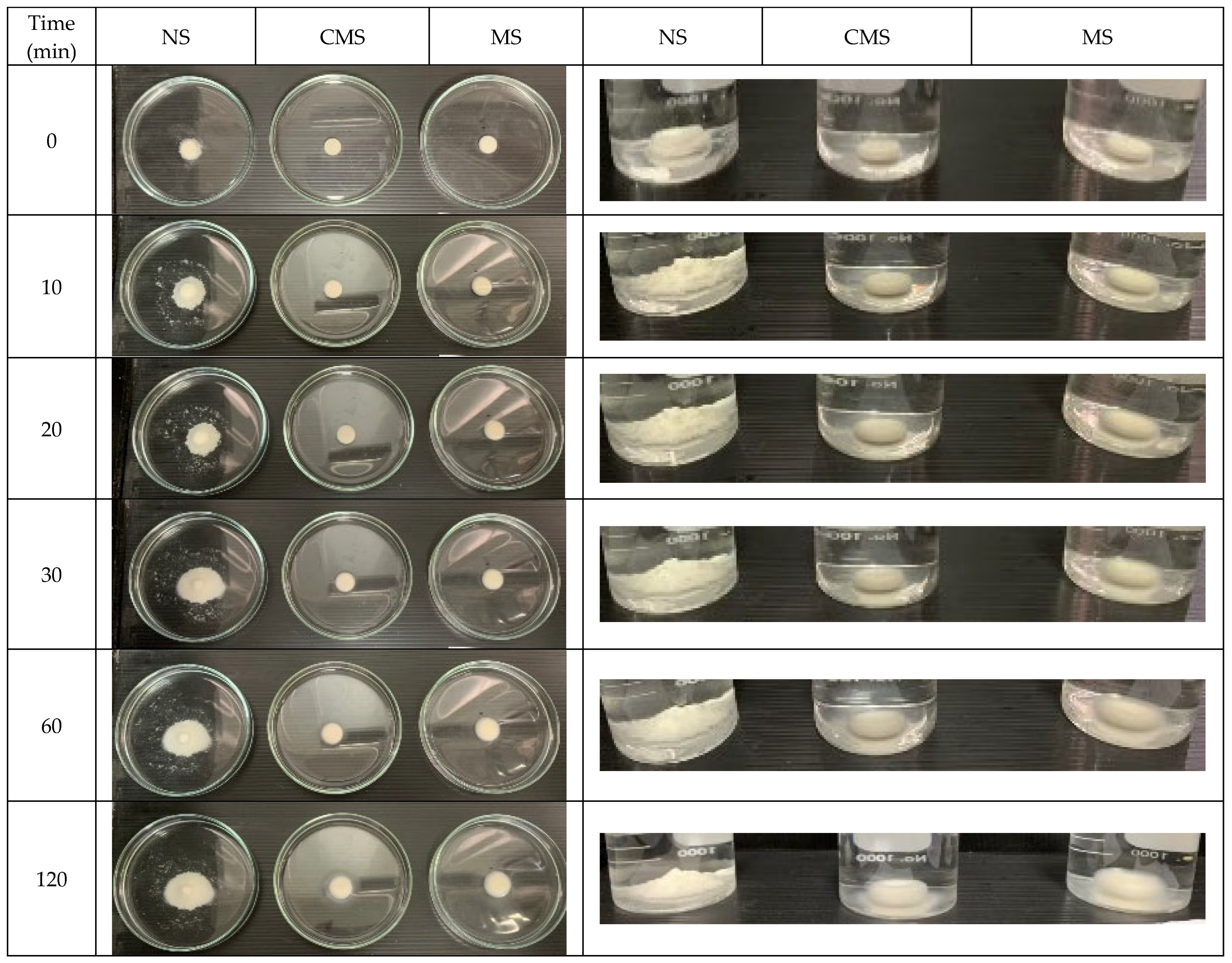
To visualize the hydration dynamics, a study of the swelling characteristics of tablets containing NS, CMS, and MS was conducted. The process was documented through photographs at specific time intervals: 0, 10, 20, 30, 60, and 120 min.
The photographic evidence revealed distinct swelling behaviors among the three starches, NS, CMS, and MS as shown in Figure 6. The NS tablet showed negligible or no swelling. Due to its inherent insolubility in cold water and tightly packed granular structure, the tablet did not absorb a significant amount of water and largely maintained its original integrity throughout the experiment. Swelling in the CMS tablet was largely confined to the outer surface. This layer quickly hydrated to form a viscous hydrogel barrier. This gel layer was observed to impede water from penetrating into the core of the tablet, thus preventing complete and uniform swelling. The tablet containing MS exhibited the most pronounced and uniform swelling. It rapidly absorbed water, leading to a substantial and consistent volumetric expansion, which is the primary mechanism for an effective swelling-type disintegrant.
The visual observations were consistent with the quantitative findings from the water uptake and bulk swelling analyses. CMS exhibited an exceptionally strong gel-forming behavior upon contact with water, rapidly producing a dense and cohesive surface gel layer. This barrier substantially restricted water penetration into the interior of the material, thereby limiting internal swelling and reducing fluid accessibility. In contrast, MS absorbed water rapidly and uniformly throughout the matrix, leading to high-volume internal swelling facilitated by its enhanced hydrophilicity and open, cross-linked architecture [19,55].
These contrasting hydration mechanisms provide a mechanistic explanation for the divergent disintegration behaviors observed between the two modified starches. MS promotes tablet breakup primarily through internal expansion and capillary-driven water transport, which accelerates structural rupture. Conversely, CMS undergoes predominantly surface-level gelation that inhibits water ingress, delaying or preventing complete matrix hydration [55,56].
This mechanistic difference also explains the manufacturing challenges encountered during tablet compression. The strong gel-forming tendency of CMS, combined with its limited internal hydration, produced granules with poor deformability. During tableting, these properties contributed to sticking, capping, and inadequate bonding, ultimately yielding tablets with unacceptable mechanical strength. As a result, CMS-based tablets could not be subjected to further porosity, disintegration, or dissolution testing, and their exclusion from further experiment is therefore both necessary and scientifically justified.

3.3. Paracetamol Tablets Formulation Properties

The properties of a paracetamol tablet formulation depend on a combination of its active ingredient and the excipients chosen to ensure its stable, effective, and can be manufactured reliably. NS, MS, and SSG were used as disintegrants for comparison on the paracetamol tablets formulation properties.

3.3.1. Hardness, Thickness, Friability, Weight Variation, and Disintegration

The hardness of a tablet is a critical attribute that affects its physical stability, handling, and disintegration behavior. To ensure a valid comparison of disintegrant performance, the hardness of the paracetamol tablets from each formulation group was carefully measured and controlled.
The hardness values for the different paracetamol tablet formulations are summarized in Table 2. The results showed that all tablet formulations exhibited highly comparable hardness values. The average crushing strength across all groups was tightly clustered between 7.10 and 7.33 kg/cm2. The inclusion of 4% NS, MS, or the commercial standard (SSG) did not significantly alter the mechanical strength of the tablets compared to the blank formulation (which contained no disintegrant). This indicates that at this concentration, the disintegrants do not interfere with the compressibility and binding of the main tablet components. It is crucial to understand that this uniformity in hardness was an intentional part of the experimental design. Tablet hardness has a direct impact on disintegration; harder tablets are typically more dense and less porous, which can physically slow down the ingress of water and prolong disintegration time.
By compressing all tablets to a similar hardness, this variable was effectively neutralized. This ensures that any observed differences in the disintegration times between the formulations can be confidently attributed to the intrinsic efficacy of the disintegrant itself, rather than variations in the physical structure of the tablets. This allows for a fair and unbiased comparison of NS, MS, and SSG.
Tablet thickness is a critical quality control parameter that ensures consistency in production and packaging. It was measured for all paracetamol tablet formulations to verify uniformity. The thickness values for each formulation group are summarized in Table 2.
The data reveals that all tablet formulations exhibited highly consistent and comparable thickness. The average values for all groups fall within a very narrow range (5.43 to 5.54 mm). This uniformity is expected, as tablet weight, diameter, and compression force (hardness) were kept constant. The results confirm that the addition of 4% of any of the starch-based disintegrants did not negatively affect the packing properties or compressibility of the powder blend, leading to consistent tablet dimensions.
Friability testing measures a tablet’s ability to withstand abrasion and chipping during handling, coating, and transportation. The test was conducted according to the USP monograph. The friability values, express as a percentage of weight loss, were shown in Table 2. According to USP standards, a friability value of not more than 1.0% is considered acceptable. While all formulations successfully met this requirement, there were significant differences in their performance. The tablets formulated with NS and MS demonstrated excellent mechanical strength, with very low friability values. This indicates that these disintegrants contribute to a robust and durable tablet matrix. Interestingly, the tablets containing the commercial standard SSG were nearly twice as friable as those with NS and MS, despite all tablets having a similar hardness. This discrepancy is likely not due to weaker tablet binding but may be an artifact of the SSG manufacturing process. It is hypothesized that residual sodium chloride crystals, a byproduct of the chemical modification to create SSG, may remain on the surface of the starch granules. During the tumbling action of the friability test, these loosely adhered crystals could easily abrade off, leading to a greater weight loss and a consequently higher (and potentially misleading) friability percentage.
Ensuring each tablet contains a consistent amount of the active drug is a critical quality requirement. The uniformity of dosage units test (per USP 905) was performed using the weight variation method to confirm this.
From the weight data of tablets from each batch, an Acceptance Value (AV) was calculated. For the test to pass the initial stage (L1), the calculated AV must be less than or equal to 15.0. The calculated AV for each paracetamol tablet formulation were shown in Table 2. All four formulations successfully passed the L1 criterion, indicating excellent uniformity of dosage units. This result confirms that the amount of paracetamol in each tablet is highly consistent. Furthermore, it implies that all powder blends, including those containing the different starches, possessed good flow properties. This led to uniform filling of the tablet press die during manufacturing, which is a hallmark of a robust and well-controlled production process.
A comparative study was conducted to evaluate the disintegration time of the paracetamol tablets containing the different starch-based disintegrants. The results showed a clear difference in the efficacy of the SSG and MS, both of which performed as super-disintegrants with extremely rapid action, which was 3.32 and 9.42 s, respectively.
Both MS and the commercial standard SSG are starches modified by substitution and cross-linking to enhance water uptake and reduce the formation of a gel barrier. However, the superior speed of SSG can be attributed to its manufacturing process. It is hypothesized that the process for creating SSG leaves residual sodium chloride crystals on the starch granules. These salt crystals are highly hydrophilic and act as potent osmotic agents. Upon contact with water, the NaCl rapidly dissolves, creating localized regions of high osmotic pressure that actively and forcefully pull water into the tablet’s core. This osmotic effect, combined with the polymer’s natural swelling, creates a synergistic and powerful disintegrating force. This dual-action mechanism allows the SSG tablets to disintegrate faster than the MS tablets, which rely primarily on the mechanism of swelling alone.
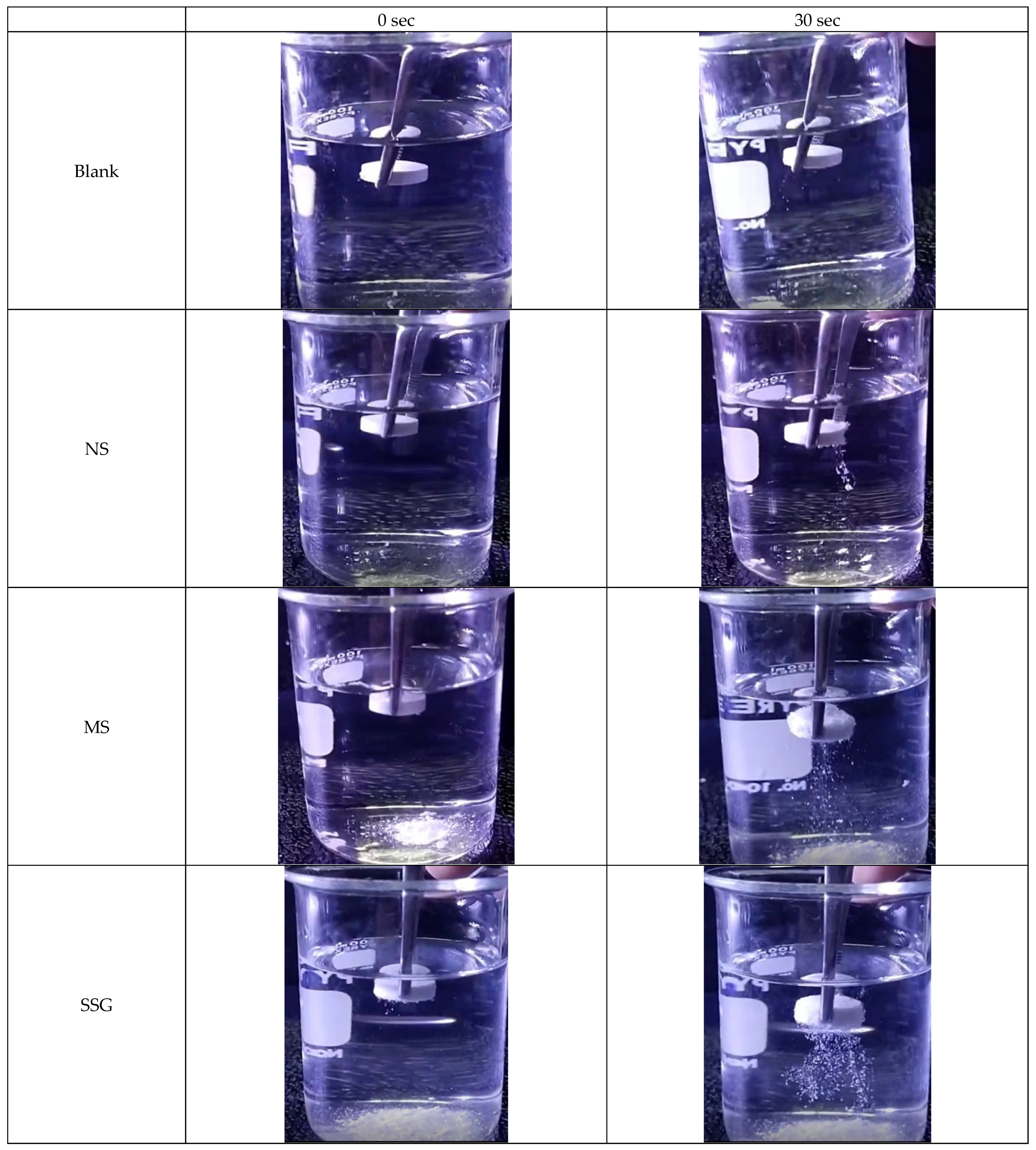
Figure 7 provides a visual assessment of the disintegration patterns of the paracetamol tablets. This qualitative analysis offers crucial insights into the mechanism and efficiency of each disintegrant, which complements the quantitative disintegration time data. The different formulations exhibited markedly distinct disintegration behaviors. The tablet containing no disintegrant (Blank) failed to break apart and remained intact. This is the expected outcome, as there is no active agent to overcome the cohesive forces of the compressed tablet matrix. The NS formulation showed inefficient and incomplete disintegration. The tablet slowly eroded into large granules. This indicates that the weak swelling force of NS was only sufficient to break the tablet along its weakest points, failing to shatter the matrix completely. The MS tablet displayed an ideal disintegration pattern. It rapidly and uniformly dispersed into a fine powder. This complete erosion is highly desirable because it maximizes the surface area of the drug particles exposed to the surrounding fluid, which is essential for rapid dissolution. The SSG tablet also disintegrated very quickly, but it broke down into small flakes or layers rather than a powder. This pattern is characteristic of the rapid, powerful swelling action of SSG, which tends to shear the tablet apart.

3.3.2. Dissolution Rate of Paracetamol Tablets

The dissolution rate is a critical performance attribute, as it determines how quickly the active drug becomes available for absorption in the body. For poorly water-soluble drugs like paracetamol, the tablet’s ability to break down and release the drug is the rate-limiting step.
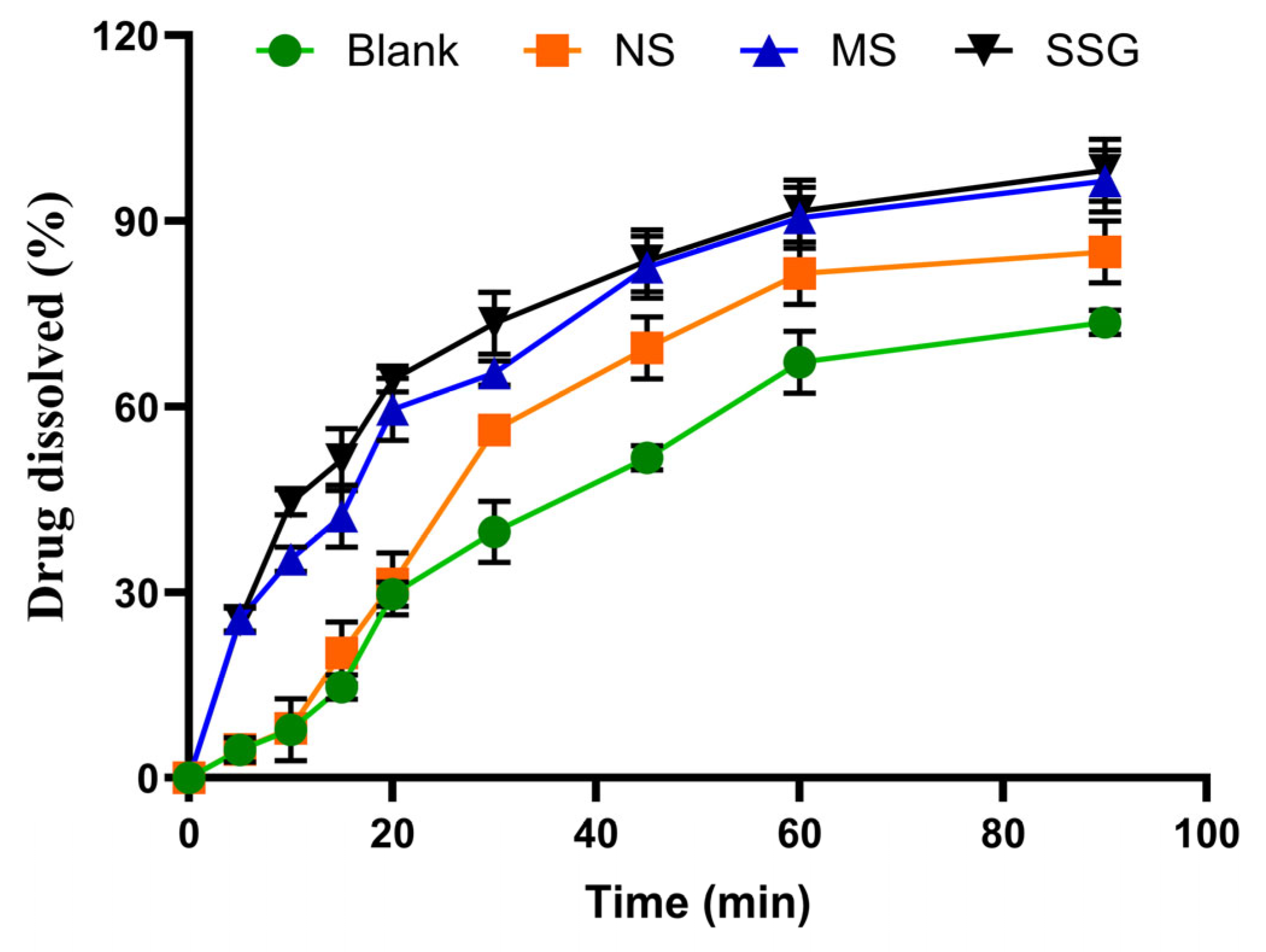
Formulations containing a disintegrant showed a significantly faster and more complete drug release than the blank formulation, which failed to release the drug effectively as observed in Figure 8. The modified starches (MS and SSG) resulted in much faster dissolution rates than the NS at the same 4% concentration. This is due to the enhanced swelling properties of the modified starches, which break the tablet into smaller granules, increasing the surface area for dissolution. Despite differences in their disintegration times, the overall dissolution profiles of the tablets containing 4% MS and 4% SSG were found to be statistically similar.
A key finding of this study was the apparent paradox: the SSG tablets disintegrated nearly three times faster than the MS tablets (3.3 s vs. 9.4 s), yet they did not produce a faster drug dissolution rate. The reason lies not in the speed of disintegration, but in the pattern of disintegration. The rapid, powerful swelling of SSG fractured the tablet into larger flakes or aggregates. While these flakes were small enough to pass through the disintegration test basket, they were not fully de-aggregated. The drug trapped within these flakes required additional time to dissolve out. The MS tablet, in contrast, disintegrated directly into a fine powder. This process, while slightly slower, immediately produced particles with a much larger effective surface area, allowing the paracetamol to dissolve rapidly and efficiently. Essentially, the slower but more complete disintegration of the MS tablet into a find powder allowed its dissolution rate to catch up to and match that of the faster but less complete disintegration of the SSG tablet.
To formally assess the similarity between the dissolution profiles, difference factor (f1) and similarity factor (f2) factors were calculated as shown in Table 3. According to regulatory standards, two profiles are considered equivalent if f1 is less than 15 and f2 is greater than 50. The analysis confirms with statistical certainty that the dissolution profiles of the tablets containing 4% MS and 4% SSG are equivalent (f1 = 7, f2 = 63) as shown in Table 1. In contrast, the profiles of the NS and Blank formulations were significantly different and not similarity profiles.
This study successfully demonstrates that the newly developed MS, when used at a 4% concentration in a paracetamol wet granulation formulation, performs as a highly effective super-disintegrant. It produces a tablet with a dissolution profile that is statistically indistinguishable from one made with the commercial gold-standard, SSG [53]. The superior disintegration pattern of MS (into a fine powder) fully compensates for the slightly faster disintegration time of SSG, leading to equivalent therapeutic performance.

3.3.3. Tablet Morphology and Porosity

The porosity of the tablets, defined as the proportion of void space within its tablet matrix, is a key determinant of mechanical strength fluid penetration and disintegrant behavior. In this study, tablet morphology and internal porosity were characterized using two complementary imaging techniques as SR-XTM. Preliminary XTM imaging provides high-resolution two-dimensional (2D) images of surface features, and SR-XTM offers a three-dimensional (3D) reconstruction of the tablet’s internal microstructure, enabling quantitative porosity analysis [57]. Three tablets (n = 3) from each formulation were examined to assess both surface and internal characteristics.
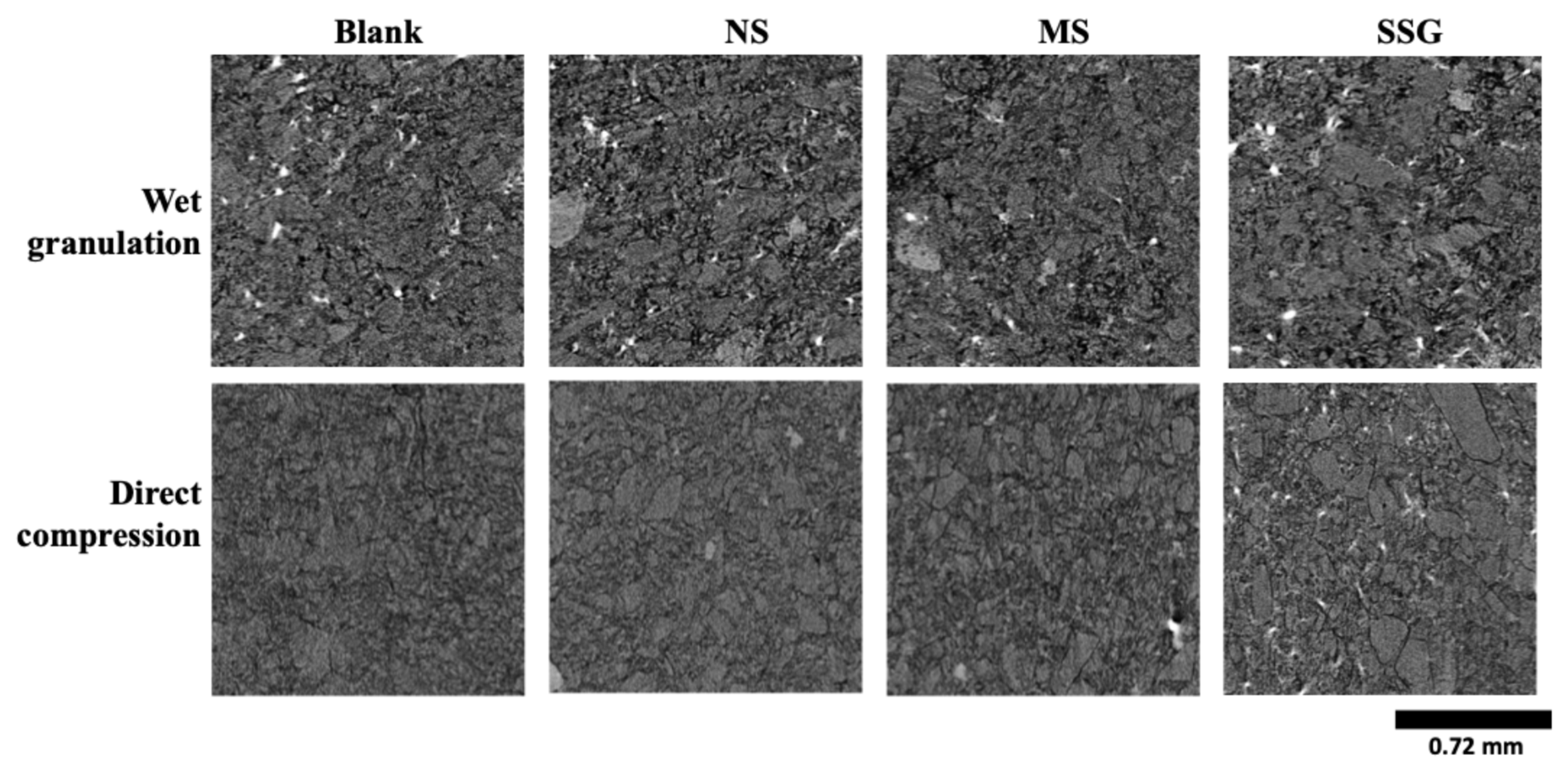
Preliminary XTM analysis (Figure 9) showed no discernible differences in surface morphology among the various formulations or manufacturing methods. The tablet surfaces appeared uniformly compact and smooth, regardless of whether they contained NS, MS, SSG, or no disintegrant (blank). However, as a 2D surface imaging technique (without synchrotron light radiation), it cannot visualize enclosed or internal pores that significantly contribute to total porosity.
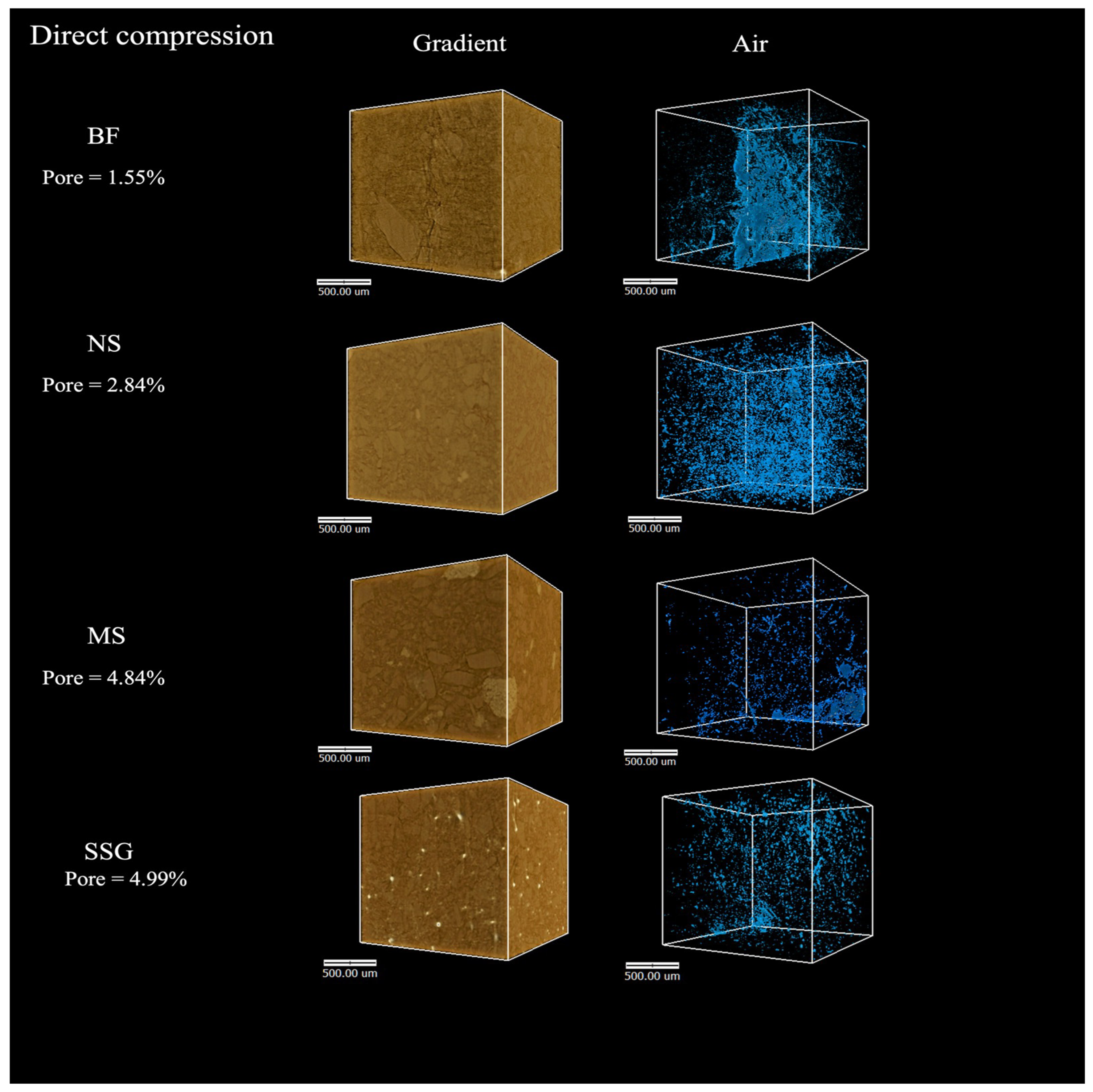
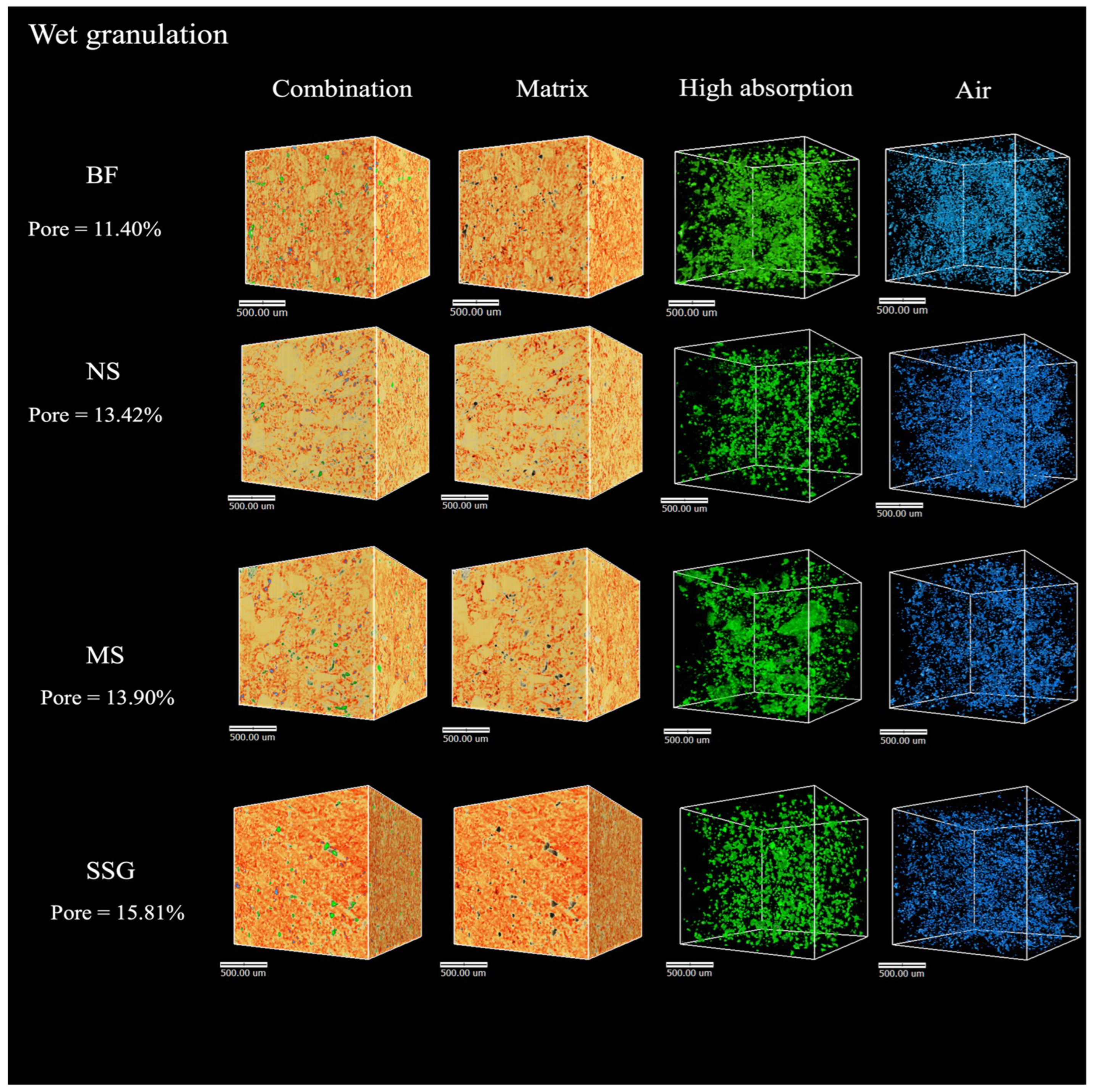
In contrast, SR-XTM (or micro-computed tomography under the sued of synchrotron light radiation) provided a detailed 3D visualization of the internal architecture of the tablets (Table 4, Figure 10 and Figure 11). The results demonstrated significant differences (p < 0.05) in total porosity depending on both the manufacturing method and type of disintegrant incorporated.
Tablets produced by wet granulation exhibited markedly higher porosity compared to those prepared by direct compression. This can be attributed to the intrinsic granules used in the wet granulation process. Each granule is a porous agglomerate of smaller particles, and upon compression, voids remain both within the granules (intra-granular pores) and between them (inter-granular pores), resulting in a less dense overall structure [58,59]. Conversely, tablets formed by direct compression displayed a denser and more compact matrix, as the fine powder particles packed more efficiently under compressive force, minimizing internal voids [60,61]. Despite this tight packing, these tablets exhibited poor mechanical integrity, characterized by higher friability and a tendency to crack, features typical of brittle matrices with limited plastic deformation [62,63].
In the SR-XTM images (Figure 10), the “high absorption” regions correspond to areas of increased X-ray attenuation, appearing as brighter zones within the tablet matrix. These were primarily observed in tablets produced by wet granulation. The presence of these high-absorption regions is likely attributable to the formation of compact, uniformly distributed granules during the wet granulation process. The granulation step promotes agglomeration of paracetamol and excipient particles, resulting in localized areas of higher density that attenuate X-rays more strongly.
In contrast, tablets prepared by direct compression (Figure 11) displayed no high-absorption areas. Because the paracetamol and excipients are blended as dry powders without a granulation step, particle packing is more heterogeneous, leading to a more uniform but less dense internal architecture. This structural difference between manufacturing methods explains why the high-absorption feature was only detected in the wet-granulated formulations.
The type of disintegrant incorporated also significantly influenced tablet porosity [64]. Formulations containing MS, SSG exhibited higher internal porosity than those containing NS or no disintegrant (blank). This effect is attributed to the granular morphology and partial elasticity of the modified starches, which resist full deformation during compression and thus preserve more interstitial voids [22,40,65]. The preserved pores form continuous capillary networks throughout the tablet, promoting faster penetration of water upon contact [66,67]. This structural feature acts synergistically with the swelling-driven disintegration mechanism of MS and SSG, resulting in rapid tablet rupture once hydration occurs. In contrast, tablets containing NS or lacking disintegrant showed lower porosity and slower water uptake, correlating with longer disintegration times.
A strong inverse correlation was observed between tablet porosity and disintegration time (Pearson’s r = −0.9770, p < 0.001), indicating that higher porosity facilitates faster tablet disintegration. This relationship reflects the critical role of microstructure architecture in fluid and capillary wicking. High porous tablets, particularly those prepared by wet granulation containing MS and SSG, provided a network of interconnected channels that enabled rapid water penetration, swelling and matrix rupture [65]. In contrast, denser tablets obtained by direct compression exhibited limited porosity and slower water diffusion, resulting in prolonged disintegration times. These findings quantitatively confirm that internal porosity is a major determinant of disintegration efficiency, consistent with previous reports highlighting the importance of pore connectivity and capillary action in tablet hydration dynamics [53,67].
The SR-XTM analysis provided critical 3D insights, demonstrating that the internal microarchitecture, rather than the external appearance, plays a decisive role in governing tablet disintegration performance. These findings underscore the significance of both formulation composition and manufacturing method in controlling tablet microstructure, hydration kinetics, and mechanical integrity.

4. Conclusions

This study successfully developed and characterized a super-disintegrant derived from Dioscorea hispida Dennst. var. hispida starch, a sustainable and locally available natural polymer. Chemical modification through carboxymethylation followed by cross-linking significantly enhanced the physicochemical and functional properties of the native starch. The modified starch (MS) exhibited smaller and more uniform granules, improved water uptake, higher swelling capacity, and optimal viscosity, attributes that collectively contributed to superior tablet disintegration performance. In preliminary model formulations and paracetamol tablets, incorporation of 4% w/w MS achieved the shortest disintegration time and demonstrated dissolution behavior statistically comparable to tablets containing the commercial super-disintegrant sodium starch glycolate (f1 = 7, f2 = 63). Advanced imaging analyses using SEM and Synchrotron radiation X-ray tomography further revealed that the modification improved particle morphology and porosity distribution, which facilitated rapid fluid penetration and disintegration. These findings confirm that modified Dioscorea hispida starch is an effective, eco-friendly, and economically viable alternative to synthetic super-disintegrants. Beyond its comparable performance to established commercial products, its renewable origin and local availability make it a promising candidate for advancing sustainable pharmaceutical manufacturing. Future work should focus on scaling up the modification process, assessing long-term stability and compatibility with diverse active pharmaceutical ingredients, and evaluating the environmental and economic impact of large-scale production. Such efforts will further validate the potential of D. hispida starch as a next-generation green excipient for immediate-release tablet formulations.

Author Contributions

Conceptualization and Experimental design, N.H., T.T. and S.L.; Investigation and data collection, N.H., T.T. and S.L.; Data evaluation and interpretation, N.H., T.T. and S.L.; Writing—Original Draft Preparation, S.L.; Writing—Review and Editing, N.H., T.T., R.C., P.P. and S.L.; Supervision, S.L.; Project administration, S.L. All authors have read and agreed to the published version of the manuscript.

Funding

This research received no external funding.

Institutional Review Board Statement

Not applicable.

Data Availability Statement

The raw data supporting the conclusions of this article will be made available by the authors on request.

Acknowledgments

The authors thank the College of Pharmacy, Rangsit University, Thailand, for support and facilitation. Additionally, our appreciation extends to Synchrotron Light Research Institute, Thailand for their support. Authors are also grateful to Thanawat Maneeratpaisan, Teerachet Pensasithron, and Sitthi Niwetthanawan for their technical assistance.

Conflicts of Interest

The authors declare no conflicts of interest.

Abbreviations

The following abbreviations are used in this manuscript:
NSNative Starch
CMSCarboxymethyl starch
MSModified starch
SEMScanning electron microscopy
SSGSodium starch glycolate
SR-XTMSynchrotron radiation X-ray tomography
DSCDifferential scanning calorimetry
TGAThermal gravimetric analysis
PXRDPowder X-ray diffraction
FTIR-ATRFourier transform infrared spectroscopy—attenuated total reflectance

References

  1. Augsburger, L.L.; Hoag, S.W. Pharmaceutical Dosage Forms–Tablets; CRC Press: Boca Raton, FL, USA, 2016. [Google Scholar]
  2. Sheskey, P.J.; Cook, W.G.; Cable, C.G. Handbook of Pharmaceutical Excipients Eight Edition; Pharmaceutical Press: London, UK, 2017. [Google Scholar]
  3. Rani, N.; Dev, D.; Prasad, D.N. Recent Trends in Developments of Superdisintegrants: An Overview. J. Drug Deliv. Ther. 2022, 12, 163–169. [Google Scholar] [CrossRef]
  4. Dilebo, J.; Gabriel, T. An Overview of Factors Affecting Superdisintegrants Functionalities. Int. J. Pharm. Sci. Nanotechnol. 2019, 12, 4355–4361. [Google Scholar] [CrossRef]
  5. Desai, P.M.; Liew, C.V.; Heng, P.W.S. Review of Disintegrants and the Disintegration Phenomena. J. Pharm. Sci. 2016, 105, 2545–2555. [Google Scholar] [CrossRef]
  6. Wei, Q.; Yang, F.; Luan, L. Preparation and in Vitro/in Vivo Evaluation of a Ketoprofen Orally Disintegrating/Sustained Release Tablet. Drug Dev. Ind. Pharm. 2013, 39, 928–934. [Google Scholar] [CrossRef] [PubMed]
  7. Chowdary, K.P.R.; Enturi, V.; Sandhya Rani, A. Preparation and Evaluation of Starch Phosphate—A New Modified Starch as a Disintegrant in Tablet Formulations. Int. J. Chem. Sci. 2011, 9, 3241–3243. [Google Scholar]
  8. Tran, P.H.L.; Tran, T.T.D. Recent Strategic Developments in the Use of Superdisintegrants for Drug Delivery. Curr. Pharm. Des. 2020, 26, 701–709. [Google Scholar] [CrossRef] [PubMed]
  9. Quodbach, J.; Kleinebudde, P. A Critical Review on Tablet Disintegration. Pharm. Dev. Technol. 2016, 21, 763–774. [Google Scholar] [CrossRef]
  10. Markl, D.; Zeitler, J.A. A Review of Disintegration Mechanisms and Measurement Techniques. Pharm. Res. 2017, 34, 890–917. [Google Scholar] [CrossRef]
  11. Wisudyaningsih, B.; Wijiani, N.; Anggraeni, V. Modification of Purple Sweet Potato Starch (Ipomoea batatas L. Poir) with Pragelatination and Acetylation Methods as Disintegrant of Paracetamol Tablets. Pharm. Educ. 2023, 23, 207–211. [Google Scholar] [CrossRef]
  12. Aanisah, N.; Wardhana, Y.W.; Chaerunisaa, A.Y.; Budiman, A. Review on Modification of Glucomannan as an Excipient in Solid Dosage Forms. Polymers 2022, 14, 2550. [Google Scholar] [CrossRef]
  13. Pal, M.S.; Waikar, D.S.B. Natural Excipients Used for Formulation of Pharmaceutical Beads. Int. J. Pharm. Sci. Rev. Res. 2023, 81, 6–12. [Google Scholar] [CrossRef]
  14. Debotton, N.; Dahan, A. Applications of Polymers as Pharmaceutical Excipients in Solid Oral Dosage Forms. Med. Res. Rev. 2017, 37, 52–97. [Google Scholar] [CrossRef]
  15. Jiang, Q.; Gao, W.; Li, X.; Xia, Y.; Wang, H.; Wu, S.; Huang, L.; Liu, C.; Xiao, P. Characterizations of Starches Isolated from Five Different Dioscorea L. Species. Food Hydrocoll. 2012, 29, 35–41. [Google Scholar] [CrossRef]
  16. Estiasih, T.; Ahmadi, K.; Sari, I.N.I.; Kuliahsari, D.E.; Martati, E. Traditional Detoxification of Wild Yam (Dioscorea hispida Dennst) Tuber in Chips Processing at East Java, Indonesia. J. Ethn. Foods 2022, 9, 49. [Google Scholar] [CrossRef]
  17. Hoover, R. Composition, Molecular Structure, and Physicochemical Properties of Tuber and Root Starches: A Review. Carbohydr. Polym. 2001, 45, 253–267. [Google Scholar] [CrossRef]
  18. Okunlola, A.; Odeku, O.A. Compressional Characteristics and Tableting Properties of Starches Obtained from Four Dioscorea Species. Farmacia 2009, 57, 756–770. [Google Scholar]
  19. Amani, N.G.; Buléon, A.; Kamenan, A.; Colonna, P. Variability in Starch Physicochemical and Functional Properties of Yam (Dioscorea Sp) Cultivated in Ivory Coast. J. Sci. Food Agric. 2004, 84, 2085–2096. [Google Scholar] [CrossRef]
  20. Oluwasina, O.O.; Wahab, O.; Umunna, Q.; Nwosa, O.C. Dioscorea dumetorum Pax as an Alternative Starch Source for Industrial Applications. IOSR J. Appl. Chem. 2017, 10, 5–13. [Google Scholar] [CrossRef]
  21. Okunlola, A.; Odeku, O.A. Comparative Evaluation of Starches Obtained from Dioscorea Species as Intragranular Tablet Disintegrant. J. Drug Deliv. Sci. Technol. 2008, 18, 445–447. [Google Scholar] [CrossRef]
  22. Obadi, M.; Xu, B. Review on the Physicochemical Properties, Modifications, and Applications of Starches and Its Common Modified Forms Used in Noodle Products. Food Hydrocoll. 2021, 112, 106286. [Google Scholar] [CrossRef]
  23. Arueya, G.L.; Ojesanmi, A.A. Evaluation of Effects of Increasing Molar Substitution of Hydroxypropylene on Physicochemical, Functional and Morphological Properties of Starch from Water Yam (Dioscorea alata). J. Food Res. 2019, 8, 58. [Google Scholar] [CrossRef]
  24. Chen, Y.F.; Kaur, L.; Singh, J. Chemical Modification of Starch. In Starch in Food: Structure, Function and Applications; Woodhead Publishing: Sawston, UK, 2017. [Google Scholar]
  25. Estiasih, T.; Kuliahsari, D.E.; Martati, E.; Ahmadi, K. Cyanogenic Compounds Removal and Characteristics of Non-and Pregelatinized Traditional Detoxified Wild Yam (Dioscorea hispida) Tuber Flour. Food Sci. Technol. 2022, 42, e1191. [Google Scholar] [CrossRef]
  26. Kumoro, A.C.; Retnowati, D.S.; Budiyati, C.S. Removal of Cyanides from Gadung (Dioscorea hispida Dennst.) Tuber Chips Using Leaching and Steaming Techniques. J. Appl. Sci. Res. 2011, 7, 2140–2146. [Google Scholar]
  27. Thi, L.; Thuy, H.; Nguyen, L.; Thanh, P.; Quynh Nhu, N.; Thao, N.T.; Thi, H.; Thao, T.; Luong, N.T.; Van Khoi, N.; et al. Evaluation of Reaction Conditions for Carboxymethylation of Mung Bean Starch Using Monochloroacetic Acid. J. Sci. Technol. Food 2020, 20, 37–46. [Google Scholar]
  28. Anutrakulchai, P.; Kittipongpatana, O.S. Effect of Dual Hydroxypropyl-Carboxymethyl Modification on the Physicochemical Properties of Mung Bean Starch. Chiang Mai Univ. J. Nat. Sci. 2011, 10, 57–69. [Google Scholar]
  29. Kittipongpatana, O.S.; Kittipongpatana, N. Physicochemical, in Vitro Digestibility and Functional Properties of Carboxymethyl Rice Starch Cross-Linked with Epichlorohydrin. Food Chem. 2013, 141, 1438–1444. [Google Scholar] [CrossRef]
  30. Lakshmi, B.S.; Ramu, A.; Vidyadhara, S.; Sailaja, Y.; Keerthana, R.S. Formulation and Evaluation of Ornidazole Oral Re-Constitutable Suspension. Res. J. Pharm. Technol. 2023, 16, 3289–3294. [Google Scholar] [CrossRef]
  31. Vlassenbroeck, J.; Masschaele, B.; Cnudde, V.; Dierick, M.; Pieters, K.; Van Hoorebeke, L.; Jacobs, P. Octopus 8: A High Performance Tomographic Reconstruction Package for X-Ray Tube and Synchrotron Micro-CT. In Advances in X-Ray Tomography for Geomaterials; Wiley: Hoboken, NJ, USA, 2010. [Google Scholar]
  32. Limaye, A. Drishti: A Volume Exploration and Presentation Tool. In Proceedings of the Developments in X-Ray Tomography VIII; SPIE: Bellingham, WA, USA, 2012; Volume 8506. [Google Scholar]
  33. Krstic, M.; Maksimovic, Z.; Ibric, S.; Bakic, T.; Prodanovic, J.; Razic, S. Lignocellulosic Biomass as a Source of Microcrystalline Cellulose—Chemical and Technological Characterization and Future Perspectives. Cellul. Chem. Technol. 2018, 52, 577–588. [Google Scholar]
  34. Dome, K.; Podgorbunskikh, E.; Bychkov, A.; Lomovsky, O. Changes in the Crystallinity Degree of Starch Having Different Types of Crystal Structure after Mechanical Pretreatment. Polymers 2020, 12, 641. [Google Scholar] [CrossRef]
  35. Warren, F.J.; Gidley, M.J.; Flanagan, B.M. Infrared Spectroscopy as a Tool to Characterise Starch Ordered Structure—A Joint FTIR-ATR, NMR, XRD and DSC Study. Carbohydr. Polym. 2016, 139, 35–42. [Google Scholar] [CrossRef]
  36. Ahmad, M.; Gani, A.; Hassan, I.; Huang, Q.; Shabbir, H. Production and Characterization of Starch Nanoparticles by Mild Alkali Hydrolysis and Ultra-Sonication Process. Sci. Rep. 2020, 10, 3533. [Google Scholar] [CrossRef]
  37. Wurm, F.; Mann, K.J.; Seidl, B.; Kozich, M.; Pham, T.; Bechtold, T. Single Fibre Coating of Cellulose Acetate Fibres for Hydrophilic Modification Using Carboxymethylated Starch. Carbohydr. Polym. Technol. Appl. 2023, 6, 100379. [Google Scholar] [CrossRef]
  38. Basri, S.N.; Zainuddin, N.; Hashim, K.; Yusof, N.A. Preparation and Characterization of Irradiated Carboxymethyl Sago Starch-Acid Hydrogel and Its Application as Metal Scavenger in Aqueous Solution. Carbohydr. Polym. 2016, 138, 34–40. [Google Scholar] [CrossRef]
  39. Zhang, J.; Li, A.; Wang, A. Study on Superabsorbent Composite. VI. Preparation, Characterization and Swelling Behaviors of Starch Phosphate-Graft-Acrylamide/Attapulgite Superabsorbent Composite. Carbohydr. Polym. 2006, 65, 150–158. [Google Scholar] [CrossRef]
  40. Lawal, M.V. Modified Starches as Direct Compression Excipients—Effect of Physical and Chemical Modifications on Tablet Properties: A Review. Starch-Staerke 2019, 71, 1800040. [Google Scholar] [CrossRef]
  41. Marta, H.; Hasya, H.N.L.; Lestari, Z.I.; Cahyana, Y.; Arifin, H.R.; Nurhasanah, S. Study of Changes in Crystallinity and Functional Properties of Modified Sago Starch (Metroxylon sp.) Using Physical and Chemical Treatment. Polymers 2022, 14, 4845. [Google Scholar] [CrossRef]
  42. Ashogbon, A.O. Dual Modification of Various Starches: Synthesis, Properties and Applications. Food Chem. 2021, 342, 128325. [Google Scholar] [CrossRef]
  43. Atuchukwu, E.; Adedokun, M.; Emeje, M. Synthesis, Characterization, and Functional Properties of a Novel Sodium Carboxymethyl Starch Obtained from Matured Seeds of Brachystegia eurycoma. Egypt. Pharm. J. 2021, 20, 145–156. [Google Scholar] [CrossRef]
  44. Huang, H.; Jiang, Q.; Chen, Y.; Li, X.; Mao, X.; Chen, X.; Huang, L.; Gao, W. Preparation, Physico-Chemical Characterization and Biological Activities of Two Modified Starches from Yam (Dioscorea opposita Thunb.). Food Hydrocoll. 2016, 55, 244–253. [Google Scholar] [CrossRef]
  45. Skopinska-Wisniewska, J.; Tuszynska, M.; Olewnik-Kruszkowska, E. Comparative Study of Gelatin Hydrogels Modified by Various Cross-Linking Agents. Materials 2021, 14, 396. [Google Scholar] [CrossRef]
  46. Ma, X.; Cheng, Y.; Qin, X.; Guo, T.; Deng, J.; Liu, X. Hydrophilic Modification of Cellulose Nanocrystals Improves the Physicochemical Properties of Cassava Starch-Based Nanocomposite Films. LWT 2017, 86, 318–326. [Google Scholar] [CrossRef]
  47. Subroto, E.; Cahyana, Y.; Indiarto, R.; Rahmah, T.A. Modification of Starches and Flours by Acetylation and Its Dual Modifications: A Review of Impact on Physicochemical Properties and Their Applications. Polymers 2023, 15, 2990. [Google Scholar] [CrossRef]
  48. Punia, S. Barley Starch Modifications: Physical, Chemical and Enzymatic—A Review. Int. J. Biol. Macromol. 2020, 144, 578–585. [Google Scholar] [CrossRef]
  49. Kodili, E.G.; Elechi, O.N. Evaluation and Optimization of the Physical and Sensory Properties of Enhanced Bread Produced from Wheat Flour and Chemically Modified African Yam Bean and Cassava Starches. Int. J. Res. Sci. Innov. 2022, 9, 110–123. [Google Scholar] [CrossRef]
  50. Jia, R.; Cui, C.; Gao, L.; Qin, Y.; Ji, N.; Dai, L.; Wang, Y.; Xiong, L.; Shi, R.; Sun, Q. A Review of Starch Swelling Behavior: Its Mechanism, Determination Methods, Influencing Factors, and Influence on Food Quality. Carbohydr. Polym. 2023, 321, 121260. [Google Scholar] [CrossRef]
  51. Ashogbon, A.O. The Recent Development in the Syntheses, Properties, and Applications of Triple Modification of Various Starches. Starch-Staerke 2021, 73, 2000125. [Google Scholar] [CrossRef]
  52. Kumari, B.; Sit, N. Comprehensive Review on Single and Dual Modification of Starch: Methods, Properties and Applications. Int. J. Biol. Macromol. 2023, 253, 126952. [Google Scholar] [CrossRef]
  53. Janssen, P.H.M.; Berardi, A.; Kok, J.H.; Thornton, A.W.; Dickhoff, B.H.J. The Impact of Lactose Type on Disintegration: An Integral Study on Porosity and Polymorphism. Eur. J. Pharm. Biopharm. 2022, 180, 251–259. [Google Scholar] [CrossRef]
  54. Martinez Villadiego, K.; Arias Tapia, M.J.; Useche, J.; Ledesma, Y.; Leyton, A. Thermal and Morphological Characterization of Native and Plasticized Starches of Sweet Potato (Ipomoea batatas) and Diamante Yam (Dioscorea rotundata). J. Polym. Environ. 2021, 29, 871–880. [Google Scholar] [CrossRef]
  55. Zou, J.; Li, Y.; Wang, F.; Su, X.; Li, Q. Relationship between Structure and Functional Properties of Starch from Different Cassava (Manihot esculenta Crantz) and Yam (Dioscorea opposita Thunb) Cultivars Used for Food and Industrial Processing. LWT 2023, 173, 114261. [Google Scholar] [CrossRef]
  56. Alamu, E.O.; Maziya-Dixon, B.; Okonkwo, C.C.; Asiedu, R. Physicochemical and Bioactive Properties of Selected White Yam (Dioscorea rotundata) Varieties Adapted to Riverine Areas of Nigeria. Afr. J. Food Sci. 2014, 8, 402–409. [Google Scholar] [CrossRef]
  57. Schomberg, A.K.; Diener, A.; Wünsch, I.; Finke, J.H.; Kwade, A. The Use of X-Ray Microtomography to Investigate the Microstructure of Pharmaceutical Tablets: Potentials and Comparison to Common Physical Methods. Int. J. Pharm. X 2021, 3, 100090. [Google Scholar] [CrossRef]
  58. Veronica, N.; Lee, E.S.M.; Heng, P.W.S.; Liew, C.V. Functionality of Wet-Granulated Disintegrant in Comparison to Directly Incorporated Disintegrant in a Poorly Water-Soluble Tablet Matrix. Int. J. Pharm. 2024, 661, 124467. [Google Scholar] [CrossRef]
  59. Šantl, M.; Ilić, I.; Vrečer, F.; Baumgartner, S. A Compressibility and Compactibility Study of Real Tableting Mixtures: The Impact of Wet and Dry Granulation versus a Direct Tableting Mixture. Int. J. Pharm. 2011, 414, 131–139. [Google Scholar] [CrossRef]
  60. Karehill, P.G.; Glazer, M.; Nyström, C. Studies on Direct Compression of Tablets. XXIII. The Importance of Surface Roughness for the Compactability of Some Directly Compressible Materials with Different Bonding and Volume Reduction Properties. Int. J. Pharm. 1990, 64, 35–43. [Google Scholar] [CrossRef]
  61. Johansson, B.; Alderborn, G. The Effect of Shape and Porosity on the Compression Behaviour and Tablet Forming Ability of Granular Materials Formed from Microcrystalline Cellulose. Eur. J. Pharm. Biopharm. 2001, 52, 347–357. [Google Scholar] [CrossRef]
  62. Mohylyuk, V. Effect of Roll Compaction Pressure on the Properties of High Drug-Loaded Piracetam Granules and Tablets. Drug Dev. Ind. Pharm. 2022, 48, 425–437. [Google Scholar] [CrossRef]
  63. Zhao, H.; Yu, Y.; Ni, N.; Zhao, L.; Lin, X.; Wang, Y.; Du, R.; Shen, L. A New Parameter for Characterization of Tablet Friability Based on a Systematical Study of Five Excipients. Int. J. Pharm. 2022, 611, 121339. [Google Scholar] [CrossRef]
  64. Markl, D.; Strobel, A.; Schlossnikl, R.; Bøtker, J.; Bawuah, P.; Ridgway, C.; Rantanen, J.; Rades, T.; Gane, P.; Peiponen, K.E.; et al. Characterisation of Pore Structures of Pharmaceutical Tablets: A Review. Int. J. Pharm. 2018, 538, 188–214. [Google Scholar] [CrossRef]
  65. Sun, C.C. Microstructure of Tablet—Pharmaceutical Significance, Assessment, and Engineering. Pharm. Res. 2017, 34, 918–928. [Google Scholar] [CrossRef]
  66. Bauhuber, S.; Warnke, G.; Berardi, A. Disintegrant Selection in Hydrophobic Tablet Formulations. J. Pharm. Sci. 2021, 110, 2028–2037. [Google Scholar] [CrossRef]
  67. Rojas, J.; Guisao, S.; Ruge, V. Functional Assessment of Four Types of Disintegrants and Their Effect on the Spironolactone Release Properties. AAPS PharmSciTech 2012, 13, 1054–1062. [Google Scholar] [CrossRef]
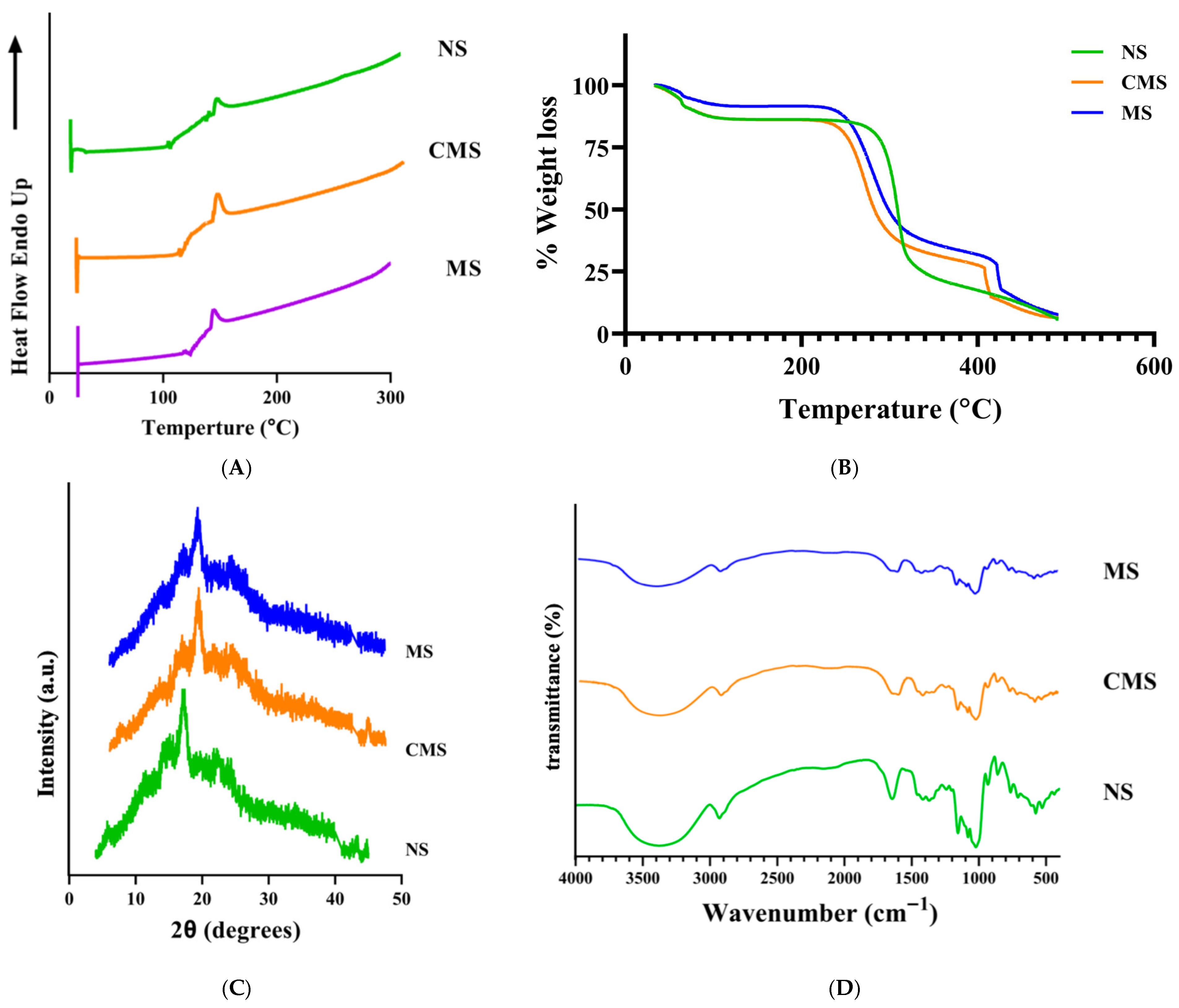
Figure 1. (A) DSC thermograms showing the thermal transitions of native starch (NS), carboxymethyl starch (CMS), and modified starch (MS), (B) TGA thermograms illustrating weight loss and thermal degradation profiles; (C) PXRD patterns highlighting crystallinity changes of each starch sample; (D) FTIR-ATR spectra confirming functional group integrity and potential interactions in all starches.
Polysaccharides 06 00109 g001
Figure 2. Hydration behavior observed on water uptake (A), percentage of bulk swelling (B) and sedimentation volume (C) of native starch (NS), carboxymethyl starch (CMS) and modified starches (MS). ** p < 0.01 vs. control and *** p < 0.001 vs. control.
Polysaccharides 06 00109 g002
Figure 3. Bulk density (A) and tapped density (B) compared with viscosity of native starch (NS), carboxymethyl starch (CMS) and modified starches (MS). * p < 0.05 vs. control.
Polysaccharides 06 00109 g003
Figure 4. Microscopic morphology of the starch samples was examined using scanning electron microscopy (SEM) at magnifications of 1000×, 2000×, and 5000×.
Polysaccharides 06 00109 g004
Figure 5. The effect of disintegrant type and concentration on the disintegration time of dicalcium phosphate (Emcompress®) tablets. The panels illustrate the performance of different starch based disintegrants at various concentrations: (A) native starch (NS), carboxymethyl starch (CMS), and modified starch (MS) and (B) the comparison of different starches at 4% concentrations.
Polysaccharides 06 00109 g005
Figure 6. Photographic documentation of the swelling behavior of tablets containing native wild yam starch (NS), carboxymethyl starch (CMS), and modified starch (MS). The images capture the process in both a 2-dimensional (Petri dish) and a 3-dimensional (beaker) environment at various time points.
Polysaccharides 06 00109 g006
Figure 7. Photographic documentation of the tablet disintegration process at the initial time point (0 s) and after 30 s of exposure to the medium.
Polysaccharides 06 00109 g007
Figure 8. Dissolution profiles of paracetamol tablets formulated with the different disintegrants (Blank, NS, MS, and SSG), illustrating the percentage of drug release over time.
Polysaccharides 06 00109 g008
Figure 9. Cross-sectional morphology of paracetamol tablets illustrating internal structure and porosity.
Polysaccharides 06 00109 g009
Figure 10. Synchrotron X-ray tomography (SR-XTM) visualization and quantified porosity of paracetamol tablets prepared by wet granulation using different disintegrants (blank, NS, MS, and SSG).
Polysaccharides 06 00109 g010
Figure 11. Synchrotron X-ray tomography (SR-XTM) visualization and quantified porosity of paracetamol tablets prepared by direct compression using different disintegrants (blank, NS, MS, and SSG).
Polysaccharides 06 00109 g011
Table 1. Formulations of paracetamol tablets containing various types of disintegrants at 4% w/w concentration.
IngredientsF1F2F3F4
Paracetamol (mg)500500500500
NS -4%--
MS--4%-
SSG---4%
10% PVP K90qs.qs.qs.qs.
Talcum2.4%2.4%2.4%2.4%
Magnesium stearate0.5%0.5%0.5%0.5%
Note: Blank formulation (F1) contained no disintegrant. NS = Native starch; MS = Modified starch (crosslinked carboxymethyl starch); SSG = Sodium starch glycolate.
Table 2. The paracetamol tablet formulations using different disintegration as native wild yam starch (NS), modified starch (MS), and (sodium starch glycolate, SSG) in comparison with the blank formulation (which contained no disintegrant).
PropertiesBlank4%NS4%MS4%SSG
Hardness (Kg/cm2)
Range7.0–8.07.0–7.57.0–7.57.0–7.5
Average7.33 ± 0.487.10 ± 0.327.30 ± 0.317.30 ± 0.27
Thickness (mm)
Range5.33–5.63 5.34–5.525.32–5.485.43–5.57
Average5.54 ± 0.215.45 ± 0.125.43 ± 0.145.50 ± 0.17
% Friability0.19 ± 0.020.37 ± 0.070.36 ± 0.010.71 ± 0.02
Weight variation529.24 ± 4.04551.65 ± 5.03549.85 ± 4.02552.30 ± 5.23
k2.42.42.42.4
Acceptance value (AV)11.5813.7111.5714.07
Disintegration time (s)60 ± 2.3244.82 ± 5.679.42 ± 2.423.32 ± 1.14
Table 3. The dissolution profiles of reference formulation (4% SSG) and test formulation (4% MS, 4% NS, and Blank) showed difference (f1) and similarity (f2) factors.
Reference FormulationTest Formulationf1
(Difference)
f2
(Similarity)
Profile Similarity
4% SSG4% MS763Equivalent
4% SSG4% NS3332Not equivalent
4% SSGBlank4627Not equivalent
Table 4. Average porosity and pore volume of the paracetamol tablets prepared by wet granulation (W) and direct compression (D) using different disintegrants (blank, NS, MS, and SSG).
SamplesAverage of Porosity (%)Average of Pore in Volume (mm3)
W111.40 ± 0.480.34 ± 0.03
W213.42 ± 0.470.39 ± 0.03
W313.90 ± 0.920.41 ± 0.05
W415.81 ± 0.970.49 ± 0.05
D11.55 ± 0.040.05 ± 0.01
D22.84 ± 0.020.09 ± 0.01
D34.84 ± 0.050.15 ± 0.01
D44.99 ± 0.070.15 ± 0.02
Disclaimer/Publisher’s Note: The statements, opinions and data contained in all publications are solely those of the individual author(s) and contributor(s) and not of MDPI and/or the editor(s). MDPI and/or the editor(s) disclaim responsibility for any injury to people or property resulting from any ideas, methods, instructions or products referred to in the content.