
Article

Design and Characterization of Yeast Protein–Polysaccharide Bioink Blends for 3D Printing
by
Or Peleg-Evron
1,†,
Noy Hen
1,2,†,
Maya Davidovich-Pinhas
3,
Shulamit Levenberg
4 and
Havazelet Bianco-Peled
1,*
1
Department of Chemical Engineering Technion, Israel Institute of Technology, Haifa 32000, Israel
2
The Norman Seiden Multidisciplinary Program for Nanoscience and Nanotechnology Technion, Israel Institute of Technology, Haifa 32000, Israel
3
Department of Biotechnology and Food Engineering Technion, Israel Institute of Technology, Haifa 32000, Israel
4
Department of Biomedical Engineering Technion, Israel Institute of Technology, Haifa 32000, Israel
*
Author to whom correspondence should be addressed.
These authors contributed equally to this work.
Polysaccharides 2025, 6(4), 101; https://doi.org/10.3390/polysaccharides6040101

Submission received: 15 August 2025 / Revised: 27 October 2025 / Accepted: 4 November 2025 / Published: 10 November 2025

Abstract

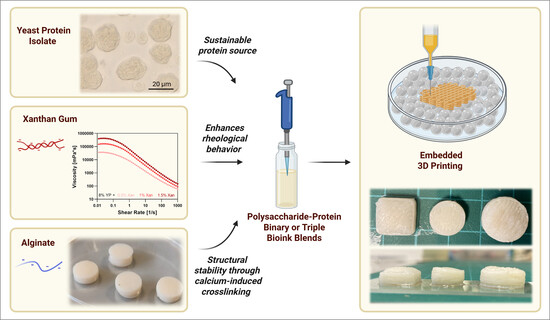
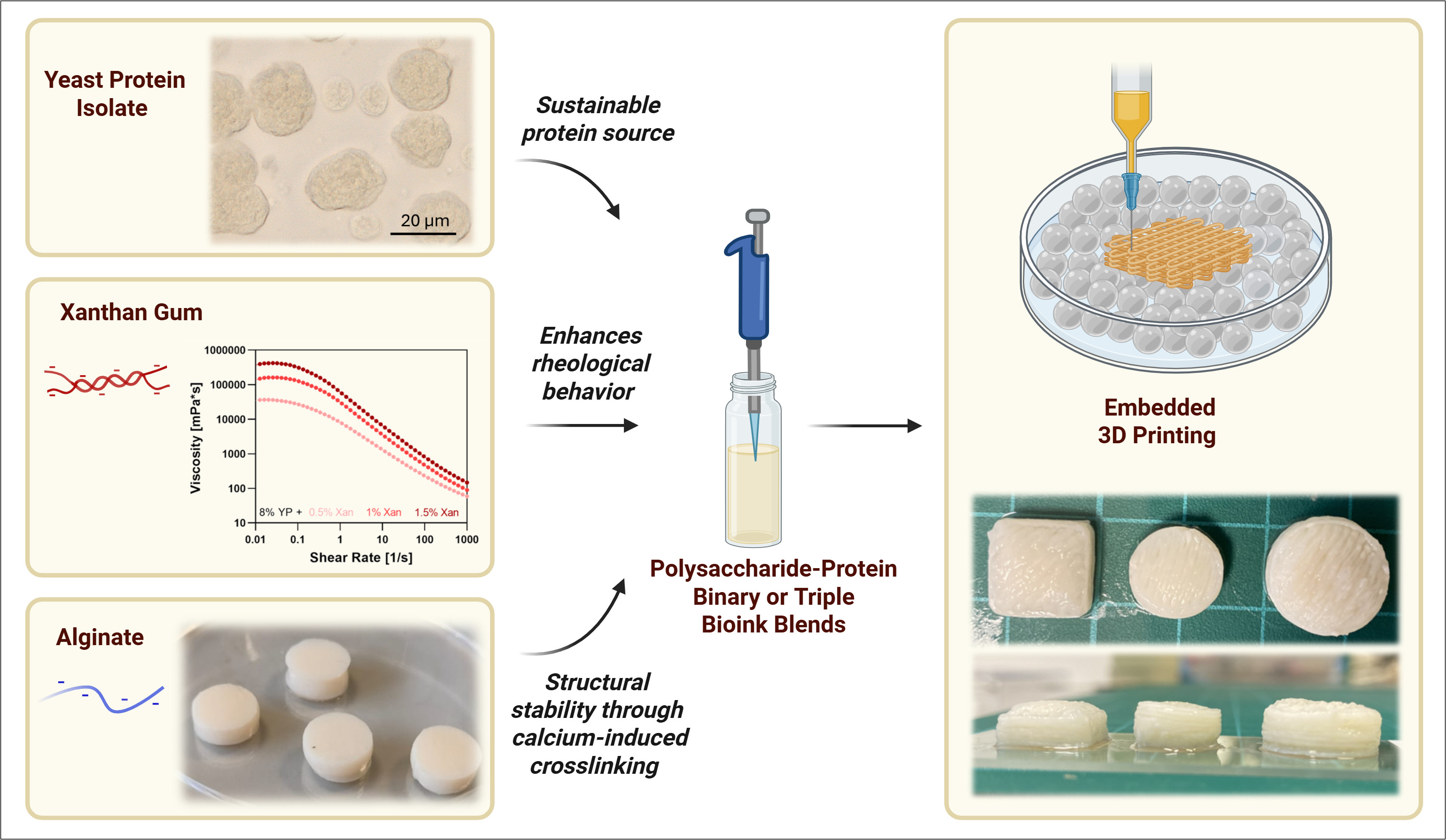
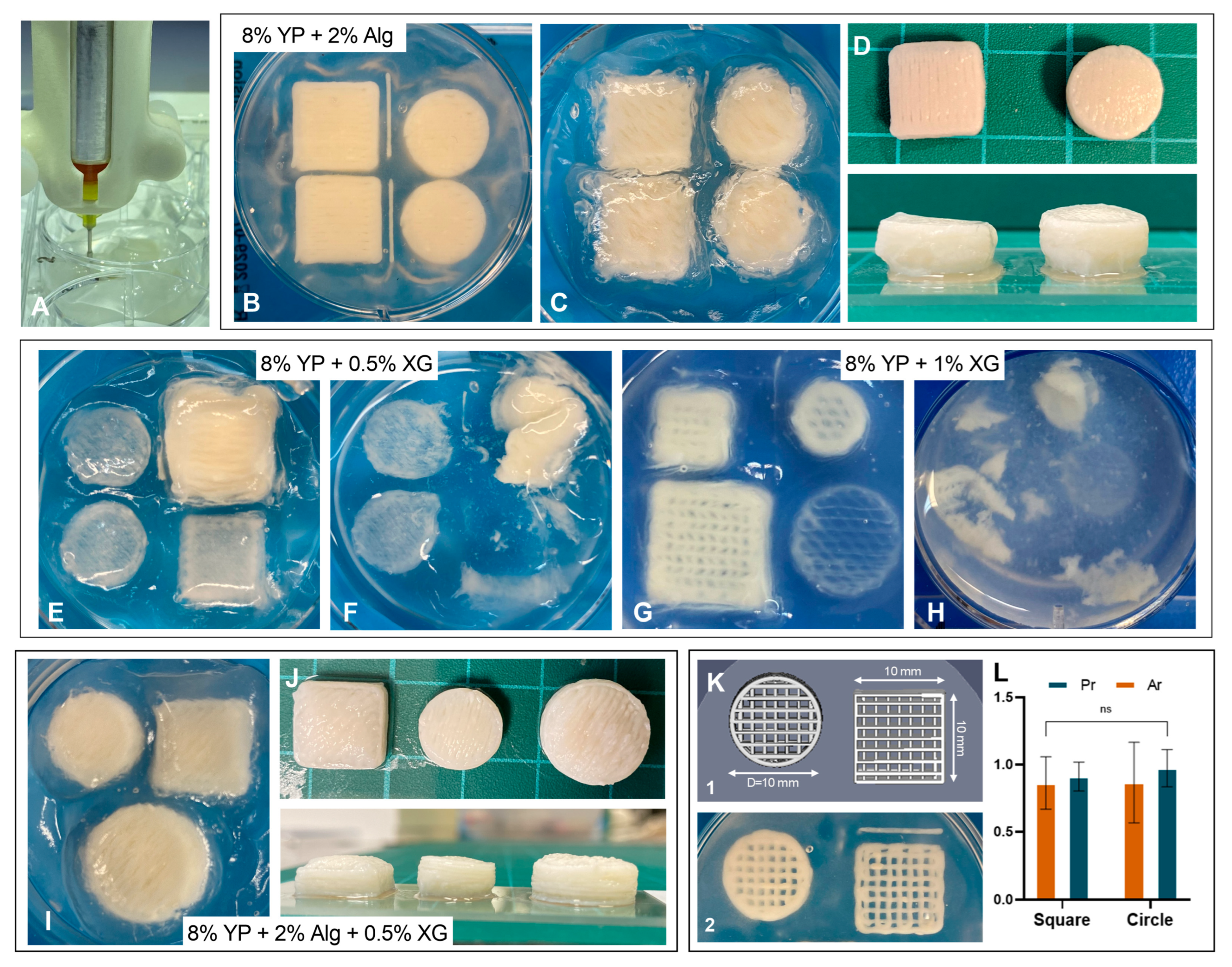
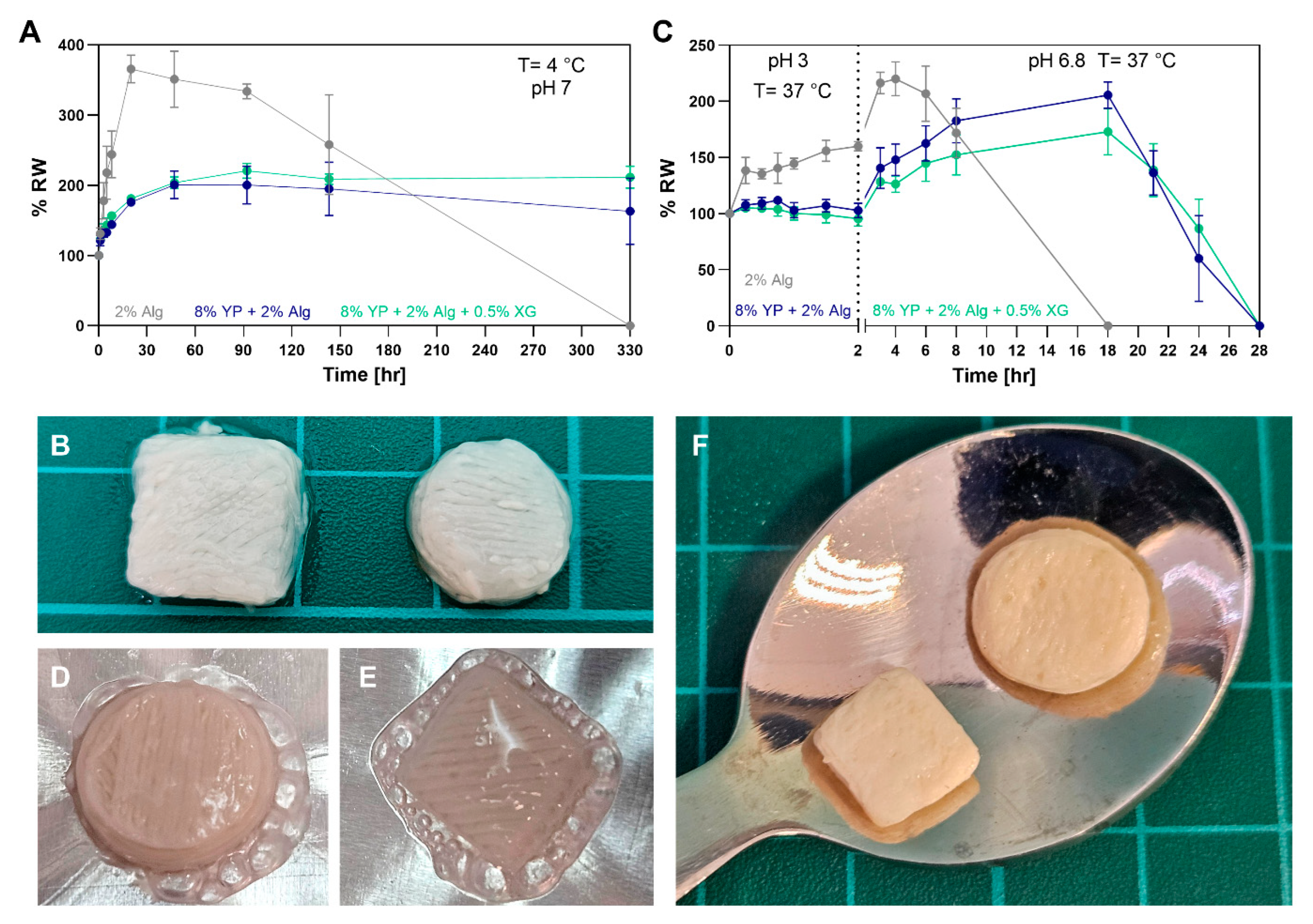
Yeast protein (YP) offers nutritional and sustainable benefits; however, its poor gelation properties limit its use in soft material formulations. This study investigates the rheological behavior and the formation of crosslinked networks using YP–polysaccharide mixtures for extrusion-based 3D printing. Binary bioink blends with alginate (Alg) or xanthan gum (XG) showed enhanced viscosity and exhibited shear-thinning properties. However, a high concentration of Alg negatively affected the material’s thixotropic recovery. On the other hand, YP–XG bioink displayed more pronounced elastic behavior and demonstrated thixotropic recovery, though they lacked the capacity for ionic crosslinking. A triple bioink formulation consisting of 8% (w/v) YP, 2% (w/v) Alg, and 0.5% (w/v) XG effectively combined the advantages of both polysaccharides. Alg provided structural stability through calcium crosslinking, while XG offered rheological flexibility. These bioinks were successfully printed using embedded 3D printing and maintained their shape fidelity after printing. The crosslinked triple hydrogel exhibited good mechanical strength, volume retention after crosslinking, structural integrity under compression of up to 70%, and recovery after deformation that indicates high structural stability. This research presents an effective strategy to enhance the application of yeast-derived proteins in sustainable, animal-free 3D printed food products and other soft biomaterials.
Keywords: yeast protein; alginate; xanthan gum; 3D printing; protein substitute; bioink yeast protein; alginate; xanthan gum; 3D printing; protein substitute; bioink
Graphical Abstract