

You are currently viewing a new version of our website. To view the old version click .

Horticulturae, Volume 7, Issue 4

April 2021 - 27 articles

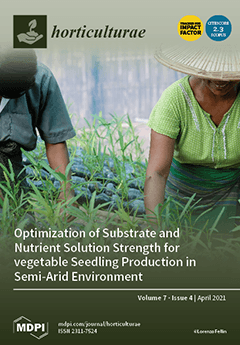
Cover Story: Challenging weather conditions force farmers around the world to find innovative solutions to grow foods that are necessary for their livelihood. In the Central Dry Zone of Myanmar, to face water shortage and low vegetable production, mainly during the dry season, farmers have adopted simplified cropping systems to grow green leafy vegetables. The starting point to ensure final vegetable cultivation success depends primarily on high-quality seedlings. This contribution focuses on two fundamental factors that significantly affect seedlings' growth at the early development stage, substrate and nutrient solution, offering optimal standards to enhance seedlings’ vegetable production in this semi-arid context. View this paper
  • Issues are regarded as officially published after their release is announced to the table of contents alert mailing list .
  • You may sign up for email alerts to receive table of contents of newly released issues.
  • PDF is the official format for papers published in both, html and pdf forms. To view the papers in pdf format, click on the "PDF Full-text" link, and use the free Adobe Reader to open them.

Articles (27)

  • Review
  • Open Access
69 Citations
21,469 Views
18 Pages

Temperate Fruit Trees under Climate Change: Challenges for Dormancy and Chilling Requirements in Warm Winter Regions

  • Abdel-Moety Salama,
  • Ahmed Ezzat,
  • Hassan El-Ramady,
  • Shamel M. Alam-Eldein,
  • Sameh K. Okba,
  • Hayam M. Elmenofy,
  • Islam F. Hassan,
  • Attila Illés and
  • Imre J. Holb

Adequate chill is of great importance for successful production of deciduous fruit trees. However, temperate fruit trees grown under tropical and subtropical regions may face insufficient winter chill, which has a crucial role in dormancy and product...

  • Article
  • Open Access
4 Citations
4,747 Views
10 Pages

Chronic kidney disease (CKD) has been a global health problem in recent years. CKD patients often restrict their potassium (K) intake to avoid the high risk of hyperkalemia. In this study, quantitative K management in hydroponics was adopted to produ...

  • Article
  • Open Access
5 Citations
3,411 Views
14 Pages

A Transcriptomic Analysis of Gene Expression in Chieh-Qua in Response to Fusaric Acid Stress

  • Min Wang,
  • Wenrui Liu,
  • Jinqiang Yan,
  • Piaoyun Sun,
  • Feng Chen,
  • Biao Jiang,
  • Dasen Xie,
  • Yu’e Lin,
  • Qingwu Peng and
  • Xiaoming He

Fusarium wilt results in undesirable effects on the quality and production of chieh-qua (Benincasa hispida Cogn. var. Chieh-qua How). Fusaric acid (FA), a secondary metabolite of biotin produced by pathogens of genus Fusarium, induced resistant respo...

  • Article
  • Open Access
51 Citations
5,055 Views
13 Pages

Exogenous EBR Ameliorates Endogenous Hormone Contents in Tomato Species under Low-Temperature Stress

  • Parviz Heidari,
  • Mahdi Entazari,
  • Amin Ebrahimi,
  • Mostafa Ahmadizadeh,
  • Alessandro Vannozzi,
  • Fabio Palumbo and
  • Gianni Barcaccia

Low-temperature stress is a type of abiotic stress that limits plant growth and production in both subtropical and tropical climate conditions. In the current study, the effects of 24-epi-brassinolide (EBR) as analogs of brassinosteroids (BRs) were i...

  • Feature Paper
  • Article
  • Open Access
26 Citations
7,634 Views
15 Pages

Peach, Apple, and Pear Fruit Quality: To Peel or Not to Peel?

  • Michail Michailidis,
  • Evangelos Karagiannis,
  • Elpida Nasiopoulou,
  • Christina Skodra,
  • Athanassios Molassiotis and
  • Georgia Tanou

The nutritional value of the peeled and unpeeled fruit (peel plus flesh tissues) was studied using four peach (Prunus persica L.; Red Heaven, Maria Blanca, Big Top, and Queen Giant), two pear (Pyrus communis L.; Santa Maria, Pyrus pyrifolia N.; Nashi...

  • Study Protocol
  • Open Access
6 Citations
3,326 Views
10 Pages

In this study, whether the addition of antifreeze protein (AFP) to a cryopreservative solution (plant vitrification solution 2 (PVS2)) is more effective in reducing freezing injuries in Hosta capitata than PVS2 alone at different cold exposure times...

  • Feature Paper
  • Article
  • Open Access
11 Citations
4,216 Views
13 Pages

The Effects of Post-Harvest Treatments on the Quality of Agastache aurantiaca Edible Flowers

  • Ilaria Marchioni,
  • Rosanna Dimita,
  • Giovanni Gioè,
  • Luisa Pistelli,
  • Barbara Ruffoni,
  • Laura Pistelli and
  • Basma Najar

Agastache spp. are used as ornamental plants for their pleasant aroma and the different colors of flowers. Nowadays, their edible flowers have become attractive for their nutraceutical properties. Post-harvest treatment appears as a crucial point to...

  • Feature Paper
  • Article
  • Open Access
23 Citations
6,055 Views
14 Pages

Blue light and ultra-violet (UV) light have been shown to influence plant growth, morphology, and quality. In this study, we investigated the effects of pre-harvest supplemental lighting using UV-A and blue (UV-A/Blue) light and red and blue (RB) lig...

  • Article
  • Open Access
18 Citations
4,866 Views
12 Pages

Cultivation Conditions Change Aroma Volatiles of Strawberry Fruit

  • Yunduan Li,
  • Yuanyuan Zhang,
  • Xincheng Liu,
  • Yuwei Xiao,
  • Zuying Zhang,
  • Yanna Shi,
  • Wenbing Kong,
  • Xiaofang Yang,
  • Guihua Jiang and
  • Bo Zhang
  • + 1 author

Volatile compounds principally contribute to flavor of strawberry (Fragaria × ananassa) fruit. Besides to genetics, cultivation conditions play an important role in fruit volatile formation. Compared to soil culture as control, effects of substrate c...

  • Feature Paper
  • Article
  • Open Access
11 Citations
3,827 Views
12 Pages

This investigation was carried out through three successive seasons (2017, 2018, and 2019) on young pomegranate trees of the Wonderful cultivar to study the effect of four different irrigation treatments (100%, 75%, 50%, and 25% of crop evapotranspir...

of 3

Get Alerted

Add your email address to receive forthcoming issues of this journal.

XFacebookLinkedIn
Horticulturae - ISSN 2311-7524