
Skip Content
You are currently on the new version of our website. Access the old version .

Fermentation, Volume 5, Issue 4

2019 December - 20 articles

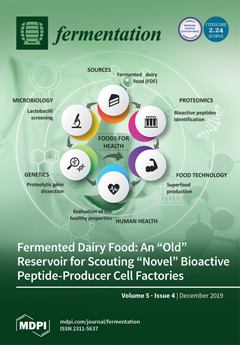
Cover Story: Advances in understanding the microbiota of artisanal fermented dairy foods reveled that lactic acid bacteria (LAB) therein have the ability to release bioactive peptides. Novel functional foods, the so-called hyperfood, can optimize the delivery of bioactive peptides to human. Knowledge-based design of hyperfood should prioritize the study on molecular effectors of LAB proteolysis. This “reverse food engineering” assists the screening of new bioactive peptide-producer cell factories and broadens the overall portfolio of functional food offered to final customers. View this paper.
  • Issues are regarded as officially published after their release is announced to the table of contents alert mailing list .
  • You may sign up for email alerts to receive table of contents of newly released issues.
  • PDF is the official format for papers published in both, html and pdf forms. To view the papers in pdf format, click on the "PDF Full-text" link, and use the free Adobe Reader to open them.

Articles (20)

  • Article
  • Open Access
45 Citations
11,497 Views
24 Pages

Screening and Application of Cyberlindnera Yeasts to Produce a Fruity, Non-Alcoholic Beer

  • Konstantin Bellut,
  • Maximilian Michel,
  • Martin Zarnkow,
  • Mathias Hutzler,
  • Fritz Jacob,
  • Jonas J. Atzler,
  • Andrea Hoehnel,
  • Kieran M. Lynch and
  • Elke K. Arendt

Non-alcoholic beer (NAB) is enjoying growing demand and popularity due to consumer lifestyle trends and improved production methods. In recent years in particular, research into the application of non-Saccharomyces yeasts to produce NAB via limited f...

  • Article
  • Open Access
6 Citations
3,293 Views
10 Pages

Preliminary Characterization of Yeasts from Bombino Bianco, a Grape Variety of Apulian Region, and Selection of an Isolate as a Potential Starter

  • Barbara Speranza,
  • Daniela Campaniello,
  • Leonardo Petruzzi,
  • Milena Sinigaglia,
  • Maria Rosaria Corbo and
  • Antonio Bevilacqua

Eighty-seven yeasts were isolated from Bombino bianco, a white grape variety from Apulian Region (Southern Italy). The isolates were characterized for the splitting of arbutin, the hydrolysis of pectins, sulphite production, the resistance to acetic...

  • Article
  • Open Access
39 Citations
7,534 Views
23 Pages

Screening for the Brewing Ability of Different Non-Saccharomyces Yeasts

  • Yvonne Methner,
  • Mathias Hutzler,
  • Dagmar Matoulková,
  • Fritz Jacob and
  • Maximilian Michel

Non-Saccharomyces yeasts have aroused interest in brewing science as an innovative and seminal way of creating new beer flavors. A screening system for potential brewing strains of non-Saccharomyces yeasts was set up to investigate the yeast’s...

  • Article
  • Open Access
226 Citations
20,697 Views
11 Pages

We isolated several strains of human and animal origin, focusing on the genera Lactobacillus and Bifidobacterium. Samples of cow colostrum, feces and saliva of calves and piglets, and infant feces were acquired, bacterial strains were isolated and id...

  • Article
  • Open Access
106 Citations
13,733 Views
17 Pages

Evaluation of Filamentous Fungal Biomass Cultivated on Vinasse as an Alternative Nutrient Source of Fish Feed: Protein, Lipid, and Mineral Composition

  • Sajjad Karimi,
  • Nasrollah Mahboobi Soofiani,
  • Torbjörn Lundh,
  • Amir Mahboubi,
  • Anders Kiessling and
  • Mohammad J. Taherzadeh

The rapid growth of aquaculture and scarcity of conventional fish feed supplements has prompted the introduction of new sustainable supplementation sources. In this study, the potential of five strains of fungal biomass of Ascomycetes and Zygomycetes...

  • Article
  • Open Access
23 Citations
5,863 Views
19 Pages

Developing a Microbial Consortium for Enhanced Metabolite Production from Simulated Food Waste

  • Nathan D. Schwalm,
  • Wais Mojadedi,
  • Elliot S. Gerlach,
  • Marcus Benyamin,
  • Matthew A. Perisin and
  • Katherine L. Akingbade

Food waste disposal and transportation of commodity chemicals to the point-of-need are substantial challenges in military environments. Here, we propose addressing these challenges via the design of a microbial consortium for the fermentation of food...

  • Article
  • Open Access
27 Citations
5,825 Views
21 Pages

In this study, we explored the diversity of yeasts and lactic acid bacteria (LAB) associated with six spontaneous sourdough fermentations from the northern part of the Apulian region (Italy). Bacterial and yeast isolates from sourdough were investiga...

  • Review
  • Open Access
101 Citations
14,553 Views
34 Pages

With rapidly ageing populations, the world is experiencing unsustainable healthcare from chronic diseases such as metabolic, cardiovascular, neurodegenerative, and cancer disorders. Healthy diet and lifestyle might contribute to prevent these disease...

  • Article
  • Open Access
7 Citations
3,702 Views
12 Pages

This study demonstrates that the consortium, which consists of the microbial flora of methane production (MFMP) and Clostridium cellulovorans grown with cellulose, can perform the direct conversion of cellulosic biomass to methane. The MFMP was taken...

  • Article
  • Open Access
18 Citations
7,372 Views
15 Pages

The high concentration of sugars in Icewine juice causes formidable stress for the fermenting Saccharomyces cerevisiae, causing cells to lose water and shrink in size. Yeast can combat this stress by increasing the internal concentration of glycerol...

  • Article
  • Open Access
16 Citations
4,069 Views
11 Pages

Influence of Native Saccharomyces cerevisiae Strains from D.O. “Vinos de Madrid” in the Volatile Profile of White Wines

  • Margarita García,
  • Braulio Esteve-Zarzoso,
  • Julia Crespo,
  • Juan Mariano Cabellos and
  • Teresa Arroyo

Yeasts during alcoholic fermentation form a vast number of volatile compounds that significantly influence wine character and quality. It is well known that the capacity to form aromatic compounds is dependent on the yeast strain. Thus, the use of na...

  • Article
  • Open Access
40 Citations
22,437 Views
12 Pages

Isolation and Optimal Fermentation Condition of the Bacillus subtilis Subsp. natto Strain WTC016 for Nattokinase Production

  • Shouyong Ju,
  • Zhilin Cao,
  • Christina Wong,
  • Yangyang Liu,
  • Mohamed F. Foda,
  • Zhenyu Zhang and
  • Jinshan Li

Nattokinase is a serine protease in the subtilisin family which is produced by Bacillus subtilis subsp. natto and exhibits vigorous fibrinolytic activity that has been suggested to be able to prevent and treat thromboembolic diseases. In this study,...

  • Article
  • Open Access
10 Citations
4,959 Views
10 Pages

(1) Background: Commercial production of fuel ethanol currently uses sugarcane and corn as feedstocks. Attempts to develop other renewable feedstocks that are more abundant have led to lignocellulosic biomass, which requires pretreatment prior to enz...

  • Article
  • Open Access
8 Citations
3,908 Views
12 Pages

Evaluation of Ionic Liquids as In Situ Extraction Agents during the Alcoholic Fermentation of Carob Pod Extracts

  • Sergio Sanchez-Segado,
  • María José Salar-García,
  • Víctor Manuel Ortiz-Martínez,
  • Antonia Pérez de los Ríos,
  • Francisco José Hernández-Fernández and
  • Luis Javier Lozano-Blanco

Anhydrous ethanol is a promising alternative to gasoline in fuel engines. However, since ethanol forms an azeotrope with water, high-energy-consumption separation techniques such as azeotropic distillation, extractive distillation, and molecular siev...

  • Article
  • Open Access
5 Citations
5,171 Views
13 Pages

Augmentation of Granular Anaerobic Sludge with Algalytic Bacteria Enhances Methane Production from Microalgal Biomass

  • Anna Doloman,
  • Yehor Pererva,
  • Michael H. Cortez,
  • Ronald C. Sims and
  • Charles D. Miller

The efficiency of anaerobic digestion relies upon activity of the inoculum converting organic substrate into biogas. Often, metabolic capacity of the inoculum needs to be augmented with new capabilities to accommodate changes in the substrate feed co...

  • Article
  • Open Access
17 Citations
4,634 Views
10 Pages

The Influence of Wheat Malt Quality on Final Attenuation Limit of Wort

  • Vinko Krstanović,
  • Kristina Mastanjević,
  • Viktor Nedović and
  • Krešimir Mastanjević

This paper aimed to investigate the influence of certain wheat and wheat malt quality indicators on limit of attenuation of wort (LAT). The experiment was conducted using wheats that have been proven to display the best malting properties with height...

  • Article
  • Open Access
40 Citations
5,869 Views
17 Pages

Selected Indigenous Saccharomyces cerevisiae Strains as Profitable Strategy to Preserve Typical Traits of Primitivo Wine

  • Angela Capece,
  • Rocchina Pietrafesa,
  • Gabriella Siesto,
  • Rossana Romaniello,
  • Nicola Condelli and
  • Patrizia Romano

Wine production by inoculated fermentation with commercial Saccharomyces cerevisiae strains is an ordinary practice in modern winemaking in order to assure the final quality of wine, although this procedure results in the production of highly homogen...

  • Article
  • Open Access
27 Citations
6,727 Views
11 Pages

The Biodiversity of Saccharomyces cerevisiae in Spontaneous Wine Fermentation: The Occurrence and Persistence of Winery-Strains

  • Lisa Granchi,
  • Donatella Ganucci,
  • Giacomo Buscioni,
  • Silvia Mangani and
  • Simona Guerrini

Saccharomyces cerevisiae populations occurring in spontaneous wine fermentations display a high polymorphism, although few strains are generally able to dominate the fermentative process. Recent studies have suggested that these indigenous S. cerevis...

  • Article
  • Open Access
12 Citations
5,899 Views
17 Pages

Developing integrated biorefineries requires the generation of high-value co-products produced alongside cellulosic ethanol. Most industrial yeast strains produce ethanol at high titers, but the small profit margins for generating ethanol require tha...

  • Review
  • Open Access
67 Citations
10,216 Views
15 Pages

Climate Changes and Food Quality: The Potential of Microbial Activities as Mitigating Strategies in the Wine Sector

  • Carmen Berbegal,
  • Mariagiovanna Fragasso,
  • Pasquale Russo,
  • Francesco Bimbo,
  • Francesco Grieco,
  • Giuseppe Spano and
  • Vittorio Capozzi

Climate change threatens food systems, with huge repercussions on food security and on the safety and quality of final products. We reviewed the potential of food microbiology as a source of biotechnological solutions to design climate-smart food sys...

Get Alerted

Add your email address to receive forthcoming issues of this journal.

XFacebookLinkedIn
Fermentation - ISSN 2311-5637