Skip to Content

Veterinary Sciences, Volume 5, Issue 4

2018 December - 22 articles

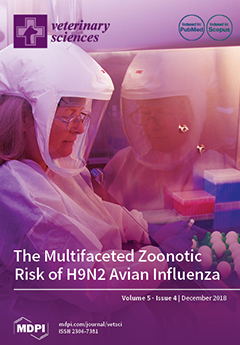
Cover Story: In 1997, a paradigm shift occurred when it was recognized that AIV could be transmitted directly from poultry to humans. Because of our increased awareness, thousands of cases of AIV in humans was documented. The first human cases of H9N2 subtype of AIV was in 1999, and sporadic cases have been reported over the last 20 years. This article summarizes multiple studies that examine the risk of H9N2 virus in humans. Serologic studies in humans in poultry-endemic countries show high seroprevalence in poultry-exposed workers, suggesting a high infection rate. Fortunately, H9N2 AIV have only been reported in cases of respiratory disease and not systemic disease with mortality. Influenza viruses by their nature can change rapidly, and we need to monitor these viruses in the hope of preventing or mitigating the next human pandemic. View this paper
  • Issues are regarded as officially published after their release is announced to the table of contents alert mailing list .
  • You may sign up for email alerts to receive table of contents of newly released issues.
  • PDF is the official format for papers published in both, html and pdf forms. To view the papers in pdf format, click on the "PDF Full-text" link, and use the free Adobe Reader to open them.

Articles (22)

  • Article
  • Open Access
1 Citations
4,112 Views
8 Pages

Serum Levels of Neuropeptides in Cows with Left Abomasal Displacement

  • Marlene Sickinger,
  • Joachim Roth,
  • Klaus Failing and
  • Axel Wehrend

17 December 2018

Abomasal displacement (AD) to the left is a common disease in high-yielding dairy cows after parturition. In view of the previously reported changes in tissue neuropeptide concentrations in cows with AD, the primary aim of this study was to evaluate...

  • Communication
  • Open Access
14 Citations
4,238 Views
9 Pages

Effect of Beta-Carotene Supplementation on the Serum Oxidative Stress Biomarker and Antibody Titer against Live Bovine Respiratory Syncytial Virus Vaccination in Japanese Black Calves

  • Konosuke Otomaru,
  • Rei Ogawa,
  • Shoko Oishi,
  • Yuki Iwamoto,
  • Hyeyoung Hong,
  • Kathuhisa Nagai,
  • Koji Hyakutake,
  • Chikara Kubota and
  • Takahiro Kaneshige

14 December 2018

The purpose of this study was to determine the effect of vaccination and beta-carotene supplementation on blood oxidative stress and antibody response in calves. Thirty Japanese Black calves were randomly assigned to two groups. Fifteen calves receiv...

  • Review
  • Open Access
21 Citations
6,840 Views
8 Pages

Cellular Immunotherapy of Canine Cancer

  • Selamawit Addissie and
  • Hans Klingemann

6 December 2018

Infusions with immune cells, such as lymphocytes or natural killer (NK) cells, represent one of several modalities of immunotherapy. In human patients with advanced B-cell leukemia or lymphoma, infusions with chimeric antigen receptor (CAR) T-lymphoc...

  • Case Report
  • Open Access
28 Citations
7,586 Views
13 Pages

The Effectiveness of a Foot and Mouth Disease Outbreak Control Programme in Thailand 2008–2015: Case Studies and Lessons Learned

  • Terdsak Yano,
  • Sith Premashthira,
  • Tosapol Dejyong,
  • Sahatchai Tangtrongsup and
  • Mo D. Salman

6 December 2018

Three Foot and Mouth Disease (FMD) outbreaks in northern Thailand that occurred during the implementation of the national FMD strategic plan in 2008–2015 are described to illustrate the lessons learned and to improve the prevention and control...

  • Article
  • Open Access
5 Citations
4,888 Views
10 Pages

Genetic Characterization of Indubrasil Cattle Breed Population

  • Ricardo Zanella,
  • Luísa V. Lago,
  • Arthur N. Da Silva,
  • Fábio Pértille,
  • Nathã S. De Carvalho,
  • João Cláudio Do Carmo Panetto,
  • Giovana C. Zanella,
  • Fernanda L. Facioli and
  • Marcos Vinicius G.B. Da Silva

3 December 2018

The Indubrasil breed was developed in the Brazilian region called Triângulo Mineiro as a result of a cross between zebu cattle. Initially, it was used as a terminal cross and currently it represents approximately 4.45% of all the Brazilian zebu...

  • Article
  • Open Access
6 Citations
6,472 Views
12 Pages

3 December 2018

Client communication is a core clinical skill that is taught as part of the required curriculum at many veterinary colleges. Although much client communication occurs face-to-face, telephone communication is used to provide patient updates, relay res...

  • Erratum
  • Open Access
3,331 Views
2 Pages

30 November 2018

Due to an error during production, the column title of Figure 2 and Figure 3 are misaligned in the Results section of the published paper [...]

  • Review
  • Open Access
38 Citations
11,716 Views
17 Pages

Lower Urinary Tract Neoplasia

  • Maureen A. Griffin,
  • William T. N. Culp and
  • Robert B. Rebhun

27 November 2018

Lower urinary tract neoplasia in companion animals is a debilitating and often life-threatening disease. Tumors of the bladder, urethra, and prostate often occur independently, although extension of these tumors into adjacent regions of the lower uri...

  • Review
  • Open Access
27 Citations
6,399 Views
9 Pages

Phytochemical Molluscicides and Schistosomiasis: What We Know and What We Still Need to Learn

  • Ronaldo de Carvalho Augusto and
  • Clelia Christina Correa De Mello-Silva

6 November 2018

Worldwide schistosomiasis remains a serious public health problem with approximately 67 million people infected and 200 million at risk of infection from inhabiting or transiting endemically active regions. Africa, South America, the Caribbean, and t...

  • Article
  • Open Access
29 Citations
10,177 Views
15 Pages

6 November 2018

Loyalty is one of the greatest intangible assets that any organization can possess and improving client loyalty is a primary marketing goal that can have a significant financial impact on any business. This quantitative study examined the mediating r...

  • Article
  • Open Access
12 Citations
5,892 Views
15 Pages

Competition among Escherichia coli Strains for Space and Resources

  • Sarah-Jo Paquette,
  • Rahat Zaheer,
  • Kim Stanford,
  • James Thomas and
  • Tim Reuter

2 November 2018

Shiga toxin-producing Escherichia coli (STEC) are a subgroup of E. coli causing human diseases. Methods to control STEC in livestock and humans are limited. These and other emerging pathogens are a global concern and novel mitigation strategies are r...

  • Review
  • Open Access
19 Citations
5,562 Views
20 Pages

Challenges and Opportunities Developing Mathematical Models of Shared Pathogens of Domestic and Wild Animals

  • Kathryn P. Huyvaert,
  • Robin E. Russell,
  • Kelly A. Patyk,
  • Meggan E. Craft,
  • Paul C. Cross,
  • M. Graeme Garner,
  • Michael K. Martin,
  • Pauline Nol and
  • Daniel P. Walsh

30 October 2018

Diseases that affect both wild and domestic animals can be particularly difficult to prevent, predict, mitigate, and control. Such multi-host diseases can have devastating economic impacts on domestic animal producers and can present significant chal...

  • Article
  • Open Access
9 Citations
7,273 Views
9 Pages

18 October 2018

Percutaneous ultrasound-guided radiofrequency heat-ablation (UG-RHA) is a therapeutic option for dogs with primary hyperparathyroidism (PHPTH) but information about its outcome is still controversial. This retrospective study aimed to evaluate the ou...

  • Review
  • Open Access
19 Citations
7,159 Views
11 Pages

17 October 2018

Collaborative learning activities are an increasingly prominent feature of veterinary curricula that have been redesigned to achieve competency-based graduate learning outcomes. This evolution challenges the traditional individualistic approach to ve...

  • Article
  • Open Access
8 Citations
4,619 Views
9 Pages

In Vitro Anthelminthic Efficacy of Hypoestes forskaolii (Vahl) R.Br (Acanthaceae) Extracts on Gastrointestinal Nematodes of Sheep

  • Massimiliano D’Ambola,
  • Antonio Bosco,
  • Andrea Ariano,
  • Laura Rinaldi,
  • Ammar Bader,
  • Alessandra Amadesi,
  • Giuseppe Cringoli and
  • Lorella Severino

16 October 2018

The anthelminthic efficacy of the crude extracts of Hypoestes forskaolii (Vahl) R.Br (Acanthaceae) against gastrointestinal nematodes (GIN) in sheep was investigated using the in vitro egg hatch inhibition assay. Faecal samples were collected from sh...

  • Article
  • Open Access
3 Citations
4,410 Views
11 Pages

Comparative Pathogenicity of Wildlife and Bovine Escherichia coli O157:H7 Strains in Experimentally Inoculated Neonatal Jersey Calves

  • Elizabeth M. Antaki-Zukoski,
  • Xunde Li,
  • Patricia A. Pesavento,
  • Tran H. B. Nguyen,
  • Bruce R. Hoar and
  • Edward R. Atwill

15 October 2018

Shiga toxin-producing Escherichia coli, like E. coli O157:H7, are important human and animal pathogens. Naturally-acquired E. coli O157:H7 infections occur in numerous species but, particularly, cattle have been identified as a significant reservoir...

  • Article
  • Open Access
12 Citations
14,342 Views
15 Pages

The Safety of an Adjuvanted Autologous Cancer Vaccine Platform in Canine Cancer Patients

  • Chris Weir,
  • Annika Oksa,
  • Jennifer Millar,
  • Miles Alexander,
  • Nicola Kynoch,
  • Zoe Walton-Weitz,
  • Peter Mackenzie-Wood,
  • Felicia Tam,
  • Hope Richards and
  • Rachel Allavena
  • + 4 authors

12 October 2018

Canine cancer rates are similar to humans, though the therapeutic options might be limited. Inducing a patient’s own immune system to have an anti-tumor response is an attractive approach to cancer therapy. In this safety study, autologous tumo...

  • Article
  • Open Access
5 Citations
4,334 Views
6 Pages

A Serological Survey on Swine Brucellosis Using Standard Procedures, Dot Blot, and Western Blot in Finisher Pigs in Central-North Italy

  • Fabrizio Bertelloni,
  • Mario Forzan,
  • Barbara Turchi,
  • Simona Sagona,
  • Maurizio Mazzei,
  • Antonio Felicioli,
  • Filippo Fratini and
  • Domenico Cerri

3 October 2018

In recent years, Brucella suis has been sporadically reported in Italy in domestic and wild swine. Since standard serological tests can determine false positive results, the development of alternative tests with improved sensitivity and specificity i...

  • Editorial
  • Open Access
1 Citations
4,182 Views
6 Pages

2 October 2018

The 9th Tick and Tick-borne Pathogen (TTP9) Conference was held in conjunction with the first Asia Pacific Rickettsia Conference (APRC1) in Cairns, Australia from 27 August until 1 September in 2017. This MDPI Veterinary Sciences Special Issue has be...

  • Article
  • Open Access
7 Citations
6,073 Views
11 Pages

28 September 2018

Clinical audit is a quality improvement tool used to assess and improve the clinical services provided to patients. This is the first study to investigate the extent to which clinical audit is understood and utilised in farm animal veterinary practic...

  • Review
  • Open Access
103 Citations
10,533 Views
18 Pages

The Multifaceted Zoonotic Risk of H9N2 Avian Influenza

  • Elizabeth A. Pusch and
  • David L. Suarez

21 September 2018

Poultry-adapted H9N2 avian influenza viruses (AIVs) are commonly found in many countries in Asia, the Middle East, Africa, and Europe, and although classified as low pathogenic viruses, they are an economically important disease. Besides the importan...

  • Review
  • Open Access
61 Citations
9,900 Views
24 Pages

21 September 2018

In a world where climate change, vector expansion, human activity, and pathogen dispersal do not respect boundaries, the human–animal–pathogen interface has become less defined. Consequently, a One Health approach to disease surveillance...

Get Alerted

Add your email address to receive forthcoming issues of this journal.

XFacebookLinkedIn
Vet. Sci. - ISSN 2306-7381