

You are currently viewing a new version of our website. To view the old version click .

Bioengineering, Volume 11, Issue 7

July 2024 - 106 articles

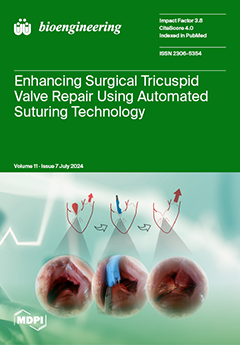
Cover Story: Valvular heart disease is a significant cause of cardiovascular morbidity and mortality. Minimal invasive cardiac surgery aims to restore health while decreasing the burden of intervention for affected patients. In the present study, we describe the use of automated suturing technology to facilitate valve repair in the setting of tricuspid regurgitation. Furthermore, we compare this modified approach to the conventional surgical technique in a passive beating heart model. The isolated and combined procedure proved to be effective in our experimental setup, offering a promising solution for the future treatment of tricuspid valve disease. View this paper
  • Issues are regarded as officially published after their release is announced to the table of contents alert mailing list .
  • You may sign up for email alerts to receive table of contents of newly released issues.
  • PDF is the official format for papers published in both, html and pdf forms. To view the papers in pdf format, click on the "PDF Full-text" link, and use the free Adobe Reader to open them.

Articles (106)

  • Article
  • Open Access
1 Citations
2,392 Views
19 Pages

Non-keratinizing carcinoma is the most common subtype of nasopharyngeal carcinoma (NPC). Its poorly differentiated tumor cells and complex microenvironment present challenges to pathological diagnosis. AI-based pathological models have demonstrated p...

  • Review
  • Open Access
8 Citations
5,812 Views
18 Pages

Wearable Near-Eye Tracking Technologies for Health: A Review

  • Lisen Zhu,
  • Jianan Chen,
  • Huixin Yang,
  • Xinkai Zhou,
  • Qihang Gao,
  • Rui Loureiro,
  • Shuo Gao and
  • Hubin Zhao

With the rapid advancement of computer vision, machine learning, and consumer electronics, eye tracking has emerged as a topic of increasing interest in recent years. It plays a key role across diverse domains including human–computer interaction, vi...

  • Article
  • Open Access
7 Citations
5,512 Views
20 Pages

The liver is a vital organ in the human body, and CT images can intuitively display its morphology. Physicians rely on liver CT images to observe its anatomical structure and areas of pathology, providing evidence for clinical diagnosis and treatment...

  • Article
  • Open Access
1 Citations
2,045 Views
13 Pages

Previous studies examining the flexion–relaxation phenomenon (FRP) in back muscles through trunk forward flexion tests have yielded inconsistent findings, primarily due to variations in leg posture control. This study aimed to explore the influ...

  • Article
  • Open Access
3 Citations
1,730 Views
16 Pages

Comparison of Left Ventricular Function Derived from Subject-Specific Inverse Finite Element Modeling Based on 3D ECHO and Magnetic Resonance Images

  • Lei Fan,
  • Jenny S. Choy,
  • Chenghan Cai,
  • Shawn D. Teague,
  • Julius Guccione,
  • Lik Chuan Lee and
  • Ghassan S. Kassab

Three-dimensional echocardiography (3D ECHO) and magnetic resonance (MR) imaging are frequently used in patients and animals to evaluate heart functions. Inverse finite element (FE) modeling is increasingly applied to MR images to quantify left ventr...

  • Article
  • Open Access
4 Citations
1,800 Views
15 Pages

The only fertility preservation and subsequent restoration option for many patients facing gonadotoxic treatments is ovarian tissue cryopreservation and transplantation. While this process is successful for some, there is significant room for improve...

  • Article
  • Open Access
1 Citations
2,865 Views
27 Pages

Helmet Radio Frequency Phased Array Applicators Enhance Thermal Magnetic Resonance of Brain Tumors

  • Faezeh Rahimi,
  • Bilguun Nurzed,
  • Thomas W. Eigentler,
  • Mostafa Berangi,
  • Eva Oberacker,
  • Andre Kuehne,
  • Pirus Ghadjar,
  • Jason M. Millward,
  • Rolf Schuhmann and
  • Thoralf Niendorf

Thermal Magnetic Resonance (ThermalMR) integrates Magnetic Resonance Imaging (MRI) diagnostics and targeted radio-frequency (RF) heating in a single theranostic device. The requirements for MRI (magnetic field) and targeted RF heating (electric field...

  • Article
  • Open Access
10 Citations
3,590 Views
13 Pages

Natural bone is a complex material that has been carefully designed. To prepare a successful bone substitute, two challenging conditions need to be met: biocompatible and bioactive materials for cell proliferation and differentiation, and appropriate...

  • Article
  • Open Access
3 Citations
2,527 Views
24 Pages

Investigation of Degradation and Biocompatibility of Indirect 3D-Printed Bile Duct Stents

  • Ming-Chan Lee,
  • Cheng-Tang Pan,
  • Ruo-Jiun Huang,
  • Hsin-You Ou,
  • Chun-Yen Yu and
  • Yow-Ling Shiue

This study proposes a bile duct stent based on indirect 3D printing technology. Four ratio materials were synthesized from lactic acid (LA) and glycolide (GA) monomers by melt polymerization: PLA, PLGA (70:30), PLGA (50:50), and PLGA (30:70). The fou...

  • Article
  • Open Access
7 Citations
1,950 Views
20 Pages

As magnetic field strength in Magnetic Resonance Imaging (MRI) technology increases, maintaining the specific absorption rate (SAR) within safe limits across human head tissues becomes challenging due to the formation of standing waves at a shortened...

of 11

Get Alerted

Add your email address to receive forthcoming issues of this journal.

XFacebookLinkedIn
Bioengineering - ISSN 2306-5354