



Environments, Volume 13, Issue 3 (March 2026) – 53 articles
Cover Story (view full-size image):
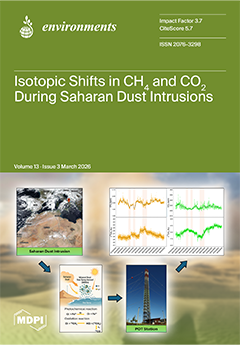
Saharan dust intrusions are increasingly recognized as active agents in atmospheric chemistry, yet their influence on the isotopic fractionation of greenhouse gases remains largely unexplored. This study provides new evidence from continuous CH₄ and CO₂ stable carbon isotope measurements at a new ICOS station in southern Italy, revealing that dust-laden air masses can measurably alter regional carbon dynamics. During dust events, δ¹³C–CH₄ shows enrichment alongside reduced CH₄ levels, suggesting enhanced oxidation driven by mineral aerosols. At the same time, δ¹³C–CO₂ exhibits unexpected depletion, consistent with dust-induced radiative suppression of photosynthesis. These findings highlight the overlooked role of Saharan dust in shaping short-term isotopic variability across the Mediterranean Basin. View this paper
- Issues are regarded as officially published after their release is announced to the table of contents alert mailing list.
- You may sign up for e-mail alerts to receive table of contents of newly released issues.
- PDF is the official format for papers published in both, html and pdf forms. To view the papers in pdf format, click on the "PDF Full-text" link, and use the free Adobe Reader to open them.
Previous Issue
Next Issue
