
Skip to Content
EnvironmentsEnvironments
  • Article
  • Open Access

12 March 2026

Risk of Cardiorespiratory Mortality Associated with Emissions from a Cement Plant: A Residential Cohort Study

,
,
,
,
,
and
1
Institute of Clinical Physiology, National Research Council, Via Moruzzi 1, 56124 Pisa, Italy
2
Institute of Atmospheric Science and Climate, National Research Council, Strada Prov.le Lecce-Monteroni, 73100 Lecce, Italy
3
Institute of Atmospheric Science and Climate, National Research Council, via Gobetti 101, 40129 Bologna, Italy
*
Author to whom correspondence should be addressed.

Abstract

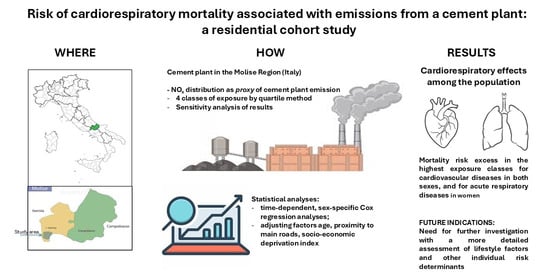
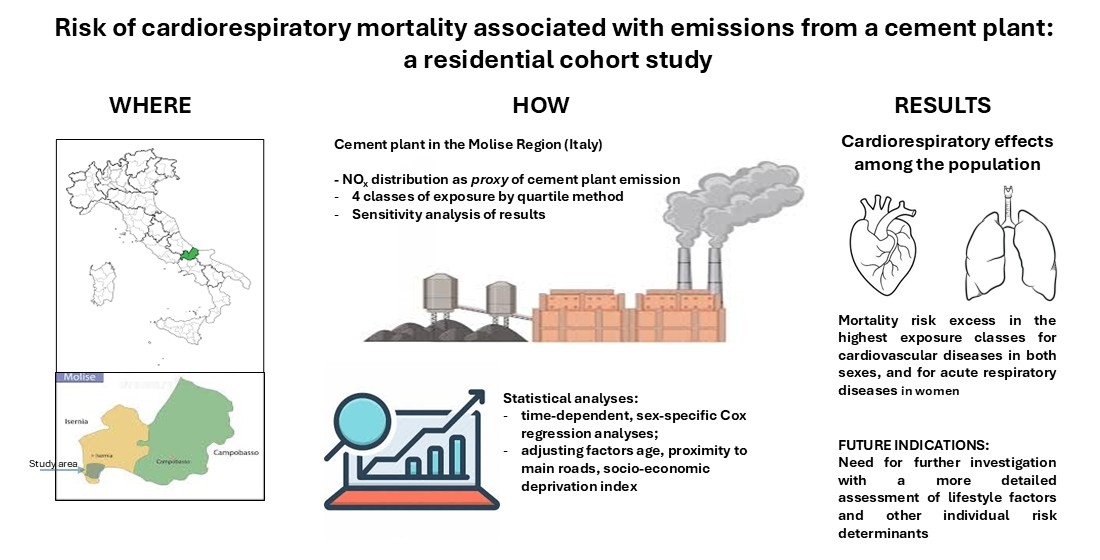
To evaluate the risk of cardiorespiratory mortality associated with exposure to air pollution produced by a cement plant, a population-based retrospective cohort study was conducted in an area of southern Italy (n = 29,495; follow-up 2006–2019; person-years = 317,810). Exposure areas were defined using the quartiles of the spatial distribution of the nitrogen oxide (NOx) mean concentration in 2016 as a proxy for the cement plant’s emissions and estimated using a meteorological–atmospheric dispersion model. The relationship between NOx and cause-specific mortality was quantified with time-dependent, sex-specific Cox regression analyses, controlling for age and proxies of socioeconomic deprivation and traffic pollution, accompanied by the confidence interval at 95% probability (CI95%) and an indicator (1 − p value) with values between 0 and 1, representing the likelihood of having a risk association. In the most exposed area, excesses of circulatory system diseases [men: HR = 1.60 (IC95% 1.24–2.06; 1 − p = 0.999); women: HR = 1.17 (0.93–1.48; 0.823)], heart diseases [men: HR = 1.66 (1.21–2.30; 0.998); women: HR = 1.24 (0.93–1.67; 0.855)], cerebrovascular diseases [men: HR = 2.11 (1.27–3.53; 0.996); women: HR = 1.52 (0.99–2.34; 0.946)], and acute respiratory diseases in women (HR = 2.46 (0.91–6.66; 0.924) were observed. The results, in line with the literature, suggest a deeper assessment of the potential impact of the cement plant, reinforcing the study design.

1. Introduction

Given its availability and its easy application process, cement is now one of the most widely used building materials [1,2,3,4]. In fact, it is able to bind materials, increasing both their durability and load-bearing capacity [5,6,7,8]. In 1960, there was a need for materials that would last over time, and the demand for cement exploded, so much so that the total cement production reached peaks of 4.4 billion tons in 2021 and 2023, while it was 1.39 billion tons in 1995 [9]. China produces more than half of the world’s production of cement (1.9 billion metric tons in 2024), and India is in second place. In Europe, the top three producers are, in order, Germany, Spain and Poland [3,10,11].
The cement manufacturing process is quite complex, and is therefore characterized by multiple sources of pollution, contributing to potentially harmful environmental and health impacts. In fact, once the pollutants emitted are released into the environment, they represent a source of exposure for both workers (potentially exposed to a range of pollutants such as nitrogen oxides (NOx), sulfur dioxide (SO2), carbon monoxide, carbon dioxide, polychlorinated dibenzo-p dioxins and dibenzofurans, and polychlorinated biphenyls) and residents near the plant (exposed to pollutants of various kinds) [12,13,14,15]. Therefore, an exposure to the substances released by cement plants can negatively affect the health of a population. There are a fair number of studies in the literature evaluating the health effects on cement plant workers [16,17,18,19,20] or on the population living near a cement plant that produces asbestos, as well as studies evaluating various types of outcomes or studies that consider different pollutants [21,22,23,24]. Few studies, however, assess the cardiorespiratory health of the general population living in the proximity of a cement plant [25,26,27,28]. In fact, to date, there are just a systematic review summarizing the evidence on the health effects of people exposed to air pollution from cement plants [26] and an Italian study evaluating the association between emissions from a cement plant in northern Italy and mortality, hospitalization, and cancer incidence among residents in the municipality where the cement plant operates [25]. The systematic review highlighted the risk associations between an exposure to cement plants’ emissions and respiratory symptoms and diseases [26], while the Italian study reported some mortality and risk excesses of hospitalization admission for diseases of the circulatory system, although it should be considered that for this pathology the literature does not report adequate evidence [25].
In the Italian region called Molise, there is the “Venafro Valley”, where one of the largest Italian cement production plants is located. This area is also subject to significant environmental pressure from urban and interurban traffic, with numerous heavy vehicles passing through.
An air quality assessment of the Venafro Valley highlighted that, during the period 2010–2019, more than three-quarters of total NOx emissions in the area were attributable to the cement plant, with the remaining contribution mainly related to road traffic [29].
This result motivates the study of the associations between the air pollution produced by the cement plant and the risk of mortality from environment-related diseases. To this end, in this study meteorological–dispersion modeling was used to estimate the spatial distribution of NOx concentrations attributable to the cement plant, allowing for exposure assessment to specifically focus on emissions from this single industrial source. The objective of the present analysis is therefore to assess the association between cement plant-related air pollution and cardiorespiratory mortality, adjusting for individual factors (age and sex), for proxies of socioeconomic deprivation, and for traffic-related air pollution from major roads. This study represents part of a previous larger study called “EPIVENAFRO+7” funded by the Molise Region [30].

2. Materials and Methods

The data and analysis methodology used in this study are based on those used in our previous one conducted in the same area [30]. The data used in this study were collected in accordance with the Helsinki Declaration of Ethical Principle. Specifically, according to precise rules in the management of regional information systems, and in full compliance with current privacy legislation (General Data Protection Regulation—GDPR, European Regulation 2016/679), all the record linkage procedures between personal, health and environmental data were carried out guaranteeing anonymity. To obtain a final dataset (containing personal data, such as demographic and residential data) with minimized information for research purposes, personal and health data have been pseudonymized. Furthermore, no personal identifiers were sent to the research staff; all addresses were geocoded and the personal data were anonymously analyzed.

2.1. Study Design

2.1.1. Study Domain

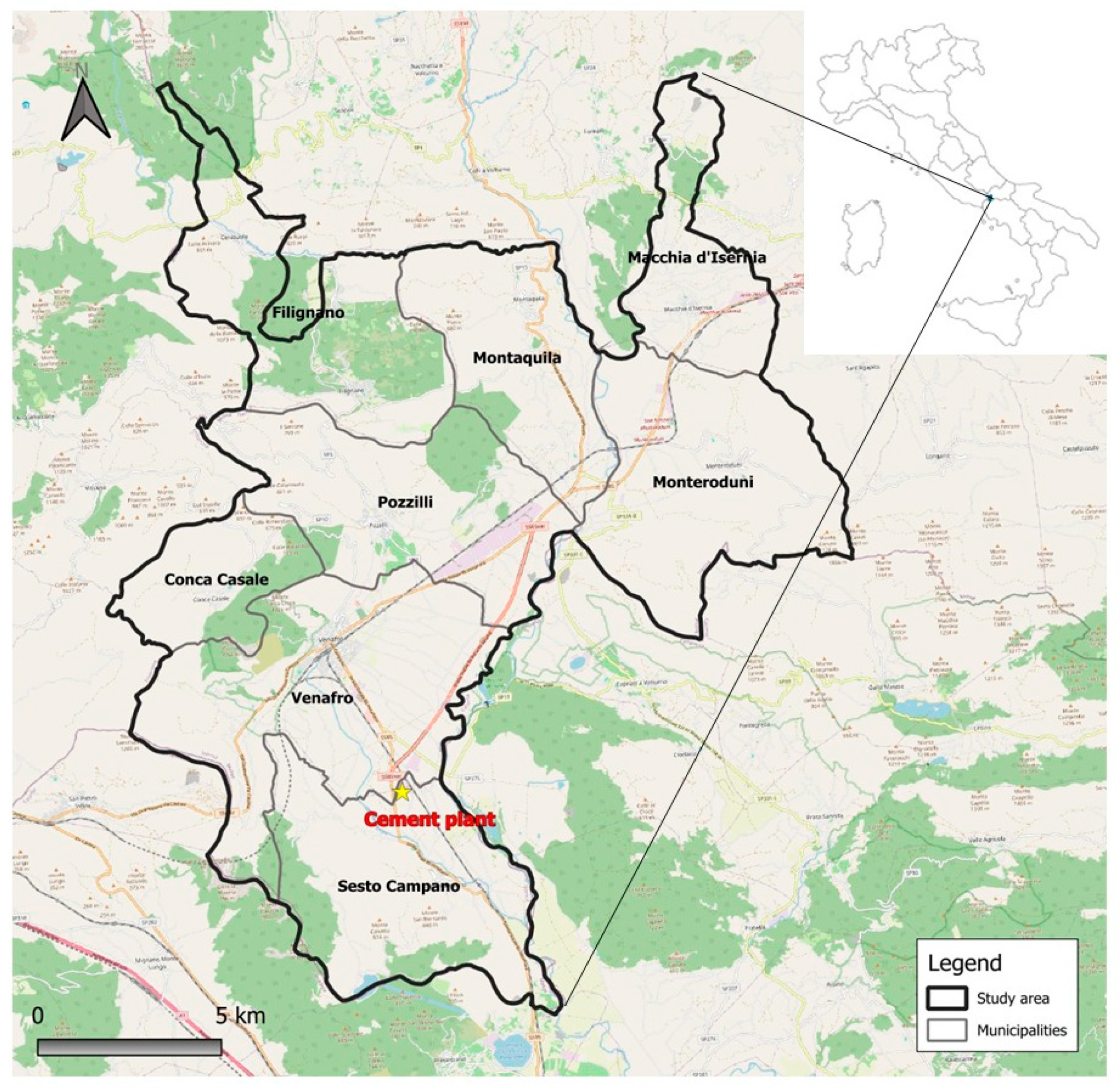
The study area included eight municipalities of the Venafro Valley (Figure 1).
Figure 1. Study area: the Venafro Valley—Molise Region (Conca Casale, Filignano, Macchia d’Isernia, Montaquila, Monteroduni, Pozzilli, Sesto Campano and Venafro) and the cement plant considered.

2.1.2. Definition of the Cohort and the Follow-Up Period

The cohort is residential and includes all individuals who were residents in the study area for at least one year during the follow-up period of 2006–2019. The peculiarity of this cohort is that it is open and dynamic: each subject can enter the cohort at different times during the study period considering birth and migration movements. In the case of a change in residence, the total person-years (PY) was the sum of PY accounting for the permanence at each address. All subjects were georeferenced.

2.2. Exposure Assessment

2.2.1. The Study Plant

The cement plant included in this study is located in the municipality of Sesto Campano (Figure 1) and represents a major industrial installation in the Venafro Valley. The facility operates a dry-process rotary kiln line to produce clinker, cement and related products. The main production phases include raw material preparation, clinker production, cement grinding, storage and shipment. The installation falls under IPPC category 3.1(a), with an authorized production capacity exceeding 500 t/day, corresponding to approximately 1,250,000 t/year of clinker and 1,700,000 t/year of cement. Since 2007, the plant has also been authorized for the co-incineration of non-hazardous waste (IPPC category 5.2(a)), with a nominal capacity of 4.16 t/h. The current ownership has been operating the plant since 2000. An Integrated Environmental Authorization (AIA) was granted in 2015 and subsequently updated in 2016 and 2017. Emissions originate both from high-temperature combustion processes, mainly associated with clinker production and conveyed through the main stack, and from low-temperature or mechanical processes (e.g., material handling and storage), which may generate diffuse or fugitive emissions. NOx, measured by the continuous emission monitoring system and expressed as the sum of nitrogen oxide and nitrogen dioxide, was selected as an indicator of plant-related emissions because it is directly associated with combustion processes and continuously monitored at the main stack, with hourly emission data available. Within the framework of this study, NOx were used as a proxy for the overall emission mixture from the cement plant and, when applied in the dispersion model, served as a tracer to characterize the spatial distribution of plant-related emissions, allowing identification of exposure gradients and areas of relatively higher and lower potential impact. In contrast, data for other pollutants, such as particulate matter and SO2, were inconsistent or unavailable.

2.2.2. Dispersion Modeling System

To isolate the contribution of the cement plant to ambient air pollution, the same dispersion modeling framework adopted in the previous study [30] was applied, with the key difference being that all input data in the present analysis refer exclusively to emissions from the cement plant. This approach allows exposure assessment to focus on a single industrial source located in a territorially complex setting. The Venafro Valley is characterized by complex orography and meteorological conditions that strongly influence pollutant transport and dispersion. In particular, the cement plant is situated close to mountainous reliefs at the margin of the valley, a configuration that enhances terrain-induced effects on plume behavior. Air pollution patterns in this context are shaped by multiple physical processes, including flow channeling along the valley axis, sheltering, cold-air pooling, drainage and slope flows, and plume impingement on higher terrain. These local circulation processes are superimposed on large-scale atmospheric motions, modifying mean flow fields, turbulence, and dispersion regimes. Accurate modeling therefore requires a detailed three-dimensional reconstruction of wind, temperature, and other meteorological variables. To consider all these processes, a modeling chain integrating the prognostic Weather Research and Forecasting (WRF) model, the CALMET micrometeorological model [31], and the CALPUFF dispersion model [32,33] was implemented. WRF provided synoptic-scale meteorological fields for the reference year 2016 over a 100 km × 100 km domain centered on Venafro, with a horizontal resolution of 1 km, sufficient to capture large-scale circulation patterns. Domain size and grid resolution were selected to balance computational efficiency with the need to resolve relevant mesoscale and local features. The year 2016 was chosen as the reference year due to the availability of hourly emissions data from the cement plant and the absence of significant meteorological anomalies. Continuous ground-level meteorological observations within the modeling domain were not available for the entire study period and therefore could not be used for a quantitative validation of the model outputs. Modeled wind patterns were qualitatively compared with wind roses reported in publicly available technical reports and in a previous study conducted in the same area, showing a consistent representation of the dominant wind directions [34]. Given that combustion-related emissions from cement plants include a mixture of gaseous and particulate pollutants, not all routinely monitored, NOx was selected as a surrogate indicator of plant-related emissions based on data availability and consistency, also considering that hourly emission measurements of other pollutants (particulate and SO2) showed a loss of valid or available values in the reference year. Hourly NOx emissions provided by the plant operators were used as input for the dispersion model, assuming a stack height of 106 m, a yearly average exit velocity of 9 m/s, an exhaust gas temperature of 391 K, and an average NOx mass flow rate of 25 g/s. Micrometeorological variables and annual mean NOx concentrations attributable to the cement plant were subsequently estimated over a finer domain of 61 km × 61 km, with a spatial resolution of 1 km × 1 km, providing spatially resolved exposure estimates for the epidemiological analyses (Table 1).
Table 1. CALMET model setup.
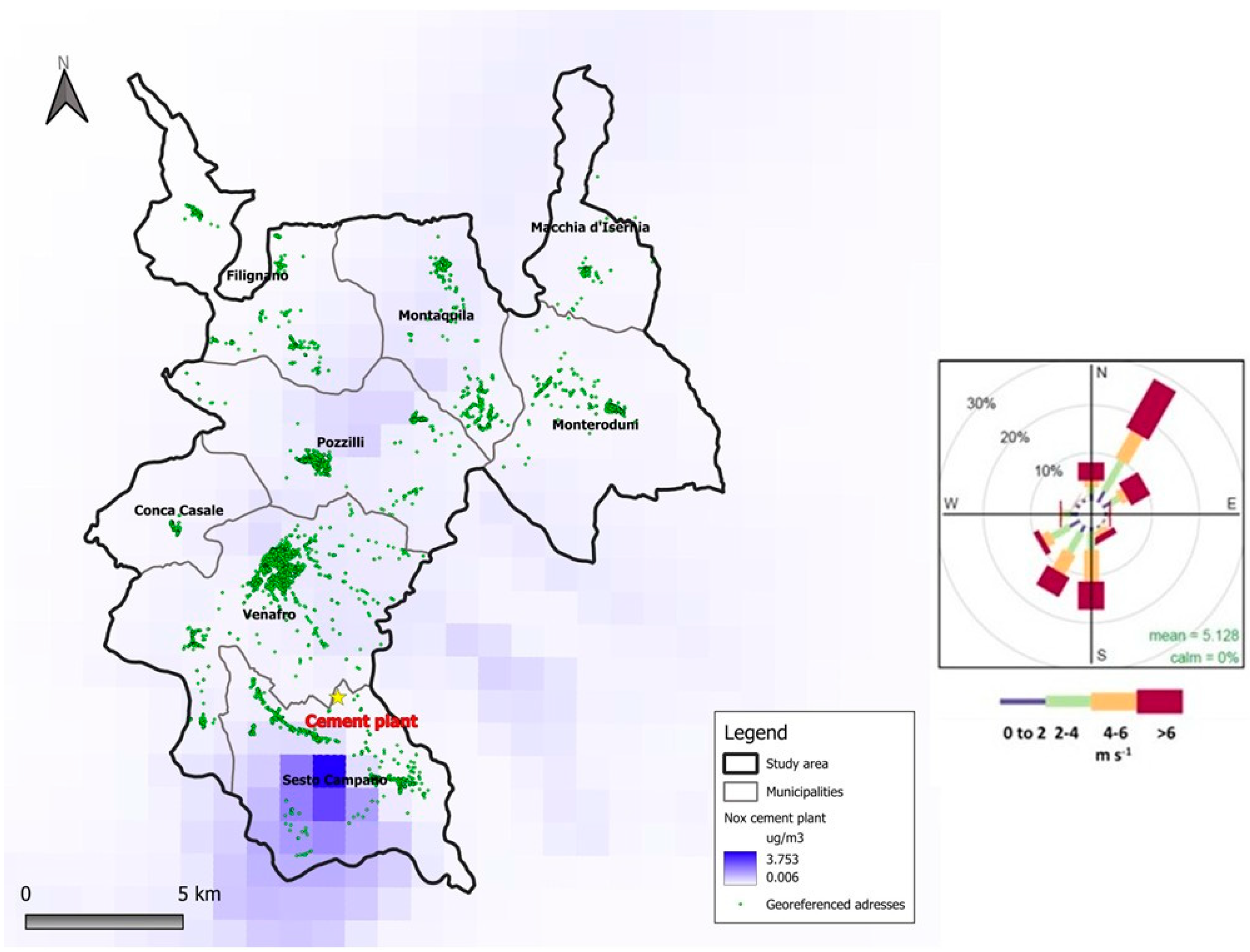
Figure 2 illustrates the spatial distribution of annual mean ground-level NOx concentrations. The spatial imprint of the plant shows marked variability, largely shaped by the complex orographic setting of the valley and the surrounding mountainous reliefs. The combined effects of local meteorology, terrain configuration, and stack height influence plume dispersion, resulting in higher concentrations near the plant and along adjacent slopes where plume impingement occurs. Concentrations range from a minimum of 0.006 μg/m3 to a maximum of 3.75 μg/m3, with the highest annual mean NOx concentrations observed around Sesto Campano, corresponding to the most exposed zone near the cement plant.
Figure 2. Dispersion map for the territory of nitrogen oxide (NOx) concentration with WRF/CALMET/CALPUFF model (reference year, 2016).

2.2.3. Population Exposure to Cement Plant

For each subject in the cohort, the NOx concentration of the 1 km × 1 km cell containing the georeferenced residential address was assigned. Estimated individual exposure levels to plant emissions were classified into four NOx classes using the quartile method. Estimated individual exposure levels to plant emissions have been classified into four classes of NOx according to the quartile method (Figure 3):
  • Class 1 (reference; least exposed class): 0.068–0.198 μg/m3;
  • Class 2: 0.199–0.291 μg/m3;
  • Class 3: 0.292–0.369 μg/m3;
  • Class 4 (class with higher exposure): 0.370–1.919 μg/m3.
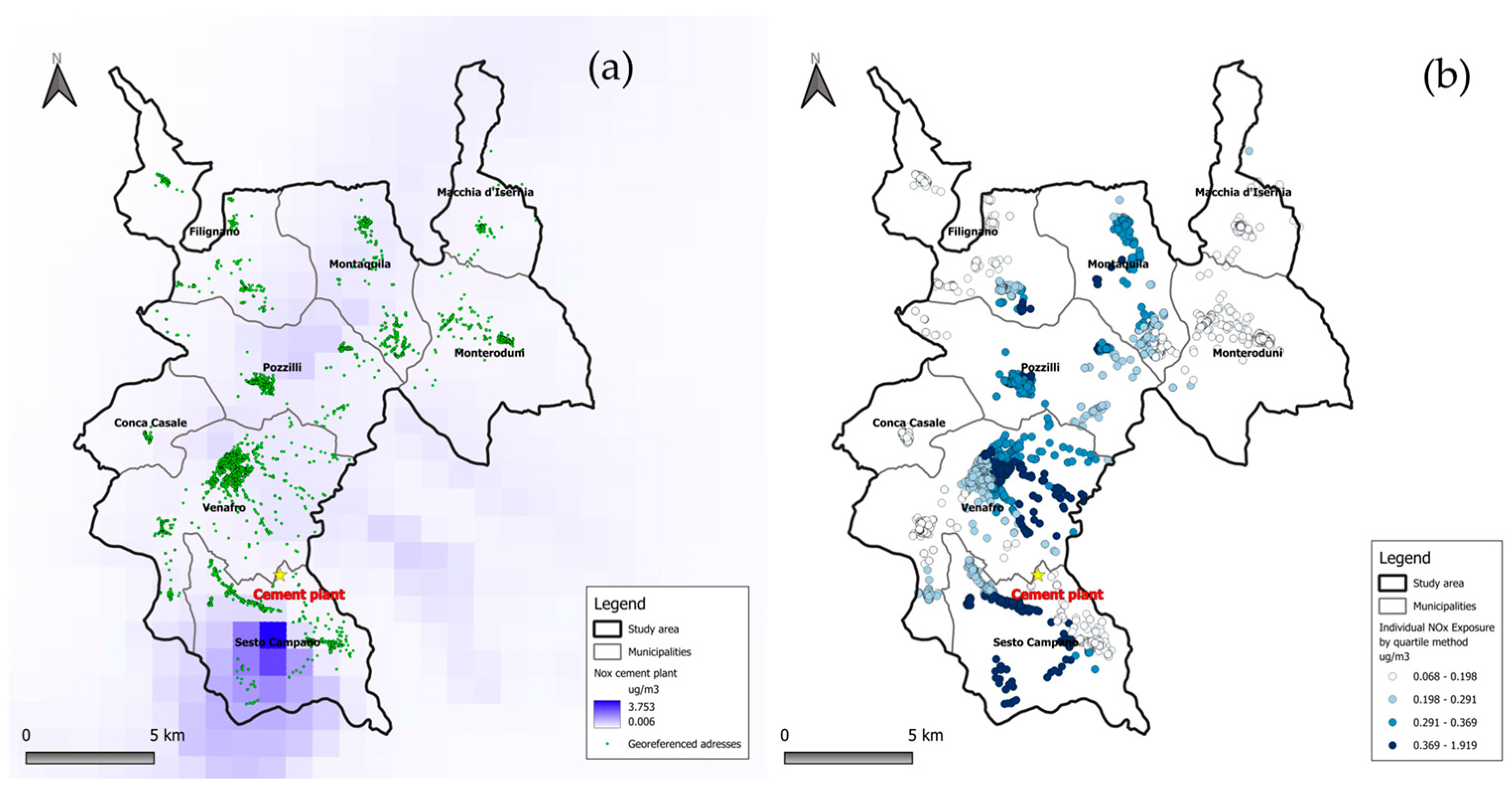
Figure 3. Dispersion map for the territory of nitrogen oxide (NOx) concentration and georeferenced addresses (a) and NOx individual distribution exposure classes obtained through the quartile method (b). Dispersion map of nitrogen oxides (NOx) concentration and georeferenced addresses (on the left) and NOx individual distribution exposure classes obtained through the quartile method (on the right).
Environments 13 00153 g003
Furthermore, Figure 3 reports the NOx dispersion map and the georeferenced addresses, and the repartition of the individuals among the four classes previously defined.

2.2.4. Individual Exposure to Confounding Factors Such as Intensive Vehicular Traffic and Socioeconomic Status

In the absence of dispersion models for traffic-related pollutants, individual exposure to vehicular traffic pollutants was estimated using a dichotomous variable that assumes the value 1 (exposed) if the georeferenced residence falls within a 200 m buffer from the two main roads in the territory (those characterized by heavy traffic, including the passage of heavy vehicles).
Since the literature shows that socioeconomic deprivation could be a risk factor for mortality [35], it potentially represents a confounding factor of the relationship between the cement plant exposure and the risk mortality. For this reason, a classic deprivation index (DI) was computed at the census-section level from the 2011 population census [36] to proxy socioeconomic factors and to quantify relative deprivation within the study region. Five variables contributed to the DI: (i) percentage with education ≤ elementary school certificate; (ii) percentage of the active population unemployed; (iii) proportion of housing units that are rented and inhabited; (iv) proportion of households headed by a single parent with dependent children who cohabit; and (v) population density (residents per 100 m2). The DI is a standardized continuous score representing each census section’s deprivation relative to the regional average. Each subject was assigned the DI value of their first-residence census section. Five deprivation categories (from high to low) were assigned to the cohort’s DIs based on quintile cut points of the DI distribution.

2.3. Health Outcomes

Mortality data (from the Molise Regional Health Agency) for the period 2006–2019 (coded according to the International Classification of Diseases 10th revision—ICD-10—in the Nominative Register of Causes of Death) were linked to the residential cohort. In light of the literature on potential health risks associated with air pollution and the induction–latency period appropriate to the 2006–2019 period, circulatory and respiratory diseases were identified as the main causes of death in the study (Table 2).
Table 2. Causes of death considered and their relative ICD-10 codes.

2.4. Statistical Analysis

To assess risk associations between the level of NOx from the cement plant and each cause of mortality, a time-dependent Cox proportional hazard regression model was applied. This model extends the Cox approach by allowing certain covariates to vary over time, making it suitable for longitudinal studies in which participants may change exposure category or age group during the follow-up. In a time-dependent Cox model, the hazard function for each individual is updated whenever the value of a time-varying covariate changes, ensuring that the estimated risk more accurately reflects the exposure status at each moment of the follow-up. The model estimates Hazard Ratios (HRs) comparing the risk of death in higher NOx exposure classes with that of the reference category (class 1). In the multivariable framework, the adjusted HR represents the association between NOx exposure and mortality after controlling for all confounders included in the model, thus isolating the independent effect of exposure. An adjusted HR > 1 indicates increased mortality hazard, an HR < 1 indicates decreased hazard, and an HR = 1 indicates no difference once confounders are taken into account. For example, an adjusted HR of 1.10 means that subjects in a given exposure class have a 10% higher hazard of death compared to the reference group, net of the effects of other covariates/confounders.
Several adjustment variables to control for potential confounding have been included:
  • age group (0–44; 45–54; …; 85+). included as a categorical time-varying covariate to account for the strong age-related gradient in mortality. This ensures that differences in age distribution across exposure classes do not influence the estimated HRs;
  • proximity to the principal road, used as a proxy for additional traffic-related air pollution, which could confound the association between plant-related NOx exposure and mortality (see Section 2.2.4);
  • DI, representing socioeconomic status at the area level, a known predictor of health outcomes and potentially correlated with residential exposure (see Section 2.2.4).
These variables may influence both exposure to cement-plant emissions and mortality risk; adjusting for these variables reduces confounding bias.
The baseline analysis was performed using quartiles. Furthermore, sensitivity analyses considering 3 and 5 exposure classes defined using the tertile and quintile methods, respectively, were performed. This allowed the assessment of the robustness of the estimated associations across different modelling choices.
Each HR is presented both with the 95% confidence interval (95%CI) and with a probabilistic measure of how credible the risk association hypothesis is (1 − p, with values between 0 and 1). As (1 − p) increases, the strength of evidence supporting the health risk associated with the exposure under study also increases [37]. Schoenfeld’s test to evaluate the proportional hazard assumption in all Cox regression models was also carried out. Sex specific analyses were performed. STATA v.15 was used as the statistical software package [StataCorp. 2017. Stata Statistical Software: Release 15. StataCorp LLC, College Station, TX, USA].

3. Results

3.1. Descriptive Analyses

From 2006 to 2019, the cohort comprised 29,495 individuals with 317,810 PYs of follow-up, including 14,804 men (50.2%). The mean follow-up was 10.7 years (10.5 for men, 11.0 for women). There were 1302 cardiovascular deaths (576 men, 44.2%) and 215 respiratory deaths (130 men, 60.5%) (Table 3). Women showed a higher circulatory disease mortality, while men had a higher respiratory-disease mortality; in both cases, the mortality significantly increased with both age and DI. For the circulatory system, mortality rates were higher in higher NOx exposure classes than in the NOx reference class. Participants living near roads had a higher mortality from circulatory and respiratory diseases.
Table 3. Descriptive characteristics of the cohort by risk factors and mortality data in the study period (2006–2019). Adapted from source [30].

3.2. Mortality Analyses

Some instructions for reading and interpreting the results are as follows:
  • If the cases are less than three, then the HR is not reported for privacy and accuracy reasons.
  • Comments are always made with reference to class 1.
  • In addition to reporting the statistically significant results (1 − p > 0.95), are also reported those results that may indicate issues requiring further investigations, using (1 − p) as defined, thus considering worth of interest event those risks with a lower (1 − p) value. Moreover, since the cohort is not so large, the estimated risks could be more imprecise, so it is useful to also highlight risk signals with a significance > 80%. This indication is in line with what is suggested by the literature for going beyond the concept of statistical significance [38]. Therefore, it was decided to comment on risk associations with 1 − p > 0.80.
  • Excess risks are reported as percentages.
  • For all causes, Schoenfeld’s test allowed us to accept the hypothesis of proportional hazards (p > 0.05).
For natural causes, significant mortality excesses among men (+19%; 1 − p = 0.951) and women (+19%; 1 − p = 0.956) were observed in class 4 (Table 4). For the circulatory system, significant mortality excesses for men (+60%; 1 − p = 0.999) and for women (+17%; 1 − p = 0.823) were observed in class 4 (Table 4). For heart mortality, risk excesses in the highest exposure class were observed (men: +66%; 1 − p = 0.998; women: +24%; 1 − p = 0.855) (Table 4). Excesses in class 4 for ischemic heart disease in men (+61%; 1 − p = 0.889) and for cerebrovascular diseases among both men (+111%; 1 − p = 0.996;) and women (+52%; 1 − p = 0.946) were observed (Table 4). Among women, an excess risk for acute respiratory diseases in exposure class 4 was observed (+133%; 1 − p = 0.803), although this was based on a small number of cases (Table 4).
Table 4. Association analysis of mortality risk by sex and class of nitrogen oxides (NOx) exposure in the study period (2006–2019).

3.3. Sensitivity Analyses of the Results

Sensitivity analyses of the results were also conducted using alternative classes of the NOx distribution, using tertiles and quintiles as classification methods. For the most exposed groups, these results were similar to those obtained in the analyses with quartiles. Furthermore, the results of the analyses performed without adjustment for DI and for proximity to main roads are in line with the results of the analyses with the adjustments. Appendix A reports the sensitivity analyses performed considering three and five exposure classes, defined using the tertile and quintile methods, respectively, reporting overlapping results (Table A1 and Table A2) and the analyses performed without considering roads and DIas adjustment factors (Table A3).

4. Discussion

The study conducted in the Venafro Valley is observational and evaluated the health risks associated with pollution from the cement plant, also considering individual factors such as age, sex, residence near roads of particular interest, and an index for the socioeconomic situation. The results of the analyses performed not adjusting for the last two factors were comparable to the adjusted ones, highlighting that an exposure to roads and socioeconomic deprivation do not substantially influence the risk estimates. This study design does not allow us to completely exclude the influence of other environmental factors that could have some effect on the exposure–outcome relationship. For the circulatory system, the analyses highlighted a mortality risk excess in the highest exposure class in both sexes (particularly attributable to heart and cerebrovascular diseases) and for acute respiratory diseases in females, even though this was based on a few cases.
The literature reports many studies on asbestos cement plants and asbestos-related diseases, not matching what we investigated. Other studies treated occupational exposure, and many of those conducted on the general population are characterized by study designs or health outcomes not comparable to ours. In general, occupational studies investigating the relationship between cement dust and heavy metals revealed a loss of lung function and abnormal spirometric parameters and a prevalence of adverse respiratory symptoms (wheezing, recurring blocked nose, sneezing/stuffy nose, fatigue/tiredness, rapid breathing, soreness/watery eyes, and breathlessness) [16,17,18,19,20]. Regarding studies on the general population that are not directly comparable with our study in terms of outcomes or study design, a study estimated the years of life lost (YLL) cost due to deaths from cardiovascular and respiratory diseases in a population living near a cement plant [21]. The results showed that the costs attributable to PM2.5 amount to approximately 3.5% of the total local annual health costs (in the city investigated), indicating that reducing PM2.5 levels can lead to health and economic benefits [21]. Another study assessed, for a population living near a cement plant, the potential health risks resulting from CO2 emissions exposure, finding a low risk for the adult population to develop adverse events [22]. Also, the impact on the surrounding area of a cement plant that also incinerates municipal waste was assessed, analyzing ground concentrations of polychlorinated naphthalenes, polychlorinated biphenyls and polychlorinated dibenzo-p-dioxins and dibenzofurans and estimating the total carcinogenic risks [23]. In addition to reporting ground concentrations for these pollutants lower than those typically found in the soils surrounding municipal waste incinerators and industrial areas located elsewhere, the results revealed a total carcinogenic risk lower than the risk threshold, concluding that there was no health risk [23]. Another study compared the chronic obstructive pulmonary diseases phenotype of two cohorts, one residing in a predominantly residential urban area without large industrial emissions and one residing in a rural area with a cement plant. The results reported that patients residing in the rural area had a higher mean wall area than those residing in the residential area, thus suggesting that the COPD phenotype is influenced by certain environmental exposures [24].
Regarding the studies comparable with ours, the Raffetti et al. (2019) review [26] highlights the limited and varied evidence. The Po Valley study used a NOx proxy like ours and found associations with hospitalizations for cardiovascular and respiratory diseases [27]. An Italian study in a northeast area of Rome assessed exposure using the distance from the cement plant and found results in line with ours for cerebrovascular mortality and partially in line with ours for mortality from respiratory diseases, since we observed an excess risk only among women, particularly for acute respiratory diseases [28]. Another Italian residential cohort study conducted near a cement plant in the Veneto region used NO2 dispersion models as a proxy for exposure and reported a risk of mortality from cardiovascular diseases among women, particularly for cerebrovascular diseases, somewhat in line with our results, which show an excess mortality in both sexes [25]. Compared to our previous study [30], the results highlight more marked excess risks for cardiovascular diseases, indicating that such excesses are more present in the areas most exposed to the cement plant emissions. This leads us to hypothesize a reduction in the contribution of other sources considering that the cement plant is in a predominantly rural area with no other industries nearby.
In summary, our results partly align with the previous work, indicating potential cardiovascular mortality signals and female-specific hints for acute respiratory disease, strengthening the hypothesis of risk associations between the exposure to cement plant emissions and the occurrence of cardiorespiratory diseases.
The study’s greatest strength lies in its design; residential cohort studies are, in fact, one of the most advanced study designs used in national environmental epidemiology and allow us to assess multiple outcomes from the same exposure [30,39,40,41]. Individual-level data enable the tracking of each participant’s residential history over time and linking exposure to residence duration. Unlike studies relying on distance, this study uses a dispersion model as a surrogate for persistent area pollution, reducing the subjectivity of exposure measures. Two additional strengths from the residential history reconstruction—georeferencing nearly all subjects (eliminating territorial distortions) and acceptable loss rates (5–10%) from mortality—enhance reliability. These characteristics are consistent with the current literature supporting the use of pollutant dispersion models and geocoding to perform accurate exposure assessments [42,43].
The study has several limitations. The study cohort is open and dynamic: this means that each subject can enter (or leave) the cohort at different times during the study period. This could lead to a selection bias, causing a dilution of true effects. However, we considered the bias as non-differential since the emigration phenomenon is very similar across the entire study area, characterized by municipalities with similar socio-demographic characteristics. The same is true for workers: the study is unable to account for the role of employment, but the eventual confounding effect is considered non-differential, since cement plant employees are considered as randomly resident throughout the study area. Another limitation is the use of NOx as the sole indicator of cement plant emissions, adopted as a proxy for stack-related combustion emissions. Although exhaust plumes from cement plants involve a mixture of pollutants emitted through elevated stacks and are influenced by stack parameters and meteorological conditions, stack-emitted pollutants are expected to disperse in a broadly similar manner within the study area. Cement production also generates particulate matter, originating not only from combustion but also from material handling, storage and grinding processes. These emissions are often intermittent and diffuse and tend to be more concentrated in close proximity to the source; however, the lack of reliable and continuous emission estimates for particulate matter prevents their robust inclusion in the present analysis. A limitation of the dispersion modeling concerns the lack of continuous ground-level meteorological observations within the study area, which prevented a formal validation of the WRF–CALMET outputs. A qualitative comparison with wind roses published in technical reports and previous studies conducted in the same area suggested a reasonable agreement in terms of dominant wind directions. Another limitation concerns the exposure assessment, which was based on an annual average concentration field obtained from a single-year dispersion simulation. This approach assumes the temporal stability of the spatial distribution of concentrations over the study period. While interannual meteorological variability and changes in emission intensity may influence absolute concentration levels, relative spatial contrasts were assumed to remain reasonably stable. A dispersion model based on a single representative year may be limiting if annual averages change during follow-up, but no such changes occurred during the study period, so the model was treated as stable. Since the study targets medium–long-term exposure, using the reference year’s average NOx as a proxy for exposure is considered acceptable despite the possible mismatches with daily peak concentrations. Furthermore, using a proxy for the cement plant pollution allowed us to generalize the results to plants with different characteristics and operating methods. The model used in this study does not measure exposure at the residential address but in a larger area (1 km × 1 km), so individual exposure is approximate. Furthermore, using residential addresses as the exposure basis may not capture true individual exposure, as people spend substantial time away from home; movements of cohort members were not accounted for, potentially causing non-differential misclassification and biasing risk estimates toward underestimation. Additionally, as important confounders (smoking, alcohol consumption, obesity, diet, physical activity, occupational exposures, and other environmental exposures) were not directly measured, the presence of other sources of environmental exposure within the most exposed areas, defined according to the proxy model, cannot be excluded; however, we expect these to be non-differentially localized, leading to a dilution effect and thus to an underestimation of risk.

5. Conclusions

This study supports the hypothesis of an association between residential exposure to air pollution attributable to a cement plant and an increased risk of cardiorespiratory mortality in the study area. Using NOx as a proxy for cement plant emissions, excess mortality risks were observed among residents living in the most exposed areas, particularly for diseases of the circulatory system. Overall, these findings indicate signals of a potential relationship between an exposure to pollutants emitted by the cement plant and the occurrence of chronic diseases, although they are accompanied by uncertainty. The present findings contribute to the existing evidence on this topic and highlight the need for further investigation, including a more detailed assessment of lifestyle factors and other individual risk determinants (i.e., questionnaires and human biomonitoring). In fact, although the cohort design is highly advanced, we can reduce the uncertainty of the estimate or methodology by improving both the accuracy and precision of exposure and by alternatively applying different available epidemiological approaches. As researchers, we recommend: (i) a more thorough assessment of the potential impact of the cement plant to strengthen the study design, (ii) a more thorough analysis of the results by population subgroups, and (iii) a specific study on cardiovascular and respiratory diseases through questionnaires combined with human biomonitoring studies.

Author Contributions

Conceptualization, F.M. and E.B.; methodology, F.M., C.M. and M.C.; software, F.M., C.M. and M.C.; validation, F.M., C.M. and M.C.; formal analysis, F.M., C.M. and M.C.; resources, F.M.; data curation, E.B. and F.M.; writing—original draft preparation, E.B. and F.M.; writing—review and editing, E.B., F.M., F.B., L.C., C.M., M.C.I. and M.C.; visualization, E.B. and F.M.; supervision, F.M.; project administration, F.M. and F.B.; funding acquisition, F.B., F.M. and L.C. All authors have read and agreed to the published version of the manuscript.

Funding

This research was funded by the Molise Region, Determination of the General Director for Health n° 60/2019-08-01.

Data Availability Statement

The data supporting the study findings are held by the Municipality of Venafro (data controller) and are not publicly available due to licensing restrictions. They are available from the authors on reasonable requests and with the permission of the Municipality of Venafro.

Acknowledgments

The authors gratefully acknowledge the Municipality of Venafro and its officials (Mayor, Environment Councillor, scientific director of the Venafro–Institute of Clinical Physiology convention, General Secretary, Data Protection Officer, privacy contact, and Registry Office) for their active participation and support of the EPIVenafro+7 project. They also thank the mayors and Registry Offices of partner municipalities (Conca Casale, Filignano, Macchia d’Isernia, Montaquila, Monteroduni, Pozzilli, Sesto Campano) for providing data. Appreciation is extended to the Molise Region for funding the study, the Molise Regional Health Authority for health data, ARPAM for ongoing collaboration, and the non-profit association “Mamme per la Salute e l’Ambiente ONLUS di Venafro” for their early involvement, support, and ongoing dialog. The authors gratefully acknowledge ISDE Italy for its ongoing presence and support of the study. They also thank Nicola Caranci (Regional Health and Social Agency, Emilia Romagna Region, Bologna) and Aldo Rosano (National Institute for Public Policy Analysis, Rome) for providing the socioeconomic deprivation index, and Cristina Imiotti, Rosanna Panini, Daniela Banti, and Anna Paola Pala (Institute of Clinical Physiology, NRC Pisa) for technical and secretarial support.

Conflicts of Interest

The authors declare no conflicts of interest.

Abbreviations

The following abbreviations are used in this manuscript:
NOxNitrogen Oxides
SO2Sulfur Dioxide
PYPerson-Years
WRFWeather Research and Forecasting
DIDeprivation Index
ICD-10International Classification of Diseases 10th Revision
HRHazard Ratio
95%CIConfidence Interval at 95% of Probability

Appendix A

Table A1. Association analysis of mortality risk by sex and five classes of nitrogen oxides (NOx) exposure in the study period (2006–2019).
Cause (ICD-10 Code)Exposure ClassMENWOMEN
nHR1 − pCI95%NHR1 − pCI95%
Natural causes
(A00-R99)
1 (ref.)3321.00 3641.00
23741.080.6490.92–1.263680.960.410.82–1.12
31931.090.6690.91–1.311971.110.7710.93–1.33
42581.140.850.95–1.362250.870.8760.73–1.04
51851.200.9430.99–1.442121.190.951.00–1.42
Diseases of the circulatory system
(I00-I99)
1 (ref.)1401.00 1971.00
21561.080.4970.85–1.381810.890.7260.72–1.10
3791.070.3810.81–1.421111.200.8780.95–1.52
4991.080.4290.82–1.431180.860.7660.67–1.10
51021.6411.26–2.131191.180.830.93–1.49
Heart diseases
(I00-I52)
1 (ref.)861.00 1141.00
21001.110.5110.82–1.51191.050.2520.80–1.37
3571.230.7750.88–1.73641.200.7460.88–1.63
4651.090.3640.77–1.54770.930.3740.68–1.26
5661.710.9981.23–2.37771.290.9020.95–1.74
Ischemic heart diseases (IHD)
(I20-I25)
1 (ref.)281.00 261.00
2270.880.3530.51–1.53311.200.4870.69–2.07
3140.910.2270.47–1.74161.350.6430.71–2.54
4221.090.2250.60–2.00231.210.4580.66–2.24
5201.550.8540.86–2.80181.090.2050.58–2.03
Acute myocardial infarction (AMI)
(I21)
1 (ref.)121.00 111.00
290.690.5740.28–1.71131.000.0010.43–2.32
340.600.6160.19–1.8971.250.3480.47–3.29
480.730.4790.27–1.9330.350.8710.09–1.35
571.060.0990.40–2.8350.720.4420.24–2.16
Cerebrovascular diseases
(I60-I69)
1 (ref.)311.00 511.00
2341.120.340.67–1.86520.930.2710.62–1.39
3171.080.2070.59–1.97331.370.8320.88–2.13
4231.250.5510.70–2.25320.900.3220.56–1.45
5292.120.9951.26–3.57381.510.9370.98–2.33
Disease of the respiratory system
(J00-J99)
1 (ref.)351.00 251.00
2431.190.5320.74–1.91220.940.1480.52–1.73
3170.950.1380.53–1.7160.520.8520.21–1.26
4241.100.2670.63–1.94171.120.2510.57–2.19
5110.660.7540.33–1.33151.360.6360.70–2.62
Acute respiratory diseases
(J00-J06; J10-J18; J20-J22)
1 (ref.)101.00 51.00
2151.680.7680.72–3.9561.110.130.33–3.74
351.020.0250.34–3.02nr
481.390.4770.51–3.7992.670.8940.81–8.76
540.960.0590.29–3.1252.100.7470.59–7.52
Chronic diseases of the lower respiratory tract (except asthma)
(J40-J44; J47)
1 (ref.)121.00 111.00
2151.110.2040.50–2.4560.640.5790.22–1.88
350.790.3320.28–2.2930.660.7540.33–1.33
491.170.2530.45–3.02nr
530.510.6880.14–1.87nr
Notes: Analyses covered 2006–2019 and were adjusted for age classes, distance to designated roads, and the socioeconomic deprivation index. ICD-10: International Classification of Diseases, 10th revision; n: sample size; HR: Hazard Ratio; CI95%: 95% confidence interval; 1 − p: evidence strength for mortality risk excess. Trend: risk trend per 1 µg/m3 NOx; 1 (ref.): exposure class 1 (0.07–0.18 μg/m3); 2: class 2 (0.19–0.29 μg/m3); 3: class 3 (0.30–0.34 μg/m3); 4: class 4 (0.35–0.37 μg/m3); 5: class 5 (0.38–1.92 μg/m3); nr: not reported due to n < 3.
Table A2. Association analysis of mortality risk by sex and three classes of nitrogen oxides (NOx) exposure in the study period (2006–2019).
Cause (ICD-10 Code)Exposure ClassMENWOMEN
nHR1 − pCI95%NHR1 − pCI95%
Natural causes
(A00-R99)
1 (ref.)5071.00 5291.00
24641.030.340.90–1.174570.980.2320.86–1.12
33711.090.7540.94–1.253801.040.4150.90–1.20
Diseases of the circulatory system
(I00-I99)
1 (ref.)2201.00 2861.00
21810.940.4270.77–1.162340.970.2810.81–1.16
31751.290.9821.04–1.592061.050.4010.87–1.27
Heart diseases
(I00-I52)
1 (ref.)1411.00 1771.00
21190.960.2470.75–1.241370.920.5110.73–1.16
31141.270.9250.98–1.651371.110.6160.88–1.41
Ischemic heart diseases (IHD)
(I20-I25)
1 (ref.)401.00 441.00
2320.860.4590.53–1.39350.970.0940.61–1.55
3391.500.9120.94–2.40350.950.1630.59–1.53
Acute myocardial infarction (AMI)
(I21)
1 (ref.)161.00 171.00
290.660.6560.28–1.56140.900.2250.42–1.90
3151.110.2180.52–2.3680.560.7990.23–1.36
Cerebrovascular diseases
(I60-I69)
1 (ref.)471.00 741.00
2411.050.1610.68–1.62731.160.6260.83–1.63
3461.630.9751.06–2.51591.140.5250.80–1.63
Trend 1.910.8860.86–4.26 1.320.5470.64–2.71
Disease of the respiratory system
(J00-J99)
1 (ref.)491.00 321.00
2551.290.7890.86–1.94271.020.060.60–1.73
3260.790.6570.48–1.29261.370.7390.79–2.36
Acute respiratory diseases
(J00-J06; J10-J18; J20-J22)
1 (ref.)161.00 71.00
2171.240.4480.61–2.5281.460.5220.52–4.10
390.990.0140.42–2.34112.460.9240.91–6.66
Chronic diseases of the lower respiratory tract (except asthma)
(J40-J44; J47)
1 (ref.)161.00 131.00
2171.220.4160.60–2.5170.660.5980.26–1.73
3110.910.1740.41–2.0330.380.8590.10–1.38
Notes: Analyses covered 2006–2019 and were adjusted for age classes, distance to designated roads, and the socioeconomic deprivation index. ICD-10: International Classification of Diseases, 10th revision; n: sample size; HR: Hazard Ratio; CI95%: 95% confidence interval; 1 − p: evidence strength for mortality risk excess. Trend: risk trend per 1 µg/m3 NOx; 1 (ref.): exposure class 1 (0.07–0.29 μg/m3); 2: class 2 (0.30–0.35 μg/m3); 3: class 3 (0.36–1.92 μg/m3).
Table A3. Association analysis of mortality risk by sex and class of nitrogen oxides (NOx) exposure in the study period (2006–2019), adjusted only for age classes.
Cause (ICD-10 Code)Exposure ClassMENWOMEN
nHR1 − pCI95%NHR1 − pCI95%
Natural causes
(A00-R99)
1 (ref.)3691.00 4031.00
23371.070.660.93–1.253290.950.4910.82–1.1
34511.070.6460.93–1.234220.980.2360.85–1.12
41851.190.9481–1.422121.190.9571.01–1.4
Diseases of the circulatory system
(I00-I99)
1 (ref.)1591.00 2201.00
21371.040.2490.83–1.31580.860.8450.7–1.06
31781.010.1070.82–1.262291.030.2120.85–1.23
41021.540.9991.2–1.971191.210.9110.97–1.52
Heart diseases
(I00-I52)
1 (ref.)981.00 1331.00
2881.070.3710.8–1.431000.900.5920.69–1.16
31221.120.5830.86–1.461411.030.2110.81–1.31
4661.610.9971.18–2.2771.300.930.98–1.72
Ischemic heart diseases (IHD)
(I20-I25)
1 (ref.)301.00 311.00
2250.970.0850.57–1.65260.980.0540.58–1.65
3361.030.110.64–1.68391.180.5010.73–1.89
4201.580.8860.9–2.78181.310.6420.73–2.35
Acute myocardial infarction (AMI)
(I21)
1 (ref.)131.00 121.00
280.690.5940.28–1.66121.140.2510.51–2.54
3120.750.5290.34–1.64100.730.5390.31–1.69
471.270.3890.51–3.1850.970.0470.34–2.75
Cerebrovascular diseases
(I60-I69)
1 (ref.)341.00 551.00
2311.110.3210.68–1.8481.060.2160.72–1.56
3401.080.2560.68–1.71651.180.6290.82–1.69
4292.060.9961.25–3.38381.550.9631.03–2.35
Disease of the respiratory system
(J00-J99)
1 (ref.)391.00 271.00
2391.220.610.78–1.9200.870.3570.49–1.56
3410.970.1240.62–1.5230.810.5450.46–1.41
4110.670.7520.35–1.32151.250.5150.67–2.35
Acute respiratory diseases
(J00-J06; J10-J18; J20-J22)
1 (ref.)121.00 51.00
2131.290.480.59–2.8461.480.4810.45–4.84
3130.970.0590.44–2.13102.100.8250.72–6.16
440.780.3330.25–2.4252.260.8020.65–7.8
Chronic diseases of the lower respiratory tract (except asthma)
(J40-J44; J47)
1 (ref.)121.00 111.00
2151.560.750.73–3.3460.640.6220.24–1.73
3141.120.2250.52–2.4350.430.880.15–1.25
430.610.5590.17–2.15n.r.
Notes: Analyses covered 2006–2019 and were adjusted for age classes. ICD-10: International Classification of Diseases, 10th revision; n: sample size; HR: Hazard Ratio adjusted for age classes; CI95%: 95% confidence interval; 1 − p: evidence strength for mortality risk excess; 1 (ref.): exposure class 1 (0.07–0.19 μg/m3); 2: class 2 (0.20–0.29 μg/m3); 3: class 3 (0.30–0.37 μg/m3); 4: class 4 (0.38–1.92 μg/m3); nr: not reported due to n < 3.

References

  1. Nilimaa, J. Smart Materials and Technologies for Sustainable Concrete Construction. Dev. Built Environ. 2023, 15, 100177. [Google Scholar] [CrossRef]
  2. Su, N.; Lou, L.; Amirkhanian, A.; Amirkhanian, S.N.; Xiao, F. Assessment of Effective Patching Material for Concrete Bridge Deck—A Review. Constr. Build. Mater. 2021, 293, 123520. [Google Scholar] [CrossRef]
  3. Gagg, C.R. Cement and Concrete as an Engineering Material: An Historic Appraisal and Case Study Analysis. Eng. Fail. Anal. 2014, 40, 114–140. [Google Scholar] [CrossRef]
  4. Chung, D.D.L. Use of Polymers for Cement-Based Structural Materials. J. Mater. Sci. 2004, 39, 2973–2978. [Google Scholar] [CrossRef]
  5. Cazacu, C.; Dumitriu, C.; Barbulescu, A. Concrete CFRP-Reinforced Beam Performances, Tests and Simulations. Sustainability 2024, 16, 2614. [Google Scholar] [CrossRef]
  6. Hosen, K. Assessment and Rehabilitation of Seismically Vulnerable Industrial RCC Structures. Comput. Eng. Phys. Model. 2024, 7, 30–48. [Google Scholar] [CrossRef]
  7. Hosen, K. Seismic Vulnerability and Rehabilitation Strategies for Industrial RC Structures. Civ. Environ. Eng. Rep. 2024, 34, 328–343. [Google Scholar] [CrossRef]
  8. Mechtcherine, V. Novel Cement-Based Composites for the Strengthening and Repair of Concrete Structures. Constr. Build. Mater. 2013, 41, 365–373. [Google Scholar] [CrossRef]
  9. Bărbulescu, A.; Hosen, K. Cement Industry Pollution and Its Impact on the Environment and Population Health: A Review. Toxics 2025, 13, 587. [Google Scholar] [CrossRef] [PubMed]
  10. Chen, J.; Hu, L.; Sun, C.; Fan, Y.; Zhou, X.; He, Y.; Su, X.; Wang, Y.; Hou, L.; Ma, W. Examination of Spatial and Temporal Evolution Characteristics of Carbon Emission and Influencing Factors in Territorial Spatial Func-tional Areas: A Case Study of Mountainous City-Chongqing. Integr. Environ. Assess. Manag. 2025, 21, 360–373. [Google Scholar] [CrossRef] [PubMed]
  11. Li, R.; Wei, Y.; Cai, W.G.; Liu, Y.; You, K.; Yu, Y. Tracking Cement Transportation Carbon Emissions in China: Historical Assessment and Future Simulation. Environ. Impact Assess. Rev. 2024, 109, 107636. [Google Scholar] [CrossRef]
  12. Zou, L.; Ni, Y.; Gao, Y.; Tang, F.; Jin, J.; Chen, J. Spatial Variation of PCDD/F and PCB Emissions and Their Composition Profiles in Stack Flue Gas from the Typical Cement Plants in China. Chemosphere 2018, 195, 491–497. [Google Scholar] [CrossRef]
  13. Leone, V.; Cervone, G.; Iovino, P. Impact Assessment of PM10 Cement Plants Emissions on Urban Air Quality Using the SCIPUFF Dispersion Model. Environ. Monit. Assess. 2016, 188, 499. [Google Scholar] [CrossRef]
  14. Mosca, S.; Benedetti, P.; Guerriero, E.; Rotatori, M. Assessment of Nitrous Oxide Emission from Cement Plants: Real Data Measured with Both Fourier Transform Infrared and Nondispersive Infrared Techniques. J. Air Waste Manag. Assoc. 2014, 64, 1270–1278. [Google Scholar] [CrossRef] [PubMed][Green Version]
  15. Chinyama, M.P.M. Alternative Fuels in Cement Manufacturing. In Alternative Fuel; IntechOpen: London, UK, 2011; ISBN 978-953-307-372-9. [Google Scholar]
  16. Cetintepe, S.P.; Demirbas, O.B.; Dinke, B.; Ilhan, M.N. Is Exposure to Cement Dust and Heavy Metals Associated with Reduced Pulmonary Function? A Cross-Sectional Study among Cement Factory Workers in Türkiye. BMJ Open 2025, 15, e102214. [Google Scholar] [CrossRef] [PubMed]
  17. Mkulisi, A.; Rathebe, P.C.; Kachingwe, E.; Bidassey-Manilal, S. Prevalence of Chronic Respiratory Symptoms among Cement Factory Workers in Gauteng Province, South Africa. J. Occup. Environ. Hyg. 2024, 21, 202–211. [Google Scholar] [CrossRef]
  18. Dewangan, P.K.; Verma, N.; Shrivastava, N.; Prasad, M.A. Pulmonary Function Parameters and Its Determinants among Cement Factory Workers in Chhattisgarh: A Cross-Sectional Study. Indian J. Public Health 2021, 65, 226–230. [Google Scholar] [CrossRef] [PubMed]
  19. Shanshal, S.A.; Al-Qazaz, H.K. Consequences of Cement Dust Exposure on Pulmonary Function in Cement Factory Workers. Am. J. Ind. Med. 2021, 64, 192–197. [Google Scholar] [CrossRef]
  20. Shanshal, S.A.; Al-Qazaz, H.K. Spirometric Outcomes and Oxidative Stress Among Cement Factory Workers: Results from a Cross-Sectional Study. J. Occup. Environ. Med. 2020, 62, e581–e585. [Google Scholar] [CrossRef] [PubMed]
  21. De Souza Zorzenão, P.C.; Santos Silva, J.C.D.; Moreira, C.A.B.; Milla Pinto, V.; de Souza Tadano, Y.; Yamamoto, C.I.; Godoi, R.H.M. Impacts of PM2.5 Exposure near Cement Facilities on Human Health and Years of Life Lost: A Case Study in Brazil. J. Environ. Manag. 2024, 370, 122975. [Google Scholar] [CrossRef]
  22. Mallongi, A.; Ernyasih, E. Health Risk Assessments of Exposure Carbon Dioxide among Communities and Children around Tonasa Cement Plant, Pangkep Regency, Indonesia. Monte Carlo Simulation (MCS) Application. Braz. J. Biol. 2023, 83, e271436. [Google Scholar] [CrossRef]
  23. Han, J.; Xu, C.; Jin, J.; Hu, J. PCNs, PCBs, and PCDD/Fs in Soil around a Cement Kiln Co-Processing Municipal Wastes in Northwestern China: Levels, Distribution, and Potential Human Health Risks. Int. J. Environ. Res. Public Health 2022, 19, 12860. [Google Scholar] [CrossRef]
  24. Kim, J.; Kim, B.; Bak, S.H.; Oh, Y.-M.; Kim, W.J. A Comparative Study of Chest CT Findings Regarding the Effects of Regional Dust Exposure on Patients with COPD Living in Urban Areas and Rural Areas near Cement Plants. Respir. Res. 2021, 22, 43. [Google Scholar] [CrossRef]
  25. Ferroni, E.; Cestari, L.; Cinquetti, S.; Corti, M.C.; Fedeli, U.; Donato, F. Residential cohort study to assess the impact of emissions released by a cement plant on the health status of the population residing in Pederobba (Veneto Region, Northern Italy). Epidemiol. Prev. 2021, 45, 82–91. [Google Scholar] [CrossRef]
  26. Raffetti, E.; Treccani, M.; Donato, F. Cement Plant Emissions and Health Effects in the General Population: A Systematic Review. Chemosphere 2019, 218, 211–222. [Google Scholar] [CrossRef] [PubMed]
  27. Bertoldi, M.; Borgini, A.; Tittarelli, A.; Fattore, E.; Cau, A.; Fanelli, R.; Crosignani, P. Health Effects for the Population Living near a Cement Plant: An Epidemiological Assessment. Environ. Int. 2012, 41, 1–7. [Google Scholar] [CrossRef] [PubMed]
  28. Giordano, F.; Grippo, F.; Perretta, V.; Figà-Talamanca, I. Impact of Cement Production Emissions on Health: Effects on the Mortality Patterns of the Population Living in the Vicinity of a Cement Plant. Fresenius Environ. Bull. 2012, 21, 1905–1909. [Google Scholar]
  29. ISPRA Working Group. La Qualità Dell’aria in Molise—Report 2022; ISPRA: Lombardy, Italy, 2023; p. 65. [Google Scholar]
  30. Bustaffa, E.; Mangia, C.; Cori, L.; Bianchi, F.; Cervino, M.; Minichilli, F. Cardiorespiratory Diseases in an Industrialized Area: A Retrospective Population-Based Cohort Study. BMC Public Health 2023, 23, 2031. [Google Scholar] [CrossRef] [PubMed]
  31. Scire, J.; Robe, F.; Fernau, M.; Yamartino, R. A User’s Guide for the CALMET Meteorological Model (Version 5); U.S. Environmental Protection Agency: Washington, DC, USA, 1998. [Google Scholar]
  32. Scire, J.S.; Strimaitis, D.G.; Yamartino, R.J. A User’s Guide for the CALPUFF Meteorological Model (Version 5); Earth Tech Inc.: Land O’ Lakes, FL, USA, 2000. [Google Scholar]
  33. Rzeszutek, M. Parameterization and Evaluation of the CALMET/CALPUFF Model System in near-Field and Complex Terrain—Terrain Data, Grid Resolution and Terrain Adjustment Method. Sci. Total Environ. 2019, 689, 31–46. [Google Scholar] [CrossRef]
  34. Mangia, C.; Bustaffa, E.; Cervino, M.; Bianchi, F.; Cori, L.; Minichilli, F. Application of Complementary Air Quality Exposure Assessment Methods in a Complex Industrial-Urban Environment: A Case Study from Venafro Valley, Italy. Air Qual. Atmos. Health 2026, 19, 10. [Google Scholar] [CrossRef]
  35. Caranci, N.; Biggeri, A.; Grisotto, L.; Pacelli, B.; Spadea, T.; Costa, G. L’indice di deprivazione italiano a livello di sezione di censimento: Definizione, descrizione e associazione con la mortalità [The Italian deprivation index at census block level: Definition, description and association with general mortality]. Epidemiol. Prev. 2010, 34, 167–176. [Google Scholar]
  36. Rosano, A.; Pacelli, B.; Zengarini, N.; Costa, G.; Cislaghi, C.; Caranci, N. Update and review of the 2011 Italian deprivation index calculated at the census section level [Aggiornamento e revisione dell’indice di deprivazione italiano 2011 a livello di sezione di censimento]. Epidemiol. Prev. 2020, 44, 162–170. [Google Scholar] [CrossRef]
  37. Biggeri, A.; Stoppa, G.; Catelan, D. P-value and the probability of direction of effect. Epidemiol. Prev. 2022, 46, 204–210. [Google Scholar] [CrossRef] [PubMed]
  38. Wasserstein, R.L.; Schirm, A.L.; Lazar, N.A. Moving to a World Beyond “p < 0.05”. Am. Stat. 2019, 73, 1–19. [Google Scholar] [CrossRef]
  39. Bustaffa, E.; Curzio, O.; Donzelli, G.; Gorini, F.; Linzalone, N.; Redini, M.; Bianchi, F.; Minichilli, F. Risk Associations between Vehicular Traffic Noise Exposure and Cardiovascular Diseases: A Residential Retrospective Cohort Study. Int. J. Environ. Res. Public Health 2022, 19, 10034. [Google Scholar] [CrossRef]
  40. Ancona, C.; Badaloni, C.; Mataloni, F.; Bolignano, A.; Bucci, S.; Cesaroni, G.; Sozzi, R.; Davoli, M.; Forastiere, F. Mortality and Morbidity in a Population Exposed to Multiple Sources of Air Pollution: A Retrospective Cohort Study Using Air Dispersion Models. Environ. Res. 2015, 137, 467–474. [Google Scholar] [CrossRef]
  41. Ranzi, A.; Fano, V.; Erspamer, L.; Lauriola, P.; Perucci, C.A.; Forastiere, F. Mortality and Morbidity among People Living Close to Incinerators: A Cohort Study Based on Dispersion Modeling for Exposure Assessment. Environ. Health 2011, 10, 22. [Google Scholar] [CrossRef] [PubMed]
  42. Negri, E.; Bravi, F.; Catalani, S.; Guercio, V.; Metruccio, F.; Moretto, A.; La Vecchia, C.; Apostoli, P. Health Effects of Living near an Incinerator: A Systematic Review of Epidemiological Studies, with Focus on Last Generation Plants. Environ. Res. 2020, 184, 109305. [Google Scholar] [CrossRef]
  43. de Titto, E.; Savino, A. Environmental and Health Risks Related to Waste Incineration. Waste Manag. Res. 2019, 37, 976–986. [Google Scholar] [CrossRef] [PubMed]
Disclaimer/Publisher’s Note: The statements, opinions and data contained in all publications are solely those of the individual author(s) and contributor(s) and not of MDPI and/or the editor(s). MDPI and/or the editor(s) disclaim responsibility for any injury to people or property resulting from any ideas, methods, instructions or products referred to in the content.

Article Metrics

Citations

Article Access Statistics

Multiple requests from the same IP address are counted as one view.