


Abstract
Almond hulls and shells are abundant by-products of the almond industry that could be valorized as bio-based absorbent polymers (BAP), offering a promising alternative to synthetic materials to improve water management in the agricultural setting. In this study, almond hulls and shells were pelletized in different proportions to assess pelletization feasibility and physical properties, followed by industrial-scale production of an industrialized formulation (80% hulls, 20% shells). Ecotoxicological risk was assessed using direct bioassays with whole pellets (germination with Lactuca sativa and Zea mays; acute toxicity with Eisenia fetida) and indirect bioassays with pellet water extracts (germination with L. sativa, immobilization with Daphnia magna, and bioluminescence inhibition with Vibrio fischeri). Field trials were conducted in an irrigated almond orchard to evaluate soil moisture dynamics and plant water status under different BAP application rates and irrigation regimes. Pelletization increased the soil’s water-holding capacity in the laboratory test and soil moisture in the field, even under reduced irrigation. However, ecotoxicological assays revealed significant to high acute toxicity at higher concentrations, depending on the organism and exposure pathway. Almond hull and shell pellets show potential to improve soil water retention and reduce irrigation demand but require cautious application and further testing to mitigate ecotoxicological risks.
1. Introduction
As the world population continues to rise, food production is expected to increase by more than 50%, placing pressure on agricultural systems, especially amid climate change and water scarcity [1,2]. This trend is already evident: over the last 20 years, crop production has increased by more than 60% and now accounts for more than one quarter of global emissions [3]. Therefore, it is crucial to find innovative ways to efficiently manage water and nutrient cycles in these systems, particularly in arid and semi-arid regions where water scarcity severely limits crop productivity. SAPs and slow-release fertilizers (SRFs) have attracted attention to address the frequent irrigation and high chemical fertilizer doses used in conventional agricultural practices, which can lead to nutrient leaching, soil degradation, and environmental pollution [4]. SAPs are materials that, relative to their mass, absorb large volumes of water and gradually release it to plants’ roots [5]. SRFs function similarly to SAPs but for nutrients: they are designed to release nutrients slowly, in line with the plant’s nutrient uptake requirements [6,7]. When used together, SAPs and SRFs can improve soil water retention, structure, and infiltration rates; reduce irrigation needs; and efficiently deliver nutrients with minimal losses [8,9,10,11]. Synthetic SAPs and SRFs exhibit higher performance and efficiency; however, their limited biodegradability, potential toxicity (due to the use of polyacrylic acid and polyacrylamide as monomers), and possible environmental risks have raised concerns about their long-term sustainability. Thus, there is a growing interest in their natural versions, namely SAPs and SRFs made from renewable sources, such as agro-industrial by-products, which are biodegradable and non-toxic [5,8]. Moreover, some of these agricultural and forest by-products are residues that can pose challenges for ecological waste management if no use is found for them [12,13,14].
Almond hulls and shells are strong candidates for these applications: first, they are abundant by-products of the almond processing industry—constituting around 80% of the whole fruit—which is very significant in Portugal, where orchards occupy more than 70 thousand acres and produce more than 50 thousand tons of almonds per year [15]; second, they are rich in lignocellulosic components and contain minerals that could be beneficial for soil structure and health [16]; lastly, they are usually disposed of, accumulating in large quantities or used for low-value applications, such as biomass fuel or animal feed [17,18,19,20,21]. This highlights the need to explore innovative ways to repurpose almond shells and hulls into high-value materials that contribute to a more circular system, thereby enhancing environmental and economic sustainability.
Almond hulls have been considered for various applications, such as the extraction of valuable compounds, including phenolics [22,23,24,25,26,27], sugars for ethanol production [22], and antioxidants for use as functional ingredients in food [24,28]. Some studies have also used hulls as a substrate for the production of yeast [29], fungi [30], and insects [31,32,33]. Other studies have considered almond hulls and shells for soil application as natural soil mulching materials [34,35,36], as substrates [37,38], as substrates for biochar production to condition soil [39], or as amendments for biosolarization [40,41,42,43,44,45,46]. Almond hulls and shells can even enhance microbial biomass and activity when applied to the soil [47,48,49]. Furthermore, Andrews et al. [50] showed that almond hulls and shells can increase tree root biomass when used as a soil amendment. Lastly, almond hulls and shells can also aid in the recycling of nutrients and carbon within almond crop systems [42,48,49].
In previous work, almond hulls were shown to significantly increase soil water-holding capacity, and their ash is high in minerals, especially P, K, Ca, and Mg, indicating that they can also provide nutrients to plants when applied as a soil amendment [16]. To the best of our knowledge, their application in functional materials, such as a BAP, is being considered for the first time.
However, before applying these materials to soil, it is essential to conduct a risk assessment to determine whether, in large quantities, they pose a risk to plants or to other soil and aquatic organisms. Toxicity can influence plant germination and growth, disturb soil organisms, and even affect aquatic organisms after runoff or leaching [51]. Ecotoxicological bioassays can be broadly divided according to the soil function they assess: bioassays performed with the whole material address the soil “habitat function”, reflecting direct exposure of terrestrial organisms, while bioassays using aqueous eluates evaluate the soil “retention function”, targeting the fraction of contaminants that may be mobilized through leaching or runoff and potentially affect porewater, surface water, and groundwater systems [52,53,54,55]. The combined use of these two approaches, which reflect bioavailability, organism sensitivity, and contaminant interactions, is essential for almond hull pellets, as they are intended for land use scenarios where seeds, soil organisms, and aquatic ecosystems may be exposed. The concept of bioavailability is also important to take into account: while chemical methods are empirical and protocol-dependent, and their relevance to true biological or toxicological bioavailability remains uncertain, comparing chemical extractions, bioaccumulation, and organism-level effects shows that higher bioaccumulation may coincide with higher potentially mobilizable fractions without translating into greater toxicity, highlighting that toxic responses cannot be reliably predicted from total concentrations or bioaccumulation alone [56].
The aim of this study was (i) to analyze whether pellets made from hulls and shells could enhance soil water retention and provide a controlled supply of nutrients by applying them to the soil in an almond orchard, (ii) to evaluate their effect on the almond orchard irrigation requirements, and (iii) to analyze whether these pellets have any toxic effects on plants, worms, and model aquatic organisms (the microcrustacean Daphnia magna and the marine bacteria Vibrio fischeri). This work advances circular economy principles in agriculture by valorizing almond by-products into high-value, multifunctional soil amendments, offering a sustainable alternative to conventional agrochemicals, including insecticides, fungicides, and herbicides such as chlorantraniliprole, propiconazole, and glyphosate.
2. Materials and Methods
2.1. Sampling
Almond shells and hulls from Guara, Avijor, Soleta, Marinada, and Belona were supplied by Vera Cruz, located in Covilhã, Portugal. Information on the chemical composition of these by-products for each variety is available in Caeiro et al. (2025) [16].
2.2. Pelletization Feasibility
Compacting shells and hulls into pellets transforms them into a material with a high apparent density and more homogeneous physical properties, thereby significantly improving handling, transport, storage, and dosing in agro-industrial applications, such as bio-based raw materials, substrates, and composites [57,58].
To test whether hulls and shells are good materials for pellet production and in which fractions the mixture is more suitable, three different types of pellets were produced: 100% hulls, 80% hulls and 20% shells, and 50% hulls and 50% shells. The operating temperature ranged from 100 to 110 °C, which falls within the optimal range for pellet production (90–120 °C) based on previous experience. This was achieved using a 6-mm matrix and hull and shell particles ranging in size from 0.045 to 4.75 mm. A knife mill (model SM 100, Retsch GmbH, Haan, Germany) was used to grind the dried raw material, which was then characterized for moisture content and particle size. The pellets were subsequently produced in a pelletizer press machine (Tojaltec, Tondela, Portugal) [59].
To characterize and evaluate the quality of the pellets obtained, two parameters were analyzed: percentage of fines, the percentage of particles below 3.35 mm that remain after sifting the pellets, and physical characterization, which includes diameter, length, mass, and density, by weighing and measuring three sets of thirty pellets for each type. The diameter was measured in three different sections. Bulk density, according to [60]. A 5 L box was filled with pellets, weighed, and the bulk density was calculated by dividing the weight of the pellets by the box’s volume. Mechanical durability was also analyzed according to [60], with three sets of 500 g for each type of pellet produced in a metallic recipient at 50 rpm for at least 10 min, and average pellet density was obtained by dividing the average mass by the volume of each pellet (assumed to be a cylinder).
2.3. Pelletization Scale-Up
The group HRV (Heleno, Ribeiro & Verissimo, Lda., Marinha Grande, Portugal) processed solutions to produce pellets for soil application, based on the best hull/shell ratio achieved in the pelletization feasibility tests (2.2). For this, 1000 kg of shells (20%) and hulls (80%) from all five almond varieties were milled to 2 mm, with a biomass moisture content of 12.5%. Using the industrial pelletizer M6 from Andritz, with a 55 kW motor and a Ø5 × 60/15 matrix, 820 kg of pellets were produced in 50 min. The machine had an energy consumption of 49 kWh and operated at 115-120 A. The quantities of hulls and shells used in the mix were calculated to maximize hull use while still achieving cohesion (provided by the shells).
2.4. Direct Ecotoxicity Assessment of the Pellets
The ecotoxicity assessment of the pellets was performed using direct bioassays with the whole material and its dilutions with a natural soil (0–50 cm layer), collected in Pegões (Portugal; Montijo municipality, 38°39′22.9″ N 8°35′37.3″ W), in a site with no previous use in agricultural or forestry production. This soil, also used as the control (0% w/w dilution), is a coarse-textured soil (sandy), slightly acidic (pH = 5.7; soil/water ratio 1:2.5 m/v), non-saline (electrical conductivity (EC; 0.02 mS cm−1; soil/water ratio 1:2 m/v)), with low organic matter content (OM; 0.28%, m/m), and low content of other nutrients, such as phosphorous (P) and potassium (K) (<10 mg P2O5 kg−1 extractable-P and 19 mg kg−1 extractable-K, respectively, Egner-Rhiem procedure). The direct bioassays performed were germination inhibition (ISO 17126:2024) [61] with lettuce (Lactuca sativa) and maize (Zea mays) and earthworm mortality (Eisenia fetida) (ASTM E 1676-97, 1997) [62].
The pellet dilutions with soil were prepared, starting with the highest concentration (considered the 100% concentration), using a geometric progression of 1/2 (50, 25, 12.5, 6.25, 3.13, and 1.56% w/w, dry weight of pellets), and natural soil as the control (0%). Three replicates were used in all tests, including those determining the mixture’s water-holding capacity (WHC). To determine the WHC, all mixtures described previously were placed in centrifuge tubes, incubated overnight in distilled water, and centrifuged for 10 min at 5000 rpm. The WHC was calculated by dividing the mass of water (the weight of the falcon and sample after centrifugation minus the weight of the falcon minus the weight of the added sample, air dried) by the mass of the dried soil (the weight of the added sample, air dried).
For the direct germination test, mixtures (soil + pellets) were moistened to 85% of their WHC, and 40 seeds of L. sativa or 5 seeds of Z. mays were placed in each Petri dish and kept in the dark for 48 h at 20 °C, then in a light/dark cycle of 16 h:8 h for 5 days, also at 20 °C. At the end, the germinated seeds were counted, and the EC50 (pellet concentration that leads to a 50% decrease in germination) was calculated.
The mortality test (acute toxicity) with E. fetida was adapted from an ASTM standard procedure (American Society for Testing and Materials) [63]. The mixtures were moistened to 60% of their WHC, and five adult earthworms were introduced into each box containing 100 g of the mixture, which was placed under continuous light at 20 °C for 14 days. At the end of the test, the number of living organisms was counted, and the mortality percentage was calculated. The EC50 value (pellet concentrations that caused 50% mortality in the exposed organisms) was also calculated.
2.5. Indirect Ecotoxicity Assessment Using the Pellet Water Extract
The ecotoxicity of the pellets was also assessed using their water extract (1:10 m/v), prepared according to DIN 38414-S4 procedure [63]. Briefly, the extraction was performed with deionized water (1:10 w/v) by agitation for 24 h, followed by centrifugation (5000 rpm for 5 min) using a Hermle Z326 (Wehingen, Baden-Württemberg, Germany), and filtration through a paper filter. With the pellet extract (100%), and its dilutions using a geometric progression of 1/2 (50, 25, 12.5, 6.25, 3.13, and 1.56% v/v), three different indirect acute toxicity bioassays were performed: germination with L. sativa, immobilization of the microcrustacean Daphnia magna, and the bioluminescence inhibition of the marine bacteria Vibrio fischeri.
The germination test was performed according to the method described by Fuentes et al. [64]: 5 mL of each solution was added to a Petri dish (15 cm ∅), lined with filter paper, and 10 seeds of L. sativa were placed to germinate at 20 °C for 5 days in the dark. At the end of the test, germinated seeds were counted, and their roots were measured with a ruler to determine the percentage of germination compared to the control (G, %), the percentage of root elongation compared to the control (R, %), and the germination index (IG, %) = (G × R)/100 [65]. Three replicates were used for each concentration, and deionized water was used to prepare the dilutions and as the control solution.
The D. magna acute toxicity test (immobilization at 48 h) was performed according to the standardized procedure ISO 6341 [65], using the DAPHTOXKIT F (Ghent University, Gent, Belgium) (5.1 tests on effluents) from Microbiotests, developed by the research teams of Prof. Dr. G. Persoone at the Laboratory for Environmental Toxicology and Aquatic Ecology (LETAE). Five organisms were used in each well of the plate, with four replicates per concentration, and a standard freshwater solution was used to prepare the dilutions and as the control.
The V. fischeri bioluminescence inhibition test was performed according to ISO 11348-2 [66] using a luminometer (Modern Water Microtox LX, York, UK) with the MicrotoxOmni software, version 4.2, which uses freeze-dried bacteria, following the basic test instructions. Duplicates were used for each concentration, prepared in a serial progression of 1/2, starting with a concentration of 45% (v/v) of the pellet water extract (45%, 22.5%, 11.25%, and 5.63% v/v), using the test dilution reactant to prepare the different solutions and as the control.
2.6. Field Tests and Data Analysis
Field tests were conducted on an intensive irrigated almond orchard located at Quinta do Carvalhal—Fundão (40°11′05.1″ N, 7°22′11.8″ W). The BAP produced in the pelletization scale-up was applied in the field at the end of March 2025, and the experimental trial consists of 7 plots: 1 control and 6 with BAP applied at different rates under different irrigation conditions. Each plot consists of 15 trees (each set of 5 trees is a repetition), to which the following treatments were applied: T0—control (no treatment + usual irrigation rate); T1—5 kg BAP + 100% irrigation rate (usual irrigation rate); T2—5 kg BAP + 75% irrigation allocation; T3—5 kg BAP + 62.5% irrigation allocation; T4—10 kg BAP +100% irrigation allocation (usual irrigation rate); T5—10 kg BAP + 80% irrigation allocation; and T6—10 kg BAP + 60% irrigation allocation.
The desired irrigation reductions were achieved by using irrigation pipes with different flow rates (1.6 L/h, 1.2 L/h, and 1 L/h) and a uniform spacing between drippers (75 cm). To apply BAP to each treatment, trenches were dug with approximately 20 to 30 cm deep at 1 m from the trunk, applying the previously established pellet quantities. Soil moisture was collected daily using probes (Capacita, 60 cm; Weenat, Nantes, France) at depths of 20, 30, and 40 cm. Water potential was measured monthly using a pressure chamber (Scholander Pump—PMS Instrument Company, Albany, OR, USA) from 12 p.m. to 14 p.m. to assess the impact of the different treatments on plant water potential, with three leaves measured per treatment, as described by Fernández. Soil samples (three per treatment) were collected on 23 April 2025 and later on 30 November 2025.
Taking into account the availability of irrigation water supplied (irrigation allocation of 100, 75, and 62.5%) to the almond grove, the precipitation that occurred during the experimental trial period (1 May 2025 to 30 September 2025), and the percentage of soil moisture recorded in all treatments and at different depths (20, 30, and 40 cm), a graphical representation of the data was made for analysis.
2.7. Statistical Treatment of the Data
Whenever possible, the ecotoxicological endpoints, i.e., the EC50 (%) values, were determined using a variable-slope model with a four-parameter dose–response curve (four-parameter logistic curve) in GraphPad Prism 10.5.0 (774) 2025 (© 2025 GraphPad Software, LLC, La Jolla, CA, USA, version). EC50 (%) values for the V. fischeri bioluminescence inhibition bioassay were determined using the MicroTox Software™, version 4.2. Data for the indirect germination bioassay were checked for homogeneity of variance by the Kolmogorov–Smirnov test and, when possible, subjected to one-way analysis of variance (ANOVA). Data that do not satisfy the assumption for ANOVA were analyzed non-parametrically using Kruskal–Wallis ANOVA by ranks test. Whenever significant differences were found (p < 0.05), a post hoc Dunnett’s test was used to compare treatments with the control at an alpha level of 0.05. Additionally, toxicity units (TUs) were calculated for the bioassays conducted in the ecotoxicological tests. TU represents the inverse of the EC50 and is calculated using the formula TU = [1/EC50] × 100. There are four classes of ecotoxicity, according to Mantis et al. [67]: class 4 (TU > 100)—very high ecotoxicity; class 3 (10 < TU < 100)—high acute ecotoxicity; class 2 (1 < TU < 10)—significant ecotoxicity; and class 1 (TU < 1)—no significant ecotoxicity.
3. Results and Discussion
3.1. Pelletization Feasibility and Hygroscopic Behavior
The pelleting process was chosen for BAP production for several reasons to overcome some of the constraints presented by the use of these by-products: (i) their seasonality, i.e., dealing with large quantities of biomass over a short period of time; (ii) storing them in a way that avoids degradation; and (iii) their low apparent density—206 kg/m3 (hulls) vs. 687 kg/m3 from pellets. At the same time, the following aspects were enhanced: (i) reduction of moisture content in biomass, avoiding biotic degradation; (ii) fragmentation of biomass to increase water-absorption capacity; (iii) increase in the shelf life of biomass in storage; and (iv) facilitating the incorporation of BAP in the field through mechanical methods.
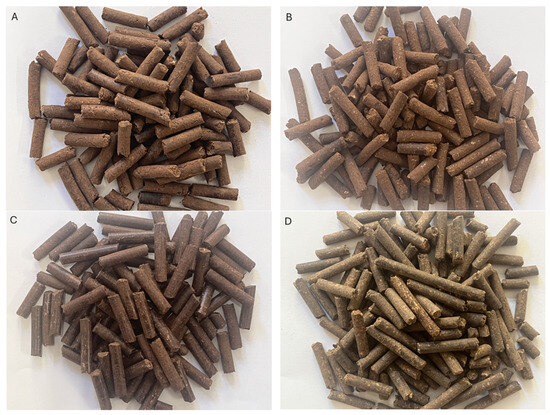
To assess whether it was possible to produce pellets from the by-products of the almond industry, with the desired characteristics, and to determine the optimal percentages of each material, three different mixtures of hulls/almond shells were tested. Figure 1A, Figure 1B, and Figure 1C present the different pellets obtained with (i) 100% hulls, (ii) a mixture of 80% hulls and 20% shells, and (iii) a mixture of 50% hulls and 50% shells, respectively. The physical characteristics of the produced pellets (percentage of fines, diameter, length, bulk density, and mechanical durability) are described in Table 1.
Figure 1.
Pellets from 100% hulls (A), 80/20% hulls/shells (B), 50/50% hulls/shells (C), and industrialized pellets (D).
Table 1.
Characteristics of the different types of pellets: 100/0—100% hulls with particles of all sizes; 80/20—80% hulls and 20% shells; 50/50—50% hulls and 50% shells.
The three pelletization experiments produced pellets with similar characteristics in terms of fine percentage (2.5–3%), length (25.4–27.2 mm), and mechanical durability (96.0–96.9%) but showed different water retention capacities (Table 1). As previously mentioned, hull biomass demonstrates pronounced hygroscopic behaviour. This may explain why the pellets obtained were larger than the matrix diameter (6 mm), especially in pellets with 100% hulls, which had an average diameter of 7.1 mm. This could be due to elasticity and/or moisture reabsorption after pelletizing. As such, pellets containing 100% hulls exhibited rapid water absorption and were prone to disintegration. As shown in Figure 1A, the pellets produced with hulls alone exhibited structural defects/fracture lines, which enhanced rapid fragmentation.
On the other hand, the 80/20% and 50/50% experiments (hulls/shells) resulted in pellets that were structurally more stable than those from hulls alone, more compacted, and without visible cracks, as evidenced in Figure 1B,C. However, due to the low hygroscopicity of shells, pellets produced with 50/50% hulls/shells exhibited low water-retention capacity and high stability, which would not be effective in enhancing soil water retention. Pellets produced from 80/20% hulls/almond shells showed a higher stability than pellets with 100% hulls, with a high-water retention capacity and a slow disintegration as they absorb water. Among the formulations tested, the pellets produced with an 80/20% hull/shell mixture exhibited the most favorable properties for enhancing soil water retention. This mixture was therefore selected to produce the industrialized pellet formulation in the scale-up process (in the table, HRV Industrial Pellets) (Figure 1D), and their characteristics are presented in Table 1.
The pellets were cylindrical and compact, as in the 80/20 and 50/50 formulations. The average length (26.9 mm) was similar to the pellets obtained in the feasibility tests; however, the diameter was lower (5 mm), resulting from the lower diameter matrix used (5 mm) in the scale-up process. Mechanical durability was not affected, with values similar to those of the control (96.9%). There was an increase in the bulk density (an essential factor for transport) when compared to the same conditions on the pelletization feasibility tests (687 vs. 572 kg/m3), most likely derived from a higher compression from the 5 mm matrix used in the industrialized pellets when compared with the 6 mm matrix used in the pelletization feasibility test.
3.2. Pellet Ecotoxicity Assessment
To perform the direct bioassays, the water-holding capacity (WHC) of mixtures with different pellet proportions applied to the soil was determined, and the results are presented in Table 2. Clearly, as the pellet concentration in soil increases, so does its WHC, indicating that the application of pellets to soil can, in fact, increase its water retention capacity.
Table 2.
Water-holding capacity of the mixtures (WHC) with different pellet concentrations in soil (100% w/w, highest pellets’ concentration; 50, 25, 12.5, 6.25, 3.13, and 1.56% w/w, dry weight of pellets, and natural soil as the control (0% of pellets); mean ± stdev, n = 3).
Table 3 shows the results obtained from the direct and indirect bioassays, expressed as EC50 values or considering the corresponding toxicity units (TU). The ecotoxicological assessment expressed in TU provides an integrated and comparable framework for evaluating the potential environmental risk of a material [68]. It is particularly useful when dealing with complex organic matrices, such as agro-industrial residues, where multiple contaminants may coexist. Even though almond hulls have been applied to the soil before, with promising results [69,70,71], to our knowledge, these bioassays have not been conducted on this material. In fact, Zabaleta et al. [72] conducted an indirect germination bioassay but only used almond shells.
Table 3.
Results of the pellets ecotoxicological tests (EC50 values, n = 3), with a 95% confidence interval (CI) and the toxicity units (TU). TU is the inverse of the EC50, expressed as a percentage (TU = (1/EC50) × 100), and is classified according to Mantis et al. [67].
Looking at the results, the pellets and their water extracts showed toxicity towards all tested organisms and across all bioassays performed. Both direct germination tests (with L. sativa and Z. mays) showed high acute ecotoxicity, with an EC50 (% w/w) of 5.1 and 1.4, and TU of 19.6 and 71.4, respectively. The mortality bioassay with E. fetida also showed toxicity, with a lower TU value (6.7), placing it in the “significant toxicity” class. As for the indirect bioassays, both immobilization with D. magna and bioluminescence inhibition with V. fischeri demonstrated high acute ecotoxicity, with an EC50 (% v/v) of 3.8 for D. magna and 7.4 (5 min) and 7.9 (15 min) for V. fischeri and TU of 26.3 (D. magna), 13.5 (5 min), and 12.6 (15 min) (V. fischeri). Finally, the indirect germination assay allowed calculation of three parameters; only relative root elongation (R) showed significant toxicity, with an EC50 (% v/v) of 50.0 and class 3 in TU. The other two calculated parameters, relative seed germination and germination index, fell into class 1 of TU, indicating no significant toxicity.
Therefore, the TU values obtained in this study indicate an ecotoxicological risk for the application of these pellets to soil at doses above certain thresholds, depending on the tested organism and exposure pathway, reinforcing the importance of integrating multiple bioassays that represent different trophic levels and exposure routes rather than relying on single-species or single-endpoint approaches. It also strengthens the idea that this material should be used with caution and in low quantities. Even though the chemical analyses performed were insufficient to assess the toxic effects of contaminants, as they do not account for biological effects, contaminant interactions, or bioavailability [73,74,75], the chemical composition of the hulls studied in our previous work did show high percentages of total extractives and some content in phenolic compounds, which could be one of the causes for the toxicity found in most bioassays [16]. In this context, a detailed analysis of the compounds present after extraction would be of great interest and might help explain the unexpected ecotoxicological responses observed. Another hypothetical cause of the observed ecotoxicity could be other chemicals applied to the almond trees in the field before the collection of almond hulls and shells, mainly pesticides and fungicides, which should not be excluded. These chemicals have been found to affect soil invertebrate fauna, microbial community, and mycorrhizal fungi [76,77,78,79,80]. However, whether this is the case remains unknown, and further testing is needed before the pellets are reapplied to the soil. Furthermore, it is increasingly accepted that toxicity is more closely related to the bioavailable fraction of contaminants and the material’s physicochemical properties than to total contaminant concentration [81,82,83]. For example, Alvarenga et al. [84] analyzed three different biodegradable organic residues and found that some were unsuitable to use as fertilizer and were not acceptable in a landfill as inert residues, being characterized as highly ecotoxic (class 3) or having significant ecotoxicity (class 2), depending on the bioassay performed. Furthermore, in a different study, Alvarenga et al. [85] found that, in some cases, the high toxicity of organic waste eluates could not be predicted from the regulatory chemical characterization, and that the toxic effects were more closely related to the degree of organic waste stabilization or treatment process than to the contaminant load. These findings highlight the limitations of chemical characterization alone and the need to integrate ecotoxicological bioassays to assess bioavailable contaminants, as was carried out for the pellets’ ecotoxicological characterization.
Another aspect to consider is that the ecotoxicological behavior of organic residues is not static but evolves over time. Following soil application, processes such as organic matter mineralization, contaminant sequestration, and microbial degradation may either reduce or enhance toxicity [55]. In our case, the degree of stabilization and decomposition dynamics could be critical factors influencing pellets’ short- and long-term environmental impact, as has been found previously for other organic materials [52,86,87]. This highlights the importance of testing almond hulls and pellets for physicochemical properties, such as electrical conductivity, organic matter stability, and soluble organic compounds, to ensure adequate processing and maturation before land application.
Although it provides limited information on population-level effects, the acute earthworm bioassay is widely applied in soil ecotoxicology, as earthworms are recognized as excellent indicators of contaminants’ bioavailability (e.g., trace elements) due to their ecological relevance, feeding and burrowing behavior, as well as their key role in terrestrial food webs [88]. In this study, pellets were significantly ecotoxic towards E. fetida, with an EC50 of 14.9. Compared with other studies, this value is lower (more toxic) than that typically found for other biodegradable organic residues [84], and it must be considered when applying almond hull and shell pellets to soil.
Additionally, the seed germination assays, although frequently regarded as sensitive indicators of early life cycle effects, are often relatively insensitive to a wide range of toxic substances, mainly because seeds do not readily take up many contaminants and because embryonic plants rely on internal nutrient reserves, limiting their interaction with the surrounding environment [84]. Our results, however, showed high acute toxicity in the direct germination assay for both L. sativa and Z. mays. Here, the lack of germination could be due to electrical conductivity, as reported by [84].
Furthermore, assessing the ecotoxicity of organic wastes is challenging, as biotests may be limited by the responses obtained to organic-matter-rich matrices, and bioassays using waste eluates are essential to evaluate the bioavailable fraction of contaminants, particularly when wastes are applied to land and contaminants may affect soil organisms or be leached to surface and groundwater [84,89].
The pellets’ water extracts also showed toxicity, especially in the immobilization and bioluminescence inhibition bioassays, as well as in the relative root elongation parameter calculated in the indirect germination bioassay. The D. magna immobilization bioassay is a sensitive and standardized tool for assessing the ecotoxicological impact of organic waste eluates on surface and groundwater, particularly due to its responsiveness to ammonia, metals, and other toxicants [90,91]. In line with this, physicochemical parameters associated with organic matter stabilization, such as ammonium, have been shown to strongly explain acute daphnid toxicity [92,93,94]. On the other hand, Huguier et al. [95] reported this bioassay as the least sensitive. However, this is likely due to methodological differences in the eluates rather than to intrinsic waste toxicity. Although linking individual contaminants to toxicity in complex matrices remains challenging, previous studies indicate that metals are major contributors to toxicity affecting D. magna [96,97,98]. Similar considerations apply to V. fischeri, for which toxicity has also been associated with metal content [99], suggesting that toxicity arises from combined, non-additive effects of multiple metals and possibly other contaminants present in both the waste matrix and its leachates. Although it is unlikely that almond hulls and shells pellets are contaminated with heavy metals, their water extracts showed high acute ecotoxicity in both bioassays; as such, this possibility should at least be excluded by determining their metal content.
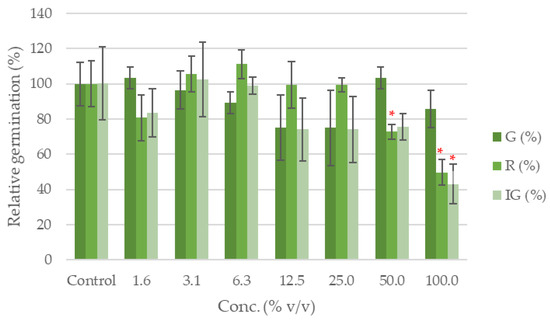
Figure 2 shows the results of the indirect germination bioassay using pellets’ water extracts at different concentrations and compares the three calculated parameters (relative seed germination—G; relative root elongation—R; and germination index—IG). Only three variables differed significantly from the control group: R at 50% (v/v) and R and IG at 100% (v/v). Again, germination index and relative seed germination were the two parameters that showed no significant ecotoxicity in TU (Table 3). In fact, at all concentrations tested (including 100%), the seeds germinated, although root elongation was smaller at 50% and 100%. The present results demonstrate that toxicity observed in eluates cannot always be predicted from solid-phase assays, especially when comparing the indirect germination bioassay (no significant ecotoxicity for germination index) with the direct germination bioassays (high acute toxicity for the two species tested), highlighting the relevance of assessing both fractions of the materials. Even though germination was not significantly affected by the pellets’ water extract, especially at concentrations below 25% (v/v), the other two indirect bioassays performed in this study showed high toxicity, reinforcing the need to use these pellets at low concentrations. Eluate-based bioassays provide a more realistic assessment of adverse effects on aquatic and soil organisms exposed through soil–water pathways. However, their outcomes must be interpreted with caution, as contaminant mobility and toxicity can be strongly modulated by soil properties under field conditions [100].
Figure 2.
Results obtained for the germination bioassay with the pellet water extract: G (%)—relative seed germination; R (%)—relative root elongation; GI (%)—germination index, calculated as GI (%) = G (%) × R (%)/100. Columns marked with a red (*) are significantly different from the control group (Dunnett’s test with one control group, 0.05 significance level).
Despite their benefits, the results from the pellets ecotoxicological risk assessment highlight three important aspects: (1) the application of this material in the soil needs to carefully consider the dose applied; (2) in the future, the array of chemical analyses has to be enlarged to understand why this high toxicity was found (either due to compounds present in the hulls themselves or due to possible contamination of the pellets with the pesticides used in field); and (3) understanding if it is possible to treat the pellets (or the production materials) to lower the toxicity before applying them to the soil.
3.3. Field Tests
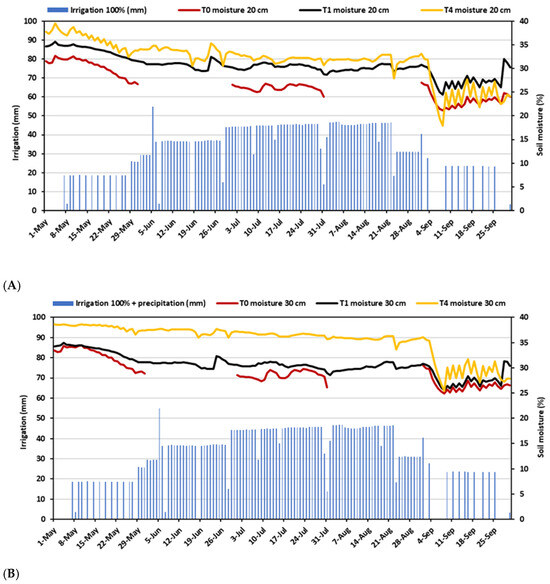
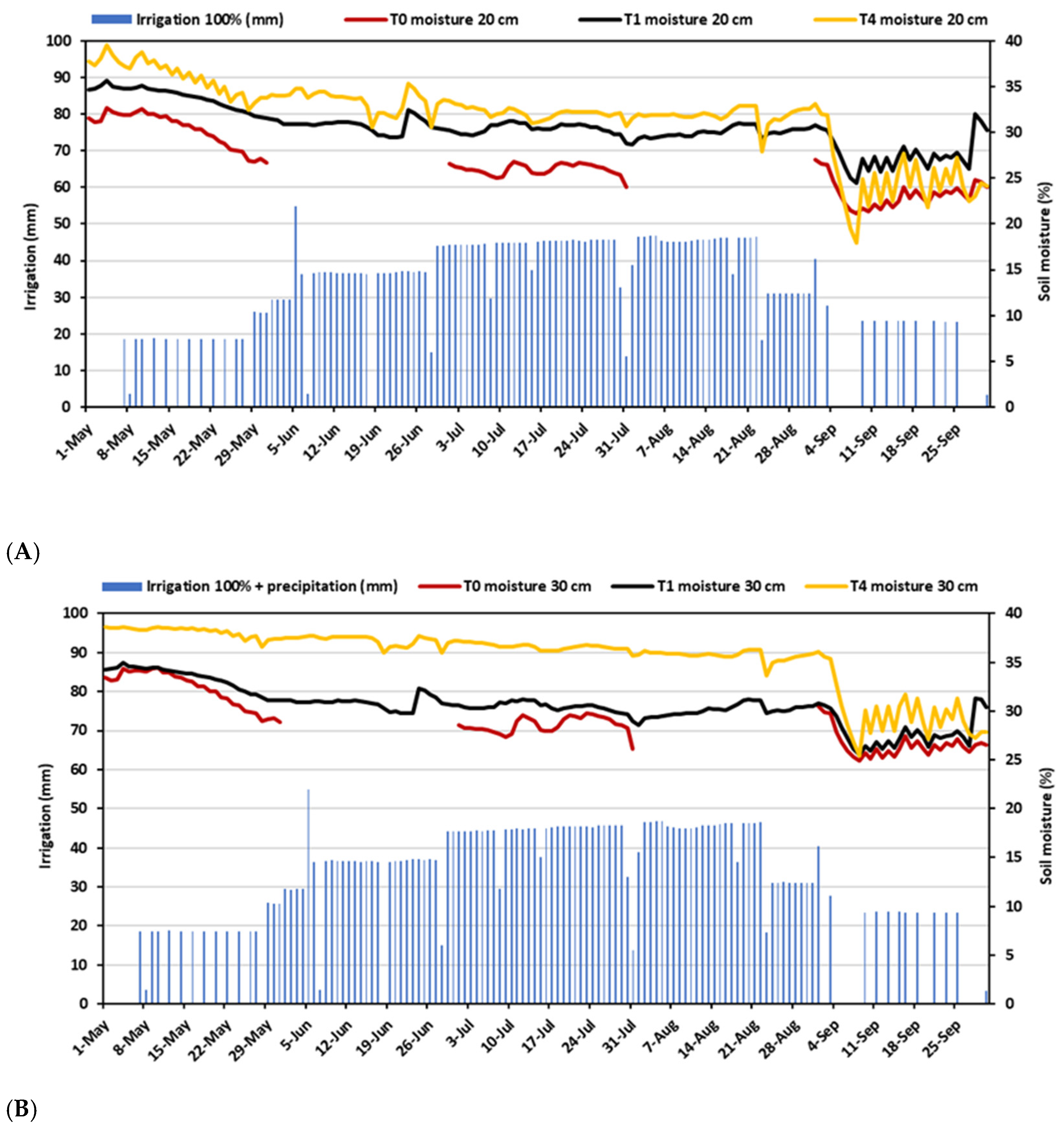
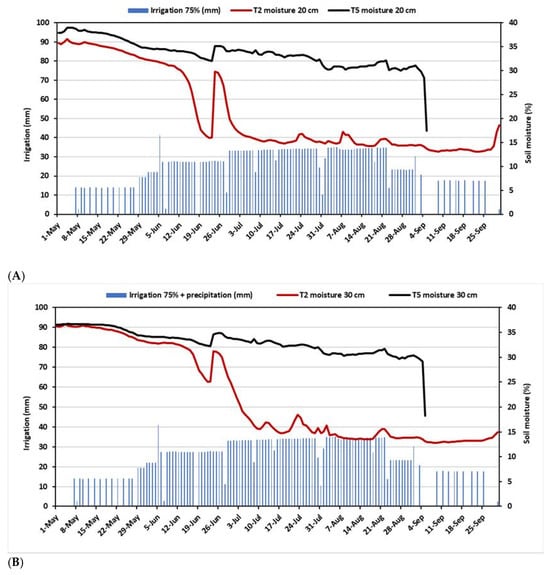
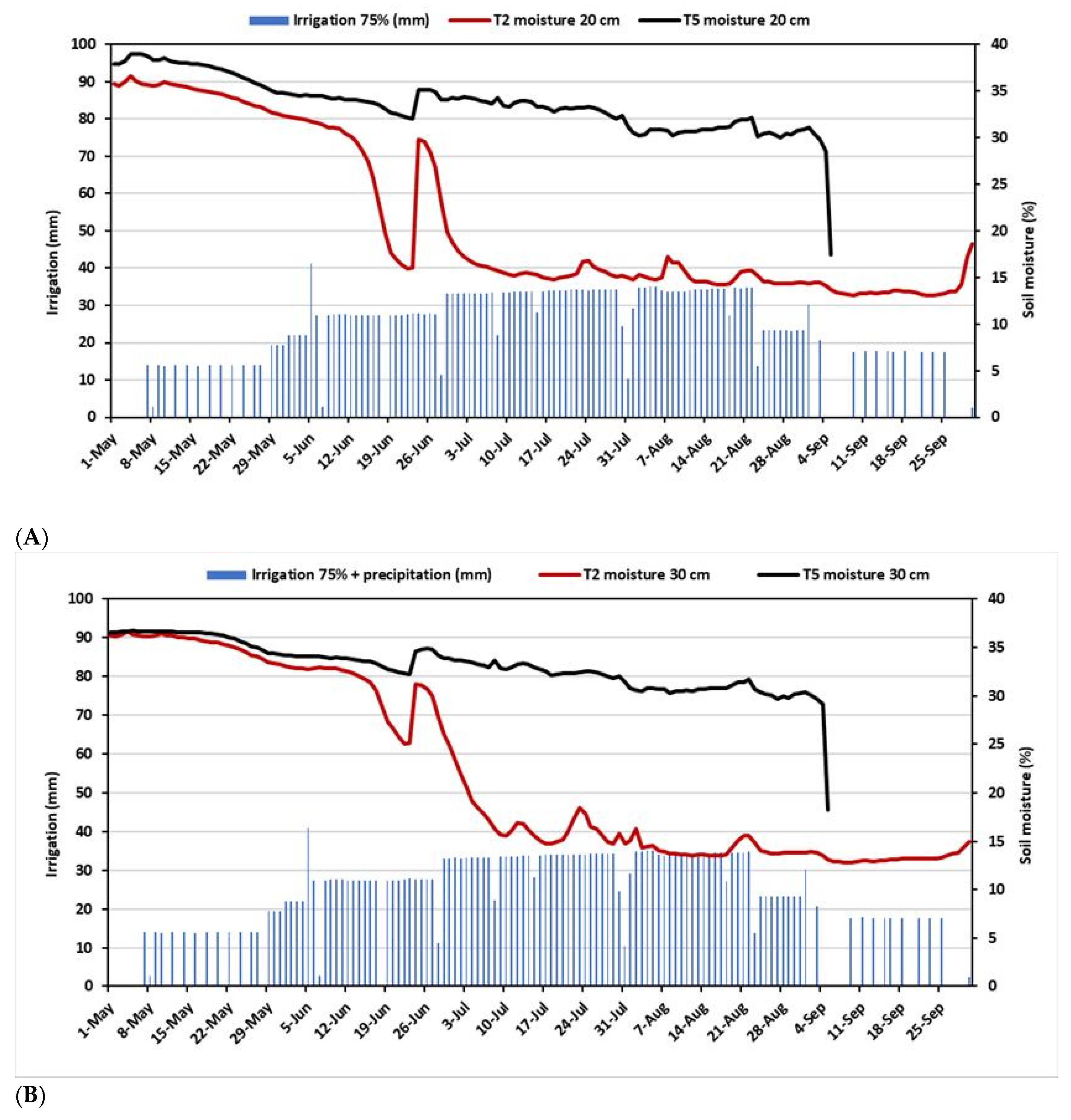
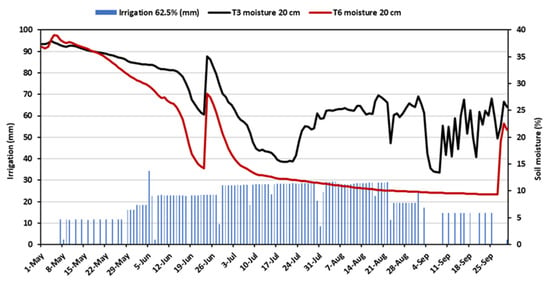
The results obtained across the different treatments show that soil moisture levels are higher in plots with 100% irrigation (usual allocation) than in plots under deficit allocations (75% and 62.5% of the normal allocation), particularly from the end of June (Figure 3, Figure 4 and Figure 5). Overall, a gradual reduction in soil moisture content was observed throughout the trial, with greater amplitude of variation in measurements at a depth of 20 cm (Figure 3, Figure 4 and Figure 5). In the plots under 100% irrigation, soil moisture content was consistently higher in the BAP-applied modalities than in the control (without BAP) across all measured depths (Figure 3). Moreover, in the treatment with 10 kg of BAP per tree, higher soil moisture levels were observed, especially at a depth of 30 cm, which corresponded approximately to the depth at which the BAP was incorporated (Figure 3).
Figure 3.
Soil moisture content throughout the field experiment across the different treatments (T0—control; T1—5 kg of pellets per tree; T4—10 kg of pellets per tree) at the 100% irrigation rate (as practiced on the farm). Measured at depths of (A) 20 and (B) 30 cm.
Figure 4.
Soil moisture content throughout the field trial across the different treatments (T2—5 kg of pellets per tree and T5—10 kg of pellets per tree) under the 75% irrigation allocation (practiced on the farm). Measured at depths of (A) 20 and (B) 30 cm.
Figure 5.
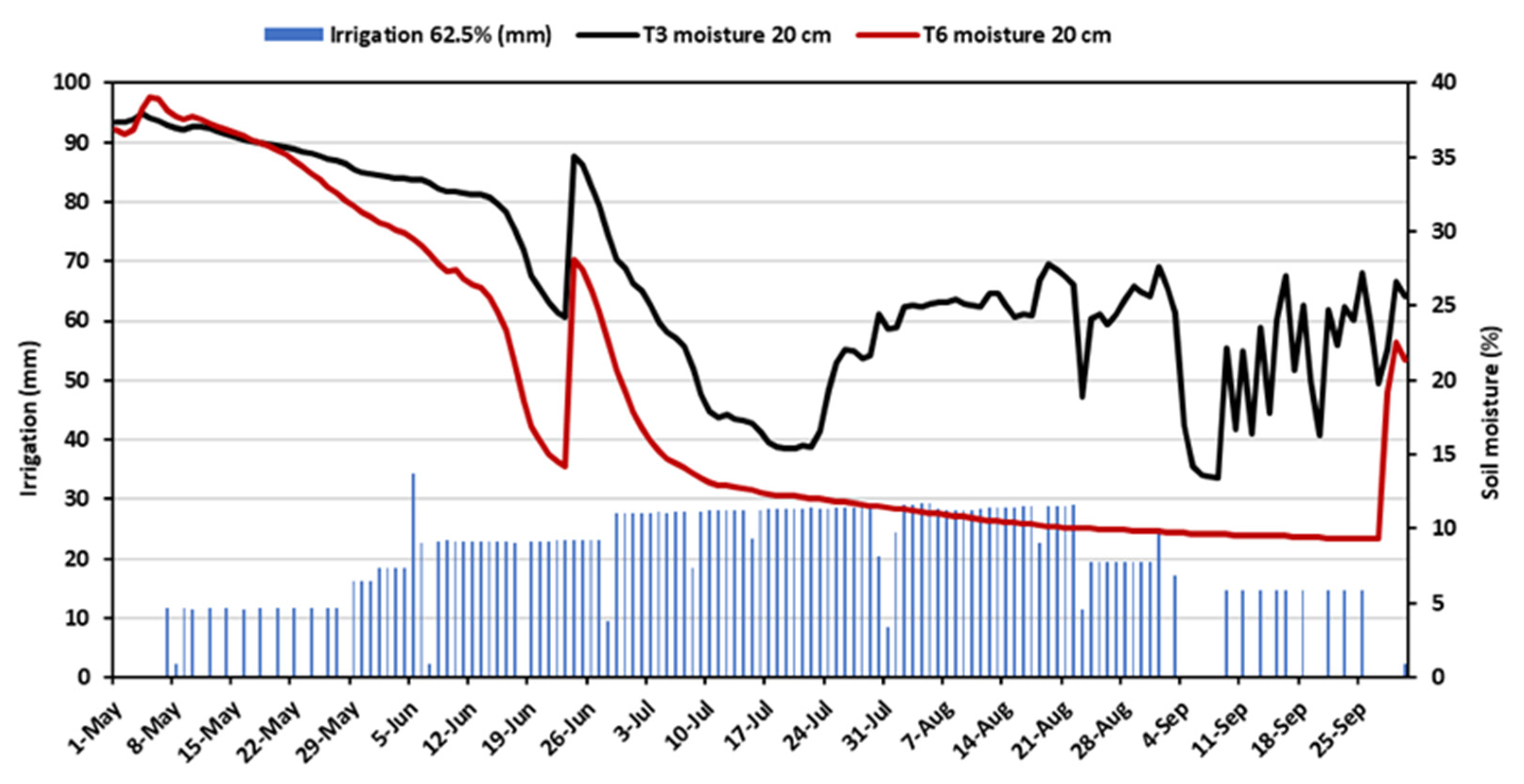
Soil moisture content throughout the trial across the different treatments (T3—5 kg BAP/tree and T6—10 kg BAP/tree) with an irrigation allocation of 62.5% (of that practiced on the property), measured at a depth of 20 cm.
When the irrigation allocation was reduced to 62.5% of the usual application rate in the farm, soil moisture content decreased throughout the experimental trial in both T3 and T6 (Figure 5). Under this allocation, the effect of precipitation was more pronounced, particularly at depths of 20 and 30 cm, where soil moisture content increased considerably due to rainfall on June 20 and at the end of September. As observed in the 75% irrigation treatment, soil moisture content was consistently higher in plots receiving 10 kg BAP than in those receiving 5 kg BAP, with the differences becoming more pronounced from the end of June onward (Figure 5).
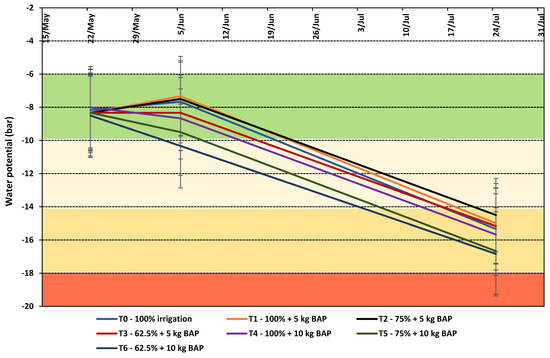
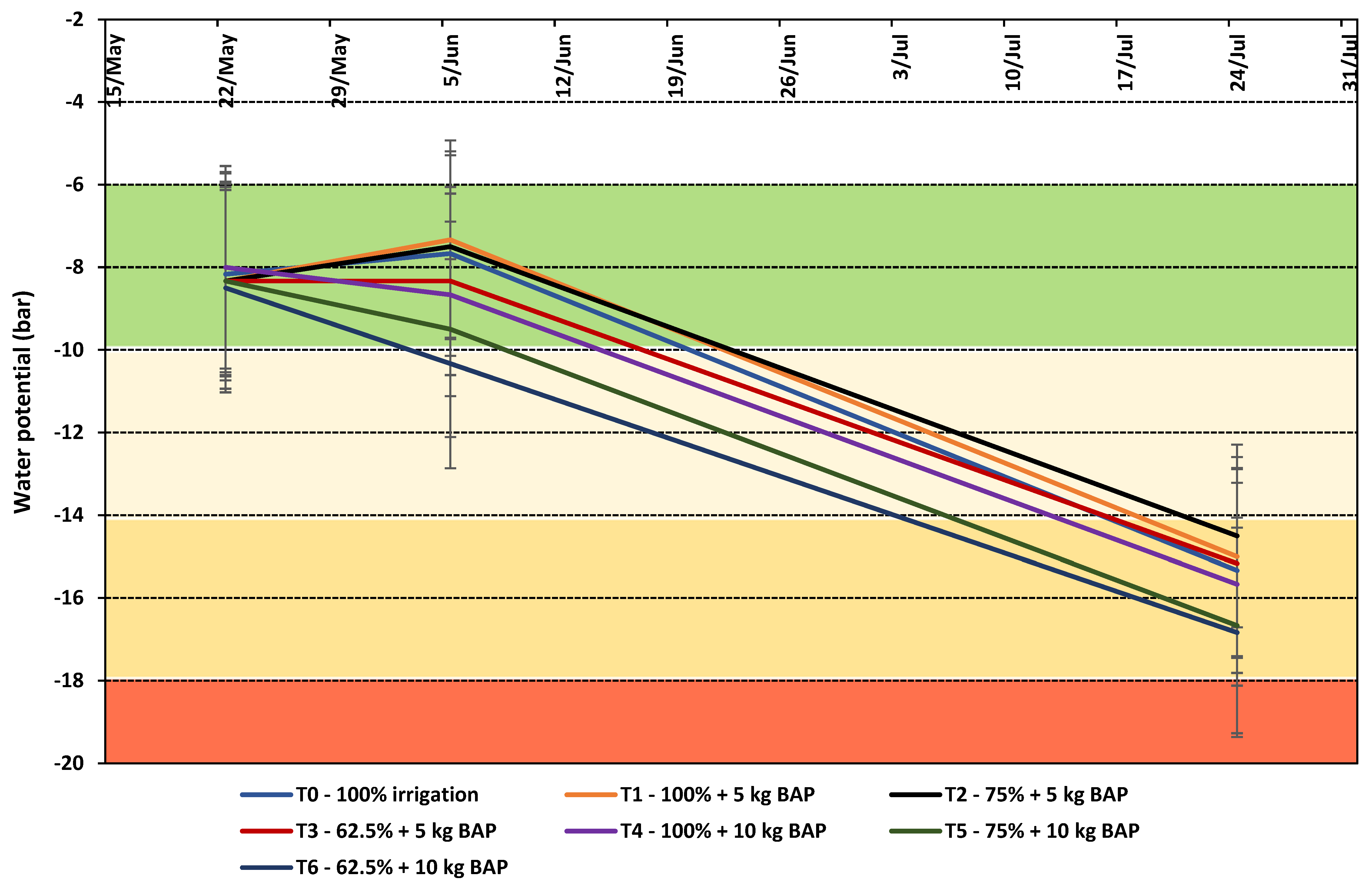
The results for the almond tree’s leaf water potential and the variation in water stress levels, based on data from Fulton et al. [101], are shown in Figure 6.
Figure 6.
Variation in water potential of almond trees across different treatments. Water stress levels: white region—water comfort (−6 bar to −10 bar); green region—low water stress (−10 bar to −14 bar); beige region—moderate water stress (−14 bar to −18 bar); orange region—high water stress (−18 bar to −20 bar) [101].
The ranges of water potential values indicate that these trees were in water comfort in all treatments until the beginning of June, when the fruits had already reached their maximum size. In the measurement carried out on 24 July, all treatments, including 100% irrigation with or without BAP application, exhibited moderate water stress, ranging from −14.5 to −16.8 bar, with no substantial differences. Overall, the temporal dynamics of water potential were very similar across treatments, with values close together between irrigation allocations and the BAP application, which was unexpected. Analyzing the water potential curves for the different irrigation allocations, it is evident that the normal irrigation allocation for the almond trees is excessive, as no high-water stress is observed even when irrigation is reduced to 62.5% of the usual allocation.
4. Conclusions
This study demonstrates the potential of almond hulls and shells to be valorized into pellets with properties that improve water-use efficiency in agricultural soils. The results showed that increasing the percentage of pellet application led to higher soil water-holding capacity and moisture levels, even under reduced irrigation regimes. However, the ecotoxicological assessment revealed toxicity in most tested organisms, both through direct exposure to the pellets and through indirect exposure via their water extract, highlighting the importance of careful dose selection when applying these materials. Further research is required to identify the sources of toxicity, to evaluate stabilization or pre-treatment strategies, and to assess long-term environmental behavior under field conditions before widespread agricultural application can be recommended.
Author Contributions
Conceptualization, J.G.; methodology, A.T.C. and R.A.C.; validation, J.G.; investigation, C.P., E.M., R.M., A.B., N.S., F.M., J.R., P.A. and A.E.; resources, Veracruz; data curation, P.A.; writing—original draft preparation, A.T.C. and R.A.C.; writing—review and editing, J.G. and P.A.; supervision, J.G.; funding acquisition, J.G. All authors have read and agreed to the published version of the manuscript.
Funding
This work was supported by Plano de Recuperação e Resiliência (PRR) under the project SAP4CircularAgriculture, with the reference PRR-C05-i03-I-000239. PRR also supported Ricardo Costa through the research contract (SAP4_Refa_BL_44_2024_9435) and Ana Caeiro through the research contract (SAP4_Refa_BL_27_2025). Additionally, the Forest Research Centre (UID/00239: Centro de Estudos Florestais), the Associate Laboratory TERRA (LA/P/0092/2020), and Linking Landscape, Environment, Agriculture and Food Research Centre (LEAF) (UID/04129/2025) are funded by Fundação para a Ciência e Tecnologia (FCT).
Data Availability Statement
The data presented in this study are available on request from the corresponding author. The data are not publicly available due to privacy concerns.
Conflicts of Interest
Author Nuno Saraiva, Francisco Marques, Jorge Rebelo, André Encarnação was employed by the company Rua Filarmonica Idanhense. The remaining authors declare that the research was conducted in the absence of any commercial or financial relationships that could be construed as a potential conflict of interest.
References
- Cao, L.; El Mashad, H.M.; Pan, Z.; Zhang, R. Production of Filamentous Fungal Biomass (Aspergillus awamori) in Pellet Form from Almond Hull Extract. Food Bioproc. Tech. 2025, 18, 8735–8750. [Google Scholar] [CrossRef] [Scilit]
- McKenzie, F.C.; Williams, J. Sustainable Food Production: Constraints, Challenges and Choices by 2050. Food Secur. 2015, 7, 221–233. [Google Scholar] [CrossRef] [Scilit]
- Skrzypczak, D.; Gil, F.; Izydorczyk, G.; Mikula, K.; Gersz, A.; Hoppe, V.; Chojnacka, K.; Witek-Krowiak, A. Innovative Bio-Waste-Based Multilayer Hydrogel Fertilizers as a New Solution for Precision Agriculture. J. Environ. Manag. 2022, 321, 116002. [Google Scholar] [CrossRef] [Scilit]
- Amin, F.; Jilani, M.I. Environmental, Microbiological and Chemical Implications of Fertilizers Use in Soils: A Review. Int. J. Chem. Biochem. Sci. (IJCBS) 2024, 25, 2024. [Google Scholar]
- Dingley, C.; Cass, P.; Adhikari, B.; Daver, F. Application of Superabsorbent Natural Polymers in Agriculture. Polym. Renew. Resour. 2024, 15, 210–255. [Google Scholar] [CrossRef] [Scilit]
- Gil-Ortiz, R.; Naranjo, M.Á.; Ruiz-Navarro, A.; Atares, S.; García, C.; Zotarelli, L.; Bautista, A.S.; Vicente, O. Enhanced Agronomic Efficiency Using a New Controlled-Released, Polymeric-Coated Nitrogen Fertilizer in Rice. Plants 2020, 9, 1183. [Google Scholar] [CrossRef] [Scilit]
- Messiga, A.J.; Dyck, K.; Ronda, K.; van Baar, K.; Haak, D.; Yu, S.; Dorais, M. Nutrients Leaching in Response to Long-Term Fertigation and Broadcast Nitrogen in Blueberry Production. Plants 2020, 9, 1530. [Google Scholar] [CrossRef] [Scilit]
- Abdel Hakiem, A.A.; Abdel Moneam, Y.K.; Said, H.M.; Senna, M.M.H. Radiation Induced Biodegradable Polymer Blends for Growth Promotion of Corn Plants. Polym. Renew. Resour. 2022, 13, 3–27. [Google Scholar] [CrossRef] [Scilit]
- Supare, K.; Mahanwar, P.A. Starch-Derived Superabsorbent Polymers in Agriculture Applications: An Overview. Polym. Bull. 2021, 79, 5795–5824. [Google Scholar] [CrossRef] [Scilit]
- El-Hafez, A.M.A.; Hassan, E.A.; El-Dein, A.A.S.; Ahmed, S.A. Effect of Bio- and Synthetic- Polymers on Enhancing Soil Physical Properties and Lettuce Plant Production. Asian J. Soil Sci. Plant Nutr. 2019, 4, 1–9. [Google Scholar] [CrossRef] [Scilit]
- Oladosu, Y.; Rafii, M.Y.; Arolu, F.; Chukwu, S.C.; Salisu, M.A.; Fagbohun, I.K.; Muftaudeen, T.K.; Swaray, S.; Haliru, B.S. Superabsorbent Polymer Hydrogels for Sustainable Agriculture: A Review. Horticulturae 2022, 8, 605. [Google Scholar] [CrossRef] [Scilit]
- Thomas, C.L.; Acquah, G.E.; Whitmore, A.P.; McGrath, S.P.; Haefele, S.M. The Effect of Different Organic Fertilizers on Yield and Soil and Crop Nutrient Concentrations. Agronomy 2019, 9, 776. [Google Scholar] [CrossRef] [Scilit]
- Thiyageshwari, S.; Gayathri, P.; Krishnamoorthy, R.; Anandham, R.; Paul, D. Exploration of Rice Husk Compost as an Alternate Organic Manure to Enhance the Productivity of Blackgram in Typic Haplustalf and Typic Rhodustalf. Int. J. Environ. Res. Public Health 2018, 15, 358. [Google Scholar] [CrossRef] [Scilit] [PubMed]
- Balentic, J.P.; Ačkar, Đ.; Jokic, S.; Jozinovic, A.; Babic, J.; Miličevic, B.; Ubaric, D.; Pavlovic, N. Cocoa Shell: A By-Product with Great Potential for Wide Application. Molecules 2018, 23, 1404. [Google Scholar] [CrossRef] [Scilit] [PubMed]
- Instituto Nacional de Estatísitca (INE). Estatísticas Agrícolas: 2023; Instituto Nacional de Estatísitca (INE): Lisboa, Portugal, 2023; ISBN 9789892506807. [Google Scholar]
- Caeiro, A.T.; Costa, R.A.; Neiva, D.M.; Silva, J.; Marrão, R.; Bento, A.; Saraiva, N.; Marques, F.; Rebelo, J.; Encarnação, A.; et al. Harnessing and Evaluating Almond Hulls and Shells for Bio-Based Products. Environments 2025, 12, 369. [Google Scholar] [CrossRef] [Scilit]
- Silva, V.; Oliveira, I.; Pereira, J.A.; Gonçalves, B. Almond By-Products Substrates as Sustainable Amendments for Green Bean Cultivation. Plants 2024, 13, 540. [Google Scholar] [CrossRef] [Scilit] [PubMed]
- Prgomet, I.; Goncalves, B.; Domínguez-Perles, R.; Pascual-Seva, N.; Barros, A.I.R.N.A. Valorization Challenges to Almond Residues: Phytochemical Composition and Functional Application. Molecules 2017, 22, 1774. [Google Scholar] [CrossRef] [Scilit]
- Esfahlan, A.J.; Jamei, R.; Esfahlan, R.J. The Importance of Almond (Prunus amygdalus L.) and Its by-Products. Food Chem. 2010, 120, 349–360. [Google Scholar] [CrossRef] [Scilit]
- Andrews, E.M.; Tabassum, M.; Galatis, E.G.; Yao, E.H.; Gaudin, A.C.M.; Lazcano, C.; Brown, P.H.; Khalsa, S.D.S. Almond Hull and Shell Organic Matter Amendments Increase Microbial Biomass and Multifunctionality in Orchard Soil and the Undisturbed Organic Layer. Appl. Soil Ecol. 2024, 197, 105321. [Google Scholar] [CrossRef] [Scilit]
- Tomishima, H.; Luo, K.; Mitchell, A.E. The Almond (Prunus dulcis): Chemical Properties, Utilization, and Valorization of Coproducts. Annu. Rev. Food Sci. Technol. 2022, 13, 145–166. [Google Scholar] [CrossRef] [Scilit]
- Holtman, K.M.; Offeman, R.D.; Franqui-Villanueva, D.; Bayati, A.K.; Orts, W.J. Countercurrent Extraction of Soluble Sugars from Almond Hulls and Assessment of the Bioenergy Potential. J. Agric. Food Chem. 2015, 63, 2490–2498. [Google Scholar] [CrossRef] [Scilit]
- Isfahlan, A.J.; Mahmoodzadeh, A.; Hassanzadeh, A.; Heidari, R.; Jamei, R. Antioxidant and Antiradical Activities of Phenolic Extracts from Iranian Almond (Prunus amygdalus L.) Hulls Shells. Turk. J. Biol. 2010, 34, 165–173. [Google Scholar] [CrossRef] [Scilit]
- Kahlaoui, M.; Vecchia, S.B.D.; Giovine, F.; Kbaier, H.B.H.; Bouzouita, N.; Pereira, L.B.; Zeppa, G. Characterization of Polyphenolic Compounds Extracted from Different Varieties of Almond Hulls (Prunus dulcis L.). Antioxidants 2019, 8, 647. [Google Scholar] [CrossRef] [Scilit] [PubMed]
- Najari, Z.; Khodaiyan, F.; Yarmand, M.S.; Hosseini, S.S. Almond Hulls Waste Valorization towards Sustainable Agricultural Development: Production of Pectin, Phenolics, Pullulan, and Single Cell Protein. Waste Manag. 2022, 141, 208–219. [Google Scholar] [CrossRef] [Scilit] [PubMed]
- Pinelo, M.; Rubilar, M.; Sineiro, J.; Núñez, M.J. Extraction of Antioxidant Phenolics from Almond Hulls (Prunus amygdalus) and Pine Sawdust (Pinus pinaster). Food Chem. 2004, 85, 267–273. [Google Scholar] [CrossRef] [Scilit]
- Takeoka, G.R.; Dao, L.T. Antioxidant Constituents of Almond [Prunus dulcis (Mill.) D.A. Webb] Hulls. J. Agric. Food Chem. 2003, 51, 496–501. [Google Scholar] [CrossRef] [Scilit]
- An, J.; Liu, J.; Liang, Y.; Ma, Y.; Chen, C.; Cheng, Y.; Peng, P.; Zhou, N.; Zhang, R.; Addy, M.; et al. Characterization, Bioavailability and Protective Effects of Phenolic-Rich Extracts from Almond Hulls against pro-Oxidant Induced Toxicity in Caco-2 Cells. Food Chem. 2020, 322, 126742. [Google Scholar] [CrossRef] [Scilit]
- Sitepu, I.R.; Hitomi, A.; Wu, W.; Wu, A.; Jeoh, T.; Boundy-Mills, K. Production of High Protein Yeast Using Enzymatically Liquefied Almond Hulls. PLoS ONE 2023, 18, e0293085. [Google Scholar] [CrossRef] [Scilit]
- Cao, L.; Barzee, T.J.; El Mashad, H.M.; Pan, Z.; Zhang, R. Potential of Utilizing Almond Hull Extract for Filamentous Fungi Production by Submerged Cultivation. Food Bioeng. 2024, 3, 3–13. [Google Scholar] [CrossRef] [Scilit]
- Axelrod, R.; Palma Miner, L.; VanderGheynst, J.S.; Simmons, C.W.; Fernandez-Bayo, J.D. Soil Application of Almond Residue Biomass Following Black Soldier Fly Larvae Cultivation. Front. Sustain. Food Syst. 2021, 5, 664635. [Google Scholar] [CrossRef] [Scilit]
- Palma, L.; Fernández-Bayo, J.; Putri, F.; VanderGheynst, J.S. Almond By-Product Composition Impacts the Rearing of Black Soldier Fly Larvae and Quality of the Spent Substrate as a Soil Amendment. J. Sci. Food Agric. 2020, 100, 4618–4626. [Google Scholar] [CrossRef] [Scilit] [PubMed]
- Miner, L.P.; Fernandez-Bayo, J.; Putri, F.; Niemeier, D.; Bischel, H.; VanderGheynst, J.S. Predicting Black Soldier Fly Larvae Biomass and Methionine Accumulation Using a Kinetic Model for Batch Cultivation and Improving System Performance Using Semi-Batch Cultivation. Bioprocess Biosyst. Eng. 2022, 45, 333–344. [Google Scholar] [CrossRef] [Scilit]
- Andry, H.; Yamamoto, T.; Irie, T.; Moritani, S.; Inoue, M.; Fujiyama, H. Water Retention, Hydraulic Conductivity of Hydrophilic Polymers in Sandy Soil as Affected by Temperature and Water Quality. J. Hydrol. 2009, 373, 177–183. [Google Scholar] [CrossRef] [Scilit]
- Burke, D.R.; Akay, G.; Bilsborrow, P.E. Development of Novel Polymeric Materials for Agroprocess Intensification. J. Appl. Polym. Sci. 2010, 118, 3292–3299. [Google Scholar] [CrossRef] [Scilit]
- Snyder, C.S.; Bruulsema, T.W.; Jensen, T.L.; Fixen, P.E. Review of Greenhouse Gas Emissions from Crop Production Systems and Fertilizer Management Effects. Agric. Ecosyst. Environ. 2009, 133, 247–266. [Google Scholar] [CrossRef] [Scilit]
- Channab, B.E.; El Idrissi, A.; Zahouily, M.; Essamlali, Y.; White, J.C. Starch-Based Controlled Release Fertilizers: A Review. Int. J. Biol. Macromol. 2023, 238, 124075. [Google Scholar] [CrossRef] [Scilit]
- Matmin, J.; Ibrahim, S.I.; Mohd Hatta, M.H.; Ricky Marzuki, R.; Jumbri, K.; Nik Malek, N.A.N. Starch-Derived Superabsorbent Polymer in Remediation of Solid Waste Sludge Based on Water–Polymer Interaction. Polymers 2023, 15, 1471. [Google Scholar] [CrossRef] [Scilit] [PubMed]
- Azeem, B.; Elboughdiri, N.; KuShaari, K.Z.; Jamoussi, B.; Ghernaout, D.; Ghareba, S.; Raza, S.; Gasmi, A. Valorization of Almond Shells’ Lignocellulosic Microparticles for Controlled Release Urea Production: Interactive Effect of Process Parameters on Longevity and Kinetics of Nutrient Release. J. Coat. Technol. Res. 2022, 19, 643–660. [Google Scholar] [CrossRef] [Scilit]
- Azeem, B.; Kushaari, K.; Man, Z.B.; Basit, A.; Thanh, T.H. Review on Materials & Methods to Produce Controlled Release Coated Urea Fertilizer. J. Control. Release 2014, 181, 11–21. [Google Scholar] [CrossRef] [Scilit]
- Chen, J.; Fan, X.; Zhang, L.; Chen, X.; Sun, S.; Sun, R.C. Research Progress in Lignin-Based Slow/Controlled Release Fertilizer. ChemSusChem 2020, 13, 4356–4366. [Google Scholar] [CrossRef] [Scilit] [PubMed]
- Chen, J.; Lü, S.; Zhang, Z.; Zhao, X.; Li, X.; Ning, P.; Liu, M. Environmentally Friendly Fertilizers: A Review of Materials Used and Their Effects on the Environment. Sci. Total Environ. 2018, 613–614, 829–839. [Google Scholar] [CrossRef] [Scilit]
- Shea, E.; Fernandez-Bayo, J.; Simmons, C. Effect of Almond Residue Soil Amendments and Irrigation Regiment on Organic Acid Development and Transport in Soil. ACS Agric. Sci. Technol. 2024, 4, 899–906. [Google Scholar] [CrossRef] [Scilit]
- Shea, E.; Fernandez-Bayo, J.D.; Pastrana, A.M.; Simmons, C.W. Identification and Evaluation of Volatile Organic Compounds Evolved during Solarization with Almond Hull and Shell Amendments. J. Air Waste Manag. Assoc. 2021, 71, 400–412. [Google Scholar] [CrossRef] [Scilit]
- Fernandez-Bayo, J.D.; Shea, E.A.; Parr, A.E.; Achmon, Y.; Stapleton, J.J.; VanderGheynst, J.S.; Hodson, A.K.; Simmons, C.W. Almond Processing Residues as a Source of Organic Acid Biopesticides during Biosolarization. Waste Manag. 2020, 101, 74–82. [Google Scholar] [CrossRef] [Scilit]
- Pastrana, A.M.; Shea, E.A.; Fernandez-Bayo, J.D.; Allison, B.; Watson, D.C.; Toniato, J.; Gordon, T.R.; Simmons, C.W.; Pastrana, A.M.; Shea, E.A.; et al. Impact of Biosolarization with Almond Hull and Shell Amendments for the Control of Fusarium Oxysporum f. Sp. Lactucae in a Lettuce/Tomato Cropping System. Crop Prot. 2022, 152, 105856. [Google Scholar] [CrossRef] [Scilit]
- Yuan, S.; Cheng, L.; Tan, Z. Characteristics and Preparation of Oil-Coated Fertilizers: A Review. J. Control. Release 2022, 345, 675–684. [Google Scholar] [CrossRef] [Scilit] [PubMed]
- Madduma-Bandarage, U.S.K.; Madihally, S.V. Synthetic Hydrogels: Synthesis, Novel Trends, and Applications. J. Appl. Polym. Sci. 2021, 138, 50376. [Google Scholar] [CrossRef] [Scilit]
- Liu, Y.; Zhu, Y.; Mu, B.; Wang, Y.; Quan, Z.; Wang, A. Synthesis, Characterization, and Swelling Behaviors of Sodium Carboxymethyl Cellulose-g-Poly(Acrylic Acid)/Semi-Coke Superabsorbent. Polym. Bull. 2022, 79, 935–953. [Google Scholar] [CrossRef] [Scilit]
- Andrews, E.M.; Rivers, D.J.; Gaudin, A.C.M.; Geisseler, D.; Brown, P.H.; Khalsa, S.D.S. In a Nutshell: Almond Hull and Shell Organic Matter Amendments Increase Soil and Tree Potassium Status. Plant Soil 2024, 495, 699–722. [Google Scholar] [CrossRef] [Scilit]
- Okereafor, U.; Makhatha, M.; Mekuto, L.; Uche-Okereafor, N.; Sebola, T.; Mavumengwana, V. Toxic Metal Implications on Agricultural Soils, Plants, Animals, Aquatic Life and Human Health. Int. J. Environ. Res. Public Health 2020, 17, 2204. [Google Scholar] [CrossRef] [Scilit] [PubMed]
- Roig, N.; Sierra, J.; Nadal, M.; Martí, E.; Navalón-Madrigal, P.; Schuhmacher, M.; Domingo, J.L. Relationship between Pollutant Content and Ecotoxicity of Sewage Sludges from Spanish Wastewater Treatment Plants. Sci. Total Environ. 2012, 425, 99–109. [Google Scholar] [CrossRef] [Scilit]
- Natal-Da-Luz, T.; Tidona, S.; Jesus, B.; Morais, P.V.; Sousa, J.P. The Use of Sewage Sludge as Soil Amendment. the Need for an Ecotoxicological Evaluation. J. Soils Sediments 2009, 9, 246–260. [Google Scholar] [CrossRef] [Scilit]
- Domene, X.; Alcañiz, J.M.; Andrés, P. Ecotoxicological Assessment of Organic Wastes Using the Soil Collembolan Folsomia Candida. Appl. Soil Ecol. 2007, 35, 461–472. [Google Scholar] [CrossRef] [Scilit]
- Malara, A.; Oleszczuk, P. Application of a Battery of Biotests for the Determination of Leachate Toxicity to Bacteria and Invertebrates from Sewage Sludge-Amended Soil. Environ. Sci. Pollut. Res. 2013, 20, 3435–3446. [Google Scholar] [CrossRef] [Scilit] [PubMed]
- Harmsen, J. Measuring Bioavailability: From a Scientific Approach to Standard Methods. J. Environ. Qual. 2007, 36, 1420–1428. [Google Scholar] [CrossRef] [Scilit]
- Nunes, L.J.R. Characterization of Cytisus Striatus (Hill) Rothm.: Waste Biomass Energy Recovery as a Measure to Reduce the Risk of Rural Fires. Recycling 2021, 6, 36. [Google Scholar] [CrossRef] [Scilit]
- Ferreira, T.; Pereira, C.; Paiva, J.M.; Pinho, C. Simple Methodology To Quantify the Fragmentation on Batches of Char Pellets During Fluidized Bed Combustion. Energy Fuels 2017, 31, 5073–5078. [Google Scholar] [CrossRef] [Scilit]
- Ferreira, T.; Paiva, J.M.; Pinho, C.; Ferreira, T.; Paiva, J.M.; Pinho, C. The Experimental Analysis of Biochar Combustion in a Traveling Grate Furnace. Fire 2024, 7, 118. [Google Scholar] [CrossRef] [Scilit]
- EN 14961-1:2010; Solid Biofuels—Fuel Specifications and Classes—Part 1: General Requirements. 2010. CEN (Comité Européen de Normalisation): Brussels, Belgium, 2010. Available online: https://standards.iteh.ai/catalog/standards/cen/fc112352-281a-4465-9034-be81d919fab6/en-14961-1-2010?srsltid=AfmBOop0vjZHMpsnFZ_lqka4mdblbz5tyLTiapRDw1lAKQVXNWdXeY1t (accessed on 9 January 2026).
- ISO 17126:2024; Soil Quality—Determination of the Effects of Pollutants on Soil Flora—Screening Test for Emergence of Lettuce Seedlings (Lactuca sativa L.). Available online: https://www.iso.org/standard/83950.html (accessed on 7 January 2026).
- ASTM E1676-97; Standard Guide for Conducting Laboratory Soil Toxicity or Bioaccumulation Tests with Lumbricid Earthworm Eisenia fetida. Annual Book of ASTM Standards; American Society for Testing and Materials: West Conshohoken, PA, USA, 1997.
- DIN 38414-S4; “German Standard Procedure for Water, Wastewater and Sediment Testing (Group S),” Determination of Leachability by Water. Institutfür Normung: Berlín, Germany, 1984. Available online: https://www.scirp.org/reference/referencespapers?referenceid=875623 (accessed on 6 January 2026).
- Fuentes, A.; Lloréns, M.; Sáez, J.; Aguilar, M.I.; Ortuño, J.F.; Meseguer, V.F. Phytotoxicity and Heavy Metals Speciation of Stabilised Sewage Sludges. J. Hazard. Mater. 2004, 108, 161–169. [Google Scholar] [CrossRef] [Scilit]
- ISO 6341:2012; Water Quality—Determination of the Inhibition of the Mobility of Daphnia magna Straus (Cladocera, Crustacea)—Acute Toxicity Test. ISO: Geneva, Switzerland, 2012. Available online: https://www.iso.org/standard/54614.html (accessed on 6 January 2026).
- ISO 11348-2:2007; Water Quality—Determination of the Inhibitory Effect of Water Samples on the Light Emission of Vibrio fischeri (Luminescent Bacteria Test)—Part 2: Method Using Liquid-Dried Bacteria. ISO: Geneva, Switzerland, 2007. Available online: https://www.iso.org/standard/40517.html (accessed on 6 January 2026).
- Mantis, I.; Voutsa, D.; Samara, C. Assessment of the Environmental Hazard from Municipal and Industrial Wastewater Treatment Sludge by Employing Chemical and Biological Methods. Ecotoxicol. Environ. Saf. 2005, 62, 397–407. [Google Scholar] [CrossRef] [Scilit]
- Fernández, J.E.; Fernández, J.E. Plant-Based Methods for Irrigation Scheduling of Woody Crops. Horticulturae 2017, 3, 35. [Google Scholar] [CrossRef] [Scilit]
- Hartman, L.W.; Andrews, E.M.; Galatis, E.G.; Gaudin, A.C.M.; Brown, P.H.; Khalsa, S.D.S. Evaluation of Almond Hull and Shell Amendments across Organic Matter Management of Orchard Soils. Soil Syst. 2024, 8, 51. [Google Scholar] [CrossRef] [Scilit]
- Shea, E.; Wang, Z.; Allison, B.; Simmons, C. Alleviating Phytotoxicity of Soils Biosolarized with Almond Processing Residues. Environ. Technol. Innov. 2021, 23, 101662. [Google Scholar] [CrossRef] [Scilit]
- Sánchez, E.; Zabaleta, R.; Fabani, M.P.; Rodriguez, R.; Mazza, G. Effects of the Amendment with Almond Shell, Bio-Waste and Almond Shell-Based Biochar on the Quality of Saline-Alkali Soils. J. Environ. Manag. 2022, 318, 115604. [Google Scholar] [CrossRef] [Scilit]
- Zabaleta, R.; Sánchez, E.; Navas, A.L.; Fernández, V.; Fernandez, A.; Zalazar-García, D.; Fabani, M.P.; Mazza, G.; Rodriguez, R. Phytotoxicity Assessment of Agro-Industrial Waste and Its Biochar: Germination Bioassay in Four Horticultural Species. Agronomy 2024, 14, 2573. [Google Scholar] [CrossRef] [Scilit]
- Li, Q.; Yin, J.; Wu, L.; Fu, R.; Chen, L. Ecotoxicity Assessment of the Water Extracts from Metal-Contaminated and Hydrocarbon-Contaminated Soils. Water 2023, 15, 4061. [Google Scholar] [CrossRef] [Scilit]
- Santos, E.S.; Abreu, M.M.; de Varennes, A.; Macías, F.; Leitão, S.; Cerejeira, M.J. Evaluation of Chemical Parameters and Ecotoxicity of a Soil Developed on Gossan Following Application of Polyacrylates and Growth of Spergularia purpurea. Sci. Total Environ. 2013, 461–462, 360–370. [Google Scholar] [CrossRef] [Scilit] [PubMed]
- Rodriguez-Ruiz, A.; Asensio, V.; Zaldibar, B.; Soto, M.; Marigómez, I. Toxicity Assessment through Multiple Endpoint Bioassays in Soils Posing Environmental Risk According to Regulatory Screening Values. Environ. Sci. Pollut. Res. 2014, 21, 9689–9708. [Google Scholar] [CrossRef] [Scilit] [PubMed]
- Panico, S.C.; van Gestel, C.A.M.; Verweij, R.A.; Rault, M.; Bertrand, C.; Menacho Barriga, C.A.; Coeurdassier, M.; Fritsch, C.; Gimbert, F.; Pelosi, C. Field Mixtures of Currently Used Pesticides in Agricultural Soil Pose a Risk to Soil Invertebrates. Environ. Pollut. 2022, 305, 119290. [Google Scholar] [CrossRef] [Scilit]
- Wang, Y.; Cang, T.; Zhao, X.; Yu, R.; Chen, L.; Wu, C.; Wang, Q. Comparative Acute Toxicity of Twenty-Four Insecticides to Earthworm, Eisenia fetida. Ecotoxicol. Environ. Saf. 2012, 79, 122–128. [Google Scholar] [CrossRef] [Scilit] [PubMed]
- Arora, S.; Sahni, D. Pesticides Effect on Soil Microbial Ecology and Enzyme Activity---An Overview. J. Appl. Nat. Sci. 2016, 8, 1126–1132. [Google Scholar] [CrossRef] [Scilit]
- Papadopoulos, C.; Roshanfekrrad, M.; Tsikou, D.; Papadopoulou, K.K.; Calonne-Salmon, M.; Declerck, S.; Karpouzas, D.G. Developing a Toolbox of Tier I Tests to Assess Pesticides Toxicity on the Asymbiotic and Symbiotic Phases of Arbuscular Mycorrhizal Fungi. Ecotoxicol. Environ. Saf. 2025, 303, 118892. [Google Scholar] [CrossRef] [Scilit]
- Fernández-Marcos, M.L. Current Developments in Soil Ecotoxicology. Toxics 2024, 12, 734. [Google Scholar] [CrossRef] [Scilit] [PubMed]
- Cipullo, S.; Negrin, I.; Claveau, L.; Snapir, B.; Tardif, S.; Pulleyblank, C.; Prpich, G.; Campo, P.; Coulon, F. Linking Bioavailability and Toxicity Changes of Complex Chemicals Mixture to Support Decision Making for Remediation Endpoint of Contaminated Soils. Sci. Total Environ. 2019, 650, 2150–2163. [Google Scholar] [CrossRef] [Scilit]
- Ortega-Calvo, J.J.; Harmsen, J.; Parsons, J.R.; Semple, K.T.; Aitken, M.D.; Ajao, C.; Eadsforth, C.; Galay-Burgos, M.; Naidu, R.; Oliver, R.; et al. From Bioavailability Science to Regulation of Organic Chemicals. Environ. Sci. Technol. 2015, 49, 10255–10264. [Google Scholar] [CrossRef] [Scilit]
- Alvarenga, P.; Palma, P.; De Varennes, A.; Cunha-Queda, A.C. A Contribution towards the Risk Assessment of Soils from the São Domingos Mine (Portugal): Chemical, Microbial and Ecotoxicological Indicators. Environ. Pollut. 2012, 161, 50–56. [Google Scholar] [CrossRef] [Scilit]
- Alvarenga, P.; Palma, P.; Gonçalves, A.P.; Fernandes, R.M.; Cunha-Queda, A.C.; Duarte, E.; Vallini, G. Evaluation of Chemical and Ecotoxicological Characteristics of Biodegradable Organic Residues for Application to Agricultural Land. Environ. Int. 2007, 33, 505–513. [Google Scholar] [CrossRef] [Scilit]
- Alvarenga, P.; Mourinha, C.; Farto, M.; Palma, P.; Sengo, J.; Morais, M.C.; Cunha-Queda, C. Ecotoxicological Assessment of the Potential Impact on Soil Porewater, Surface and Groundwater from the Use of Organic Wastes as Soil Amendments. Ecotoxicol. Environ. Saf. 2016, 126, 102–110. [Google Scholar] [CrossRef] [Scilit]
- Duddigan, S.; Shaw, L.J.; Alexander, P.D.; Collins, C.D. Effects of Application of Horticultural Soil Amendments on Decomposition, Quantity, Stabilisation and Quality of Soil Carbon. Sci. Rep. 2022, 12, 17631. [Google Scholar] [CrossRef] [Scilit]
- Kumar, D.; Purakayastha, T.J.; Das, R.; Yadav, R.K.; Shivay, Y.S.; Jha, P.K.; Singh, S.; Aditi, K.; Prasad, P.V.V. Long-Term Effects of Organic Amendments on Carbon Stability in Clay–Organic Complex and Its Role in Soil Aggregation. Agronomy 2022, 13, 39. [Google Scholar] [CrossRef] [Scilit]
- Chen, Z.; Kama, R.; Cao, Y.; Liu, Z.; Qiu, J.; Yang, X.; Li, H. The Potential of Earthworms and Arbuscular Mycorrhizal Fungi to Enhance Phytoremediation in Heavy Metal-Contaminated Soils: A Review. Mycorrhiza 2025, 35, 33. [Google Scholar] [CrossRef] [Scilit]
- Dorn, P.B.; Vipond, T.E.; Salanitro, J.P.; Wisniewski, H.L. Assessment of the Acute Toxicity of Crude Oils in Soils Using Earthworms, Microtox®, and Plants. Chemosphere 1998, 37, 845–860. [Google Scholar] [CrossRef] [Scilit]
- Albert, S.; Bloem, E. Ecotoxicological Methods to Evaluate the Toxicity of Bio-Based Fertilizer Application to Agricultural Soils—A Review. Sci. Total Environ. 2023, 879, 163076. [Google Scholar] [CrossRef] [Scilit]
- De la Torre, A.I.; Jiménez, J.A.; Carballo, M.; Fernandez, C.; Roset, J.; Muoz, M.J. Ecotoxicological Evaluation of Pig Slurry. Chemosphere 2000, 41, 1629–1635. [Google Scholar] [CrossRef] [Scilit]
- Serra, T.; Soler, M.; Pous, N.; Colomer, J. Daphnia magna Filtration, Swimming and Mortality under Ammonium, Nitrite, Nitrate and Phosphate. Sci. Total Environ. 2019, 656, 331–337. [Google Scholar] [CrossRef] [Scilit]
- Domene, X.; Alcañiz, J.M.; Andrés, P. Comparison of Solid-Phase and Eluate Assays to Gauge the Ecotoxicological Risk of Organic Wastes on Soil Organisms. Environ. Pollut. 2008, 151, 549–558. [Google Scholar] [CrossRef] [Scilit]
- Ma, Y.; Liu, Y.; Sun, J.; Min, P.; Liu, W.; Li, L.; Yi, P.; Guo, R.; Chen, J. Ecological Risks of High-Ammonia Environment with Inhibited Growth of Daphnia magna: Disturbed Energy Metabolism and Oxidative Stress. Sci. Total Environ. 2024, 948, 174959. [Google Scholar] [CrossRef] [Scilit]
- Huguier, P.; Manier, N.; Chabot, L.; Bauda, P.; Pandard, P. Ecotoxicological Assessment of Organic Wastes Spread on Land: Towards a Proposal of a Suitable Test Battery. Ecotoxicol. Environ. Saf. 2015, 113, 103–111. [Google Scholar] [CrossRef] [Scilit] [PubMed]
- Lari, E.; Gauthier, P.; Mohaddes, E.; Pyle, G.G. Interactive Toxicity of Ni, Zn, Cu, and Cd on Daphnia magna at Lethal and Sub-Lethal Concentrations. J. Hazard. Mater. 2017, 334, 21–28. [Google Scholar] [CrossRef] [Scilit] [PubMed]
- Cojocaru, P.; Pastia, M.C.; Biali, G.; Cojocaru, C. Heavy Metal Toxicity on Daphnia magna. Environments 2025, 12, 70. [Google Scholar] [CrossRef] [Scilit]
- Limouni, W.; Dupraz, V.; Couture, P.; Neculita, C.M.; Cloutier, V.; Rosa, E. Evaluating the Acute Toxicity of Binary and Ternary Mixtures of Cu, Zn, As and Se to Daphnia magna: A Component-Based Approach Using Isobologram Analyses and Ternary Diagrams. Chemosphere 2026, 394, 144791. [Google Scholar] [CrossRef] [Scilit] [PubMed]
- Rosado, D.; Usero, J.; Morillo, J. Assessment of Heavy Metals Bioavailability and Toxicity toward Vibrio fischeri in Sediment of the Huelva Estuary. Chemosphere 2016, 153, 10–17. [Google Scholar] [CrossRef] [Scilit] [PubMed]
- Biswas, B.; Qi, F.; Biswas, J.K.; Wijayawardena, A.; Khan, M.A.I.; Naidu, R. The Fate of Chemical Pollutants with Soil Properties and Processes in the Climate Change Paradigm—A Review. Soil Syst. 2018, 2, 51. [Google Scholar] [CrossRef] [Scilit]
- Fulton, A.; Grant, J.; Buchner, R.; Connell, J. Using the Pressure Chamber for Irrigation Management in Walnut, Almond and Prune. Using the Pressure Chamber for Irrigation Management in Walnut, Almond and Prune; ANR Peer Reviewed Publications: Davis, CA, USA, 2014. [Google Scholar] [CrossRef] [Scilit]

Disclaimer/Publisher’s Note: The statements, opinions and data contained in all publications are solely those of the individual author(s) and contributor(s) and not of MDPI and/or the editor(s). MDPI and/or the editor(s) disclaim responsibility for any injury to people or property resulting from any ideas, methods, instructions or products referred to in the content. |
© 2026 by the authors. Licensee MDPI, Basel, Switzerland. This article is an open access article distributed under the terms and conditions of the Creative Commons Attribution (CC BY) license.