


Abstract
The Marano and Grado lagoon (Northern Adriatic Sea, Italy) has been affected by long-standing mercury (Hg) pollution due to inputs from the Isonzo River—mainly in the form of cinnabar (HgS)—and inorganic Hg conveyed into the lagoon by discharges from the chlor-alkali plant of Torviscosa. The present study compared different occupational sub-groups along the Marano and Grado lagoon against residents of the Dolomites Alps. Seventy-three local fishermen, 81 workers of the fish industry, and 76 local workers (52 employees of a large adhesive factory and 24 workers of an oil mill) of Porto Nogaro were recruited by convenience sampling. Hair mercury levels of the latter three groups were compared with those of 93 residents of the Dolomites Alps. Linear and logistic regression analyses were used to assess the association of hair mercury with various factors collected by a structured questionnaire. Median hair Hg levels were significantly lower in Dolomites’ residents (0.58 mg/Kg) compared to Porto Nogaro workers (1.31 mg/Kg), workers of the fish industry (2.32 mg/Kg) or fishermen (2.56 mg/Kg), following an upward trend. After adjusting for a number of potential confounders, the concentration of hair Hg progressively increased with fish intake at linear and logistic regression analysis. Advising to limit the consumption of locally caught fish to no more than one meal per week should not be restricted to pregnant women and children, but should also be extended to adults, in order to avoid the potential long-term neurological effects of low-dose Hg exposure. It is crucial to remain vigilant and continue monitoring Hg environmental contamination in the lagoon across various environmental matrices, such as sediments, water, fish, shellfish and birds. Regardless of Hg levels measured in the workplace, occupational health protocols of steel plants along the coastal area of the Marano and Grado lagoon should include biological monitoring of Hg, to disentangle the effect of occupational exposure from non-occupational exposure to the metal.
1. Introduction
The Marano and Grado lagoon (Northern Adriatic Sea, Italy) has been affected by long-standing mercury (Hg) pollution. Most of Hg was conveyed by the Isonzo River to the Gulf of Trieste, mainly as cinnabar (HgS) discharged by the Idrija mine (Slovenia) [1]. In addition, inorganic Hg was also conveyed into the lagoon by discharges from the chlor-alkali plant (CAP) of Torviscosa [2].
While the mining activities of Idrija were suppressed in 1995, the supply of cinnabar in association with sediments of the Isonzo River is ongoing, especially during natural events such as heavy rains and river floods [3,4,5]. Likewise, despite Torviscosa CAP having stopped using Hg as an electrode and medium to capture alkaline metal cations in 2008, the artificial channel (the Banduzzi channel) connecting the latter industrial complex to the upper Aussa-Corno river continues to be an active supply since Hg seems to be scavenged by fine particles conveyed by surface water downstream to the lagoon environment [6].
The commercial limit of Hg (0.5 mg/kg wet weight, ww) in fish set by the Commission of the European Communities was found to be exceeded in several species of the Marano and Grado lagoon [7], especially in the Eastern sector, featuring the highest concentrations of Hg supplied by the Isonzo River supplies, although Hg levels vary by the size and habits of species [8]. Despite widespread Hg contamination, some areas may be safe from a bioaccumulation perspective because the sediment-to-biota accumulation factor (BSAF) computed in the previously mentioned study indicates that the bioavailable Hg for transfer from sediments to biota is low [8].
Long-term exposure to methylmercury (MeHg) by fish intake is predominantly estimated by measuring total Hg in hair, and the World Health Organization (WHO) recommended levels <2 mg/kg in the general population, although the cutoff for no effects on humans set by the European Food and Safety Authority (EFSA) for hair is currently 11.5 mg/kg [9].
Research on the possible accumulation of Hg in the population of the coastal areas of Friuli Venezia Giulia region, mainly in the city of Trieste, on 301 individuals—119 males vs. 182 females—exhibited an average of 1.63 mg/kg hair Hg level, slightly above the WHO recommended threshold of 1.0 mg/kg for pregnant women and children, yet under the level of no observed adverse effect (NOAEL) of 11.5 mg/kg [10]. However, the latter threshold refers to individual, not average group measurements. A preliminary study had previously demonstrated that workers on the beaches of Grado in the Gulf of Trieste had a similar concentration of Hg in their hair to that of males in the general population of the Friuli Venezia Giulia region, suggesting that there is no risk of metal absorption through skin contact with sand contaminated with cinnabar. The main factor influencing Hg concentrations in human hair is still diet and, in particular, fish consumption [11].
Median concentrations of hair Hg in residents of Marano Lagunare, a municipality located in the Western sector of the respective lagoon, were found to be higher than 2 mg/kg and increasing with fish consumption and in particular categories involved in the fishing business [12].
Although individuals involved with the fishing business have privileged access to edible fish thanks to their work, the general population of coastal areas of the Marano and Grado lagoon still has access to locally caught fish.
In view of the above, the present study aimed to include a further occupational category (workers of two local factories with no occupational risk of exposure to Hg) to the aforementioned investigation, hypothesizing that their level of hair mercury would be higher than that of Dolomite residents yet lower than that of fishermen and workers of the fish industry of Marano, as a reflection of lower-level access to locally caught fish.
2. Materials and Methods
This study was approved by the Ethical Committee of the University of Trieste (Prot. N. 11; 17 December 2024); written with informed consent from each study participant.
2.1. Field Investigation
The survey in Marano Lagunare, conducted during December 2023 and April 2024, included 73 professional fishermen—32 working solely in open sea and 42 working both in open sea and lagoon—and 81 local workers involved in the fish industry [12]. In addition to the individuals described above, 93 Dolomites residents were recruited [12].
In the present study, an additional group of 76 workers was recruited from Porto Nogaro, an industrial area located at the mouth of the Aussa-Corno River, approximately 8 Km from Marano Lagunare and 8–9 Km from Torviscosa CAP, including 52 employees of a large adhesive factory and 24 workers of an oil mill.
2.2. Sample Collection and Analysis
Approximately 100 mg of hair was collected from the occipital scalp of each participant using stainless steel scissors. All participants also completed a questionnaire investigating various socio-demographic and habit information (Table 1), as previously described [12].
Table 1.
Distribution of variables by study group. Number (N), column and percentage in parentheses (%), mean ± standard deviation (SD); median and quartile in parentheses (Q1; Q3); chi-square test p- value; Mann–Whitney test p-value. M: missing values.
Total Hg in hair samples was measured using a Direct Mercury Analyzer (DMA-80, Milestone, Sorisole, Italy), according to the EPA Method 7473 (U.S. EPA, 1998) [13]. The limit of detection (LOD) was equal to 0.004 mg/kg, calculated as three times the standard deviation derived from the average of 10 blanks divided by the slope of the calibration curve. The accuracy of the method for the analytical determination of Hg was verified by analyzing the ERM-DB001, Human Hair European Reference Material (0.365 ± 0.028 mg/kg), for a better representation of the results. Acceptable recoveries were obtained, ranging between 98 and 106%.
2.3. Statistical Analysis
The Mann–Whitney test was used to contrast continuous variables, whereas categorical variables were compared by the chi-square test. For the analysis, hair Hg concentration was log-transformed to increase symmetry. A multivariable linear regression model on log-transformed hair Hg concentration was fitted, reporting adjusted differences in mean log-transformed hair Hg levels by sub-categories, accompanied by 95% confidence intervals (95% CI). Moreover, a multiple logistic regression model was fitted to investigate the odds ratio of hair Hg concentration > 2 vs. ≤ 2 mg/kg, reporting an adjusted odds ratio (aOR) with 95% CI.
Variables to be retained in both multivariable regression models were selected by a backward procedure, using a p < 0.05 selection criterion. In both regression models the Benjamini-Hochberg (BH) test was applied to control the false discovery rate due to multiple testing.
3. Results
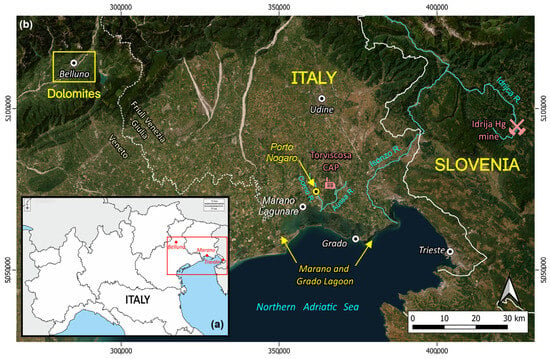
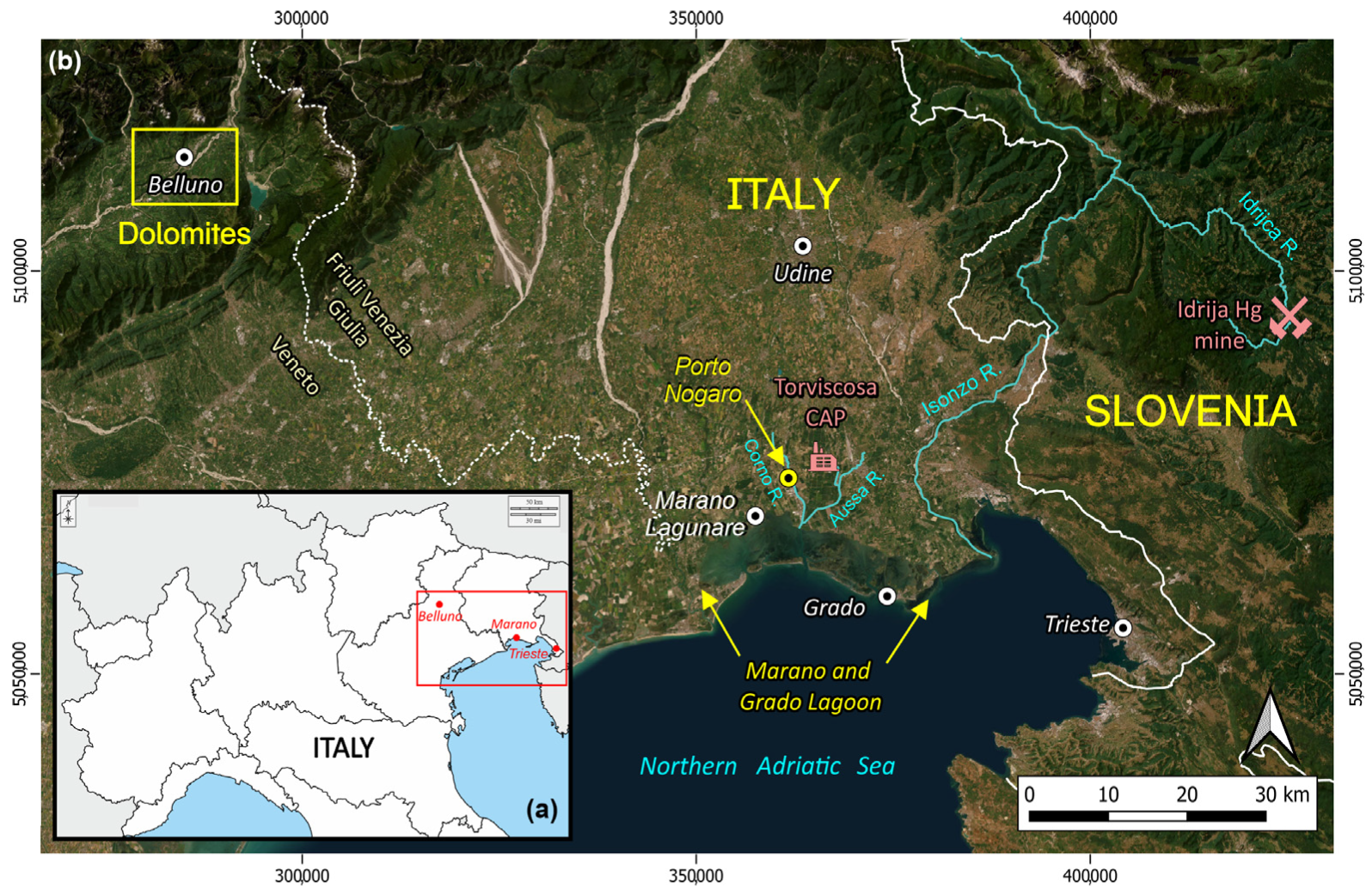
Figure 1 illustrates the geographical location of the study area, including the Marano and Grado lagoon, Torviscosa chlor-alkali plant, Porto Nogaro area, the Aussa-Corno river system, Grado, the Isonzo river, Idrija (Slovenia) and the Belluno area (Italian Dolomites Alps).
Figure 1.
(a) Geographical location of Belluno area (Italian Dolomites Alps) and Marano Lagunare; (b) Index map at regional scale of the study area, including the Marano and Grado lagoon, Torviscosa chlor-alkali plant, Porto Nogaro area, the Aussa-Corno river system, Grado, the Isonzo river, Idrija (Western Slovenia) and Belluno area (Italian Dolomites Alps).
As can be seen from Table 1, males were predominant (61.8%), and the median age of workers of Porto Nogaro (44.5 years) was lower than that of other groups and significantly lower than controls (p = 0.007). Dolomites’ residents were predominantly females, whereas fishermen and workers of the fish industry were predominantly males.
Fishermen exhibited a significantly higher median Body Mass Index—BMI (26.5) compared to residents from the Dolomites (25.5; p < 0.001) (Table 1).
Prevalence of never smokers was lower among workers of the fish industry (49.4%) or fishermen (38.9%), which also exhibited significantly higher proportion of ex-smokers (32.5% vs. 23.6%, respectively) (Table 1).
The proportion of people drinking tap water was significantly higher among Dolomites residents (82.1%), the proportion of those drinking well water was significantly higher among Porto Nogaro workers (34.7%), whereas workers of the fish industry (73.7%) and fishermen (74.7%) predominantly drank bottled water (Table 1).
Wine intake >0.5 L/day increased among fishermen (15.1; p < 0.001), and use of supplements was significantly higher among Porto Nogaro workers (38.2%; p < 0.001) and workers of the fish industry (39.8%; p < 0.001) compared to residents of the Dolomites (Table 1).
Prevalence of subjects consuming < 3 fish meals per month was higher among Dolomites residents (48.5%) (Table 1).
Fresh fish intake was significantly higher (p < 0.001) in workers of the fish industry (86.8%) or fishermen (93.2%), who also exhibited the lower proportion of usual intake of frozen fish (19.8% vs. 2.7%, respectively). Intake of canned fish was significantly lower in workers of the fish industry (7.2%; 0.003). Usual consumption of big, small-medium size or shell/crayfish/mollusks was significantly lower in controls from the Dolomites Alps (Table 1).
Hair Mercury Levels
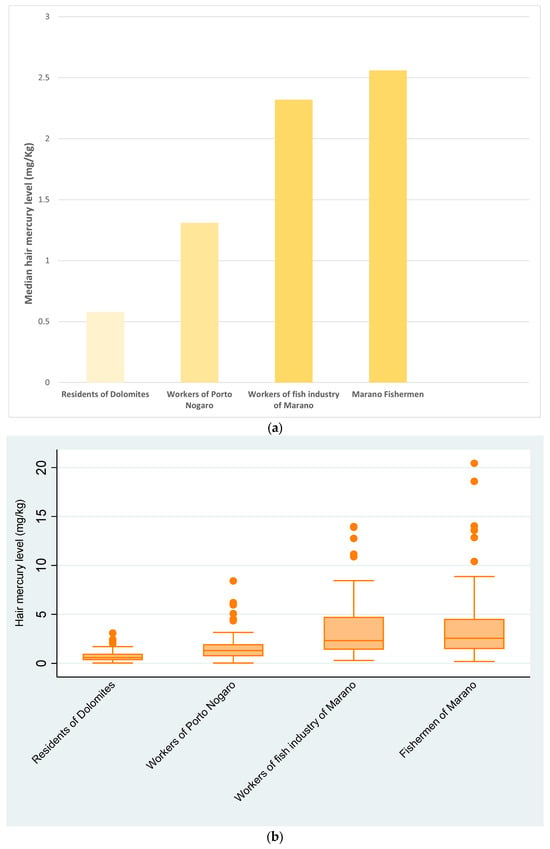
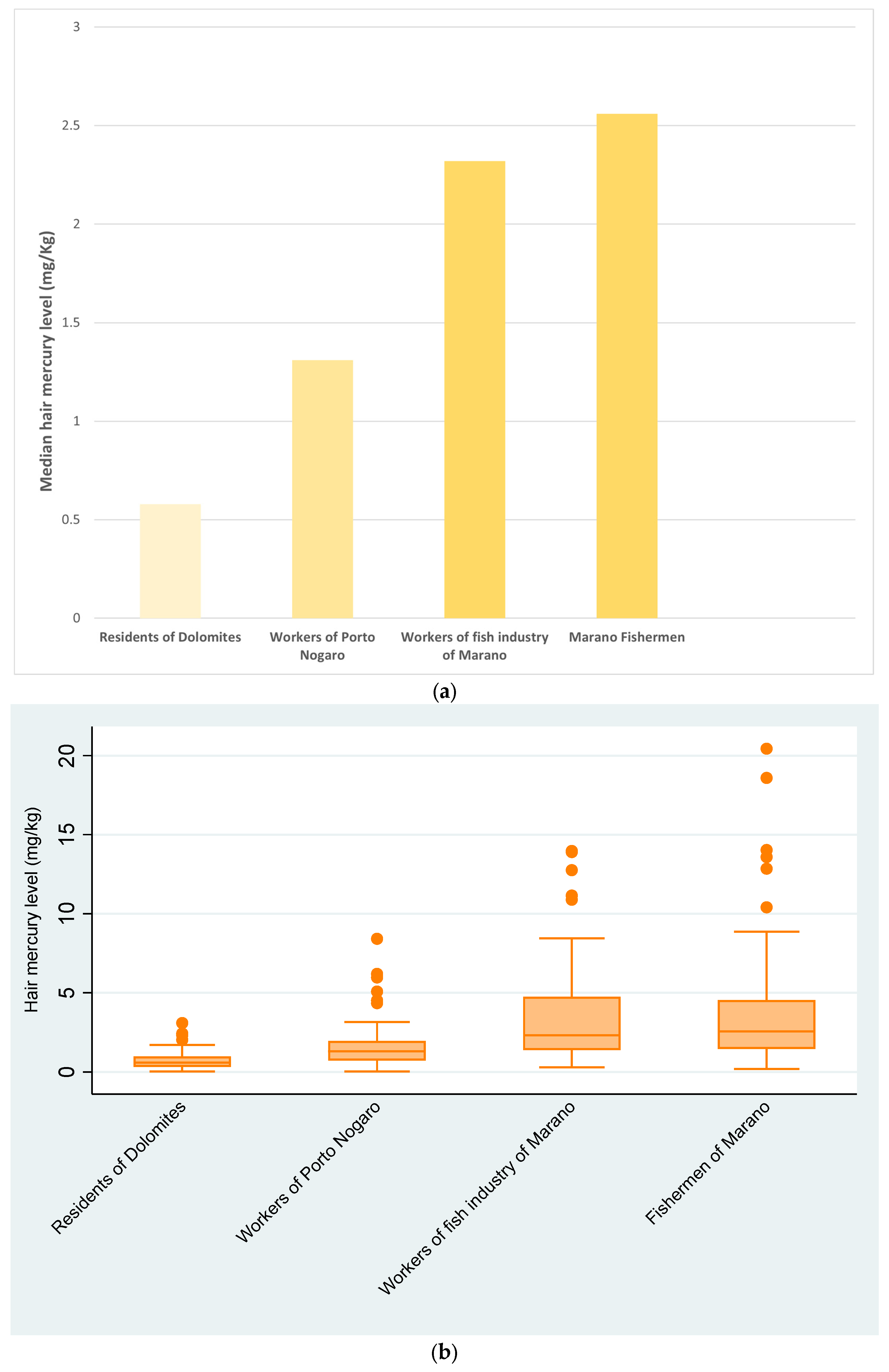
Median hair Hg levels were significantly lower in residents from the Dolomites (0.58 mg/Kg) compared to Porto Nogaro workers (1.31 mg/Kg), workers of fish industry of Marano Lagunare (2.32 mg/Kg) or fishermen of Marano Lagunare (2.56 mg/Kg) (Table 2, Figure 2a,b). The latter group differences were maintained across all sub-groups (Table 2).
Table 2.
Concentration of hair mercury (mg/Kg) by explanatory factors. Median and quartiles in parentheses (Q1; Q3); Mann–Whitney test p-value.
Figure 2.
(a) Distribution of median hair mercury (mg/Kg) by study group. (b) Box plot displaying the median hair mercury levels (mg/Kg) by study group.
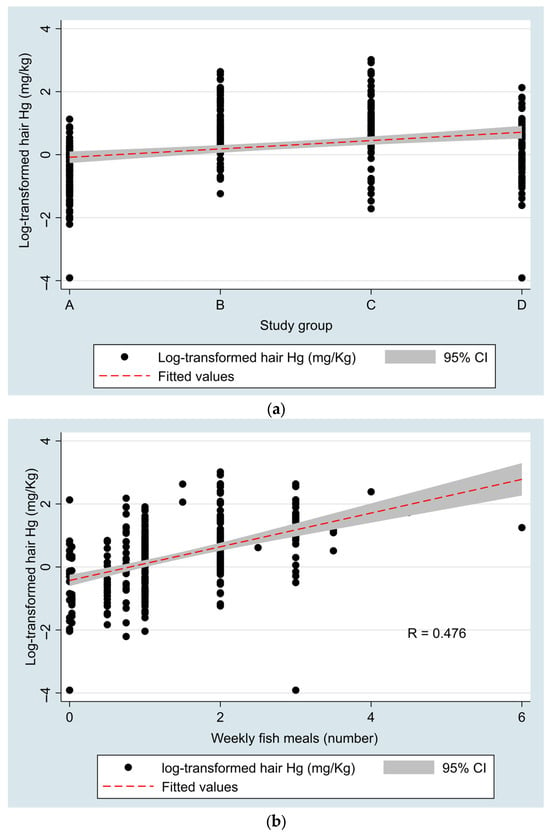
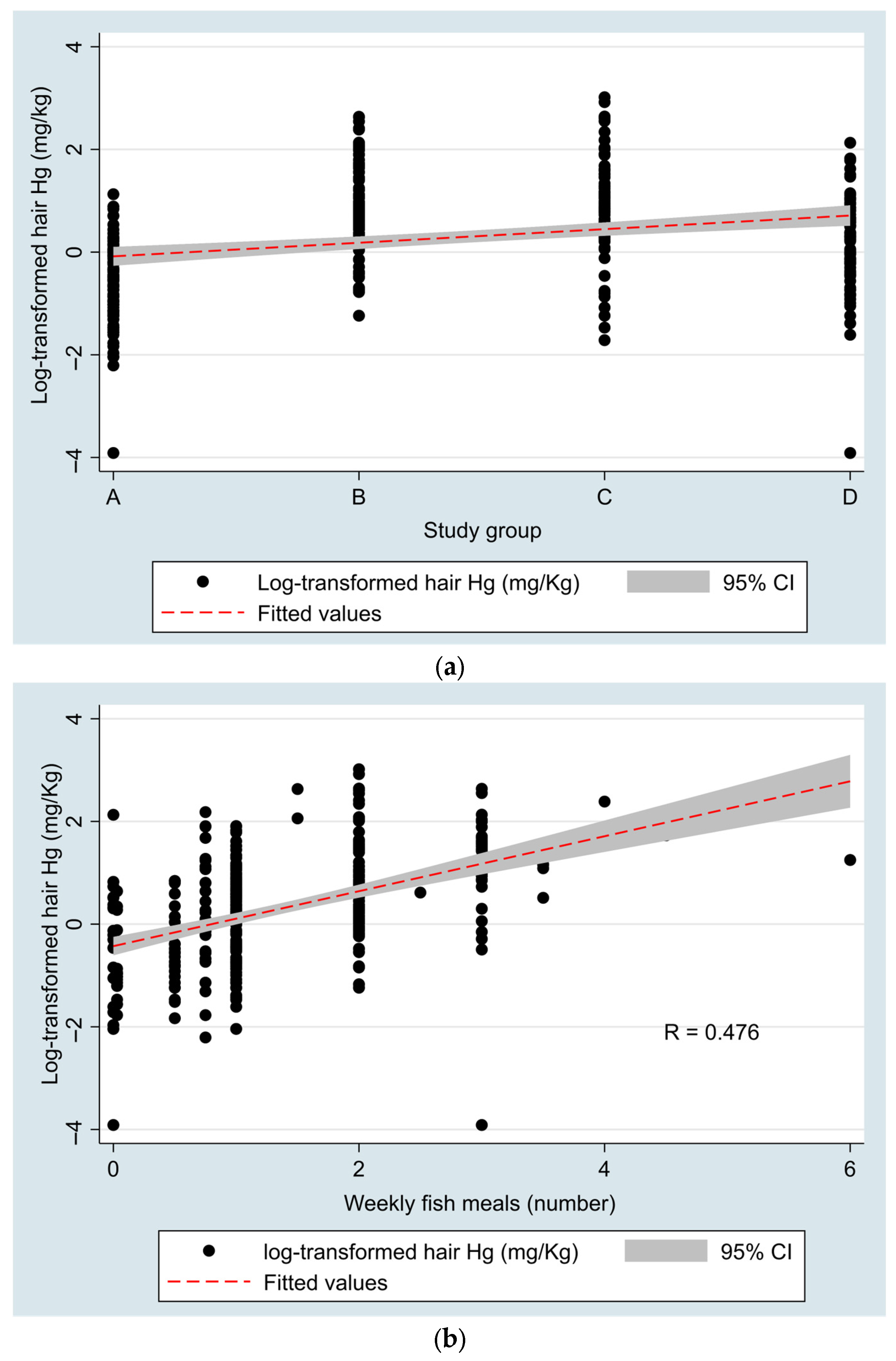
Table 3 shows the distribution of hair mercury (mg/Kg) and weekly fish consumption by study group. The distribution of log-transformed hair Hg levels by study group and weekly fish intake is displayed in Figure 3a and Figure 3b, respectively.
Table 3.
Distribution of hair mercury (mg/Kg) and weekly fish consumption by study group. Number of respondents (N); column percentage (%); Median and quartiles in parentheses (Q1; Q3); range. Green background colour denotes category at low risk of exposure to mercury (Hg); yellow background colour denotes categories at higher risk of exposure to Hg (more intense gradient reflecting higher level of Hg exposure or fish consumption).
Figure 3.
(a) Linear prediction of log-transformed hair-Hg by study group (F-test < 0.001). A = Dolomites’ residents; B = Porto Nogaro workers; C = Workers of the fish industry; D = Fishermen. (b). Linear prediction of log-transformed hair-Hg by weekly fish meals (F-test < 0.001).
Table 4 shows the distribution of fish type and size usually consumed by the study group.
Table 4.
Distribution of fish type and size usually consumed by the study group. Number of respondents (N) and column percentage in parentheses (%). Green background colour denotes category at low risk of exposure to mercury (Hg); yellow background colour denotes categories at higher risk of exposure to Hg (more intense gradient reflecting higher level of Hg exposure or fish consumption).
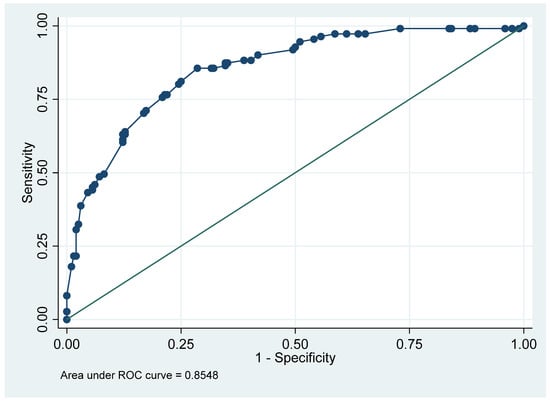
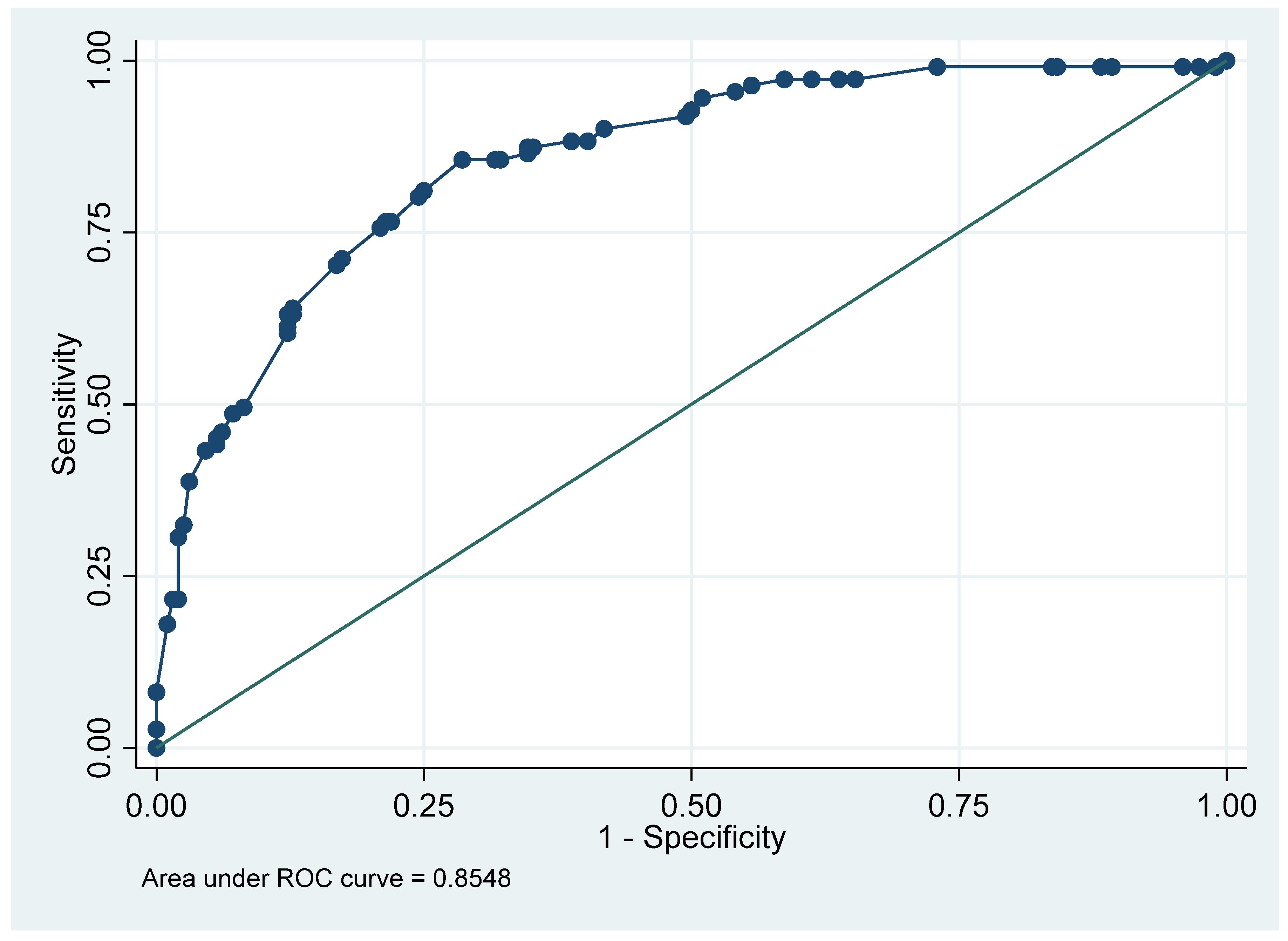
Table 5 displays the output of a multivariable linear regression analysis on log-transformed hair Hg and a logistic regression on the odds ratio of Hg > 2 vs. ≤2 mg/Kg. In both latter models, the main factors associated with increased hair Hg increased consistently with weekly fish consumption and study group, with an incremental gradient going from Dolomites residents to Porto-Nogaro workers, workers of the fish industry and fishermen. Additionally, whilst BMI ≥ 2 Kg/m2 was associated with significantly lower log-transformed hair Hg levels, usual consumption of fresh fish increased the mean log-transformed hair Hg level (Table 5). Figure 4 displays a receiver operating characteristic (ROC) curve on the proportion of hair concentration of Hg > 2 mg/kg. The overall prediction performance of the test was good (area under ROC = 0.8548) (Figure 4).
Table 5.
MODEL 1: Multivariable linear regression model on the level of log-transformed hair mercury. Results expressed as adjusted regression coefficients (aRC) with 95% confidence intervals (F-test < 0.001). MODEL 2: Multivariable logistic regression models on the level of log hair mercury > 2 vs. ≤ 2 mg/Kg. BH= Benjamini-Hochberg test. NS = Not significant. Green background colour denotes significantly lower levels of mercury (Hg); yellow background colour denotes significantly higher levels of Hg (more intense gradient reflecting higher Hg levels).
Figure 4.
Receiver operating characteristic (ROC) curve on the proportion of concentration of hair Hg >2 mg/kg.
4. Discussion
4.1. Key Findings
This study confirmed that the amount of weekly fish intake and the study group were the main determinants of Hg exposure in workers and residents of the coastal areas of the Marano and Grado lagoon. In particular, median Hg increased from 0.58 mg/Kg in Dolomites residents to 1.31 mg/Kg in Porto Nogaro workers, 2.32 mg/Kg in workers of the fish industry and 2.56 mg/Kg in fishermen of Marano Lagunare. Likewise, median hair Hg concentrations increased from 0.68 mg/Kg in those individuals consuming less than 3 fish meals per month to 1.27 mg/kg in those eating 3–4 fish servings per month, 1.90 mg/Kg in those having 1–2 fish meals per week and 3.49 mg/Kg with > 3 fish meals per week.
After removing the effect of residual confounders, the concentration of hair Hg progressively increased with fish consumption, following an upward trend from Dolomites residents to Porto Nogaro workers to workers of the fish industry and fishermen. The latter pattern likely reflected higher consumption of locally caught fish, placing Porto Nogaro workers in an intermediate position between controls from the Dolomites and the other two Marano Lagunare categories, which had higher availability of local edible fish.
Indeed, the proportion of individuals consuming > 2 fish meals per week was higher among workers of the fish industry (25.3%), followed by fishermen (21.6%), Porto Nogaro workers (6.6%) and Dolomites’ residents (1.0%), in decreasing order.
4.2. Comparison with the Literature
Differently from a recent study, no socio-demographic factors like age and sex were associated with hair Hg levels [14].
Porto Nogaro workers were all residents and exhibited hair Hg levels slightly higher than those recently found in the above-mentioned survey conducted among the general population of the Gulf of Trieste (median = 1.2 mg/Kg; mean = 1.63 mg/Kg) [11].
Likewise, the mean Hg hair level of 606 local pregnant women delivering during 2007–2009 was slightly lower (1.06 mg/kg) than that of workers of Porto Nogaro and associated with fish intake [14]. Moreover, the median Hg hair concentration in pregnant women from the coastal lagoon areas of municipalities of Marano Lagunare, Grado and Carlino that gave birth during 2007–2009 was significantly higher (1.17 mg/kg) than their counterparts residing inland (0.871 mg/Kg) [15].
4.3. Neurological Risk
Despite the benefits of fish consumption, including supply of Omega-3, iron, iodine, chlorine and selenium (an antagonist of Hg) [16], the adult population of coastal areas of the Marano and Grado lagoon should be informed about the health impact of low-dose long-term exposure to Hg. Most studies so far have, in fact, focused on the impact of Hg exposure on pregnant women for the neuro-development of the newborn [15,17].
However, Hg exposure has also been indictedas an independent risk factor for neurological disorders, including Alzheimer’s disease, amyotrophic lateral sclerosis, multiple sclerosis (MS) and Parkinson’s disease (PD) [18,19], a chronic condition that has more than doubled in the last 30 years in high income countries, also due to the aging population [20,21].
The aggregation of alpha-synuclein in fibrils, an important component of Lewy bodies (typical marker of PD), was facilitated in vitro by the presence of heavy metals, particularly lead and mercury [22,23].
The epidemiological evidence on neurological risk associated with exposure to Hg is founded on observational studies. For instance, in a case–control study conducted between 2018 and 2019 on 694 patients with PD against 640 healthy controls from 6 neurologic centers in Italy, adjusting for a number of potential confounders for exposure to heavy metals was independently associated with increased risk of PD (OR = 2.8; 95%CI: 15–5.4) [24].
Another case–control reported a higher risk of PD with increasing levels of Hg in blood, urine or hair [25].
However, measuring Hg at the time of PD diagnosis prevents knowing the intensity and duration of exposure to the metal, and PD is a chronic condition likely requiring a long latency to develop. Moreover, blood and urine Hg concentrations reflect acute exposures, hence varying over time [25].
Assessing the long-term neurological impact of low-dose exposure to Hg on residents of coastal areas of the Marano and Grado lagoon is therefore challenging, since it would require a cohort study with repeated measurements over time by fish consumption in disease-free residents.
As mentioned above, exposure to heavy metals—particularly Hg—was also found to be associated with MS, a chronic neurological condition featured by fluctuant disease course [18,26]. Overexposure to lead and Hg ions is known to be neurotoxic, particularly for motor neurons. Moreover, cellular accrual of lead and Hg was associated with the development of autoantibodies against neuronal cytoskeletal proteins, neurofilaments and myelin basic protein in animals and humans [27,28,29]. A number of case–control studies reported an association between MS and dental amalgams [30,31,32,33,34].
A rapid and relatively cheap approach to evaluate the neurological effects of exposure to Hg could be recruiting residents of coastal areas of the Marano and Grado lagoon, known to be affected by MS, and monitoring the respective disease course in relation to variation in fish dietary intake.
The Food and Drug Administration (FDA) recently recommended avoiding dental amalgams in patients with pre-existing neurological conditions, such as MS, Alzheimer’s disease or PD [35]. In addition to dental amalgams, the main source of exposure to Hg in humans is fish intake [36]. The above FDA recommendations could also be extended to fish consumption in residents of areas with established environmental Hg contamination.
Advising to limit the consumption of local fish to no more than one serving per week in pregnant women and children does consider only the impact of Hg on the neuro-development of children, neglecting its potential long-term neurological effects in adults (especially patients with established neurological diseases), considering that some fishermen and workers of the fish industry at Marano Lagunare exhibited hair Hg levels > 10 mg/Kg, in relation to higher intake of locally caught fish.
5. Conclusions
Median Hg concentrations increased from 0.58 mg/Kg in residents of the Dolomites to 1.31 mg/Kg in Porto Nogaro workers, 2.32 mg/Kg in workers of the fish industry and 2.56 mg/Kg in fishermen of Marano Lagunare. Study subjects from Porto Nogaro included workers not occupationally exposed to heavy metals.
After removing the effect of residual confounders, the concentration of hair Hg progressively increased with weekly consumption of fish and displayed an upward trend from Dolomites residents to Porto Nogaro workers, to workers of the fish industry and to fishermen. The latter pattern likely reflected higher consumption of locally caught fish, placing Porto Nogaro workers in an intermediate position between controls from the Dolomites and the other two Marano categories, who arguably had higher access to locally caught fish.
Advising to limit the consumption of locally caught fish to no more than one meal per week should not be restricted to pregnant women and children but also extended to adults, in order to avoid the potential long-term neurological effects of low-dose Hg exposure.
Despite Torviscosa CAP ceasing operations in 2008, environmental Hg contamination of the Marano and Grado lagoon will inevitably remain due to the historical legacy of previous human activities that cause the ongoing input of Hg, especially during natural flooding events involving the Isonzo and Aussa-Corno river systems [2]. It is therefore crucial to remain vigilant and continue monitoring Hg environmental contamination in the lagoon across various environmental matrices, such as sediments, water, fish, shellfish and birds.
Further research could be planned to mitigate Hg availability for methylation in the lagoon. Hg environmental decontamination should require an integrated multidisciplinary approach, combining advanced remediation strategies such as phytoremediation [37], bioremediation [38], sorbent-based technologies and nano-engineered materials. For instance, graphene (Gn), due to its enormous surface area, chemical stability and extraordinary adsorption capabilities, is a promising candidate for application in various adsorption processes [39], biochar was effective in reducing Hg mobility at the sediment–water interface [40], and again sulfur and nitrogen applied to high surface area porous organic polymers proved very effective for adsorptive removal since interactions with Hg(II) ions are enhanced [41].
A recent review explored the intricate pathways of Hg transformation, its cascading effects on biodiversity and human health, and cutting-edge remediation strategies [42] Understanding these complex dynamics is essential for developing sustainable mitigation measures, ensuring ecological balance and safeguarding public health in the face of environmental Hg burdens [42].
Author Contributions
Study conception: L.C.; investigation: L.C., E.P. (Emilia Patriarca), S.C., E.P. (Elisa Petranich) and D.S.; data curation: L.C. and E.P. (Emilia Patriarca); manuscript drafting (original draft): L.C.; data analysis: L.C.; data interpretation: L.C., S.C. and G.M.; contributed to drafting: D.S., S.C., G.M. and F.L.F., E.P. (Elisa Petranich). All authors have read and agreed to the published version of the manuscript.
Funding
This research received no external funding.
Institutional Review Board Statement
This study was approved by the Ethic Committee of the University of Trieste (Prot. N. 11; 17 December 2024).
Informed Consent Statement
Informed consent was obtained from all subjects involved in the study.
Data Availability Statement
The data generated and analyzed during the current study are not publicly accessible, but they may be available from the corresponding author upon reasonable request.
Acknowledgments
The authors would like to thank Sandro Caporale, President of Cooperativa San Vito, for facilitating the survey and data collection from fishermen and workers of the fish industry of Marano Lagunare. Sandro Cinquetti (Director of Public Health of AULSS 1 “Dolomiti”) and Damiano Comin (Director of Veterinary Unit of AULSS 1 “Dolomiti”), for facilitating the survey and data collection from herdsmen and farmers within the Belluno catchment area. Emiliano Conchin of COSEF, for helping liaise with the factories of Porto Nogaro.
Conflicts of Interest
The authors declare no conflicts of interest.
References
- Gosar, M.; Teršič, T. Contaminated Sediment Loads from Ancient Mercury Ore Roasting Sites, Idrija Area, Slovenia. J. Geochem. Explor. 2015, 149, 97–105. [Google Scholar] [CrossRef] [Scilit]
- Acquavita, A.; Bettoso, N. Mercury and selenium in the grass goby Zosterisessor ophiocephalus (Pisces: Gobiidae) from a mercury contaminated Mediterranean lagoon. Mar. Pollut. Bull. 2018, 135, 75–82. [Google Scholar] [CrossRef] [Scilit] [PubMed]
- Acquavita, A.; Brandolin, D.; Cattaruzza, C.; Felluga, A.; Maddaleni, P.; Meloni, C.; Pasquon, M.; Predonzani, S.; Poli, L.; Skert, N.; et al. Mercury distribution and speciation in historically contaminated soils of the Isonzo River Plain (NE Italy). J. Soils Sediments 2022, 22, 79–92. [Google Scholar] [CrossRef] [Scilit]
- Rajar, R.; Žagar, D.; Sirca, A.; Horvat, M. Three-dimensional modelling of mercury cycling in the Gulf of Trieste. Sci. Total Environ. 2000, 260, 109–123. [Google Scholar] [CrossRef] [Scilit] [PubMed]
- Pavoni, E.; Petranich, E.; Signore, S.; Fontolan, G.; Covelli, S. The Legacy of the Idrija Mine Twenty-Five Years after Closing: Is Mercury in the Water Column of the Gulf of Trieste Still an Environmental Issue? Int. J. Environ. Res. Public Health 2021, 18, 10192. [Google Scholar] [CrossRef] [Scilit] [PubMed]
- Covelli, S.; Acquavita, A.; Piani, R.; Predonzani, S.; De Vittor, C. Recent contamination of mercury in an estuarine environment (Marano lagoon, northern Adriatic, Italy). Estuar. Coast. Shelf Sci. 2009, 82, 273–284. [Google Scholar] [CrossRef] [Scilit]
- European Community. Commission regulation no 1881/2006 of 19 December 2006 setting maximum levels for certain contaminants in foodstuffs. Off. J. Eur. Union 2006, 364, 5–24. [Google Scholar]
- Bettoso, N.; Pittaluga, F.; Predonzani, S.; Zanello, A.; Acquavita, A. Mercury Levels in Sediment, Water and Selected Organisms Collected in a Coastal Contaminated Environment: The Marano and Grado Lagoon (Northern Adriatic Sea, Italy). Appl. Sci. 2023, 13, 3064. [Google Scholar] [CrossRef] [Scilit]
- EFSA Panel on Contaminants in the Food Chain (CONTAM). Scientific Opinion on the risk for public health related to the presence of mercury and methylmercury in food. EFSA J. 2012, 10, 2985.
- Cegolon, L.; Petranich, E.; Pavoni, E.; Floreani, F.; Barago, N.; Papassissa, E.; Filon, F.L.; Covelli, S. Concentration of mercury in human hair and associated factors in residents of the Gulf of Trieste (North-Eastern Italy). Environ. Sci. Pollut. Res. 2023, 30, 21425–21437. [Google Scholar] [CrossRef] [Scilit]
- Cegolon, L.; Mastrangelo, G.; Covelli, S.; Petranich, E.; Pavoni, E.; Larese Filon, F. Occupational exposure to mercury from cinnabar enriched sand in workers of Grado Beach, Gulf of Trieste (North-eastern Italy, upper Adriatic Sea). Mar. Pollut. Bull. 2022, 184, 114057. [Google Scholar] [CrossRef] [Scilit] [PubMed]
- Cegolon, L.; Covelli, S.; Patriarca, E.; Petranich, E.; Floreani, F.; Sansone, D.; Mastrangelo, G.; Larese Filon, F. Contrasting hair mercury in fishermen and workers of fish industry of Marano Lagunare (Upper Adriatic Sea), a coastal lagoon area contaminated by mining and industrial activities, against residents from the Dolomites Alps. Sci. Total Environ. 2025, 965, 178039. [Google Scholar] [CrossRef] [Scilit] [PubMed]
- USEPA (U.S. Environmental Protection Agency). Method 7473 (SW-846) Mercury in Solids and Solutions by Thermal Decomposition, Amalgamation, and Atomic Absorption Spectrophotometry; EPA: Washington, DC, USA, 1998. Available online: https://www.epa.gov/esam/epa-method-7473-sw-846-mercury-solids-and-solutions-thermal-decomposition-amalgamation-and (accessed on 11 January 2026).
- Packull-McCormick, S.; Ratelle, M.; Drysdale, M.; Borghese, M.M.; Bouchard, M.; Stark, K.D.; Gamberg, M.; Swanson, H.; Skinner, K.; Laird, B.D. Determinants of human hair mercury, blood mercury, blood selenium, and plasma omega-3 fatty acid levels within northern Canada. Int. J. Hyg. Environ. Health 2026, 271, 114703. [Google Scholar] [CrossRef] [Scilit] [PubMed]
- Valent, F.; Mariuz, M.; Bin, M.; Little, D.; Mazej, D.; Tognin, V.; Tratnik, J.; McAfee, A.J.; Mulhern, M.S.; Parpinel, M.; et al. Associations of prenatal mercury exposure from maternal fish consumption and polyunsaturated fatty acids with child neurodevelopment: A prospective cohort study in Italy. J. Epidemiol. 2013, 23, 360–370. [Google Scholar] [CrossRef] [Scilit] [PubMed]
- Food and Drug Administration (FDA). Advice About Eating Fish. Available online: https://www.fda.gov/media/102331/download?attachment (accessed on 10 January 2026).
- Barbone, F.; Valent, F.; Pisa, F.; Daris, F.; Fajon, V.; Gibicar, D.; Logar, M.; Horvat, M. Prenatal low-level methyl mercury exposure and child development in an Italian coastal area. Neurotoxicology 2020, 81, 376–381. [Google Scholar] [CrossRef] [Scilit]
- Siblerud, R.; Mutter, J. An Overview of Evidence that Mercury from Dental Fillings may be an Etiological Factor in Many Health Disorders. J. Biomed. Res. Environ. Sci. 2021, 2, 472–485. [Google Scholar] [CrossRef] [Scilit]
- Tolosa, E.; Garrido, A.; Scholz, S.W.; Poewe, W. Challenges in the diagnosis of Parkinson’s disease. Lancet Neurol. 2021, 20, 385–397. [Google Scholar] [CrossRef] [Scilit]
- The Lancet Neurology. Parkinson’s disease needs an urgent public health response. Lancet Neurol. 2022, 21, 759. [Google Scholar] [CrossRef] [Scilit]
- GBD 2021 Nervous System Disorders Collaborators. Global, regional, and national burden of disorders affecting the nervous system, 1990–2021: A systematic analysis for the Global Burden of Disease Study 2021. Lancet Neurol. 2024, 23, 344–381.
- Uversky, V.N.; Li, J.; Fink, A.L. Metal-triggered structural transformations, aggregation, and fibrillation of human α-synuclein. J. Biol. Chem. 2001, 276, 44284–44296. [Google Scholar] [CrossRef] [Scilit]
- Yamin, G.; Glaser, C.B.; Uversky, V.N.; Fink, A.L. Certain metals trigger fibrillation of methionine-oxidized alpha-synuclein. J. Biol. Chem. 2003, 278, 27630–27635. [Google Scholar] [CrossRef] [Scilit]
- Belvisi, D.; Pellicciari, R.; Fabbrini, A.; Costanzo, M.; Pietracupa, S.; De Lucia, M.; Modugno, N.; Margrinelli, F.; Dallocchio, C.; Ercoli, T.; et al. Risk factors of Parkinson disease: Simultaneous assessment, interactions, and etiologic subtypes. Neurology 2020, 95, e2500–e2508. [Google Scholar] [CrossRef] [Scilit] [PubMed]
- Ngim, C.H.; Devathasan, G. Epidemiologic study on the association between body burden mercury level and idiopathic Parkinson’s disease. Neuroepidemiology 1989, 8, 128–141. [Google Scholar] [CrossRef] [Scilit] [PubMed]
- Bjørklund, G.; Peana, M.; Dadar, M.; Chirumbolo, S.; Aaseth, J.; Martins, N. Mercury-induced autoimmunity: Drifting from micro to macro concerns on autoimmune disorders. Clin. Immunol. 2020, 213, 108352. [Google Scholar] [CrossRef] [Scilit]
- Hansson, M.; Djerbi, M.; Rabbani, H.; Mellstedt, H.; Gharibdoost, F.; Hassan, M.; De Pierre, J.W.; Abedi-Valugerdi, M. Exposure to mercuric chloride during the induction phase and after the onset of collagen-induced arthritis enhances immune/autoimmune responses and exacerbates the disease in DBA/1 mice. Immunology 2005, 114, 428–437. [Google Scholar] [CrossRef] [Scilit]
- Stejskal, J.; Stejskal, V.D. The role of metals in autoimmunity and the link to neuroendocrinology. Neuroendocrinol. Lett. 1999, 20, 351–364. [Google Scholar] [PubMed]
- El-Fawal, H.A.; Waterman, S.J.; De Feo, A.; Shamy, M.Y. Neuroimmunotoxicology: Humoral assessment of neurotoxicity and autoimmune mechanisms. Environ. Health Perspect. 1999, 107, 767–775. [Google Scholar]
- Attar, A.M.; Kharkhaneh, A.; Etemadifar, M.; Keyhanian, K.; Davoudi, V.; Saadatnia, M. Serum mercury level and multiple sclerosis. Biol. Trace Elem. Res. 2012, 146, 150–153. [Google Scholar] [CrossRef] [Scilit]
- Siblerud, R.L.; Kienholz, E. Evidence that mercury from silver dental fillings may be an etiological factor in multiple sclerosis. Sci. Total Environ. 1994, 142, 191–205. [Google Scholar] [CrossRef] [Scilit]
- Siblerud, R.L. A comparison of mental health of multiple sclerosis patients with silver/mercury dental fillings and those with fillings removed. Psychol. Rep. 1992, 70, 1139–1151. [Google Scholar] [CrossRef] [Scilit]
- Siblerud, R.; Kienholz, E. Evidence that mercury from silver dental fillings may be an etiological factor in reduced nerve conduction velocity in multiple sclerosis patients. J. Orthomol. Med. 1997, 12, 169–172. [Google Scholar]
- Napier, M.D.; Poole, C.; Satten, G.A.; Ashley-Koch, A.; Marrie, R.A.; Williamson, D.M. Heavy metals, organic solvents, and multiple sclerosis: An exploratory look at gene-environment interactions. Arch. Env. Occup. Health 2016, 71, 26–34. [Google Scholar] [CrossRef] [Scilit]
- Food and Drug Administration (FDA). FDA Issues Recommendations for Certain High-Risk Groups Regarding Mercury-Containing Dental Amalgam. Available online: https://www.fda.gov/news-events/press-announcements/fda-issues-recommendations-certain-high-risk-groups-regarding-mercury-containing-dental-amalgam (accessed on 30 January 2025).
- Torrey, E.F.; Simmons, W. Mercury and Parkinson’s Disease: Promising Leads, but Research Is Needed. Park. Dis. 2023, 2023, 4709322. [Google Scholar] [CrossRef] [Scilit]
- Adewuyi, A. Biogeochemical dynamics and sustainable remediation of mercury in West African water systems. Chemosphere 2025, 379, 144436. [Google Scholar] [CrossRef] [Scilit] [PubMed]
- Jayakodi, S. Role of proteins in phytoremediation and mycoremediation for heavy metal removal: A focus on protein-based remediation. Int. J. Phytoremediat. 2026, 28, 476–492. [Google Scholar] [CrossRef] [Scilit]
- Jalilian, M.; Parvizi, P.; Zangeneh, M.R. Advances in graphene-based nanomaterials for heavy metal removal from water: Mini review. Water Environ. Res. 2025, 97, e70062. [Google Scholar] [CrossRef] [Scilit] [PubMed]
- Pavoni, E.; Floreani, F.; Petranich, E.; Berto, D.; Gion, C.; Fornasaro, S.; Greggio, N.; Larese Filon, F.; Covelli, S. Biochar as a sustainable amendment for mitigating mercury and methylmercury mobility in contaminated lagoon sediments: Insights from incubation experiments. Sci. Total Environ. 2025, 991, 179883. [Google Scholar] [CrossRef] [Scilit]
- Chowdhury, A.; Das, S.K.; Mondal, S.; Ruidas, S.; Chakraborty, D.; Chatterjee, S.; Bhunia, M.K.; Chandra, D.; Hara, M.; Bhaumik, A. Sul-fur-containing nitrogen-rich robust hierarchically porous organic polymer for adsorptive removal of mercury: Experimental and theoretical insights. Environ. Sci. Nano 2021, 8, 2641–2649. [Google Scholar] [CrossRef] [Scilit]
- Ray, S.; Vashishth, R.; Mukherjee, A.G.; Gopalakrishnan, A.; Sabina, E.P. Mercury in the environment: Biogeochemical transformation, ecological im-pacts, human risks, and remediation strategies. Chemosphere 2025, 381, 144471. [Google Scholar] [CrossRef] [Scilit]

Disclaimer/Publisher’s Note: The statements, opinions and data contained in all publications are solely those of the individual author(s) and contributor(s) and not of MDPI and/or the editor(s). MDPI and/or the editor(s) disclaim responsibility for any injury to people or property resulting from any ideas, methods, instructions or products referred to in the content. |
© 2026 by the authors. Licensee MDPI, Basel, Switzerland. This article is an open access article distributed under the terms and conditions of the Creative Commons Attribution (CC BY) license.