
Article

Vertebral Malformations in Fish from the Coast of Nayarit, Mexico, and Their Association with Organochlorine and Organophosphate Pesticides


by
José Belisario Leyva-Morales
1,
Angélica Yomira Ramos-Ávila
2,
Pedro de Jesús Bastidas-Bastidas
3,
Jasmin Granados Amores
4,
Esperanza Granados Amores
5,
Javier González Ramírez
4,
Fernando Salas-Martínez
1,*,
Otilio Arturo Acevedo-Sandoval
1,
Claudia Romo-Gómez
1,
César Camacho-López
1,
César Abelardo González-Ramírez
1,
Lucía Leyva-Camacho
6 and
Edgar Cruz-Acevedo
7,*
1
Área Académica de Química, Instituto de Ciencias Básicas e Ingeniería, Universidad Autónoma del Estado de Hidalgo, Carr. Pachuca-Tulancingo km. 4.5, Mineral de la Reforma 42184, Hidalgo, Mexico
2
Programa de Maestría en Ciencias Biológico-Agropecuarias, Universidad Autónoma de Nayarit, Xalisco 63780, Nayarit, Mexico
3
Centro de Investigación en Alimentación y Desarrollo, A.C., Carretera a Eldorado km. 5.5 Campo El Diez, Culiacán 80111, Sinaloa, Mexico
4
Escuela Nacional de Ingeniería Pesquera, Universidad Autónoma de Nayarit, San Blas 63740, Nayarit, Mexico
5
Programa de Doctorado en Ciencias Biológico-Agropecuarias, Universidad Autónoma de Nayarit, Xalisco 63780, Nayarit, Mexico
6
Departamento de Salud, Licenciatura en Ciencias Biomédicas, Universidad Autónoma de Occidente (Unidad Regional Guasave), Guasave 81048, Sinaloa, Mexico
7
Departamento de Ciencias Exactas y Desarrollo Humano, Facultad de Ciencias Biológicas, Universidad Autónoma de Nuevo León, San Nicolás de los Garza 66450, Nuevo León, Mexico
*
Authors to whom correspondence should be addressed.
Environments 2026, 13(3), 151; https://doi.org/10.3390/environments13030151
Submission received: 5 February 2026 / Revised: 5 March 2026 / Accepted: 9 March 2026 / Published: 11 March 2026

Abstract

In recent years, the recording of fish with vertebral malformations has attracted growing interest worldwide, as these malformations may be associated with exposure to xenobiotics. This study aimed to determine the presence and concentrations of pesticide residues (organochlorines and organophosphates) in coastal fish in Nayarit, Mexico, and to assess their potential association with vertebral malformations. From November 2013 to September 2021, 32 fish, with visible malformations were conveniently collected, an equal number of healthy specimens per species was selected for comparative analysis. The fish exhibited vertebral malformations of the following types: kyphosis, lordosis, and scoliosis in 9, 8 and 6 species, respectively, while the total number of malformations was higher across the sampled organisms. Furthermore, pesticide residues were detected in both healthy and malformed fish using gas chromatography coupled with tandem mass spectrometry (GC-MS/MS). The samples analyzed contained at least one pesticide, with the group of healthy fish showing greater diversity of organochlorine compounds. The most frequent of these were p,p’-DDE, followed by p,p’-DDT (41%), p,p’-DDD (25%), and endrin (25%). The species C. raredonae and A. seemanni exhibited the greatest number of pesticides. The pesticides observed in malformed fish samples were p,p’-DDE (100%), p,p’-DDD (97%), p,p’-DDT (97%), endrin (50%), and BHC delta (31%). Chlorpyrifos was present (56% and 100% in healthy and malformed fish), with the highest frequency observed in A. seemanni and B. panamensis. The highest concentrations were observed in the DDT group. An association was also observed between vertebral malformations and concentrations of p,p’-DDE and chlorpyrifos in the species C. raredonae and A. guatemalensis. Multivariate analysis revealed a clear separation between malformed and healthy fish based on contaminant profiles.

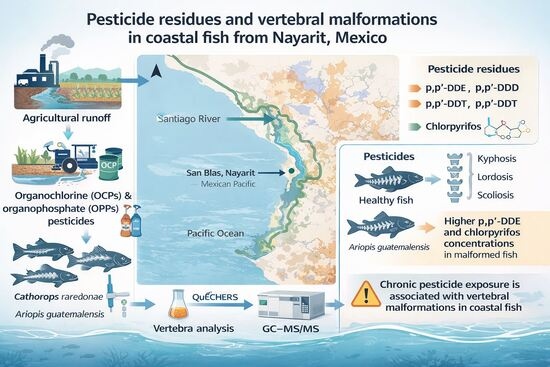
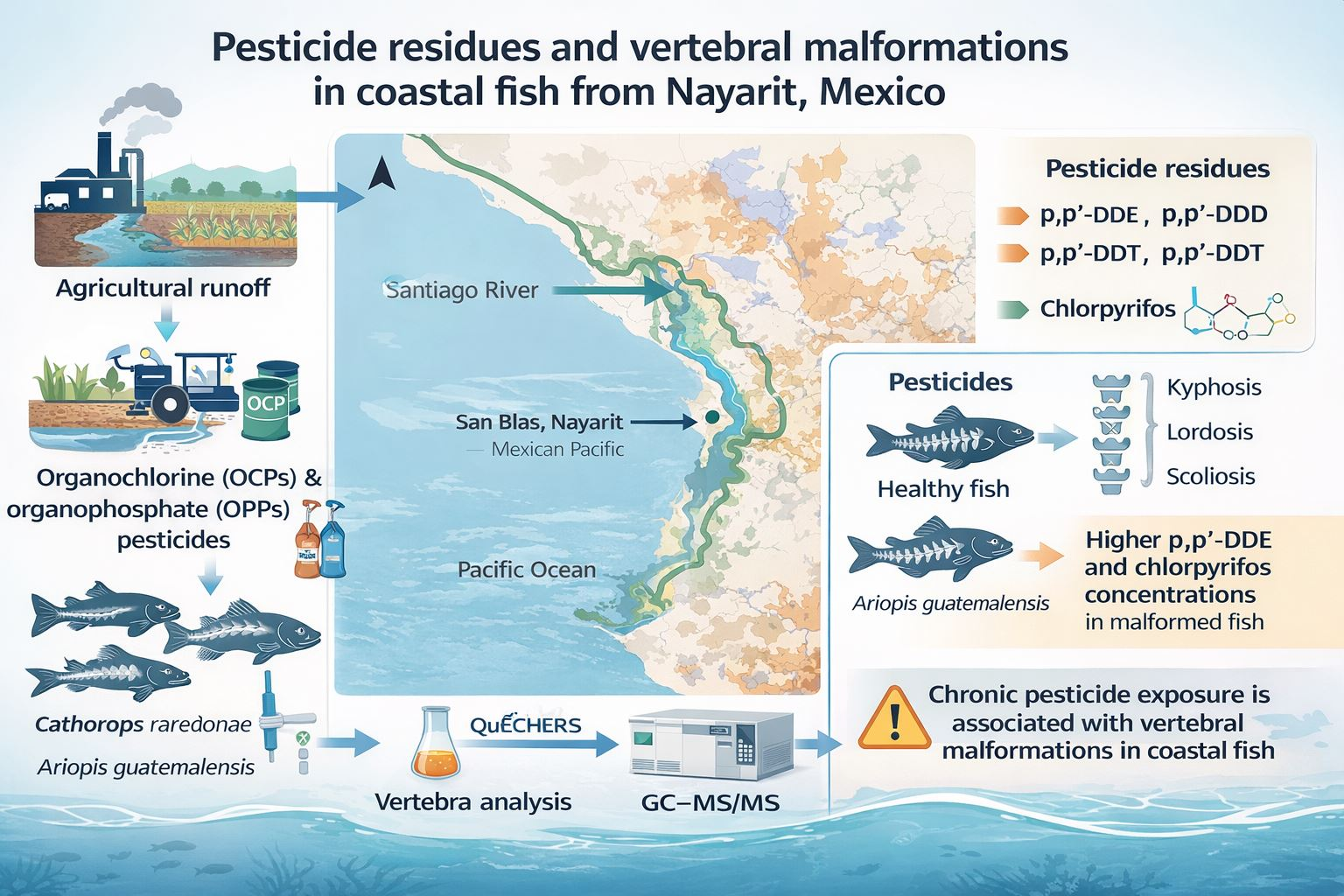
Graphical Abstract

1. Introduction

In Mexico, organochlorine (OCPs) and organophosphate (OPPs) pesticides have historically been applied on a large scale for the control of agricultural pests and disease vectors, as well as in industrial, medical, and domestic environments [1]. Their implementation contributed to higher crop productivity and reduced vector-borne illnesses such as malaria [2]. Despite these benefits, the extensive past and ongoing application of these compounds has generated environmental and public health concerns. Both OCPs and OPPs exhibit toxicity toward non-target species and may interfere with essential biological functions, particularly in aquatic organisms [3,4,5,6]. OCPs are especially problematic due to their chemical stability and environmental persistence. These compounds are widely distributed, exhibit strong hydrophobicity, and resist degradation through physical, chemical, or biological processes [7,8,9]. Their lipophilic nature promotes accumulation in adipose tissues of wildlife and humans, facilitating biomagnification across trophic levels [10]. Even at relatively low environmental concentrations, chronic exposure can result in sublethal but ecologically significant effects. Moreover, their capacity for long-range atmospheric and oceanic transport extends their impact beyond areas of application, making them contaminants of local, regional, and global concern [9,10,11]. Although numerous OCPs have been banned or restricted under international agreements, their continued detection in Mexican coastal zones indicates ongoing environmental persistence and sustained exposure risks for marine biota [1,4,5,12,13].
In contrast, OPPs are generally less stable in environmental compartments; however, they are associated with pronounced acute and chronic toxicity. Their toxicological action is primarily linked to inhibition of acetylcholinesterase activity, which disrupts neurotransmission and can lead to neuromuscular dysfunction and systemic physiological impairment [12,14].
Along the Pacific coastline of Mexico, one of the principal routes by which pesticide residues reach marine and estuarine systems is agricultural runoff [4,5,13,15,16,17,18,19]. Consequently, both OCPs and OPPs have been identified in multiple environmental matrices and biological compartments within these coastal ecosystems, including the State of Nayarit [5,20,21,22,23,24]. Reports document their presence in surface waters, sediments, crustaceans, fish, reptiles, and marine mammals, demonstrating widespread distribution within trophic networks [4,5,24].
Given this scenario, certain aquatic organisms chronically exposed to these compounds may serve as effective bioindicators of contamination in coastal environments. Fish are frequently employed in environmental assessment programs because they assimilate pollutants through both dietary intake and direct contact with contaminated water. This dual exposure pathway enables their use in evaluating the transfer and biomagnification of OCPs and OPPs within food webs [25].
The consequences of pesticide exposure on fish populations have been the subject of considerable research endeavors, though most studies focus on acute exposures during embryonic or larval stages. Among the effects reported from exposure to OCPs in fish are various endocrine and teratogenic alterations, as well as effects on embryonic and larval development, which trigger adverse effects on physiology and development, including malformations, alterations in hormonal systems and neurological responses, and cellular damage that compromises tissue homeostasis [26,27,28,29,30,31]. Meanwhile, for OPPs, studies show that exposure of fish to these compounds can induce a variety of adverse effects, including oxidative stress, biochemical alterations, genotoxic damage, and histopathological changes in vital organs, as well as structural abnormalities (skeletal malformations) [31,32,33,34,35,36].
In the Mexican Pacific, malformations were detected in a wide variety of bony fishes, including demersal, reef, and estuarine fishes. For instance, De la Cruz & Pérez Gómez-Álvarez [37] detected lordosis in the topsmelt silverside, Atherinops affinis, collected in September 1994, in Laguna Ojo de Liebre, Baja California Sur. Similarly, Rodríguez-Romero et al. [38] reported the same malformation in a specimen of the Pacific creole-fish, Paranthias colonus from Espiritu Santo Island, Baja California Sur (sample collection date not specified). Particularly, on the coast of the State of Nayarit, an economically important region in Mexico’s fishery [39], Tirado-León [40] characterized the presence of vertebral malformations in seven species, collected from January 2013 to June 2014, of catfish belonging to the genera Sciades, Bagre, and Cathorops, and to the species Bagre panamensis, B. pinnimaculatus, Cathorops liropus, C. raredonae, and Occidentarius platypogon obtained in the fishing area off the coast of Nayarit, Mexico. Vertebral malformations (lordosis, scoliosis, and kyphosis) were observed in all specimens, and in some cases, the catfish presented a combination of more than one type of malformation. The highest prevalence of malformations by species was observed as follows: B. panamensis (n = 43) > S. seemanni (n = 11) > C. raredonae (n = 10) > S. guatemalensis (n = 8) > B. pinnimaculatus = C. liropus = O. platypogon (n = 3). The author indicates that vertebral malformations of this type in the evaluated fish may be associated with anthropogenic contaminants, such as pesticides.
Despite these well-documented effects, the possible association between chronic environmental exposure to OCPs and OPPs and the occurrence of vertebral malformations in fish has not been systematically evaluated and warrants studies that integrate chemical residue analysis with morphological assessments. In this context, the present study aims to evaluate the potential association between OCPs and OPPs residues and the occurrence of vertebral malformations in fish from the coast of the State of Nayarit, as a case study in the Mexican Pacific.

2. Materials and Methods

2.1. Study Area

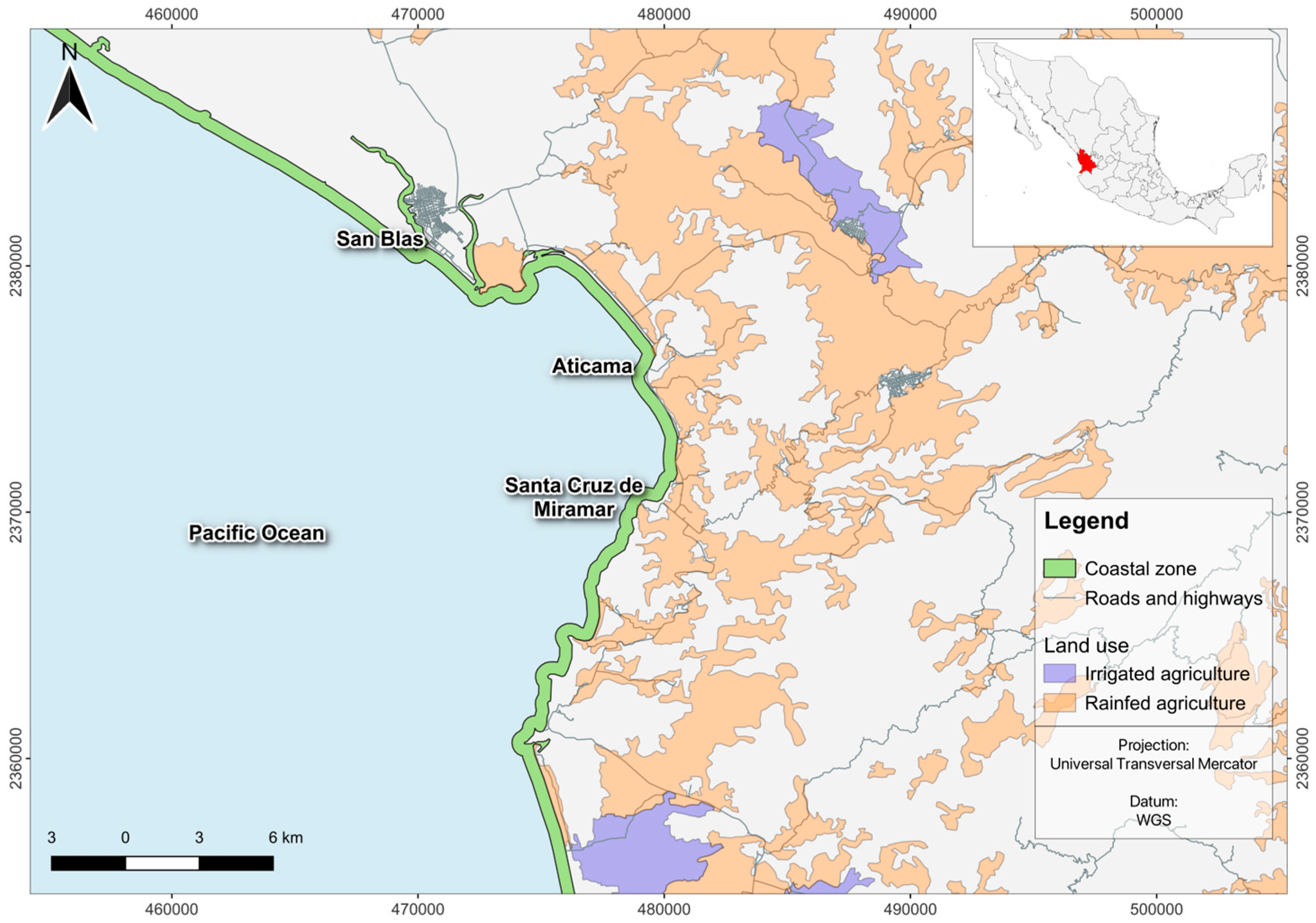
Nayarit is recognized as one of Mexico’s leading coastal states in terms of fisheries and aquaculture output. In 2024, the state ranked sixth nationwide in total production, with 32,512 metric tons, and seventh in economic value, with an estimated revenue of approximately USD 90,887 [39]. This productive capacity is closely linked to the state’s extensive marine and coastal resources. The Nayarit shoreline extends for approximately 289 km along the eastern Pacific and covers nearly 29,378 km2, including insular territories such as Islas Marías, Islas Marietas, and Isla Isabel. The coastal landscape is predominantly low-lying plains, interspersed with marshes and barrier formations. The region hosts several major lagoon systems, notably Mexcaltitán, Agua Brava, Laguna Grande, and La Garza, as well as a wide network of wetlands. Among these, the Agua Brava–Mexcaltitán complex represents the most extensive estuarine–lagoon system in the state [41]. The present study focuses on the central coastal sector of Nayarit, specifically within the municipality of San Blas (Figure 1). Hydrologically, this area is influenced by two major basins: Lerma–Santiago (RH12) and Huicicila (RH13). From a geomorphological perspective, it forms part of the Pacific Coastal Plain, within the Río Grande de Santiago Delta subprovince [42]. The regional climate is classified as warm subhumid, characterized by elevated temperatures and high atmospheric moisture. Rainfall is markedly seasonal, occurring mainly between June and October. Long-term climatic records indicate an average annual precipitation of approximately 1316.3 mm and a mean annual temperature of 25.6 °C [43].
The municipality of San Blas encompasses 849.78 km2, roughly 3% of Nayarit’s total surface area [44]. Its territory includes extensive beach zones, estuaries, floodplains, and low-gradient agricultural lands. Surface hydrology is dominated by several fluvial systems, including the Santiago River and tributaries. The coastal fringe also contains important estuarine environments [43]. Soils in the region are largely fluvisols and acrisols, distributed across plains and marshy environments, and are frequently associated with saline, sandy barriers. These conditions support seasonal and irrigated agriculture, particularly in low-lying areas with variable moisture regimes [44]. Finally, the water quality in the coastal waters of San Blas is strongly influenced by the Santiago River, one of western Mexico’s principal drainage systems. Originating from Lake Chapala, the river traverses the states of Jalisco and Nayarit before discharging into the Pacific Ocean near San Blas. Along its course, it receives substantial municipal, industrial, and agricultural effluents, which may affect downstream estuarine and marine environments [24].

2.2. Fish Collection and Characterization of Malformations

Fish specimens were obtained through a fishery-dependent sampling approach, from November 2013 to September 2021, based on commercial catches carried out by fishing cooperatives in the San Blas region of Nayarit, Mexico, in compliance with NOM-059-SEMARNAT-2010 [45]. This non-probabilistic strategy was adopted because malformed fish occur sporadically in natural populations and are rarely captured through standardized sampling designs. Therefore, the use of fishery landings allowed the detection and collection of individuals presenting visible skeletal deformities over a multi-year period. To allow a balanced comparison, apparently healthy individuals belonging to the same species and obtained from the same sampling pool were selected as the reference group. This approach ensured that both malformed and healthy specimens originated from the same fishing area and time frame, improving comparability between groups. The organisms were transferred to the Genetics and Geometric Morphometry Laboratory of the National School of Fisheries Engineering, where they were identified at the specific level using the taxonomic keys of Fischer et al. [46] and Nelson et al. [47]. Subsequently, the total weight (g) of each specimen was obtained using a digital scale. Using an ichthyometer and a vernier caliper, morphometric measurements were taken according to the proposal of Marceniuk & Menezes [48]. 22 basic measurements from Fischer et al. [46] were used to characterize the vertebral malformations in the fish. In this study, a control group of catfish and scale fish without vertebral malformations was used.
Photographic documentation was undertaken for each malformed specimen using a NIKON® digital camera (Nikon Corporation, Tokyo, Japan). Furthermore, photographs of morphologically healthy specimens of each species were obtained. The detection and characterization of vertebral malformations in the species were performed using X-ray images acquired from a conventional CMR® X-ray machine (Compañía Mexicana de Radiología CGR, S.A. de C.V., Querétaro, México). The X-rays were taken in a lead-lined room. The equipment employed for this purpose comprised an X-ray tube suspended above a specially designed table. The frame holder was placed on the table, with the frame containing the X-ray film positioned on top. The fish were positioned on the upper surface of the frame, initially in a dorsal position and subsequently in a lateral position. A 52 kV pulse was used for 10 ms per shot, and the soft technique was employed. The X-ray was developed according to the standard procedure, which comprises the following stages: rinsing, fixing, washing, and drying. The photographs were edited using the software program PhotoScape version 3.6.2 [40].

2.3. Fish Processing

A total of 32 fish with observable malformations, corresponding to eleven species, were collected during the sampling period. To ensure a balanced and comparable analysis, an equal number of apparently healthy individuals per species was selected, enabling a direct comparison between malformed and non-malformed groups. A section of the vertebrae of fish with (n = 32) and without (n = 32) malformations was extracted using dissection equipment, and the residual soft tissues were carefully excised with a scalpel. The isolated vertebrae were subsequently transferred to sterile Petri dishes, and 30% hydrogen peroxide was added for 5 min to remove the remaining tissue. Subsequently, the samples were rinsed with sterile water to ensure complete removal of any residual hydrogen peroxide [49]. To complete the vertebrae extraction process, they needed to be placed separately in polyethylene bags. The bags were labelled according to two criteria: the number of organisms and the collection point. Subsequently, the samples were preserved at 4 °C under refrigerated conditions until pesticide residue analysis was performed. In each instance in which the vertebrae were extracted from the fish individually, the work area was meticulously cleaned, and the dissection equipment used was rinsed with water and reactive acetone to avert potential cross-contamination of the sample.

2.4. Preparation of Vertebrae Samples

The method described by Hashemy-Tonkabony & Asadi-Langaroodi [50] was utilized for the preparation of the vertebrae samples, with certain modifications. The vertebrae were meticulously labelled individually and placed in aluminum trays, which were then heated in an oven at 80 °C for 3 h. The grinding and pulverizing were conducted in an agate mortar. The pulverized samples were subsequently weighed separately on an analytical balance. Finally, the pulverized samples, which had been weighed and homogenized, were placed in labelled Falcon tubes for storage. After each homogenization step, all contact areas were thoroughly decontaminated, and the equipment was sequentially washed with phosphate-free detergent, distilled water, and alcohol to avoid cross-contamination.

2.5. Extraction of Organochlorine and Organophosphate Pesticides

The extraction of target organochlorine (BHC-α, BHC-β, BHC-δ, BHC-γ (lindane), heptachlor, aldrin, heptachlor epoxide, endosulfan-α, dieldrin, endrin, endosulfan-β, p,p’-DDE, p,p’-DDD, p,p’-DDT, endosulfan sulfate, methoxychlor) and organophosphate (mevinfos, etoprop, cadusafos, diazinon, methyl chlorpyrifos, methyl parathion, methyl pirimiphos, malathion, chlorpyrifos, parathion, fenamiphos, ethion, and triazophos) pesticides from vertebral tissue was carried out using a matrix-adapted dispersive extraction approach derived from the QuEChERS principle, incorporating procedural adjustments to optimize recovery in this biological material [51]. Briefly, 0.15 g (±0.05 g) of homogenized, finely powdered tissue was added to 50 mL centrifuge tubes. Matrix conditioning was achieved by adding 5 mL of ultrapure water, followed by a 10 min equilibration period to ensure adequate hydration. Thereafter, 5 mL of acetonitrile acidified with 1% acetic acid (v/v) was added as extraction solvent. The mixture was vigorously agitated and sonicated for 10 min to promote analyte migration into the organic phase.
To induce liquid–liquid partitioning, 0.5 g of anhydrous sodium acetate, together with 2.0 g of anhydrous magnesium sulfate, was incorporated. Samples were immediately shaken, vortex-mixed for 1 min, and centrifuged at 4000 rpm for 5 min to facilitate phase separation [51].
For extract clean-up, 4 mL of the acetonitrile layer was transferred to a 15 mL tube containing 0.6 g magnesium sulfate and 0.2 g primary–secondary amine (PSA) sorbent. After the manual agitation and vortexing, the mixture was centrifuged again under identical conditions. Subsequently, 2 mL of the purified extract was evaporated at 40 °C using a rotary evaporator (BÜCHI Labortechnik AG, Flawil, Switzerland) until near dryness [51].
The residue was adjusted to a final volume of 250 µL, and 10 µL of triphenyl phosphate (10 ppm) was added as internal standard. Final extracts were placed in high-recovery autosampler vials for chromatographic analysis [51].

2.6. Chromatographic Conditions

Instrumental analysis was conducted using a gas chromatographic system (Agilent 7890B, Agilent Technologies, Inc., Santa Clara, CA, USA) coupled to a triple quadrupole mass spectrometer detector (7000D GC/TQ, Agilent Technologies, Inc., Santa Clara, CA, USA). Aliquots of 2 µL were introduced in splitless mode via an automatic injector onto a low-polarity HP-5 MS capillary column (30 m × 0.25 mm internal diameter, 0.25 µm film thickness). The oven temperature profile was programmed as follows: initial temperature of 60 °C (held for 1 min), ramped to 170 °C at 40 °C min−1, immediately followed by a second ramp to 310 °C at 10 °C min−1 with a 3 min final hold. The injector temperature was maintained at 280 °C, and the transfer line/detector temperature at 304.9 °C. Helium (ultra-high purity) was used as the carrier gas at a constant flow rate of 1.0 mL min−1. The total runtime per injection was 21 min. Data acquisition was performed in multiple reaction monitoring (MRM) mode to enhance selectivity and sensitivity. Specific precursor–product ion transitions and optimized parameters are presented in Table S1.

2.7. Method Validation

Method validation followed the performance criteria described in the European Commission SANTE 11312/2021 guidance document for pesticide residue analysis [52]. The assessment included linear behavior, detection capability, quantification limits, accuracy, and precision. Calibration curves were generated using six concentration levels (0.05–1.50 ng mL−1). Linear regression analysis yielded coefficients of determination exceeding 0.99 for all analytes. Limits of detection (LOD) and quantification (LOQ) were estimated using the standard deviation of blank responses and the calibration slope. Method accuracy was evaluated through matrix fortification assays.
OCPs exhibited recovery values between 91.35% and 104.86%, while OPPs recoveries ranged from 91.11% to 100.62%. Precision, expressed as relative standard deviation (RSD), remained below 15% for all target compounds. For OCPs, LOD values ranged from 0.0003 to 0.011 µg g−1 and LOQs from 0.001 to 0.032 µg g−1. OPPs showed LODs between 0.0004 and 0.0048 µg g−1 and LOQs between 0.0013 and 0.0143 µg g−1. All performance indicators complied with SANTE acceptance thresholds [52], confirming the method’s reliability within the tested analytical range (Table S2).

2.8. Quality Control

To ensure analytical consistency, each batch of samples included duplicate analyses and a matrix sample fortified at 1 mg kg−1 with a mixture of the target pesticides [53]. The relative difference between duplicate measurements did not exceed 5%, indicating satisfactory repeatability. Recovery values for fortified samples were consistently within the 70–120% interval recommended by SANTE guidelines [52]. These quality assurance measures verified the stability and robustness of the analytical procedure.

2.9. Statistical Analysis

Because the dataset included censored observations, the arithmetic mean and standard deviation of pollutants, stratified by species, were calculated using the Kaplan–Meier survival estimator (function “cenfit” in the “NADA” package). This approach is recommended when 50–80% of the measurements fall below the Method Detection Limit (<MDL). When censored values exceeded 80% of total observations, only the minimum and maximum concentrations were reported [54].
Non-metric multidimensional scaling (nMDS) was used to assess potential similarities and differences in pesticide concentrations among organisms. This analysis was undertaken to identify possible spatial correlations between organisms exhibiting malformations and those with normal, healthy morphology [55]. Subsequently, contaminant concentrations were compared between malformed and non-malformed (healthy) organisms, initially across all organisms and subsequently within the same species (when there were three or more records of malformed organisms). As the most prevalent DDT metabolite, p,p’-DDE was selected for the purpose of evaluating differences in its concentrations between malformed and non-malformed/healthy organisms. p,p’-DDE did not present censored data; the assumptions of normality and homogeneity of variance on its concentrations were tested. If these assumptions were not met, the data were transformed to base-10 logarithms, depending on whether the statistical assumptions were met or not, and Student’s t-tests or the U-Mann–Whitney test may be employed. In instances where the contaminants exhibited censored data, yet more than 50% of the records exceeded the detection limit (chlorpyrifos), comparisons were conducted utilizing maximum likelihood regression analysis (“cenmle” function; NADA package; R 4.5.2) [54]. To evaluate the association between contaminant concentrations and the trophic level of the species, Spearman’s rank-order correlations were performed between the two most reported contaminants (p,p’-DDE and chlorpyrifos) and the numerical trophic level of the species [56]. All statistical tests were performed in R 4.5.2, with a significance level of 0.05 [57].

3. Results

3.1. Biological Samples and the Presence of Vertebral Malformations

Thirty-two fish were found to have vertebral malformations, including kyphosis, lordosis, and scoliosis (see Figure S1). The organisms exhibiting malformations were then separated from their healthy counterparts, leading to the identification of the following species: C. raredonae (12), A. seemanni (3), A. guatemalensis (4), N. kessleri (2), B. panamensis (3), O. altus (1), M. ectenes (1), C. caninus (1), C. viridis (2), C. chanos (2), and L. argentiventris (1). Regarding size variation, these ranged from 11.7 to 47.4 cm in standard length (SL). The organisms ranged in weight from 14 to 1530 g. At the specific level, size intervals for C. raredonae organisms ranged from 11.7 to 22.7 cm. For A. guatemalensis, sizes ranged from 17.2 cm to 38.1 cm, while for C. viridis, the smallest organism measured 31.3 cm, and the largest measured 47.4 cm.
Finally, for the organism C. chanos, sizes ranged from 20.8 to 32.3 centimeters. As illustrated in Figure S1, the eleven fish species examined in the study exhibited at least one instance of vertebral malformation, including kyphosis, lordosis, and scoliosis. Specifically, nine species demonstrated kyphosis, eight exhibited lordosis, and six displayed scoliosis. The most prevalent vertebral malformations were kyphosis (23) and lordosis (20), predominantly observed in C. raredonae, with 10 cases of kyphosis, 7 of lordosis, and 5 of scoliosis (Table 1).

3.2. OCPs and OPPs in the Vertebrae, with and withoutMalformations, of Different Fish Species from the Coast of San Blas, Nayarit, Mexico

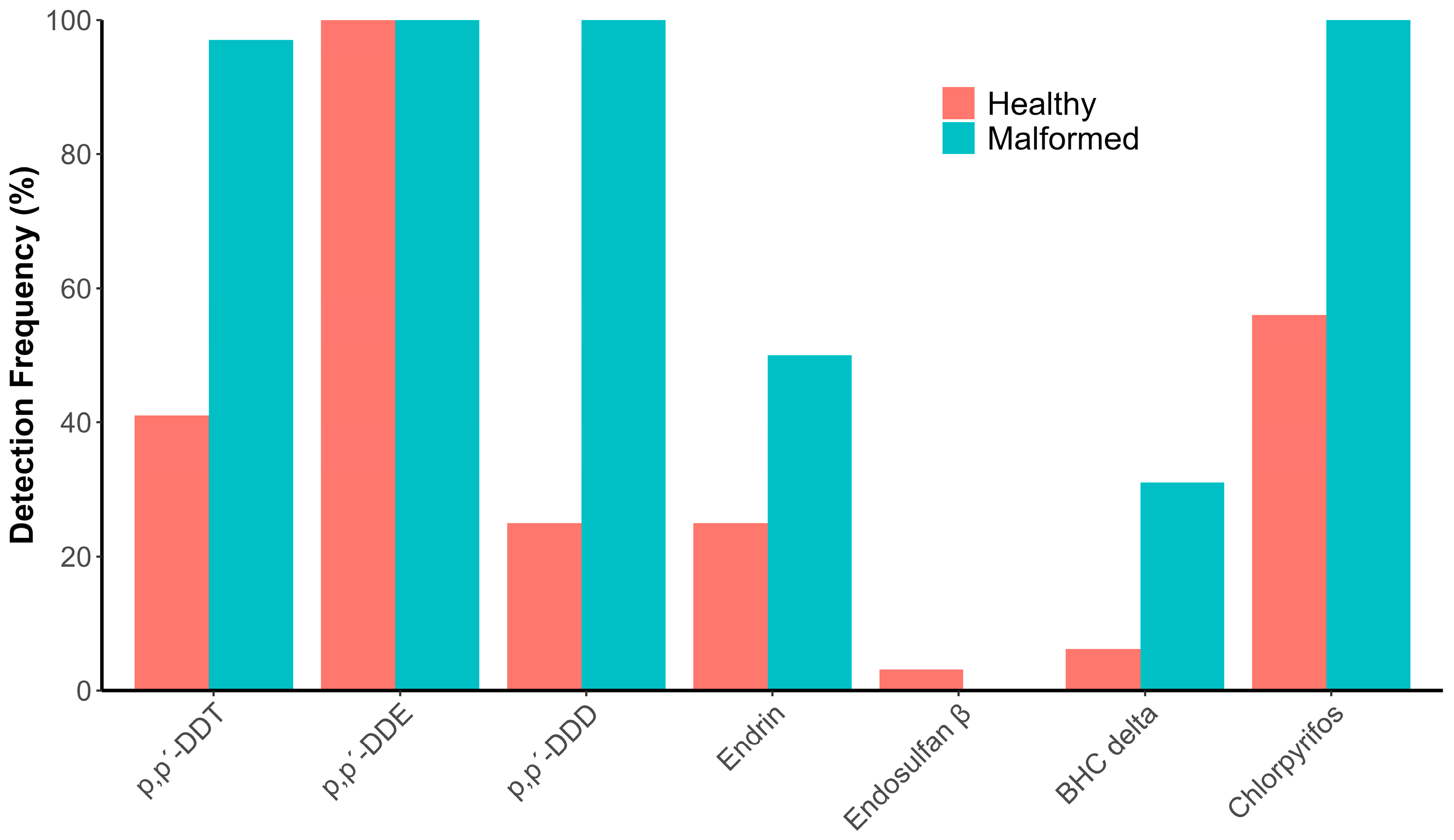
Of the 64 samples analyzed from healthy and malformed fish vertebrae, at least one of the OCPs and OPPs evaluated was present in 100% of cases. However, the detection frequency varied significantly, both by type of pesticide and by the group of organisms analyzed (healthy and malformed) (Figure 2). The group of healthy fish showed the highest diversity in OCPs (6), whereas the group of malformed fish showed only 5. In healthy fish, analysis of vertebrae revealed the presence of at least one pesticide in each specimen. In this regard, the OCPs detected in all the samples were p,p’-DDE, followed by p,p’-DDT (41%), p,p’-DDD (25%), endrin (25%), endosulfan β (3.13%), and BHC delta (6.25%), while the remainder of the OCPs evaluated were not detected (Figure 2). The species with the highest number of OCPs were C. raredonae and A. seemanni, each with five compounds, followed by A. guatemalensis and B. panamensis, both with four, and N. kessleri with two. The rest of the species analyzed had only one (p,p’-DDE), present in all cases.
The detection frequency of the identified OCPs in A. seemanni was 100% for p,p’-DDE, 66.7% for p,p’-DDT and endrin, and 33.3% for p,p’-DDD and endosulfan β. In C. raredonae, the identified compounds were p,p’-DDE, p,p’-DDT, endrin, p,p’-DDD, and BHC delta, with frequencies of 100%, 58.3%, 33.3%, 25%, and 8.3%, respectively. Four OCPs were also observed in A. guatemalensis: p,p’-DDE (100%), p,p’-DDT (75%), p,p’-DDD (50%), and endrin (25%). The OCPs compounds detected in B. panamensis were p,p’-DDE (100%), p,p’-DDD (66.6%), p,p’-DDT (33.3%), and BHC delta (33.3%). Finally, in N. kessleri, two pesticides were presented: p,p’-DDE and endrin, with detection frequencies of 100% and 50%, respectively. The other species analyzed (O. altus, M. ectenes, C. caninus, C. viridis, C. chanos, and L. argentiventris) showed p,p’-DDE in 100% of healthy organisms (Table 2).
In a similar vein, the analysis of samples from malformed fish species revealed the presence of at least one OCP. In the samples examined, the compounds p,p’-DDE and p,p’-DDD were detected in all instances. Conversely, p,p’-DDT was detected in 97% of cases, followed by endrin (50%) and BHC delta (31%). The remaining OCPs analyzed were not detected (Figure 2). The species with the greatest diversity of OCPs were C. raredonae, A. seemanni, N. kessleri, and C. viridis, each with five compounds; these were followed by A. panamensis and L. argentiventris, each with four. The remaining species (A. guatemalensis, O. altus, M. ectenes, C. caninus, and C. chanos) only presented p,p’-DDE, p,p’-DDT, and p,p’-DDD in all cases (see Table 2 for further details). The frequency of detection of the species C. raredonae for the identified OCPs was 100% for the compounds p,p’-DDE and p,p’-DDD, followed by p,p’-DDT (91.6%), endrin (66.7%), and BHC delta (50%); while in A. seemanni, the OCPs identified were: p,p’-DDE, p,p’-DDD, p,p’-DDT, endrin, and BHC delta, with a frequency of 100, 100, 100, 66.7, and 33.3%, respectively.
Five compounds were also observed in N. kessleri, corresponding to p,p’-DDE, p,p’-DDD, and p,p’-DDT (all at 100%), as well as endrin and BHC delta (both at 50%). Meanwhile, the pesticides detected in C. viridis were p,p’-DDE, p,p’-DDD, p,p’-DDT, endrin, and BHC delta, all of which were present in 100% of the analyzed samples. In A. panamensis, the OCPs corresponding to p,p’-DDE, p,p’-DDD, and p,p’-DDT (all 100%) and endrin (66.7%) were observed. In L. argentiventris, four compounds were also observed: p,p’-DDE, p,p’-DDD, p,p’-DDT, and endrin, all at a frequency of 100%. The remaining species analyzed (A. guatemalensis, O. altus, M. ectenes, C. caninus, and C. chanos) exhibited 100% of the compounds corresponding to p,p’-DDE, p,p’-DDD, and p,p’-DDT (Table 2).
Conversely, an organophosphate pesticide was detected in the samples analyzed from healthy fish species. Chlorpyrifos was detected in 56% of the species analyzed. The remaining organophosphates evaluated were not detected (Figure 2). The frequency of detection of this compound by species varied in the following order: A. seemanni = B. panamensis = N. kessleri = M. ectenes = L. argentiventris (100%) > A. guatemalensis (75%) > C. raredonae (41.67%). Chlorpyrifos was not detected in the remaining species (Table 2). Conversely, samples from malformed fish species tested positive for chlorpyrifos in 100% of cases, regardless of species (Table 2).
The concentrations of OCPs in the vertebrae of the healthy fish species under investigation exhibited significant interspecies variability, ranging from undetectable (ND, i.e., below the detection limit) to notably elevated levels (Table S3). In general, the highest concentrations were observed in the DDT group (p,p’-DDT, p,p’-DDE, and p,p’-DDD), regardless of species, followed by the drins group (endrin) and finally the endosulfans group (endosulfan β). No other organochlorine groups were detected.
The highest average concentration of p,p’-DDE was observed in A. seemanni (0.052 ± 0.034 µg/g), followed by A. guatemalensis (0.032 ± 0.022 µg/g), C. raredonae (0.021 ± 0.011 µg/g), B. panamensis (0.017 ± 0.008 µg/g), N. kessleri (0.014 ± 0.007 µg/g), C. chanos (0.006 ± 0.002 µg/g), and C. viridis (0.005 ± 0.003 µg/g). The remaining species exhibited a single data point. In the case of p,p’-DDD, the highest recorded concentration was observed in the species A. guatemalensis (0.002 ± 0.001 µg/g) and the lowest in C. raredonae (0.0010 ± 0.0004 µg/g). A. seemanni exhibited a single data point (0.002 µg/g), while the remaining species did not present this compound. Finally, the highest average concentrations of p,p’-DDT were found in the species A. seemanni (0.015 ± 0.010 µg/g) and A. guatemalensis (0.014 ± 0.005 µg/g), while the lowest concentration was found in C. raredonae (0.0046 ± 0.0015 µg/g). The presence of this pesticide was not observed in the rest of the fish species analyzed. In the case of the sum of DDTs, the same behavior was observed as for p,p’-DDE, since this is the major component (Table S3).
Regarding the drins group, only endrin was detected in A. seemanni (0.069 ± 0.092 µg/g), C. raredonae (0.013 ± 0.002 µg/g), A. guatemalensis (0.024 µg/g), and N. kessleri (0.015 µg/g). However, it was not observed in the other species. Conversely, within the endosulfans group, endosulfan β was only detected on a single occasion in A. seemanni (0.085 µg/g). As with the DDT sums, the sum of chlorinated compounds showed behavior equivalent to that of the DDT sums in terms of concentrations observed per species, perhaps for the same reason (Table S3).
As observed in the case of healthy fish, the concentrations of OCPs in the vertebrae of malformed fish species samples exhibited significant interspecies variability, with some compounds being below the detection limit and others reaching 0.185 µg/g of p,p’-DDE in the species A. guatemalensis and O. altus (Table S4). In general, the highest concentrations were observed in the DDT family (p,p’-DDT, p,p’-DDE, and p,p’-DDD), regardless of species, followed by the HCH group (BHC delta) and finally the drins (endrin). The average concentration of p,p’-DDE varied in the following order by species and concentration: A. guatemalensis (0.185 ± 0.11 µg/g) > B. panamensis (0.074 ± 0.038 µg/g) > N. kessleri (0.072 ± 0.05 µg/g) > C. chanos (0.071 ± 0.042 µg/g) > C. raredonae (0.067 ± 0.044 µg/g) > A. seemanni (0.066 ± 0.75 µg/g) > C. viridis (0.049 ± 0.004 µg/g). The remaining fish species analyzed had a single concentration data point (Table S4).
In the case of p,p’-DDD, the average concentration, from highest to lowest, by species was as follows: A. guatemalensis (0.01 ± 0.006 µg/g) > B. panamensis (0.004 ± 0.002 µg/g) = N. kessleri (0.004 ± 0.005 µg/g) > C. raredonae (0.003 ± 0.003 µg/g) = A. seemanni (0.003 ± 0.004 µg/g) = C. chanos (0.003 ± 0.002 µg/g). The remaining fish species analyzed showed a single concentration value. Finally, the highest average concentration of p,p’-DDT was found in A. guatemalensis (0.066 ± 0.064 µg/g), followed by B. panamensis (0.027 ± 0.02 µg/g), C. chanos (0.023 ± 0.015 µg/g) and C. raredonae (0.02 ± 0.022 µg/g), with the exception of the species A. seemanni, C. caninus, O. altus, and N. kessleri, which presented unique concentration data corresponding to 0.065, 0.056, 0.028, and 0.020 µg/g, respectively. The rest of the species showed no evidence of this compound. The group sum of DDT, as with healthy fish, was influenced by the concentration of p,p’-DDE, varying in the following order: A. guatemalensis (0.200 ± 0.172 µg/g) > B. panamensis (0.090 ± 0.058 µg/g) > C. chanos (0.088 ± 0.041 µg/g) > N. kessleri (0.070 ± 0.069 µg/g) > C. raredonae (0.057 ± 0.067 µg/g) > C. viridis (0.048 ± 0.003 µg/g) > A. seemanni (0.046 ± 0.116 µg/g) > O. altus (0.038 ± 0.080 µg/g) > C. caninus (0.026 ± 0.049 µg/g) > M. ectenes (0.004 ± 0.031 µg/g) > L. argentiventris (0.002 ± 0.017 µg/g) (Table S4).
Conversely, the sole compound detected in the drins group was endrin, and it was observed in merely two species: B. panamensis (0.07 ± 0.093 µg/g) and A. seemanni (0.012 µg/g) (Table S4). The sum of chlorinated compounds, as with healthy fish, was influenced by the concentration of p,p’-DDE, varying in the following order: A. guatemalensis (0.200 ± 0.172 µg/g) > B. panamensis (0.132 ± 0.137 µg/g) > C. chanos (0.88 ± 0.041 µg/g)> N. kessleri (0.07 ± 0.069 µg/g) > A. seemanni (0.059 ± 0.111 µg/g) > C. raredonae (0.057 ± 0.067 µg/g) > C. viridis (0.054 ± 0.007 µg/g) > O. altus (0.038 ± 0.080 µg/g) > C. caninus (0.026 ± 0.049 µg/g) > M. ectenes (0.004 ± 0.024 µg/g) > L. argentiventris (0.002 ± 0.017 µg/g) (Table S4).
Regarding the concentration of OPPs pesticides in the vertebrae of the healthy fish species analyzed, only chlorpyrifos was detected in four of the species analyzed (C. raredonae, A. guatemalensis, A. seemanni, and B. panamensis), with concentrations ranging from below the detection limit to 0.058 µg/g in the species A. seemanni (see Table 3). Within the same context, the concentrations of the only organophosphate detected (chlorpyrifos) in the malformed fish evaluated exhibited significant variation, spanning from below the detection limit to notably high levels, irrespective of species. The highest average concentration of chlorpyrifos detected in malformed fish species was observed in A. guatemalensis (0.053 ± 0.016 µg/g), followed by C. raredonae (0.030 ± 0.049 µg/g), N. kessleri (0.023 ± 0.018 µg/g), C. viridis (0.021 ± 0.003 µg/g), and B. panamensis (0.017 ± 0.002 µg/g). The remaining species exhibited a solitary concentration value (Table 3).

3.3. Association Between the Concentration of OCPs and OPPs in Vertebrae of Different Fish Species from the Coast of San Blas, Nayarit, Mexico, and the Presence or Absence of Vertebral Malformations

The nMDS showed a spatial separation between organisms with malformations and those without, and had low stress (0.049). Figure 3 shows that malformed fish are apparently related to higher concentrations of p,p’-DDT, p,p’-DDD, and p,p’-DDE, while fish without malformations are associated with higher concentrations of BHC-delta.
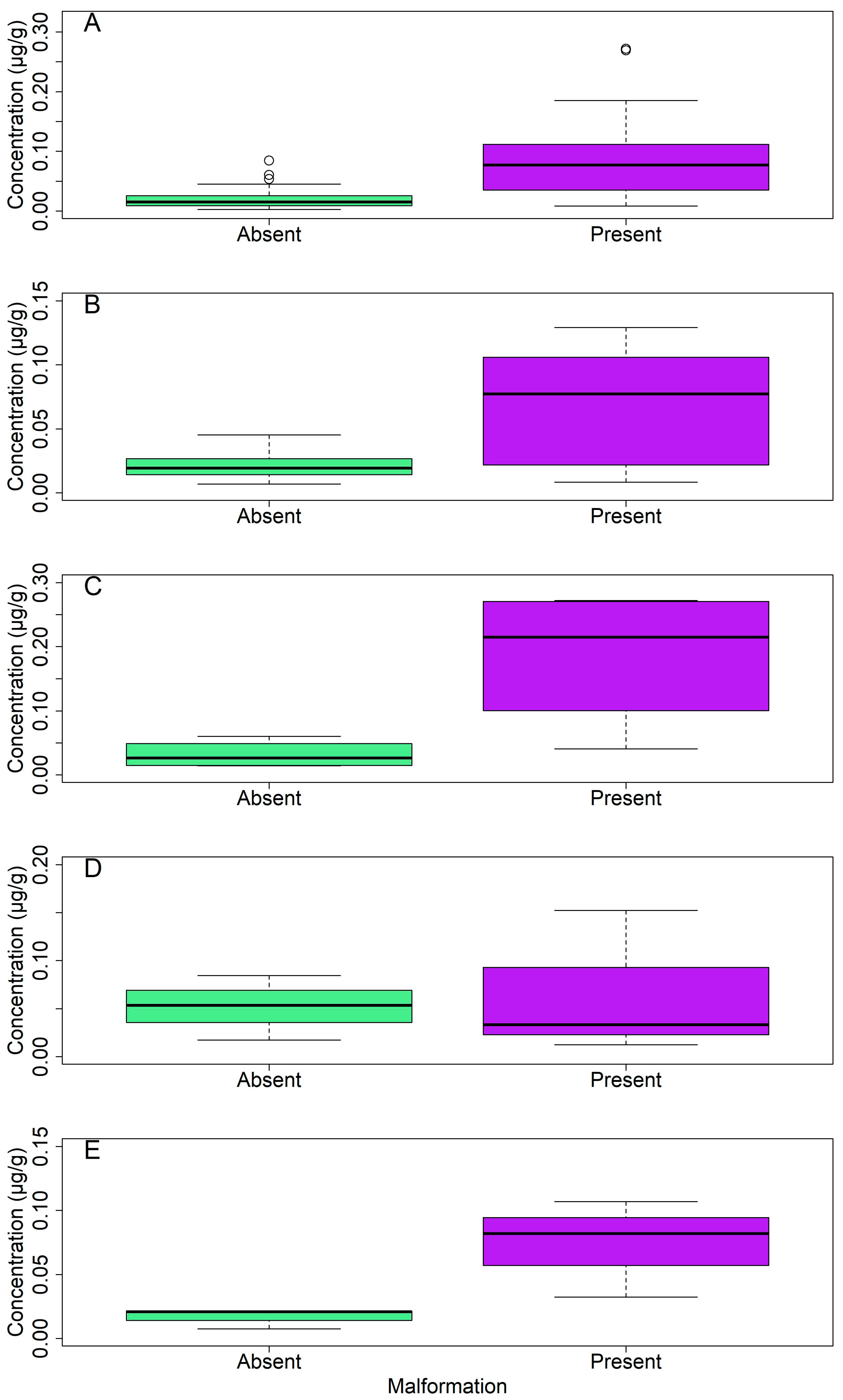
A comparison between all organisms demonstrated that those that were malformed had higher concentrations of p,p’-DDE than those that were non-malformed (U = 132, n = 64, p < 0.001; Figure 4A). Regarding species, C. raredonae exhibited higher concentrations of p,p’-DDE in malformed organisms (t = −3.097, d.f.: 17.23, p = 0.006; Figure 4B), as did A. guatemalensis (t = −3.021, d.f.: 5.69, p = 0.02; Figure 4B). Conversely, A. seemanni (t = −0.298, d.f.: 2.76, p = 0.79; Figure 4C), and B. panamensis exhibited no statistically significant variations in p,p’-DDE concentrations between non-malformed and malformed organisms (t = −2.55, d.f.: 2.18, p = 0.11; Figure 4E).
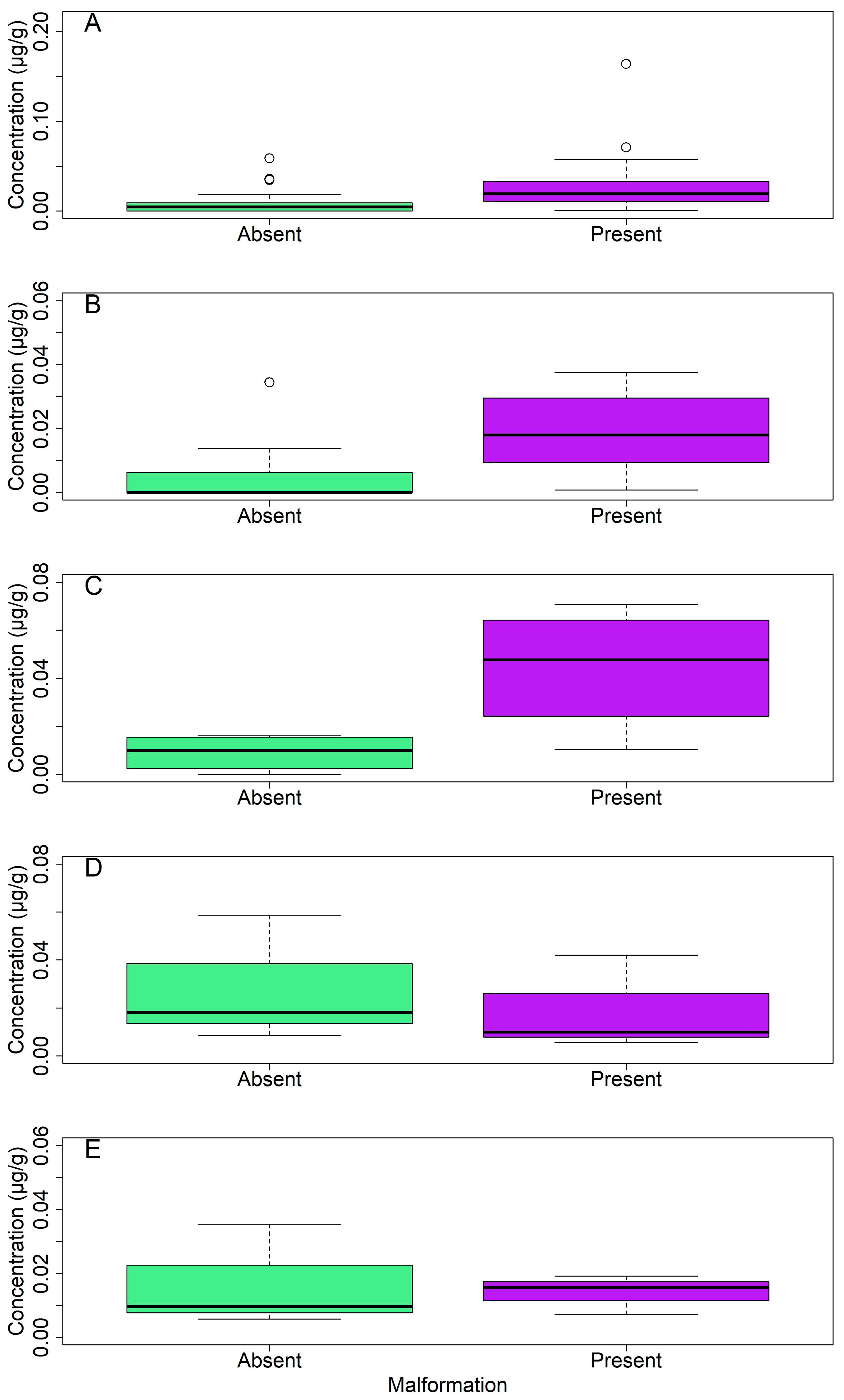
Conversely, a comparison across all organisms revealed that individuals with malformations exhibited higher chlorpyrifos concentrations than their non-malformed counterparts (X2 = 11.92, d.f.: 1, p < 0.001; Figure 5A). Regarding species, C. raredonae exhibited higher concentrations of chlorpyrifos in malformed organisms (X2 = 3.92, d.f.: 1, p = 0.04; Figure 5B), as did A. guatemalensis (X2 = 7.47, d.f.: 1, p = 0.006; Figure 5C). However, A. seemanni (X2 = 0.02, d.f.: 1, p = 0.89; Figure 5D) and B. panamensis did not demonstrate significant differences in chlorpyrifos concentrations between non-malformed and malformed organisms (X2 = 0.38, d.f.: 1, p = 0.54; Figure 5E). Finally, concentrations of p,p’-DDE (rho = −0.048, p = 0.71) and chlorpyrifos (rho = −0.063, p = 0.62) showed no correlation with species trophic level.
The consistent detection of higher p,p’-DDE and chlorpyrifos concentrations in malformed fish across global and species-level analyses supports a possible association between chronic pesticide exposure and vertebral deformities.

4. Discussion

4.1. Biological Samples and Presence of Vertebral Malformations

Ten of the eleven fish species (Ariopsis guatemalensis, A. Seemanni, B. panamensis, N. kessleri, O. altus, M. ectenes, C. caninus, C. viridis, C. chanos, and L. argentiventris) reported in this study are included in the systematic list of fish in the state of Nayarit, Mexico [58]. C. raredonae is a recently described species with few curatorial records, which may explain why it is the only species not included in the list of fish in Nayarit [59]. All eleven fish species exhibited vertebral malformations, as reported by Tirado-León [40] in different species of marine catfish (Ariopsis guatemalensis, A. seemanni, Bagre panamensis, and C. raredonae) from the coast of San Blas, Nayarit. These included lordosis, kyphosis, and scoliosis curvatures of the vertebrae. Similarly, Wakida-Kusunoki et al. [60] reported ten specimens with kyphosis and/or scoliosis in the catfish Pterygoplichthys pardalis; likewise, Wakida-Kusunoki and Amador del Ángel [61] detected scoliosis of the vertebrae in the specimen.
In Mexico, studies reporting malformations in fish are very scarce. Among the few that have been conducted in the last 20 years, Wakida-Kusunoki et al. [60] reported the presence of two distinct types of vertebral malformations (kyphosis and scoliosis) in a total of ten specimens of the species Pterygoplichthys pardalis. These specimens were captured during the period spanning from June to November 2012 and from February to March 2013 in the vicinity of Mangal, near Palizada, Campeche, Mexico. The distribution of malformations observed was as follows: three cases had scoliosis, two had kyphosis, and five had both. The total length (TL) of the fish ranged from 12.6 to 43.0 cm, while their weight ranged from 158.5 to 565 g. The remaining organisms exhibiting vertebral malformations had a total length of 25 cm. In this regard, some of the malformed fish found in this study coincide with a length of 25 cm, as is the case with specimens of A. guatemalensis (25.6 cm TL), N. kessleri (25.4 cm TL), and O. altus (25.4 cm TL). Conversely, the frequency of malformations observed in the present study differed from those reported by these authors, due to greater diversity and a higher number of affected organisms: kyphosis (23) > lordosis (20) > scoliosis (12). Some fish exhibited more than one malformation; for instance, nine specimens displayed kyphosis-lordosis, particularly: M. ectenes, A. guatemalensis, N. kessleri, C. raredonae, A. seemanni, and B. panamensis; four kyphosis-scoliosis (C. Raredonae, N. Kessleri, and C. viridis) were the subjects of the study. Five presented kyphosis-scoliosis-lordosis [C. raredonae, B. panamensis, and A. seemanni] (Table 1).
On the other hand, Wakida-Kusunoki and Amador del Ángel [61] documented the occurrence of an Ariopsis felis organism exhibiting vertebral malformations of kyphotic and scoliotic types. This specimen was captured in July 2014 at the Copesmar fishing cooperative dock in Frontera, Tabasco, Mexico. The specimen measured a total length of 25 cm, similar to those of A. guatemalensis (25.6 cm), N. kessleri (25.4 cm), and O. altus (25.4 cm). However, the malformations observed in the present study’s specimens included precaudal vertebral lordosis, lordosis-kyphosis in the central vertebrae, and kyphosis in the precaudal vertebrae, respectively. However, as reported by these authors, 4 specimens exhibited kyphosis-scoliosis, and 5 exhibited kyphosis-scoliosis-lordosis, as indicated above.
Regarding the coastal area of San Blas, Nayarit, Mexico, where the malformed fish in this study were obtained, previous studies have documented the presence of malformations in fish. For instance, Tirado-León [40] documented vertebral malformations in 30 specimens captured between January 2013 and June 2014, representing seven species (Ariopsis guatemalensis, A. seemanni, Bagre panamensis, B. pinnimaculatus, Cathorops liropus, C. raredonae, and Occidentarius platypogon). As in the present study, the organisms exhibited vertebral malformations grouped into three types: lordosis, kyphosis, and scoliosis. However, the distribution pattern exhibited in the present study differed from that observed in the study, with scoliosis (28) > kyphosis (27) > lordosis (26) being the most prevalent. Based on the results, the species with the highest incidence of malformations was B. panamensis, with 13 cases of lordosis, 15 of scoliosis, and 15 of kyphosis, while A. guatemalensis demonstrated two cases of lordosis, three of scoliosis, and three of kyphosis. A. seemanni exhibited four instances of lordosis and four of scoliosis. C. raredonae exhibited four cases of lordosis, three of scoliosis, and three of kyphosis. Finally, the species B. pinnimaculatus, C. liropus, and O. platypogon were the only specimens with malformations of the following types: lordosis, kyphosis, and scoliosis in combination.
In general, the maximum size and weight were observed in B. pinnimaculatus (76.8 cm L and 3980 g), while the smallest sizes were found in C. liropus (19.8 cm L and 65 g). The size ranges per species were in the following order: A. guatemalensis (26.1 to 34.7 Lt cm), A. seemanni (28.4 to 44.7 Lt cm), and B. panamensis (27.8 to 43.9 Lt cm). Meanwhile, C. raredonae (25.5 Lt cm) and O. Platypogon (37.8 Lt cm) had a single record. The species that exhibited a record of all three malformations were C. raredonae, B. panamensis, and A. seemanni (Table 1). This pattern is inconsistent with the observations reported by Tirado-León [40], who noted that the maximum and minimum sizes (total length) exceed those observed in the current study.
The maximum size recorded in the present study was observed in C. viridis (35.7 to 47.4 Lt cm), while the smallest size was observed in C. raredonae (15.8 to 22.7 Lt cm). The size ranges (Lt cm) were arranged in the following order: N. kessleri (25.4 to 34.1 Lt cm), A. seemanni (20.5 to 21.3 Lt cm), A. guatemalensis (19.4 to 28.8 Lt cm), C. chanos (20.8 to 22.4 Lt cm), and B. panamensis (22.2 to 33.3 Lt cm). The remaining species exhibited a solitary size record, namely O. altus (25.4 Lt cm), M. ectenes (23.3 Lt cm), C. caninus (20.7 Lt cm), and L. argentiventris (19.7 Lt cm). According to the sizes observed, this author recorded larger organisms than those observed in this study.
In a recent study, Guzmán-Morales et al. [62] documented a variety of malformations in fish specimens of the species Ariopsis guatemalensis and A. seemanni. These malformations included the loss of an eye, a cleft lip, and a malformed chin. The study was conducted in the San Blas area of Nayarit, Mexico, from September 2015 to September 2016. The distribution of malformations is outlined below: A. guatemalensis exhibited five types of morphological malformations (absence of the right eye, small undeveloped eye, malformed barbels, malformed upper dental plate, and cleft lip), while A. seemanni demonstrated only two (small right eye and malformed lower dental plate). However, the present study was limited to vertebral deformities. In contrast, Guzmán-Morales et al. [62] reported the presence of additional morphological malformations in the species A. guatemalensis and A. seemanni. This highlights the necessity for further in-depth studies to identify the causes of this problem, which is constantly observed in fish species in this area. It is well documented that this species is highly impacted by waste from agricultural activities in the region [63].

4.2. Detection and Quantification of OCPs and OPPs in Vertebrae, with and Without Malformations, from Different Fish Species of the Coast of San Blas, Nayarit, Mexico

There are currently no reports of pesticides in the vertebrae of healthy or malformed fish in San Blas, Nayarit, Mexico. However, several studies have reported the presence of pesticides in different matrices in the Nayarit area. Robledo-Marenco et al. [20] reported OCPs in sediments from the El Pozo-Rey and San Cristóbal estuaries and in shrimp (Litopenaeus spp.) from San Blas, Nayarit, Mexico. The detection frequency in sediments from both estuaries (Pozo-Rey and San Cristóbal) shows that the most frequent compounds were HCH isomers, endosulfan, and the DDT group. The same pattern of pesticide distribution was found in shrimp muscle. In the Pozo-Rey estuary, 13 of the 16 compounds analyzed were detected; the average concentrations recorded showed notable variability, ranging from 0.00182 to 0.07282 µg/g. The most frequent compounds were endosulfan α and β-HCH. Meanwhile, 14 pesticides were detected in the San Cristóbal estuary, with beta-HCH being the most frequent compound. The maximum concentrations observed in sediments from the San Cristóbal estuary were higher than the sediment concentrations reported in the Pozo-Rey estuary. In shrimp, a total of 14 pesticides were detected in the Pozo-Rey Estuary, with concentrations ranging from 0.00904 to 0.09839 µg/g. On the other hand, shrimp tissue from the San Cristóbal Estuary contained only eight organochlorine compounds. The maximum concentration ranged from 0.01617 to 0.04698 µg/g. The authors affirm the existence of similarities between the compounds observed in the different matrices analyzed (shrimp and sediments), possibly due to the benthic habits of these organisms.
Bernal-Hernández [64] also reported the presence of two OCPs (delta HCH and heptachlor epoxide) in the sediments of the Boca de Camichín Estuary, Nayarit. The most frequently detected pesticide, delta HCH, was detected at four stations, whereas heptachlor epoxide was detected at only one. A variable concentration range from 0.00015 to 0.00237 µg/g was observed for the delta HCH compound, while heptachlor epoxide showed 0.0112 µg/g as the only data point.
As demonstrated by Aranguré-Zúñiga et al. [65], the presence of OCPs residues was recorded in sediment and in five fish species: the tilapia (Oreochromis aureus), the largemouth bass (Micropterus salmoides), the catfish (Ictalurus punctatus), the carp (Cyprinus carpio), and the palacha (Dorosoma smithi) of the Aguamilpa dam, Nayarit, Mexico. The following pesticides were identified in the sediments: alpha-HCH, beta-HCH, gamma-HCH, delta-HCH, p,p’-DDE, p,p’-DDD, heptachlor, heptachlor epoxide, aldrin, dieldrin, endosulfan α, endosulfan sulfate, endrin, and endrin aldehyde. The range of the most frequently detected compounds was as follows: alpha-HCH (0.00106 and 0.00638 µg/g), endosulfan α (0.00184 to 0.02123 µg/g), endrin (0.00107 to 0.00363 µg/g), and p,p’-DDE (0.0003 to 0.00225 µg/g). The mean total concentration of organochlorines in the sediment samples ranged from 0.00208 to 0.02859 µg/g. In fish, the frequency and concentration of pesticides varied by species. In this regard, the species with the highest number of organochlorines were Micropterus salmoides (eight), followed by Cyprinus carpio (seven), Oreochromis aureus (six), Ictalurus punctatus (four), and Dorosoma smithi (two). The maximum concentrations of OCPs observed in fish caught during the dry season varied by species and compound. However, during the rainy season, significant variability in pesticide concentrations was observed among the fish species analyzed. The concentrations reported in both fish and sediments were comparable to those found in vertebrates in this study.
On the other hand, Osuna-López et al. [23] reported the concentrations of OCPs present in bivalve mollusks in Estero San Cristóbal, Nayarit. The compounds identified were: δ-HCB, methoxychlor, endosulfan β, and arochlor 54 were found with 2.918, 1.438, 0.906, and 1.3184 μg/g, respectively.
Aguayo-Quiroz [24] reported the presence of OCPs in the muscle tissue of four commercial species: Mojarra (Diapterus brevirostris), Constantino (Centropomus robalito), Sierra (Scomberomorus sierra), and Bicuda (Sphyraena ensis), which are frequently consumed in the coastal area of Nayarit. It was found that 100% of the samples contained at least one pesticide, with frequencies that varied significantly. However, no significant differences were reported between the species from which the samples were taken. Although the detection frequencies varied among species, statistical comparisons did not reveal significant interspecific differences. Despite this, Sphyraena ensis exhibited the greatest diversity of OCPs (14 compounds), followed by Centropomus robalito and Scomberomorus sierra (13 compounds each), whereas Diapterus brevirostris presented the lowest number (eight compounds). In S. ensis, the compounds most consistently detected were p,p’-DDE and heptachlor epoxide (both present in 100% of samples), followed by dieldrin (30%) and p,p’-DDD (26.7%). For C. robalito, p,p’-DDE was identified in all samples (100%), with endosulfan sulfate (66.7%) and dieldrin (23.3%) also occurring frequently. In S. sierra, p,p’-DDE was again ubiquitous (100%), accompanied by high detection of heptachlor epoxide (96.7%), γ-HCH (lindane) (43.3%), and endosulfan sulfate (40%). Similarly, in D. brevirostris, p,p’-DDE was consistently detected (100%), together with endosulfan sulfate (63.3%), heptachlor (53.3%), and heptachlor epoxide (50%). The remaining compounds analyzed exhibited detection frequencies of less than 20%, except for methoxychlor, which was not detected in any sample. The highest average concentration of the sum of OCPs was observed in Scomberomorus sierra (0.02248 ± 0.0164 μg/g), followed by Diapterus brevirostris (0.01642 ± 0.01115 μg/g), Sphyraena ensis (0.01396 ± 0.01402 μg/g), and Centropomus robalito (0.00797 ± 0.00628 μg/g). The difference between species according to trophic level is evident, contrary to the findings of this study for concentrations of p,p’-DDE (rho = −0.048, p = 0.71) and chlorpyrifos (rho = −0.063, p = 0.62), which were not correlated with the trophic level of species, both healthy and malformed organisms.
Studies in aquatic ecosystems of Nayarit, Mexico, document the presence of pesticides in various matrices (water, sediments, and organisms), including freshwater and saltwater fish. To our knowledge, this investigation constitutes the first regional assessment quantifying residues of both historically used (organochlorines) and currently used (organophosphates) pesticides in the vertebrae of apparently healthy and malformed marine fish from the coastal area of San Blas, Nayarit. In the absence of prior studies on this subject in Nayarit, comparing potential variations in the concentration of these contaminants in the analyzed vertebrae is challenging. Nonetheless, studies conducted on water, sediments, and organisms in the area [20,23,24,64,65] have shown that the intrinsic characteristics of these compounds (persistence, water solubility, vapor pressure, volatility, octanol-water partition coefficient, among others) render them ubiquitous in the environment. It can thus be concluded that all organisms are exposed to both chronic (organochlorine pesticides) and acute (organophosphate pesticides) levels, which may contribute to ecological disturbances and could be associated with skeletal abnormalities in fish populations.

4.3. Association Between the Concentration of Organochlorine and Organophosphate Pesticides in Vertebrae of Different Fish Species from the Coast of San Blas, Nayarit, Mexico, and the Presence or Absence of Vertebral Malformations

A plethora of factors have been associated with malformations in fish across both epicontinental and marine bodies of aquatic ecosystems. As outlined in the existing literature, the factors under investigation include nutritional deficiencies of specific vitamins or minerals [66,67,68,69,70,71], defects during embryonic development [72,73], parasitic infections [74,75], genetic factors [76,77,78,79], low levels of dissolved oxygen in water [80,81], sudden changes in water temperature [82,83,84,85,86,87], and exposure to environmental pollutants such as metals [88,89,90,91,92], petroleum-derived hydrocarbons and pesticides [93,94,95,96,97,98,99,100,101]. Given the multifactorial nature of these deformities, it is challenging to attribute them to a single etiological cause. Therefore, although the present study identified differences in pesticide concentrations between malformed and healthy fish, the results should be interpreted as associations between contaminant occurrence and skeletal abnormalities, rather than as evidence of a direct causal relationship.
In this regard, the present study demonstrated an association between certain pesticides and malformations in various fish species. For instance, the vertebral malformations observed in C. raredonae and A. guatemalensis were associated with elevated concentrations of p,p’p’-DDE and chlorpyrifos. Among the studies that have suggested a causal role of pesticides under experimental conditions in the development of vertebral malformations in fish, we can mention, for example, the work conducted by Holden [80], who, through a comprehensive review of relevant publications, established a direct link between the presence of specific OCPs and OPPs, as well as carbamates, with various health problems in exposed fish, under static or experimental conditions. These problems include fry mortality, delayed hatching, respiratory distress, degenerative liver lesions, lesions in various tissues (gills, liver, and kidneys), and bone malformations.
Prolonged exposure to pesticides has been shown to induce a range of physiological and behavioral alterations, as well as histopathological damage to various tissues and organs (including malformations), across a variety of aquatic ecosystem organisms. The impact of these pesticides extends to alterations in hematological parameters, enzymatic changes, immunosuppression, hormonal disruption, decreased intelligence, reproductive abnormalities, and cancer [102,103,104,105,106,107].
As indicated by previous studies, certain herbicides are associated with a range of health complications in marine fish. In this regard, Lazhar et al. [108] conducted acute toxicity tests to evaluate the evidence of three herbicides (alachlor, atrazine, and diuron) on the marine fish turbot (Scophthalmus maximus). Turbot larvae were found to be more sensitive than embryos, although all the pesticides evaluated were shown to have a teratogenic effect on both stages of development at concentrations above 1250 μg/L for alachlor and 2500 μg/L for atrazine and diuron, particularly causing malformations in embryonic development, failure to hatch, and consequent coagulation of the egg at 48 h. Furthermore, the exposed organisms exhibited pericardial oedema and skeletal deformation in the larvae. The authors’ evaluation revealed that all the herbicides under scrutiny were teratogenic during the early stages of turbot development. However, the herbicides differed in toxicity, with alachlor proving the most toxic, followed by atrazine and diuron.
On the other hand, Camargo-Buitrago [109] conducted a study to analyze the impact of four different doses of carbofuran (2.0 µg/L, 2.5 µg/L, 3.0 µg/L, and 3.5 µg/L) on the eggs of Oncorhynchus mykiss. The results of this study indicated an 81.6% mortality rate, corresponding to 2840 cases of malformation. The malformations observed included darkening of the yolk sac, additional yolk, kyphosis–lordosis, scoliosis, yolk sac oedema, yolk sac constriction, size reduction, discoloration, and pericardial oedema. These results are consistent with those reported in the present study, although our results represent field associations rather than experimentally demonstrated causal effects, in which the species C. raredonae and A. guatemalensis exhibited vertebral malformations. The former presented kyphosis, scoliosis, and lordosis, while the latter presented only kyphosis and lordosis. These malformations were associated with the presence of both p,p’-DDE and chlorpyrifos in the bone tissue.
Finally, Zhang et al. [110] evaluated the effects of the herbicide promethrin, widely used worldwide in agriculture, on the marine medaka (Oryzias melastigma), also known as the Indian medaka or brackish medaka. To evaluate the potential effects of this pesticide, embryos of the species were exposed to reported environmental concentrations of the pesticide in water (0, 1, 10, 100, and 1000 μg/L). The findings of these researchers indicated that this herbicide, regardless of concentration, resulted in constriction of the yolk sac and cardiac malformations. Additionally, a substantial decline in hatching time was observed, along with an augmentation in both the heart rate and the incidence of hatching failure among the embryos. An increase in lipid accumulation was also observed. Furthermore, the administration of this substance resulted in the occurrence of congenital anomalies and reduced the size of newly emerged larvae.

5. Conclusions

The results of this study demonstrate a high incidence of vertebral malformations (kyphosis, lordosis, and scoliosis) in fish from the coast of San Blas, Nayarit, encompassing various species of the analyzed ichthyofauna. Cathorops raredonae exhibited the highest incidence of malformations, a phenomenon that is concomitant with the largest sample size of this species.
The analysis revealed that 100% of the vertebrae samples, from both healthy and malformed fish, contained at least one of the organochlorine or organophosphate pesticides evaluated. Healthy fish exhibited a greater diversity of organochlorine pesticides, while chlorpyrifos was the only organophosphate detected in both groups.
In both groups of fish, DDT group compounds (p,p’-DDT, p,p’-DDE, and p,p’-DDD) exhibited the highest average concentrations, which were elevated in malformed organisms. In addition, an association was identified between the presence of vertebral malformations in C. raredonae and A. guatemalensis and the concentrations of p,p’-DDE and chlorpyrifos.
The findings suggest that environmental exposure to persistent pesticides may be associated with alterations in fish skeletal development. Therefore, experimental and toxicological studies are recommended to clarify the mechanisms involved and establish causal relationships, as well as possible synergistic effects, enhancers, or additives due to exposure to complex mixtures of these groups of compounds.
Furthermore, the pervasive detection of these contaminants in the ichthyofauna of San Blas underscores the persistence of contamination sources in the study area, underscoring the necessity for uninterrupted environmental monitoring programs and management strategies aimed at reducing the use and discharge of pesticides in coastal ecosystems.

Supplementary Materials

The following supporting information can be downloaded at: https://www.mdpi.com/article/10.3390/environments13030151/s1. Figure S1: Malformations present in Bagre panamensis. a = external lateral view; b = dorsal view; c = lateral X-ray radiograph; d = dorsal X-ray radiograph. Vertebral malformations: Kyphosis, Lordosis, and Scoliosis; Table S1: Mass spectrum acquisition conditions for the analyzed compounds; Table S2: Method validation parameters; Table S3: Concentration of OCPs in vertebrae of healthy fish (μg/g, dry weight), from the coast of San Blas, Nayarit, Mexico. Range: minimum–maximum, arithmetic mean ± standard deviation estimated from the Kaplan–Meier survival function, n: total samples, parentheses: censored samples, <LD: measurement below the detection limit [54], * Single data point, Σ: Sum of pesticides; Table S4: Concentration of OCPs in vertebrae of malformed fish (μg/g, dry weight), from the coast of San Blas, Nayarit, Mexico. Range: minimum–maximum, arithmetic mean ± standard deviation estimated from the Kaplan–Meier survival function, n: total samples, parentheses: censored samples, <LD: measurement below the detection limit [54], * Single data point, Σ: Sum of pesticides.

Author Contributions

Conceptualization, J.B.L.-M., E.C.-A., J.G.A. and F.S.-M.; methodology, A.Y.R.-Á., P.d.J.B.-B., E.C.-A., J.G.A. and J.B.L.-M.; software, E.C.-A., P.d.J.B.-B., J.G.A., F.S.-M. and C.A.G.-R.; validation, E.G.A., J.G.R., E.C.-A., J.B.L.-M., C.C.-L., C.R.-G., O.A.A.-S. and C.A.G.-R.; formal analysis, E.G.A., J.G.R., F.S.-M., E.C.-A., J.B.L.-M., C.C.-L., C.R.-G., O.A.A.-S. and C.A.G.-R.; investigation, E.C.-A., F.S.-M., P.d.J.B.-B. and J.B.L.-M.; resources, J.B.L.-M., P.d.J.B.-B. and J.G.A.; project administration, J.B.L.-M., P.d.J.B.-B. and J.G.A.; data curation, L.L.-C. and F.S.-M.; writing—original draft preparation, L.L.-C., F.S.-M., E.C.-A., J.B.L.-M., P.d.J.B.-B. and A.Y.R.-Á.; writing—review and editing, F.S.-M., J.B.L.-M., C.C.-L., C.R.-G., O.A.A.-S., E.G.A., J.G.R. and C.A.G.-R.; supervision, C.C.-L., C.R.-G., O.A.A.-S., E.G.A., J.G.R. and C.A.G.-R.; visualization, L.L.-C., F.S.-M., E.C.-A., J.B.L.-M., P.d.J.B.-B. and A.Y.R.-Á. All authors have read and agreed to the published version of the manuscript.

Funding

This research received no external funding.

Institutional Review Board Statement

Captured fish were acquired with a fisherman possessing an official fishing permit. Fish comply with the International Union for Conservation of Nature (IUCN) and are not listed in the IUCN or in the NOM-059-SEMARNAT-2010 Mexican Legislation regarding endangered species in Mexico.

Data Availability Statement

Data will be made available on request.

Acknowledgments

The authors would like to express their gratitude to the students of the Biomedical Sciences Education Program at the Autonomous University of the West (UAdeO) Guasave Regional Unit, Carolina Bojórquez López, Lluvia Iris Sauceda Navarro, and Mónica Citlally Romero Rodríguez, for their invaluable technical assistance in developing the project. We would like to thank the Secretaría de Ciencia, Humanidades, Tecnología e Innovación (SECIHTI) for the scholarship awarded to Angelica Yomira Avila Ramos, with support number 784065, during the development of the thesis research.

Conflicts of Interest

The authors declare no conflicts of interest.

References

  1. Comisión Federal para la Protección Contra Riesgos Sanitarios. Consulta de Registros Sanitarios de Plaguicidas, Nutrientes Vegetales y LMR. Available online: https://siipris03.cofepris.gob.mx/resoluciones/consultas/conwebregplaguicida.asp (accessed on 17 June 2025).
  2. Fernández-Bremauntz, A.; Yarto-Ramírez, M.; Castro-Díaz, J. Las Sustancias Tóxicas Persistentes en México; Instituto Nacional de Ecología: Tlalpan, Mexico, 2024; Volume 1. [Google Scholar]
  3. Arellano-Aguilar, O.; Rendón von Osten, J. La Huella de los Plaguicidas en México; Greenpeace: Amsterdam, The Netherlands, 2017. [Google Scholar]
  4. García Hernández, J.; Leyva Morales, J.B.; Martínez Rodríguez, I.E.; Hernández Ochoa, M.I.; Aldana Madrid, M.L.; Rojas Gracía, A.E.; Betancourt Lozano, M.; Pérez Herrera, N.; Perera Ríos, J.H. Estado actual de la investigación sobre plaguicidas en México. Rev. Int. Contam. Ambient. 2018, 34, 29–60. [Google Scholar] [CrossRef]
  5. Ponce-Vélez, G.; Botello, A.V. Plaguicidas organoclorados en organismos costeros y marinos de los litorales mexicanos: Una revisión. Rev. Int. Contam. Ambient. 2018, 34, 81–89. [Google Scholar] [CrossRef]
  6. Mathikere, S.A.; Kundlas, K. Negative impacts of intensive agricultural practices on environment and ecosystem: A review. Int. J. Res. Agron. 2024, 7, 285–289. [Google Scholar] [CrossRef]
  7. Huang, D.; Gao, L.; Zhu, S.; Qiao, L.; Liu, Y.; Ai, Q.; Xu, C.; Wang, W.; Lu, M.; Zheng, M. Target and non-target analysis of organochlorine pesticides and their transformation products in an agrochemical-contaminated area. Chemosphere 2023, 324, 138314. [Google Scholar] [CrossRef]
  8. Gao, Z.; Chen, Y.; Qin, Q.; Wang, R.; Dai, Z. Distribution Characteristics and Influencing Factors of Organochlorine Pesticides in Agricultural Soil from Xiamen City. Int. J. Environ. Health Res. Public Health 2023, 20, 1916. [Google Scholar] [CrossRef]
  9. Wang, H.; Zhang, L.; Yang, F.; Yan, L.; Lin, C.; Shen, C. Characteristics, source analysis, and risk assessment of organochlorine pesticide contamination in nearshore surface sediments of a tropical tourist island. Front. Mar. Sci. 2025, 11, 36–41. [Google Scholar] [CrossRef]
  10. Walker, C.H. Organic Pollutants: An Ecotoxicological Perspective, 2nd ed.; Routledge: Abingdon, UK, 2008. [Google Scholar]
  11. Taiwo, A.M. A review of environmental and health effects of organochlorine pesticide residues in Africa. Chemosphere 2019, 220, 1126–1140. [Google Scholar] [CrossRef] [PubMed]
  12. Zambrano-Soria, M.; Toledo-Ibarra, G.A.; Covantes-Rosales, C.E.; Barajas-Carrillo, V.W.; Rios-Jiménez, I.; Leyva-Morales, J.B.; Navidad-Murrieta, M.S.; Razura-Carmona, F.F.; Girón-Pérez, M.I. Pesticide levels in shrimp on Mexican coasts. Int. J. Environ. Health Res. 2025, 35, 1456–1476. [Google Scholar] [CrossRef] [PubMed]
  13. Briones-Venegas, A.; Ponce-Vélez, G.; Elías-García, V.G.; Botello, A.V. Organochlorine contaminants in sediments and factors influencing their distribution in the natural marine protected area in the gulf of Mexico. Chemosphere 2023, 339, 139781. [Google Scholar] [CrossRef]
  14. Bernal-González, K.G.; Covantes-Rosales, C.E.; Camacho-Pérez, M.R.; Mercado-Salgado, U.; Barajas-Carrillo, V.W.; Girón-Pérez, D.A.; Montoya-Hidalgo, A.C.; Díaz-Resendiz, K.J.G.; Barcelos-García, R.G.; Toledo-Ibarra, G.A.; et al. Organophosphate-Pesticide-Mediated Immune Response Modulation in Invertebrates and Vertebrates. Int. J. Mol. Sci. 2023, 24, 5360. [Google Scholar] [CrossRef]
  15. Carvalho, F.P.; Fowler, S.W.; Gonzalez-Farias, F.; Mee, L.D.; Readman, J.W. Agrochemical residues in the Altata-Ensenada del Pabellon coastal lagoon (Sinaloa, Mexico): A need for integrated coastal zone management. Int. J. Environ. Health Res. 1996, 6, 209–220. [Google Scholar] [CrossRef]
  16. Carvalho, F.P.; Gonzalez-Farias, F.; Villeneuve, J.P.; Cattini, C.; Hernandez-Garza, M.; Mee, L.D.; Fowler, S.W. Distribution, Fate and Effects of Pesticide Residues in Tropical Coastal Lagoons of Northwestern Mexico. Environ. Technol. 2002, 23, 1257–1270. [Google Scholar] [CrossRef]
  17. Camacho-Jiménez, L.; González-Ruiz, R.; Yepiz-Plascencia, G. Persistent organic pollutants (POPs) in marine crustaceans: Bioaccumulation, physiological and cellular responses. Mar. Environ. Res. 2023, 192, 106184. [Google Scholar] [CrossRef] [PubMed]
  18. Carvalho, F.P. Agriculture, pesticides, food security and food safety. Environ. Sci. Policy 2006, 9, 685–692. [Google Scholar] [CrossRef]
  19. Leyva-Morales, J.B.; Bastidas-Bastidas, P.d.J.; Salvatierra-Stamp, V.d.C.; González-Márquez, L.C.; Davizon, Y.A.; Márquez-Pacheco, H.; Amillano-Cisneros, J.M.; Cruz-Acevedo, E.; Amézquita-López, B.A.; Romo Gómez, C.; et al. Temporal distribution and ecological risk assessment for pesticides in water from the north-central coastal zone of Sinaloa, Mexico. Heliyon 2024, 10, e35207. [Google Scholar] [CrossRef] [PubMed]
  20. Robledo-Marenco, M.L.; Botello, A.V.; Romero-Banuelos, C.A.; Diaz-Gonzalez, G. Presence of persistent organochlorine pesticides in estuaries of the subtropical Mexican Pacific. Int. J. Environ. Pollut. 2006, 26, 284–294. [Google Scholar] [CrossRef]
  21. Osuna-López, J.I.; Frías-Espericueta, M.G.; López-López, G.; Zazueta-Padilla, H.M.; Izaguirre-Fierro, G.; Páez-Osuna, F.; Ruiz-Fernández, A.C.; Voltolina, D. Cd, Pb and organochlorine pesticides of Mytella strigata (Pelecypoda: Mytilidae) of six coastal lagoons of NW Mexico. Boletín Investig. Mar. Costeras 2009, 38, 233–239. [Google Scholar]
  22. Martínez-Villa, G.; Betancourt-Lozano, M.; Aguilar-Zárate, G.; Ruelas-Inzunza, J.; Anislado-Tolentino, V.; Cerdenares Ladrón de Guevara, G.; Ramos Carrillo, S.; González-Medina, G. Contenido de plaguicidas organoclorados en varios peces depredadores de la costa de Oaxaca; evaluación del riesgo de exposición por consumo en la salud humana. In Pacífico Mexicano. Contaminación e Impacto Ambiental: Diagnóstico; Tendencias; Botello, A.V., Páez-Osuna, F., Méndez-Rodríguez, L., Betancourt-Lozano, M., Álvarez-Borrego, S., Lara-Lara, R., Eds.; Epomex Institute-Autonomous University of Campeche: Campeche, México, 2014; pp. 169–208. [Google Scholar]
  23. Osuna-López, I.; Frías-Espericueta, M.G.; López-López, G.; Izaguirre-Fierro, G.; Zazueta-Padilla, H.; Aguilar-Juárez, M.; Correa-González, E.M.; Bautista-Covarrubias, J.C.; Cervantes-Atondo, J.A.; Sánchez-Osuna, L.; et al. Niveles de concentración de pesticidas organoclorados en moluscos bivalvos del noroeste de México. In Pacífico Mexicano. Contaminación e Impacto Ambiental: Diagnóstico; Tendencias; Botello, A.V., Páez-Osuna, F., Méndez-Rodríguez, L., Betancourt-Lozano, M., Álvarez-Borrego, S., Lara-Lara, R., Eds.; Epomex Institute-Autonomous University of Campeche: Campeche, México, 2014; pp. 33–42. [Google Scholar]
  24. Aguayo-Quiroz, C.E. Evaluación del riesgo para la salud humana por la ingesta de plaguicidas organoclorados en peces comerciales de la costa de Nayarit, México. Master’s Thesis, Universidad Autónoma de Nayarit: Tepic, México, 2019; Unpublished work. [Google Scholar]
  25. Akoto, O.; Azuure, A.A.; Adotey, K.D. Pesticide residues in water, sediment and fish from Tono Reservoir and their health risk implications. SpringerPlus 2016, 5, 1849. [Google Scholar] [CrossRef]
  26. Tiedeken, J.A.; Ramsdell, J.S. DDT exposure of zebrafish embryos enhances seizure susceptibility: Relationship to fetal p,p’-DDE burden and domoic acid exposure of California sea lions. Environ. Health Perspect. 2009, 117, 68–73. [Google Scholar] [CrossRef] [PubMed]
  27. Ullah, S.; Zorriehzahra, M.J. Ecotoxicology: A Review of Pesticides Induced Toxicity in Fish. Adv. Anim. Vet. Sci. 2015, 3, 40–47. [Google Scholar] [CrossRef]
  28. Martyniuk, C.J.; Mehinto, A.C.; Denslow, N.D. Organochlorine pesticides: Agrochemicals with potent endocrine-disrupting properties in fish. Mol. Cell. Endocrinol. 2020, 507, 110764. [Google Scholar] [CrossRef] [PubMed]
  29. Ghosh, A.K.; Sarower, M.G. Potential toxicity of pesticides and its transformation products to aquatic organisms. Khulna Univ. Stud. 2024, 21, 21–32. [Google Scholar] [CrossRef]
  30. Burch, E.; Hussein, M.A.; Zaki, M.; Kamal, L.T.; Zaki, G.; Shoeib, T.; Dawood, M.; Sewilam, H.; Abdelnaser, A. Assessing the Effects of Pesticides on Aquacultured Fish and Ecosystems: A Comprehensive Environmental Health Review. Fishes 2025, 10, 223. [Google Scholar] [CrossRef]
  31. Moezzi, S.A.; Ramezani, S.; Rezaei, K.; Khoei, A.J. Mechanisms of Pesticide Toxicity in Fish: Insights into the Ameliorative Role of Plant-Derived Compounds-A Review. Aquac. Nutr. 2025, 2025, 5328773. [Google Scholar] [CrossRef] [PubMed]
  32. Watson, F.L.; Schmidt, H.; Turman, Z.K.; Hole, N.; Garcia, H.; Gregg, J.; Tilghman, J.; Fradinger, E.A. Organophosphate pesticides induce morphological abnormalities and decrease locomotor activity and heart rate in Danio rerio and Xenopus laevis. Environ. Toxicol. Chem. 2014, 33, 1337–1345. [Google Scholar] [CrossRef] [PubMed]
  33. Rahman, M.S.; Islam, S.M.M.; Haque, A.; Shahjahan, M. Toxicity of the organophosphate insecticide sumithion to embryo and larvae of zebrafish. Toxicol. Rep. 2020, 7, 317–323. [Google Scholar] [CrossRef]
  34. Neylon, J.; Fuller, J.N.; van der Poel, C.; Church, J.E.; Dworkin, S. Organophosphate Insecticide Toxicity in Neural Development, Cognition, Behaviour and Degeneration: Insights from Zebrafish. J. Dev. Biol. 2022, 10, 49. [Google Scholar] [CrossRef]
  35. Erhunmwunse, N.O.; Tongo, I.; Omigie, K. Embryonic toxicity of Imidacloprid: Impact on hatchability, survivability, swimming speed and cardiac function of catfish, Clarias gariepinus. Ecotoxicology 2023, 32, 127–134. [Google Scholar] [CrossRef]
  36. Dishaw, L.V.; Hunter, D.L.; Padnos, B.; Padilla, S.; Stapleton, H.M. Developmental Exposure to Organophosphate Flame Retardants Elicits Overt Toxicity and Alters Behavior in Early Life Stage Zebrafish (Danio rerio). Toxicol. Sci. 2014, 142, 445–454. [Google Scholar] [CrossRef]
  37. De La Cruz-Agüero, J.; Perezgómez-Alvarez, L. Lordosis in topsmelt Atherinops affinis (Ayres, 1860) (Teleostei: Atherinopsidae). Rev. Biol. Mar. Oceanogr. 2001, 36, 109–110. [Google Scholar] [CrossRef]
  38. Rodríguez-Romero, J.; Cárdenas, L.; Pérez-Urbiola, J.C.; Hinohuye-Rivera, R.; Silva-Hernández, M.A. A spinal column malformation in the creolefish Paranthias colonus (Osteichthyes: Serranidae). Rev. Biol. Trop. 2001, 49, 1267–1268. [Google Scholar] [PubMed]
  39. Comisión Nacional de Acuacultura y Pesca. Anuario Estadístico de Acuacultura y Pesca. Available online: https://nube.conapesca.gob.mx/sites/cona/dgppe/2024/ANUARIO_ESTADISTICO_DE_ACUACULTURA_Y_PESCA_2024.pdf (accessed on 15 June 2024).
  40. Tirado-León, D.E. Caracterización de Malformaciones Vertebrales en Bagres (Siluriformes: Ariidae) del Litoral de Nayarit, México. Master’s Thesis, Universidad Autónoma de Nayarit, Nayarit, México, 2019. [Google Scholar]
  41. Instituto Nacional de Estadística y Geografía. Áreas Geográficas de Nayarit. Available online: https://www.inegi.org.mx/app/areasgeograficas/?ag=18 (accessed on 20 May 2024).
  42. Berlanga-Robles, C.A.; Ruiz-Luna, A. Evaluación de cambios en el paisaje y sus efectos sobre los humedales costeros del sistema estuarino de San Blas, Nayarit (México) por medio de análisis de imágenes Landsat. Cienc. Mar. 2006, 32, 523–538. [Google Scholar] [CrossRef]
  43. ECURED. San Blas (México). Available online: https://www.ecured.cu/San_Blas_(M%C3%A9xico) (accessed on 9 May 2025).
  44. Instituto Nacional para el Federalismo y el Desarrollo Municipal. Enciclopedia de los Municipios de México: Nayarit. Available online: http://www.inafed.gob.mx/work/enciclopedia/EMM18nayarit/ (accessed on 10 May 2025).
  45. Diario Oficial de la Federación. Norma Oficial Mexicana NOM-059-SEMARNAT-2010. Available online: https://www.dof.gob.mx/normasOficiales/4254/semarnat/semarnat.htm (accessed on 10 May 2025).
  46. Fischer, W.; Krupp, F.; Schnelder, W.; Sommer, C.; Carpenter, K.E.; Niem, V.H. Guía FAO para la Identificación de Especies para los Fines de la Pesca. Pacífico Centro-Oriental; FAO: Rome, Italy, 1995; Volume III. [Google Scholar]
  47. Nelson, J.S.; Grande, T.C.; Wilson, M.V.H. Fishes of the World, 5th ed.; Wiley: Hoboken, NJ, USA, 2016. [Google Scholar]
  48. Alexandre, A.P.; Menezes, N.A. Systematics of the family Ariidae (Ostariophysi, Siluriformes), with a redefinition of the genera. Zootaxa 2007, 1416, 1–126. [Google Scholar] [CrossRef]
  49. Rooker, J.; Zdanowicz, V.; Secor, D. Chemistry of tuna otoliths: Assessment of base composition and postmortem handling effects. Mar. Biol. 2001, 139, 35–43. [Google Scholar] [CrossRef]
  50. Hashemy-Tonkabony, S.E.; Langaroodi, F.A. Detection and determination of chlorinated pesticide residues in Caspian sea fish by gas-liquid chromatography. Environ. Res. 1976, 12, 275–280. [Google Scholar] [CrossRef]
  51. Lehotay, S.J. Determination of Pesticide Residues in Foods by Acetonitrile Extraction and Partitioning with Magnesium Sulfate: Collaborative Study. J. AOAC Int. 2019, 90, 485–520. [Google Scholar] [CrossRef]
  52. Pihlström, T.; Fernández-Alba, A.R.; Ferrer-Amate, C.; Poulsen, M.E.; Lippold, R.; Carrasco-Cabrera, L.; Pelosi, P.; Valverde, A.; Mol, H.; Jezussek, M.; et al. Analytical Quality Control and Method Validation Procedures for Pesticide Residues Analysis in Food and Feed Sante 11312/2021-v2; EURL: Ispra, Italy, 2021. [Google Scholar]
  53. Leyva-Morales, J.B.; Bastidas-Bastidas, P.J.; Muñiz-Valencia, R.; Ceballos Magaña, S.G.; Ponce-Vélez, G.; Aguilera-Márquez, D.; Grajeda-Cota, P.; Navidad-Murrieta, M.S.; Flores-Munguía, M.E.; Ramírez-Castillo, J.A.; et al. Measurement of organochlorine pesticides in drinking water: Laboratory technical proficiency testing in Mexico. Accredit. Qual. Assur. 2019, 24, 451–461. [Google Scholar] [CrossRef]
  54. Helsel, D.R. Statistics in Practice. In Statistics for Censored Environmental Data Using Minitab® and R; Wiley: Hoboken, NJ, USA, 2011; p. 325. [Google Scholar]
  55. Clarke, K.R.; Warwick, R.M. Change in Marine Communities: An Approach to Statistical Analysis and Interpretation, 2nd ed.; Primer-E Ltd.: Plymouth, UK, 2001. [Google Scholar]
  56. FishBase. Available online: https://www.fishbase.se/search.php (accessed on 11 September 2024).
  57. R Core Team. R: A Language and Environment for Statistical Computing. Available online: https://www.r-project.org/ (accessed on 20 September 2025).
  58. González-Díaz, A.A.; Soria-Barreto, M. Lista sistemática preliminar de los peces del Estado de Nayarit, México. BioCiencias 2013, 2, 200–215. [Google Scholar] [CrossRef]
  59. Marceniuk, A.P.; Betancur-R, R.; Acero, A. A new species of Cathorops (Siluriformes: Ariidae) from Mesoamerica, with redescription or four species from the eastern pacific. Bull. Mar. Sci. 2009, 85, 245–280. [Google Scholar]
  60. Wakida-Kusunoki, A.T.; Amador-del Ángel, L.E.; Moreno-Miranda, C. Spinal deformities in Amazon sailfin catfish Pterygoplichthys pardalis (Siluriformes: Locariidae), an introduced fish in the Palizada River (Southeastern Mexico). Cybium 2014, 38, 155–157. [Google Scholar]
  61. Wakida-Kusunoki, A.T.; Amador del Ángel, L.E. Vertebral deformities in hardhead catfish Ariopsis felis (Siluriformes: Ariidae) in the southeastern Mexico. Rev. Biol. Mar. Oceanogr. 2017, 52, 159–162. [Google Scholar] [CrossRef]
  62. Guzmán-Morales, F.; Ramos-Ávila, A.Y.; Díaz-Santana-Iturrios, M.; Granados-Amores, E.; Granados-Amores, J. Records of malformed sea catfishes (Ariopsis seemanni and Ariopsis guatemalensis) (Actinopterygii: Siluriformes: Ariidae) off San Blas (Mexican Pacific). Acta Ichthyol. Piscat. 2023, 53, 45–49. [Google Scholar] [CrossRef]
  63. González-Arias, C.A.; Robledo-Marenco, M.D.L.; Medina-Díaz, I.M.; Velázquez-Fernández, J.B.; Girón-Pérez, M.I.; Quintanilla-Vega, B.; Ostrosky-Wegman, P.; Pérez-Herrera, N.E.; Rojas-García, A.E. Patrón de uso y venta de plaguicidas en Nayarit, México. Rev. Int. Contam. Ambient. 2010, 26, 221–228. [Google Scholar]
  64. Bernal-Hernández, Y.Y. Evaluación de la Exposición a Plaguicidas y Metales Pesados en Ostión (Crassostrea corteziensis) del Estero Boca de Camichín, Nayarit. Master’s Thesis, Universidad Autónoma de Nayarit, Nayarit, México, 2009. [Google Scholar]
  65. Aranguré Zúñiga, F.J.; Zambrano Cárdenas, R.M.; González Torres, L.; Robledo Marenco, M.L. Evaluación de los niveles de contaminación por residuos de plaguicidas organoclorados en sedimento y peces, de la presa de Aguamilpa, Nayarit, México. Waxapa 2011, 3, 20–35. [Google Scholar]
  66. Cahu, C.; Zambonino Infante, J.; Takeuchi, T. Nutritional components affecting skeletal development in fish larvae. Aquaculture 2003, 227, 245–258. [Google Scholar] [CrossRef]
  67. Baeverfjord, G.; Antony Jesu Prabhu, P.; Fjelldal, P.G.; Albrektsen, S.; Hatlen, B.; Denstadli, V.; Ytteborg, E.; Takle, H.; Lock, E.-J.; Berntssen, M.H.G.; et al. Mineral nutrition and bone health in salmonids. Rev. Aquac. 2019, 11, 740–765. [Google Scholar] [CrossRef]
  68. Sivagurunathan, U.; Dominguez, D.; Tseng, Y.; Zamorano, M.J.; Philip, A.J.P.; Izquierdo, M. Interaction between Dietary Vitamin D3 and Vitamin K3 in Gilthead Seabream Larvae (Sparus aurata) in Relation to Growth and Expression of Bone Development-Related Genes. Aquac. Nutr. 2023, 2023, 3061649. [Google Scholar] [CrossRef] [PubMed]
  69. Zwart, P.; Nijboer, J.; Schaftenaar, W. Four-Eyed Fish (A. anableps) Fingerlings Demonstrated Multiple Birth Defects Suggestive of Nutritional Deficiencies. J. Pathol. Res. Rev. 2024, 6, 1–7. [Google Scholar] [CrossRef]
  70. Tseng, Y.; Izquierdo, M.; Sivagurunathan, U.; Philip, A.J.P.; Domínguez, D. Effects of dietary zinc on growth, bone-related genes expression and skeletal anomalies in gilthead seabream (Sparus aurata) larvae. Aquaculture 2025, 599, 742076. [Google Scholar] [CrossRef]
  71. Tseng, Y.; Dominguez, D.; Sivagurunathan, U.; Zamorano, M.J.; Philip, A.J.P.; Izquierdo, M. Effects of the dietary supplementation of manganese on growth, skeletal development, oxidative stress and bone metabolism related genes in gilthead seabream (Sparus aurata) larvae. Aquaculture 2025, 594, 741439. [Google Scholar] [CrossRef]
  72. Fisher, S.; Jagadeeswaran, P.; Halpern, M.E. Radiographic analysis of zebrafish skeletal defects. Dev. Biol. 2003, 264, 64–76. [Google Scholar] [CrossRef] [PubMed]
  73. Aydın, İ.; Alemdağ, M.; Terzi, Y.; Öztürk, R.Ç.; Küçük, E.; Polat, H.; Çoban, D. Ontogeny of vertebral column and fin development, and detection of deformations in hatchery-reared European Flounder (Platichthys flesus) during early life stage. Aquaculture 2024, 582, 740498. [Google Scholar] [CrossRef]
  74. Kent, M.L.; Watral, V.G.; Whipps, C.M.; Cunningham, M.E.; Criscione, C.D.; Heidel, J.R.; Curtis, L.R.; Spitsbergen, J.; Markle, D.F. A Digenean Metacercaria (Apophallus sp.) and a Myxozoan (Myxobolus sp.) Associated with Vertebral Deformities in Cyprinid Fishes from the Willamette River, Oregon. J. Aquat. Anim. Health 2004, 16, 116–129. [Google Scholar] [CrossRef]
  75. Ngo, A.L.; Go, J.; Spiers, Z.B.; Jenkins, C. Scoliosis and kyphosis in blue-spotted and marbled flathead fish associated with a Myxobolus acanthogobii-like parasite. J. Vet. Diagn. Investig. 2024, 36, 380–388. [Google Scholar] [CrossRef]
  76. Harris, M.P.; Henke, K.; Hawkins, M.B.; Witten, P.E. Fish is Fish: The use of experimental model species to reveal causes of skeletal diversity in evolution and disease. J. Appl. Ichthyol. 2014, 30, 616–629. [Google Scholar] [CrossRef] [PubMed]
  77. Chong, R.S.-M. Chapter 72—Fish genetic malformations. In Aquaculture Pathophysiology; Kibenge, F.S.B., Baldisserotto, B., Chong, R.S.-M., Eds.; Academic Press: Cambridge, MA, USA, 2022; pp. 801–809. [Google Scholar]
  78. Chen, Y.; Li, H.; Wei, Q.; Liu, G.; Liu, Z.; Wu, X.; Chen, Y.; Yu, Y.; Tu, Q.; Yang, H. Transcriptome sequencing reveals the molecular mechanisms of early malformations in the critically endangered Sichuan taimen (Hucho bleekeri). Comp. Biochem. Physiol. Part D Genom. Proteom. 2025, 56, 101639. [Google Scholar] [CrossRef]
  79. Pumputis, P.G.; Xu, R.; Gopaul, J.; Panahifar, A.; Erfani, V.; Van Gennip, J.L.M.; Eames, B.F.; Fakhari, N.; Baranger, J.; Lebel, D.E.; et al. Oxidative stress-induced intervertebral disc remodelling and elevated stiffness drive idiopathic scoliosis in preclinical models. Nat. Commun. 2025, 16, 8719. [Google Scholar] [CrossRef]
  80. Divanach, P.; Boglione, C.; Menu, B.; Koumoundouros, G.; Kentouri, M.; Cataudella, S. Abnormalities in finfish mariculture: An overview of the problem, causes and solutions. Spec. Publ. Eur. Aquac. Soc. 1996, 45–66. [Google Scholar]
  81. Mo, J.; Chen, Y.; Lai, K.P.; Zhang, Z.; Seemann, F.; Liu, W. Hypoxia to the skeletal systems of teleost: Impacts, mechanisms, and health implications. J. Environ. Manag. 2025, 391, 126530. [Google Scholar] [CrossRef] [PubMed]
  82. Boglione, C. Skeletal abnormalities. In Climate Change and Non-Infectious Fish Disorders; CABI Digital Library: Davis Davis, CA, USA, 2020; pp. 54–79. [Google Scholar] [CrossRef]
  83. Georgakopoulou, E.; Katharios, P.; Divanach, P.; Koumoundouros, G. Effect of temperature on the development of skeletal deformities in Gilthead seabream (Sparus aurata Linnaeus, 1758). Aquaculture 2010, 308, 13–19. [Google Scholar] [CrossRef]
  84. Østervold, M.; Imsland, A.K.D.; Yilmaz, O.; Fjelldal, P.G.; Mangor-Jensen, R.; Siapazis, C.; Mangor-Jensen, A.; Norberg, B. Effect of temperature on growth, expression of growth regulating genes, and deformity development of juvenile European plaice (Pleuronectes platessa). Aquaculture 2025, 594, 741450. [Google Scholar] [CrossRef]
  85. Pan, L.; Zhang, Y.; Li, Y.; Wen, H.; Liu, X.; Yang, J.; Qi, X.; Zhang, K. Study on the mechanism of skeletal deformity of Lateolabrax maculatus induced by low temperature stress. Comp. Biochem. Physiol. Part D Genom. Proteom. 2025, 56, 101592. [Google Scholar] [CrossRef]
  86. Rodríguez-Ibarra, L.E.; Abdo-de la Parra, M.I.; Velasco-Blanco, G.; Aguilar-Zárate, G.; Martínez-Brown, J.M. Effect of temperature on the incubation, growth, survival, and presence of skeletal deformities in larvae of the clownfish Amphiprion ocellaris (Pomacentridae) under rearing conditions. Lat. J. Aquat. Res. 2024, 52, 7. [Google Scholar] [CrossRef]
  87. Mattos, D.d.C.; Cardoso, L.D.; Oliveira, A.T.d.; Screnci-Ribeiro, R.; Mattos, B.O.d.; Aride, P.H.R.; Radael, M.C.; Motta, J.H.d.S.; Vidal, M.V. Effect of temperature on the embryonic and larvae development of discus fish Symphysodon aequifasciatus and time of first feeding. Zygote 2024, 32, 279–284. [Google Scholar] [CrossRef]
  88. Hassanain, M.A.; Abbas, W.T.; Ibrahim, T.B. Skeletal Ossification Impairment in Nile Tilapia (Oreochromis niloticus) after Exposure to Lead Acetate. Pak. J. Biol. Sci. 2012, 15, 729–735. [Google Scholar] [CrossRef]
  89. Jezierska, B.; Ługowska, K.; Witeska, M. The effects of heavy metals on embryonic development of fish (a review). Fish Physiol. Biochem. 2009, 35, 625–640. [Google Scholar] [CrossRef]
  90. Sfakianakis, D.G.; Renieri, E.; Kentouri, M.; Tsatsakis, A.M. Effect of heavy metals on fish larvae deformities: A review. Environ. Res. 2015, 137, 246–255. [Google Scholar] [CrossRef] [PubMed]
  91. Hu, J.; Wang, W.-X. Cadmium impacts on calcium mineralization of zebrafish skeletal development and behavioral impairment. Aquat. Toxicol. 2024, 273, 107033. [Google Scholar] [CrossRef] [PubMed]
  92. Shahjahan, M.; Taslima, K.; Rahman, M.S.; Al-Emran, M.; Alam, S.I.; Faggio, C. Effects of heavy metals on fish physiology—A review. Chemosphere 2022, 300, 134519. [Google Scholar] [CrossRef] [PubMed]
  93. Villeneuve, D.L.; Curtis, L.R.; Jenkins, J.J.; Warner, K.E.; Tilton, F.; Kent, M.L.; Watral, V.G.; Cunningham, M.E.; Markle, D.F.; Sethajintanin, D.; et al. Environmental Stresses and Skeletal Deformities in Fish from the Willamette River, Oregon. Environ. Sci. Technol. 2005, 39, 3495–3506. [Google Scholar] [CrossRef]
  94. Cherr, G.N.; Fairbairn, E.; Whitehead, A. Impacts of Petroleum-Derived Pollutants on Fish Development. Annu. Rev. Anim. Biosci. 2017, 5, 185–203. [Google Scholar] [CrossRef]
  95. Holden, A.V. Effects of Pesticides on Fish. In Environmental Pollution by Pesticides; Edwards, C.A., Ed.; Springer: Boston, MA, USA, 1973; pp. 213–253. [Google Scholar]
  96. Bengtsson, B.-e. Biological variables, especially skeletal deformities in fish, for monitoring marine pollution. Philos. Trans. R. Soc. Lond. B Biol. Sci. 1979, 286, 457–464. [Google Scholar] [CrossRef]
  97. Berillis, P. Factors that can lead to the development of skeletal deformities in fishes: A review. J. Fish. Sci. 2015, 9, 17–23. [Google Scholar]
  98. Tang, X.; Meng, Y.; Li, H.; Liu, K.; Wang, X.; Zhong, Z.; Ye, J.; Chen, J. Characterization of metalaxyl-induced notochord toxicity based on biochemical and transcriptomics in zebrafish (Danio rerio) model. J. Hazard. Mater. 2025, 486, 136985. [Google Scholar] [CrossRef]
  99. Fukugami, S.; Yamasaki, M.; Kokushi, E.; Uno, S. Influence of CYP1A and AhR modulation on polycyclic aromatic hydrocarbon-induced developmental defects in Japanese medaka. Aquat. Toxicol. 2025, 280, 107267. [Google Scholar] [CrossRef] [PubMed]
  100. Sørhus, E.; Sørensen, L.; Grøsvik, B.E.; Le Goff, J.; Incardona, J.P.; Linbo, T.L.; Baldwin, D.H.; Karlsen, Ø.; Nordtug, T.; Hansen, B.H.; et al. Crude oil exposure of early life stages of Atlantic haddock suggests threshold levels for developmental toxicity as low as 0.1 μg total polyaromatic hydrocarbon (TPAH)/L. Mar. Pollut. Bull. 2023, 190, 114843. [Google Scholar] [CrossRef]
  101. Zhang, T.; Yuan, J.; Guo, Y.; Wang, X.; Li, Q.X.; Zhang, J.; Xie, J.; Miao, W.; Fan, Y. Combined toxicity of trifloxystrobin and fluopyram to zebrafish embryos and the effect on bone development. Aquat. Toxicol. 2024, 268, 106834. [Google Scholar] [CrossRef] [PubMed]
  102. Johal, M.S.; Sharma, M.L.; Ravneet. Impact of low dose of organophosphate, monocrotophos on the epithelial cells of gills of Cyprinus carpio communis Linn.--SEM study. J. Environ. Biol. 2007, 28, 663–667. [Google Scholar]
  103. Omitoyin, B.O.; Ajani, E.K.; Adesina, B.T.; Okuagu, C.N.F. Toxicity of Lindane (Gamma Hexachloro-CycloHexane) to Clarias gariepinus (Burchell 1822). World J. Zool. 2006, 1, 57–63. [Google Scholar]
  104. Singh, N.N.; Srivastava, A.K. Formothion-induced haematological changes in the freshwater Indian catfish Heteropneustes fossilis. J. Ecotoxicol. Environ. Monit. 1994, 4, 137–140. [Google Scholar]
  105. Singh, N.N.; Das, V.K.; Srivastava, A.K. Formothion and propoxur induced ionic imbalance and skeletal deformity m a catfish, Heteropneustes fossilis. J. Environ. Biol. 1997, 18, 357–363. [Google Scholar]
  106. Srivastava, P.; Singh, A.; Pandey, A.K. Pesticides toxicity in fishes: Biochemical, physiological and genotoxic aspects. Biochem. Cell. Arch. 2016, 16, 199–218. [Google Scholar]
  107. Velmurugan, B.; Selvanayagam, M.; Cengiz, E.I.; Unlu, E. The Effects of Monocrotophos to Different Tissues of Freshwater Fish Cirrhinus mrigala. Bull. Environ. Contam. Toxicol. 2007, 78, 450–454. [Google Scholar] [CrossRef]
  108. Lazhar, M.; Hela, T.; Moncef, B.; Néji, A. Toxicity of three selected pesticides (Alachlor, Atrazine and Diuron) to the marine fish (turbot Psetta maxima). Afr. J. Biotechnol. 2012, 11, 11321–11328. [Google Scholar] [CrossRef]
  109. Camargo-Buitrago, J.D. Análisis de las Malformaciones del Embrión de Trucha Oncorhynchus Mykiss (Walbaum, 1792) en Condiciones de Laboratorio Bajo los Efectos de Dosis sub Letales de Carbofurano (2,2-Dimethyl-2,3-dihydro-1-benzofuran-7-yl methylcarbamate). Master’s Thesis, Universidad del Bosque, Bogotá, Colombia, 2017. [Google Scholar]
  110. Samreen; Zhang, X.; Wang, J.; Li, Y.; Li, X.; Zheng, Y.; Arif, M.; Ru, S. Environmental relevant herbicide prometryn induces developmental toxicity in the early life stages of marine medaka (Oryzias melastigma) and its potential mechanism. Aquat. Toxicol. 2022, 243, 106079. [Google Scholar] [CrossRef] [PubMed]
Figure 1. Study area. The shaded area corresponds to the fishing area for fish fauna on the coast of San Blas, Nayarit, Mexico.
Environments 13 00151 g001
Figure 2. Frequency of detection of OCPs and OPPs in healthy and malformed fish from the coast of San Blas, Nayarit, Mexico.
Environments 13 00151 g002
Figure 3. Non-Metric Dimensional Scaling (NMDS) for contaminant concentrations in healthy and malformed fish.
Environments 13 00151 g003
Figure 4. Concentrations of p,p’-DDE in healthy and malformed fish. (A) All species, (B) C. raredonae, (C) A. guatemalensis, (D) A. seemanni, (E) B. panamensis. The circle indicates extreme values observed.
Environments 13 00151 g004
Figure 5. Concentrations of chlorpyrifos in healthy and malformed fish. (A) All species, (B) C. raredonae, (C) A. guatemalensis, (D) A. seemanni, (E) B. panamensis. The circle indicates extreme values observed.
Environments 13 00151 g005
Table 1. Type of malformation in different species of fish from the coast of San Blas, Nayarit, Mexico.
SpeciesKyphosisLordosisScoliosis
C. raredonaeCentral vertebrae
(n = 3)
Central and precaudal vertebrae
(n = 3)
Central vertebrae
(n = 6)
Central and precaudal vertebrae
(n = 1)
Precaudal vertebrae
(n = 5)
Precaudal vertebrae (n = 4)--
A. guatemalensisPrecaudal vertebrae (n = 1)Central vertebrae
(n = 1)
Central vertebrae
(n = 1)
-Central and precaudal
Vertebrae
(n = 1)
-
-Precaudal vertebrae
(n = 1)
-
A. seemanniCentral and precaudal vertebrae
(n = 1)
Central vertebrae
(n = 3)
Precaudal vertebrae
(n = 1)
-Precaudal vertebrae
(n = 2)
--
N. kessleriCentral vertebrae
(n = 2)
Central vertebrae
(n = 1)
Central vertebrae
(n = 1)
B. panamensisCentral vertebrae
(n = 1)
Central vertebrae
(n = 2)
Precaudal vertebrae
(n = 1)
-Precaudal vertebrae
(n = 1)
Precaudal vertebrae
(n = 1)
-
O. altusPrecaudal vertebrae (n = 1)--
M. ectenesPrecaudal vertebrae
(n = 1)
Precaudal vertebrae
(n = 1)
-
C. caninusPrecaudal vertebrae
(n = 1)
--
C. viridisPrecaudal vertebrae
(n = 1)
-Precaudal vertebrae
(n = 2)
-Central vertebrae
(n = 1)
--
C. chanos-Precaudal vertebrae
(n = 1)
Precaudal vertebrae
(n = 1)
L. argentiventris-Precaudal vertebrae
(n = 1)
-
Total232012
n = number of organisms.
Table 2. OCPs and OPPs in various species of healthy (H) and malformed (M) fish from the coast of San Blas, Nayarit, Mexico.
Pesticides/Speciesp,p’-DDEp,p’-DDDp,p’-DDTEndrinEndosulfan βBHC DeltaChlorpyrifos
HMHMHMHMHMHMHM
C. raredonae121231271148--16512
A. guatemalensis4424341-----34
A. seemanni331323221--133
B. panamensis332313-2--1-33
N. kessleri22-2-211---122
O. altus11-1-1-------1
M. ectenes11-1-1------11
C. caninus11-1-1-------1
C. viridis22-2-2-2---2-2
C. chanos22-2-2-------2
L. argentiventris11-1-1-1----11
Total32328321331816102101832
Table 3. Concentration of chlorpyrifos (organophosphate) in vertebrae of healthy and malformed fish (μg/g, dry weight), from the coast of San Blas, Nayarit. Range: minimum–maximum, geometric mean ± standard deviation, n: total samples, parentheses: censored samples, <LD: measurement below the detection limit [55], * Single data point, NR = No reported.
Species/PesticideHealthy FishMalformed Fish
ChlorpyrifosChlorpyrifos
C. raredonae0.030 ± 0.0490.021 ± 0.014
LD-0.163<LD-0.034
(12/4)(12/10)
A. guatemalensis0.053 ± 0.0160.015 ± 0.001
LD-0.070<LD-0.016
(4/1)(4/2)
A. seemanni-0.032 ± 0.028
<LD-0.041 *LD-0.058
(3/2)(3/1)
B. panamensis0.017 ± 0.002-
LD-0.019<LD-0.035 *
(3/1)(3/2)
N. kessleri0.023 ± 0.018
0.013–0.039NR
(2/0)
O. altus-
<LD-0.025 *NR
(1/0)
M. ectenes-
<LD-0.023 *NR
(1/0)
C. caninus-
<LD-0.013 *NR
(1/0)
C. viridis0.021 ± 0.003
0.018–0.023NR
(2/0)
C. chanos-
<LD-0.035 *NR
(2/1)
L. argentiventris-
<LD-0.026 *NR
(1/0)
Disclaimer/Publisher’s Note: The statements, opinions and data contained in all publications are solely those of the individual author(s) and contributor(s) and not of MDPI and/or the editor(s). MDPI and/or the editor(s) disclaim responsibility for any injury to people or property resulting from any ideas, methods, instructions or products referred to in the content.