Article

Groundwater Radionuclide Contamination in the Saumalkol Settlement Located near Decommissioned Uranium Mining Sites


1
Scientific Research Institute of Radiobiology and Radiation Protection, Astana Medical University, Astana 010000, Kazakhstan
2
Institute of Radiation Emergency Medicine, Hirosaki University, 66-1 Hon-cho, Hirosaki 036-8564, Japan
3
International Department of Nuclear Physics, New Materials and Technologies, L.N. Gumilyov Eurasian National University, Astana 010000, Kazakhstan
*
Authors to whom correspondence should be addressed.
Environments 2026, 13(3), 161; https://doi.org/10.3390/environments13030161
Submission received: 10 February 2026 / Revised: 7 March 2026 / Accepted: 12 March 2026 / Published: 13 March 2026

Abstract

Groundwater used for drinking in settlements located near decommissioned uranium mining facilities may contain elevated naturally occurring radioactive materials, posing long-term public-health concerns. The purpose of this study was to evaluate the radiological quality of groundwater used for drinking in the Saumalkol settlement by applying gross alpha–beta screening and isotope-specific analysis of 226Ra and 228Ra to identify the main contributors to groundwater radioactivity and estimate the associated radiation dose from water consumption. Groundwater samples were analyzed using gross alpha–beta screening and isotope-specific determination of 226Ra and 228Ra by radiochemical separation and low-background counting, and ingestion doses were estimated using international dose coefficients. Gross alpha activity averaged 2.26 ± 0.96 Bq/L, with most samples exceeding the WHO screening value of 0.5 Bq/L, while gross beta activity averaged 0.65 ± 0.17 Bq/L. Mean activity concentrations of 226Ra and 228Ra were 0.17 ± 0.03 Bq/L and 1.47 ± 0.9 Bq/L, respectively, with significantly higher 228Ra in deep boreholes and a systematic predominance of 228Ra over 226Ra (p < 0.05), indicating a thorium-controlled geochemical signature in fractured crystalline aquifers. The estimated annual committed effective ingestion dose from radium isotopes was 0.46 mSv, exceeding the reference level of 0.1 mSv for drinking-water exposure. These findings demonstrate that groundwater radioactivity in Saumalkol is dominated by radium from the thorium series and highlight the need for sustained radionuclide-specific monitoring and targeted water management strategies in uranium-affected regions.

1. Introduction

Water contamination represents one of the most pressing global environmental and public health challenges, with profound consequences for ecosystems and human well-being [1]. Groundwater is the primary source of drinking and household water. Groundwater quality concerns extend beyond conventional chemical pollution to include naturally occurring radioactive material (NORM) mobilized from uranium–thorium mineralization [2]. In such settings, radionuclides from the 238U and 232Th decay series can enter aquifer systems through water–rock interaction, redox-controlled dissolution, ion exchange, and desorption processes, creating spatially heterogeneous patterns of radioactivity that are difficult to detect using chemistry-only monitoring programs [3,4].
Among NORM radionuclides, radium and radon are of particular importance for public health and radiological protection. Radium isotopes occurring in groundwater primarily belong to the natural decay series of uranium and thorium. The isotope 226Ra is part of the uranium decay chain (238U → 234U → 230Th → 226Ra → 222Rn), whereas 228Ra originates from the thorium decay series (232Th → 228Ra → 228Ac → 228Th → 220Rn) [5,6]. Both isotopes are radioactive alpha- and beta-emitting radionuclides whose presence in groundwater is mainly controlled by geochemical interactions between water and uranium- or thorium-bearing minerals in aquifer rocks. Radium is relatively soluble under certain hydrogeochemical conditions and can therefore migrate in groundwater systems and enter drinking-water supplies [7,8].
From a radiological protection perspective, radium isotopes are of particular concern because they behave chemically similarly to calcium and tend to accumulate in bone tissue after ingestion [9]. Long-term exposure to radium through drinking water may lead to internal irradiation of bone and bone marrow, increasing the risk of bone cancer, leukemia, and other radiation-induced diseases. Although both isotopes present radiological risks, 226Ra and 228Ra differ in their decay properties and dose contribution. 226Ra decays primarily by alpha emission and produces the radioactive gas 222Rn as a daughter product, while 228Ra is a beta-emitting radionuclide that decays through short-lived daughter isotopes such as 228Ac and 228Th, which can contribute significantly to internal radiation dose when ingested [10,11].
Although many international studies have examined the influence of mining on water quality, detailed analyses focusing on the transport behavior, distribution patterns, and environmental dynamics of uranium and radon in groundwater systems across Central Asia remain limited [12]. In Kazakhstan, these issues are highly relevant due to the country’s extensive uranium resources, long history of uranium mining, and the presence of decommissioned facilities with persistent environmental legacies [13,14]. While several studies have reported uranium or radon in groundwater in the region, specific gaps remain inadequately addressed. Many investigations rely primarily on screening indicators (gross alpha/beta) or single-nuclide measurements, which limit the interpretation of radionuclide sources and transport pathways. Second, the relative behavior of 226Ra and 228Ra in groundwater, particularly the occurrence and implications of 228Ra dominance, has rarely been evaluated systematically in mining-impacted rural water supplies, despite its potential to indicate thorium-controlled mobilization and to influence dose assessment. Third, few studies integrate isotope-specific radium data with evidence of radon exceedances in the same water sources, even though radon generation is directly tied to radium in aquifer matrices. Addressing these gaps is essential to move from descriptive reporting of activity levels to a mechanistic understanding of groundwater radioactivity and to develop effective monitoring strategies [15,16].
Previous pilot research in the Saumalkol identified extremely high radon levels in borehole water, suggesting that local groundwater systems may be strongly influenced by uranium-series mobilization and confined-aquifer conditions that favor radon accumulation [17]. However, radon data alone do not identify the broader radiological composition of groundwater, nor do they clarify whether the observed radioactivity is driven mainly by uranium-series radionuclides (via 226Ra) or by thorium-series radionuclides (via 228Ra). A combined assessment using screening indicators alongside radionuclide-specific radium measurements is therefore necessary to understand the controlling processes and to support evidence-based risk management in drinking-water supplies.
The purpose of this study was to evaluate the radiological quality of groundwater used for drinking in the Saumalkol settlement by applying gross alpha–beta screening and isotope-specific analysis of 226Ra and 228Ra to identify the main contributors to groundwater radioactivity and estimate the associated radiation dose from water consumption.
The novelty of this work lies in the integrated assessment of screening indicators (gross alpha and beta activities) and isotope-specific radium measurements to identify the dominant radionuclide contributors. By linking radionuclide activity concentrations to radiological dose assessments, this study provides new insights into the mechanisms governing groundwater radioactivity in uranium-bearing regions of Northern Kazakhstan. It contributes to improving environmental monitoring strategies and the management of drinking-water safety in post-mining areas.

2. Materials and Methods

2.1. Study Area

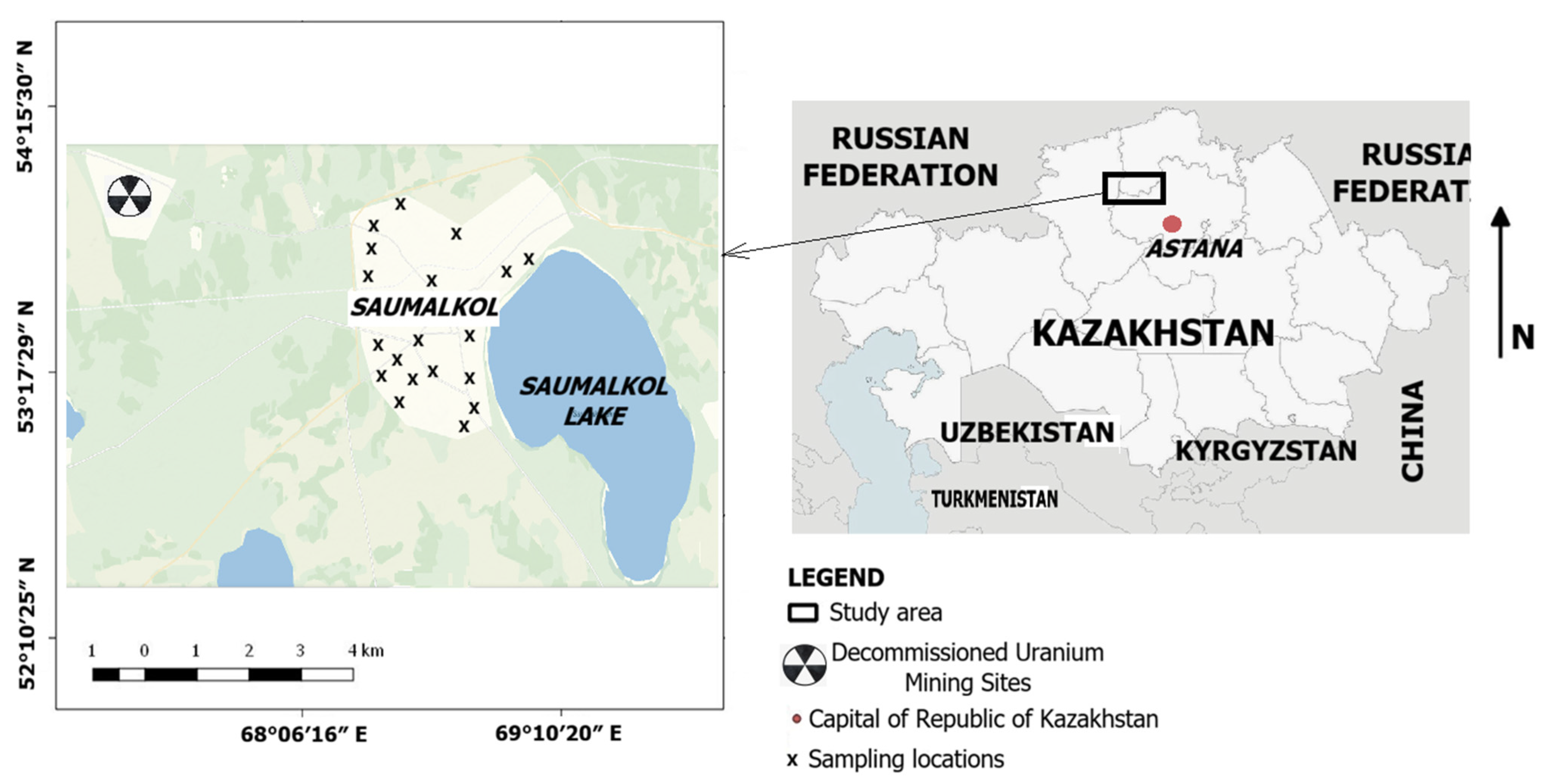
The Saumalkol settlement, located in the North Kazakhstan Region (Figure 1), represents a geographically and environmentally significant area due to its proximity to historic uranium mining operations. Its geographical coordinates are 53°17′29″ N latitude and 68°06′16″ E longitude. It lies approximately 5 km northwest of the former Mining Administration No. 5 of the Tselinny Mining and Chemical Combine (present Stepnogorsk Mining and Chemical Plant), a decommissioned uranium mining site with a legacy of radiological and geochemical influence. The settlement sits on the northwestern shore of Lake Saumalkol, which could potentially serve as a hydrological receptor for contaminants mobilized from the surrounding mining and industrial zones [12].
To the north of the settlement, near the local railway station, a construction materials quarry (specifically for crushed stone) operates adjacent to the decommissioned uranium infrastructure. While this quarry is unrelated to radioactive mining, its proximity to former uranium operations may raise concerns regarding inadvertent exposure or contamination pathways, such as dust or groundwater leaching.
Geologically, Northern Kazakhstan, including the Saumalkol area, is underlain by folded Proterozoic and Paleozoic bedrock formations. These are structurally complex zones characterized by vein-stockwork uranium mineralization and by deposits of gold, copper, zinc, lead, iron ore, and rare-earth elements. The area was historically prioritized during the Soviet era for strategic resource extraction, placing Saumalkol within a former uranium ore province that played a key role in the national nuclear fuel cycle [18].
The Saumalkol’s proximity to a decommissioned uranium mine and its position within a uranium-rich geological province place it at the intersection of public health, environmental monitoring, and post-mining land-use planning. This makes it a critical case study area for assessing water quality, radionuclide, and heavy-metal contamination in drinking water, as well as the related health risks stemming from historic mining practices [19].

2.2. Sample Collection

Groundwater samples were collected from drinking-water sources in the Saumalkol settlement. Water samples were obtained from 20 groundwater sources, including private shallow wells (4–6 m) and deep boreholes (up to 80 m). Gross alpha and gross beta activities were measured in all 20 collected groundwater samples. Radium isotope analysis (226Ra and 228Ra) was performed during a subsequent sampling campaign focused on extended radiochemical analysis. Due to limited access to some households during this second campaign and the requirement for larger sample volumes, radium measurements were conducted for 12 of the 20 sampling locations for which water could be recollected under identical conditions. Sampling was conducted during the summer and autumn of 2025, following standard groundwater sampling procedures. Samples were collected directly at points of use in pre-cleaned polyethylene containers, transported to the laboratory under cooled conditions, and analyzed without preservation for radiometric measurements.

2.3. Gross Alpha–Beta Measurements

2.3.1. Measurement Procedure

Gross alpha and gross beta activities were measured using a low-background α–β radiometer UMF-2000 (serial No. 977, NPP Doza JSC, Moscow, Russian Federation). The analytical approach is based on pre-concentration of non-volatile radionuclides by evaporation, followed by radiometric counting of the dry residue. This method is widely applied for screening-level assessment of drinking water radioactivity and is consistent with WHO recommendations for preliminary radiological evaluation [20].
The radiometer was calibrated prior to sample measurements using certified reference sources traceable to national standards, in accordance with the manufacturer’s calibration procedures described in the UMF-2000 user manual. The alpha channel was calibrated using a certified 241Am source, and the beta channel using certified 90Sr/90Y sources, under the same counting geometry as the sample measurements [21]. Periodic checks with control sources were performed to ensure calibration stability throughout the measurement campaign.

2.3.2. Sample Preparation and Measurement

A volume of 1.0 L of each water sample was evaporated at temperatures below 90 °C to avoid loss of volatile radionuclides. The evaporated residue was chemically stabilized and prepared as a solid counting source according to standard radiometric procedures [22].

2.4. Radium Isotope Analysis (226Ra and 228Ra)

Analytical Method

Radium isotopes were determined using a radiochemical separation followed by low-background α–β counting with the same UMF-2000 radiometer. The method involves selective co-precipitation of radium with barium sulfate from a 2 L water sample, preparation of a solid counting source, and delayed measurements to account for ingrowth of daughter products. This approach enables discrimination between 226Ra and 228Ra based on time-dependent alpha and beta counting rates [23].

2.5. Quality Assurance and Quality Control (QA/QC)

Quality assurance and quality control procedures were implemented throughout sampling, preparation, and measurement. Instrument calibration was verified using certified control sources before sample measurements. Laboratory blanks were processed alongside samples to assess background contributions from reagents and sample preparation; blank activities were consistently below detection limits.
Activity concentrations and minimum detectable activities (MDA) were calculated according to standard measurement methodologies for gross alpha–beta activity and radium isotopes in natural waters [23,24].
During the 1000 s measurement period, the device provided MDA of approximately 0.05 Bq/L for gross alpha activity, 0.1 Bq/L for gross beta activity, and 0.02–0.05 Bq/L for 226Ra and 228Ra, depending on counting time and background conditions [23]. For the calculation of descriptive statistics and annual effective dose, results reported as below the MDA were treated as censored data and substituted with half the corresponding MDA (MDA/2) (i.e., 0.01 Bq/L for 226Ra and 0.025 Bq/L for 228Ra), which is commonly used in environmental radioactivity datasets; using the detection limit itself as a value would overestimate the mean, median, and standard deviation [24].

2.6. Detection Limit Calculation

MDA for 226Ra and 228Ra were calculated for each measurement using the experimentally determined background count rate, counting time, detector efficiency, chemical yield, and sample volume. Background measurements were performed before and during the analytical campaign under identical counting conditions.
The detection limit was calculated using the following equation:
M D A = L D ε · Y · t · V
where L D = 2.71 + 4.65 B is the decision level (counts), B is the total background count during counting time t ( s ) , ε is the detector efficiency, Y is the chemical yield, and V is the sample volume (L).

2.7. Uncertainty Estimation

Measurement uncertainty was evaluated using standard error propagation, accounting for the main contributing components: sample and background counting statistics, detector efficiency calibration, radiochemical yield, sample volume, and mass determination, for gross alpha–beta measurements. Expanded uncertainties (k = 2) typically ranged from 10 to 20% at low activity levels to <10% for elevated activities. For radium isotope measurements, the combined relative uncertainties were generally 15–25%, reflecting additional uncertainty arising from radiochemical separation and ingrowth correction. All results are reported with 95% confidence intervals.

2.8. Estimation of the Effective Dose

The annual effective dose for radionuclides was calculated as recommended by UNSCEAR [25]:
D a d u l t s = i A i · e a g e · q a g e · f 1
where D a d u l t s is the annual effective dose for adults (mSv), A i is mean activity concentration of radium isotopes (Bq/L), e a g e is effective dose coefficient for adults (226Ra: 2.8 × 10⁻⁴ mSv/Bq; 228R: 6.9 × 10⁻⁴ mSv/Bq), f 1 is fractional absorption in the gastrointestinal tract—0.6, and q a g e is the average water intake for a person in 1-year, 730 L/year [26,27].

3. Results

3.1. Gross Alpha–Beta Results

The results of the screening analysis of gross alpha and beta activity concentrations in the investigated water samples demonstrate a pronounced variability in radiological characteristics across the study area (Table 1).
As shown in Table 1, the gross alpha activity (Aα) ranged from 0.16 to 18.7 Bq/L, with a mean of 2.26 ± 0.96 Bq/L, while the gross beta activity (Aβ) ranged from 0.06 to 3.23 Bq/L, with a mean of 0.65 ± 0.17 Bq/L. These values were evaluated against the recommended intervention levels for drinking water (0.5 Bq/L for Aα and 1.0 Bq/L for Aβ), which are widely applied as preliminary indicators of radiological safety [20]. The majority of water samples exhibited elevated gross alpha activity. Exceedance of the alpha screening level was observed in 18 out of 20 samples, indicating that alpha-emitting radionuclides are widely present in the investigated water sources. Several sampling points displayed particularly elevated activity. Sample S10 showed an exceptionally high gross alpha activity of 18.7 Bq/L, followed by S15 (6.6 Bq/L) and S2 (6.3 Bq/L). During sampling, the pH of groundwater was measured in situ and varied between 6 and 7.5, indicating near-neutral hydrochemical conditions.

3.2. Radium Concentration in Water Samples

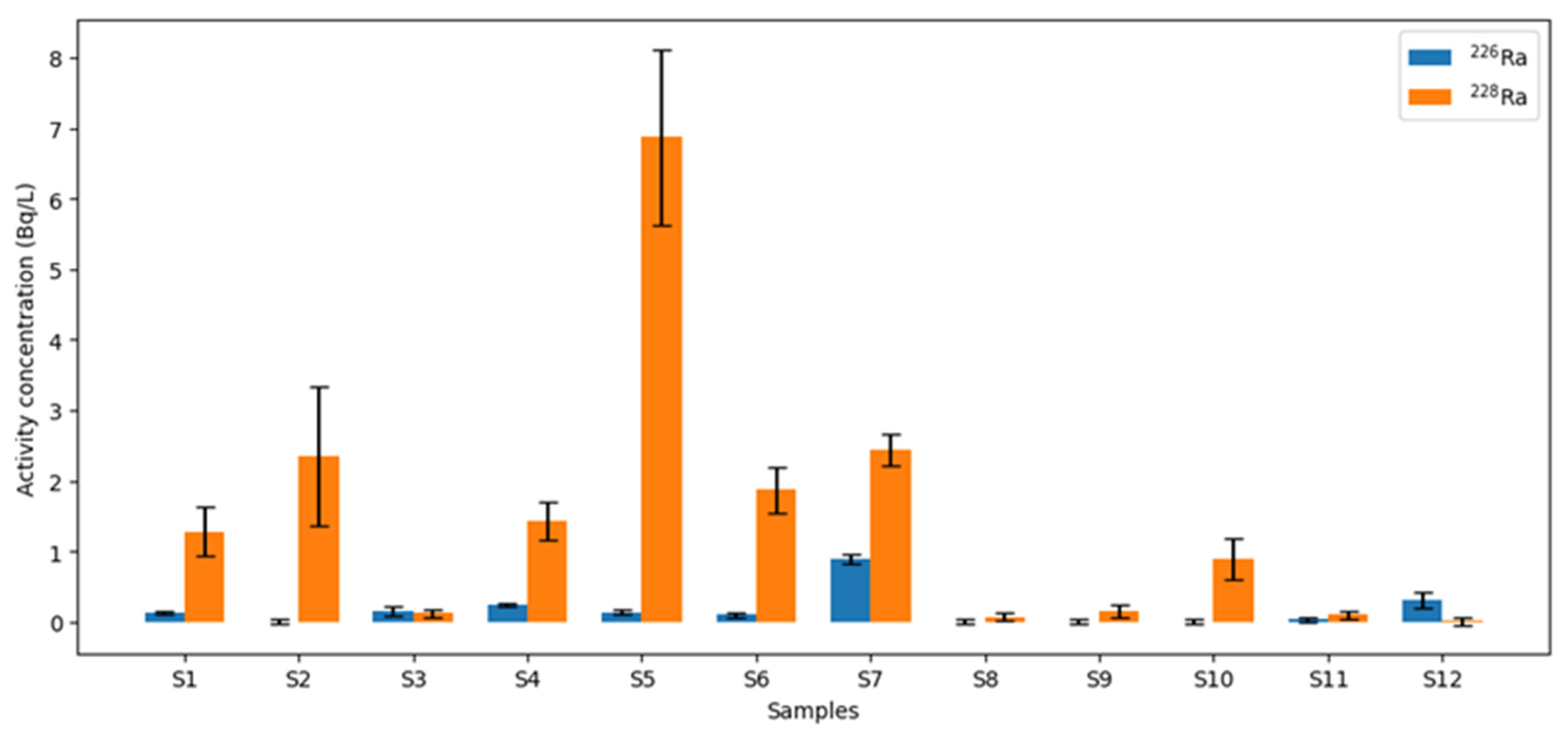
The activity concentrations of radium isotopes (226Ra and 228Ra) measured in drinking water sources demonstrate substantial spatial variability across the study area (Figure 2).
Figure 2 shows that the 226Ra concentration in most samples is low to moderate. For samples in which radium activity was below the detection limit, results are reported as <MDA, where the MDA represents the sample-specific detection limit evaluated from the measured background and counting conditions for that sample. Under the measurement conditions applied in this study, the calculated MDA values varied only slightly among samples and were typically within the range of 0.02–0.03 Bq/L for 226Ra and 0.04–0.05 Bq/L for 228Ra. The activity concentration of 226Ra in water samples ranged from <0.02 to 0.89 Bq/L, with a mean value of 0.17 Bq/L and a median of 0.12 Bq/L. The standard deviation was 0.25 Bq/L, indicating moderate variability, largely influenced by a single elevated value. The distribution of 226Ra was strongly right-skewed (skewness = 2.57) and leptokurtic (kurtosis = 7.39). Normality tests confirmed a significant deviation from normal distribution (Shapiro–Wilk W = 0.66, p < 0.001; Kolmogorov–Smirnov p = 0.002).
For 228Ra, concentrations varied from <0.05 to 6.87 Bq/L, with a mean of 1.47 Bq/L and a median of 1.09 Bq/L. The standard deviation was 1.93 Bq/L, reflecting pronounced spatial heterogeneity. The distribution was also positively skewed (skewness = 2.23) and leptokurtic (kurtosis = 5.93). Normality testing showed non-normal distribution for 228Ra as well (Shapiro–Wilk W = 0.73, p = 0.002). Because both radium isotope datasets deviated significantly from normal distribution, a non-parametric Mann–Whitney U test was applied to evaluate potential differences between shallow wells (4–6 m) and deep boreholes (up to 80 m). The comparison indicated a tendency toward higher 228Ra concentrations in deep boreholes, whereas shallow wells generally exhibited lower activities.
A weak positive correlation was observed between 226Ra and 228Ra (r = 0.39), indicating only partial association between the two isotopes. This moderate correlation suggests that although both radionuclides originate from uranium–thorium mineralization within aquifer rocks, their mobilization into groundwater is likely controlled by different hydrogeochemical processes. The calculated 228Ra/226Ra ratios ranged from 0.03 ± 0.17 to 49.1 ± 12.5. In most samples, the ratio significantly exceeded unity even after uncertainty propagation, indicating a systematic predominance of thorium-series radium.

3.3. Annual Effective Dose from Ingestion of 226Ra and 228Ra

The annual effective dose was calculated using Equation 4 based on the mean activity concentrations of 226Ra and 228Ra in drinking water. The annual effective dose from ingestion was estimated as 0.021 mSv for 226Ra and 0.44 mSv for 228Ra, resulting in a combined radium-related ingestion annual effective dose of 0.46 mSv. According to international radiological protection guidance, the reference level for committed effective dose from drinking water is 0.1 mSv [20,25]. The dose attributable to 226Ra represents only about 5% of the total radium-related ingestion dose, whereas 228Ra accounts for approximately 95%, demonstrating that thorium-series radium is the dominant contributor to internal exposure in the study area.

4. Discussions

The Saumalkol area lies within a fractured zone of Precambrian–Paleozoic metamorphic and intrusive rocks. Northern Kazakhstan belongs to a long-established uranium-bearing province, where natural uranium mineralization is widely distributed in granitoids, metamorphic rocks, and associated fracture systems [28]. Large-scale hydrogeochemical investigations of groundwater in Northern Kazakhstan have demonstrated that high concentrations of uranium and radon are controlled by aquifer lithology and water–rock interaction processes rather than mining activity. That study shows that groundwater radon activity can reach several thousand Bq/L, and uranium concentrations may exceed tens of mg/L under purely natural conditions, especially where granitoid massifs act as emanation sources and groundwater residence times are long [29].
The observed predominance of 228Ra over 226Ra reflects natural geochemical controls associated with thorium-bearing minerals in fractured aquifers. Elevated 228Ra/226Ra ratios have also been reported in other crystalline aquifer systems, where the distribution of parent radionuclides and mineralogical composition influences radium mobilization [29]. Similar patterns have been observed in fractured crystalline aquifers in the United States, where radium concentrations in groundwater typically range from 0.01 to 5 Bq/L depending on hydrochemical conditions and aquifer characteristics [30].
Although the Saumalkol settlement is located near decommissioned uranium mining infrastructure, the present dataset does not allow a definitive distinction between natural geological sources and possible technogenic inputs. Elevated radionuclide concentrations may result from natural uranium mineralization within the regional geological formations as well as from long-term water–rock interaction in fractured aquifers. Therefore, the results of this study should be interpreted primarily in the context of regional geological conditions, while the potential influence of historical mining activities cannot be conclusively demonstrated without additional hydrochemical or isotopic investigations.
The radium isotope data demonstrate substantial spatial heterogeneity and identify radium, particularly 228Ra, as a major contributor to gross alpha activity. One 226Ra sample exhibited a markedly elevated concentration of 0.89 Bq/L, suggesting that localized geochemical conditions may favor radium release from uranium-bearing minerals. Particularly elevated 228Ra activities were predominantly observed in deep boreholes, with a maximum value of 6.87 Bq/L, whereas shallow wells generally showed lower 228Ra levels. This dominance of 228Ra over 226Ra is typical of groundwater systems influenced by possible thorium-rich sediments or uranium mining residues, where sulfate-rich or alkaline conditions can preferentially mobilize radium from mineral surfaces [30].
The relationship between radium and radon provides additional insight into the sources of gross alpha activity in the Saumalkol groundwater. Previous studies conducted at the same sampling locations reported elevated concentrations of 222Rn [17]. Although radon is produced by the decay of 226Ra, high radon activity in groundwater does not necessarily require high dissolved radium concentrations. In fractured crystalline aquifers, radium often remains largely bound within mineral structures or adsorbed on mineral surfaces, while the noble gas radon generated in the rock matrix can migrate into groundwater through fractures and pore spaces. As a result, groundwater may exhibit high radon concentrations even when dissolved 226Ra activities remain relatively low. This mechanism likely explains the observed discrepancy between elevated gross alpha activity and relatively low dissolved radium concentrations in several Saumalkol samples.
Large-scale groundwater evaluations have shown that both 226Ra and 228Ra can reach or exceed ~1 Bq/L, and that their occurrence is highly variable, reflecting lithologic and geochemical controls [28]. Studies specifically investigating hydrochemical controls on Ra emphasize that depth (confined vs. unconfined), residence time, and redox/mineralization gradients can produce substantial 228Ra enrichment and high 228Ra/226Ra ratios. In mining-affected or mineralized regions, these results underscore the need to treat 228Ra as a priority radionuclide, especially when gross alpha screening values are frequently exceeded [31,32,33,34].
The annual effective dose estimated in this study was calculated using mean radium concentrations and therefore represents an average exposure scenario for the investigated groundwater sources. While the ingestion dose associated with 226Ra alone remains below the recommended reference level, the contribution of 228Ra results in a combined annual effective dose exceeding the commonly applied guideline value of 0.1 mSv. It should be noted, however, that individual wells with elevated radionuclide concentrations may lead to higher exposure for households relying on those specific water sources. Therefore, site-specific monitoring and well-level assessments are important to identify locations where potential radiation doses may exceed recommended safety levels.
From a practical perspective, reducing exposure to radionuclides in drinking water can be achieved through several treatment approaches. Technologies such as ion exchange, reverse osmosis, lime softening, and adsorption using manganese oxide–coated filters have been shown to effectively remove radium isotopes from groundwater [35,36]. In rural settlements where centralized treatment systems are unavailable, household-level water treatment units based on reverse osmosis or ion-exchange filtration may significantly reduce radionuclide concentrations in drinking water. In addition, regular monitoring of groundwater quality and identification of wells with elevated radionuclide concentrations are important measures for minimizing long-term exposure to naturally occurring radioactive materials.

5. Conclusions

This study demonstrates that groundwater used for drinking in the Saumalkol settlement exhibits systematically elevated radioactivity, which cannot be reliably assessed using screening indicators alone. Gross alpha activity ranged from 0.2 to 18.7 Bq/L, with 90% of samples exceeding the WHO screening value of 0.5 Bq/L, confirming the need for radionuclide-specific investigation under the tiered assessment framework for drinking water.
The mean activity concentrations of 226Ra are 0.17 ± 0.03 Bq/L lower than the permissive levels of 1.0 Bq/L, and 228R is 1.47 ± 0.9 Bq/L, exceeding the permissive level. The systematic predominance of 228Ra over 226Ra indicates a thorium-controlled geochemical regime typical of fractured crystalline and granitic–gneissic formations. Elevated 228Ra was most frequently observed in deep boreholes, highlighting the role of groundwater residence time and enhanced water–rock interaction in confined fracture-flow systems.
The combined radium-related effective dose from ingestion was estimated at 0.46 mSv, exceeding the commonly applied reference level of 0.1 mSv, with 228Ra accounting for approximately 95% of the dose.
These results indicate that groundwater monitoring programs in the Saumalkol area should include periodic measurements of gross alpha activity, radium isotopes (226Ra and 228Ra), and radon in drinking-water sources. Annual or seasonal monitoring of boreholes used for drinking water would allow early identification of wells with elevated radionuclide concentrations. In addition, practical risk reduction measures for residents may include the installation of household water treatment systems such as reverse osmosis or ion-exchange filters, as well as the use of alternative water sources where available. Such measures could significantly reduce long-term exposure to naturally occurring radionuclides in groundwater.
The isotope-specific assessment of radium presented in this study provides a scientific basis for improving groundwater radiological monitoring in uranium-bearing regions. The integrated evaluation of screening indicators and radionuclide-specific measurements may serve as a practical framework for groundwater surveillance in other rural settlements of Northern Kazakhstan and Central Asia.

Author Contributions

Conceptualization, M.K. and D.I.; data curation, D.I. and M.B.; formal analysis, Y.O., M.H., M.K. and D.I.; software, D.I. and Y.K.; funding acquisition, D.I.; methodology, M.B., M.K., D.I., A.S., K.I. and A.B.; writing—original draft preparation, D.I. and M.K.; investigation, D.I., Y.O., M.H. and M.K.; validation, M.K.; writing—review and editing, M.H., D.I. and M.K.; resources, D.I., M.K. and Y.K. All authors have read and agreed to the published version of the manuscript.

Funding

This research has been funded by the Science Committee of the Ministry of Education and Science of the Republic of Kazakhstan (Grant No. AP22686525) “Study radon content in groundwater and development methods reduce population exposure dose living in uranium mining area of Akmola region” (2024–2026).

Data Availability Statement

The data presented in this study are available upon request from the corresponding author, Danara Ibrayeva.

Conflicts of Interest

The authors have no relevant conflicts of interest, financial or otherwise, to disclose.

References

  1. Tetteh, A.A.; Tettey, E. Water Pollution and Public Health. In The Palgrave Handbook of Ecosystems and Wellbeing. Palgrave Studies in Sustainable Futures; Brears, R.C., Ed.; Palgrave Macmillan: Cham, Switzerland, 2025. [Google Scholar] [CrossRef]
  2. Jiang, X.; Kirsten, K.L.; Qadeer, A. Contaminants in the Water Environment: Significance from the Perspective of the Global Environment and Health. Water 2025, 17, 1257. [Google Scholar] [CrossRef]
  3. Lin, L.; Yang, H.; Xu, X. Effects of Water Pollution on Human Health and Disease Heterogeneity: A Review. Front. Environ. Sci. 2022, 10, 880246. [Google Scholar] [CrossRef]
  4. Li, P.; Karunanidhi, D.; Subramani, T.; Srinivasamoorthy, K. Sources and Consequences of Groundwater Contamination. Arch Environ Contam Toxicol. 2021, 80, 1–10. [Google Scholar] [CrossRef]
  5. U.S. Environmental Protection Agency (EPA). Radionuclide Basics: Radium. Available online: https://www.epa.gov/radiation/radionuclide-basics-radium (accessed on 28 February 2026).
  6. World Nuclear Association. Naturally Occurring Radioactive Materials (NORM). Available online: https://world-nuclear.org/information-library/safety-and-security/radiation-and-health/naturally-occurring-radioactive-materials-norm (accessed on 28 February 2026).
  7. Ahmad, S.; Jia, H.; Ashraf, A.; Yin, D.; Chen, Z.; Xu, C.; Chenyang, W.; Jia, Q.; Xiaoyue, Z.; Israr, M.; et al. Water resources and their management in Pakistan: A critical analysis on challenges and implications. Water-Energy Nexus 2023, 6, 137–150. [Google Scholar] [CrossRef]
  8. Ostoich, P.; Beltcheva, M.; Rojas, J.; Metcheva, R. Radionuclide Contamination as a Risk Factor in Terrestrial Ecosystems: Occurrence, Biological Risk, and Strategies for Remediation and Detoxification. In The Toxicity of Environmental Pollutants; IntechOpen: London, UK, 2022. [Google Scholar] [CrossRef]
  9. Elaboudi, Z.; Madinzi, A.; Saadi, R.; Laissaoui, A.; Kurniawan, T.A.; Anouzla, A.; Souabi, S. A review of radionuclides impacts and remediation techniques. Euro-Mediterr. J. Environ. Integr. 2024, 10, 1243–1259. [Google Scholar] [CrossRef]
  10. Ilbekova, K.; Ibrayeva, D.; Kazymbet, P.; Bakhtin, M.; Dogalbayev, Y. Cancer Incidence in a Population Living Near Radioactive Waste Storage of Uranium Mining in Stepnogorsk Area, Northern Kazakhstan. Asian Pac. J. Cancer Prev. 2024, 25, 2685–2693. [Google Scholar] [CrossRef]
  11. Senila, M.; Cadar, O.; Begy, R.-C.; Tanaselia, C.; Simedru, D.; Roman, C. Silver-Exchanged Clinoptilolite-Rich Natural Zeolite for Radon Removal from Air. Materials 2025, 18, 1465. [Google Scholar] [CrossRef]
  12. Severinenko, M.; Solodukhin, V.; Lennik, S.; Kabirova, G.; Zheltovb, D.; Bychenko, A. Water Elemental Composition and Toxicity in Kazakhstan’s Transboundary Rivers. Cent. Asian J. Water Res. 2023, 9, 19–32. [Google Scholar] [CrossRef]
  13. World Nuclear Association. Uranium and Nuclear Power in Kazakhstan. Available online: https://world-nuclear.org/information-library/country-profiles/countries-g-n/kazakhstan (accessed on 28 February 2026).
  14. International Atomic Energy Agency (IAEA). Environmental Remediation of Former Uranium Production Sites. Available online: https://www.iaea.org/newscenter/news/cleaning-up-a-toxic-legacy-environmental-remediation-of-former-uranium-production-sites (accessed on 7 March 2026).
  15. Ibrayeva, D.; Bakhtin, M.; Aumalikova, M.; Kashkinbayev, Y.; Kazymbet, P.; Masaharu, H.; Sakaguchi, A. Preliminary studies of the water contamination in settlements located near the uranium mining territory in Northern Kazakhstan. Environ. Sci. Pollut. Res. Int. 2025, 32, 11242–11250. [Google Scholar] [CrossRef] [PubMed]
  16. Ibrayeva, D.S.; Aumalikova, M.N.; Ilbekova, K.B.; Bakhtin, M.; Kazymbet, P.K.; Ibrayeva, S.S.; Zhumadilov, K.h. Assessment of radiation exposure in the settlements located in Stepnogorsk area. Eurasian J. Phys. Funct. Mater. 2021, 5, 52–63. [Google Scholar] [CrossRef]
  17. Ibrayeva, D.; Bakhtin, M. Assessment of Radon Concentration in Groundwater and Ingestion Dose in Settlements Located Near Uranium Mining-Affected Areas. Water Air Soil Pollut. 2025, 236, 657. [Google Scholar] [CrossRef]
  18. Kostanay Regional University. Available online: https://environmental-assessment.ksu.edu.kz/database/grachevskoe/location (accessed on 20 December 2025).
  19. Aumalikova, M.; Ibrayeva, D.; Bizhanova, D.; Kusherbayev, N.; Kairullova, M.; Kazhiyakhmetova, B.; Shokabayeva, A.; Ilbekova, K.; Bakhtin, M. Radon exposure in residential premises and basements in settlement of Northern Kazakhstan: A case study near a dormant uranium mine. J. Radioanal. Nucl. Chem. 2025, 334, 7719–7726. [Google Scholar] [CrossRef]
  20. World Health Organization. Guidelines for Drinking-Water Quality: Fourth Edition Incorporating the First and Second Addenda; WHO: Geneva, Switzerland, 2022. [Google Scholar]
  21. NPP DOZA JSC. UMF-2000 Low-Background Alpha–Beta Radiometer: User Manual; NPP DOZA JSC: Moscow, Russia; Available online: https://www.doza.ru/docs/eng/UMF_2000_UserManual.pdf (accessed on 27 February 2026).
  22. Republic of Kazakhstan. Total Activity of Alpha- and Beta-Emitting Radionuclides in Natural Waters; Measurement methods №KZ.07.00.01080-2010; Electronic Register of Technical Regulation and Metrology (e-KTRM): Astana, Kazakhstan, 2010. [Google Scholar]
  23. Republic of Kazakhstan. Methodology for Measuring the Volumetric Activity of Radium Isotopes (226Ra, 228Ra) in Natural Water Samples with Mineralization up to 5 mg/dm3 Using the Alpha-Beta Radiometric Method with Radiochemical Preparation; Measurement methods №KZ.07.00.01508-2017; Electronic Register of Technical Regulation and Metrology (e-KTRM): Astana, Kazakhstan, 2017. [Google Scholar]
  24. Wood, M.D.; Beresford, N.A.; Copplestone, D. Limit of detection values in data analysis: Do they matter? Radioprotection 2011, 46, S85–S90. [Google Scholar] [CrossRef]
  25. UNSCEAR. Attachment C-13: Methodology for the Assessment of Dose from External Exposure and Inhalation of Radioactive Material; UN Publications: New York, NY, USA, 2015. [Google Scholar]
  26. International Commission on Radiological Protection ICRP. Compendium of Dose Coefficients Based on ICRP Publication 60; ICRP Publication 119: London, UK, 2012. [Google Scholar]
  27. International Commission on Radiological Protection (ICRP). Occupational Intakes of Radionuclides: Part 3; ICRP Publication 137; Ann. ICRP: London, UK, 2017; Volume 46, pp. 1–486. [Google Scholar]
  28. Available online: https://asgidrogeo.kz/blogs/novostnye-sobytiya/gidrogeologicheskie-struktury-podzemnyh-vod-kazahstana (accessed on 21 January 2026).
  29. Medeshova, N.; Novikov, D.; Zhinak, K.; Makyzhanova, A.; Zapparov, M.; Orynbek, A.; Dultsev, F. Uranium in the groundwaters of the Republic of Kazakhstan. Groundw. Sustain. Dev. 2025, 31, 101527. [Google Scholar] [CrossRef]
  30. Diego-Feliu, M.; Rodellas, V.; Saaltink, M.W.; Alorda-Kleinglass, A.; Goyetche, T.; Martínez-Pérez, L.; Folch, A.; Garcia-Orellana, J. New Perspectives on the Use of 224Ra/228Ra and 222Rn/226Ra Activity Ratios in Groundwater Studies. J. Hydrol. 2021, 596, 126043. [Google Scholar] [CrossRef]
  31. Hwang, J.; Lee, J.; Viaroli, S. Occurrence and geochemistry of altered radioactive accessory minerals as sources of radionuclide in Mesozoic granite aquifers (Korea). Chemosphere 2024, 359, 142326. [Google Scholar] [CrossRef] [PubMed]
  32. Novikov, D.A.; Dultsev, F.F.; Pyryaev, A.N.; Khvashchevskaya, A.A.; Derkachev, A.S.; Chernykh, A.V. Natural Radionuclides and Geochemical Features of Siberian Waters: The Case of the Novobibeyevo Hydro-Radon Occurrence. Appl. Radiat. Isot. 2025, 223, 111852. [Google Scholar] [CrossRef]
  33. Nikitenkov, A.N.; Novikov, D.A.; Korneeva, T.V.; Dultsev, F.F. Numerical Physicochemical Modeling of the Geochemical Behavior of Uranium and Thorium in Radon Waters of Southern Siberia. Aquat. Geochem. 2025, 31, 6. [Google Scholar] [CrossRef]
  34. Faraj, T.; Ragab, A.; El Alfy, M. Geochemical and hydrogeological factors influencing high levels of radium contamination in groundwater in arid regions. Environ. Res. 2020, 184, 109303. [Google Scholar] [CrossRef]
  35. Al-Shomali, Z.; Pereira, A.; Marques, A.C.; Dinis, M.d.L. State-of-the-Art Review on Removal of Naturally Occurring Radioactive Materials in Water. Int. J. Environ. Res. Public Health 2025, 22, 727. [Google Scholar] [CrossRef]
  36. Nikitenkov, A.N.; Novikov, D.A.; Korneeva, T.V. Forms of migration of chemical elements in radon waters in the south of Siberia. Geol. Miner. Resour. Sib. 2023, 2, 81–90. (In Russian) [Google Scholar] [CrossRef]
Figure 1. Map of sampling locations.
Environments 13 00161 g001
Figure 2. Results of radium concentration in water samples, Bq/L.
Environments 13 00161 g002
Table 1. Results of gross specific activity of alpha-beta radionuclides in water samples, Bq/L.
No.Sample NameAαAβpHNo.Sample NameAαAβpH
1S1 **1.40.2711S11 *0.90.36
2S2 **6.32.07.512S12 **0.70.17.3
3S3 **1.30.47.313S13 *0.30.46.2
4S4 **0.61.07.114S14 *0.80.16
5S5 **0.60.47.415S15 **6.63.27.1
6S6 **0.60.47.216S16 **0.40.27
7S7 **2.41.0717S17 *0.60.36.3
8S8 **1.60.57.318S18 **0.20.27.2
9S9 **0.60.57.119S19 **0.20.37.4
10S10 **18.71.17.220S20 **0.70.57.1
*—Shallow wells (4–6 m depth); **—Boreholes (up to 80 m depth).
Disclaimer/Publisher’s Note: The statements, opinions and data contained in all publications are solely those of the individual author(s) and contributor(s) and not of MDPI and/or the editor(s). MDPI and/or the editor(s) disclaim responsibility for any injury to people or property resulting from any ideas, methods, instructions or products referred to in the content.