


Abstract
Solar photovoltaic (PV) systems can provide a clean and sustainable alternative to fossil fuel energy, but the uptake of solar PV systems is often constrained by perceived and actual barriers. Despite South Africa’s very high solar generation potential, solar PV adoption remains low, accounting for less than 10% of the country’s energy mix. Central to renewable energy debates is making sure that the transition is equitable, affordable, and inclusive. Yet, despite high levels of inequality, there is no empirical standing on the factors hindering solar PV adoption among a socially differentiated household gradient. Using household interviews, the study investigated barriers to solar PV adoption across an income gradient in four towns located in the Eastern Cape province of South Africa. Results showed that significantly more high-income (82%) than low-income (63%) households had considered solar PV adoption, primarily to mitigate power cuts (89%). Both income groups were constrained by financial, institutional, and social barriers, but low-income households were disproportionately affected. While 86% of high-income households cited initial financial constraints, low-income households were nearly twice as likely to worry about high maintenance costs (48% vs. 26%) and system unfamiliarity (36% vs. 14%). High-income respondents were more concerned with institutional and technical barriers, such as a lack of supportive policies and grid-feed difficulties. Nearly all (98%) low-income households lacked knowledge regarding solar PV system capacity, compared to 60% for high-income households. Altogether, the results highlight that heterogeneity matters in our understanding of barriers to solar PV adoption and should be a key consideration in designing differentiated approaches to address barriers and ensure equity in renewable energy adoption.
1. Introduction
The global shift to renewable energy is gaining traction rapidly, mostly driven by high energy costs [1,2,3,4], environmental costs of fossil fuels, including land and air pollution [5,6], and the moral responsibility to reduce human impact responsible for global warming and climate change [7,8]. Among renewable energy sources, solar photovoltaic (PV) systems have experienced significant growth globally, increasing over 30 times between 2010 (31 TWh) and 2021 (1000 TWh) [9]. In this study, solar PV systems refer to Solar Home Systems (SHSs) comprising solar panels, inverters, and batteries, designed to supply electricity for basic household needs and Solar Water Geysers (SWGs); the latter are critical as they offset approximately 49% of households’ energy bills [7]. A key discussion point in renewable energy debates and practice is a “just transition” based on principles of equity and inclusiveness [10,11,12]. However, the achievement of equity requires an understanding of barriers encountered or perceived by different household groups, particularly in contexts characterised by high levels of social inequality. While there is increased research on barriers to renewable energy adoption [13,14], research on the specific types and extent of barriers across various household groups is comparatively scarce, especially in developing countries such as South Africa [13,15,16], Pakistan [17,18], and India [19,20]. Such research is important, especially in countries with high levels of inequality, such as the BRICS bloc countries (Brazil, Russia, India, China, and South Africa) [21]. In South Africa, previous studies have focused on financial, institutional, technical, social, and cognitive barriers in homogenous income groups [13], and not across an income gradient. For instance, ref. [22] have investigated barriers to solar PV adoption among middle-income households only, whilst [13] focused on the low-income only.
South Africa is one of the biggest emitters of carbon dioxide in the world and is under intense pressure to minimise its energy-related carbon emissions from coal, which generates more than 77% of the country’s energy [23]. To address this, the country is embracing renewable energy sources, including solar PV. For instance, the South African government rolled out Solar Water Geysers (SWGs) among selected low-income households in a bid to minimise dependence on the national grid, reduce energy poverty, and improve the quality of lives [24]. This initiative underscores the government’s recognition of SWGs as a key technology for domestic energy independence and demand reduction, particularly in the residential sector, where water heating is a significant energy load. Further, the government offered tax rebates of up to 25% of the total cost of the solar panels for all installations done as of March 2023 [25]. Further, despite the potential for solar PV energy generation (4.5–6.5 kWh/m2 per day and approximately 2500 sunlight hours per year [26] and declining solar PV costs, adoption of solar PV systems remains low among households due to multi-dimensional challenges [27,28]. It is estimated that solar PV systems contributed less than 5% to the country’s energy mix and had been adopted by only 10% of households [28,29], though these figures might have improved in the last few years.
Although barriers to solar PV adoption are widely documented, the literature increasingly recognises that barriers are dynamic and highly context-dependent, requiring continual reassessment as energy systems evolve [30]. In South Africa, grid instability and rising electricity costs are reshaping household energy decision-making, and solar PV is no longer just a backup option, but increasingly a primary source of energy. The scholarly contribution of this study lies in its theoretically grounded, income-differentiated analysis of solar PV adoption barriers in South Africa using the Theory of Planned Behaviour (TPB). While prior research has explored renewable energy uptake, few have applied TPB to unpack household-level barriers in a structurally unequal emerging economy like South Africa, where household sectors vary starkly by income. This paper advances the field by systematically examining how attitudes, subjective norms, and perceived behavioural control shape adoption intentions across low- and high-income groups. Key research questions included: (i) what are the main barriers to solar PV adoption, and (ii) how do they vary by income group?
Literature Review
Barriers are obstacles preventing intended actions, such as adopting solar PV [31]. Financial barriers include high start-up costs and a lack of standardised pricing, as reported in Japan [32], Pakistan [17,18,19], and Germany [33]. Other financial barriers relate to the lack of credit facilities among potential solar PV adopters [31,34]. In the USA and the Netherlands, households were often disqualified from solar loans due to poor credit scores or pre-existing debt [31,34,35]. Institutional factors, such as the absence of Feed-in Tariffs (FIT), also discourage investment [29,36,37].
Low FITs can discourage households from supplying excess solar PV energy to the grid, as the benefits are much lower than grid energy costs [38]. In Malaysia, ref. [39] found that imbalances between the price at which households sell solar PV energy to companies and the price at which these companies sell energy back to households discouraged households from adopting solar PV. Institutional barriers can disproportionately impact specific groups of people [38,40], for instance, studies conducted in the USA found that the country’s renewable energy deployment policies generally marginalise Black and Asian minority groups [41,42]. Addressing institutional barriers to energy transition can ensure that there is an equitable sharing of benefits and mitigation of the negative impacts of transitions to cleaner forms of energy between the high-income and low-income groups of society [43].
Technical barriers encompass solar PV-related technological challenges such as limited generating capacity, lack of expertise, and poor access to service parts [44,45]. For example, research conducted in Hong Kong highlighted low energy output from solar PV systems and limited rooftop space to install solar panels as key challenges to adoption [44]. For SWGs, issues like poor installation and a lack of trained technicians lead to a high failure rate [46]. Furthermore, the prevalence of low-quality components in Nigeria and India [47,48] has been reported to create a negative reputation that discourages potential adopters. For instance, Agaja et al. [47] reported poorly performing solar PV systems due to substandard materials, unreliable inverters, and degraded panels. Similar findings were also found among South Asian households, such as India and Sri-Lanka where there was widespread availability of unlabelled appliances sold at a reduced price [48]. Although these studies do not directly link low-quality components to low adoption rates among households, the connection becomes evident when early adopters experience frequent system failures and unreliable energy supply, which in turn undermines confidence and discourages wider adoption of solar PV technologies. These negative sentiments could discourage others from investing in solar PV systems. Other technical barriers relate to limited rooftop space for solar panel installation. Evidence from developed European countries, such as the United Kingdom, shows that rooftop suitability is also a challenge, with issues like limited space and roof conditions preventing households from installing solar systems [49].
Apart from technical barriers, social barriers such as theft of solar PV appliances, particularly solar panels within a community, might deter households from adopting solar PV [50,51,52]. Theft of rooftop solar panels is prevalent in less secure areas, potentially resulting in extra costs to install robust security measures. Studies in Guinea [52] and Tanzania [51], found that security concerns and vandalism increased costs and discouraged installation, especially where no legal action was taken against suspected perpetrators of these crimes.
Beyond external factors, cognitive factors can also influence people’s decisions to adopt solar PV. Cognitive factors are characteristics within a person that affect their ability to learn or behave [53], and can play a pivotal role on households’ decision-making process [54,55]. For example, lack of knowledge on solar PV systems, including how they function, is one of the most significant cognitive barriers to solar PV adoption [54,55]. For instance, studies conducted in Seychelles [54] and Bangladesh [56] have shown that insufficient information among adopters contributes to ineffective utilisation and maintenance of solar PV systems, consequently shortening their lifespan. These negative experiences, attributed to a lack of knowledge, can contribute to negative perceptions of solar PV systems, which in turn could discourage potential solar PV adopters. Some studies on transition to renewable energy have emphasised the importance of tailored information and education in facilitating successful implementation of new technologies [57,58]. This study is informed by the TPB [59], which posits that behavioural intention is shaped by attitudes toward behaviour, subjective norms, and perceived behavioural control. The TPB provides a robust analytical lens for examining household decision-making in relation to solar PV adoption, as it recognises that adoption intentions are influenced not only by personal evaluations of technology, but also by social pressures and perceived capacity to act. In this study, financial, institutional, technical, social, and cognitive barriers are conceptualised as multi-dimensional constraints that shape attitudes toward solar PV, influence normative expectations, and affect perceived behavioural control across different household groups. The TPB was selected because it better captures contextual constraints and individual agency and is particularly suitable for analysing income-related control limitations and normative pressures in unequal settings such as South Africa.
2. Materials and Methods
2.1. Study Areas
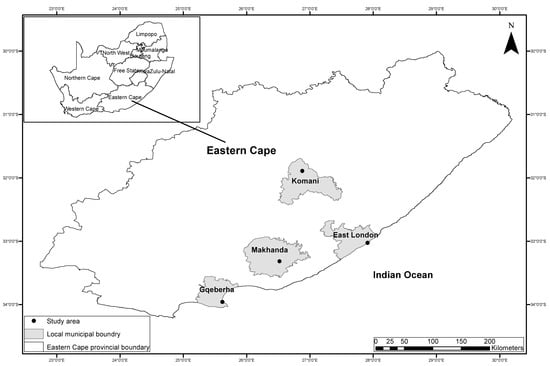
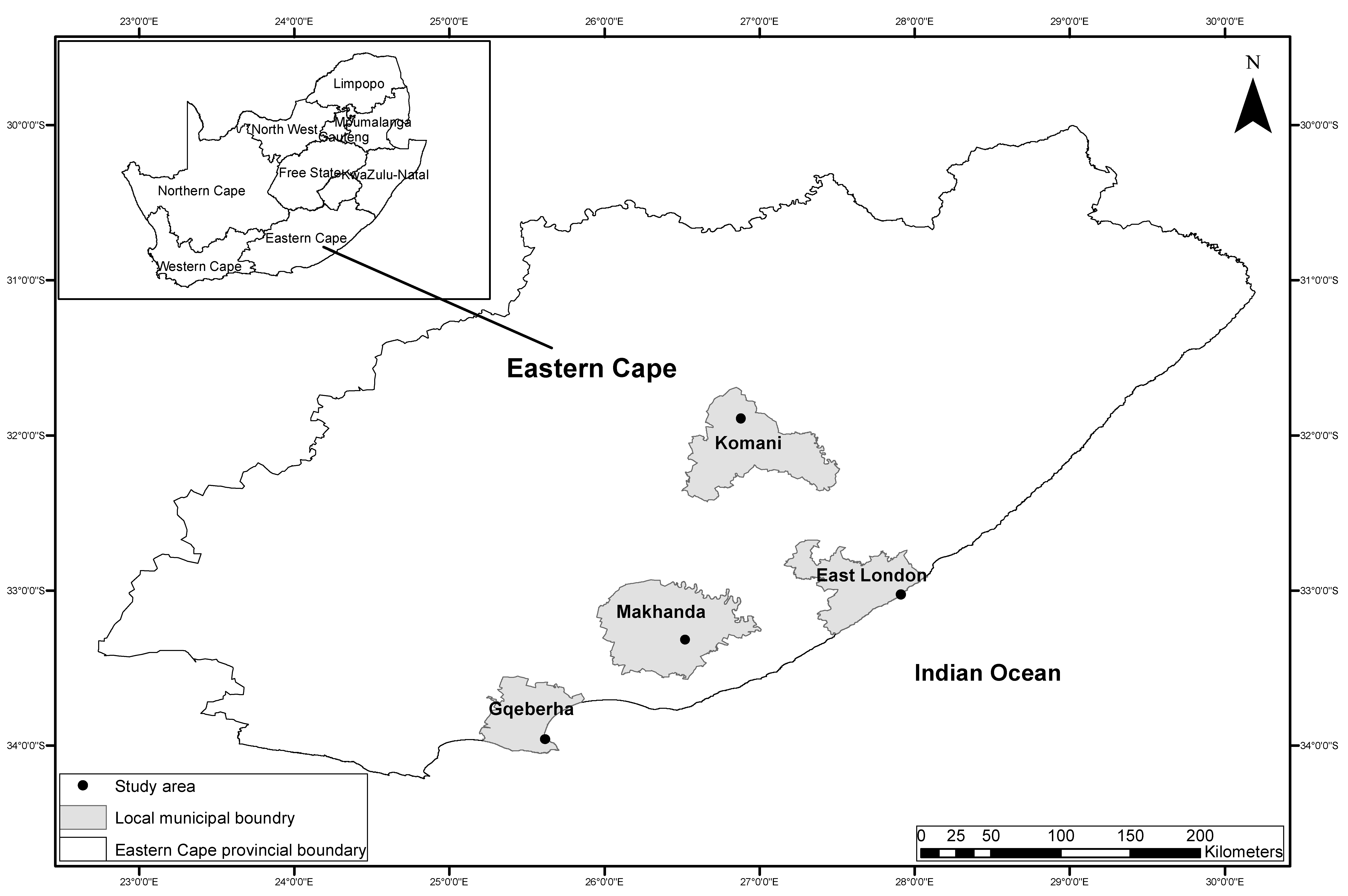
The study was conducted in four urban areas located in the Eastern Cape province of South Africa (Figure 1). The provinces’ abundant sunlight makes it an ideal location for solar PV adoption. Two of the selected cities, namely, Gqeberha (formerly Port Elizabeth) and East London, are classified as metropolises because of their exclusive and legislative authority, whereas the other two, Makhanda and Komani (formerly Grahamstown and Queenstown, respectively), are classified as big towns since their population exceeds 20,000 people. Gqeberha, East London, Komani, and Makhanda each have a population of approximately 1,312,631, 403,581, 122,365, and 75,170, respectively [60]. The four sites were purposively selected to represent a stratified cross-section of the Eastern Cape towns. This approach follows the logic of analytical generalisation [61], where sites were chosen to represent specific ‘archetypes’ rather than for statistical randomness. The inclusion of metropolitan and secondary towns accounts for variance in municipal governance and electricity demand tiers [62]. Furthermore, the coastal-inland dichotomy allows for the observation of PV adoption under distinct environmental stressors: coastal sites represent a high-humidity and high-corrosion environment, whereas inland sites represent a high-temperature and high-soiling (dust) environment [63]. Overall, the Eastern Cape is one of the poorest provinces in South Africa, characterised by low literacy levels of 20.5% and a high unemployment rate of about 42% [64]. Approximately 40% of the Eastern Cape’s population benefits from the government’s social grants scheme [64], illustrative of high poverty levels. Moreover, between 2012 and 2020, the province had one of the highest rates of free basic electricity provision (21.7% of households received 50 kWh to alleviate energy poverty) [65,66]. From 2020 to 2022, this proportion decreased to 15.5%. Consistent with most South African urban areas, the selected study towns are spatially segregated, mirroring segregation policies of the apartheid government, which separated human settlements based on race [67]. The distinction between high- and low-income households was based on location and homestead quality, serving as proxy indicators of income status, consistent with the South African literature [68,69]. These spatial arrangements, separating affluent and impoverished areas, were inherited from apartheid-era segregated spatial planning and persist today. This approach justifies the income-differentiated analysis of solar PV adoption barriers [68,69]. High-income suburbs are characterised by large houses, good educational facilities, and social services, whilst low-income households tend to have small houses built on small residential units. In addition, a sizeable proportion of low-income households live in Reconstruction and Development Programme (RDP) houses built by the government for the poor. Low-income areas are typically characterised by high levels of illiteracy and general municipal poor service delivery [60]. Low-income areas are often marked by high illiteracy levels, inconsistent water supply, poor waste disposal, and inadequate municipal services [64,70].
Figure 1.
Location of the four study cities and towns in Eastern Cape Province of South Africa.
2.2. Study Design
Data collection for this research was carried out between November 2022 and February 2023 in the above-mentioned four towns. The towns were purposively selected based on their population size and location to gather a wide range of solar PV adoption views across different urban areas that are in different environmental conditions. Within each of the four selected towns, non-solar PV adopters were selected across high-income and low-income suburbs. Each of the high- and low-income group was randomly selected per study town, and randomisation was achieved by (i) identifying, using google earth, and listing all the suburbs in the urban area, (ii) assigning numbers to all the identified suburbs, and (iii) using the excel RANDBETWEEN function to select one sampling suburb per income group and per town, following [70]. After the selection of suburbs, a random selection of target households was conducted. To achieve that, sampling streets were selected randomly using the above-described random selection procedure. Once the streets were selected, the first house on the street was targeted for interviews; thereafter, a systematic sampling selection was adopted where every fifth household was interviewed. In cases where respondents from the selected household were not available or willing to participate, the next available household was selected. The interviews targeted household heads, and in the absence of the household head, the eldest member of the household present. The questionnaires targeted 20 high-income and 20 low-income households in each study town (160 households in total), thus offering a big sample size for comparisons and statistical rigour. However, due to security concerns (i.e., the fear of violent crime such as theft and robbery), especially among high-income households, it was difficult to access some households, and the study ended up with 49 high-income participants and 94 low-income participants. Prior to conducting the study, ethics approval was secured through the Rhodes University Ethics Committee (Review reference number 2022-5895-7199).
2.3. Data Collection
The selected households from the four study towns were interviewed via household questionnaire surveys administered to non-adopter households. The design of the questionnaire was theoretically informed by the TPB, which guided the operationalisation of adoption intention, perceived behavioural control, subjective norms, and attitudinal constructs related to solar PV adoption. The questionnaires were administered in the preferred language of the respondents, either English or IsiXhosa, with the help of a translator for the latter. The interview questionnaires were piloted with Makhanda community members to assess their length, relevance, and clarity. The questionnaire was divided into four sections. The first section gathered information on the respondents’ perceptions of solar PV adoption, including the intention to adopt solar PV and perceived benefits and risks. The intentions to adopt solar PV were assessed by asking households questions such as “Have you ever considered adopting solar PV energy for your home, and if so, give reasons?”, with Yes or No, followed by a reason for the given response. To evaluate the perceived risks and benefits of adopting solar PV, households were asked to indicate their agreement with various predetermined statements such as: “I would worry about having solar energy because it would be expensive to maintain” and “Solar energy helps slow down climate change” with responses on a 5-point Lickert scale ranging from “Strongly agree” to “Strongly disagree”.
The second section of the questionnaire was designed to collect information on financial, technical, institutional, and cognitive barriers to solar PV adoption. Information on financial barriers was collected by asking respondents to indicate their agreement with various predetermined statements, such as, “I would worry about having solar PV energy because they would be expensive to maintain”. Similarly, information on technical barriers was collected by asking respondents to indicate their level of agreement with questions such as: “I would worry about having solar energy because I do not have rooftop space to install it”. To collect information on institutional barriers, respondents were asked questions such as: “Do you feel that the government (favourable policy instruments) might support your decision to purchase solar for your household?”, with respondents choosing either Yes or No, followed by a reason for the given response. The third section of the questionnaire collected the respondents’ profiles, including age, gender, education level, income, home language, and household size. Combined, these constructs and items were adapted from established renewable energy adoption literature informed by the Theory of Planned Behaviour, as well as empirical studies on solar PV systems [59,71]. Internal consistency of the 13 Likert-scale items was assessed using Cronbach’s alpha (α = 0.67; standardized α = 0.71), indicating acceptable reliability for exploratory social science research, and the items were subsequently combined to construct composite indices for analysis. Variables were analysed according to their measurement levels, with binary, ordinal, and continuous variables informing the selection of appropriate parametric or non-parametric statistical tests, following standard practice in energy adoption research [72].
2.4. Data Analyses
Data were analysed using descriptive and inferential statistics. Statistica version 14.0 was used for all inferential statistics (TIBCO Software Inc., Palo Alto, CA, USA, 2020). Tables and proportions were used to summarise the socio-demographic data. Numeric demographic data, such as mean household size and average age of respondents, were analysed using a T-test to compare differences between high-income and low-income households. Interview responses were transcribed and analysed through thematic analysis to extract key insights following [73]. The first stage involved data capturing and familiarisation, and the generation of initial codes, followed by the organisation of identified codes into potential themes. The next stage involved reviewing and refining potential themes, eliminating those lacking supporting data, and breaking down overly broad ones. The final stage involved naming and defining the themes to capture their essence.
There are potential limitations in this study. First, purposive selection of the study towns and a convenience sampling strategy employed following failure to obtain randomly selected households might result in sample-selection bias, making it difficult to generalise the findings. However, given that the sample was stratified by income group, it is not expected that the sampling approach would have missed important dynamics relating to differentiation. Further, the goal of the study was not to generalise findings, but to generate transferable insights on barriers to solar PV adoption in the Eastern Cape.
2.5. Limitations
The study yielded 143 valid household responses, slightly below the planned sample of 160 due to non-responses and incomplete questionnaires. High-income households were particularly underrepresented, due to security concerns and time constraints. While this raises the possibility of non-response bias, the qualitative design prioritises contextual depth over statistical generalisation [74]. Qualitative approaches are widely used in social science and energy studies to explore lived experiences, perceptions, and barriers to technology adoption [61,75,76].
Because the analysis was qualitative and relied on thematic analysis, the study did not rely on proportional statistical comparisons across income groups, thereby reducing the risk of bias arising from unequal representation [77,78]. Thematic analysis in qualitative research emphasises emergent patterns from rich data rather than population-level inferences, allowing skewed samples to still yield credible insights when saturation is achieved [79,80]. To further minimise potential bias, the study included four geographically diverse study areas. Following the principle of information power, smaller samples can yield robust insights when data are rich and theoretically grounded [81,82]. Nevertheless, future research should employ more targeted recruitment strategies to engage less responsive groups, particularly high-income households.
2.6. The Socio-Demographic Profile of Respondents
Across all the study towns, the number of male (51%) and female (49%) respondents was evenly distributed among high-income households, but not for the low-income households, which had high female (64%) representation. The uneven distribution by gender in low-income households could be because females in the sampled urban areas are generally unemployed, self-employed, or working from home [64]. The mean household size for high-income households (3.4 ± 1.5) was significantly lower than that of low-income households (5 ± 2.6) (t = 3.811; p = 0.001). Across all sampled study towns, the average age of respondents was significantly higher for high-income households (52 ± 15) than low-income households (46 ± 14; t = 2.138; p = 0.034). Among high-income households, the level of education was generally high, with the majority (88%) having attained tertiary-level education. In contrast, most of the low-income households (86%) had only secondary level education. About half (50%) of the high-income households were formally employed, reporting a monthly income of more than ZAR30,000.00 (US$1565.67), whilst most of the low-income households (65%) were dependent on the government’s social grants. Social grants are provided to low-income households to reduce poverty as part of the government’s broader social welfare mechanisms [60]. Among the few low-income respondents who were formally employed, most of them received a monthly income of less than ZAR6000.00 (US$313.14), indicative of low-income status. About two-thirds (66%) of the respondents across all income groups had stayed in the study areas for more than 20 years.
3. Results
3.1. Respondents’ Perceptions of Solar PV Energy
More than half of the respondents in both income groups reported that they had considered solar PV adoption, but significantly more high-income (82%) than low-income (63%) households reported so (χ2 = 15.359, p = 0.004). Most respondents said they had seriously considered solar PV adoption in the past 2 years, and similarly, with significantly more high-income (76%) than low-income (50%) households (2021–2023) (χ2 = 6.614, p = 0.010). The main reason for solar PV consideration reported by 89% the majority of all households was to find an alternative source of energy to deal with persistent power cuts.
When asked about the perceived benefits of solar PV adoption, nearly all (98%) of the respondents cited alleviation of power outages. However, about 8% of high-income households viewed alternatives like diesel generators and storage batteries as more cost-effective than solar PV systems, whilst 92% viewed solar PV as cheaper in the long run. In contrast, most low-income households considered solar PV to be a cheaper option because they believed it was provided by the government. Further, significantly more low-income (89%) than high-income (64%) households felt solar PV systems provided a cost-effective alternative to grid energy (χ2 = 14.215, p = 0.003). A nearly similar proportion of both high-income (79%) and low-income (82%) households either strongly agreed or agreed that solar PV could help slow down climate change.
3.2. Reported Barriers to Solar PV System Adoption
3.2.1. Financial Barriers
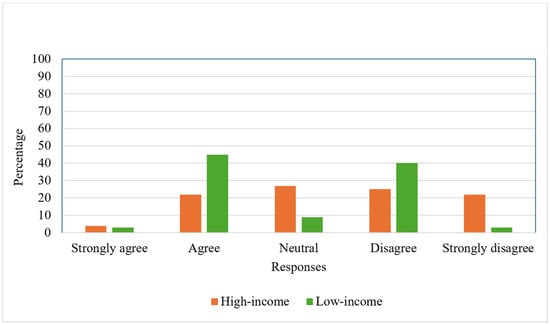
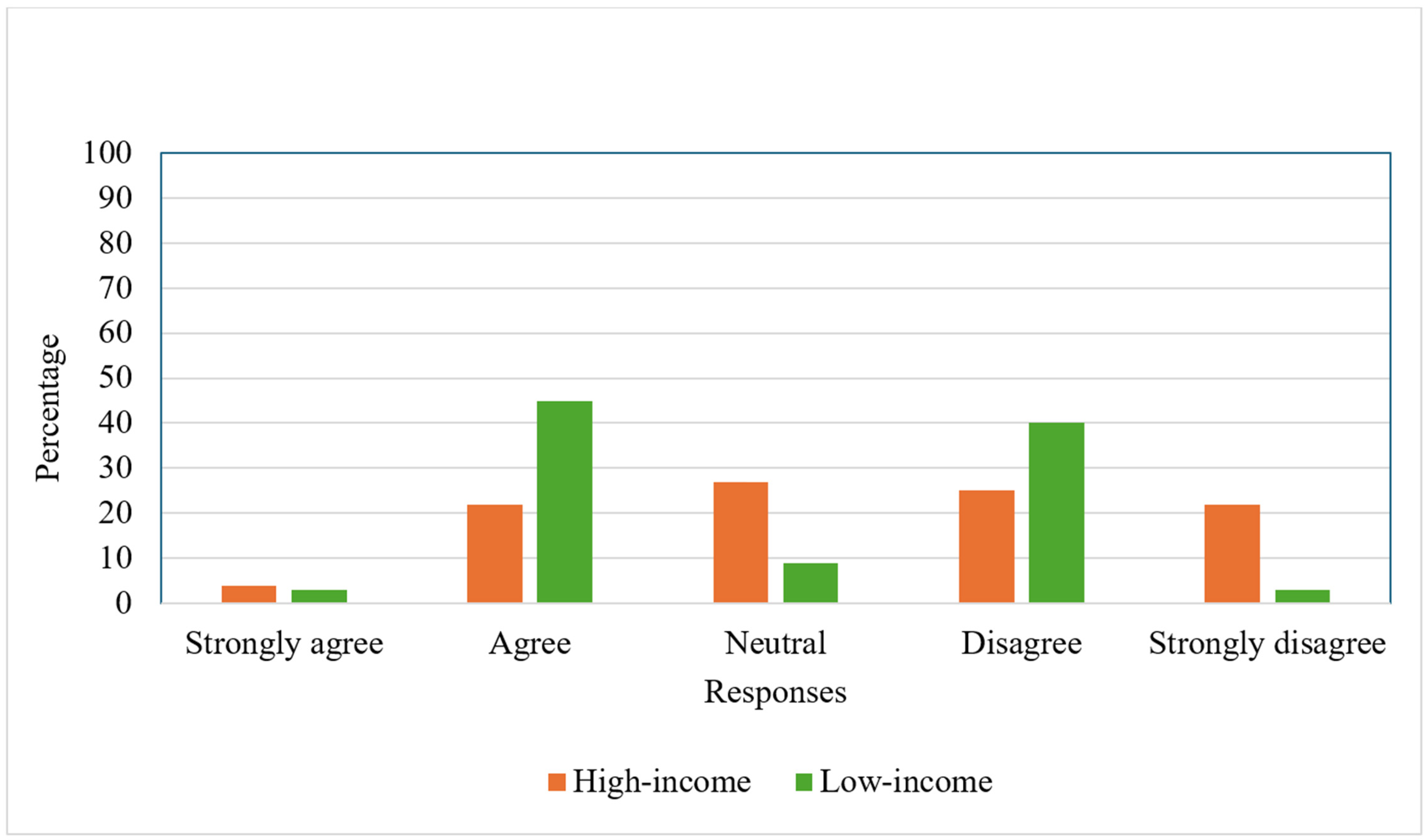
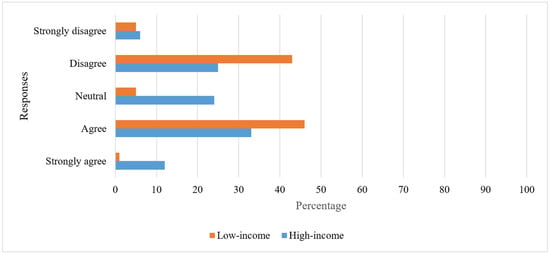
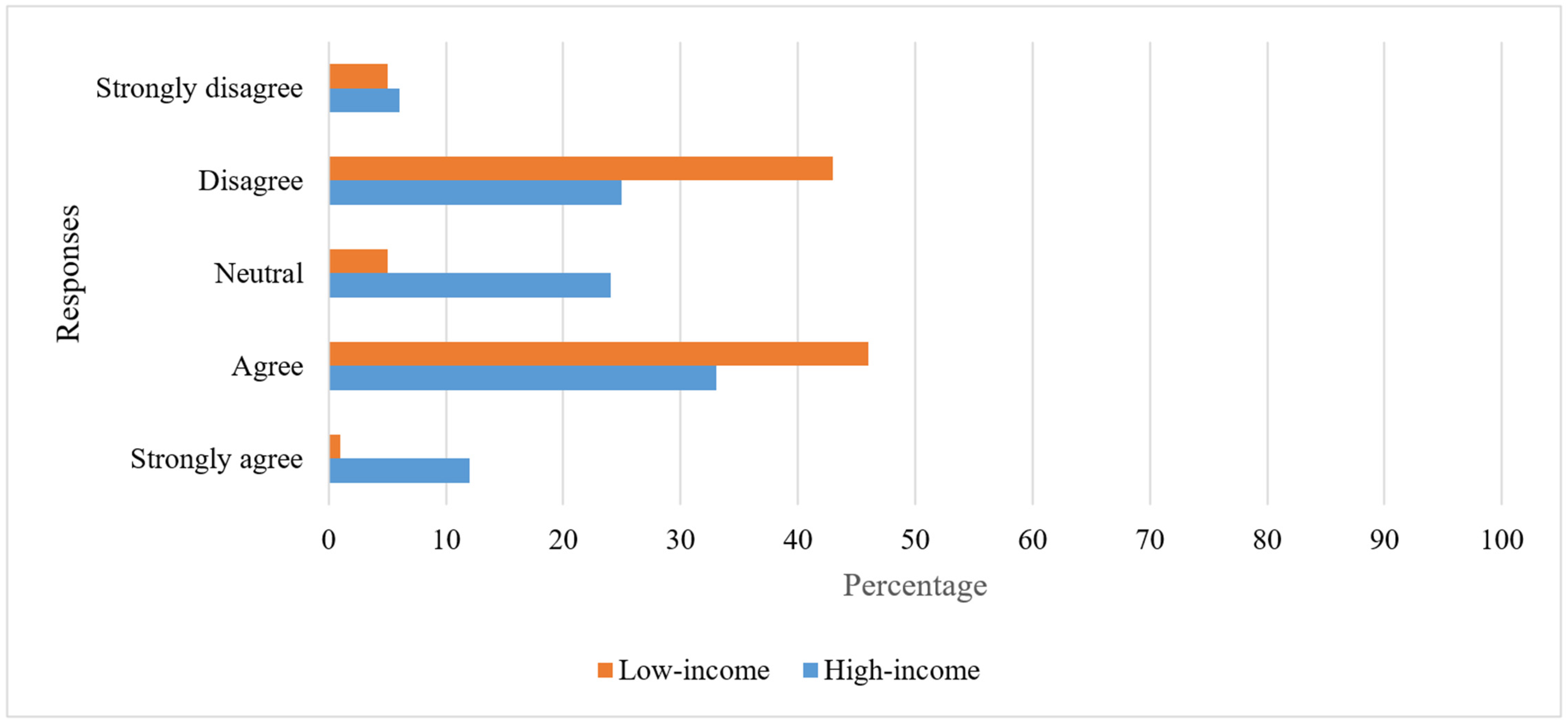
A significantly higher proportion of high-income households (86%) than low-income households (58%) reported financial constraints as a barrier to solar PV adoption (χ2 = 27.519, p = 0.001). In contrast, perceptions of solar PV system maintenance costs differed markedly by income group, with nearly twice as many low-income households (48%) as high-income households (26%) indicating that maintenance costs were excessively high (χ2 = 26.031, p = 0.001) (Figure 2). Reported maintenance-related cost concerns included expenses associated with battery replacement, inverter repairs or replacement, panel damage or replacement, wiring and balance-of-system components, and technician servicing costs. These differences indicate statistically significant variation in the types of financial barriers perceived by households across income categories.
Figure 2.
Perceived maintenance cost of residential solar PV systems.
3.2.2. Technical Barriers
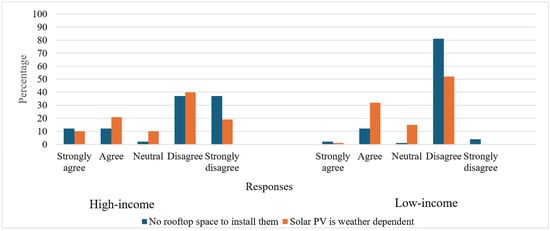
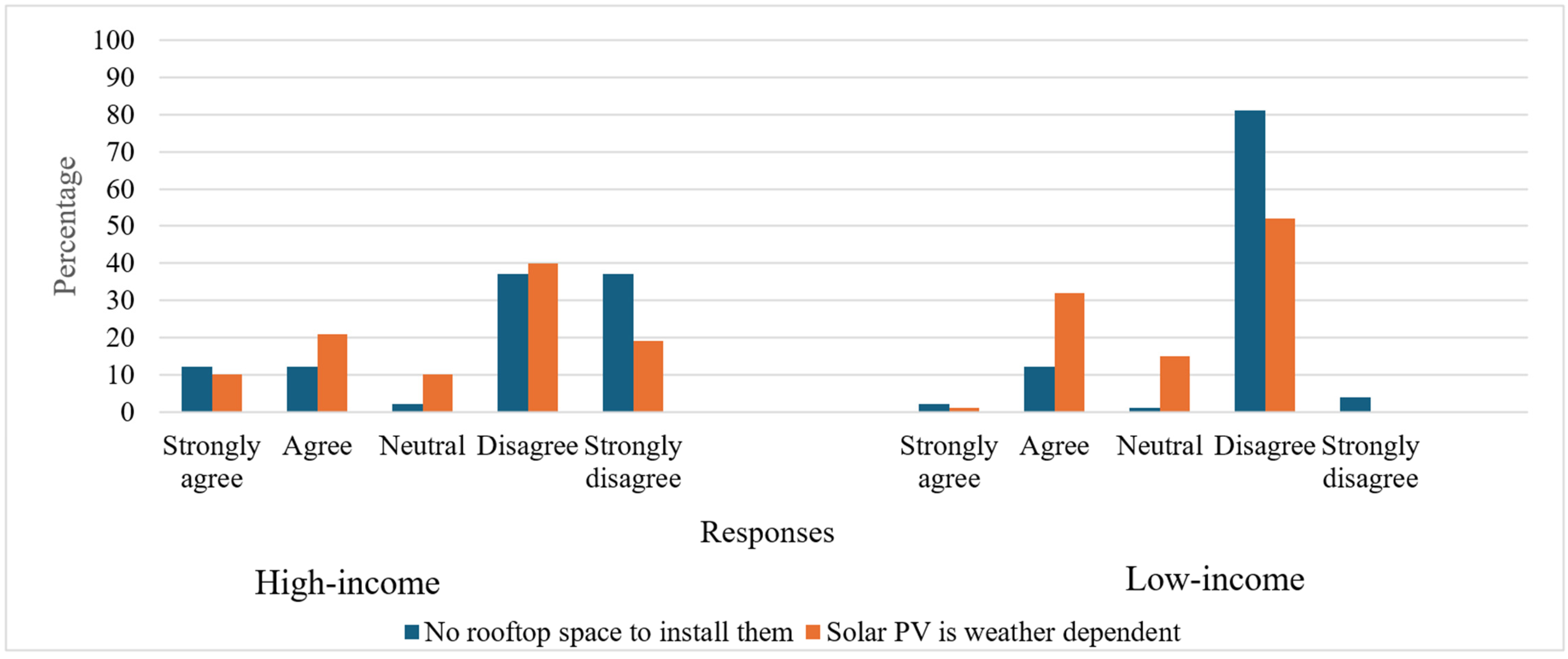
A nearly similar proportion of high-income (31%) and low-income (33%) households expressed concerns about the weather dependency of solar PV systems (Figure 3), stating solar PV systems were unreliable during dusty, wet, and adverse weather conditions. Perceived negative impacts on the aesthetic appeal of houses were also highlighted by only a handful of respondents. Rooftop space was reported by relatively few households across the sample, but significantly more high-income households (24%) than low-income households reported so (14%) (χ2 =37.744, p = 0.001).
Figure 3.
Perceived technical barriers to solar adoption among households.
3.2.3. Social Barriers
Concerns regarding the security of solar PV panels were common across the sample. More than half of all respondents reported being worried about the potential theft of solar PV panels. This concern was slightly more prevalent among high-income households (60%) than low-income households (52%), as illustrated in Figure 4.
Figure 4.
Perceived social barriers to solar adoption among households.
3.2.4. Institutional Barriers
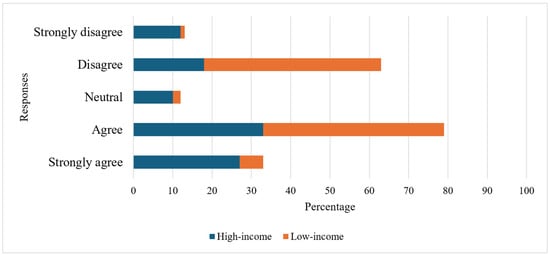
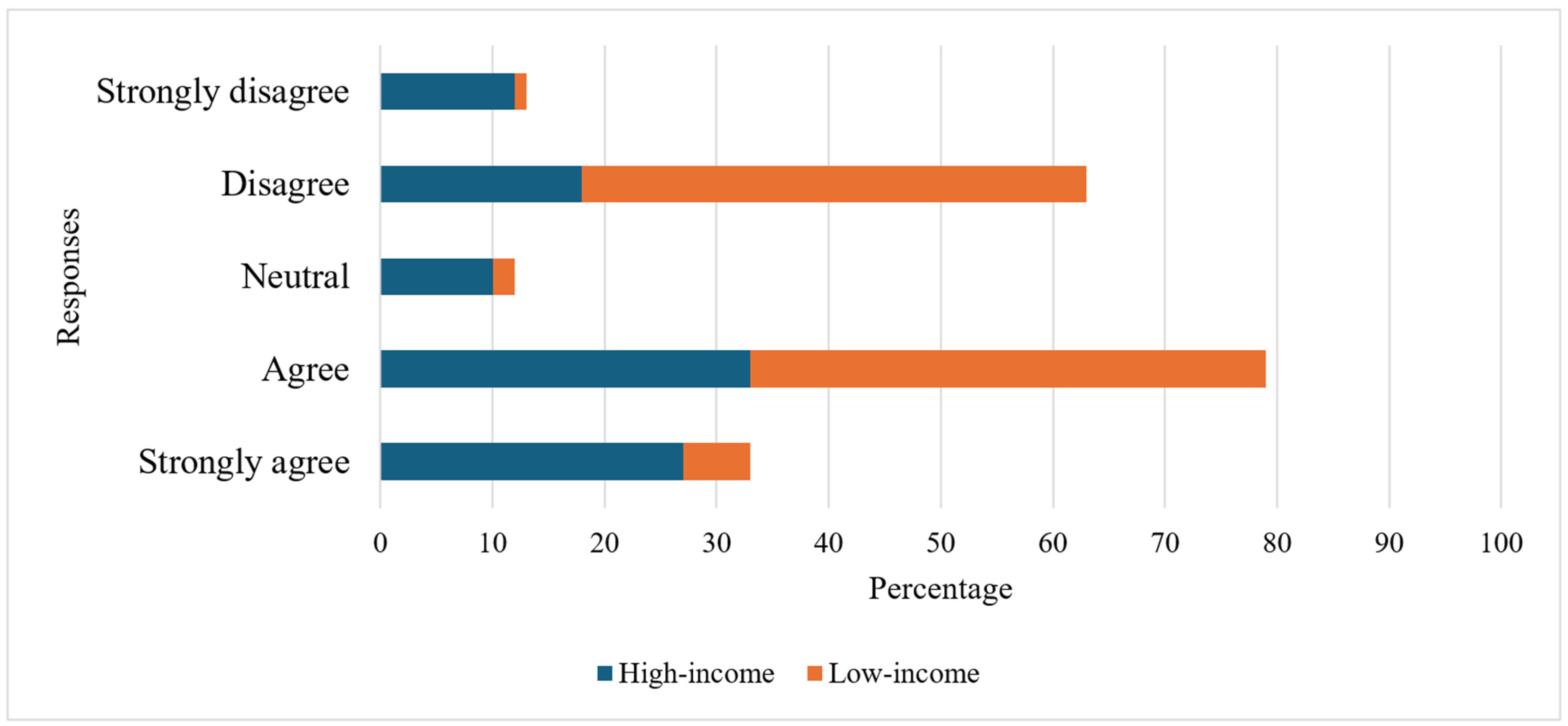
Regarding institutional barriers, significantly more high-income (42%) than low-income households (35%) (χ2 =37.036, p = 0.001) felt that the government had no comprehensive and supportive solar PV adoption policies. Similarly, when households were asked about the perceived level of ease in supplying excess electricity to the national grid, significantly more high-income households (48%) than low-income households (33%) perceived it as either difficult or very difficult (χ2 = 15.359, p = 0.004). When asked if they agreed that institutional factors constrained solar PV adoption, about 45% of high-income and 47% of low-income households agreed, citing concerns about government tax on solar PV installation (Figure 5).
Figure 5.
Reported institutional barriers to solar PV adoption among households.
3.2.5. Cognitive Barriers
The results indicate that significantly more high-income households (51%) than low-income respondents (20%) had knowledge about the storage of solar PV energy (χ2 = 14.351, p = 0.002). Similar trends were found for knowledge levels regarding power-generating capacity needed to meet their household needs of solar PV systems, with nearly all low-income households (98%) reporting a lack of knowledge compared to 60% among high-income households (χ2 = 37.036, p = 0.001). Additionally, households were asked about their familiarity with solar PV functions. Nearly three times more low-income households (36%) than high-income households (14%) expressed concerns about installing solar PV due to unfamiliarity with the system.
4. Discussion and Analysis
4.1. Perceptions of Solar PV Systems
The period most households seriously considered solar PV coincides with record power outages in South Africa, which reached 72.6 days in 2023 [83]. This drive for grid independence mirrors findings in Seychelles and Pakistan, where outage concerns were also the primary reasons for considering solar PV adoption [17,54]. However, our analysis reveals that the response to this crisis follows a distinct income gradient. For low-income households, the primary barrier is the high upfront cost, yet they show the strongest motivation for solar PV as a means of ‘economic survival’ to alleviate the burden of rising electricity bills [84]. In this group, the cost-saving potential is particularly salient.
Conversely, as we move up the income gradient, the focus shifts from cost-saving to convenience. High-income households often bypass the financial barriers that stop lower-income groups, yet they are more likely to rely on more immediate, carbon-heavy alternatives like generators [85]. While studies in US and Germany [26,86] found that the decision to adopt was determined by a desire to reduce emissions, this study suggests that the South African motivation is driven by energy security. This divergence highlights that while the energy crisis is universal, the transition to solar PV is socio-economically stratified, with financial capacity acting as the gatekeeper between the environmental ‘desire’ and the practical ‘act’ of adoption.
4.2. Financial Barriers
While financial barriers are evident across both income groups, similar perceptions do not translate into similar meanings or constraints across different demographic groups. The higher frequency of financial complaints among high-income households stems from their comparison of solar PV’s high upfront capital costs against more immediate alternatives such as diesel generators or standalone battery storage. For these households, affordability is assessed relative to competing energy technologies rather than absolute income constraints, as these options may be perceived as more immediately affordable or reliable, given that diesel generators typically involve lower initial capital costs while providing instant power, whereas solar PV systems require substantial upfront investment [87]. In this sense, financial barriers among high-income households reflect opportunity costs and expectations of uninterrupted energy supply rather than an inability to mobilise capital needed to purchase solar PV systems. At the same time, low-income households might perceive solar PV as a more affordable option, especially if there are government donations involved [24] as found in this study. Thus, for low-income households, affordability concerns are more closely linked to access, external support, and the ability to avoid recurring energy expenses, rather than comparisons with alternative energy technologies. This highlights a clear income-gradient effect, where financial barriers among high-income households are shaped by comparative choice, while among low-income households, they are shaped by structural constraints and dependence on external assistance. Hence, addressing financial barriers requires an understanding of the nuances of context in informing interventions.
Affordability concerns relating to the adoption of solar PV have been reported elsewhere. For instance, ref. [17] found that high start-up costs were one of the main barriers to the diffusion of solar PV among households in Pakistan, especially in the absence of supportive financial arrangements by the government. Similarly, ref. [54] found that solar PV requires significant capital investment, making it unaffordable for most low-income households without subsidies or government assistance. Thus, calls for a just energy transition require inclusive policies and programmes that support people’s propensity to purchase and maintain solar PV systems. Such policies must be sensitive to income gradients, recognising that identical financial instruments may not address the differentiated barriers experienced by high- and low-income households. These policies can be in the form of inclusive financial legislation to support households, especially low-income households. For example, the government can implement strategies such as pay-as-you-go models, where households receive solar PV systems and pay a small monthly fee until the systems are fully paid off. Pay-as-you-go policies have been successfully implemented among Kenyan households, leading to more than 80,000 solar PV adoptions in just two years [88]. Another policy initiative involves power purchase agreements, which can enable the government to install solar PV systems in households and sell electricity to homeowners at a fixed pre-set price, thus reducing upfront costs [89,90]. Power purchase agreements have been implemented with success among low-income and medium-income households in California, USA [89]. In California, households have benefited from the government’s solar PV leasing program, where solar PV companies are contracted to lease panels to homeowners who then pay for them over time [89,90]. Although power purchase agreements have been successful in other countries, their success in South Africa might be constrained by the government’s interest in ‘cheap’ coal-powered energy, making solar PV power more expensive to buy than grid energy. The limited effort from the South African government, Eskom, or municipalities to promote solar PV adoption might be attributed to the potential revenue loss from reducing dependence on conventional energy sales. For example, a study conducted in Stellenbosch, South Africa, found that the local municipality would lose up to 2.4% of its annual revenue if all households transitioned to solar PV [91]. This potential loss is significant, given that most municipalities are failing to provide basic services due to limited funding [92].
4.3. Technical Barriers
Technical barriers to solar PV adoption manifest differently across income groups. Consistent with findings from this study, concerns relating to the reliability of solar PV systems have also been reported by [93] who found that some rural households in South Africa shunned the government-donated solar PV systems due to fear of being pseudo-connected to an unreliable weather-dependent energy source, which could prevent them from accessing grid energy. These concerns were more pronounced among low-income than high-income households, for whom energy reliability is closely tied to livelihood security and the avoidance of risk. In contrast, technical barriers reported by high-income households were more closely related to system design and capacity requirements.
Despite having significantly larger rooftops, high-income households reported more space-related technical barriers than low-income households. This does not mean that low-income households have more rooftop space than high-income households. Rather, high-income households tend to require a larger number of solar panels to meet higher household electricity demand, particularly for energy-intensive appliances. In addition, many residential roofs were not designed with solar PV installation in mind, meaning that even large roof surfaces may have suboptimal orientation or shading, which could limit effective panel placement. Therefore, with the right systems and enough storage of solar PV energy, households should be able to sustain most of their energy needs even during rare adverse weather conditions.
Concerning limited rooftop space, stakeholders such as government, solar PV installers, and designers could consider alternative methods for solar PV installations or optimise the use of limited rooftop space. These alternatives may include balcony or C-steel ground-mounted solar PV systems to minimise the chances of theft, as seen elsewhere [94,95]. High-income households may further reduce space constraints by adopting monocrystalline solar panels, which are approximately 20% more efficient than polycrystalline panels and thus require fewer panels for the same output [87]. However, these panels are said to be more expensive and generate substantial silicon waste during manufacturing, potentially offsetting some environmental benefits [87]. Such options may therefore remain largely inaccessible to low-income households. For low-income households, communal solar PV projects offer a promising alternative. Installing solar PV systems on shared community spaces and distributing electricity through mini-grids can alleviate individual rooftop and aesthetic constraints while reducing per-household costs through shared installation and maintenance responsibilities [96]. Additionally, communal systems are easier to secure against theft, as security infrastructure and personnel can be concentrated at a limited number of sites, as reported by a study conducted elsewhere [97,98]. Taken together, from a policy and implementation perspective, technical design considerations should be integrated into national and municipal renewable energy strategies to accommodate heterogeneous household demand profiles. The government needs to provide funding for low-income communal mini-grids. Mini-grids are important because they ensure that households without adequate or suitable rooftops do not have to worry about roof constraints, as the solar panels can be installed in centralized and secure community locations.
4.4. Social Barriers
Social barriers related to security concerns differ in intensity and underlying drivers between high- and low- income households. High-income households reported more security-related social barriers than low-income households. This difference reflects variation not only in the level of concern but also in the mechanisms through which security risks are perceived across income groups. This could be attributed to the fact that most high-income households have access to crime rate information, which might heighten their awareness of theft [99] and tend to be isolated, making them easy targets for crime [100]. For high-income households, solar PV systems are often viewed as high-value assets that could increase household exposure to crime. In contrast, while low-income households reported fewer theft-related concerns, this does not imply that theft is insignificant for this group. Rather, for low-income households, security concerns are closely intertwined with limited capacity to absorb losses. The potential theft or damage of a solar PV system may represent a significant financial setback, making adoption risky even when theft is perceived as common or unavoidable. This suggests that theft functions as a deterrent for both income groups, but for different reasons—high-income households focus on risk exposure and asset protection, whereas low-income households are constrained by vulnerability to loss.
Evidence from other contexts supports the widespread nature of theft as a barrier to solar PV adoption. For example, ref. [13] found that households in the Vhembe district of Limpopo province, South Africa, were less willing to adopt solar PV due to high crime rates, while ref. [52] similarly reported that residents in Papua New Guinea preferred less visible investments that did not attract crime. These findings suggest that security concerns are not context-specific but are particularly pronounced in settings characterised by socio-economic inequality and weak protective infrastructure. However, theft seems to be more prevalent in less developed countries than in developed countries, since solar PV distributors in some developed nations distribute solar PV systems with anti-theft fasteners in addition to security lighting, such as motion-sensor-connected floodlights [101]. While advanced alarm and monitoring systems could proactively deter theft, particularly in South Africa’s high-crime urban areas, these options are often financially inaccessible, especially for households already struggling to afford solar PV systems. As a result, the ability to mitigate security risks is itself unevenly distributed across income groups. Addressing security-related social barriers, therefore, requires institutional support. Government authorities should consider provision of subsidies for anti-theft features (e.g., tamper-proof fasteners, motion-sensor lighting, and GPS tracking) bundled with low-cost Solar Home Systems, similar to Germany’s KfW programmes [102]. Moreover, the government needs to foster public–private partnerships with security firms for discounted communal monitoring in low-income areas and high-value asset protection for isolated high-income homes. These measures would lower perceived theft risks, boost adoption confidence across the income gradient, and align with South Africa’s just transition goals by making solar PV viable even in perceived high-crime contexts.
4.5. Institutional Barriers
Institutional barriers reported in the study broadly suggest that income status influence perceptions of policy-related barriers to solar PV adoption. Institutional barriers relating to the lack of supportive solar PV policies were reported by relatively few low-income households, possibly because their prior exposure, directly or indirectly to government-led renewable energy initiatives, particularly the Solar Water Heating programme, which distributed solar water heaters to selected low-income households across several provinces as part of broader efforts to address energy poverty and diversify the national energy mix [24]. Thus, most low-income households, who either benefited from, or were aware of the beneficiaries of such programmes, may have presumed that government policies supportive of solar PV adoption were in place. Given that public policy plays a key role in shaping attitudes and motivating rooftop solar uptake [103,104], these earlier initiatives may have positively influenced low-income households’ perceptions of institutional support.
In contrast, high-income households were more likely to express dissatisfaction with existing solar PV policies, reflecting their greater engagement with formal regulatory frameworks and incentive structures. For this group, institutional barriers were closely linked to the perceived inadequacy, inconsistency, and uncertainty of policy instruments. For example, although the solar rebate programme introduced in March 2023 provided a 25% tax rebate on solar panel costs, it excluded the most expensive system components, namely batteries and inverters, thereby limiting its effectiveness, particularly for households seeking full energy independence [25]. Moreover, though the 25% solar rebate is important, there is uncertainty on the part of the government to continue with the programme, which could hinder solar PV adoption [105]. Such policy uncertainty disproportionately affects high-income households, who base investment decisions on long-term cost recovery and system optimisation. In South Africa, feeding back to the grid is generally expensive and requires substantial upgrades, with bi-directional meters that allow the transfer of excess energy to the grid costing more than ZAR12,000.00 (US$625) [106]. Moreover, households are taxed for feeding back to the grid, yet the feed-in rate is as low as ZAR0.79/kWh, as approved by the National Energy Regulator of South Africa [106]. In addition, a recent study in South Africa suggests that despite a significant reduction in photovoltaic costs, the costs of bi-directional metering and prosumer integration are still prohibitively higher (75%) than the costs of grid energy [92]. Thus, it is plausible to suggest that the perceived costs of solar PV energy integration might constrain solar PV adoption, especially among high-income households. Concerns on feed-in tariffs reported in this study are consistent with findings by [29], who found that the installation of solar PV was strongly correlated with changes in the feed-in tariff policies in Queensland, Australia. Overall, the uncertainty that comes with incomprehensive policies can negatively affect households’ propensity to adopt solar PV systems irrespective of their economic status. Thus, concerns affecting both high- and low-income households ought to be considered when developing renewable energy policies that ensure a just transition imperative for solar PV adoption [11]. Policy recommendations to address these stratified institutional barriers include expanding the 25% solar tax rebate to explicitly cover batteries and inverters, with a multi-year commitment (e.g., through 2030) to reduce uncertainty for high-income investors. The government also needs to introduce tiered feed-in tariffs as well as subsidise bi-directional meters. These measures would enhance policy coherence, lower integration costs, and accelerate equitable solar PV uptake in line with South Africa’s Integrated Resource Plan goals [107].
4.6. Cognitive Barriers
These results show that there is a lack of sufficient information on solar PV systems among both high-income and low-income households, though the former tended to have higher levels of solar PV knowledge than the latter. For high-income households, knowledge gaps were often relatively linked to uncertainty about system optimisation, long-term performance, and return on investment, whereas for low-income households, gaps were more fundamental and related to basic awareness and understanding of how solar PV systems function. This lack of knowledge could help explain the low uptake of solar PV in general, particularly among low-income respondents. High-income households primarily rely on formal information sources such as television advertisements and internet-based content, whereas low-income households depend largely on informal networks of friends, relatives, and neighbours, reflecting unequal access to reliable information. As a result, information circulating among low-income households is more likely to be fragmented, experiential, or inaccurate, while high-income households are better positioned to access diverse and up-to-date technical information. This disparity in information channels can constrain solar PV adoption among low-income households by limiting access to accurate technical guidance on system requirements, storage capacity, and energy generation potential [108]. In South Africa, solar PV initiatives are relatively new, and inadequate information on solar PV systems can hinder widespread adoption [13,109]. Along the income gradient, limited awareness among low-income households is compounded by misconceptions surrounding reliability and affordability, whereas among high-income households, skepticism is more closely tied to uncertainty about system performance under local conditions. Limited awareness of the benefits of solar PV and the misconceptions surrounding its reliability and affordability can erode the trust households might have for solar PV. Thus, the government needs to introduce targeted policy measures to reduce information asymmetry and improve solar PV literacy across income groups. For example, the Department of Mineral Resources and Energy (South Africa) could strengthen nationwide awareness programmes that promote basic solar PV knowledge, particularly among low-income households. Public education campaigns through television, community radio, and digital platforms could provide simplified information on system functionality, safety, and long-term benefits. Additionally, municipalities should support community-based solar PV advisory services to provide reliable technical guidance on installation, sizing, and cost considerations. Collaboration with private installers and telecommunications platforms is also recommended to improve the dissemination of verified technical information and strengthen household trust in solar PV systems.
5. Conclusions and Recommendations
The scholarly contribution of this study lies in its analysis of barriers to solar PV adoption across a differentiated household gradient and rapidly changing socio-economic context. The findings show that solar PV adoption is shaped by an interrelated set of financial, institutional, technical, cognitive, and social barriers, but that these barriers operate unevenly across income groups. While both high-income and low-income households report similar categories of barriers, low-income households are disproportionately constrained by them, revealing that income-based heterogeneity is central to understanding adoption dynamics and to designing equitable energy transitions.
The analysis demonstrates that for low-income households, barriers such as affordability, limited access to reliable information, security concerns, and housing constraints function as structural limitations that directly undermine adoption feasibility. In contrast, high-income households experience these barriers more as risks associated with policy uncertainty, asset protection, and system performance. This distinction underscores the limitations of uniform policy approaches and highlights the need for income-sensitive interventions that recognise unequal capacities to absorb risk and financial loss.
Policy implications emerge in four key areas. First, inclusive financing mechanisms such as leasing schemes and power purchase agreements are essential to enable participation by low-income households [64]. Second, clearer and more consistent policy frameworks, including improved feed-in tariff structures, are necessary to enhance household confidence in solar PV investments. Third, cognitive and technical barriers can be addressed through targeted information dissemination, including integrating solar PV knowledge into education systems and community-based outreach. Finally, low-cost technical interventions, such as anti-theft measures and high-efficiency panels, may help alleviate security and space-related concerns.
Overall, the study reinforces the need to situate solar PV adoption within broader debates on energy security and just energy transitions. Addressing income-differentiated barriers is critical for ensuring that the benefits of decentralised renewable energy are distributed equitably, while future research should examine the labour and livelihood implications of shifting away from fossil-based energy systems.
Author Contributions
Conceptualisation, U.M., G.T. and S.R.; methodology, U.M., G.T., and S.R.; validation, U.M., G.T., and S.R.; formal analysis, U.M.; investigation, U.M.; resources, G.T. and S.R.; writing—original draft preparation, U.M.; writing—review and editing, U.M., G.T., and S.R.; supervision, G.T. and S.R.; funding acquisition, G.T. and S.R. All authors have read and agreed to the published version of the manuscript.
Funding
This work was funded by the National Research Foundation (Grant No PMDS22051611004) and the Rhodes University African Studies Centre, a Cluster Centre of the Africa Multiple Cluster of Excellence at the University of Bayreuth, funded by the Deutsche Forschungsgemeinschaft (DFG, German Research Foundation) under Germany’s Excellence Strategy—EXC 2052/1—390713894.
Institutional Review Board Statement
The study was conducted in accordance with the Declaration of Helsinki, and approved by the Rhodes University Ethics Committee (Review reference number 2022-5895-7199).
Informed Consent Statement
Informed consent was obtained from all subjects involved in the study.
Data Availability Statement
The data that support the findings of this study are available from the corresponding author upon reasonable request.
Acknowledgments
Special thanks to the communities that participated in the study. We would like to thank Thantaswa Currinta Zondani and Unathi Klaas for field work assistance. Also, we would like to thank Rhodes University for providing fieldwork transport.
Conflicts of Interest
The authors declare that they have no competing interests.
References
- Herman, R.; Nistor, C.; Jula, N.M. The Influence of the Increase in Energy Prices on the Profitability of Companies in the European Union. Sustainability 2023, 15, 15404. [Google Scholar] [CrossRef] [Scilit]
- Milewska, B.; Milewski, D. The Impact of Energy Consumption Costs on the Profitability of Production Companies in Poland in the Context of the Energy Crisis. Energies 2023, 16, 6519. [Google Scholar] [CrossRef] [Scilit]
- Krozer, Y.; Bykuc, S.; Coenen, F. Growth of Renewable Energy: A Review of Drivers from the Economic Perspective. Energies 2025, 18, 5250. [Google Scholar] [CrossRef] [Scilit]
- Liebensteiner, M.; Ocker, F.; Abuzayed, A. High Electricity Price despite Expansion in Renewables: How Market Trends Shape Germany’s Power Market in the Coming Years. Energy Policy 2025, 198, 114448. [Google Scholar] [CrossRef] [Scilit]
- Ziervogel, G.; Lennard, C.; Midgley, G.; New, M.; Simpson, N.P.; Trisos, C.H.; Zvobgo, L. Climate Change in South Africa: Risks and Opportunities for Climate-Resilient Development in the IPCC Sixth Assessment WGII Report. S. Afr. J. Sci. 2022, 118, 14492. [Google Scholar] [CrossRef] [Scilit]
- Jena, M.C.; Mishra, S.K.; Moharana, H.S. Shifting towards renewable energy: A sustainable solution to pollution. Sustain. Soc. Dev. 2024, 2, 2905. [Google Scholar] [CrossRef] [Scilit]
- Culiberg, B.; Cho, H.; Koklic, M.K.; Zabkar, V. The Role of Moral Foundations, Anticipated Guilt and Personal Responsibility in Predicting Anti-Consumption for Environmental Reasons. J. Bus. Ethics 2023, 182, 465–481. [Google Scholar] [CrossRef] [Scilit]
- Marchetti-Mercer, M. Resilience Is Not Enough: The Mental Health Impact of the Ongoing Energy Crisis in South Africa. S. Afr. J. Sci. 2023, 119, 16608. [Google Scholar] [CrossRef] [Scilit]
- Shakeel, S.R.; Yousaf, H.; Irfan, M.; Rajala, A. Solar PV Adoption at Household Level: Insights Based on a Systematic Literature Review. Energy Strategy Rev. 2023, 50, 101178. [Google Scholar] [CrossRef] [Scilit]
- Mirzania, P.; Gordon, J.A.; Balta-Ozkan, N.; Sayan, R.C.; Marais, L. Barriers to Powering Past Coal: Implications for a Just Energy Transition in South Africa. Energy Res. Soc. Sci. 2023, 101, 103122. [Google Scholar] [CrossRef] [Scilit]
- Pathak, S.; Sharma, V.; Chougule, S.; Goel, V. Prioritization of Barriers to the Development of Renewable Energy Technologies in India Using Integrated Modified Delphi and AHP Method. Sustain. Energy Technol. Assess. 2022, 50, 101818. [Google Scholar] [CrossRef] [Scilit]
- Agbaitoro, G.A.; Ekhator, E.O. Just Energy Transition in Africa: Towards Social Inclusion and Environmental Rights-Based Imperatives. Bus. Hum. Rights J. 2025, 10, 34–55. [Google Scholar] [CrossRef] [Scilit]
- Chidembo, R.; Francis, J.; Kativhu, S. A Review of the Achievements, Weaknesses, and Challenges of Rural Electrification through Solar Home Systems in South Africa. Afr. J. Dev. Stud. 2022, 2022, 191–211. [Google Scholar] [CrossRef]
- Fatoki, O. Determinants of Intention to Purchase Photovoltaic Panel System: An Integration of Technology Acceptance Model and Theory of Planned Behaviour. Int. J. Energy Econ. Policy 2022, 12, 432–440. [Google Scholar] [CrossRef] [Scilit]
- Mutumbi, U.; Thondhlana, G.; Ruwanza, S. Adoption of Residential Rooftop Solar PV Systems in South Africa: A Scoping Review of Barriers. Heliyon 2024, 10, e30937. [Google Scholar] [CrossRef] [Scilit]
- Molepo, P.M.; Aboalez, K.; Mathaba, T.N.D. Analysis of Barriers to South Africa’s Energy Transition: Perspectives from Industry Experts. Energy Sustain. Dev. 2025, 88, 101777. [Google Scholar] [CrossRef] [Scilit]
- Qureshi, T.M.; Ullah, K.; Arentsen, M.J. Factors Responsible for Solar PV Adoption at Household Level: A Case of Lahore, Pakistan. Renew. Sustain. Energy Rev. 2017, 78, 754–763. [Google Scholar] [CrossRef] [Scilit]
- Parveen, Z.; Salman, V.; Jamil, F. Examining the Challenges and Drivers of Solar Photovoltaic Adoption in the Twin Cities of Pakistan. Util. Policy 2025, 96, 102005. [Google Scholar] [CrossRef] [Scilit]
- Irfan, M.; Zhao, Z.-Y.; Ahmad, M.; Mukeshimana, M.C. Solar Energy Development in Pakistan: Barriers and Policy Recommendations. Sustainability 2019, 11, 1206. [Google Scholar] [CrossRef] [Scilit]
- Kaur, N.; Sharma, A. Adoption of Solar Home Lighting System: A Behavioral Paradigm Shift from Consumers to Prosumers in the Urban Household Energy Transition of Punjab, India. Environ. Res. Commun. 2024, 6, 115020. [Google Scholar] [CrossRef] [Scilit]
- Acheampong, A.O.; Adebayo, T.S.; Dzator, J.; Koomson, I. Income Inequality and Economic Growth in BRICS: Insights from Non-Parametric Techniques. J. Econ. Inequal. 2023, 21, 619–640. [Google Scholar] [CrossRef] [Scilit]
- McKay, T.; Hendricks, D. Pitiful Rooftop Solar Uptake in Sunny South Africa: A Policy, Funding and Service Delivery Perspective. Front. Sustain. Cities 2022, 4, 969040. [Google Scholar] [CrossRef] [Scilit]
- Calitz, J.; Wright, J. Statistics of Utility-Scale Power Generation in South Africa in 2020. 2021. Available online: http://hdl.handle.net/10204/11865 (accessed on 16 March 2026).
- Department of Energy SA Media: Annual Report. Department: Energy, Republic of South Africa. Available online: http://www.energy.gov.za/files/media/media_ar.html (accessed on 21 June 2022).
- South African National Treasury, Solar Panel Tax Incentive for Individuals. Available online: https://www.treasury.gov.za/documents/National%20Budget/2023/2023%20Budget%20FAQs%20-%20Solar%20Panel%20Tax%20Incentive.p (accessed on 24 April 2023).
- IRENA World Energy Transitions Outlook 1-5C Pathway 2022 Edition. Available online: https://www.irena.org/publications/2022/Mar/World-Energy-Transitions-Outlook-2022 (accessed on 18 September 2023).
- Thobejane, J.; Masekameni, D.; Rathebe, P.; Mgwambani, S.L. The Effectiveness of Solar Water Heating Geysers in South Africa: A Review. University of Johannesburg. Available online: https://ujcontent.uj.ac.za/esploro/outputs/conferencePaper/The-effectiveness-of-solar-water-heating/9911391707691 (accessed on 18 September 2023).
- Galvin, R. Why German Households Won’t Cover Their Roofs in Photovoltaic Panels: And Whether Policy Interventions, Rebound Effects and Heat Pumps Might Change Their Minds. Renew. Energy Focus 2022, 42, 236–252. [Google Scholar] [CrossRef] [Scilit]
- Lan, H.; Cheng, B.; Gou, Z.; Yu, R. An Evaluation of Feed-in Tariffs for Promoting Household Solar Energy Adoption in Southeast Queensland, Australia. Sustain. Cities Soc. 2020, 53, 101942. [Google Scholar] [CrossRef] [Scilit]
- Palm, J. Household Installation of Solar Panels—Motives and Barriers in a 10-Year Perspective. Energy Policy 2018, 113, 1–8. [Google Scholar] [CrossRef] [Scilit]
- Cook, J.; Bird, L. Unlocking Solar for Low- and Moderate-Income Residents: A Matrix of Financing Options by Resident, Provider, and Housing Type. Available online: https://www.semanticscholar.org/paper/Unlocking-Solar-for-Low-and-Moderate-Income-A-of-by-Cook-Bird/da2fa4410272a8d1c67fd976c1f056fb63f84398 (accessed on 19 September 2023).
- Shimada, H.; Honda, T. What Drives Households’ Choices of Residential Solar Photovoltaic Capacity? Energy Policy 2022, 168, 113120. [Google Scholar] [CrossRef] [Scilit]
- Victoria, M.; Haegel, N.; Peters, I.M.; Sinton, R.; Jäger-Waldau, A.; del Cañizo, C.; Breyer, C.; Stocks, M.; Blakers, A.; Kaizuka, I.; et al. Solar Photovoltaics Is Ready to Power a Sustainable Future. Joule 2021, 5, 1041–1056. [Google Scholar] [CrossRef] [Scilit]
- Ghimire, J.; Plange-Rhule, D.; Smith, E. Perception and Challenges of Solar Energy Adoption in the United States: A Systematic Review for Future Directions. Sustainability 2026, 18, 227. [Google Scholar] [CrossRef] [Scilit]
- Kılıç, U.; Kekezoğlu, B. A Review of Solar Photovoltaic Incentives and Policy: Selected Countries and Turkey. Ain Shams Eng. J. 2022, 13, 101669. [Google Scholar] [CrossRef] [Scilit]
- Tanaka, Y.; Chapman, A.; Sakurai, S.; Tezuka, T. Feed-in Tariff Pricing and Social Burden in Japan: Evaluating International Learning through a Policy Transfer Approach. Soc. Sci. 2017, 6, 127. [Google Scholar] [CrossRef] [Scilit]
- Lyeonov, S.; Moroz, A.; Wenerska, B.; Tangl, A. The impact of feed-in tariffs and power purchase agreements on public investments in renewable energy. J. Int. Stud. 2025, 18, 179–218. [Google Scholar] [CrossRef] [Scilit]
- Hartvig, Á.D. Trade-Offs in Feed-in Tariff Scenarios for Incentivizing Clean Technologies in Central and Eastern Europe. Sol. Energy 2025, 294, 113499. [Google Scholar] [CrossRef] [Scilit]
- Cheam, W.-Y.; Lau, L.-S.; Wei, C.-Y. Factors Influencing the Residence’s Intention to Adopt Solar Photovoltaic Technology: A Case Study from Klang Valley, Malaysia. Clean Energy 2021, 5, 464–473. [Google Scholar] [CrossRef] [Scilit]
- O’Brien, R.; Neman, T.; Seltzer, N.; Evans, L.; Venkataramani, A. Structural Racism, Economic Opportunity and Racial Health Disparities: Evidence from U.S. Counties. SSM Popul. Health 2020, 11, 100564. [Google Scholar] [CrossRef] [Scilit]
- Ding, Y.; Si, Y.; Xu, K.; Zhang, S.; Wang, Z. Spatial Disparity of Utility-Scale Solar Energy and the Role of Solar Policy in the U.S. Energy Strategy Rev. 2023, 50, 101179. [Google Scholar] [CrossRef] [Scilit]
- Gao, X.; Zhou, S. Solar Adoption Inequality in the U.S.: Trend, Magnitude, and Solar Justice Policies. Energy Policy 2022, 169, 113163. [Google Scholar] [CrossRef] [Scilit]
- Eckersley, R.; Fitz-Henry, E. What Is a “Just” Transition to Net Zero - and Why Is Australia Struggling to Get There? Available online: https://findanexpert.unimelb.edu.au/news/72642-what-is-a-%27just%27-transition-to-net-zero---and-why-is-australia-struggling-to-get-there%3F (accessed on 30 April 2024).
- Lo, T.S.K.; Mah, D.N.; Wang, G.; Leung, M.K.H.; Lo, A.Y.; Hills, P. Barriers to Adopting Solar Photovoltaic Systems in Hong Kong. Energy Environ. 2018, 29, 649–663. [Google Scholar] [CrossRef] [Scilit]
- Abu Saim, M.; Tanvir Ahammed, M.; Khan, I. Technical Barriers and User Challenges toward Sustainable Energy Solutions in Remote Rural Areas of Bangladesh. Energy Rep. 2025, 13, 3745–3759. [Google Scholar] [CrossRef] [Scilit]
- Mohloding, R.; Phogole, B.; Yessoufou, K. Household Acceptance of Solar Water Heaters in South Africa: An Expectancy-Disconfirmation Model. Util. Policy 2025, 95, 101916. [Google Scholar] [CrossRef] [Scilit]
- Agaja, S.A.; Ajibade, B.F.; Nwaezeapu, A.O.; Igbinosun, A. Study on the Performance of Selected Solar Photovoltaic Systems Installed by Government Intervention Agencies in Delta State, Nigeria. IJIRMPS Int. J. Innov. Res. Eng. Multidiscip. Phys. Sci. 2020, 8, 777. [Google Scholar] [CrossRef] [Scilit]
- Sarangi, G.K.; Pugazenthi, D.; Mishra, A.; Palit, D.; Bhattacharyya, S.C. Marginalisation of Off-Grid Energy Sector in Sri Lanka: What Lessons Could Be Learnt? Environ. Dev. Sustain. 2020, 22, 5219–5243. [Google Scholar] [CrossRef] [Scilit]
- Bamford, L. Overcoming the Barriers to Rooftop Solar Energy. Planning, Building & Construction Today, 19 May 2022.
- Ahmed, Y.A.; Rashid, A.; Khurshid, M.M. Investigating the Determinants of the Adoption of Solar Photovoltaic Systems—Citizen’s Perspectives of Two Developing Countries. Sustainability 2022, 14, 11764. [Google Scholar] [CrossRef] [Scilit]
- Raymond, J.; Kihedu, J.H.; Kimambo, C.Z.M. A Model for Sustainable Adoption of Solar Photovoltaic Technology in Tanzania. Tanzan. J. Eng. Technol. 2022, 41, 16–34. [Google Scholar] [CrossRef] [Scilit]
- Sovacool, B.K.; D’Agostino, A.L.; Jain Bambawale, M. The Socio-Technical Barriers to Solar Home Systems (SHS) in Papua New Guinea: “Choosing Pigs, Prostitutes, and Poker Chips over Panels”. Energy Policy 2011, 39, 1532–1542. [Google Scholar] [CrossRef] [Scilit]
- Roy, E. Cognitive Factors. In Encyclopedia of Behavioral Medicine; Gellman, M.D., Turner, J.R., Eds.; Springer: New York, NY, USA, 2013; pp. 447–448. [Google Scholar]
- Etongo, D.; Naidu, H. Determinants of Household Adoption of Solar Energy Technology in Seychelles in a Context of 100% Access to Electricity. Discov. Sustain. 2022, 3, 38. [Google Scholar] [CrossRef] [Scilit]
- Wang, C.; Wang, Y.; Zhao, Y.; Shuai, J.; Shuai, C.; Cheng, X. Cognition Process and Influencing Factors of Rural Residents’ Adoption Willingness for Solar PV Poverty Alleviation Projects: Evidence from a Mixed Methodology in Rural China. Energy 2023, 271, 127078. [Google Scholar] [CrossRef] [Scilit]
- Podder, A.; Habibullah, M.; Roy, N.; Pota, H. A Chronological Review of Prospects of Solar Photovoltaic Systems in Bangladesh: Feasibility Study Analysis, Policies, Barriers, and Recommendations. IET Renew. Power Gener. 2021, 15, 2109–2132. [Google Scholar] [CrossRef] [Scilit]
- Altassan, A. Sustainable Integration of Solar Energy, Behavior Change, and Recycling Practices in Educational Institutions: A Holistic Framework for Environmental Conservation and Quality Education. Sustainability 2023, 15, 15157. [Google Scholar] [CrossRef] [Scilit]
- Ferreira, M.F.; Freitas, M.A.V.; da Silva, N.F.; da Silva, A.F.; Paz, L.R.L. da Insertion of Photovoltaic Solar Systems in Technological Education Institutions in Brazil: Teacher Perceptions Concerning Contributions towards Sustainable Development. Sustainability 2020, 12, 1292. [Google Scholar] [CrossRef] [Scilit]
- Ajzen, I. The Theory of Planned Behavior. Organ. Behav. Hum. Decis. Process. 1991, 50, 179–211. [Google Scholar] [CrossRef] [Scilit]
- Statistics South Africa. 2011 Census; Statistics South Africa: Pretoria, South Africa, 2011. [Google Scholar]
- Yin, R.K. Case Study Research and Applications: Design and Methods, 6th ed.; SAGE: Thousand Oaks, CA, USA, 2018. [Google Scholar]
- Jaglin, S. Urban Energy Policies and the Governance of Multilevel Issues in Cape Town. Urban Stud. 2014, 51, 1394–1414. [Google Scholar] [CrossRef] [Scilit]
- Mustafa, R.J.; Gomaa, M.R.; Al-Dhaifallah, M.; Rezk, H. Environmental Impacts on the Performance of Solar Photovoltaic Systems. Sustainability 2020, 12, 608. [Google Scholar] [CrossRef] [Scilit]
- Statistics South Africa. General Household Survey 2021; Statistics South Africa: Pretoria, South Africa, 2022. [Google Scholar]
- Eskom. Eskom Clarifies the 18.65% Tariff Increase; Eskom: Johannesburg, South Africa, 2023. [Google Scholar]
- Mukumba, P.; Chivanga, S.Y. An Overview of Renewable Energy Technologies in the Eastern Cape Province in South Africa and the Rural Households’ Energy Poverty Coping Strategies. Challenges 2023, 14, 19. [Google Scholar] [CrossRef] [Scilit]
- Strauss, M. A Historical Exposition of Spatial Injustice and Segregated Urban Settlement in South Africa. Fundamina 2019, 25, 135–168. [Google Scholar] [CrossRef] [Scilit]
- Parnell, S.; Mosdell, T. Parnell: Recognising, Explaining and Measuring Chronic Urban Poverty in South Africa. Available online: https://scholar.google.com/scholar_lookup?title=Recognising%2C+Explaining+and+Measuring+Chronic+Poverty+in+South+Africa&publication_year=1999&author=S.+Parnell&author=T.+Mosdell&inst=16395086716386193010 (accessed on 4 March 2026).
- Thondhlana, G.; Kua, H.W. Promoting Household Energy Conservation in Low-Income Households through Tailored Interventions in Grahamstown, South Africa. J. Clean. Prod. 2016, 131, 327–340. [Google Scholar] [CrossRef] [Scilit]
- Ngalo, N.; Thondhlana, G. Illegal Solid-Waste Dumping in a Low-Income Neighbourhood in South Africa: Prevalence and Perceptions. Int. J. Environ. Res. Public Health 2023, 20, 6750. [Google Scholar] [CrossRef] [Scilit]
- Palm, J.; Tengvard, M. Motives for and Barriers to Household Adoption of Small-Scale Production of Electricity: Examples from Sweden. Sustain. Sci. Pract. Policy 2011, 7, 6–15. [Google Scholar] [CrossRef] [Scilit]
- Hair, F.; Babin, B.J.; Anderson, R.E.; Black, W.C. Multivariate Data Analysis, 8th ed.; Cengage: Melbourne, Australia; Available online: https://au.cengage.com/c/multivariate-data-analysis-8e-hair-babin-anderson-black/9781473756540/ (accessed on 15 January 2026).
- Israel-Akinbo, S. An Evaluation of Energy Programme and Policy in South Africa: Evidence from the General Household Survey. J. Energy S. Afr. 2018, 29, 65–77. [Google Scholar]
- Dworkin, S.L. Sample Size Policy for Qualitative Studies Using In-Depth Interviews. Arch. Sex. Behav. 2012, 41, 1319–1320. [Google Scholar] [CrossRef] [Scilit]
- Bickerstaff, K.; Bulkeley, H.; Walker, G. Energy Justice in a Changing Climate; Zed Books: London, UK, 2013; pp. 1–234. [Google Scholar]
- Khosla, R.; Renaldi, R.; Mazzone, A.; McElroy, C.; Palafox-Alcantar, G. Sustainable Cooling in a Warming World: Technologies, Cultures, and Circularity. Annu. Rev. Environ. Resour. 2022, 47, 449–478. [Google Scholar] [CrossRef] [Scilit]
- Guest, G.; Bunce, A.; Johnson, L. How Many Interviews Are Enough?: An Experiment with Data Saturation and Variability. Field Methods 2006, 18, 59–82. [Google Scholar] [CrossRef] [Scilit]
- Saunders, B.; Sim, J.; Kingstone, T.; Baker, S.; Waterfield, J.; Bartlam, B.; Burroughs, H.; Jinks, C. Saturation in Qualitative Research: Exploring Its Conceptualization and Operationalization. Qual. Quant. 2018, 52, 1893–1907. [Google Scholar] [CrossRef] [Scilit] [PubMed]
- Braun, V.; Clarke, V. Using Thematic Analysis in Psychology. Qual. Res. Psychol. 2006, 3, 77–101. [Google Scholar] [CrossRef] [Scilit]
- Braun, V.; Clarke, V. One Size Fits All? What Counts as Quality Practice in (Reflexive) Thematic Analysis? Qual. Res. Psychol. 2021, 18, 328–352. [Google Scholar] [CrossRef] [Scilit]
- Malterud, K.; Siersma, V.D.; Guassora, A.D. Sample Size in Qualitative Interview Studies: Guided by Information Power. Qual. Health Res. 2016, 26, 1753–1760. [Google Scholar] [CrossRef] [Scilit]
- Hennink, M.; Kaiser, B.N. Sample Sizes for Saturation in Qualitative Research: A Systematic Review of Empirical Tests. Soc. Sci. Med. 2022, 292, 114523. [Google Scholar] [CrossRef] [Scilit]
- Businesstech. Load Shedding and Blackout Warning for 2024; Businesstech: Pretoria, South Africa, 2024. [Google Scholar]
- Mutumbi, U.; Thondhlana, G.; Ruwanza, S. Co-Designed Interventions Yield Significant Electricity Savings among Low-Income Households in Makhanda South Africa. Energies 2022, 15, 2320. [Google Scholar] [CrossRef] [Scilit]
- Bakri, J.A.; Badmus, I.; Hammed, S.O. Comparative Assessment of Solar Photovoltaic System and Diesel Generating Set for Energy Sustainability in Engineering Buildings of Yaba College of Technology. Eur. J. Energy Res. 2022, 2, 10–16. [Google Scholar] [CrossRef] [Scilit]
- Stern, P.C.; Dietz, T.; Vandenbergh, M.P. The Science of Mitigation: Closing the Gap between Potential and Actual Reduction of Environmental Threats. Energy Res. Soc. Sci. 2022, 91, 102735. [Google Scholar] [CrossRef] [Scilit]
- EnergySage. Monocrystalline vs. Polycrystalline Solar Panels. 2023. Available online: https://www.energysage.com/solar/monocrystalline-vs-polycrystalline-solar/ (accessed on 16 March 2026).
- Adwek, G.; Boxiong, S.; Ndolo, P.O.; Siagi, Z.O.; Chepsaigutt, C.; Kemunto, C.M.; Arowo, M.; Shimmon, J.; Simiyu, P.; Yabo, A.C. The Solar Energy Access in Kenya: A Review Focusing on Pay-As-You-Go Solar Home System. Environ. Dev. Sustain. 2020, 22, 3897–3938. [Google Scholar]
- Chao, J. How to Accelerate Solar Adoption for the Underserved. Available online: https://newscenter.lbl.gov/2020/11/09/how-to-accelerate-solar-adoption-for-the-underserved/ (accessed on 18 September 2023).
- Liu, X.; O’Rear, E.G.; Tyner, W.E.; Pekny, J.F. Purchasing vs. Leasing: A Benefit-Cost Analysis of Residential Solar PV Panel Use in California. Renew. Energy 2014, 66, 770–774. [Google Scholar] [CrossRef] [Scilit]
- Korsten, N.; Brent, A.C.; Sebitosi, A.B.; Kritzinger, K. The Impact of Residential Rooftop Solar PV on Municipal Finances: An Analysis of Stellenbosch. J. Energy S. Afr. 2017, 28, 29–39. [Google Scholar] [CrossRef] [Scilit]
- Walwyn, D.R. An Alternative to Higher Energy Tariffs: Extracting Unused Capacity from Small-Scale Embedded Solar. S. Afr. J. Sci. 2026, 122, 102–109. [Google Scholar] [CrossRef] [Scilit] [PubMed]
- Azimoh, C.L.; Klintenberg, P.; Wallin, F.; Karlsson, B. Illuminated but Not Electrified: An Assessment of the Impact of Solar Home System on Rural Households in South Africa. Appl. Energy 2015, 155, 354–364. [Google Scholar] [CrossRef] [Scilit]
- Yang, Y.; Campana, P.E.; Stridh, B.; Yan, J. Potential Analysis of Roof-Mounted Solar Photovoltaics in Sweden. Appl. Energy 2020, 279, 115786. [Google Scholar] [CrossRef] [Scilit]
- Yao, H.; Zhou, Q. Research Status and Application of Rooftop Photovoltaic Generation Systems. Clean. Energy Syst. 2023, 5, 100065. [Google Scholar] [CrossRef] [Scilit]
- Maghami, M.R.; Pasupuleti, J.; Ling, C.M. Comparative Analysis of Smart Grid Solar Integration in Urban and Rural Networks. Smart Cities 2023, 6, 2593–2618. [Google Scholar] [CrossRef] [Scilit]
- Mehta, P.; Tiefenbeck, V. Solar PV Sharing in Urban Energy Communities: Impact of Community Configurations on Profitability, Autonomy and the Electric Grid. Sustain. Cities Soc. 2022, 87, 104178. [Google Scholar] [CrossRef] [Scilit]
- Narjabadifam, N.; Fouladvand, J.; Gül, M. Critical Review on Community-Shared Solar—Advantages, Challenges, and Future Directions. Energies 2023, 16, 3412. [Google Scholar] [CrossRef] [Scilit]
- Silva, C.; Guedes, I. The Role of the Media in the Fear of Crime: A Qualitative Study in the Portuguese Context. Crim. Justice Rev. 2023, 48, 300–317. [Google Scholar] [CrossRef] [Scilit]
- Statistics South Africa. Victims of Crime Report 2018/19; Statistics South Africa: Pretoria, South Africa, 2018. [Google Scholar]
- Thompson, C. Solar Panel Installation: How to Install Solar Step by Step. Available online: https://unboundsolar.com/blog/step-by-step-diy-solar-installation (accessed on 30 April 2024).
- Arnoldi, M. South Africa Secures €500m KFW Loan to Advance the Just Energy Transition. Available online: https://www.engineeringnews.co.za/article/south-africa-secures-500m-kfw-loan-to-advance-the-just-energy-transition-2025-07-29 (accessed on 2 March 2026).
- Nguyen, L.T.; Ratnasiri, S.; Wagner, L.; Nguyen, D.T.; Rohde, N. Solar Adoption and the Decisive Role of the Feed-in Tariff Policy. Econ. Lett. 2023, 227, 111129. [Google Scholar] [CrossRef] [Scilit]
- García-Alcaraz, J.; Sánchez-Ramírez, C.; Limon-Romero, J.; Baez-Lopez, Y.; Tlapa, D. The Role of Facilitating Conditions and Social Support in Solar Energy Systems Adoption: Evidence from Mexican Urban Households. Results Eng. 2025, 27, 107016. [Google Scholar] [CrossRef] [Scilit]
- Businesstech. Bad News for Solar in South Africa; Businesstech: Pretoria, South Africa, 2024. [Google Scholar]
- News24. Cape Town Eyes Cheaper Feed-in Meters to Cut Cost of Selling Power Back to the Grid. News24Wire, 30 May 2023.
- Integrated Resource Plan. Department: Energy, Republic of South Africa. Available online: https://www.dmre.gov.za/Portals/0/Energy_Website/IRP/irp-2023.html (accessed on 2 March 2026).
- Wolske, K.S.; Stern, P.C.; Dietz, T. Explaining Interest in Adopting Residential Solar Photovoltaic Systems in the United States: Toward an Integration of Behavioral Theories. Energy Res. Soc. Sci. 2017, 25, 134–151. [Google Scholar] [CrossRef] [Scilit]
- Curry, C.; Cherni, J.A.; Mapako, M. The Potential and Reality of the Solar Water Heater Programme in South African Townships: Lessons from the City of Tshwane. Energy Policy 2017, 106, 75–84. [Google Scholar] [CrossRef] [Scilit]
Disclaimer/Publisher’s Note: The statements, opinions and data contained in all publications are solely those of the individual author(s) and contributor(s) and not of MDPI and/or the editor(s). MDPI and/or the editor(s) disclaim responsibility for any injury to people or property resulting from any ideas, methods, instructions or products referred to in the content. |
© 2026 by the authors. Licensee MDPI, Basel, Switzerland. This article is an open access article distributed under the terms and conditions of the Creative Commons Attribution (CC BY) license.