


Next Issue
Volume 15, January
Previous Issue
Volume 14, November


Soc. Sci., Volume 14, Issue 12 (December 2025) – 55 articles
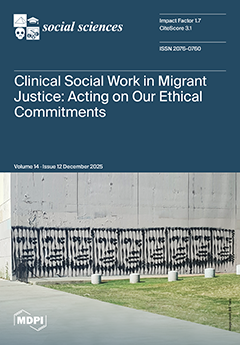
Cover Story (view full-size image): Migrating people fleeing violence and persecution face narrowing options to seek safety through immigration courts. Social work’s historical and ongoing commitment to immigrant health and immigrant justice supports an enlarged presence within asylum and other immigration processes. In the role of experts, through evaluation and testimony, social work clinicians can play an essential part in communicating the complexity of migrating people’s stories to adjudicators. They support displaced people’s human right to safety and dignity in line with the skills and values of the profession. Our paper is an invitation and roadmap for both new and established clinical social workers to use their mental health expertise to meet our profession’s ethical obligations to the human rights of migrating people. View this paper
  • Issues are regarded as officially published after their release is announced to the table of contents alert mailing list.
  • You may sign up for e-mail alerts to receive table of contents of newly released issues.
  • PDF is the official format for papers published in both, html and pdf forms. To view the papers in pdf format, click on the "PDF Full-text" link, and use the free Adobe Reader to open them.
Order results
Result details
Section
Select all
Export citation of selected articles as:
17 pages, 518 KB  
Article
Responding to Racism in the Academy: Black Women Professors Engaging in Public Discourse
by Kelsey Bogard, Ruqayyah Perkins-Williams and Mary Howard-Hamilton
Soc. Sci. 2025, 14(12), 730; https://doi.org/10.3390/socsci14120730 - 18 Dec 2025
Viewed by 236
Abstract
Perspectives on race and gender from Black women professors in higher education today are shaped by their lived experiences navigating both systemic racism and sexism within academia. These perspectives often reflect a unique intersectional understanding of institutional challenges, resilience, and advocacy for equity. [...] Read more.
Perspectives on race and gender from Black women professors in higher education today are shaped by their lived experiences navigating both systemic racism and sexism within academia. These perspectives often reflect a unique intersectional understanding of institutional challenges, resilience, and advocacy for equity. Full article
(This article belongs to the Special Issue Race and Ethnicity Without Diversity)
Show Figures

Figure 1

15 pages, 251 KB  
Article
Revisiting Social Participation in Hong Kong Older Adults During the COVID-19 Pandemic
by Stephen Cheong Yu Chan, Michael Ka Wai Lai and Chi Chung Wong
Soc. Sci. 2025, 14(12), 729; https://doi.org/10.3390/socsci14120729 - 18 Dec 2025
Viewed by 233
Abstract
Social participation is vital for older adults’ well-being. The COVID-19 pandemic disrupted daily activities, but many adapted using SOC (Selection, Optimization, and Compensation) strategies. This study examines how older adults in Hong Kong navigated adversity through strategic decision-making. Twenty-five participants underwent in-depth interviews, [...] Read more.
Social participation is vital for older adults’ well-being. The COVID-19 pandemic disrupted daily activities, but many adapted using SOC (Selection, Optimization, and Compensation) strategies. This study examines how older adults in Hong Kong navigated adversity through strategic decision-making. Twenty-five participants underwent in-depth interviews, with thematic analysis identifying key SOC-related themes: loss-based selection (reducing physical interactions, shifting engagement modes, pursuing solo activities), elective selection (volunteering, exercise, online learning), optimization (adjusting participation methods and timing, taking preventive measures), and compensation (modifying or substituting activities, supporting physical functions). Despite restrictions, older adults actively sought ways to remain socially engaged. Our findings highlight the role of SOC strategies in sustaining participation and enable us to propose a framework for adaptive changes to enhance future well-being. This research deepens discussions on social participation, offering practical insights for fostering resilience among older adults in challenging conditions. Full article
(This article belongs to the Special Issue Active Aging Across the Life Course)
18 pages, 383 KB  
Article
From Girls to Women: A Comparison of the Coverage of the Spanish Women’s National Football Team in the 2015 and 2023 Women’s World Cups
by Lara Carrascosa Puertas and Rubén Ramos Antón
Soc. Sci. 2025, 14(12), 728; https://doi.org/10.3390/socsci14120728 - 18 Dec 2025
Viewed by 426
Abstract
Professional women football players have increased in Spain, but the little more than 107,000 licences registered in 2023 are still far from the more than one million for men. Androcentrism, gender roles, and the invisibility of female athletes in the media have been [...] Read more.
Professional women football players have increased in Spain, but the little more than 107,000 licences registered in 2023 are still far from the more than one million for men. Androcentrism, gender roles, and the invisibility of female athletes in the media have been some of the problems they have faced. By comparing the media coverage of the four most widely read newspapers in Spain (Marca, El País, El Mundo, and AS) during the first World Cup played by the Spanish Women’s National Football Team (2015) and the most recent one (2023), we have identified the media characterisation of the players through discourse analysis. From the reading of 145 documents from 2015 and 375 from 2023, 39 semantic codes emerged, which rose to 47 in the second sample. The conclusions point to a trend of androcentrism through additions such as “women’s” football or “female” footballers and a proliferation of quotations in which the male coach is the protagonist, although there has been progress in the number of pages and resources used by each outlet. Regarding language, the decline in the characterisation of the players as “girls” or “youngsters” and the increase in references to their Talent or Leadership represent advances. Full article
(This article belongs to the Section Gender Studies)
Show Figures

Figure 1

12 pages, 429 KB  
Article
Gender and Sustainability in Higher Education: The Case of Female Leadership at Universidad Pontificia Bolivariana (Colombia)
by Danny Jean Paul Mejía Holguín, Ana Elena Builes-Vélez, Juliana Restrepo Jaramillo and Juan Diego Martínez Marín
Soc. Sci. 2025, 14(12), 727; https://doi.org/10.3390/socsci14120727 - 18 Dec 2025
Viewed by 374
Abstract
This study addresses the limited empirical evidence on women’s contributions to sustainable development leadership within higher education institutions. Focusing on Universidad Pontificia Bolivariana in Colombia, we employed a mixed-methods approach that combines surveys, semi-structured interviews, and bibliometric analysis of women-led scientific publications and [...] Read more.
This study addresses the limited empirical evidence on women’s contributions to sustainable development leadership within higher education institutions. Focusing on Universidad Pontificia Bolivariana in Colombia, we employed a mixed-methods approach that combines surveys, semi-structured interviews, and bibliometric analysis of women-led scientific publications and academic courses. Our findings demonstrate that women leaders at UPB significantly influence and enhance sustainable practices and policies, fostering a culture of sustainability through their formal roles and collaborative, empathetic leadership. Key characteristics include inclusivity, shared vision-building, and community responsibility. Their systematic thinking and holistic problem-solving contribute to more effective sustainability outcomes, integrating environmental values into curricula, campus operations, and community engagement. The positive impact of women’s presence in sustainability governance on the university’s performance and commitment to Sustainable Development Goals highlights the importance of the institutional context. The research highlights the importance of policies that strengthen women’s leadership in sustainability as well as for continuous measurement of their contributions within specific educational and research ecosystems. Full article
Show Figures

Figure 1

13 pages, 601 KB  
Article
Validating Scales for Measuring Self-Efficacy, Growth Mindset, and Goal Setting
by Nicole Buzzetto-Hollywood, Leesa Thomas-Banks, Leslie West and Rob Richerson
Soc. Sci. 2025, 14(12), 726; https://doi.org/10.3390/socsci14120726 - 18 Dec 2025
Viewed by 661
Abstract
Self-efficacy beliefs and mindset influence student success, impacting how a learner experiences and responds to learning situations and setbacks. Accordingly, mindset interventions, are successful at increasing student performance with particular efficacy with historically underserved students such as those attending HBCUs. This paper studies [...] Read more.
Self-efficacy beliefs and mindset influence student success, impacting how a learner experiences and responds to learning situations and setbacks. Accordingly, mindset interventions, are successful at increasing student performance with particular efficacy with historically underserved students such as those attending HBCUs. This paper studies a classroom-based mindset intervention that was implemented with the goal of increasing learning and achievement through improving the students’ cognitive disposition. The intervention, implemented at a mid-Atlantic minority serving institution of higher education, involved the creation of a custom-designed three-tool self-assessment developed to engender students’ critical reflection. The scales in question measured self-efficacy, growth mindset, and mastery goal orientation. This paper presents the results of reliability testing via Cronbach’s alpha and inter-item covariance. According to the findings, all three tools showed strong (good to excellent) reliability with acceptable positive covariance indicating that they are capable of serving as appropriate instruments for further adoption, usage, and analysis. It is the goal that this paper contributes to the body of literature on mindset interventions encouraging more individuals working with traditionally underserved learners to consider exploring efforts to increase students’ positive mindsets. Full article
Show Figures

Figure 1

18 pages, 710 KB  
Article
Contributing Factors to Cohesion Within Women’s Refugee Networks
by Siobhán C. McEvoy, Finiki Nearchou and Laura K. Taylor
Soc. Sci. 2025, 14(12), 725; https://doi.org/10.3390/socsci14120725 - 17 Dec 2025
Viewed by 294
Abstract
This study aimed to understand the contributing factors to cohesion in women’s refugee resettlement networks in Northern Ireland and the Republic of Ireland. In 2022, forty women across four networks participated in semi-structured, in-depth interviews in an exploratory study into a social phenomenon [...] Read more.
This study aimed to understand the contributing factors to cohesion in women’s refugee resettlement networks in Northern Ireland and the Republic of Ireland. In 2022, forty women across four networks participated in semi-structured, in-depth interviews in an exploratory study into a social phenomenon of community-building with refugee women resettling on the island of Ireland. We identified four themes through reflexive thematic analysis. Motherhood and Strength of Relationships related to the networks’ interactions and effect on members’ lives, whereas Leadership Dynamics and Goal Setting and Problem Solving related to the networks’ structure and practices. This study offers evidence of how members viewed their networks as having a transformative power in the process of resettling their lives in Ireland for themselves and their families. Full article
(This article belongs to the Special Issue Civil Society, Migration and Citizenship)
Show Figures

Figure 1

19 pages, 271 KB  
Article
Beyond Metrics: Racial Identity Development as Anti-Colonial Praxis in Contested Institutional Spaces
by Dwuana Bradley, Mya Haynes, Gabriela M. Torres and Stacey Speller
Soc. Sci. 2025, 14(12), 724; https://doi.org/10.3390/socsci14120724 - 17 Dec 2025
Viewed by 280
Abstract
Amid escalating attacks on the diversity, equity, and inclusion, Historically Black Emerging Hispanic-Serving Institutions (HBeHSIs) represent overlooked spaces of resistance in U.S. Higher education. This study examines how faculty and administrators negotiate racial and professional identities within institutions shaped by Black liberatory traditions [...] Read more.
Amid escalating attacks on the diversity, equity, and inclusion, Historically Black Emerging Hispanic-Serving Institutions (HBeHSIs) represent overlooked spaces of resistance in U.S. Higher education. This study examines how faculty and administrators negotiate racial and professional identities within institutions shaped by Black liberatory traditions and exclusionary HSI policy. Guided by Bradley and Tillis’s Afro-Latinidades heuristic, we link psychosocial identity development to institutional praxis and anti-colonial resistance. Interviews with 10 BIPOC professionals reveal identity ork as collective praxis challenging essentialist narratives and affirming servingness beyond enrollment metrics. Five themes illustrate work as collective praxis challenging essentialist narratives and affirming servingness beyond enrollment metrics. Five themes illustrate strategies for sustaining equity-driven missions under racial retrenchment, calling for renewed commitments to justice-centered higher education. Full article
(This article belongs to the Special Issue Race and Ethnicity Without Diversity)
12 pages, 291 KB  
Article
An Analysis of the Differences Between Unionised and Non-Unionised Workers in Psychological Well-Being, Job Satisfaction, and Life Satisfaction: A Study in Organisations Located in the Basque Country
by Imanol Ulacia, Klara Smith-Etxeberria and Angel Beldarrain-Durandegui
Soc. Sci. 2025, 14(12), 723; https://doi.org/10.3390/socsci14120723 - 17 Dec 2025
Viewed by 369
Abstract
Given the limited literature on the association between trade unions and mental health, this study aims to analyse differences between unionised and non-unionised workers in terms of psychological well-being, job satisfaction, and overall life satisfaction. These differences were analysed based on a sample [...] Read more.
Given the limited literature on the association between trade unions and mental health, this study aims to analyse differences between unionised and non-unionised workers in terms of psychological well-being, job satisfaction, and overall life satisfaction. These differences were analysed based on a sample of 260 workers from organisations located in the Basque Country, of whom 144 were members of a trade union and 116 were not. Our results suggest significant differences between unionised and non-unionised workers in terms of autonomy (t = 3.10; p < 0.01), environmental mastery (t = 2.20; p < 0.05), and personal growth (t = 2.10; p < 0.05), with trade union members demonstrating higher mean scores in all three metrics than their non-unionised counterparts. The results also revealed significant differences in job satisfaction (t = −0.31; p < 0.01), although non-unionised workers scored higher than their unionised counterparts. Contrary to expectations, no differences were found between the groups in relation to overall life satisfaction. After discussing the results, the main limitations of the study are described, and some proposals are made for future research. Full article
(This article belongs to the Special Issue Job Stress and Burnout: Emerging Issues in Today’s Workplace)
18 pages, 341 KB  
Article
Reform Without Transformation: The EU’s Diminishing Leverage in the Western Balkans
by Andrej Semenov
Soc. Sci. 2025, 14(12), 722; https://doi.org/10.3390/socsci14120722 - 17 Dec 2025
Viewed by 656
Abstract
This article explains why the European Union has not replicated Central and Eastern Europe’s (CEE) transformation in the Western Balkans (WB6). Drawing on the original External Incentives Model (EIM) conditions, the article argues that a different political climate in the WB6 requires attention [...] Read more.
This article explains why the European Union has not replicated Central and Eastern Europe’s (CEE) transformation in the Western Balkans (WB6). Drawing on the original External Incentives Model (EIM) conditions, the article argues that a different political climate in the WB6 requires attention to additional contextual conditions within the EIM framework to show how the weakened linkage between compliance and rewards emerges. Geopolitical enlargement and the presence of rival powers, a stability-over-democracy approach, bilateral vetoes, and the EU’s ongoing “permacrisis” negatively impact determinacy and EU credibility, while also increasing adoption costs. At the WB6 level, reforms become partial and reversible/at-risk, and even in cases of real progress (Montenegro and Albania), institutions remain fragile. The current arrangement serves both Brussels and local elites, providing short-term stability and keeping the WB6 on the EU path at the price of tolerating domestic capture and reforms without transformation. Yet, this arrangement carries a long-term risk of eroding the EU’s transformative power, as public dissatisfaction with local elites is not met with EU support, and rival powers exploit identity ties and elite channels. Full article
(This article belongs to the Section International Politics and Relations)
20 pages, 291 KB  
Article
Gender-Based Violence Prevalence, Psychosocial Effects, and Coping Mechanisms Among Refugee Women in Kebribeyah Camp, Ethiopia: Baseline for Interventions to Prevent Psychosocial Challenges
by Fikadu Tafesse Lakew, Getachew Abeshu Disassa and Kassim Kimo Kebelo
Soc. Sci. 2025, 14(12), 721; https://doi.org/10.3390/socsci14120721 - 17 Dec 2025
Viewed by 511
Abstract
The study investigated the prevalence of gender-based violence, its psychological effects, and coping mechanisms among refugees in Ethiopia’s Kebribeyah Camp, which is believed to be the least recognized issue for female refugees. Owing to the loss of a social network and power, refugee [...] Read more.
The study investigated the prevalence of gender-based violence, its psychological effects, and coping mechanisms among refugees in Ethiopia’s Kebribeyah Camp, which is believed to be the least recognized issue for female refugees. Owing to the loss of a social network and power, refugee women are the most vulnerable to different forms of gender-based violence and psychosocial challenges. The data collection and analysis were performed using a cross-sectional explanatory, quantitative design. The study involved 357 women refugees who were eligible for the study and found that there was a prevalence of 10.98% for GBV. In this study, it was determined that the most prevalent forms of GBV are psychological, physical, and sexual forms, respectively, which require immediate interventions. Irrational verbal and physical violence against women by men is identified as a signal for sexual violence. The mediation analysis examines the relationship between GBV acts, psychosocial challenges, and survivors’ coping strategies. GBV was found to be a significant predictor of both psychological and social difficulties, accounting for a significant variance in psychological difficulties (71%) and phobias (59%), and a substantial portion of social challenges (35%). GBV accounts for 82% of the variance in coping strategies. The study deduces the multidimensional pathway of the adverse effects of GBV among survivors, and suggests a combination of interventions to address GBV acts, psychological challenges, social challenges, and psychological phobias through an intersectional approach. Full article
(This article belongs to the Section Gender Studies)
23 pages, 813 KB  
Systematic Review
Green Social Work as a Framework for Socio-Environmental Transformation: A Systematic Review
by Maryurena Lorenzo, María Luisa Rios-Rodríguez, Cristina Chinea, Bernardo Hernández and Christian Rosales
Soc. Sci. 2025, 14(12), 720; https://doi.org/10.3390/socsci14120720 - 16 Dec 2025
Viewed by 321
Abstract
The findings of this Systematic Review suggest that Green Social Work (GSW) is gaining momentum as a framework that integrates environmental sustainability with social and relational justice. In the context of climate emergencies and deepening socio-environmental inequalities, GSW proposes a transformative vision for [...] Read more.
The findings of this Systematic Review suggest that Green Social Work (GSW) is gaining momentum as a framework that integrates environmental sustainability with social and relational justice. In the context of climate emergencies and deepening socio-environmental inequalities, GSW proposes a transformative vision for professional practice and highlights the need to rethink the role of social work in addressing ecological challenges. This article presents a systematic review of academic literature aimed at analyzing the conceptual development, areas of application, and methodological characteristics of GSW. Fifteen peer-reviewed articles were selected through a structured search in five international databases, applying inclusion criteria that required explicit reference to the GSW framework. The review examines how GSW has been implemented in practice, education, community intervention, and policy design. The findings point to emerging patterns in the application of GSW across contexts of environmental vulnerability, such as disaster recovery, rural development, and climate justice, as well as its incorporation into professional training and ethical codes. However, the review also reveals the absence of shared operational definitions and the predominance of qualitative, exploratory studies with limited generalizability. Overall, GSW offers a valuable pathway for strengthening the contribution of social work to ecological and social challenges. Its integration into education, research, and policy can enhance professional responses to complex crises, although clearer operational frameworks and more robust empirical studies are needed to consolidate GSW as a key tool for socio-environmental transformation. Full article
Show Figures

Figure 1

27 pages, 5037 KB  
Article
From Likes to Votes? Exploring Exposure to Digital Election Campaigns and Its Correlation with Voting Behavior of Young Voters in the 2025 German Federal Election
by Sebastian Jäckle and Rafael Bauschke
Soc. Sci. 2025, 14(12), 719; https://doi.org/10.3390/socsci14120719 - 16 Dec 2025
Viewed by 833
Abstract
This article examines how social media and digital channels are related to information behavior and voting among young voters (aged 18–30) during the 2025 German federal election. Based on an online survey (n = 673) conducted after the election among participants from [...] Read more.
This article examines how social media and digital channels are related to information behavior and voting among young voters (aged 18–30) during the 2025 German federal election. Based on an online survey (n = 673) conducted after the election among participants from southwest Germany and three diverse educational backgrounds, our exploratory study found no overarching generational effect in social media use or political socialization. Instagram emerged as the most important platform for political information. TikTok played a limited role overall; however, the Left Party was the only party able to gain visible support from it. In contrast, voters of the radical right Alternative for Germany (AfD) often reported receiving political content via private messenger groups, highlighting the role of non-public channels in political communication. Concerning vote choice, we find that it depends on the platform to what extent a party can benefit from digital campaigning, e.g., the Left Party benefits from frequent TikTok usage, while YouTube correlates with voting for the Greens, and messenger usage with voting for the AfD. The findings, therefore, suggest a more professionalized and targeted approach to digital campaigning, with specific parties reaching distinct voter groups through tailored platform strategies. Full article
(This article belongs to the Section International Politics and Relations)
Show Figures

Figure 1

16 pages, 862 KB  
Article
Decline in Labor Force and the Affecting Factors: Insights from System Dynamics, PEST, and SWOT Analysis in Latvia
by Viktorija Šipilova, Ludmila Aleksejeva and Aleksejs Homutiņins
Soc. Sci. 2025, 14(12), 718; https://doi.org/10.3390/socsci14120718 - 16 Dec 2025
Viewed by 462
Abstract
Like many modern economies, Latvia experiences demographic decline, which will cause shortages in the labor force in the future. This article aims to characterize the decline in the working-age population and the factors causing it using system dynamics, PEST, and SWOT analysis. First, [...] Read more.
Like many modern economies, Latvia experiences demographic decline, which will cause shortages in the labor force in the future. This article aims to characterize the decline in the working-age population and the factors causing it using system dynamics, PEST, and SWOT analysis. First, the article provides two scenarios for the numerical presentation of a long-term change in the population of working age in Latvia due to emigration. Second, the article describes political, economic, social, and technological factors important for a territory to be economically active and attractive for living and working, which, in turn, is a prerequisite for a populous territory. Third, the article characterizes current peculiarities of the labor market in Latvia given findings on political, economic, social, and technological factors, including achievements and issues. As a result of the analysis, the article provides an analysis of a highly illustrative case study of Latvia, with low birth rates and high emigration, on the one hand, and a broad understanding of reasons for demographic decline on the other hand. In combination with the current characteristics of the labor market, the analysis provides knowledge on achievements and issues for the long-term development of the labor force. The article contributes to debates through a multimethod approach to clarify both working-age population projections and factors affecting the economic attractiveness of a territory. The novelty of the research lies in the application of system dynamics for population projections and a combination of PEST and SWOT analysis for macroeconomic issues. The findings may advise policy-making. The main research findings demonstrate that the expected decline in the working-age population in Latvia is alarming. Besides policies for preventing further decline in the working-age population, policy-making should address such issues as the lack of human capital in smart specialization areas, a low interest of society in becoming an entrepreneur, and insufficient activity in high-tech sectors of the economy. At the same time, the realization of smart specialization strategies contributes to labor market resilience. Full article
(This article belongs to the Section Work, Employment and the Labor Market)
Show Figures

Figure 1

19 pages, 312 KB  
Article
Are Low-Income Households in Sri Lanka Adequately Food Secure? An Empirical Analysis with Special Reference to the Rural Sector in Sri Lanka
by N. P. Dammika Padmakanthi, Roshini Jayaweera, Anupama Dias and Dhanushka Thamarapani
Soc. Sci. 2025, 14(12), 717; https://doi.org/10.3390/socsci14120717 - 15 Dec 2025
Viewed by 278
Abstract
This study estimates the prevalence of food insecurity and coping mechanisms among low-income rural households in Sri Lanka, collecting primary data from 400 households in the Ayagama Divisional Secretariat in Rathnapura District. The results uncover that around 38.1% of the households faced food [...] Read more.
This study estimates the prevalence of food insecurity and coping mechanisms among low-income rural households in Sri Lanka, collecting primary data from 400 households in the Ayagama Divisional Secretariat in Rathnapura District. The results uncover that around 38.1% of the households faced food scarcity within a year prior to the survey date, with 77.9% being uncertain about maintaining a nutritious diet in the next 30 days. Notably, household dietary diversity scores reveal that they are either moderately (62%) or severely (22.3%) lacking essential nutrients, irrespective of the gender of the household head. The leading cause is the unaffordability of protein-rich foods and certain fruits. Coping strategies are primarily short-term and consumption-based, such as purchasing food on credit and reducing meal sizes, which propagate future food insecurity. The findings underscore the need for government interventions that combine short-term safety nets with long-term agricultural productivity improvements, alongside nutrition-sensitive practices and market stabilisation to enhance food availability and affordability. Consequently, targeted social protection programmes for vulnerable groups, combined with livelihood support and climate-resilient agriculture, could reduce reliance on harmful coping mechanisms. Lastly, this study proposes integrating food security goals within broader development frameworks and community initiatives as pivotal for long-term stability and resilience. Full article
25 pages, 883 KB  
Article
Labour Productivity, Wages, and Social Welfare: Implications for South Africa’s Budget Deficit and Fiscal Policy
by Marlin Jason Fortuin and Patricia Lindelwa Makoni
Soc. Sci. 2025, 14(12), 716; https://doi.org/10.3390/socsci14120716 - 15 Dec 2025
Viewed by 288
Abstract
This study investigates the relationship between labour productivity, wages, and social welfare expenditure (SWE) in South Africa, with implications for fiscal sustainability and budget deficits. A theoretical model linking government expenditure, taxation, and labour market dynamics is developed and empirically tested using data [...] Read more.
This study investigates the relationship between labour productivity, wages, and social welfare expenditure (SWE) in South Africa, with implications for fiscal sustainability and budget deficits. A theoretical model linking government expenditure, taxation, and labour market dynamics is developed and empirically tested using data from 1994 to 2022. Results from state and private labour market regressions reveal significant evidence of wage–productivity decoupling in the state labour market, where wages are influenced more by institutional factors than productivity growth. Conversely, private sector wages show a positive association with productivity, inflation, and working capital balances. The budget deficit model demonstrates strong alignment with empirical trends, though it underestimates the impact of economic shocks such as COVID-19. Findings suggest that increases in productivity alone will not reduce social welfare dependency in South Africa, given structural inequality, weak labour absorption, and low skills development. Policy implications highlight the need for targeted investment, industrial expansion, and education reform to mitigate rising welfare expenditure and ensure fiscal sustainability. Full article
(This article belongs to the Section Work, Employment and the Labor Market)
Show Figures

Figure 1

27 pages, 523 KB  
Article
Gender Mainstreaming in Social Work Education: Linking Faculty Practice, Student Self-Efficacy, and Institutional Climate
by Cristina Miralles-Cardona, José María Esteve-Faubel, Esther Villegas-Castrillo, Raquel Suriá-Martínez and María-Cristina Cardona-Moltó
Soc. Sci. 2025, 14(12), 715; https://doi.org/10.3390/socsci14120715 - 15 Dec 2025
Viewed by 342
Abstract
Gender mainstreaming in social work education requires moving beyond policy commitments to ensure that gender perspectives are meaningfully integrated into teaching and learning. This study examines how gender-responsive pedagogy is implemented in a Spanish public university and how these practices relate to students’ [...] Read more.
Gender mainstreaming in social work education requires moving beyond policy commitments to ensure that gender perspectives are meaningfully integrated into teaching and learning. This study examines how gender-responsive pedagogy is implemented in a Spanish public university and how these practices relate to students’ self-efficacy for gender-sensitive social work. A sample of 166 undergraduate students completed validated measures of gender-responsive teaching, self-efficacy, and institutional climate. The instruments demonstrated strong psychometric performance. Results indicate that while gender-related content is incorporated into curricula, practice-oriented and participatory pedagogies are less consistently used. Students reported high confidence in gender knowledge and attitudes but lower confidence in applied skills. Teaching methods, rather than content coverage, showed the strongest associations with self-efficacy. Institutional reforms at the degree and course levels were positively linked to teaching practices and student outcomes, whereas governance-level changes showed weaker associations. These findings highlight the importance of aligning institutional commitments with pedagogical innovation to advance gender equality in social work education. Full article
Show Figures

Figure 1

19 pages, 1145 KB  
Article
Mental Health of Ukrainian Female Forced Migrants in Ireland: A Socio-Ecological Model Approach
by Iryna Mazhak and Danylo Sudyn
Soc. Sci. 2025, 14(12), 714; https://doi.org/10.3390/socsci14120714 - 15 Dec 2025
Viewed by 380
Abstract
This study examines the perceived mental health of Ukrainian female forced migrants in Ireland through the lens of the socio-ecological model (SEM). Using binomial logistic regression on a 2023 online survey dataset (N = 656), it explores multi-level predictors across individual, relationship, community, [...] Read more.
This study examines the perceived mental health of Ukrainian female forced migrants in Ireland through the lens of the socio-ecological model (SEM). Using binomial logistic regression on a 2023 online survey dataset (N = 656), it explores multi-level predictors across individual, relationship, community, and societal domains. Results indicate that individual-level factors explain the largest proportion of variance in perceived mental health (Nagelkerke R2 = 0.399). Employment status, self-rated physical health, and coping strategies were key determinants: part-time employment and good physical health were associated with higher odds of good perceived mental health. In contrast, avoidant coping and worsening health were associated with poorer outcomes. Relationship-level factors (R2 = 0.194) also contributed significantly; lack of social support and deteriorating family or friendship ties were linked to poorer mental health, whereas participation in refugee meetings was strongly protective. Community-level factors (R2 = 0.123) revealed that unstable housing, living with strangers, and declining neighbourhood relationships were associated with reduced mental well-being. At the societal level (R2 = 0.168), insufficient access to psychological support and excessive exposure to Ukrainian news were associated with poorer outcomes, while moderate news engagement was protective. The findings highlight the multifaceted nature of refugees’ perceived mental health, emphasising the interdependence of personal resilience, social connectedness, and systemic support. Full article
(This article belongs to the Special Issue Health and Migration Challenges for Forced Migrants)
Show Figures

Figure 1

18 pages, 237 KB  
Article
Mothering in Motion: Migrant Mothers’ Spatial Negotiation of Motherhood in Urban China
by Man Zou, Yi Ouyang and Quan Gao
Soc. Sci. 2025, 14(12), 713; https://doi.org/10.3390/socsci14120713 - 15 Dec 2025
Viewed by 406
Abstract
China’s rapid urbanization has created the world’s largest internal migration, increasingly shaped by women’s participation. Co-migrant mothers—rural women who bring their children to cities—occupy complex roles as workers, wives, and caregivers. Existing studies focus on left-behind mothers or individual coping, but little is [...] Read more.
China’s rapid urbanization has created the world’s largest internal migration, increasingly shaped by women’s participation. Co-migrant mothers—rural women who bring their children to cities—occupy complex roles as workers, wives, and caregivers. Existing studies focus on left-behind mothers or individual coping, but little is known about how co-migrant mothers collectively reshape motherhood through urban spatial and social change. Based on fieldwork in a Guangzhou migrant community, this study develops the “disembedding–re-embedding–reconstruction” framework to show how mobility reconfigures motherhood. Moving from villages to cities disembeds mothers from the moral surveillance that enforces self-sacrificing norms. Community-based organizations (CBOs) then serve as re-embedding sites where women form new maternal subjectivities through mutual support and reflection, producing a locally rooted idea of self-caring motherhood. This idea reframes care as reciprocal rather than self-depleting and affirms mothers’ emotional and bodily well-being as part of family life. Finally, these values are reconstructed in households through subtle temporal and spatial negotiations that adjust gendered divisions of labor without open conflict. Highlighting collective empowerment and spatial transformation, this study moves motherhood research beyond individualized lenses and reveals grounded, pragmatic forms of gendered agency in China’s rural–urban migration. Full article
(This article belongs to the Section Family Studies)
19 pages, 284 KB  
Article
Beyond Parents: The Role of Sibling Social Capital in Self-Confidence in Emerging Adulthood
by Micah Harmon, Emily E. Pulsipher and Mikaela J. Dufur
Soc. Sci. 2025, 14(12), 712; https://doi.org/10.3390/socsci14120712 - 13 Dec 2025
Viewed by 392
Abstract
A robust literature focused on social capital created in the family has emphasized the efficacy of parental involvement in child, adolescent, and young adult development. Social capital created with and derived from parents has strong and consistent connections to academic achievement and attainments [...] Read more.
A robust literature focused on social capital created in the family has emphasized the efficacy of parental involvement in child, adolescent, and young adult development. Social capital created with and derived from parents has strong and consistent connections to academic achievement and attainments and pro-social behavior, as well as protective effects against delinquent behavior and mental health difficulties. Other forms of family social capital, however, are less well understood. In this paper, we explore the association between social capital built with and derived from siblings and self-confidence during emerging adulthood, including examining how sibling social capital built at different times might contribute to the development of self-confidence. We use restricted-use data from the National Longitudinal Study of Adolescent to Adult Health (Add Health), with information on 3630 respondents who had siblings who were also study participants, and Ordinary Least Squares (OLS) models with robust standard errors to test our hypothesis that greater sibling social capital would be associated with greater self-confidence in adolescents and emerging adulthood, net of other forms of social capital and demographic characteristics. Our findings support that hypothesis, suggesting that social capital derived from siblings is another significant potential source of key resources during important developmental stages. In particular, sibling social capital has a significant correlation to the self-confidence of individuals transitioning to adulthood. Full article
(This article belongs to the Special Issue Nurturing Bridges: Embracing Growth and Connecting Life for Children)
16 pages, 1802 KB  
Article
COVID-19 Oral Historias Project: Amplifying the Lived Experiences of San Antonio’s Hispanic Community
by Whitney Chappell
Soc. Sci. 2025, 14(12), 711; https://doi.org/10.3390/socsci14120711 - 12 Dec 2025
Viewed by 552
Abstract
Through a series of over 100 bilingual interviews with Hispanic San Antonians, the COVID-19 Oral Historias Project documents the Latino/a/e community’s experiences through the pandemic by sharing individual stories, amplifying local voices, and creating compassion in a fragmented time. The present article documents [...] Read more.
Through a series of over 100 bilingual interviews with Hispanic San Antonians, the COVID-19 Oral Historias Project documents the Latino/a/e community’s experiences through the pandemic by sharing individual stories, amplifying local voices, and creating compassion in a fragmented time. The present article documents the project itself, contextualizing its creation, detailing its methodology, highlighting the most common themes across interviews, and pointing out its novel contributions. While the interviewees’ experiences are inarguably diverse, narrative threads were found throughout the corpus, united by the duality of the narrators’ experiences; throughout this period, they simultaneously negotiated community norms and official health directives, local and international anxieties, and hopelessness and hope. The project is unique in (1) its language use, privileging minoritized ways of speaking (Spanish and Spanglish); (2) its size, with over 100 interviews; and (3) its clearly delimited scope, with all respondents living in San Antonio. This massive, unified resource creates a public collection of bilingual stories, highlighting non-hegemonic voices that are of value to the community itself, as well as to the recorded history of the pandemic, filling in historical gaps and providing real, lived accounts of this period that might otherwise be lost over time. Full article
Show Figures

Figure 1

15 pages, 358 KB  
Article
Do Families Raising Children with Autism Save for Children’s Future? An Exploratory Study from China
by Ling Zhou, Jin Huang, Yingying Zhang, Xiaoyu Huang, Xinquan Xiang and Li Zou
Soc. Sci. 2025, 14(12), 710; https://doi.org/10.3390/socsci14120710 - 12 Dec 2025
Viewed by 293
Abstract
Families raising children with autism face financial planning challenges, particularly in countries with limited social support. Using data from 497 Chinese families, this study examined saving behavior for children with autism. Results showed that only 46% of families had saved for their children’s [...] Read more.
Families raising children with autism face financial planning challenges, particularly in countries with limited social support. Using data from 497 Chinese families, this study examined saving behavior for children with autism. Results showed that only 46% of families had saved for their children’s future, with an average of 104,000 RMB. Key predictors of saving probability included debt (β = −0.02, p < 0.05), financial skills (β = 0.10, p < 0.01), financial attitude (β = 0.09, p < 0.05), and subjective financial well-being (β = 0.09, p < 0.05). Factors associated with savings amount were assets (β = 0.12, p < 0.05), debt (β = −0.07, p < 0.05), financial attitude (β = 0.57, p < 0.001), and subjective financial well-being (β = 0.56, p < 0.001). Findings highlight the need for financial capability interventions and policy support to help families manage debt, build assets, and improve long-term financial planning. Full article
Show Figures

Figure 1

13 pages, 360 KB  
Review
Four Pillars of the Immigration-Crime Myth: A Summary of U.S. Public Opinion and Research on Immigration-Crime Rhetoric
by Calvin Proffit and Ben Feldmeyer
Soc. Sci. 2025, 14(12), 709; https://doi.org/10.3390/socsci14120709 - 12 Dec 2025
Viewed by 855
Abstract
Political rhetoric on immigration has increasingly framed it as a threat to public safety—fueling aggressive immigration enforcement strategies, including the expanded use of federal agents, mass deportations, and strict border controls. In particular, the immigration-crime narrative has been built on four key themes [...] Read more.
Political rhetoric on immigration has increasingly framed it as a threat to public safety—fueling aggressive immigration enforcement strategies, including the expanded use of federal agents, mass deportations, and strict border controls. In particular, the immigration-crime narrative has been built on four key themes or “pillars,” which suggest that immigration (1) increases crime, (2) fuels gang violence, (3) is responsible for drug problems, and (4) requires mass deportation and strict border control policies to combat these issues and reduce crime. Using data from a 2025 Lucid survey and a review of existing literature, this article provides a clear and focused summary describing the extent to which these four claims of the immigration-crime narrative are supported by (1) public opinion and (2) findings from scientific research. As we highlight in the following sections, all four of these “pillars” of the immigration-crime narrative are in fact myths with no consistent empirical support. Full article
(This article belongs to the Section International Migration)
Show Figures

Figure 1

26 pages, 823 KB  
Systematic Review
Protective Factors of Resilience and Well-Being Among Natural Hazard Event Helpers: A Rapid Systematic Literature Review
by Elena Grossi, Silvia Marocco, Michela Cortini, Teresa Galanti and Alessandra Talamo
Soc. Sci. 2025, 14(12), 708; https://doi.org/10.3390/socsci14120708 - 11 Dec 2025
Viewed by 413
Abstract
The management of natural hazard events has significant consequences for the well-being of the operators who find themselves intervening in these situations. In order to protect their mental health and ensure an effective response in support of the community, it is necessary to [...] Read more.
The management of natural hazard events has significant consequences for the well-being of the operators who find themselves intervening in these situations. In order to protect their mental health and ensure an effective response in support of the community, it is necessary to identify the factors that protect the well-being and resilience of operators and to exploit and enhance them. This rapid systematic literature review aims to detect and summarize evidence about protective factors of resilience and well-being among natural hazard events helpers; the literature was searched for on Scopus, Web of Science, Pub-med, and PsycINFO, resulting in 876 records. After a full-text screening, 84 records were selected to meet the inclusion criteria and examined in this paper. The results underline the variety of research methods and samples adopted by the included studies. Moreover, the results highlight the relevance of both the role of individual factors, such as personality aspects, coping strategies, and the level of exposure to the disaster/community, and the role of organizational/social factors, such as training, organizational issues and social support on the well-being and resilience of helpers. In conclusion, this rapid review indicates that the empowerment of helpers is an important source of resilience; it must be promoted inside the organization both at an individual and supportive level (through, for example, training on self-care strategies) and at a more organizational and social level, enhancing internal and team resources. Full article
Show Figures

Figure 1

1 pages, 126 KB  
Correction
Correction: Warthe et al. (2025). Dating Violence on Post Secondary Campuses: Men’s Experiences. Social Sciences 14: 544
by D. Gaye Warthe, Catherine Carter-Snell and Peter Choate
Soc. Sci. 2025, 14(12), 707; https://doi.org/10.3390/socsci14120707 - 11 Dec 2025
Viewed by 176
Abstract
In the original publication [...] Full article
24 pages, 917 KB  
Article
Resisting Uniformity: How Transgender and Gender-Diverse Teachers Subvert School Dress Codes for Self-Affirmation and Possibility
by Kayden J. Schumacher, Lis Bundock and Peter Clough
Soc. Sci. 2025, 14(12), 706; https://doi.org/10.3390/socsci14120706 - 10 Dec 2025
Viewed by 433
Abstract
Transgender and gender-diverse teachers occupy a precarious position within educational spaces, often facing increased scrutiny and regulation aimed at disciplining their gender expression. This article brings to light original and significant insights by exploring how transgender and gender-diverse teachers resist and subvert cisnormative [...] Read more.
Transgender and gender-diverse teachers occupy a precarious position within educational spaces, often facing increased scrutiny and regulation aimed at disciplining their gender expression. This article brings to light original and significant insights by exploring how transgender and gender-diverse teachers resist and subvert cisnormative dress codes, as acts of self-affirmation and resistance within their professional educational contexts. Through an unconventional lens of Barad’s feminist new materialism combined with Wieringa’s continuum of symbolic subversion, our analysis offers an important theoretical contribution by interpreting how these individuals negotiate and challenge institutional cisnormativity, unsettling the tacit expectations of gendered professionalism in their trans embodiment. Drawing on the experiences of three transgender and gender-diverse teacher participants, a group often overlooked, this paper integrates findings from two distinct qualitative studies which used a participatory-focused ‘object-interview’ methodology. Findings from these in-depth studies reveal that transgender and gender-diverse teachers trouble dress code regulations by simultaneously embodying resistance and compliance, effectively reshaping and disrupting gendered expectations and institutional norms. While some forms of self-affirmation expressed by participants remained unseen, others materialised as embodied subversions of normative organisational expectations. Additionally, the degree of agency these teachers have in resisting binary dress code constraints is contingent on the entanglements of the teachers themselves, students, school policies, leadership and institutional climates. Unexpectedly, this research suggests that schools can act as sites of visibility and safety for transgender and gender-diverse teachers, where gender expression is validated and extends beyond the classroom. This article concludes by recognising that, when transgender and gender-diverse teachers resist uniformity and dress code norms, they embody their affirmed identities and, in doing so, offer vital representation for transgender and gender-diverse students, providing a sense of belonging, possibility, and authenticity within educational spaces. Full article
(This article belongs to the Special Issue The Embodiment of LGBTQ+ Inclusive Education)
Show Figures

Figure 1

18 pages, 299 KB  
Article
The Public Perception of Hate Speech Regulation in Unconventional Media
by Ismael Crespo Martínez, Inmaculada Melero López and María Isabel López Palazón
Soc. Sci. 2025, 14(12), 705; https://doi.org/10.3390/socsci14120705 - 10 Dec 2025
Viewed by 322
Abstract
This study provides one of the first quantitative analyses regarding citizens’ perception of hate speech regulation in Spain, based on the influential, empirical study of the Torre Pacheco case. The research at hand statistically validates the correlation between the consumption of content through [...] Read more.
This study provides one of the first quantitative analyses regarding citizens’ perception of hate speech regulation in Spain, based on the influential, empirical study of the Torre Pacheco case. The research at hand statistically validates the correlation between the consumption of content through unconventional media and a reduced tendency to accept regulatory measures, a significant finding given the current climate of growing disinformation and digital polarization. The results indicate that women are more likely to support regulation, while individuals who are politically more conservative tend to reject such intervention. The conclusions highlight a potential association between political affiliation, trust in state institutions, and resistance to content regulation in the digital environment, which provide key insights into the current challenges facing democratic governance. Full article
(This article belongs to the Special Issue Understanding the Influence of Alternative Political Media)
1 pages, 126 KB  
Correction
Correction: Hazan-Liran and Levkovich (2025). The Weight of Loneliness: Family Resilience and Social Support Among Parents of Children with and Without Special Needs. Social Sciences 14: 531
by Batel Hazan-Liran and Inbar Levkovich
Soc. Sci. 2025, 14(12), 704; https://doi.org/10.3390/socsci14120704 - 9 Dec 2025
Viewed by 197
Abstract
Missing Institutional Review Board and Informed Consent Statements [...] Full article
17 pages, 709 KB  
Article
Assessing the Relationship Between the Implementation of Compulsory Education Laws and Girls’ School Attendance in Twenty-Seven Countries
by Bijetri Bose, Alfredo Martin, Amy Raub and Jody Heymann
Soc. Sci. 2025, 14(12), 703; https://doi.org/10.3390/socsci14120703 - 8 Dec 2025
Viewed by 402
Abstract
Achieving education for all and gender parity in education is central to Sustainable Development Goal 4. However, there are still an estimated 78 million primary-school-age children and 64 million lower-secondary-school-age children. Half of these out-of-school children live in sub-Saharan Africa. Disproportionately, girls are [...] Read more.
Achieving education for all and gender parity in education is central to Sustainable Development Goal 4. However, there are still an estimated 78 million primary-school-age children and 64 million lower-secondary-school-age children. Half of these out-of-school children live in sub-Saharan Africa. Disproportionately, girls are out of school, particularly rural and low-income girls. Building longitudinal policy data from 51 African countries and using data on school attendance from 35 African countries, we assess school attendance in the 27 countries that had made at least primary education compulsory and tuition-free. We find that once education becomes compulsory, it is possible to achieve gender parity in education. In 20 of the 27 countries studied with compulsory tuition-free education, primary-school-aged girls were as likely or slightly more likely than boys to be reported as attending school. Rural girls were more likely to be out of school than urban girls and girls from the poorest households were more likely to be out of school than girls from the richest households. Importantly, in countries where overall implementation was high, the gaps for girls across location and social class were small, indicating strong implementation is feasible in rural areas and in poorer neighborhoods. Full article
Show Figures

Figure 1

20 pages, 876 KB  
Article
Polarization and Politicization in Media Discourse: Comparing Climate Change Narratives in Italy and the U.S.
by Alessandra De Luca and Mara Maretti
Soc. Sci. 2025, 14(12), 702; https://doi.org/10.3390/socsci14120702 - 8 Dec 2025
Viewed by 302
Abstract
This study investigates how Italian and American media frame climate change through politically oriented and, in some cases, populist narratives that challenge the principles of the open society. The analysis draws on a dataset of 71 items from eight outlets, evenly divided by [...] Read more.
This study investigates how Italian and American media frame climate change through politically oriented and, in some cases, populist narratives that challenge the principles of the open society. The analysis draws on a dataset of 71 items from eight outlets, evenly divided by country and political alignment, collected from Facebook posts that generated at least forty comments. A mixed-methods design was employed, including keyness analysis, topic modeling, keyword-in-context exploration, and qualitative content analysis. The findings show clear cross-national and ideological differences: conservative sources rely more heavily on politicized and populist framings, particularly in the U.S., where climate change is frequently narrated through an antagonistic “elites versus ordinary citizens” lens associated with skepticism toward scientific authority and sustainable technologies. Italian media display a more technocratic approach, emphasizing institutional, economic, and policy dimensions within the European context. Progressive sources in both countries rely more consistently on scientific and policy-oriented arguments, although American progressive outlets show higher political engagement than their Italian counterparts, likely in response to the stronger populist rhetoric and distrust of expertise found in U.S. conservative media. Overall, the results highlight how populist narratives can shape climate communication and influence the openness of public debate in different democratic contexts. Full article
(This article belongs to the Section Contemporary Politics and Society)
Show Figures

Figure 1

18 pages, 312 KB  
Opinion
Clinical Social Work’s Place in Migrant Justice: A Call to Act on Our Ethical Commitments
by Cherra M. Mathis, Mary Lehman Held, Karen E. Latus and Laurie Cook Heffron
Soc. Sci. 2025, 14(12), 701; https://doi.org/10.3390/socsci14120701 - 5 Dec 2025
Viewed by 783
Abstract
Migrating people fleeing violence and persecution face narrowing options to seek safety through the U.S. immigration courts. Social work’s historical and ongoing commitment to immigrant health and immigrant justice supports an enlarged presence within asylum and other immigration processes. In the role of [...] Read more.
Migrating people fleeing violence and persecution face narrowing options to seek safety through the U.S. immigration courts. Social work’s historical and ongoing commitment to immigrant health and immigrant justice supports an enlarged presence within asylum and other immigration processes. In the role of experts, social work clinicians can evaluate displaced people to collect evidence of harm, draft reports and affidavits for the lawyer, and may even testify to educate the court on the physical and mental sequelae of violence and trauma. They play an essential part in communicating the complexity of migrating people’s stories to adjudicators. Social work clinicians seeking to join this work will attune to cultural humility, relationship building, and an opportunity to support displaced peoples’ human right to safety, in line with the skills and values of the profession. This paper serves as a brief introduction to how clinical social workers can use their mental health expertise to contribute to immigrant legal proceedings, as well as a call to action to invite both new and established social workers to use their clinical skills to meet our profession’s ethical obligations to the human rights of migrating people. Full article
(This article belongs to the Special Issue International Social Work Practices with Immigrants and Refugees)
Previous Issue
Next Issue
Back to TopTop
