1. Introduction
Football has been considered a male sport whose expansion was, for years, exclusively linked to the format played by men. For example, although women’s football was not explicitly prohibited, in the country where modern football originated (England), it was legally hindered in the early twentieth century, as its practice was banned on the grounds of clubs affiliated with the English Football Association (FA) (
Jenkel 2021). Further evidence of this restrictive context is that the first men’s world championship was played in Uruguay in 1930, while the women’s, after some previous attempts, had to wait until 1991, with its first edition being held in China. As for the Olympic Games, while the men’s discipline was incorporated in Paris in 1900, women’s football made its appearance in the tournament in Atlanta in 1996. The modern Olympic Games, in fact, emerged as an event with a distinctly misogynistic character, as evidenced by the fact that their leading figure, Pierre de Coubertin, was openly opposed to the participation of women in them (
Mateos Padorno et al. 2010).
Furthermore, over the years, football has constituted a space conducive to misogyny and homophobia (
Brancher et al. 2022), in which women have had to employ various strategies in order to fit in (
Jones 2008). This situation has gradually changed with the growing popularity of women’s football, although this misogyny has not been fully eradicated (
Martínez-Corcuera et al. 2024).
Considering the level of regular participants in the sport, despite a notable rise among women in recent years, a significant gap between the sexes remains evident. In 2002 in Spain, over 618,000 people held a football federation licence (a sports licence is an authorisation issued by a governing sports federation that certifies an athlete’s eligibility to participate in regulated training and competitive activities), of which only about ten thousand were women, representing a meagre 1.7%. With the passage of time and the growing popularity of women’s football, bolstered by the sporting successes achieved by Spanish teams on the international stage (both at club level, with the three Champions Leagues won by Fútbol Club Barcelona since 2020/21, and by the Spanish National Team, World Cup champions in 2023 and Nations League champions in 2024), the number of women’s licences has increased by over 1000%, yet it still lags far behind the numbers for men. Thus, in 2023, over one million one hundred thousand men’s licences were recorded compared to just over 107,000 women’s (8.6% of the total) (
Consejo Superior de Deportes n.d.). In this regard, it must be borne in mind that the incorporation of women into this sport entails “a crisis in football as a sport representative of masculinity” (
Ruiz 2011, p. 32), which means that the women who play, simply by doing so, are already transforming a social reality. However, even though symbolic inclusion has been achieved “through federation acknowledgment and the launch of national competitions, real access and legitimacy have been consistently undermined by persistent gender ideologies and economic marginalisation. These limitations are not isolated incidents but part of a broader system of exclusion that reinforces patriarchal norms” (
Nagel et al. 2025, p. 18). In fact, the Australian women football players “have largely adopted a frame of gratitude, optimism, and persistence to explain their experiences”, despite the fact that merely increasing the number of women in football clubs does not directly or necessarily transform their patriarchal structure (
Richardson et al. 2025, p. 14).
This study aims to analyse several aspects of the Spanish press coverage of the Spanish Women’s National Football Team’s first participation in a Women’s World Cup (2015) and their most recent one, in which they became champions.
This conception of women as subjects of sport with different aims to those of men has been justified by the androcentric perspective of the world in general and elite sport in particular (
Flores et al. 2022). Consequently, legislation in different countries has taken steps to correct a tendency that symbolically impedes women’s access to sport. In Spain, Organic Law 3/2007 for the Effective Equality of Women and Men establishes, in Article 29, that “all public programmes for the development of sport shall incorporate the effective consideration of the principle of real and effective equality between women and men in their design and execution” and that “the Government shall promote women’s sport and favour the effective opening up of sporting disciplines to women, through the development of specific programmes at all stages of life and at all levels, including those of responsibility and decision-making”. Furthermore, Law 39/2022, of 30 December, on Sport, establishes measures to guarantee equal access to sports practice for men and women, which are specifically set out in Article 4. Despite the reluctance and difficulties that a field such as sport still maintains for the development of real equality, this regulation has represented clear progress in that direction (
Pérez and Barquero-Ruiz 2024).
It should not be forgotten that the years of the Francoist Dictatorship meant an enormous setback in the rights acquired by women, who were once again limited to the home and the roles of mother and caregiver. In fact, in the 1920s, such relevant figures as Gregorio Marañón maintained that a woman’s only function in sport was to be “the prize” for athletes who won an award in competition (
Torrebadella-Flix 2016). In this way, “the behaviour patterns used in sport are constructed and derived from the social, cultural, and historical context where they take place, showing a strong tradition and resistance to change” (
Mérida et al. 2022, p. 302), as has occurred in Spain.
In approaching this research, we start from the premise that gender stereotypes, “a set of socially shared beliefs about the characteristics possessed by males and females” (
D’Adamo et al. 2008, p. 92), still affect and shape the discourse emitted by the press, especially when the subjects of discourse are, precisely, women who do not conform to the applied gender role, as is the case in the subject we are dealing with:
In football, the performance of women is, generally, perceived and produced by different discursive regimes—mainly the media regime—as naturally inferior to that of men. This suggests that women’s performance is perceived as something that would obey limitations given by their sexual nature or the supposed nature of their gender (
Dias 2018, p. 137).
Part of that constant comparison with men stems from an androcentric approach, which establishes the former as subjects of full rights, while women appear as The Other, defined in relation to him (
De Beauvoir 2015), those who also have the right to play in the highest competition.
In this regard, the discourse broadcast by the media is relevant, given that it permeates the collective consciousness and is capable of reinforcing or breaking down gender stereotypes. Thus, if we limit ourselves to linguistic aspects,
Bengoechea (
2015, p. 109) points out that the direct style is usually indicative “of the perspective adopted by the newspaper, as it lends itself to an interpretation of the words spoken, which are not granted sufficient authority to be reproduced literally”. Linguistic mechanisms have also been identified to displace the players’ protagonism, such as the Genitive code used in this analysis, which manifests a tendency “towards the personification of the team in a single person” (
Carrascosa 2021). Within linguistic sexism, the use of the generic masculine would also occupy a prominent place, as a tendency that leads to “the concealment and/or subordination of women in discourse” (
Toledano 2022, p. 241).
2. Materials and Methods
The general objective of this research is to compare the media coverage (texts, photographs, images, and layout elements) of the Spanish Women’s National Football Team in the El País, El Mundo, Marca, and AS newspapers during the first World Cup in which they participated (2015) and the most recent one (2023), which they won. In this regard, the specific objectives are:
To analyse formal aspects of the published texts with the aim of finding patterns in the representation of the female footballers in the media (SO1).
To identify mentions in the media discourse that contribute to the construction of the public image of the sportswomen, taking into account the attributes and qualities that are highlighted about them (SO2).
To compare the results obtained to infer conclusions related to the agenda-setting of general and specialised press
1, as well as their discourse on the female footballers (SO3).
To ascertain the evolution of the journalistic treatment of women’s football through the monitoring of two World Championships (2015 and 2023) (SO4).
To achieve these objectives, a compilation of the texts and images from the aforementioned newspapers that mentioned the Spanish National Team was carried out for the periods of 7 June to 6 July 2015 and between 24 July and 21 August 2023, both of which coincided with the day after the start and the end of the World Cups. The choice of the four newspapers was motivated by the fact that they had the highest number of daily readers in the third wave of the Encuesta General de Medios (General Media Survey) in 2015 (
AIMC 2015) and in 2023 (
Reason Why 2023). Empirical studies highlight the enduring trust and institutional legitimacy associated with printed news, which distinguishes it from ephemeral digital platforms and reinforces its role as a stable source for research and public discourse analysis (
Strömbäck et al. 2020).
Initially, notes were taken on formal aspects of the four newspapers, referring to the banners, bylines, photographs, and front-page mentions, considered relevant for understanding the evolution or involution of the analysed media. Subsequently, an analysis of the content of the texts was carried out, followed by an analysis of the media discourse about the female footballers. This critical discourse analysis aims to combine language analysis with the analysis of social structure and cultural practice (
Matheson 2005). “Beyond description or superficial application, critical science in each domain asks further questions, such as those of responsibility, interests, and ideology” (
Wodak 1989, p. XV) For this purpose, the Atlas.ti programme was used, and codes were created to group and unify the quotations in a qualitative approach to the research based on Grounded Theory, which is that which seeks the “emergence of a set of conceptual hypotheses that can account for the variety of described events and occurrences” (
Trinidad et al. 2006, p. 17).
From the reading of the 145 documents in the empirical corpus of the first Women’s World Cup in which the Spanish National Team participated (2015), 57 codes emerged. These codes were subsequently reused and expanded to 67 in the analysis of the 375 documents from the 2023 World Cup sample. Consistent with the design of this research, the codes were grouped into Semantic Aspects (39 in the 2015 sample and 47 in the 2023 sample), Formal Aspects and Journalistic Genres, with the latter being integrated into Formal Aspects.
We carried out an open, inductive coding process in which we remained ‘open’ to the ideas emerging from the text, some of them based on the theoretical knowledge we had from previous research on the topic. Other recurring expressions or meanings were selected as free quotations until we identified the wording of a code that captured the overall ‘sense’ of the expression. Each of the codes was defined in order to avoid arbitrariness.
3. Results
In 2015, none of the articles about the World Cup published in El Mundo were signed by a female journalist. All the texts were signed by Javier Sánchez, José Parra, and Eduardo J. Castelao. Furthermore, none of them travelled to cover the event. The same is true for El País, with no female bylines in the news reports. As an exception, we found a single female byline (Ana Rosell) in one analysis piece. Regarding formal aspects, El Mundo does not have a banner for the World Cup, but it does use locators in some columns marking “Women’s World Cup”. The same occurs in El País, except on the specific pages of the Sports supplement, where it alternates “Canadian World Cup” with “Women’s World Cup of Canada”.
Regarding the sports newspapers, we must highlight that Marca did dispatch a journalist, Javier de la Casa, to Montreal, but, as is the case in the general interest press, none of the bylines addressing the topic are female. AS, for its part, does feature female journalists: Amalia Fra, who was sent to Canada. Furthermore, Bárbara Quesada signs interviews from Montreal, and a third professional, Marina Romero, writes when the players arrive in Madrid. Also notable among the opinion columnists is Isabel Roldán, as she is one of the few women who regularly authors opinion pieces, thus serving as an example of women’s agency and authority in a traditionally male-dominated area. In its page layout, the banners on Marca state “National Team. Canadian Word Cup”, meaning there is no androcentrism in them because it is not specified that either the World Cup or the team is the women’s one, as happens in other cases. However, just above, next to the pagination, they do specify “Fútbol femenino” (Women’s football). Nonetheless, this element is occasionally modified and the tag line “femenino” (women’s) is removed.
The banner on AS, for its part, refers to the “femenina” (women’s) national team or the “Mundial femenino” (Women’s World Cup). The most frequently used banner is “Canada 2015”, although they occasionally include a specific detail.
Although not directly related to the World Cup coverage, we consider it relevant to mention that AS, in 2015, still featured sexualised images of women on its back page, in the section “La chica de AS” (The AS Girl). This element was no longer present in the 2023 sample. Under the guise of a photo-news item and with titles such as “Jessica ruge con el motor” (Jessica growls with the engine) or “A Britanny le encanta el basket” (Brittany loves basketball), the newspaper featured photos of young, attractive women with large breasts, often in their underwear and posed with unnatural expressions and postures. This element is similar to the Page Three Girl of the British newspaper The Sun, which was discontinued in 2015.
Regarding the formal aspects of El Mundo’s media coverage of the 2023 World Cup, female bylines appeared in the coverage. These included Iria Otero, with no location given or from Pontevedra, and Inma Lidón, from Valencia. On 18 August, Luis de la Cal appeared, signing as a Direct Witness, in Sydney. Later, he was identified as a special correspondent. In the opinion section, Vicky Losada, a former player, signed an article. In contrast, El País did have a journalist deployed to Australia from the start of the World Cup, Jordi Quixano. On some occasions, Marion Reimers also provided a byline from Mexico. In terms of layout, El Mundo did not use specific banners but in some texts did highlight the “femenino” (women’s) tag in other titling elements; the opposite of El País, which did have a specific banner for these pages
Marca, for its part, had three special correspondents at the 2023 World Cup, all with male bylines: David Menayo, Pablo Parra, and Matt Cannon. Meanwhile, AS again had a notable presence of female bylines: Amalia Fra (as a correspondent), Aimara G. Gil (in opinion or with no data given), Marta Griñán (with no data given), and Patricia Campos (in opinion). The male bylines were Raúl Castro, Christian González, and Juan Jiménez (opinion). Two other individuals signed with initials, making it impossible to determine their gender: H. Martínez (opinion) and G. Caquero (from Wellington).
Regarding the distribution of formal aspects such as the banners, Marca uses the banner “Selección (f)—Mundial 2023” (Women’s National Team—World Cup 2023) to which they add other elements, such as the countries the team is about to face or the remaining days. AS also features its own banner for these pages, which does highlight the word “femenino” (women’s).
The number of pages on which text dedicated to both World Cups was found varies depending on the type of newspaper: generalist newspapers dedicated less space, with
El Mundo being the least interested in the competition, while specialist newspapers threw themselves into the coverage. In the 2015 tournament,
Marca was slightly ahead, while in the 2023 tournament,
AS surpassed it by six pages (
Table 1). However, this data must be contextualised by considering the type of journalistic piece and the layout.
3.1. Formal Aspects
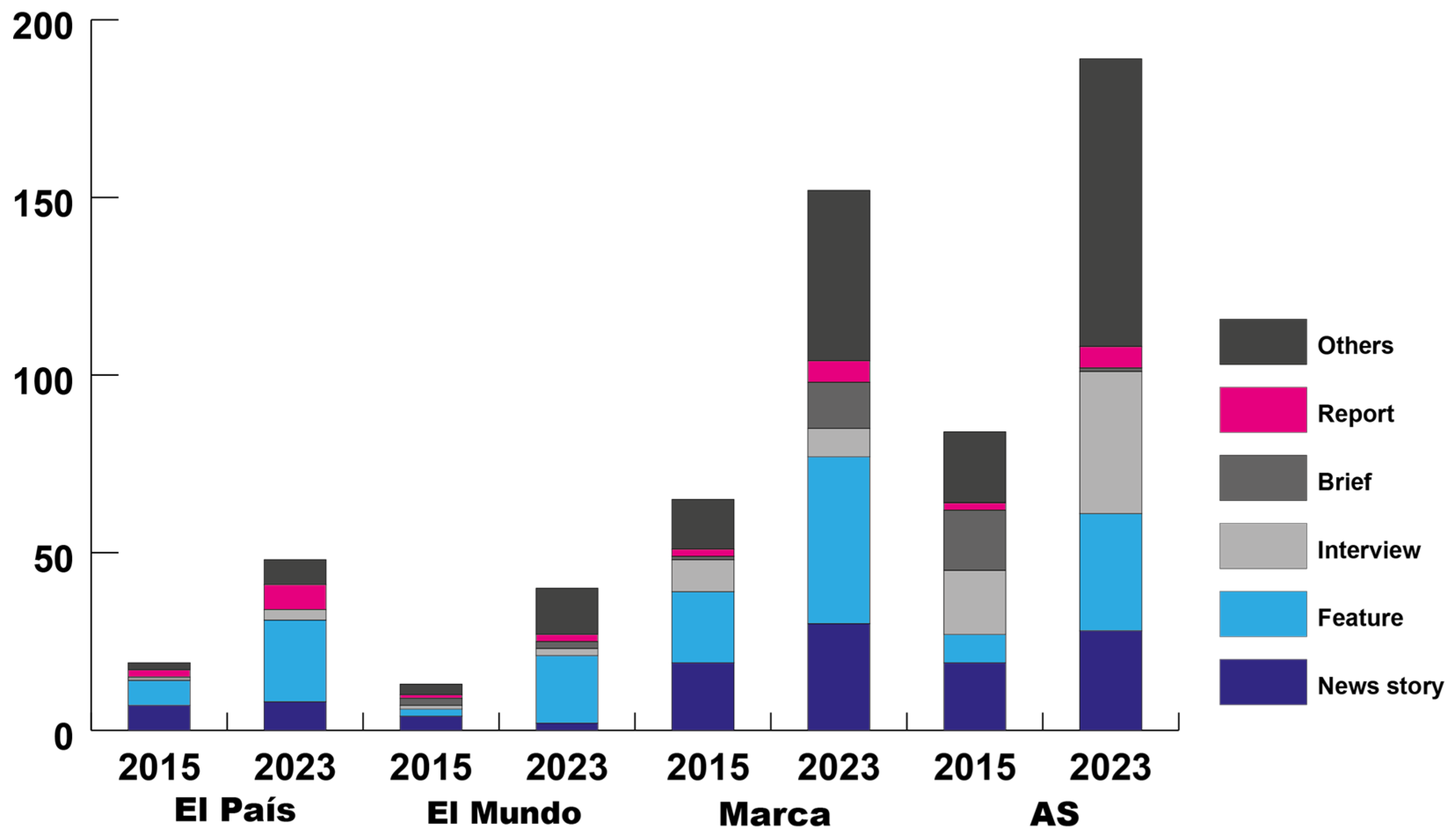
The texts were categorised according to journalistic genre, and in the coverage of the 2015 World Cup, a pre-eminence of news reports (49) is observed, followed by feature articles (37) and interviews (29). Twenty briefs (17 in
AS) were published, which provides data on the media space occupied by the athletes. In the specialist media, the feature article in
Marca (20) and the interview in
AS (18) stand out. The total number of pieces was 181. In the 2023 World Cup, however, the trend concerning journalistic genres is reversed, and the feature article is the genre with the highest number of pieces (122), followed by opinion articles (75) and news reports (68). The total was 429 pieces, the distribution of which by newspaper, piece count, and year can be consulted in
Figure 1.
Regarding graphic representation, a total of 135 photographs related to the Spanish National Team were published during the 2015 World Cup. In 25 of these, the coach, Ignacio Quereda, was the protagonist or main figure, which represents 18.52% of the total. Furthermore, out of the 18 front pages where the team was mentioned, six also included an image of the coach or mentioned him (33.33% of the total). In the 2023 World Cup, the number of images rose to 486, with Jorge Vilda, the national coach, being the protagonist in 40 of them (8.23%). It is noteworthy that, although the coach’s graphic prominence was limited, he was mentioned or his image was used on 11 of the 77 front pages (14.29% of the total). On the Marca and AS front pages of 19 August, Vilda garnered all the attention.
Regarding the text, the number of direct and indirect quotes was also analysed, establishing a clear superiority for the former in the newspapers in 2015 (206 quotes versus 45) and in 2023 (614 versus 16). For the generic masculine, only 5 quotes were registered in 2015, but this rose to 28 in 2023 (
Table 2). An example is: “[Del Bosque] admitió desconocer la situación dentro del vestuario, y se mostró ‘partidario de escuchar a los jugadores, porque parte del éxito proviene de su inspiración’” (“[Del Bosque] Admitted to not knowing the situation inside the dressing room, and stated he was ‘in favour of listening to the players, because part of the success comes from their inspiration’”) (
J. Parra 2015, p. 40). In 2023, the interview with Jorge Vilda, in which he assures: “También creo que ha sido un año que nos ha hecho mejorar a todos” (“I also believe it has been a year that has made us all improve”) (
P. Parra 2023, p. 3).
In Spanish, the unmarked gender is the masculine. This form ‘refers to the member of a binary opposition that can encompass the whole, rendering it unnecessary to mention the marked term’ (
RAE and ASALE 2009), namely the feminine grammatical gender. Thus, the term ‘generic masculine’ designates the use of the masculine form to refer to a group that may include women and even contexts in which women constitute the majority, as is the case with women football players. This use of grammatical gender—commonly referred to as the generic masculine—is endorsed by the Real Academia Española (the Royal Spanish Academy), yet it is contested by a number of feminist theorists (
Bengoechea 2015).
In summary, the analysis of the formal aspects that emerged from the newspapers reviewed suggests greater attention (an increase in the number of texts, more extensive and elaborate journalistic genres such as feature stories, and correspondents sent on assignment) to the coverage of the Women’s Football World Cup. However, issues of invisibility (photographs and quotes from male coaches) and problems in language use, such as the generic masculine, persist.
3.2. Semantic Aspects
From the reading and analysis of the texts in the 2015 sample, 39 semantic codes emerged, which rose to 47 in 2023. Those with significant results have been selected for this analysis, although the complete comparison of the number of quotes can be consulted in
Table 3.
The codes related to male coaches were those that gathered the highest number of citations. Ignacio Quereda received a total of 279 in 2015, while Jorge Vilda reached 599 in 2023. The Androcentrism code was the second most entrenched, with 165 citations in 2015 and 289 in 2023. Similarly, the Genitive code, which tallies the citations that shift attention towards the coach, accrued 32 citations in 2015 and 72 in 2023.
On the other hand, the citations indexing comparisons with men’s football were 54 in 2015 and 131 in 2023. Although many of these refer to the wage or sponsorship gap (tallied with the Money code, with 24 citations in 2015 and 88 in 2023), the Machismo code, which required an explicit mention of the word or behaviour, only accrued 12 citations in 2015 and 5 in 2023. Feminism, which indexed complaints about the lack of equality, did gather more mentions, with a total of 54 in 2015 and 96 in 2023.
To tally the aspects of language that infantilise the players, we created the code “Girls” to index citations that refer to them in that way. There were 90 citations in 2015, while in 2023 this number dropped to 25, even though the number of texts analysed was higher. Codes such as Mansplaining, Paternalism or Arrogance also experienced a decrease from 2015 to 2023 (from 21 citations to 2; from 37 to 6, and from 42 to 6, respectively). Similarly, the code “Lack of professionalisation” referred to criticism about the absence of professional treatment for the athletes and reached 99 citations in 2015, but only 27 in 2023. References to “Lack of experience” of La Roja compiled 24 citations in 2015 and only 2 in 2023.
Regarding the analysis of the messages articulated about the players’ performance, the Talent code accrued 24 citations in 2015, but 76 in 2023. The same occurred with Determination, which refers to the players’ eagerness to improve and which counted 55 citations in 2015 and 120 in the 2023 empirical corpus. It seems significant that the 2015 texts mentioned Luck or the lack thereof on 26 occasions, but only 17 in the 2023 World Cup. Finally, mentions of the Leadership of any of the players rose to 15 citations in 2015 and 27 in 2023.
Part of the two empirical corpora partially addresses three controversies concerning the National Team. In 2015, the players requested the dismissal of coach Ignacio Quereda and, in 2023, an email sent by 15 players refusing to be called up and the non-consensual kiss by Rubiales. In this regard, the code Rebellion emerged, to index all mentions that the players had rebelled or staged a mutiny, as this way of expressing it was considered to detract from the legitimacy of the protest in a democratic society. In 2015, Rebellion had 26 citations, while in 2023, it had 32. Another of the codes, denominated as “Not like this”, brought together all the criticism received on both occasions because the players did not channel their complaints, according to various individuals, through “the correct channels.” In 2015, we counted 36 citations of this code and only 4 in 2023. However, other codes such as Reprisals, which refers to the punishments inflicted on players who complain, reached 30 citations in 2015 and 19 in 2023. The Fear precisely of these reprisals was mentioned on 12 occasions in 2015 and on no occasion in 2023. This result may be influenced by the fact that in the empirical corpus analysed in 2015, the players were eliminated early from the competition and decided to demand the resignation of coach Ignacio Quereda due to his lack of professionalism and mistreatment. In this way, a prior resignation request came to light—and the players who signed it were never called up again (Reprisals). However, the controversy over the non-consensual kiss by the then president of the Spanish Football Federation, Luis Rubiales, who was later convicted by the National Court for sexual assault for this act, developed and was published only after the end of the World Cup. An example of Fear and Reprisals is: “La sensación de desgaste en el vestuario es antigua. Si no se expresó antes de forma más clara fue por miedo a que el técnico acaba prescindiendo de las rebeldes y pudieran quedarse sin su primer Mundial. Ahora ya no importan las represalias” (‘The feeling of burnout in the changing room is long-standing. If it was not expressed more clearly before, it was out of fear that the coach would end up dispensing with the rebellious players and that they could miss out on their first World Cup. Now, reprisals no longer matter’) (
Nieto 2015a, p. 32). In 2023, an example of Rerprisals is: “Alexia, Jenni y Paredes no estaban entre
Las 15, pero de una forma u otra les manifestaron su apoyo. Volvieron paulatinamente a la selección, pero despojadas del brazalete de capitanas y con un foco menor […]” (‘Alexia, Jenni and Paredes were not among
Las 15, but in one way or another they expressed their support. They gradually returned to the national team, but stripped of the captain’s armband and with less visibility […].’) (
Menayo 2023, p. 15).
Finally, the codes Insults and Irony compile the mockery suffered by the players. The first of these collected 17 citations in 2015 and 19 in 2023. Examples from 2015 include: “«Mira, ahí hay una chica más tonta que tú», soltó en voz alta Ignacio Quereda […]”. («Look, there’s a girl who is more stupid than you», Ignacio Quereda blurted out aloud […]”) (
Nieto 2015b, p. 36), and from 2023, in an opinion piece: “Estas futbolistas han derribado cimientos rancios y arcaicos que aún quedaban en torno al fútbol femenino («no sabéis jugar», «parecéis marimachos», «las niñas no juegan al fútbol) para construir ilusiones, sueños e igualdad”. (“These footballers have torn down the stale and archaic foundations that still remained surrounding women’s football («you don’t know how to play», «you look like tomboys», «girls don’t play football») to build dreams, aspirations, and equality”) (
Fleitas 2023, p. 10).
Co-Occurrences of Semantic Codes and Comparison Across Newspapers
With the aim of establishing relationships between the semantic codes, we analysed the co-occurrences of codes between “Money” and other codes that might justify or qualify the content of the messages. Thus, it is worth noting that neither in the 2015 nor the 2023 empirical corpus was any co-occurrence found with Machismo, although co-occurrences were found with other codes such as Comparison with Male Football Players, Lack of Professionalisation (to justify or denounce that salary gap), Feminism, which precisely denounces that inequity, Gender Roles and Personal Life (
Table 4).
On the other hand, we have compared the density of some of the codes in each newspaper in
Table 5. It stands out that in both 2015 and 2023,
AS maintained an androcentric tendency above the rest of the newspapers. In the use of the generic masculine,
AS remained in the lead in both events (3 and 14 mentions). In comparison with its male peers, the same orientation was maintained in 2015 and 2023, with the exception of
El País, which multiplied its mentions, increasing from 3 to 46, respectively. And, within this prominence shared with the male coach, the trends in the four media outlets are similar, although
El Mundo stands out as the one that dedicates the fewest mentions to the coach in question, a fact that may be conditioned by the scarce space it dedicates to both World Cups. In contrast, in the Genitive code, which shifts the attention to the coach,
AS remains in the lead in both periods. Continuing with the comparison with its peers, the mentions grouped under the Money code multiply in
El País and
AS in 2023 (from 3 to 43 and from 5 to 21, respectively).
Regarding the infantilisation of female footballers through appellations such as “chicas” (girls) or “chavalitas” (young girls), it is significant that the total number of mentions is substantially lower in 2023 than in 2015 (from 90 to 25), despite the greater number of pages analysed. In both events, AS is the newspaper that includes the most mentions (45 in 2015 and 11 in 2023), and the pronounced decrease in El Mundo and Marca is striking, dropping from 14 to 1 mention in the former case, and from 21 to 3 in the latter. Similarly, Lack of experience, being a code with little grounding, especially in the last World Cup, persists in El Mundo with two mentions and has disappeared from the rest of the newspapers.
Regarding Feminism, Marca experiences a drop, going from being the most advocating newspaper in 2015 (20) to the least in 2023 (8 mentions); while in explicit denunciations of Machismo, El País remains in the lead in both periods (6 and 4 mentions).
Regarding the controversies surrounding the National Team in both World Cups, El País changed its tendency from 2015 to 2023, going from being the one that accumulated the most mentions of Rebellion (14) to the one with the fewest, along with AS (3). Nevertheless, it profusely used the code Las 15 (22 mentions), ranking above the rest of the newspapers. In 2023, El Mundo stands out as being the only newspaper that made no mention of the non-consensual kiss from Rubiales to Hermoso, or that it was the one that made the fewest mentions of the pay gap in 2023 (10 mentions). In contrast, when employing expressions such as “Las 15” (The 15), it remained in third position with 15 mentions; as well as when discussing “Rebellion” with 17 mentions, making it the newspaper with the greatest grounding of this code in 2023.
In summary, from the analysis of the semantic aspects of the empirical corpus, we can infer that, despite some advances in the journalistic narrative about Spanish female footballers (an increase in mentions of Leadership and Talent, and a decrease in referring to them as Girls), there remains a shift in focus toward male coaches and a symbolic ‘punishment’ through language of any female demand or protest (the codes Rebellion or Las 15).
4. Discussion and Conclusions
Sports reporting, especially when focused on football, possesses certain characteristics regarding the format of the pages and the treatment of the subjects featured within it. From the analysis of the sample, it can be concluded that the mediation in women’s voices (the indirect style) that has been proven in other research is not reflected in the Sports pages, where a faster and lighter style prevails, marked by direct-style statements, whether from players or coaches, as well as a tendency towards the hybridisation of genres and discursive fragmentation, especially in the specialist newspapers (SO1 and SO3). It could be said that the maxim that sports reporting is “characterised by the simplicity of the narrative” (
Sáinz de Baranda 2014b, p. 107) is maintained.
Regarding the space occupied in the media (invisibility), what is striking is not only the limited space granted to the Spanish National Team’s first participation in a World Cup but also the fact that the generalist newspapers (El País and El Mundo) did not consider it necessary to send any correspondent, an extreme that would be impossible to imagine if the Football World Cup had been played by men. In fact, El Mundo did not send anyone in 2023 either, until it confirmed that La Roja had a chance of winning (SO3). Similarly, the masculinisation of Sports coverage in 2015 was practically unanimous across the four media outlets (with the exception of AS), but this changed in 2023, allowing the introduction of female bylines, which is a step forward in Sports sections where women have historically been a minority, and this may influence the discourse conveyed about the players. It is also positive that AS eliminated the sexualised image of a woman on the back page, representing a step towards equality within the medium and addressing the contradiction of treating women as subjects in its inner pages and as objects on the last one (SO4).
In the general comparison of formal aspects, including the number of pages dedicated and the type of piece, we can affirm that
El Mundo was the newspaper that showed the least interest in the coverage of both World Cups. This lack contrasts with the treatment and the page length dedicated in 2023 to the Swimming World Championships and, specifically, with a feature titled “Why does no one watch swimming?” (
Sánchez 2023, p. 33). From this, we infer a clear difficulty on the part of the newspaper in weighing up the progress of football played by women (SO4).
Likewise, regarding the male and female journalists who covered the respective World Cups, we observed two marked and contradictory trends: one in which all the work is assigned to women, as if it were a minor, ‘women’s’ topic that only they could report on, and another in which only men write. The newspaper Marca is particularly representative of the former, while AS exemplifies the latter. Although we did not find a correlation between a higher number of women journalists and less sexist content, we believe that the hypothesis that women journalists may encounter difficulties within newspapers’ internal structures when covering football, or that they may unconsciously apply certain androcentric patterns, should be explored in future research (SO4).
Regarding the images published, in absolute terms the coach’s prominence decreased in the comparison between 2015 and 2023, although his presence and mentions on the front page of the newspapers nevertheless increased (from 18.52% to 33.33%), demonstrating that, even when the female players should be the protagonists, this prominence tends to be shared with a man, albeit on a small scale. Along these lines, we highlight the mentions in Generic masculine (5 and 28) which, although few, many of them stem from statements made by both coaches, who impose a grammatical form in the discourse that deliberately invisibilises their female players, and the mentions of Genitive (32 and 72), which shift attention towards the male coach. In this way, it is confirmed that these sportswomen do not have the full investiture of power spoken of by
Valcárcel (
[1997] 2012), as they remain in the coach’s shadow through these discursive strategies (SO1).
Regarding the analysis of media discourse in both World Cups, androcentrism remains one of the most relevant aspects. This can be shown through more or less fixed elements of the layout, but it is alarming that it still remains a central element of the discourse, with 165 mentions in 2015 and 289 in 2023, given that it maintains the symbolic status of the female players as The Other, invited to a competition that is the property of men. However, some journalistic pieces insist on defending their right to be there, or on denouncing situations of inequality through mentions about Feminism or Comparison (from 54 to 96 and from 54 to 131), where the language used does not fully align with these intentions (SO3). These findings are consistent with those of other studies that examined the media coverage of the England Women’s National Football Team during the 2015 World Cup (
Black and Fielding-Lloyd 2017;
Petty and Pope 2018).
For this reason, it is difficult to talk about machismo using the full term in the newspapers, which prefer to discuss salary inequality (from 24 to 88 mentions), fear of reprisals (12 in 2015) if players complain, or the differences with their male peers. The step of starting to name sexist situations or attitudes as sexist, if you will pardon the redundancy, remains an unfinished task for the sports press in particular, due to their exhaustive knowledge of the field. This difficulty in naming was also seen with the non-consensual kiss from Rubiales, which El Mundo did not even mention and over which the rest of the newspapers, apart from El País in one opinion piece, tiptoed. The same, however, does not happen when it is the female players who speak out to demand a change of coach or more technical and economic resources. In that case, they are characterised as rebels, accused of leading a mutiny, or stigmatised as “Las 15” (The 15). The newspapers even multiply the authorised voices that claim they did not complain through the appropriate channels, even though in the case of the 2015 World Cup they ended up giving space to other earlier complaints from the players that fell on deaf ears (SO2).
Female footballers are subjected to a unique and extraordinary level of mental pressure due to “societal expectations, gender-based comparisons, and the struggle for equal recognition and support in the sport” (
Trandafirescu et al. 2024, p. 479). However, the hypothesis that press narratives reinforce their fear of reprisals by reporting in a whitewashed manner on certain abusive behaviours (avoiding the use of the word sexism or failing to provide gender-based contextualisation), or through the selection of certain authoritative voices (mainly men), must be explored in greater depth in future research (SO3). Women internalise a high level of symbolic violence as consubstantial with gender imperatives, and we are therefore aware that any act of resistance can be labelled as a challenge to the dominant order. These findings are similar to those of studies conducted in Romania (
Nagel et al. 2025) or Australia (
Richardson et al. 2025). Thus, the question that should be addressed through the analysis of other similar empirical corpora is how much responsibility the Spanish media bear in this, given that this is the first time a study has investigated these aspects from an inductive perspective.
Regarding the characterisations of the female players through language, the tendency towards infantilisation, which was implicit in the use of “chicas” (girls) to refer to these women, has been corrected, with a drastic drop in this appellation in 2023 (from 90 to 25 mentions), despite the number of pages and texts dedicated to La Roja being much higher in the last World Cup. There is also progress in highlighting their Leadership (from 15 to 27 mentions) and their Talent (from 24 to 78), although it is striking that the code showing the greatest advance is that of Determination (from 55 to 120). From this, we infer that the perception of women’s “fixed limitations” in football still subtly persists, which, according to the narrative created, women try to compensate for with more work and dedication (
Richardson et al. 2025). The stereotype of the hardworking woman versus the brilliant man is thus transferred to the media discourse about female footballers (SO2).
Although the comparison between generalist and specialist newspapers yields common evidence regarding the lack of specific attention from the former compared to the latter, the progress in interest and treatment of the championships played by women is notable, both through the type of journalistic piece dedicated (from news report to feature) and through the deployment of correspondents and the incorporation of female bylines. The exception, in terms of sending journalists and the number of pages, could be El Mundo. Nevertheless, we consider that the bulk of the media analysed has transferred the greater interest and participation of women in football onto its pages, which constitutes an important, though insufficient, step forward in the fight against the invisibility of women in the most important of games (SO4).
This research has sought to account for the advances and resistances in the treatment and media representation of Spanish women footballers by comparing two key moments in the history of women’s football: the first participation of the Spanish National Team in a World Cup and the most recent one, in which they emerged as champions. The analysis, conducted through open and inductive coding, has served to confirm a form of invisibilisation that is no longer evident (in terms of number of pages) but still persists through discursive and symbolic dimensions.
Finally, of all the media outlets analysed, only one (El País) has had a Gender Correspondent since 2008, that is, a person responsible for ensuring that texts produced about women comply with certain standards of equality. In this regard, we recommend that the other media outlets equip themselves with similar figures or specific guides containing clear and brief instructions to ensure equal treatment of sportswomen when they are the subject of their texts and reports.