


Abstract
Like many modern economies, Latvia experiences demographic decline, which will cause shortages in the labor force in the future. This article aims to characterize the decline in the working-age population and the factors causing it using system dynamics, PEST, and SWOT analysis. First, the article provides two scenarios for the numerical presentation of a long-term change in the population of working age in Latvia due to emigration. Second, the article describes political, economic, social, and technological factors important for a territory to be economically active and attractive for living and working, which, in turn, is a prerequisite for a populous territory. Third, the article characterizes current peculiarities of the labor market in Latvia given findings on political, economic, social, and technological factors, including achievements and issues. As a result of the analysis, the article provides an analysis of a highly illustrative case study of Latvia, with low birth rates and high emigration, on the one hand, and a broad understanding of reasons for demographic decline on the other hand. In combination with the current characteristics of the labor market, the analysis provides knowledge on achievements and issues for the long-term development of the labor force. The article contributes to debates through a multimethod approach to clarify both working-age population projections and factors affecting the economic attractiveness of a territory. The novelty of the research lies in the application of system dynamics for population projections and a combination of PEST and SWOT analysis for macroeconomic issues. The findings may advise policy-making. The main research findings demonstrate that the expected decline in the working-age population in Latvia is alarming. Besides policies for preventing further decline in the working-age population, policy-making should address such issues as the lack of human capital in smart specialization areas, a low interest of society in becoming an entrepreneur, and insufficient activity in high-tech sectors of the economy. At the same time, the realization of smart specialization strategies contributes to labor market resilience.
1. Introduction
Nowadays, development processes face challenges in terms of depopulation in both urban and rural areas. To address the issue, development policies have been elaborated that take into account the peculiarities and potential of every territory (Loras-Gimeno et al. 2025; Alamá-Sabater et al. 2021; Park and Heim LaFrombois 2019; Merino and Prats 2020). In the long term, a big concern arises due to possible shortages in the labor force. From a labor market perspective, this process puts the future development potential of territories at risk. Nowadays, the scale and persistence of depopulation is characterized as chronic when talking about rural areas (Hidalgo-Arellano and Fernández-Avilés 2025). Urban areas also experience depopulation, especially in outflow regions, which causes a loss of human capital (González-Leonardo et al. n.d.). Such tendencies, in turn, create unfavorable socio-economic conditions (San-Martín González and Soler-Vaya 2024), including shortages in the labor force and workplaces, and further deepen the issue of depopulation. Scientists believe that this process can be managed. For example, San-Martín González and Soler-Vaya (2024) conclude that diversification of economic activities can revitalize rural areas. Loras-Gimeno et al. indicate that relevant policies can influence depopulation given the specificity of every case. Merino and Prats highlight a specific role of the economic situation that makes a place attractive for living and working.
For a deeper understanding of the phenomenon of economic development in modern conditions, the authors consider the depopulation caused by a decrease in the number of individuals of working age, the factors that support economic activity and the attractiveness of a territory, and the features of a labor market. First, the article provides two scenarios for the numerical presentation of a long-term change in the population of working age in Latvia due to emigration. Second, the article describes the political, economic, social, and technological factors important for a territory to be economically active and attractive for living and working in, which in turn, is a prerequisite for a populous territory. Third, the article characterizes the current peculiarities of the labor market in Latvia given the findings on the political, economic, social, and technological factors, including achievements and issues. Within the article, the case of Latvia is used, given the fact that households without children dominate in Latvia, accounting for approximately 73% in 2024 (Lente.lv 2025; Kuncevičs 2025a). Moreover, emigration of the working-age population in Latvia is characterized as the most intense among EU member states (Hazans 2019), which, in combination with negative natural change, is especially unfavorable and frames a risk of continuing depopulation and labor force shortage in the future.
From the labor market perspective, the case of Latvia is also representative. In Latvia, the number of employees, including qualified employees, decreases every year, especially in some regions, which will seriously affect the future labor market (Kuncevičs 2025b; Jauns.lv 2024). In Latvia, there was an attempt to partly solve the issue by discovering the potential of labor reserves (Krasnopjorovs 2019), automation, and the attraction of employees from abroad (Kuncevičs 2025b), which is of high importance in conditions of the decline in the working-age population. However, the issue remains topical, and not only for the case of Latvia. In conditions of labor shortage, competition between employers for the labor force is expected to be high (Latvijas Banka 2025). Additionally, population aging will be considered as an additional pressing factor in the future labor market (Leta.lv 2023). Mismatches between labor demand and supply in the long term can increase regional differences in the labor market (Ekonomikas Ministrija n.d.). Given the above, the question of factors that affect depopulation and thus the future of the labor market deserves attention, but studies on this topic are currently insufficient in Latvia. For example, Apsite-Berina et al. (2018) pointed out the importance of return migration for attracting human resources for sustainable development. Mieriņa et al. (2021) consider remote working mode as a source for attracting human capital.
This article aims to characterize the decline in the working-age population and the factors causing this using system dynamics, PEST, and SWOT analysis. For this aim, the authors designed their research through the analysis of academic literature, policy documents, media, and statistical data. First, depopulation was presented using secondary data from statistical databases, as well as elaborating two scenarios for changes in the population of working age by the application of system dynamics. Second, factors that are important for a territory to be economically active and to stay well populated were detected through an analysis of the academic literature and policy documents and presented through PEST analysis. Third, particular characteristics of the labor market in Latvia were presented through SWOT analysis. Then, these characteristics were linked with political, economic, social, and technological factors. This sequence of research steps demonstrates the urgency of the issue and presents peculiarities that are important for a complex understanding of long-term tendencies and present challenges in the labor market. As a result of the analysis, the findings offer theoretical and practical implications. From a research perspective, the article may serve as a reference for a broad understanding of reasons for depopulation and consequences for the labor market. Additionally, the characterization of a case study is highly illustrative and, in combination with theoretical considerations, may be useful for policy-making.
The article is organized into four sections. Section 1 provides the introduction. Section 2 explains the methods and data used for this study in detail. Section 3 presents population change trends in working age, factors affecting the economic attractiveness of a place for living and working, and peculiarities of the case of Latvia in terms of the labor market. Section 4 concludes the article.
2. Materials and Methods
The combination of unfavorable features like population decline, low birth rates, and emigration makes the case of Latvia representative. The analysis steps mentioned above ensure insights into tendencies.
First, the article demonstrates long-term projections of the population, particularly of the population of working age. Population projections are hypothetical, but they help to make informed decisions in different socio-economic areas (Eurostat n.d.). Informed decisions are important because depopulation affects territories differently (European Commission 2025a).
To present long-term population change, data from Eurostat are used. Data from Eurostat show population projections in Latvia until 2050 (Eurostat 2025) and in Latvian regions until 2100 (Eurostat 2021). These data are informative but do not offer variations in projections, which could provide a detailed understanding of future trends.
Subsequently, scenario-based long-term projections of the labor force are offered using system dynamics. System dynamics is a methodology and mathematical modeling method for describing and understanding the behavior of complex systems over time (Sterman 2000). It examines the internal feedback loops and time delays that influence the behavior of the entire system. System dynamics differs from other approaches to studying complex systems in its use of feedback loops, as well as stocks and flows. These elements help describe how even seemingly simple systems exhibit nonlinearity.
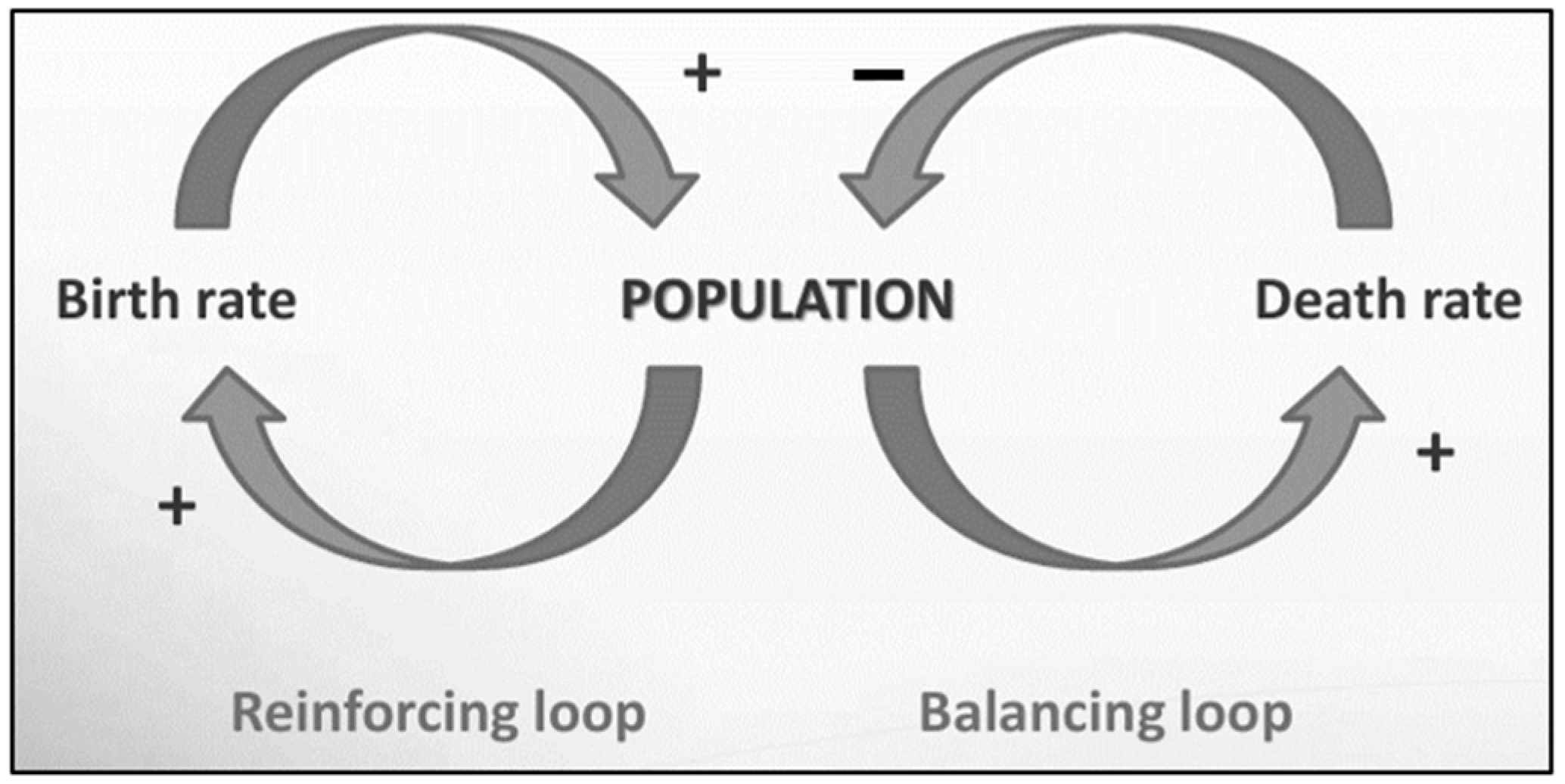
Figure 1 presents two theoretical causal loops—reinforcing and balancing. Positive reinforcing loops provide favorable results and help to set correct goals for system development. Balancing loops ensures the equilibrium of a system. According to Sterman (2000), system dynamics are affected by feedback loop configurations, which can be growth-promoting (positive) and stability-seeking (negative) feedback loops. System dynamics works with the concept of stocks and flows (Sterman 2000). Stocks deal with system accumulations or state variables, and flows deal with the changes over time (Sterman 2000). Computer simulations allow for testing various scenarios and systems’ reactions to different measures. Simulations are pivotal to ensure that models realistically mirror actual systems and subsequently produce credible insights (Sterman 2000).
Figure 1.
Casual loops—reinforcing loop and balancing loop in system dynamics.
Data from the Official Statistics Portal—Official Statistics of Latvia (n.d.c, n.d.d, n.d.e, n.d.f)—are used for the elaboration of the population in working age projections in Latvian regions until 2076 using a simulation model based on system dynamics methods (Richardson 1991, 1996). The data on deaths by sex and age group, fertility rates, long-term international migration by age and sex, and population in regions and cities by age and gender at the beginning of the year by territorial unit, age, sex, and time period were used for the calculations. Two scenarios are offered—Scenario A, which is based on current trends in emigration, and Scenario B, which represents historically higher emigration rates. This approach benefits knowledge on long-term changes in the population of working age due to differentiated scenarios based on emigration.
The authors used ISEE iThink v.10.0.2 software for computer modeling. The use of different sources for population projections in combination with our own calculations allows for more precise and diverse characteristics of population change.
A basic formula for computer simulation was used:
where x is a vector of levels (stocks or state variables), p is a set of parameters, and f is a nonlinear vector-valued function (Richardson 1991) (p. 145).
The simulation process includes a timeframe divided into distinct intervals, each with a length of dt, and the gradual development of a system one dt interval at a time. Each state variable is computed from its previous value and its net rate of change x(t) (Richardson 1996) (p. 807):
For this simulation, fertility and mortality rates are assumed to be constant for scenarios A and B, with a focus on variations in emigration. The time horizon of all calculations is up to the year 2076. Accurate predictions for a specific period of time are not the aim of this simulation; a rather long simulation period is necessary to study the system’s behavior and stability. Moreover, most of the residents who are determining the population development in this period are already living today.
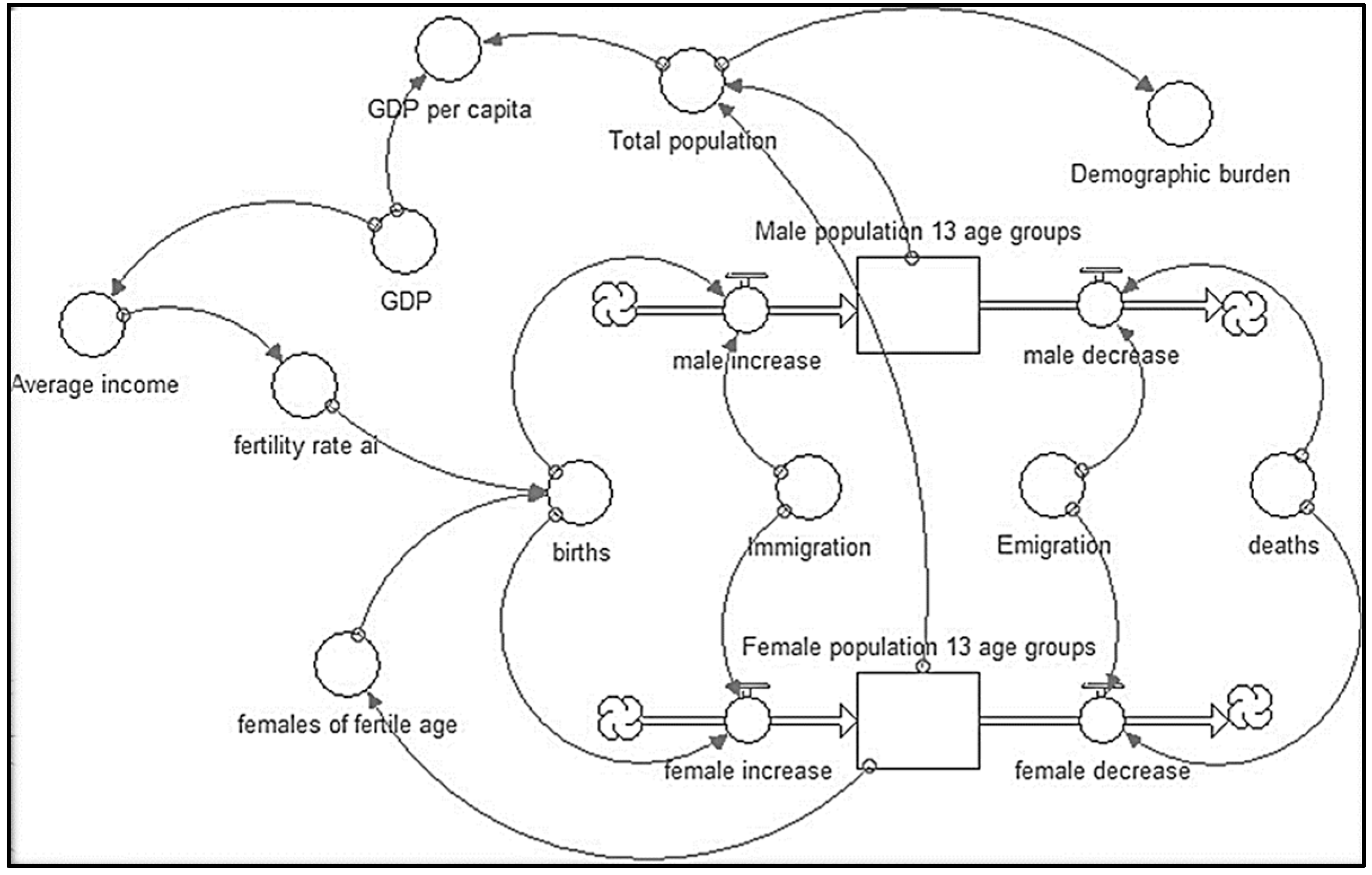
Population change is linked with socio-economic conditions because demographic shifts affect economic growth and wellbeing (see Figure 2). For example, population growth should be accompanied by economic growth to avoid a decline in wellbeing. In turn, a decline in population numbers and aging challenge labor markets and the welfare system, which requires supportive policy-making.
Figure 2.
Simplified structure on how population change is linked with socio-economic conditions.
Second, a PEST analysis is used for presenting factors, which are important for a territory to be economically active and to stay well populated. PEST analysis helps to contextualize the issue under research within the environment in which it usually exists (Walsh 2024). For the analysis, the authors use academic literature and policy documents that focus on depopulation, regional development, human capital, and the labor market. As a result of PEST analysis, political, economic, social, and technological factors, which affect the economic vitality of a territory and population change, are presented. The purpose of using this analysis was to present common factors documented in academic studies and policy documents in the context of the issue. This approach is important because depopulation is usually caused by different socio-economic factors that are common to many territories. As a result of PEST analysis, a list of factors that are important for a territory to stay populated is identified.
The use of PEST analysis in combination with SWOT analysis helps to make informed decisions (Walsh 2024). This is especially important for a long-term vision of socio-economic development. In the article, SWOT analysis supports an understanding of how external factors obtained during PEST analysis reflect real-life situations. SWOT analysis focuses on the case of Latvia. As mentioned above, the case is one with extremely low birth rates and high emigration rates.
The selected set of methods helps to demonstrate trends of population change in the context of accumulated knowledge on socio-economic development features and perspectives. The limitations of this study relate to the selected time and the number of academic studies and policy documents analyzed.
3. Results and Discussion
Population is important for long-term economic growth (Papapetrou and Tsalaporta 2020). Jones (2022) highlights that economic growth models consider stagnant or growing populations, which is impossible in the case of fertility below the replacement rate. Moreover, depopulation causes negative socio-economic consequences, which may result in the worsening of wellbeing (Wojewódzka-Wiewiórska 2019) and cause emigration due to unfavorable socio-economic conditions. Additionally, emigration may cause unemployment because of a possible mismatch between labor supply and demand, which is presented by the case of several European Union member states, including the case of Latvia (Škuflić and Vučković 2018).
The total fertility rate in the world is declining (Roser 2014), and demographic tendencies indicate that the labor force will be in short supply (Zorgenfreija 2025). Low fertility and emigration exacerbate the problem of aging, which in the long term leads to a shrinkage of the working-age population and its aging. Aging reduces the labor supply (Papapetrou and Tsalaporta 2020), the labor force participation rate, and productivity (Bodnar and Nerlich 2022; Aiyar et al. 2016). In the economy, older populations (as well as younger populations) are associated with weaker economic outcomes than middle-aged populations (Cylus and Al Tayara 2021). Policy-makers (Cylus and Al Tayara 2021) expect that population aging will worsen the realization of economic potential. Researchers try to clarify the effects of shrinking working-age populations (Cylus and Al Tayara 2021). Alongside expectations of reduced labor supply and productivity, experts indicate (Bloom et al. 2025) that low fertility may contribute to the redistribution of investments in favor of research and development and innovation and increased participation of women in the labor market. However, economic growth needs a population (Papapetrou and Tsalaporta 2020). Scientists indicate a need to manage the processes of depopulation for the development of communities (Lobato Becerra and Pérez González 2025). In turn, the International Monetary Fund (Bloom et al. 2025) concludes that society needs to address the side socio-economic effects of depopulation and aging.
A rapid population decline creates a challenge for labor markets, which requires innovative responses through stimulating the inclusiveness of labor markets, boosting labor productivity, and supporting regulated labor immigration (United Nations 2024). While talking about the future labor market, the World Economic Forum (2025) indicates that nuanced forecasts and understanding of future labor demand and supply are crucial for informed decisions.
International Labour Organization (2018) indicates that the labor force is declining in the European Union and that the share of older workers will increase in the near future. The European Union emphasizes life-long learning and training in its Employment Policy (European Parliament 2025) to reach high employment rates and a skilled workforce, especially for older workers (International Labour Organization 2018). In a long-term vision, the International Labour Organization (2018) sees the workplace of tomorrow as flexible, age-friendly, and open to phased retirement.
The information above demonstrates that organizations at the international scale take care of the issue of an aging labor force and the overall shrinkage of the population. At the same time, while the overall declining trend is similar between many countries, the expansion of the tendency will differ, which will frame policy responses. Public or entrepreneurial policy-making that addresses human capital availability should consider the medium- and long-term vision of a situation. The article presents an example of the decline in the population of working age and a decline in the long term in Latvia given secondary data available in statistical databases and our own calculations.
Population projections for Latvia are available until 2050 (Eurostat 2025) and 2100 (Eurostat 2021). The data demonstrate declining trends. According to the data, in Latvia, a population decline in the age range from 15 to 74 is expected to be about 23 percentage points by 2050. Against the general background, this is a very high number. For comparison, the expected population decline in the European Union for a similar time is only 0.07 percentage points. In 2024, Latvia had the fastest population decline in the European Union (LSM+ English 2024), and birth numbers are still going down (LSM+ English 2025). A negative natural increase and emigration are mentioned as the main factors negatively affecting the population in Latvia (Chmielewski 2024). According to Eurostat (2021), at the regional level, until 2100, a decline in the population in Latvia is expected to be high. In percentage terms, the projected decline in population is expected to be as follows: in the Latgale region, about 62%; in Vidzeme region, about 59%; in the Kurzeme and Zemgale regions, about 53%; in the Pieriga region, about 33%; and in Riga region, about 31%.
Researchers also try to make population projections that are based on differentiated scenarios (Homutiņins et al. 2021). The next table (see Table 1) presents population change forecasts for two scenarios, which widen the understanding of trends presented in statistical databases.
Table 1.
Decline in the population of working age until 2076 in regions in Latvia; percentage.
According to the scenario-based projections, the changes in the working-age population is clearly unfavorable in both scenarios, especially in the case of the pessimistic scenario (Scenario B) based on historically the highest emigration rates. The projections demonstrate a dramatic decrease in the regional population of working age for all regions regardless of their economic profile and wellbeing level. In Latvia, regional disparities are among the highest in OECD countries (Vides aizsardzības un reģionālās attīstības ministrija n.d.). For example, the capital-city region has a sufficiently higher GDP per capita than other regions. In recent years, regions demonstrated higher growth rates than average rates (Vides aizsardzības un reģionālās attīstības ministrija n.d.). Despite this positive tendency, population projections indicate a possible high decline in population. Insufficient working possibilities and the level of salaries are among the main reasons for emigration (Vides aizsardzības un reģionālās attīstības ministrija n.d.).
In percentage terms, the projected decline in the working-age population ranges from 58 to 66 percent for Scenario A, which takes into account current emigration rates. For Scenario B, which is based on a more pessimistic supposition on emigration, the projected population decline is expected to vary between 78 and 83 percentage points until 2076. The numbers call for place-based sustainable development policy responses, which take into account socio-demographic changes at the regional level. Regional Policy Guidelines 2021–2027 in Latvia indicate the aim of providing solutions for the development of population density and quality of life in accordance with the specifics of the territories (Vides aizsardzības un reģionālās attīstības ministrija n.d.).
For a generalized view on a depopulation phenomenon, it is useful to delve into factors that are important for a territory to stay well populated. From the development perspective, the population change trajectory is usually caused by factors of socio-economic, political, and technological nature, which provide a certain level of wellbeing. Therefore, the authors employ PEST analysis for defining factors, which should be taken into account when talking about territorial socio-economic attractiveness. These factors are defined through the analysis of academic and policy documents.
Policy-making has a long tradition of being a tool for effective management of regional development issues (OECD 2018). Regional policy-making gains additional value when talking about declining territories, which need attention and a specified approach. An analysis of literature allows for defining some core principles. In this study, we address an issue of depopulation that, according to scientists, may be mitigated. Places experiencing a persistent decline in population need strategic investments that help to develop territorial potential.
Tietjen and Jorgensen (2016) show that strategic planning implemented through locally oriented projects may address rural shrinkage. Given the uniqueness of every shrinking place, Tietjen and Jorgensen (2016) highlight the role of adaptive, participative, and transdisciplinary approaches in to strategic planning. Locally oriented projects contribute to digital infrastructure, which, according to Liu and Li (2024), is significant for the revitalization of declining territories. Government initiatives may be a tool to support territorial potential for long-term sustainable development. Solving the issues of shrinking territories means adaptation to depopulation. Makkonen and Inkinen (2023) call such a policy-making approach ‘smart shrinkage’, meaning that declining territory should have a good quality of life. In their study, Makkonen and Inkinen (2023) refer to the viewpoint that the maintenance of wellbeing in a territory may be more effective than trying to reverse depopulation. This viewpoint has a logic, because the level of quality of life is a predictor of territorial attractiveness for living and working. Policies for retaining and attracting talent (European Urban Initiative n.d.); legal migration of skilled workers (European Commission 2025b); family-friendly policies (Potančoková et al. 2021); diverse public–private partnerships (Eraydin and Özatağan 2021); collaborative, bottom-up policy-making practices (Brad and Moldovan 2019); and choice of policy accents depending on regional population preferences (Panagopoulos et al. 2015) are crucial for places that experience a pronounced decline in population numbers.
Of course, not all issues in depopulated areas can be solved solely through regional development policy interventions. Competitive economy, modern infrastructure, investments, an economically active population, and enthusiastic entrepreneurs play crucial roles in the vitality of a territory. Depopulating places need strong connectivity with economic centers and access to facilities. Digitalization is a tool that minimizes the digital divide (Sommer et al. 2025) and increases the vitality of a place (Liu and Li 2024). An insufficient level of economic activity in shrinking territories may be successfully mitigated by activating labor resources and attracting talent (European Commission 2025b). Additionally, predicting future labor shortages may be helpful for timely responses (Norlén and Dzhavatova 2024). Experts see the unused potential of labor resources and entrepreneurial potential, for example, women, young people, and men of middle age can help attract talent. According to the European Commission (2025b), a comprehensive approach is required for increasing the economic attractiveness of a place and its economic activity level. Such factors as strengthening of collaborative ties between regional authorities, academia, entrepreneurs, and educational institutions, as well as job training, financial assistance, development of competences necessary for green and digital transition, community-based projects, rejuvenation of public spaces, and attraction of researchers create an innovative environment and more significantly contribute to the economic vitality of a territory and its attractiveness for living and working.
A favorable socio-economic environment is a prerequisite for a place to be populated. For individuals, the availability of labor opportunities and public facilities is of high importance. Therefore, the existence of affordable housing (European Commission 2025b), investments in public services, and quality infrastructure are the key factors to keeping a place populous. From the subjective perspective, emotional investments and loyalty to a place (Niu et al. 2025) support the attractiveness of a place for living and working. For example, Niu et al. (2025) indicate that tourists may participate in regional revitalization and address demographic issues, which is important in conditions where people move away searching for better socio-economic conditions. Ubarevičienė and van Ham (2017) tried to portray residents who are more likely to move. According to Ubarevičienė and van Ham (2017), residents with higher socio-economic status and high-skilled jobs prefer larger city-regions rather than rural areas. In turn, residents with lower socio-economic status, older residents, and residents with low-skilled jobs represent the populations of declining territories (Ubarevičienė and van Ham 2017). Younger, single residents and residents with higher levels of education and better job positions are also more likely to move from declining territories (Ubarevičienė and van Ham 2017). In combination with population aging, this is a significant challenge for maintaining the population of working age in economically less developed regions. Labor market inclusiveness may contribute to the revitalization of declining territories. For example, the International Labour Organization (2025) indicates issues in terms of the gender income gap, young people who are not employed or receiving education, and limited opportunities for people with disabilities to enter the labor market.
Nowadays, sectors of economic activity pursue the application of the newest technologies to be competitive. In terms of spatial development, Sommer et al. (2025) indicate that digitalization contributes to minimizing the rural–urban digital divide. Digitalization provides labor opportunities and accessibility of public facilities, which is important for balanced socio-economic development. On the other hand, given the above-mentioned higher share of the elderly and low-skilled population in declining territories, technological requirements may create inequalities in terms of skills and technology access (Dachs 2018). At the same time, Dachs (2018) indicates how technological development benefits equality. From the labor market perspective, technologies can replace routine jobs, which reduces job opportunities, but at the same time, technologies create new jobs, albeit jobs with additional requirements for skills and education. From the depopulation perspective, technologies and processes such as AI and automation may solve economic issues of labor shortages and keeping economic vitality in territories with a declining population.
In conclusion, factors of a political, economic, social, and technological nature create a favorable or unfavorable environment for living and working in a territory. Table 2 offers a summary of factors that are important for the economic vitality of a territory and its attractiveness for living and working. Policy-making is an effective tool for how a territory may respond to depopulation challenges through management and adjustment. The maintenance of socio-economic vitality and the population is a favorable result for development. In this context, an understanding of the existing socio-economic context and the activation of the labor potential create a basis for the development of shrinking territories. The local economy’s potential, in combination with sustainable economic activities, may activate the economic competitiveness of a territory. Socio-economic wellbeing and opportunities, loyalty to place, and quality infrastructure support place attractiveness for living and working. In turn, technologies and their application create a competitive environment for human and spatial development.
Table 2.
PEST analysis of territorial socio-economic attractiveness.
Political, economic, social, and technological factors that are significant for a territory to be economically active and to stay well populated find their reflection in real-life situations. The next table (see Table 3) presents a SWOT analysis of labor market peculiarities in Latvia. The mentioned peculiarities may be attributed to political, economic, social, and technological factors that appear in positive and less positive contexts.
Table 3.
SWOT analysis of the labor market in Latvia.
SWOT analysis allows seeing that political, economic, social, and technological factors affect the labor market in Latvia. In terms of political factors, employment-promoting projects within EU funds create strength in the labor market. Activities supporting people in becoming entrepreneurs and smart specialization development policies encourage the realization of potential. In turn, an insufficient number of professionals in areas selected as priority for smart specialization challenges the labor market.
Economic factors provide effects through a gradual decrease in long-term unemployment rates, a relatively similar share of employment in urban and rural areas, and awareness of significant internal labor reserves, which are strengths of the labor market. At the same time, insufficient skills and interest in vocational education, life-long learning in required professions, and health problems are structural economic weaknesses of the labor market in Latvia. In turn, insufficient interest in becoming an entrepreneur threatens the long-term vision of labor market development.
Social factors affect the labor market through inclusiveness, i.e., higher than the EU’s average employment of women, which is a strength, and lower than the EU’s average rates of youth employment, which is a weakness of the labor market. Additionally, workforce aging and depopulation create weakness and are a threat to the labor market in thhee long term.
Technological factors create opportunities for the labor market. For example, remote working allows human capital to be attracted, and the use of artificial intelligence may improve productivity and partly address labor force shortages. However, several issues challenge further qualitative development of the labor market. These issues are a higher employment share in less knowledge-intensive service sectors, a lower share of remote workers than the EU’s average, entrepreneurs’ insufficient awareness of the EU’s artificial intelligence regulations, and insufficient preparedness of employees to work with artificial intelligence solutions.
4. Conclusions
Demographic decline will cause shortages in labor force. Within this article, the authors present a decline in the working-age population and discover factors causing this by applying system dynamics, PEST, and SWOT analysis.
First, the article numerically presents long-term changes in the working-age population in Latvia. As a result of system dynamics analysis, the authors presented two scenarios of the working-age population changes in the long term. The projections correspond with forecasts presented in statistical databases but provide a nuanced view on the population decline given different emigration rates. Both scenarios indicate that population decline in working age is expected to be high in Latvia in all regions, regardless of their socio-economic development level. Declining rates reach high values from 59 percentage points for Scenario A to 82 percentage points for Scenario B. The economically better-developed capital-city region exhibits slightly lower rates of decline but is still similar to other regions. The trends forecast an alarming tendency for possible shortages in the labor force in the long term. The application of system dynamics for population projections is novel and provides knowledge of a system’s behavior, which allows for timely policy-making. In this article, system dynamics numerically presents an alarming tendency of a decline in the working-age population, which provides context for understanding the factors affecting the economic attractiveness of a territory and the peculiarities of a labor market.
Second, the article discovers factors from political, economic, social, and technological areas, which are important for a territory to be economically active and attractive for living and working and thus staying populous. The article provides insights into factors that in the academic literature and policy documents are understood as favorable for economic activity and population growth. According to PEST analysis, academic and practical experience acknowledge policy-making as a tool for addressing depopulation and labor shortages. Both the usual approaches to the stimulation of economic activity through projects and government initiatives and novel approaches addressing shrinkage through smartness and place-specific features are mentioned. Inclusiveness, sustainability, digitalization, and the activation of local potential are considered among the economic factors that support the attractiveness of a territory for living and working. Social factors that are important for existing and potential inhabitants of a territory are objective and subjective in their nature. The availability of public facilities and labor opportunities are complemented by an emotional disposition with respect to a place and the socio-economic positions of individuals. Finally, technologies provide opportunities for the realization of economic potential and at the same time increase demands on employees.
Third, the article characterizes the labor market in Latvia given factors from political, economic, social, and technological areas. During the third step of the analysis, a SWOT analysis was applied for the case of the labor market in Latvia. The results were explained according to the political, economic, social, and technological factors discussed in the PEST analysis. Features of the labor market presented in the SWOT analysis demonstrate that from a policy-making perspective, the realization of the smart specialization approach improves economic activity levels, but improvements are needed in human capital availability and employees’ proficiency in smart specialization areas. From the economic perspective, the labor market demonstrates an increase in employment but a modest interest of society in becoming entrepreneurs. From the social perspective, the inclusiveness of the labor market is present but is not equally realized among different social groups. From the technological perspective, the remote working mode, artificial intelligence awareness, and the development of high-tech and knowledge-intensive sectors have potential for labor market qualitative development.
As a result, the article presents a highly illustrative case study. The population projections presented in statistical databases and complemented by forecasts within this article demonstrate a continuing tendency of a decline in the population of working age. Understanding the political, economic, social, and technological factors that are important for economic activity and increase the attractiveness of a territory for living and working provides a contribution to the theoretical and practical understanding of the issue. The approach to the analysis and results may be useful for place-based development research and policy-making. Future studies that could expand the analysis include population projections, additional causal variables, and an expansion of the PEST analysis with environmental and legal factors.
Author Contributions
Conceptualization, V.Š.; methodology, A.H., V.Š. and L.A.; formal analysis, V.Š.; investigation, V.Š., L.A. and A.H.; project administration, L.A.; data curation, A.H. and V.Š.; resources, V.Š., L.A. and A.H.; supervision, L.A.; validation, A.H., V.Š. and L.A.; writing—original draft preparation, V.Š.; writing—review and editing, L.A. and V.Š. All authors have read and agreed to the published version of the manuscript.
Funding
This paper is based on research conducted within the framework of the “Study of long-term population changes in a regional context under the influence of natural population growth and migration”. The project has received funding from the Daugavpils University under grant agreement No. 14-95/2025/13.
Institutional Review Board Statement
Not applicable.
Informed Consent Statement
Not applicable.
Data Availability Statement
The statistical data presented in this study are available in Official Statistics Portal—Official Statistics of Latvia—https://stat.gov.lv/en (accessed on 6 October 2025) and Eurostat—https://ec.europa.eu/eurostat (accessed on 6 October 2025). The projections data supporting the conclusions of this article will be made available by the authors on request.
Conflicts of Interest
The authors declare no conflict of interest.
References
- Aiyar, Shekhar, Christian Ebeke, and Xiaobo Shao. 2016. The Impact of Workforce Aging on European Productivity. IMF Working Paper. Available online: https://www.imf.org/external/pubs/ft/wp/2016/wp16238.pdf (accessed on 6 October 2025).
- Alamá-Sabater, Luisa, Vicente Budí, Norat Roig-Tierno, and Jose Maria Garcia-Alvarez-Coque. 2021. Drivers of depopulation and spatial interdependence in a regional context. Cities 114: 103217. [Google Scholar] [CrossRef] [Scilit]
- Albinowski, Maciej, and Piotr Lewandowski. 2024. The impact of ICT and robots on labour market outcomes of demographic groups in Europe. Labour Economics 87: 102481. [Google Scholar] [CrossRef] [Scilit]
- Apsite-Berina, Elina, Girts Burgmanis, and Zaiga Krisjane. 2018. Return Migration Trends in Latvia: Re-attracting the Main Human Resource for Sustainable Regional Development. Environment. Technology. Resources. Proceedings of the 12th International Scientific and Practical Conference 1: 16–19. [Google Scholar] [CrossRef] [Scilit]
- Biagi, Federico, Christoph Deuster, and Fabrizio Natale. 2025. A Demographic Perspective on the Future of European Labour Force Participation. JRC Publications Repository. Available online: https://publications.jrc.ec.europa.eu/repository/handle/JRC141153 (accessed on 6 October 2025).
- Bloom, David E., Michael Kuhn, and Klaus Prettner. 2025. The Debate Over Falling Fertility. International Monetary Fund. Available online: https://www.imf.org/en/publications/fandd/issues/2025/06/the-debate-over-falling-fertility-david-bloom (accessed on 6 October 2025).
- Bodnar, Katalin, and Carolin Nerlich. 2022. The Macroeconomic and Fiscal Impact of Population Ageing. European Central Bank. Available online: https://www.ecb.europa.eu/pub/pdf/scpops/ecb.op296~aaf209ffe5.en.pdf (accessed on 6 October 2025).
- Brad, Alexandru, and Aura Moldovan. 2019. Development frames in peripheralized areas of Romania. Regional Studies, Regional Science 7: 1–9. [Google Scholar] [CrossRef] [Scilit]
- Chmielewski, Bartosz. 2024. Looking for a Way Out: Latvia’s Demographic Crisis. Available online: https://www.osw.waw.pl/en/publikacje/komentarze-osw/2024-07-16/w-poszukiwaniu-drogi-wyjscia-lotwa-wobec-kryzysu (accessed on 6 October 2025).
- Cylus, Jonathan, and Lynn Al Tayara. 2021. Health, an ageing labour force, and the economy: Does health moderate the relationship between population age-structure and economic growth? Social Science & Medicine 287: 114353. [Google Scholar] [CrossRef] [Scilit]
- Dachs, Bernhard. 2018. The Impact of New Technologies on the Labour Market and the Social Economy. STOA—Science and Technology Options Assessment. European Parliament. Available online: https://www.europarl.europa.eu/RegData/etudes/STUD/2018/614539/EPRS_STU(2018)614539_EN.pdf (accessed on 6 October 2025).
- Ekonomikas Ministrija. n.d. Darba tirgus prognozes līdz 2040. gadam. [Labor Market Forecasts Until 2040]. Available online: https://www.em.gov.lv/lv/media/15413/download (accessed on 6 October 2025).
- Eraydin, Ayda, and Güldem Özatağan. 2021. Pathways to a resilient future: A review of policy agendas and governance practices in shrinking cities. Cities 115: 103226. [Google Scholar] [CrossRef] [Scilit]
- European Commission. 2025a. Demography 2040: Cities Keep Growing, While Population Shrinks in Remote Rural Regions. The Joint Research Centre: EU Science Hub. Available online: https://joint-research-centre.ec.europa.eu/jrc-news-and-updates/demography-2040-cities-keep-growing-while-population-shrinks-remote-rural-regions-2025-04-04_en (accessed on 6 October 2025).
- European Commission. 2025b. Tackling EU’s Shrinking Workforce? Better Education, More Women in Jobs, Skilled Migration. The Joint Research Centre: EU Science Hub. Available online: https://joint-research-centre.ec.europa.eu/jrc-news-and-updates/tackling-eus-shrinking-workforce-better-education-more-women-jobs-skilled-migration-2025-06-11_en (accessed on 6 October 2025).
- European Parliament. 2025. Employment Policy. Fact Sheets on the European Union. Available online: https://www.europarl.europa.eu/factsheets/en/sheet/54/employment-policy (accessed on 6 October 2025).
- European Urban Initiative. n.d. Harnessing Talent in Shrinking Cities. Available online: https://www.urban-initiative.eu/innovative-actions-harnessing-talent (accessed on 6 October 2025).
- Eurostat. 2021. Population on 1st January by Age, Sex, Type of Projection and NUTS 3 Region. Available online: https://ec.europa.eu/eurostat/databrowser/view/proj_19rp3/default/table?lang=en&category=proj.proj_19r (accessed on 6 October 2025).
- Eurostat. 2025. Short-Term Population Projections (2024–2050). Available online: https://ec.europa.eu/eurostat/databrowser/view/proj_stp25/default/table?lang=en&category=proj.proj_23n (accessed on 6 October 2025).
- Eurostat. n.d. Population Projections. Available online: https://ec.europa.eu/eurostat/web/population-demography/population-projections (accessed on 6 October 2025).
- González-Leonardo, Miguel, Antonio López-Gay, and Joaquín Recaño. n.d. Urban Depopulation and Loss of Human Capital: An Emerging Phenomenon in the European Union. Population Europe. Available online: https://population-europe.eu/research/policy-insights/urban-depopulation-and-loss-human-capital-emerging-phenomenon-european (accessed on 6 October 2025).
- Gunderson, Morley. 2025. Can AI Mitigate Our Labour Force Problems? Available online: https://www.fraserinstitute.org/commentary/can-ai-mitigate-our-labour-force-problems (accessed on 6 October 2025).
- Hazans, Mihails. 2019. Emigration from Latvia: A Brief History and Driving Forces in the 21st Century. MPRA Paper No. 118484. Available online: https://mpra.ub.uni-muenchen.de/118484/ (accessed on 6 October 2025).
- Hidalgo-Arellano, Isidro, and Gema Fernández-Avilés. 2025. Spatial depopulation risk assessment through spatial principal component analysis and indicator kriging in Castilla-La Mancha (Spain). Journal of Rural Studies 119: 103771. [Google Scholar] [CrossRef] [Scilit]
- Homutiņins, Aleksejs, Viktorija Šipilova, and Ludmila Aleksejeva. 2021. Population Forecast with Focus on Emigration: Scenarios for the Case of Peripheral Region. European Journal of Sustainable Development 10: 139. [Google Scholar] [CrossRef] [Scilit]
- International Labour Organization. 2018. Europe’s Ageing Population Comes with a Silver Lining. Available online: https://www.ilo.org/resource/news/europes-ageing-population-comes-silver-lining (accessed on 6 October 2025).
- International Labour Organization. 2025. Responding to Demographic Shifts in the Labour Market in Europe and Central Asia. Available online: https://www.ilo.org/resource/news/responding-demographic-shifts-labour-market-europe-and-central-asia (accessed on 6 October 2025).
- Jauns.lv. 2024. Ekonomists: Iedzīvotāju skaita samazinājums Latvijā visspēcīgāk atspoguļosies darba tirgū. [Economist: The Decline in the Population of Latvia Will Be Most Strongly Reflected in the Labor Market]. Ziņu nodaļa [News Department]. Available online: https://jauns.lv/raksts/zinas/624196-ekonomists-iedzivotaju-skaita-samazinajums-latvija-visspecigak-atspogulosies-darba-tirgu (accessed on 6 October 2025).
- Jones, Charles I. 2022. The End of Economic Growth? Unintended Consequences of a Declining Population. American Economic Review 112: 3489–527. [Google Scholar] [CrossRef] [Scilit]
- Kiviaho, Annamari, and Torsti Hyyryläinen. 2025. Sustainability transition in shrinking regions: Uncovering perceived regional opportunity spaces and expectations shaping regional development. Geoforum 164: 104326. [Google Scholar] [CrossRef] [Scilit]
- Krasnopjorovs, Oļegs. 2019. Darbaspēka rezervju anatomija Baltijas valstīs: Skats 15 gadu pēc pievienošanās ES. [Anatomy of Labor Reserves in the Baltic States: A View 15 Years After EU Accession]. Latvijas Banka. Available online: https://datnes.latvijasbanka.lv/diskusijas-materiali/dm_2_2019-lv.pdf (accessed on 6 October 2025).
- Krasnopjorovs, Oļegs. 2023. Latvijas darba tirgus: Stiprās un vājās puses no makroekonomikas skatu punkta. [Latvian Labor Market: Strengths and Weaknesses from a Macroeconomic Perspective]. Available online: https://www.makroekonomika.lv/sites/default/files/2023-06/Olegs%20K_Future%20of%20jobs_2023_05_24.pdf (accessed on 6 October 2025).
- Kuncevičs, Miks. 2025a. Latvijā pērn 18 administratīvajās teritorijās nav piedzimis neviens bērns. [No Children Were Born in 18 Administrative Territories of Latvia Last Year]. Available online: https://www.lsm.lv/raksts/zinas/latvija/12.08.2025-latvija-pern-18-administrativajas-teritorijas-nav-piedzimis-neviens-berns.a610072/ (accessed on 6 October 2025).
- Kuncevičs, Miks. 2025b. Reģionos īpaši izjūt darbaspēka trūkumu. [The Regions Are Particularly Affected by the Labor Shortage]. Available online: https://www.lsm.lv/raksts/zinas/ekonomika/17.07.2025-regionos-ipasi-izjut-darbaspeka-trukumu.a607184/ (accessed on 6 October 2025).
- Latvijas Banka. 2025. Forecasts of Latvijas Banka. 2025. Available online: https://www.bank.lv/en/operational-areas/task-monetary-policy/forecasts (accessed on 6 October 2025).
- Latvijas Darba devēju konfederācija, and Rīgas Tehniskā universitāte. 2024. Digitalizācijas ietekme uz darba devēju un darba ņēmēju tiesiskajām attiecībām: Mākslīgais intelekts un attālinātais darbs. [The Impact of Digitalization on Legal Relations Between Employers and Employees: Artificial Intelligence and Remote Work]. Available online: https://lddk.lv/wp-content/uploads/2023/10/Digitalizacijas-ietekme-uz-darba-deveju-un-darba-nemeju-tiesiskajam-attiecibam-1.pdf (accessed on 6 October 2025).
- Lente.lv. 2025. Latvijā dominē mājsaimniecības bez bērniem, taču ģimenēm ar bērniem aug nabadzības riski. [Households Without Children Dominate in Latvia, but Poverty Risks Are Increasing for Families with Children]. Available online: https://lente.lv/sabiedriba/raksts/latvija-domine-majsaimniecibas-bez-berniem-tacu-gimenem-ar-berniem-aug-nabadzibas-riski-35420.html (accessed on 6 October 2025).
- Leta.lv. 2023. Brīdina par darbaspēka pieprasījuma un piedāvājuma neatbilstību ietekmi uz darba tirgus reģionālām atšķirībām [Warns About the Impact of Labor Supply and Demand Mismatches on Regional Labor Market Disparities]. Available online: https://www.leta.lv/home/important/07B5ED31-F3B1-4139-8E36-FDB1038953B2/ (accessed on 6 October 2025).
- Liu, Juan, and Feng Li. 2024. Rural revitalization driven by digital infrastructure: Mechanisms and empirical verification. Journal of Digital Economy 3: 103–16. [Google Scholar] [CrossRef] [Scilit]
- Lobato Becerra, Juan A., and Maria C. Pérez González. 2025. Toward a More Integrated Approach to Planning and Implementing Local Development Policies to Tackle Rural Depopulation in Empty Spain. Journal of Urban Planning and Development 151: 04024056. [Google Scholar] [CrossRef] [Scilit]
- Loras-Gimeno, Diego, Jorge Díaz-Lanchas, and Gonzalo Gómez-Bengoechea. 2025. Rural depopulation in the 21st century: A systematic review of policy assessments. Regional Science Policy & Practice 17: 100176. [Google Scholar] [CrossRef] [Scilit]
- LSM+ English. 2024. Latvia Had Fastest Population Drop in EU Last Year. Available online: https://eng.lsm.lv/article/society/society/02.10.2024-latvia-had-fastest-population-drop-in-eu-last-year.a570988/ (accessed on 6 October 2025).
- LSM+ English. 2025. Birth Numbers Still Going Down in Latvia. Available online: https://eng.lsm.lv/article/society/society/14.02.2025-birth-numbers-still-going-down-in-latvia.a587847/?utm_source=lsm&utm_medium=article-bottom&utm_campaign=article (accessed on 6 October 2025).
- Makkonen, Teemu, and Tommi Inkinen. 2023. Benchmarking the vitality of shrinking rural regions in Finland. Journal of Rural Studies 97: 334–44. [Google Scholar] [CrossRef] [Scilit]
- Merino, Fernando, and Maria A. Prats. 2020. Why do some areas depopulate? The role of economic factors and local governments. Cities 97: 102506. [Google Scholar] [CrossRef] [Scilit]
- Mieriņa, Inta, Inese Šūpule, Miks Muižarājs, Rasa Jansone, Anna Žukovska, and Ilze Koroļeva. 2021. Attālinātais darbs kā cilvēkkapitāla piesaistes iespēja Latvijas attīstībai. [Remote Work as an Opportunity to Attract Human Capital for Latvia’s Development]. Available online: https://www.diaspora.lu.lv/fileadmin/user_upload/lu_portal/projekti/diaspora/Gala_zinojums_-_Attalinatais_darbs.pdf (accessed on 6 October 2025).
- Niu, Han-Jen, En-Tzu Wu, Chen-Yun Yen, Mei-Jen Chen, and Chun-Chieh Yu. 2025. From visitors to vitality: How relational populations support regional revitalization in aging urban and rural areas. Sustainable Futures 9: 100669. [Google Scholar] [CrossRef] [Scilit]
- Norlén, Gustaf, and Kamila Dzhavatova. 2024. Statistical Overview. Nordregio Report 2024, No. 23. Available online: https://pub.nordregio.org/r-2024-23-rural-labour-shortage/statistical-overview.html (accessed on 6 October 2025).
- OECD. 2018. Rethinking Regional Development Policy-Making. OECD Multi-Level Governance Studies. Paris: OECD Publishing. [Google Scholar] [CrossRef] [Scilit]
- Official Statistics Portal—Official Statistics of Latvia. 2025. Latvian Unemployment Rate Was 7.4% in Q1 2025. Available online: https://stat.gov.lv/en/statistics-themes/labour-market/unemployment/press-releases/22891-unemployment-1st-quarter-2025 (accessed on 6 October 2025).
- Official Statistics Portal—Official Statistics of Latvia. n.d.a. NBA031. Activity Rate, Employment Rate and Unemployment Rate by Region (Per Cent) 2019–2024. Available online: https://data.stat.gov.lv/pxweb/en/OSP_PUB/START__EMP__NBB__NBA/NBA031/ (accessed on 6 October 2025).
- Official Statistics Portal—Official Statistics of Latvia. n.d.b. EKA081. Population Aged 15 and Over by Kind of Economic Activity and Gender in Regions, Cities, Municipalities, Towns and Rural Territories at the Beginning of the Year 2011–2024. Available online: https://data.stat.gov.lv/pxweb/lv/OSP_PUB/START__EMP__NB__NBLA/EKA081 (accessed on 6 October 2025).
- Official Statistics Portal—Official Statistics of Latvia. n.d.c. IMV010w. Deaths by Sex and Age Group in Regions 2000W01–2023W39. Available online: https://data.stat.gov.lv/pxweb/en/OSP_PUB/START__POP__IM__IMSV/IMV010w/ (accessed on 6 October 2025).
- Official Statistics Portal—Official Statistics of Latvia. n.d.d. IDK010. Fertility Rates (Age-Specific, Total, Gross and Net Reproduction Rate, Crude Birth Rate) 1965–2022. Available online: https://data.stat.gov.lv/pxweb/en/OSP_PUB/START__POP__ID__IDK/IDK010/ (accessed on 6 October 2025).
- Official Statistics Portal—Official Statistics of Latvia. n.d.e. IBE030. Long-Term International Migration by Age and Sex 2000–2024. Available online: https://data.stat.gov.lv/pxweb/en/OSP_PUB/START__POP__IB__IBE/IBE030/ (accessed on 6 October 2025).
- Official Statistics Portal—Official Statistics of Latvia. n.d.f. IRD040. Population in Regions and Cities by Age and Gender at the Beginning of Year by Territorial Unit, Age, Sex and Time Period. Available online: https://data.stat.gov.lv/pxweb/en/OSP_PUB/START__POP__IR__IRD/IRD040/ (accessed on 6 October 2025).
- Panagopoulos, Thomas, Maria H. Guimarães, and Ana P. Barreira. 2015. Influences on citizens’ policy preferences for shrinking cities: A case study of four Portuguese cities. Regional Studies, Regional Science 2: 141–70. [Google Scholar] [CrossRef] [Scilit]
- Papapetrou, Evangelia, and Pinelopi Tsalaporta. 2020. The impact of population aging in rich countries: What’s the future? Journal of Policy Modeling 42: 77–95. [Google Scholar] [CrossRef] [Scilit]
- Park, Yunmi, and Megan E. Heim LaFrombois. 2019. Planning for growth in depopulating cities: An analysis of population projections and population change in depopulating and populating US cities. Cities 90: 237–48. [Google Scholar] [CrossRef] [Scilit]
- Potančoková, Michaela, Marcin Stonawski, and Nicholas Gailey. 2021. Migration and demographic disparities in macro-regions of the European Union, a view to 2060. Demographic Research 45: 1317–54. [Google Scholar] [CrossRef] [Scilit]
- Richardson, George P. 1991. System dynamics: Simulation for policy analysis from a feedback perspective. In Qualitative Simulation Modeling and Analysis. Edited by Paul A. Fishwick and Paul A. Luker. Advances in Simulation. New York: Springer, vol. 5, pp. 144–69. [Google Scholar] [CrossRef] [Scilit]
- Richardson, George P. 1996. System Dynamics. In Encyclopedia of Operations Research and Management Science. Edited by Saul I. Gass and Carl M. Harris. Norwell: Kluwer Academic Publishers, pp. 807–10. [Google Scholar]
- Roser, Max. 2014. The Global Decline of the Fertility Rate. Our World in Data. Available online: https://ourworldindata.org/global-decline-fertility-rate (accessed on 6 October 2025).
- San-Martín González, Enrique, and Federico Soler-Vaya. 2024. Depopulation determinants of small rural municipalities in the Valencia Region (Spain). Journal of Rural Studies 110: 103369. [Google Scholar] [CrossRef] [Scilit]
- Sommer, Carola, Tobias Chilla, Lisa Birnbaum, and Stephan Kröner. 2025. Digital social innovations in rural areas—Process tracing and mapping critical junctures. Journal of Rural Studies 114: 103510. [Google Scholar] [CrossRef] [Scilit]
- Sroka, Bartłomiej T. 2022. Urban Shrinkage as a Catalyst of a Transition, Revolving around Definitions. Sustainability 14: 13203. [Google Scholar] [CrossRef] [Scilit]
- Sterman, John D. 2000. Business Dynamics: Systems Thinking and Modelling for a Complex World. Columbus: Irwin/McGraw Hill, pp. 4, 107, 181. [Google Scholar]
- Swedbank. 2021. Strādāt sev—Galvenā motivācija dibināt savu uzņēmumu arī pandēmijas laikā. [Working for Yourself Is the Main Motivation to Start Your Own Business Even During a Pandemic]. Available online: https://blog.swedbank.lv/uzsaksana/jaundibinatie-uznemumi-8352 (accessed on 6 October 2025).
- Škuflić, Lorena, and Valentina Vučković. 2018. The effect of emigration on unemployment rates: The case of EU emigrant countries. Economic Research-Ekonomska Istraživanja 31: 1826–36. [Google Scholar] [CrossRef] [Scilit]
- Tietjen, Anne, and Gertrud Jorgensen. 2016. Translating a wicked problem: A strategic planning approach to rural shrinkage in Denmark. Landscape and Urban Planning 154: 29–43. [Google Scholar] [CrossRef] [Scilit]
- Ubarevičienė, Rūta, and Maarten van Ham. 2017. Population decline in Lithuania: Who lives in declining regions and who leaves? Regional Studies, Regional Science 4: 57–79. [Google Scholar] [CrossRef] [Scilit]
- United Nations. 2024. World Population Prospects 2024. Summary of Results. Available online: https://population.un.org/wpp/assets/Files/WPP2024_Summary-of-Results.pdf (accessed on 6 October 2025).
- Vides aizsardzības un reģionālās attīstības ministrija. n.d. Reģionālā politika 2021.-2027. gadam—Pamats investīcijām teritoriju attīstībai. [Regional Policy for 2021–2027—The Basis for Investments in Territorial Development]. Available online: https://www.varam.gov.lv/sites/varam/files/inline-images/varam-info-15-10-zalsh_update-01_min.jpg (accessed on 6 October 2025).
- Walsh, John. 2024. PEST Analysis. Available online: https://www.ebsco.com/research-starters/social-sciences-and-humanities/pest-analysis (accessed on 6 October 2025).
- Wojewódzka-Wiewiórska, Agnieszka. 2019. Depopulation in rural areas in Poland—Socio-economic local perspective. Research for Rural Development 2: 126–32. [Google Scholar] [CrossRef] [Scilit]
- World Economic Forum. 2025. The Future of Jobs Report 2025. Conclusions. Available online: https://www.weforum.org/publications/the-future-of-jobs-report-2025/in-full/conclusions-721d3cd435/#conclusions-721d3cd435 (accessed on 6 October 2025).
- Zorgenfreija, Līva. 2025. Bezdarbs audzis, bet nākotnē atkal bažas par darbaspēka trūkumu. [Unemployment Has Risen, but Concerns About Labor Shortages Are Back in the Future]. Available online: https://www.financelatvia.eu/news/bezdarbs-audzis-bet-nakotne-atkal-bazas-par-darbaspeka-trukumu/ (accessed on 6 October 2025).

Disclaimer/Publisher’s Note: The statements, opinions and data contained in all publications are solely those of the individual author(s) and contributor(s) and not of MDPI and/or the editor(s). MDPI and/or the editor(s) disclaim responsibility for any injury to people or property resulting from any ideas, methods, instructions or products referred to in the content. |
© 2025 by the authors. Licensee MDPI, Basel, Switzerland. This article is an open access article distributed under the terms and conditions of the Creative Commons Attribution (CC BY) license (https://creativecommons.org/licenses/by/4.0/).