Next Issue
Volume 16, February
Previous Issue
Volume 15, December


Societies, Volume 16, Issue 1 (January 2026) – 38 articles

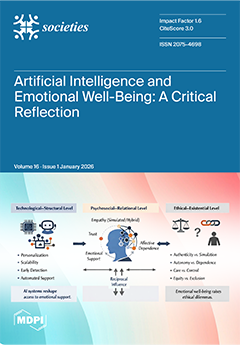
Cover Story (view full-size image): Between 2020 and 2025, artificial intelligence became deeply embedded in emotional life, reshaping how people seek support, express vulnerability, and build trust. From mental health chatbots to affective recommendation systems, AI increasingly mediates emotional experiences that were once rooted in human interaction. This article offers a critical reflection on the psychosocial, ethical, and sociotechnical implications of AI-mediated emotional well-being. Drawing on an analytical review of 40 peer-reviewed studies, it identifies both opportunities—such as expanded access and early emotional detection—and emerging risks, including simulated empathy, affective dependence, and the erosion of relational authenticity. A multilevel conceptual model is proposed to advance a human-centered understanding of AI in emotional ecologies. View this paper
  • Issues are regarded as officially published after their release is announced to the table of contents alert mailing list.
  • You may sign up for e-mail alerts to receive table of contents of newly released issues.
  • PDF is the official format for papers published in both, html and pdf forms. To view the papers in pdf format, click on the "PDF Full-text" link, and use the free Adobe Reader to open them.
Order results
Result details
Section
Select all
Export citation of selected articles as:
14 pages, 1401 KB  
Article
Social Conformity to Bots
by Tamas Olah and Laszlo Erdey
Societies 2026, 16(1), 38; https://doi.org/10.3390/soc16010038 - 22 Jan 2026
Viewed by 93
Abstract
This study explored the impact of social conformity when participants encountered unanimous responses from bots to both objective and subjective questions. Seventy-two participants from Heidelberg University participated in a simulated “Quiz Show”, answering general knowledge and opinion-based questions on economic policy. Using a [...] Read more.
This study explored the impact of social conformity when participants encountered unanimous responses from bots to both objective and subjective questions. Seventy-two participants from Heidelberg University participated in a simulated “Quiz Show”, answering general knowledge and opinion-based questions on economic policy. Using a within-subject design, participants first responded independently, then saw answers from three bots modeled after Asch’s classic conformity studies, which were displayed with usernames and profile pictures generated by artificial intelligence. The results showed significant conformity for both objective and subjective questions, regardless of whether the bot responses aligned with or opposed the initial beliefs of the participants. Gender differences emerged, with women showing higher conformity rates, as well as conformity in objective and subjective contexts appeared to be driven by distinct personality traits. Full article
Show Figures

Figure 1

17 pages, 248 KB  
Concept Paper
The Precarity of Disability Rights Historically and in the Trump Administration
by Allison C. Carey
Societies 2026, 16(1), 37; https://doi.org/10.3390/soc16010037 - 21 Jan 2026
Viewed by 415
Abstract
The United States is experiencing an attack on disability rights unprecedented since the emergence of the modern Disability Rights Movement. This paper examines the various ways in which disability rights have been undercut in 2025. To do so, I provide a theoretical framework [...] Read more.
The United States is experiencing an attack on disability rights unprecedented since the emergence of the modern Disability Rights Movement. This paper examines the various ways in which disability rights have been undercut in 2025. To do so, I provide a theoretical framework based in rights theory to reveal the precarity of disability rights and the strategy behind the actions taken by the Trump administration. I examine four key strategies to undercut disability rights: constructing disabled people as unworthy of the status of rights-bearer, constructing threats and conflicts across rights, dismantling the infrastructure of positive rights, and rejecting the value of disability rights across relational sites. Moreover, I argue that in part the effectiveness of contemporary attacks are deeply related to American history, because disability rights have always been contentious and left vulnerable to attack. Full article
(This article belongs to the Special Issue Neurodivergence and Human Rights)
22 pages, 986 KB  
Article
Working Smarter with AI in Hotel Industry: How Awareness Fuels Eustress, Task Crafting, and Adaptation
by Ahmed Mohamed Hasanein, Hazem Ahmed Khairy, Bassam Samir Al-Romeedy and Abbas N. Albarq
Societies 2026, 16(1), 36; https://doi.org/10.3390/soc16010036 - 21 Jan 2026
Viewed by 340
Abstract
The purpose of this study is to examine how employees’ artificial intelligence awareness (AIA) influences adaptive performance in the workplace through the mediating roles of eustress and task crafting within the Job Demands–Resources (JD-R) Theory. Data were collected from 372 full-time employees working [...] Read more.
The purpose of this study is to examine how employees’ artificial intelligence awareness (AIA) influences adaptive performance in the workplace through the mediating roles of eustress and task crafting within the Job Demands–Resources (JD-R) Theory. Data were collected from 372 full-time employees working in five-star hotels and analyzed using PLS-SEM with WarpPLS. The findings reveal that employees’ AI awareness significantly enhances adaptive performance both directly and indirectly. AI awareness also positively predicts eustress and task crafting, suggesting that informed employees experience motivating stress and actively reshape their tasks to optimize work processes. Moreover, both eustress and task crafting serve as significant mediators, amplifying the effect of AI awareness on adaptive performance. These results underscore the value of cultivating AI knowledge among employees to foster proactive behaviors and positive stress responses, ultimately supporting adaptability in dynamic work environments. The study contributes to JD-R Theory by integrating AI-related awareness as a personal resource driving employee adaptation. Full article
(This article belongs to the Special Issue Employment Relations in the Era of Industry 4.0)
Show Figures

Figure 1

16 pages, 444 KB  
Article
Balancing Unemployment and Psychache: An Individual Cross-Sectional Survey in People with Multi-Comorbidity
by Yuri Gimelfarb and Daniela Cojocaru
Societies 2026, 16(1), 35; https://doi.org/10.3390/soc16010035 - 20 Jan 2026
Viewed by 191
Abstract
Background: Suicide represents a challenging societal question. There is a correlation between multi-comorbidity (mental, addictive, social, and physical) and excess suicide. Aside from recognizing this correlation, our understanding of employment’s impact on psychache in adults with the multi-comorbidity of schizophrenia and multi-substance use [...] Read more.
Background: Suicide represents a challenging societal question. There is a correlation between multi-comorbidity (mental, addictive, social, and physical) and excess suicide. Aside from recognizing this correlation, our understanding of employment’s impact on psychache in adults with the multi-comorbidity of schizophrenia and multi-substance use disorders remains incomplete. Methods: This individual survey of 88 inpatients (with multi-comorbidity) examined the hypothetical impact of preadmission employment on psychache intensity. Fifty of them (56.8%) reported being employed prior to admission, while thirty-eight of them (43.2%) reported they were not. Written informed consent was obtained from all subjects involved in this survey before inclusion. Results: The findings demonstrated that the connection between general self-efficacy and current psychache intensity is dependent on the subjects’ preadmission employment status, with a stronger negative correlation observed in subjects who worked prior to admission (p < 0.001). Employment status provided the moderator variable in the association between general self-efficacy and current psychache intensity (p < 0.001). Conclusions: These measures are crucial for balancing work and psychache as well as translating the findings regarding the social nature of health and well-being into real-world application of suicide prevention in individuals with multi-comorbidity. Full article
(This article belongs to the Special Issue Innovative and Multidisciplinary Approaches to Healthcare)
Show Figures

Figure 1

16 pages, 515 KB  
Review
Empowering Local Communities Through Homestay Management: An Innovative Strategy for Sustainable Rural Tourism in Yogyakarta
by Rosianna Sianipar, Juliana Juliana, Ira Brunchilda Hubner, Diena M. Lemy and Amelda Pramezwary
Societies 2026, 16(1), 34; https://doi.org/10.3390/soc16010034 - 20 Jan 2026
Viewed by 329
Abstract
This study explores the empowerment of local communities through homestay management as an innovative strategy for sustainable rural tourism in Yogyakarta. Using a qualitative research design, data were collected through in-depth interviews, focus group discussions, and participant observation with homestay owners, community leaders, [...] Read more.
This study explores the empowerment of local communities through homestay management as an innovative strategy for sustainable rural tourism in Yogyakarta. Using a qualitative research design, data were collected through in-depth interviews, focus group discussions, and participant observation with homestay owners, community leaders, and local tourism stakeholders. The findings reveal that homestay management not only enhances economic opportunities for rural households but also strengthens cultural preservation and community participation in tourism governance. Moreover, the integration of traditional hospitality practices with innovative management approaches fosters visitor satisfaction while ensuring sustainability. The study contributes to the literature by highlighting how homestay management can serve as a model of community-based tourism development, offering practical implications for policymakers, local governments, and tourism practitioners in promoting inclusive and resilient rural tourism. Full article
Show Figures

Figure 1

24 pages, 923 KB  
Article
Boosting Employee Creativity in SMEs: Double Mediation of Knowledge Management and Competitive Work Environment
by Ni Putu Santi Suryantini, I Wayan Edi Arsawan, Viktor Koval, Siyka Demirova, Amiril Azizah and Viktoriia Udovychenko
Societies 2026, 16(1), 33; https://doi.org/10.3390/soc16010033 - 16 Jan 2026
Viewed by 172
Abstract
Despite existing studies on creativity, examining human resource management practices alongside knowledge management models for constructing creativity remains lacking. This study investigates employee creativity in small and medium enterprises (SMEs) in Indonesia, using data from 508 respondents within a 254-sample frame and employing [...] Read more.
Despite existing studies on creativity, examining human resource management practices alongside knowledge management models for constructing creativity remains lacking. This study investigates employee creativity in small and medium enterprises (SMEs) in Indonesia, using data from 508 respondents within a 254-sample frame and employing partial least squares structural equation modeling (PLS-SEM). The results indicate that human resource management practices and technological innovation significantly influence knowledge management and cultivate competitive work environments that foster creativity. The PLS-SEM model confirmed that human resource management practices and technological innovation have a significant direct effect on employee creativity, as well as indirect effects through knowledge management and competitive work environments. Knowledge management and competitive work environment served as double mediators in the mediation mechanism tested in this model. The findings provide practical insights for managers seeking to optimize human resources and technological innovation to enhance knowledge management and create competitive work environments that boost creativity. Full article
Show Figures

Figure 1

25 pages, 2212 KB  
Article
Will AI Replace Us? Changing the University Teacher Role
by Walery Okulicz-Kozaryn, Artem Artyukhov and Nadiia Artyukhova
Societies 2026, 16(1), 32; https://doi.org/10.3390/soc16010032 - 16 Jan 2026
Viewed by 282
Abstract
This study examines how Artificial Intelligence (AI) is reshaping the role of university teachers and transforming the foundations of academic work in the digital age. Building on the Dynamic Capabilities Theory (sensing–seizing–transforming), the article proposes a theoretical reframing of university teachers’ perceptions of [...] Read more.
This study examines how Artificial Intelligence (AI) is reshaping the role of university teachers and transforming the foundations of academic work in the digital age. Building on the Dynamic Capabilities Theory (sensing–seizing–transforming), the article proposes a theoretical reframing of university teachers’ perceptions of AI. This approach allows us to bridge micro-level emotions with meso-level HR policies and macro-level sustainability goals (SDGs 4, 8, and 9). The empirical foundation includes a survey of 453 Ukrainian university teachers (2023–2025) and statistics, supplemented by a bibliometric analysis of 26,425 Scopus-indexed documents. The results indicate that teachers do not anticipate a large-scale replacement by AI within the next five years. However, their fear of losing control over AI technologies is stronger than the fear of job displacement. This divergence, interpreted through the lens of dynamic capabilities, reveals weak sensing signals regarding professional replacement but stronger signals requiring managerial seizing and institutional transformation. The bibliometric analysis further demonstrates a theoretical evolution of the university teacher’s role: from a technological adopter (2021–2022) to a mediator of ethics and integrity (2023–2024), and, finally, to a designer and architect of AI-enhanced learning environments (2025). The study contributes to theory by extending the application of Dynamic Capabilities Theory to higher education governance and by demonstrating that teachers’ perceptions of AI serve as indicators of institutional resilience. Based on Dynamic Capabilities Theory, the managerial recommendations are divided into three levels: government, institutional, and scientific-didactic (academic). Full article
(This article belongs to the Special Issue Technology and Social Change in the Digital Age)
Show Figures

Figure 1

16 pages, 240 KB  
Article
Neurodivergence & Gender (Mis)Recognition: Addressing Inequity Through Neuroqueer Knowing
by Jessica Penwell Barnett
Societies 2026, 16(1), 31; https://doi.org/10.3390/soc16010031 - 16 Jan 2026
Viewed by 326
Abstract
There is an established association between neurodivergence and gender variance, with growing documentation of the challenges and inequities faced by those who exist at this intersection. This paper contributes a critical analysis of interviews with 24 autistic adults in the U.S. about their [...] Read more.
There is an established association between neurodivergence and gender variance, with growing documentation of the challenges and inequities faced by those who exist at this intersection. This paper contributes a critical analysis of interviews with 24 autistic adults in the U.S. about their gender experience; yielding three themes: “gender divergence?”, “gender socialization on crip time”, and “either/or: whose intolerance for ambiguity?”. Results suggest that gender variance—if it is best understood as such—among those on the spectrum emerges through a complex set of relationships between participants’ bodyminds (e.g., sensory and cognitive styles); dominant cultural concepts of gender; and ableist and heterocissexist social relations. Neuronormative ways of knowing gender, institutionalized through biomedical research, healthcare, and social policy, emerge as a normalizing discourse contributing to the oppression and marginalization of participants as neurodivergent people. Justice implications of accounting for the epistemology of the neurodivergent bodymind and decentering neuronormative ways of knowing are discussed. Full article
(This article belongs to the Special Issue Neurodivergence and Human Rights)
19 pages, 1349 KB  
Article
Silent Witness as Civic Theology: Zurab Kiknadze and the Ethics of Public Religion in Post-Soviet Georgia
by Gül Mükerrem Öztürk
Societies 2026, 16(1), 30; https://doi.org/10.3390/soc16010030 - 15 Jan 2026
Viewed by 194
Abstract
In post-Soviet Georgia, the renewed visibility of religion in the public sphere has generated ambivalent effects, fostering both social cohesion and identity-based exclusion. This article focuses on the work I Am the Way by Georgian Orthodox thinker Zurab Kiknadze to explore how a [...] Read more.
In post-Soviet Georgia, the renewed visibility of religion in the public sphere has generated ambivalent effects, fostering both social cohesion and identity-based exclusion. This article focuses on the work I Am the Way by Georgian Orthodox thinker Zurab Kiknadze to explore how a non-instrumental, ethics-based conception of public religion can be sociologically conceptualized. Drawing on a qualitative, hermeneutic-narrative method, the analysis identifies two core motifs in Kiknadze’s thought—“spiritual journey” and “silent witness”—and interprets them through the lenses of public religion theory (Casanova), lived religion paradigms (McGuire, Ammerman), and post-secular debates (Habermas). The findings indicate that Kiknadze understands faith not as a marker of dogmatic or ethno-political belonging but as a practice contributing to ethical continuity and the reconstruction of social trust. Within this framework, “silent witness” is defined as a form of faith grounded in consistency, humility, and action-oriented conviction; it is proposed as a transferable sociological mechanism that supports trust, reconciliation, and inclusive citizenship in transitional societies. Centering on the Georgian case, this article offers a conceptual contribution to rethinking the public role of religion in post-authoritarian contexts within an ethical framework. Full article
14 pages, 245 KB  
Article
Conflict, Gendered Borders, and Emotional Mobility: The Case of Kashmiri Women Seeking Legal Justice
by Sweta Sen and Aarash Pirzada
Societies 2026, 16(1), 29; https://doi.org/10.3390/soc16010029 - 15 Jan 2026
Viewed by 325
Abstract
How do Kashmiri women, seeking justice for the enforced disappearance and detention of their male relatives, navigate and negotiate with the gendered borders of ‘spaces of legality’? Drawing on ethnographic research and interviews with key stakeholders, this article uses spaces of legality, exemplified [...] Read more.
How do Kashmiri women, seeking justice for the enforced disappearance and detention of their male relatives, navigate and negotiate with the gendered borders of ‘spaces of legality’? Drawing on ethnographic research and interviews with key stakeholders, this article uses spaces of legality, exemplified by courts, police stations, and judicial bodies, as its primary analytical sites to examine the multiple ways Kashmiri women traverse from ‘home’ into a masculine, public space. The theoretical framework argues that pre-existing patriarchal norms, in collusion with militarization and conflict-induced hypermasculinity, engender an intangible gendered border for women in Kashmir. In navigating this border, they engage in what we term ‘emotional mobility’, an infra-political agentic movement that results in renegotiating their roles, both at home and outside. Full article
20 pages, 604 KB  
Article
Inclusive Digital Practices in Pre-Service Teacher Training in Chile and Portugal: Design and Validation of a Scale to Assess the Social Determinants of the Digital Divide
by Juan Alejandro Henríquez, Eva Olmedo-Moreno and Jorge Expósito-López
Societies 2026, 16(1), 28; https://doi.org/10.3390/soc16010028 - 14 Jan 2026
Viewed by 335
Abstract
This study examines the social determinants of the digital divide in pre-service teacher education through the design and validation of the Digital Hospitality Scale (DSBD-HD-FID). The instrument was developed to diagnose social inequalities across six key dimensions: socioeconomic status, geographic location, gender, age, [...] Read more.
This study examines the social determinants of the digital divide in pre-service teacher education through the design and validation of the Digital Hospitality Scale (DSBD-HD-FID). The instrument was developed to diagnose social inequalities across six key dimensions: socioeconomic status, geographic location, gender, age, disability status, and interculturality. These dimensions are understood as structural factors shaping access to, use of, and participation in digital environments within teacher education. The research followed a non-experimental, quantitative, and cross-sectional design, including content validation through expert judgment and statistical analysis based on a pilot sample of education students from Chile and Portugal. An exploratory factor analysis was conducted, and internal consistency was assessed using Cronbach’s alpha coefficient. The results confirm strong content and construct validity, as well as high reliability (α = 0.93). Empirical findings indicate that socioeconomic status and geographic location significantly condition access to connectivity and digital literacy, while gender differences emerge mainly in recreational uses and frequency of digital training. Beyond these results, the study highlights the relevance of addressing digital inequalities in teacher education through inclusive and equity-oriented training policies. The findings support the integration of digital hospitality, human rights education, and the Sustainable Development Goals into initial teacher training curricula as measurable and evaluable dimensions, providing an evidence-based framework to inform future teacher education policies aimed at reducing digital divides and promoting social cohesion. Full article
Show Figures

Figure 1

14 pages, 233 KB  
Article
When Narratives Belong to Others: Craft Evolution and the Question of Authorship
by Suresh Sethi
Societies 2026, 16(1), 27; https://doi.org/10.3390/soc16010027 - 13 Jan 2026
Viewed by 294
Abstract
This paper examines how narrative authority shapes craft evolution by analyzing two Indian craft development initiatives: the Golden Eye exhibition (1985) and the Jawaja project (1970s–1990s). Drawing on narrative theory and design research, I argue that the capacity to author one’s own story [...] Read more.
This paper examines how narrative authority shapes craft evolution by analyzing two Indian craft development initiatives: the Golden Eye exhibition (1985) and the Jawaja project (1970s–1990s). Drawing on narrative theory and design research, I argue that the capacity to author one’s own story from lived experience is fundamentally generative—creating conditions for autonomous evolution. While designers routinely claim narrative authority as a basis for innovation, craftspeople are positioned as subjects within frameworks others establish. Through an analysis of these cases and my embedded relationship to them, I propose five dimensions of narrative authority—source authority, generative capacity, framework control, ambiguity privilege, and validation—that reveal how structural positioning rather than capability determines whose stories count as legitimate bases for evolution. The paper demonstrates that even well-intentioned interventions cannot create genuine self-reliance without addressing the epistemic conditions that make craftspeople’s narratives recognizable as authoritative knowledge. Full article
21 pages, 262 KB  
Article
Encountering Generative AI: Narrative Self-Formation and Technologies of the Self Among Young Adults
by Dana Kvietkute and Ingunn Johanne Ness
Societies 2026, 16(1), 26; https://doi.org/10.3390/soc16010026 - 13 Jan 2026
Viewed by 382
Abstract
This paper examines how young adults integrate generative artificial intelligence chatbots into everyday life and the implications of these engagements for the constitution of selfhood. Whilst existing research on AI-mediated subjectivity has predominantly employed identity frameworks centered on social positioning and role enactment, [...] Read more.
This paper examines how young adults integrate generative artificial intelligence chatbots into everyday life and the implications of these engagements for the constitution of selfhood. Whilst existing research on AI-mediated subjectivity has predominantly employed identity frameworks centered on social positioning and role enactment, this study foregrounds selfhood—understood as the organization of subjective experience through narrative coherence, interpretive authority, and practices of self-governance. Drawing upon Paul Ricœur’s theory of narrative self and Michel Foucault’s concept of technologies of the self, the analysis proceeds through in-depth qualitative interviews with sixteen young adults in Norway to investigate how algorithmic systems participate in autobiographical reasoning and self-formative practices. The findings reveal four dialectical tensions structuring participants’ engagements with ChatGPT: between instrumental efficiency and existential unease; between algorithmic scaffolding and relational displacement; between narrative depth and epistemic superficiality; and between agency and deliberative outsourcing. The analysis demonstrates that AI-mediated practices extend beyond instrumental utility to reconfigure fundamental dimensions of subjectivity, raising questions about interpretive authority, narrative authorship, and the conditions under which selfhood is negotiated in algorithmic environments. These findings contribute to debates on digital subjectivity, algorithmic governance, and the societal implications of AI systems that increasingly function as interlocutors in meaning-making processes. Full article
(This article belongs to the Special Issue Algorithm Awareness: Opportunities, Challenges and Impacts on Society)
19 pages, 2764 KB  
Systematic Review
Trends and Approaches in Inclusive Graphic Design: A Systematic Literature Review
by Santiago Fabián Barriga-Fray, Mariela Verónica Samaniego-López, Luis Miguel Viñan-Carrasco and Iván Fabricio Benítez-Obando
Societies 2026, 16(1), 25; https://doi.org/10.3390/soc16010025 - 13 Jan 2026
Viewed by 429
Abstract
Inclusive graphic design has emerged as a relevant approach within contemporary visual communication studies, driven by the need to ensure that graphic messages can be understood and used by diverse groups of users. Within this context, the present study conducted a systematic literature [...] Read more.
Inclusive graphic design has emerged as a relevant approach within contemporary visual communication studies, driven by the need to ensure that graphic messages can be understood and used by diverse groups of users. Within this context, the present study conducted a systematic literature review with the aim of identifying the advances, trends, and recommendations that support the development of inclusive practices in graphic design. Using the PRISMA methodology, 85 primary studies were selected and analyzed, providing evidence to address the proposed research questions. The findings indicate a concentration of applications in digital interface design and visual communication, alongside the recurrent use of perceptual, cognitive, and semiotic theories, as well as principles of universal design. The analysis also reveals emerging trends related to new technologies, participatory approaches, and multisensory interactions, in addition to strategies that prioritize legibility, contrast, diverse representation, and user-centered design. Altogether, these findings depict a consolidating field that integrates technical, cultural, and social dimensions, highlighting the importance of continuing to develop research and tools that strengthen accessibility and inclusion in visual communication. Full article
Show Figures

Figure 1

34 pages, 1184 KB  
Article
Student Attitudes and Experiences with Distance Learning During COVID-19: A Framework for Hybrid Education
by Aristogiannis Garmpis, Spyridon Garmpis, Aliki Panagiotarou, Hera Antonopoulou and Constantinos Halkiopoulos
Societies 2026, 16(1), 24; https://doi.org/10.3390/soc16010024 - 13 Jan 2026
Cited by 1 | Viewed by 535
Abstract
Background: The COVID-19 pandemic forced an unprecedented global transition to emergency remote teaching, fundamentally disrupting traditional higher education delivery methods. This study investigated how Greek higher education students adapted to mandatory distance learning during the acute phase of the COVID-19 pandemic (March 2020 [...] Read more.
Background: The COVID-19 pandemic forced an unprecedented global transition to emergency remote teaching, fundamentally disrupting traditional higher education delivery methods. This study investigated how Greek higher education students adapted to mandatory distance learning during the acute phase of the COVID-19 pandemic (March 2020 to May 2021), providing baseline evidence of forced technology adoption patterns that can inform understanding of subsequent hybrid learning developments and future educational design. Methods: A quantitative cross-sectional design surveyed n = 477 students from Greek higher education institutions using a structured questionnaire measuring technology access, platform usage, learning modality preferences, challenges encountered, and future educational perspectives. Data analysis employed descriptive statistics, Pearson correlations, and multiple linear regression to identify predictors of distance learning satisfaction and preferences. Results: Most students expressed positive attitudes toward distance learning (67.9%) and reported comfort with online courses (71.6%), with 69.8% strongly preferring hybrid approaches combining synchronous and asynchronous modalities. Internet connectivity emerged as the primary predictor of satisfaction (β = 0.393, p = 0.052), while demographic factors showed minimal influence (R2 = 0.048). Most students achieved platform proficiency within ten days (73.6%), though 67.9% recognized that distance learning poses differential accessibility challenges. Conclusions: Despite successful adaptation to emergency remote teaching, students envision a hybrid educational future that strategically integrates online and face-to-face modalities rather than wholesale replacement of traditional methods, emphasizing the need for infrastructure investment and pedagogical innovation while preserving valued social learning dimensions. Full article
Show Figures

Figure 1

23 pages, 669 KB  
Article
Reconstructing Society Through Memory: Smong, Cultural Trauma, and Community Resilience in Post-Disaster Simeulue, Indonesia
by Dian Novita Fitriani, Atwar Bajari, Jenny Ratna Suminar and Nindi Aristi
Societies 2026, 16(1), 23; https://doi.org/10.3390/soc16010023 - 13 Jan 2026
Viewed by 329
Abstract
For the Simeulue community, trauma does not remain a source of fear or psychological burden. Instead, it becomes a guideline for their survival. This study explores how societies reconstruct themselves through memory by examining smong, the local knowledge of the Simeulue community [...] Read more.
For the Simeulue community, trauma does not remain a source of fear or psychological burden. Instead, it becomes a guideline for their survival. This study explores how societies reconstruct themselves through memory by examining smong, the local knowledge of the Simeulue community in Indonesia, as a cultural mechanism that transforms disaster experience into social resilience. Using a qualitative ethnographic approach, the research utilizes interviews, nandong and song lyrics, field notes, and historical documentation. The findings indicate that smong operates through interconnected layers of communicative and cultural memory: it is preserved in family stories, bedtime stories, artistic expressions, commemorative practices, and symbolic markers such as monuments and grave inscriptions. Through these processes, traumatic experiences are reframed as moral instructions and actionable knowledge that guide rapid evacuation, mutual aid, and collective vigilance during earthquakes and tsunamis. This study demonstrates that the reconstruction of the Simeulue community is driven not by a formal disaster management system but by practices rooted in culture. Past disaster experiences are continuously reinterpreted and integrated into everyday life. This highlights the importance of memory-based strategies for strengthening community resilience and offers directions for future research on intergenerational knowledge transmission, cultural adaptation, and disaster preparedness in oral societies. Full article
Show Figures

Figure 1

21 pages, 2871 KB  
Concept Paper
From Othering to Understanding: Participatory Design as a Practice of Critical Design Thinking
by Naureen Mumtaz
Societies 2026, 16(1), 22; https://doi.org/10.3390/soc16010022 - 12 Jan 2026
Viewed by 235
Abstract
Every act of design tells a story about who belongs, who is seen, and who is heard. This paper looks at how participatory design-based research (PDR), practiced with relational care and reflexivity, can help shift interactions among marginalized youth from urban Indigenous and [...] Read more.
Every act of design tells a story about who belongs, who is seen, and who is heard. This paper looks at how participatory design-based research (PDR), practiced with relational care and reflexivity, can help shift interactions among marginalized youth from urban Indigenous and newcomer immigrant communities in Canada from othering toward understanding. Moving beyond surface-level celebrations of multiculturalism, the study frames design as a relational and ethical practice, one that surfaces assumptions, holds space for difference, and creates openings for intercultural dialogue. The study draws on a series of design circles (d.circles) in which youth co-created visual communication artefacts reflecting their lived experiences. These artefacts became catalysts for dialogue, enabling participants to challenge stereotypes, articulate concerns, and develop shared perspectives. Reflexivity was integral to the process, guiding both participants and the facilitator to consider power, positionality, and relational accountability throughout. Findings show that participatory design, grounded in Indigenous relational principles and participatory action research, can unsettle dominant narratives, foster mutual recognition, and support youth-led meaning-making. This work contributes to emerging conversations that position design thinking as a practice of ethical engagement rather than a tool for problem-solving alone. The learnings from this study show how critically practiced PDR can cultivate more inclusive and socially responsive pathways for intercultural understanding to take shape. Full article
Show Figures

Figure 1

15 pages, 388 KB  
Article
Exploring Students’ Attitudes Toward the Integration of Artificial Intelligence in Education
by Remus Runcan, Patricia Luciana Runcan, Dana Rad and Lucian Marina
Societies 2026, 16(1), 21; https://doi.org/10.3390/soc16010021 - 12 Jan 2026
Viewed by 416
Abstract
The acceptance of, perceived advantages to, and skepticism toward the integration of artificial intelligence (AI) in undergraduate education is investigated in this paper. In this study, a total of 675 students from six Romanian universities answered a self-administered online questionnaire evaluating three main [...] Read more.
The acceptance of, perceived advantages to, and skepticism toward the integration of artificial intelligence (AI) in undergraduate education is investigated in this paper. In this study, a total of 675 students from six Romanian universities answered a self-administered online questionnaire evaluating three main aspects: AI acceptance, AI benefits, and AI skepticism. While AI skepticism has a modest but substantial negative influence (β = −0.113, p = 0.001), results show that AI benefits favorably predict AI acceptance (β = 0.541, p = 0.001). Whereas AI skepticism negatively correlates with AI acceptance (r = −0.124, p = 0.001), correlational analysis reveals a high positive association between AI acceptance and AI benefits (r = 0.544, p = 0.001). Despite concerns about its limitations, the regression model suggests that students’ willingness to embrace AI in education is mostly driven by its perceived advantages. This explains 30.8% of the variance in AI acceptance (R2 = 0.308, F(2, 641) = 142.909, p < 0.001). These results highlight the importance of techniques that improve perceived benefits while addressing uncertainty since they offer insightful analysis of student attitudes regarding artificial intelligence integration in higher education. By guiding policy decisions and educational activities meant to maximize AI-driven learning environments, this study adds to the current conversation on artificial intelligence adoption in education. Full article
Show Figures

Figure 1

20 pages, 266 KB  
Article
Skills Ecosystem and the Role of School Management for Sustainable Development of Dual Education
by Svetlana Alexandrova and Veneta Krasteva
Societies 2026, 16(1), 20; https://doi.org/10.3390/soc16010020 - 12 Jan 2026
Viewed by 370
Abstract
The article presents an analysis of the mechanisms used by a vocational high school in Bulgaria to develop dual training and implement it sustainably. It focuses on the school management’s leadership role in the network of different stakeholders, demonstrating the importance of this [...] Read more.
The article presents an analysis of the mechanisms used by a vocational high school in Bulgaria to develop dual training and implement it sustainably. It focuses on the school management’s leadership role in the network of different stakeholders, demonstrating the importance of this aspect in the entire process of developing dual education. Apart from the case analysis of the Bulgarian vocational high school’s successful implementation of dual learning, the research strategy includes examining regulatory documents, evaluation reports and publications in media and by companies, as well as analyzing the attitudes among key stakeholders. An overview of the challenges facing dual education in Bulgaria is also provided. Based on the case study findings, the factors supporting the implementation and sustainability of the dual system have been identified. We conclude that the long-term development of the dual education model depends on the understanding that the formation of professional skills is a dynamic process, requiring attention to the needs of the local environment, adaptability to current changes and active participation by all stakeholders. The role of school leadership—with regard to both its motivation and activity—has proven to be essential, and therefore it should not be overlooked when creating state incentives to support dual training. Full article
27 pages, 1117 KB  
Review
Corporate Social Responsibility with Chinese Characteristics: Institutional Embeddedness, Political Logic, and Comparative Theoretical Perspective
by Yi Ouyang, Hong Zhu, Man Zou and Quan Gao
Societies 2026, 16(1), 19; https://doi.org/10.3390/soc16010019 - 9 Jan 2026
Viewed by 392
Abstract
Corporate Social Responsibility (CSR) in China has evolved from reproducing Western-centric frameworks to engaging with the institutional and political particularities that shape how CSR is reconfigured and practiced. Yet few studies have critically reviewed this growing body of literature to capture the core [...] Read more.
Corporate Social Responsibility (CSR) in China has evolved from reproducing Western-centric frameworks to engaging with the institutional and political particularities that shape how CSR is reconfigured and practiced. Yet few studies have critically reviewed this growing body of literature to capture the core characteristics and mechanisms of state-corporate coordination in China. This paper fills this gap by reviewing 112 peer-reviewed English-language studies published between 2007 and 2025, synthesizing how CSR in China is conceptualized, embedded, and operationalized across cultural, economic, political, and global dimensions. This review identifies three institutional logics structuring Chinese CSR: (1) moral–cultural framing rooted in Confucian ethics and socialist collectivism; (2) economic coordination under state-led capitalism and selective neoliberalism; and (3) political signaling through Party-state governance and legitimacy negotiation. It also outlines six major research themes—CSR as a legitimacy strategy, CSR reporting, CSR in Chinese multinational enterprises, CSR’s link to financial performance, environmental CSR, and civil CSR—highlighting the mechanisms underlying each. Findings show that CSR in China is different from the managerial-stakeholder framework (e.g., explicit/implicit CSR, pyramid model or integrative model). Instead, it operates as an adaptive political technology within state-led capitalism, reinforcing moral legitimacy and political conformity as firms—especially SOEs and politically connected private enterprises—align with state-defined priorities. Through a comparative perspective, this review demonstrates how China’s CSR model fundamentally recalibrates corporate agency toward political negotiation rather than stakeholder responsiveness, offering a distinct configuration that challenges the presumed universality of Western CSR theories. Full article
Show Figures

Figure 1

18 pages, 263 KB  
Article
General Strain and Reported Gun Ownership Before and During the COVID-19 Pandemic: Implications for Crime and Public Safety
by Kosar Haghani and James L. Williams
Societies 2026, 16(1), 18; https://doi.org/10.3390/soc16010018 - 9 Jan 2026
Viewed by 271
Abstract
The COVID-19 pandemic has been one of the most globally disruptive social events in recent history, bringing widespread lockdowns, restrictions on movement, remote work, mass vaccination campaigns, and millions of deaths worldwide. These unprecedented circumstances have reshaped many aspects of social life, including [...] Read more.
The COVID-19 pandemic has been one of the most globally disruptive social events in recent history, bringing widespread lockdowns, restrictions on movement, remote work, mass vaccination campaigns, and millions of deaths worldwide. These unprecedented circumstances have reshaped many aspects of social life, including perceptions of safety and firearm ownership. This study examines changes in reported gun ownership before and during the COVID-19 pandemic in the United States, using binary logistic regression analyses of General Social Survey (GSS) data from 2018 and 2021. Analysis revealed that reported gun ownership remained stable at approximately 35% in both years. However, the demographic and social profile of gun owners shifted significantly. Demographic factors such as sex, US birth, marital status, and income consistently predicted ownership in both years, while race, middle-class identification, and political party affiliation emerged as significant predictors only during the pandemic, with Democrats becoming significantly less likely to report gun ownership. The results demonstrate how social crises can reshape the composition of firearm owners rather than overall rates, with implications for public policy and safety. Full article
19 pages, 792 KB  
Article
Reimagining Professional Associations in Disrupted Research Systems: A Hybrid Governance Model and Lessons from Indonesia
by Syahrir Ika, Badrun Susantyo, Agus Fanar Syukri, Abdul Wachid Syamroni, Destika Cahyana, Sari Intan Kailaku, Sri Djangkung Sumbogo Murti, R. Siti Zuhro, Haznan Abimanyu, Deni Shidqi Khaerudini, Ahyar Ahyar, Irma Himmatul Aliyyah and Anggita Tresliyana Suryana
Societies 2026, 16(1), 17; https://doi.org/10.3390/soc16010017 - 5 Jan 2026
Viewed by 1214
Abstract
This study investigates the institutional transformations within Indonesia’s research ecosystem, focusing on the impacts of the National Research and Innovation Agency (BRIN) establishment and the subsequent Work From Office (WFO) policy on the Association of Indonesian Researchers (PPI). The research aims to evaluate [...] Read more.
This study investigates the institutional transformations within Indonesia’s research ecosystem, focusing on the impacts of the National Research and Innovation Agency (BRIN) establishment and the subsequent Work From Office (WFO) policy on the Association of Indonesian Researchers (PPI). The research aims to evaluate these impacts and propose an adaptive institutional revitalization model. Employing a mixed-methods approach, a total of 150 online questionnaires were distributed across 21 regional branches of PPI between February and March 2025. Of these, 87 were completed and valid for analysis, representing a 58% response rate. Findings reveal that the WFO policy has led to a significant decline in member participation, coordination difficulties across regions, and weakened collaboration with local partners such as regional governments and universities. A SWOT analysis of three revitalization options—full agglomeration, bounded agglomeration, and non-BRIN integration—identified a hybrid model as the most adaptive and widely supported alternative (41.5%). This hybrid model combines selective structural efficiency with inclusive membership expansion, aiming to preserve regional identity, enhance collaboration, and strengthen organizational legitimacy. The study offers key insights for developing adaptive governance frameworks rooted in epistemic justice, digital accountability, and cross-sectoral collaboration, applicable to professional organizations navigating decentralization and institutional disruption. The proposed hybrid model serves as a strategic reference for achieving organizational resilience and fostering a more inclusive national innovation ecosystem. Full article
Show Figures

Figure 1

18 pages, 410 KB  
Review
Strategies of Health-Focused Narratives to Develop Coping and Growth for Young People: A Thematic Analysis of the Literature
by India Bryce, Jessica Gildersleeve, Nycole Prowse, Carol du Plessis, Annette Brömdal, Govind Krishnamoorthy, Beata Batorowicz, Tayissa Pannell, Kate Cantrell and Amy B. Mullens
Societies 2026, 16(1), 16; https://doi.org/10.3390/soc16010016 - 4 Jan 2026
Viewed by 585
Abstract
While there are many approaches in the use of narratives for children and young people as symbolic forms of real-life education, this article specifically investigates the use of narratives as a public health communication and intervention strategy for young people. This strategy foregrounds [...] Read more.
While there are many approaches in the use of narratives for children and young people as symbolic forms of real-life education, this article specifically investigates the use of narratives as a public health communication and intervention strategy for young people. This strategy foregrounds imaginative stories based on health education messaging that are told from patient perspectives. Through a thematic analysis of 57 research articles, the article explores the themes and discursive strategies of narrative-based health communication, including digital storytelling, in supporting young people to develop coping and resilience skills. The article identifies five interrelated themes, revealing that narratives are not only effective tools for conveying health information but also foster psychosocial support, patient empowerment, and social connection. Such narratives serve as tools for facilitating change and informing decision-making across various stages of health engagement, including prevention, promotion, and management of chronic conditions. These narratives are socially transformative: in assisting young people; they also educate clinical professionals and organizations and thereby inform public health practice at large. In this way the article both consolidates and clarifies the field of literature concerned with the use of story as a health communication strategy for children and young people. Full article
(This article belongs to the Special Issue Building Healthy Communities)
Show Figures

Figure 1

23 pages, 728 KB  
Article
Unemployment Factors Among Venezuelan Immigrants in Colombia
by Miguel Ángel Morffe Peraza, Neida Albornoz-Arias, María-Antonia Cuberos, Carolina Ramírez-Martínez and José Alberto Peña Echezuría
Societies 2026, 16(1), 15; https://doi.org/10.3390/soc16010015 - 1 Jan 2026
Viewed by 629
Abstract
Since 2015, nearly 3 million Venezuelans have fled to Columbia, forced to leave their homeland by a multidimensional humanitarian crisis. Entering the Columbian labour market has become one of the key challenges facing these migrants. In the fragile socio-economic context of cities bordering [...] Read more.
Since 2015, nearly 3 million Venezuelans have fled to Columbia, forced to leave their homeland by a multidimensional humanitarian crisis. Entering the Columbian labour market has become one of the key challenges facing these migrants. In the fragile socio-economic context of cities bordering Venezuela, finding employment is especially difficult. This study aimed to clarify the factors related to unemployment among Venezuelan immigrants in the border municipalities of Villa del Rosario, Los Patios and Cúcuta (Colombia). The target population included 122 Venezuelan migrants who reported being unemployed. The primary data was collected from July to October 2022. Using multiple correspondence analysis and positioning maps, we identified three different profiles that emerge among these unemployed immigrants. Profile 1 is characterised as young people with an education level ranging from primary school to high school and an occupational profile of mainly service workers and salespeople in commerce and markets. Profile 2, of greatest interest in this study, is characterised as mostly young women who received university education but have not managed to enter the labour market. Profile 3 is largely men aged 48 to 61 years and older, with medium technical and higher university-level education and an occupational profile of mostly technical and professional medium level. We conclude with several recommendations to promote formal labour integration among Venezuelan migrants. Full article
Show Figures

Figure 1

35 pages, 1122 KB  
Article
Place Attachment Disruption: Emotions and Psychological Distress in Mexican Land Defenders
by Silvana Mabel Nuñez Fadda and Daniela Mabel Gloss Nuñez
Societies 2026, 16(1), 14; https://doi.org/10.3390/soc16010014 - 1 Jan 2026
Viewed by 400
Abstract
Land defense is crucial in the face of the current ecological crisis. From a qualitative perspective, this work describes and analyzes the relations between place attachment disruption, emotions, and psychological distress among a group of Mexican land defenders in El Salto and Juanacatlán, [...] Read more.
Land defense is crucial in the face of the current ecological crisis. From a qualitative perspective, this work describes and analyzes the relations between place attachment disruption, emotions, and psychological distress among a group of Mexican land defenders in El Salto and Juanacatlán, Jalisco. Following an ethnographical methodology, the data was collected through seven individual narrative interviews, two discussion groups, and participant observation during four years of fieldwork. The resulting qualitative data was transcribed, coded, categorized, and analyzed using qualitative software and narrative analysis perspective. Results: Place attachment disruption is associated with unpleasant emotions, leading to psychological distress. Through organized actions and emotional management strategies, land defenders produce emotions of resistance that help reconstruct place attachment and overcome psychological distress. Repeated disruptions and changes to place increase psychological distress; in response, restorative actions of place attachment strengthen emotions such as love, pride, and joy. These findings highlight that observing the simultaneity of place attachment disruption and reconstruction processes is central to understanding the emotional impact of prolonged territorial damage and the double role of psychological distress: increasing vulnerability while also contributing to positive action. These findings have theoretical and practical implications for mental health, ecology, and public policy, and highlight the need for interdisciplinary approaches in designing effective, community-based and collaborative strategies to sustain land defense and ecological activism. Full article
Show Figures

Figure 1

20 pages, 403 KB  
Article
Therapy Farms as Social Innovations Shaping Social Transformations in Rural Areas: Case Study Analysis
by Vitalija Simonaitytė and Erika Ribašauskienė
Societies 2026, 16(1), 13; https://doi.org/10.3390/soc16010013 - 1 Jan 2026
Viewed by 330
Abstract
Therapy farms are increasingly recognized as social innovations that respond to exclusion, mental health challenges, and youth disconnection, particularly in rural areas. While often praised for their inclusive and rehabilitative potential, their broader impact on structural social transformation remains under-examined. This study explores [...] Read more.
Therapy farms are increasingly recognized as social innovations that respond to exclusion, mental health challenges, and youth disconnection, particularly in rural areas. While often praised for their inclusive and rehabilitative potential, their broader impact on structural social transformation remains under-examined. This study explores the House of Educational Experiences, a therapeutic farm in rural Lithuania, to critically assess how such initiatives function as both agents of inclusion and stabilizers of existing socio-economic arrangements. Drawing on a qualitative case study approach, the research analyses in-depth interview data through the lens of the social innovation cycle, focusing on novelty, process, heterogeneity, impact, scalability, and transformative potential. Our findings reveal that the therapeutic farm generates significant individual and community benefits, particularly in psychosocial well-being, social skills, and pathways back into education and employment. However, the initiative also operates within institutional constraints, relying on project-based funding and reproducing aspects of conventional care systems. As such, its transformative capacity appears limited by structural dependencies and policy fragmentation. The study concludes that therapy farms represent an ambivalent form of social innovation: capable of creating inclusive, localized change, but often constrained in their ability to catalyze systemic transformation. Policy recommendations emphasize the need for long-term funding, institutional integration, and cross-sector collaboration. Full article
(This article belongs to the Special Issue Building Healthy Communities)
Show Figures

Figure 1

73 pages, 747 KB  
Review
Incivility, Ostracism, and Social Climate Surveys Through the Lens of Disabled People: A Scoping Review
by Gregor Wolbring, Esha Dhaliwal and Mahakprit Kaur
Societies 2026, 16(1), 12; https://doi.org/10.3390/soc16010012 - 30 Dec 2025
Viewed by 511
Abstract
Incivility and civility have been studied for more than a century across disciplines and in many areas ranging from workplaces to communication, the digital world, and everyday life. They are often used to the detriment of marginalized groups. Their negative use is seen [...] Read more.
Incivility and civility have been studied for more than a century across disciplines and in many areas ranging from workplaces to communication, the digital world, and everyday life. They are often used to the detriment of marginalized groups. Their negative use is seen to set the groundwork for other negative treatments, such as bullying and harassment, impacting the social climate in a negative way. Ostracism is seen to be linked to incivility. Disabled people disproportionally face negative treatments, such as bullying and harassment, and experience a negative social climate, as highlighted by the UN Convention on the Rights of People with Disabilities, suggesting that they also disproportionately experience incivility and ostracism. Climate surveys aim to expose toxic social climate in workplaces, schools, and communities caused by incivility, ostracism, bullying, and harassment. As such, how incivility, civility, ostracism, and the design of climate surveys are discussed in the literature is of importance to disabled people. We could find no review that analyzed the use of climate surveys beyond individual surveys and the concepts of incivility and ostracism in relation to disabled people. The objective of our study was to contribute to filling this gap by analyzing the academic literature present in SCOPUS, EBSCO HOST (70 databases), and Web of Science, performing keyword frequency and content analysis of abstracts and full texts. Our findings provide empirical evidence for a systemic neglect of disabled people in the topics covered: from 21,215 abstracts mentioning “civilit*” or “incivilit*”, only 14 were relevant, and of the 8358 abstracts mentioning ostracism, only 26 were relevant. Of the 3643 abstracts mentioning “climate surveys,” 12 sources covered disabled people by focusing on a given survey, but not one study performed an evaluation of the utility of climate surveys for disabled people in general. Racism is seen as a structural problem facilitating civility/incivility. Ableism, the negative judgments of a given set of abilities someone has, and disablism, the systemic discrimination based on such judgments, are structural problems experienced by disabled people, facilitating civility/incivility. However, ableism generated only 2 hits, and disablism/disableism had no hits. Most of our sources focused on workplace incivility, and authors were mostly from the USA. We found no linkage to social and policy discourses that aim to make the social environment better, such as equity, diversity, and inclusion, well-being, and science and technology governance. This is the first paper of its kind to look in depth at how the academic literature engages with the concepts of civility, incivility, and ostracism and with the instrument of social climate surveys in relation to disabled people. Our findings can be used by many different disciplines and fields to strengthen the theoretical and practical discussions on the topics in relation to disabled people and beyond. Full article

31 pages, 904 KB  
Article
How Can Professional Sports Clubs Enhance the Level of Corporate Social Responsibility Fulfillment? Evidence from Professional Sports Clubs in China
by Qiao Meng, Lian Wang, Yu Liu, Xinghao Wang and Tomasz Chamera
Societies 2026, 16(1), 11; https://doi.org/10.3390/soc16010011 - 29 Dec 2025
Viewed by 318
Abstract
This study explores the multifactorial synergistic effects and configurational pathways for enhancing corporate social responsibility (CSR) performance among Chinese professional sports clubs. Drawing on 188 valid questionnaires from Chinese professional football and basketball clubs, the research employs fuzzy-set qualitative comparative analysis to examine [...] Read more.
This study explores the multifactorial synergistic effects and configurational pathways for enhancing corporate social responsibility (CSR) performance among Chinese professional sports clubs. Drawing on 188 valid questionnaires from Chinese professional football and basketball clubs, the research employs fuzzy-set qualitative comparative analysis to examine the influence of seven antecedent conditions, commercial environment, government regulation, expectancy pressure, economic interests, internal emotional traits, moral quality, and information disclosure, on CSR performance. The findings reveal that CSR performance results from the interplay of multiple factors, identifying two equivalent pathways for enhancement: the coupling of government pressure with internal autonomy, and the coordination of commercial environment with internal moral qualities. These insights clarify the complex causal mechanisms underlying CSR implementation in professional sports clubs and propose two strategic approaches for promoting CSR: optimizing external institutional frameworks and activating internal endogenous motivation. The study offers configurationally grounded pathway options and managerial implications for improving CSR practices in Chinese professional sports clubs. Full article
Show Figures

Figure 1

28 pages, 1121 KB  
Article
Diminished Quality of Life and Psychosocial Strain of Women Under the New Taliban Era: A Thematic Analysis
by Heer Shah, Jessi Hanson-DeFusco, Hamid Popalzai, Nandita Kumar, Sakil Malik, Anton Sobolev, Min Shi, Ravin Regina Cline, Sonali Singh, Albert DeFusco and Alexis McMaster
Societies 2026, 16(1), 9; https://doi.org/10.3390/soc16010009 - 26 Dec 2025
Viewed by 880
Abstract
Background: Life for women drastically altered after the 2021 US-NATO military withdrawal from Afghanistan. Methods: Applying a gendered general strain theory (GGST) model, this paper presents mixed-method findings from a 2023 semi-structured digital survey of 29 Afghan women, identifying key shared hardships concerning [...] Read more.
Background: Life for women drastically altered after the 2021 US-NATO military withdrawal from Afghanistan. Methods: Applying a gendered general strain theory (GGST) model, this paper presents mixed-method findings from a 2023 semi-structured digital survey of 29 Afghan women, identifying key shared hardships concerning the daily lives of Afghan women (ages 18–65) and psychosocial stress. Results: A thematic analysis of their responses indicates that support for the Taliban’s return to power ranges among women; however, respondents experience diminished quality-of-life (DQOL) factors like persistent food insecurity that affect their views of the current government and affect their psychosocial health. Furthermore, most struggle with financial insecurity and growing governmental restrictions, particularly gender discrimination policies (GDP), further increasing their stress as they try to acclimate to the new political environment. Additionally, we triangulate the key qualitative findings with a statistical analysis to help illustrate emerging patterns between DQOL factors, GDP experiences, and psychosocial stress (PSS). Conclusions: This study is one of the first known semi-structured surveys conducted within the country of Afghanistan after the Taliban reseized control, offering crucial insights into life of Afghan women through their own intimate experiences and perspectives. Full article
(This article belongs to the Section The Social Nature of Health and Well-Being)
Show Figures

Figure 1

21 pages, 293 KB  
Article
Growth and Strife: A Malthusian Perspective on Population and Political Instability in Developing Countries (1960–2022)
by Jeremy Ko, Chuangjian Xin, Mohammad Ridwan, Chunlan Guo and Chun Kai Leung
Societies 2026, 16(1), 10; https://doi.org/10.3390/soc16010010 - 26 Dec 2025
Viewed by 535
Abstract
This study, based on the Neo-Malthusian framework, examines the association between population growth, resource scarcity, and political instability in 128 developing countries from 1960 to 2022. Results show that rapid population growth is associated with higher levels of political instability. This association appears [...] Read more.
This study, based on the Neo-Malthusian framework, examines the association between population growth, resource scarcity, and political instability in 128 developing countries from 1960 to 2022. Results show that rapid population growth is associated with higher levels of political instability. This association appears stronger in low-income countries, which generally exhibit weaker institutions, limited fiscal capacity, and lower carrying capacity that coincide with greater sociopolitical tensions and inequalities. In contrast, high-income developing countries tend to show greater resilience, associated with stronger governance and technological adaptability. The findings highlight the importance of policies that strengthen governance, enhance resource management, and promote sustainable development to address potential instability risks associated with demographic pressures. Full article
Previous Issue
Next Issue
Back to TopTop