
Article

Balancing Unemployment and Psychache: An Individual Cross-Sectional Survey in People with Multi-Comorbidity

Department of Sociology, Social Work and Human Resources, Alexandru Ioan Cuza University, 700506 Iasi, Romania
*
Author to whom correspondence should be addressed.
Societies 2026, 16(1), 35; https://doi.org/10.3390/soc16010035
Submission received: 12 November 2025 / Revised: 14 January 2026 / Accepted: 16 January 2026 / Published: 20 January 2026
(This article belongs to the Special Issue Innovative and Multidisciplinary Approaches to Healthcare)

Abstract

Background: Suicide represents a challenging societal question. There is a correlation between multi-comorbidity (mental, addictive, social, and physical) and excess suicide. Aside from recognizing this correlation, our understanding of employment’s impact on psychache in adults with the multi-comorbidity of schizophrenia and multi-substance use disorders remains incomplete. Methods: This individual survey of 88 inpatients (with multi-comorbidity) examined the hypothetical impact of preadmission employment on psychache intensity. Fifty of them (56.8%) reported being employed prior to admission, while thirty-eight of them (43.2%) reported they were not. Written informed consent was obtained from all subjects involved in this survey before inclusion. Results: The findings demonstrated that the connection between general self-efficacy and current psychache intensity is dependent on the subjects’ preadmission employment status, with a stronger negative correlation observed in subjects who worked prior to admission (p < 0.001). Employment status provided the moderator variable in the association between general self-efficacy and current psychache intensity (p < 0.001). Conclusions: These measures are crucial for balancing work and psychache as well as translating the findings regarding the social nature of health and well-being into real-world application of suicide prevention in individuals with multi-comorbidity.

1. Introduction

1.1. Unemployment—Well-Being Balance

The adverse effects of being unemployed have been demonstrated in sociological research regarding personal [1,2,3,4,5,6] and societal well-being [7], as well as a healthy lifespan [5,8] in both the general population [9] and outpatients with mental illness [10]. This research’s findings demonstrated pronounced negative health consequences, such as excess all-cause mortality [8,11,12], elevated psychoactive substances consumption [8,13], subsequent incidence of substance use disorders [13], a negative effect on subjective well-being [1,4,5,6], etc.

1.2. Unemployment-Suicide Link

Social stratification by work [14], the workplace [15], labor force participation [16,17], occupational integration [18], and/or (un-)employment [2,8,19,20,21,22,23,24,25,26,27] status, as a mirror of social integration [28], is among the current major themes in the sociology of suicide [29]. A brief (2000–2024) summary of this research among the general population is presented in Table 1.
The data in Table 1 shows the following:
  • Unemployment is one of the independent predictors of increased risk for suicidal behavior in the general population.
  • At the beginning of this millennium, sociologist Steven Stack suggested that individual level research is still needed to distinguish between mental and social contributors for suicide [28]. Since then, it has been well-established that both (un-)employment and mental illness have separate and independent effects on suicide. For instance, the risk of suicide in males with schizophrenia was 11.85 (95% CI 10.94–12.84) and with substance use disorders was 6.88 (95% CI 4.51–10.5), while in unemployed males, the risk of suicide was 1.68 (95% CI 1.11–2.54). The risk of suicide in females with schizophrenia was 12.64 (95% CI 11.47–13.94) and with substance use disorders was 14.59 (95% CI 12.79–16.65), while in unemployed females, the risk of suicide was 1.68 (95% CI 1.09–2.59) [32].
  • The potential contribution of (un-)employment to suicidal tendencies in socially excluded and highly deprived populations suffering from a multi-comorbidity of both schizophrenia and multi-substance use disorders has not yet been explored.
This study seeks to address this lacuna.

1.3. Psychache and General Self-Efficacy as a Proximal Contributors of Suicide

Psychache reflects hurt, anguish, soreness, aching, and pain in the psyche (mind). Based on current theoretical models (e.g., pain and suicidality model [37], the strain theory of suicide [38], social pain model [39]) in social sciences, it is currently well-established that psychache is positively related and is a predictor of suicidal behavior [10,40,41,42,43,44].
Otherwise, general self-efficacy was found to be negatively related to suicidal behavior [45,46,47,48,49,50]. An investigation of interrelated underlying risk factors is required to understand the unique paths leading to the generation of suicidal behavior among socially excluded and highly deprived populations suffering from a multi-comorbidity of both schizophrenia and multi-substance use disorders. Following a cross-disciplinary collaboration, the aim of the present survey was to examine the impact of preadmission (un-)employment and general self-efficacy on psychache in adults in this population.
In addition, given the research results discussed above, as well as the paucity of research in this field, there is reason to suspect that (un-)employment may have differential effects on the relationship between general self-efficacy and current psychache. Therefore, the present survey examined the unique role of preadmission (un-)employment as a moderator variable in the association between the levels of general self-efficacy and current psychache intensity.
Study Hypotheses:
(1)
The levels of general self-efficacy and the current psychache intensity would differ between employed and unemployed sub-populations.
(2)
The levels of general self-efficacy would reciprocally correlate with current psychache intensity.
(3)
The preadmission (un-)employment would act as moderator factor in the association between the levels of general self-efficacy and current psychache intensity.

2. Materials and Methods

2.1. Participants/Setting

All subjects met the inclusion criteria as follows: aged 18 years or older; both genders; inpatient from the university affiliated mental health facility; diagnosed with a multi-comorbidity of both schizophrenia spectrum disorders [SSD] (codes F20–F25) as well as at least one of substance use disorders (codes F10–F19) [51]; sufficient comprehension of the individual survey’s procedures and implications of participation; provided a written informed consent form, as approved by the Institutional Review Board (IRB) from the university affiliated mental health facility. Sufficient comprehension was defined as the subject’s demonstrated ability to understand the individual survey’s assessments, their rights as survey participants (e.g., the right to withdraw at any time without penalty, etc.), as well as the completely voluntary nature of their participation. This comprehension was assessed through a pre-consent conversation during which all potential subjects were encouraged to ask questions regarding different aspects of the individual survey and their own participation.
Subjects were excluded based on the following criteria: ongoing serious concurrent conditions (such as drug poisoning/intoxication, medical instability) that required urgent medical intervention; inadequate interpersonal cooperation, preventing meaningful participation in survey procedures (for example, due to neurocognitive impairment, language-related barriers, etc.); known pregnancy or lactation at the time of enrollment (due to potential adverse effects to the fetus or infant, as well as the difficulty of accounting for hormonal fluctuations during the discussion on this highly-sensitive topic); receipt of undergoing Electro-Convulsive Therapy either currently or within the preceding two months (due to potential memory impairment); refusal to participate in the survey and/or failure to provide written informed consent form.

2.2. Measures

The subjects were asked a number of background questions regarding their age, gender (male, female), country of birth (native or foreign-born), education (elementary school, middle school, no high school diploma, high school, academic/professional), marital status (married, not married), whether they were living alone or not, preadmission (un-)employment status (not employed, employed), and admissions and global length of stay (LOS) in mental health facilities. Lifetime suicidal ideation was assessed with a “yes”/”no” question (“Have you ever thought about committing suicide?”) based on established research [50]. Similarly, lifetime suicide attempts were assessed via a separate “yes”/”no” question (“Have you ever attempted to commit suicide?”) [52,53,54,55].
The Charlson comorbidity index (CCI) was used to assess the prevalence of multiple medical physical comorbidities, with each condition weighted by severity. Higher scores reflect a greater overall burden of physical illness, and one additional point was added for each decade over the age of 40 [56].
The Addiction Severity Index (ASI) was used to assess the characteristics of the past 30 days and lifetime multi-substance use [57]: most severe route of substance administration (oral, nasal, smoking, non-intra-venous [IV] injection, IV injection), multi-substance use in the past month (days), substances in use (lifetime number), and multi-substances use (lifetime years).
The New General Self-Efficacy 8-item Scale (NGSES) was used to measure the level of general self-efficacy [58]. The NGSES comprises a 5-point Likert scale ranging from 1 = “strongly disagree” to 5 = “strongly agree”. The item scores were summed to get a total score of general self-efficacy level, which may range between 8 and 40, with a higher value indicating more resilience. The NGSES has good validity and reliability and its Cronbach’s α coefficient was 0.89 in this study.

2.3. Outcome Measure

The Orbach and Mikulincer Mental Pain Scale (OMMPS) was adopted to measure the current experience of psychache/mental pain intensity [44,59]. In its original version, this scale comprised 44 items (with a 5-point Likert scale ranging from 1 “strongly disagree” to 5 “strongly agree”) divided into 9 factors (Irreversibility of pain, Loss of control, Narcissistic wounds, Emotional flooding, Freezing, Self-estrangement, Confusion, Social distancing and Emptiness). A higher score reflects higher psychache intensity. Because of its low Cronbach’s α coefficient (0.43), the social distancing factor was omitted from the data analysis [54,60], while Cronbach α coefficients for the other 8 factors in the current study ranged between 0.65 and 0.85; the Cronbach α coefficient of the total scale was 0.95.

2.4. Study Ethics

The study was conducted in accordance with the Declaration of Helsinki and approved by the IRB of the University Mental Health Facility (reference number 182). In every stage of the planning, collection, processing, analysis, interpretation, storage, and dissemination of this survey data, every action was ethically considered [61] in strict accordance with the Declaration of Helsinki—ethical principles for research involving human subjects with medical diagnoses [62].

2.5. Design and Procedure

This study was an individual cross-sectional survey that took place in the University Mental Health Facility. After the IRB approval, all potential participants were screened. After this previous screening, an individual meeting was held with each potential participant during which they were kept fully informed about the details of participation in this survey. Written informed consent was obtained from all participants involved in this survey before inclusion. Following this, the researcher (Y.G.) administered the study questionnaire.

2.6. Statistical Analysis

Data were analyzed by IBM Statistical Package for the Social Sciences (SPSS) 29th version for Windows (IBM Corp., Armonk, NY, USA). Continuous variables (age, admissions and LOS in mental health facilities, CCI, lifetime years of multi-substance use, number of days in the last month under multi-substance use, lifetime number of multi-substances use, total OMMPS and its sub-scales, and NGSES) are expressed as mean with standard deviation (SD) as appropriate. Categorical variables are presented as frequency (n) and percentages (%). Descriptive statistics were calculated, including the mean, SD, skewness, and kurtosis. Namely, the skewness and kurtosis measures of this study were applied to examine the normality of the variable’s distribution.
The subject’s characteristics were compared between the preadmission employment sub-populations (“was not employed” vs. “was employed”) using the X2 test for nominal variables (gender, country of birth, marital status, living status, suicidal thoughts and attempts), Mann–Whitney test for ordinal variables (education, multiple substance route of administration) or Student’s t-test for independent samples (age, admissions and LOS in mental health facilities, CCI, lifetime years of multi-substance use, number of days in the month under multi-substance use, lifetime number of substance use, total OMMPS and its sub-scales, NGSES).
To test the first hypothesis, Student’s t-test for two independent samples was conducted for each current psychache intensity measure and for general self-efficacy measure. The independent variables were preadmission employment status and general self-efficacy scales, while the dependent variable was current psychache intensity.
To test the second hypothesis, Pearson correlation analyses were conducted for the whole sample and for each preadmission employment sub-population separately.
To test the third hypothesis, moderation analysis using Model 1 was conducted with the PROCESS macro [63] to examine whether subjects’ preadmission employment status moderates the association between general self-efficacy and current psychache intensity. The subjects’ gender, country of birth, and suicidal thoughts were included as covariates in the moderation analysis since these background variables contributed to explaining current psychache intensity in preliminary multiple regression analysis.
It should be noted that given the examination of 10 dependent variables (total and 8 sub-scales of OMMPS, and NGSES), a Bonferroni correction was applied to reduce the likelihood of Type I errors associated with multiple comparisons [64].

3. Results

3.1. Sample Population Description

The sample included 88 inpatients with 45 males (51.1%) and 43 females (48.9%).
Fifty (56.8%) inpatients reported as being employed prior to admission, while thirty-eight (43.2%) reported they were not. Table 2 demonstrates the subjects’ characteristics by preadmission (un-)employment sub-populations.
As shown in Table 2, no statistically significant differences were found between subjects who were employed and those who were not prior to admission across any of the background characteristics. Table 3 demonstrates the subject’s multi-substance routes of administration (as measured by ASI [57]) and suicidal behavior by preadmission (un-)employment sub-populations.
As shown in Table 3, there were no significant differences between employed and unemployed subjects regarding the most severe route of multi-substance administration or suicidal tendencies.
Table 4 demonstrates the subject’s age, admissions and LOS in mental health facilities, CCI, and characteristics of multi-substance use by preadmission employment sub-populations.
As shown in Table 4, there were no significant differences between employed and unemployed subjects regarding the subject’s age, admissions and LOS in mental health facilities, CCI, and characteristics of multi-substance use.

3.2. Hypothesis Testing

Prior to hypothesis testing, descriptive statistics were calculated for OMMPS measures and NGSES. Skewness values between −1 and +1 and kurtosis values between −2 and +2 are widely regarded as indicative of acceptable normality for parametric analyses [65]. These results supported the appropriateness of using parametric statistical methods in subsequent analyses. Table 5 demonstrates the descriptive statistics.

3.2.1. Current Psychache Intensity and General Self-Efficacy According to Preadmission Employment Status

The first hypothesis suggested that the level of current psychache intensity and general self-efficacy would differ between the preadmission employment sub-populations (Table 6).
As shown in Table 6, the results indicated that no significant differences were found in the current psychache intensity and general self-efficacy according to preadmission employment status. This finding does not support the first research hypothesis, which suggested that levels of current psychache intensity and general self-efficacy would differ between the two preadmission employment sub-populations.

3.2.2. Correlation Between Current Psychache Intensity and General Self-Efficacy

The second hypothesis suggested that general self-efficacy would reciprocally correlate with current psychache intensity (Table 7).
As can be seen in Table 7, in line with the suggested hypothesis, a negative correlation was found between NGSES score and the total score of the OMMPS, as well as in all sub-scales (except for freezing), among subjects who were not employed. These findings indicate that higher levels of general self-efficacy were associated with a lower intensity of current psychache, particularly among subjects who were not employed prior admission. All the correlations were significant in the restricted p < 0.005 (adjusted p-value). No significant negative correlations were found between general self-efficacy and the measures of current psychache intensity among subjects who were employed prior admission. Fisher r-to-z transformation indicated that the correlation coefficients between the two preadmission employment statuses were significantly different with regard to the total score of the current psychache intensity scale, as well as in all sub-scales (except from freezing). These results suggest that the association between general self-efficacy and current psychache intensity is dependent on the subjects preadmission employment status, with a stronger negative correlation observed in subjects who worked prior admission.

3.2.3. Preadmission Employment Status as a Moderating Variable

Before examining whether preadmission employment status moderates the association between general self-efficacy and the intensity of current psychache, a multiple regression analysis was conducted to identify which background variables significantly explain current psychache intensity scores. This preliminary analysis was used to determine which covariates should be included in the moderation model.
The stepwise regression revealed that three variables significantly explained current psychache intensity: gender, place of birth, and suicidal thought. These variables together explained 31.6% of the variance in current psychache intensity scores (R2 = 0.316, p < 0.001). The negative β coefficients for gender and country of birth and the positive β coefficient for suicidal thoughts indicate that subjects who were female, native-born, and reported suicidal thoughts tended to report higher levels of current psychache intensity. Table 8 demonstrates the multiple regression results for subjects’ current psychache intensity.
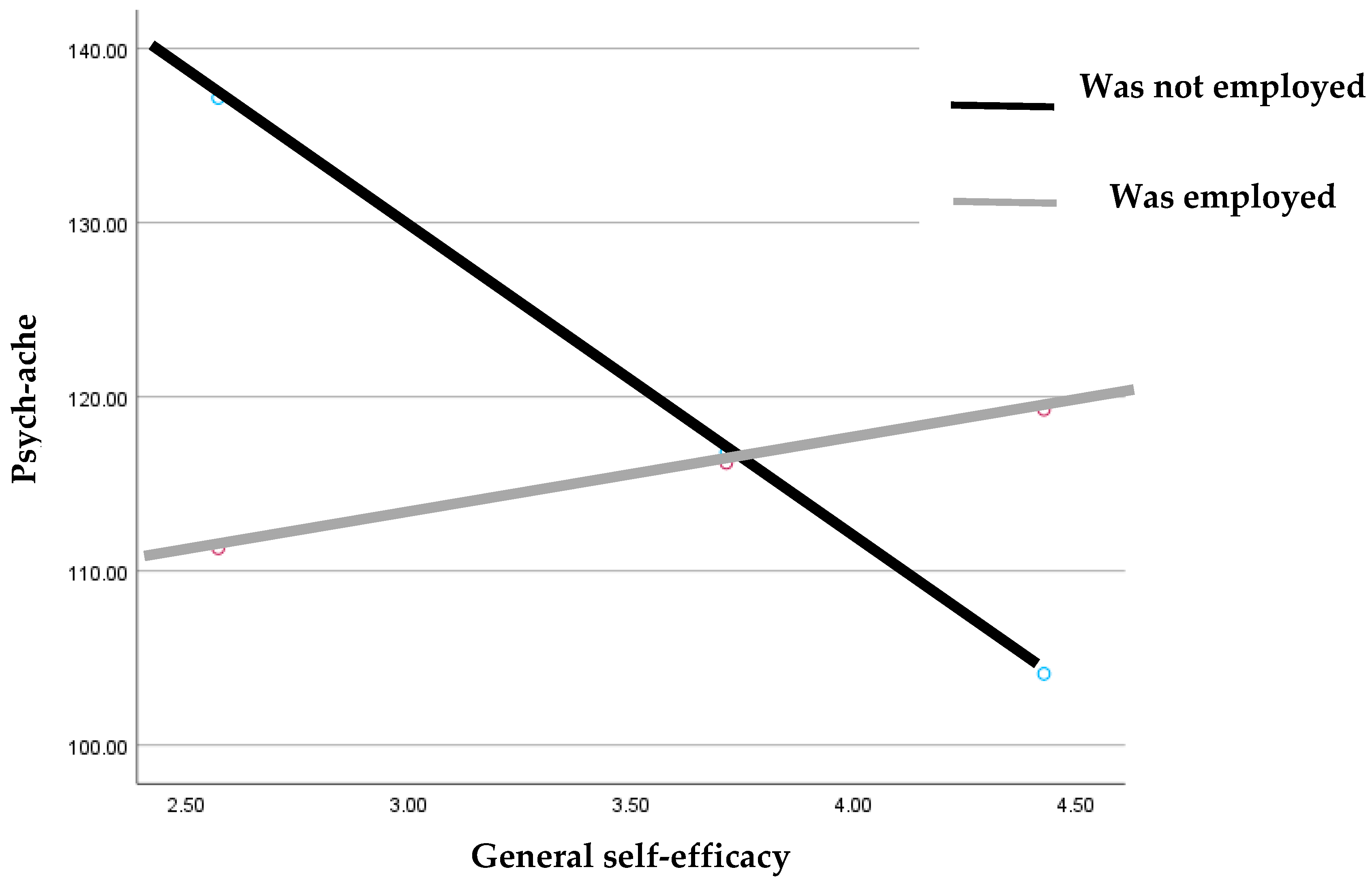
Given these findings, gender, place of birth, and suicidal thoughts were included as covariates in the subsequent moderation analysis to statistically control for their influence on current psychache intensity. Due to the limited research exploring this area, the current survey examined whether preadmission employment status moderates the relationship between general self-efficacy and current psychache intensity. To test this, a moderation analysis was conducted using Model 1 of the PROCESS macro for SPSS [63], with general self-efficacy as the independent variable, current psychache intensity as the dependent variable, and preadmission employment status as the moderator. Table 9 shows the results of the moderation analysis while Figure 1 visualizes these.
The results of the moderation analysis indicated that subjects’ preadmission (un-)employment status significantly moderated the association between NGSES and OMMPS (R2 = 6.25%; F(1,81) = 8.19; p = 0.005; 95% CI 6.73–37.46). This suggests that the association between general self-efficacy and current psychache intensity differs depending on whether the participant worked prior admission.

4. Discussion

This pilot study examined the hypothetical contribution of psychiatric preadmission (un-)employment on psychache among adults with the multi-comorbidity. This is a unique study population in this individual survey. In terms of sociological geometry, these individuals with disabilities might be defined as an extremely curtailed population compared to the general/normative population [66,67]. The achievement of balance between appropriate health and a healthy lifestyle for this extremely curtailed population must be the primary purpose of any developed society.
An additional exceptionality of the current study is that, unlike the study of suicide as a social phenomenon in classical sociology, the current study did not examine suicidal behavior or suicide risk in a population at a consistent and very high risk, but rather psychache as a distal expression of suicidality or behavioral intention toward suicide.
Regarding the first hypothesis, it was found that the levels of current psychache intensity did not differ between the preadmission (un-)employment sub-populations. Therefore, the first hypothesis was refuted. No studies were found in the scientific literature that dealt with the estimated contribution of (un-)employment on psychache in the general population, nor in a population with multi-comorbidity. However, studies among the general population have indicated that unemployment is associated with an increased risk of suicide [2,7,19,20,21,22,23,24,30,31,32,33,34,35] during their lifetime. A similar picture was also found in a single study of outpatients with mental illness (Table 1). Lucca [10] examined employment status at the baseline assessment and found that the rate of suicide attempts during the subsequent six months was significantly higher among the unemployed subjects than among those who were employed. However, no mention was made of psychache intensity either at baseline assessment or during the six-month prospective follow-up. It should be noted that in most other studies of psychache among adults with a significant mental illness, the issue of the study subjects’ employment was not mentioned [53,55,68,69,70,71,72] nor was the level of psychache presented in a breakdown by (un-)employment [52,54,73,74,75].
It is possible that the failure to find a difference between the study sub-populations according to current psychache intensity in the current study does not necessarily indicate that these differences do not exist. It might simply be necessary to increase the sample population and/or include subjects with different types of mental illness (similar to the longitudinal study by Lucca [10]) and not only subjects with multi-comorbidity; doing this might allow the difference in current psychache intensity to be detected.
Regarding the second hypothesis, a reciprocal relationship was found between current psychache intensity and general self-efficacy only in the sub-population of subjects who reported as being unemployed prior to their hospitalization. However, the relationship between these two variables was not found in the whole sample population at all, nor in the sub-population of the sample who reported being employed prior to their hospitalization. Therefore, this hypothesis was only partially confirmed. Among the possible explanations for finding a relationship between current psychache intensity and general self-efficacy, it can be noted that in the unemployed sub-population, the risk of suicide is relatively high, as detailed in the introduction section. It is well known that the high risk of suicide is related to both high intensity of psychache [10,41,42,43,44] and to low levels of general self-efficacy [45,46,47,48].
Additionally, it is well-established in the general population that the longer one is unemployed, the greater the economic pressure as income and financial savings are eliminated. The likelihood for mental anguish or psychache and the generation of suicidal behaviors increase [36]. This is also reflected in the current study. No studies were found that address the estimated contribution of (non-)employment to psychache in the general population nor in the study population with multi-comorbidity.
To achieve balance between unemployment and well-being without suicidal behavior, the proactive integrated socio-economic strategies are highly recommended for this socially excluded and highly deprived population suffering from multi-comorbidity. According to this solution, the necessary balance can be achieved through socially assistance programs, for instance, expanding supported employment, creating additional unique employment opportunities, close training, supportive guidance through an expert colleague, etc. [7]. Furthermore, it is imperative to allocate an adequate social budget accordingly, and encourage the employment of people with disabilities through legislation, etc.
Regarding the third hypothesis, the results of the moderation analysis indicated that subjects’ preadmission employment status significantly moderated the association between general self-efficacy and current psychache intensity. Therefore, it seems like the association between general self-efficacy and current psychache intensity differs depending on whether the participant worked prior to admission.
This finding, together with findings related to the second hypothesis, indicates the need to plan the pilot interventional program in order to minimize psychache in a multi-comorbidity population. This pilot project should focus on the sub-population of those who are not employed and act in an integrative manner to increase their general self-efficacy or alternatively to reduce their current psychache intensity. In other words, to achieve a balance between unemployment and healthy well-being (without suicidal behaviors) in this multi-comorbidity population, it is necessary to encourage them to participate in the labor market, including partial employment such as a part-time job. Simultaneously, this pilot project should draw attention to the cross-disciplinary solution to assist in reducing the intensity of psychache and/or increasing the levels of general self-efficacy. This is the practical implication of the current study.
As previously mentioned, there is little research on the moderator variables of the relationship between psychache (as measured by OMMPS) and other factors that participate in the generation of suicidal behavior, especially in the population with mental illness, which has an increased risk of suicide. Alacreu-Crespo and colleagues [76] found that decision-making skills moderate the relationship between psychache intensity and suicidal behavior in a population of subjects with a depressive episode. However, psychache was measured using a different measurement scale, not the OMMPS.

Limitations

One of the limitations of this study is in its cross-sectional, but lack of follow-up, design [10]. Therefore, causality cannot be inferred from the relationship between the variables. However, this study is a pilot study on this topic and forms the basis for future prospective studies within this population.
In addition, the information regarding (un-)employment was only self-reported. It was not based on formal documentation from organizations or, alternatively, on information from subjects’ relatives and/or significant others. However, self-reports constitute the appropriate method of gathering information among people with severe mental illness [10,77]. The findings of this study provide preliminary evidence for employment-related patterns that warrant further investigation.
Moreover, the duration of preadmission (un-)employment period [30,36] was not taken into consideration. It is worth noting that usually due to severe mental illness, with most of the subjects suffering from severe mental illness having the right to receive a government pension and not be employed. Therefore, there is a possibility that the legality of status of the actual employment was not reported by the participants (the employment might have been illegal due to the possible need to pay income tax). Yet, despite its theoretical/hypothetical impact on study results, the rate of unemployed subjects in the current survey did not significantly differ from a longitudinal study in a population of outpatients [10].
Furthermore, other economic (income, type of job), social (doing volunteer work or community service), and clinical (severity of current episode of mental illness, adherence with the prescribed treatment, etc.) factors contributing to suicidal tendencies were not examined. Further investigation of these contributing factors to suicidal behavior within this population is needed.
An additional limitation is the risk that only severe cases were chosen due to the participation of inpatients with multi-substance use disorders and not with single (mono-) substance use disorders. Otherwise, this is a real-world trend which we see depicted in this population, i.e., there is currently an increasing amount of people with mental illness that have become addicted to additional psychoactive substances and suffer from multi-substance use disorders [77]/poly-drug use [78].

5. Conclusions

This individual survey on psychache is a pilot study within an extremely curtailed population of multi-comorbidity. The main results suggest that the association between general self-efficacy and current psychache intensity is dependent on the subjects’ preadmission employment status, with a stronger negative correlation observed in subjects who worked prior to admission. It needs to be said that the impact of unemployment on suicidality in the population with multi-comorbidity was in line with the state of current (2023–2025) sociological research in social nature of health and well-being in both the general population [6,19,20,21,22,23] and the population with mental illness [10]. Subjects’ preadmission employment status moderates the association between general self-efficacy and current psychache intensity. In today’s complex and interconnected world, all these measures are crucial for balancing unemployment and psychache in multi-comorbidity in order to achieve a cross-disciplinary solution for reduced suicidal tendencies.

Further Research

Further individual interventional as well as aggregative longitudinal research in social and health sciences is needed in coming decades to confirm and extend these findings within this population of multi-comorbidity. Due to significant risks for suicidal behavior in the population with multi-comorbidity, a further investigation of the factors to indicate a sub-population at increased risk is required. In addition, a further investigation of hypothetical variables that moderate the potential relationship between current psychache and other interrelated risk factors of suicide is needed.

Author Contributions

Conceptualization, Y.G. and D.C.; methodology, Y.G. and D.C.; software, Y.G.; validation, D.C. and Y.G.; formal analysis, Y.G.; investigation, Y.G.; resources, Y.G.; data curation, D.C.; writing—original draft preparation, Y.G.; writing—review and editing, D.C.; visualization, Y.G.; supervision, D.C.; project administration, Y.G. and D.C. All authors have read and agreed to the published version of the manuscript.

Funding

This research received no external funding.

Institutional Review Board Statement

The study was conducted in accordance with the Declaration of Helsinki and approved by Institutional Review Board of the University Mental Health Facility (approval code: 182; approval date: 15 October 2024).

Informed Consent Statement

Informed consent was obtained from all subjects involved in the study.

Data Availability Statement

The subjects of this individual survey did not give written consent for their data to be shared publicly, so due to privacy and ethical restrictions, as well as due to the highly sensitive nature of the study supporting data is not available.

Acknowledgments

The authors would like to thank the staff at the participating University Mental Health Facility for their assistance. The authors would like to forward special thanks to Ms. Inga Novikov (RN, MA) for her continued technical support in this study.

Conflicts of Interest

The authors declare no conflicts of interest.

References

  1. Theodossiou, I. The effects of low-pay and unemployment on psychological well-being: A logistic regression approach. J. Health Econ. 1998, 17, 85–104. [Google Scholar] [CrossRef] [Scilit]
  2. Stack, S. Suicide: A 15-year review of the sociological literature part I: Cultural and economic factors. Suicide Life Threat. Behav. 2000, 30, 145–162. [Google Scholar]
  3. Paul, K.I.; Moser, K. Unemployment impairs mental health: Meta-analyses. J. Vocat. Behav. 2009, 74, 264–282. [Google Scholar] [CrossRef] [Scilit]
  4. Fors Connolly, F.; Gärling, T. Mediators of differences between employed and unemployed in life satisfaction and emotional well-being. J. Happiness Stud. 2022, 23, 1637–1651. [Google Scholar] [CrossRef] [Scilit]
  5. Gedikli, C.; Miraglia, M.; Connolly, S.; Bryan, M.; Watson, D. The relationship between unemployment and wellbeing: An updated meta-analysis of longitudinal evidence. Eur. J. Work Organ. Psychol. 2023, 32, 128–144. [Google Scholar] [CrossRef] [Scilit]
  6. Picchio, M.; Ubaldi, M. Unemployment and health: A meta-analysis. J. Econ. Surv. 2024, 38, 1437–1472. [Google Scholar] [CrossRef] [Scilit]
  7. Andrés, A.R.; Collings, S.; Qin, P. Sex-specific impact of socio-economic factors on suicide risk: A population-based case–control study in Denmark. Eur. J. Public Health 2010, 20, 265–270. [Google Scholar] [CrossRef] [Scilit] [PubMed]
  8. Jin, R.L.; Shah, C.P.; Svoboda, T.J. The impact of unemployment on health: A review of the evidence. Can. Med. Assoc. J. 1995, 153, 529. [Google Scholar] [CrossRef] [Scilit]
  9. Milner, A.; Page, A.; LaMontagne, A.D. Long-term unemployment and suicide: A systematic review and meta-analysis. PLoS ONE 2013, 8, e51333. [Google Scholar] [CrossRef] [Scilit]
  10. Lucca, G. Assessing Mental Pain as a Predictive Factor of Suicide Risk in a Clinical Sample of Patients with Psychiatric Disorders. Ph.D. Thesis, University of Insubria, Varese, Italy, 2024. Available online: https://irinsubria.uninsubria.it/handle/11383/2170414 (accessed on 11 November 2025).
  11. Roelfs, D.J.; Shor, E.; Davidson, K.W.; Schwartz, J.E. Losing life and livelihood: A systematic review and meta-analysis of unemployment and all-cause mortality. Soc. Sci. Med. 2011, 72, 840–854. [Google Scholar] [CrossRef] [Scilit]
  12. Garcy, A.M.; Vågerö, D. The length of unemployment predicts mortality, differently in men and women, and by cause of death: A six year mortality follow-up of the Swedish 1992–1996 recession. Soc. Sci. Med. 2012, 74, 1911–1920. [Google Scholar] [CrossRef] [Scilit] [PubMed]
  13. Henkel, D. Unemployment and substance use: A review of the literature (1990–2010). Curr. Drug Abus. Rev. 2011, 4, 4–27. [Google Scholar] [CrossRef] [Scilit] [PubMed]
  14. Bielby, D.D.V.; Bielby, W.T. Work commitment, sex-role attitudes, and women’s employment. Am. Sociol. Rev. 1984, 49, 234–247. [Google Scholar] [CrossRef] [Scilit]
  15. Hedström, P.; Liu, K.Y.; Nordvik, M.K. Interaction domains and suicide: A population-based panel study of suicides in Stockholm, 1991–1999. Soc. Forces 2008, 87, 713–740. [Google Scholar] [CrossRef] [Scilit]
  16. Stack, S. Suicide: A comparative analysis. Soc. Forces 1978, 57, 644–653. [Google Scholar] [CrossRef]
  17. Breault, K.D. Suicide in America: A test of Durkheim’s theory of religious and family integration, 1933–1980. Am. J. Sociol. 1986, 92, 628–656. [Google Scholar] [CrossRef] [Scilit]
  18. Gibbs, J.P. Status integration and suicide: Occupational, marital, or both? Soc. Forces 2000, 79, 363–384. [Google Scholar] [CrossRef]
  19. Goel, D.; Dennis, B.; McKenzie, S.K. Is suicide a mental health, public health or societal problem? Curr. Opin. Psychiatry 2023, 36, 352–359. [Google Scholar] [CrossRef] [Scilit]
  20. Chandler, A.; Wright, S. Suicide as slow death: Towards a haunted sociology of suicide. Sociol. Rev. 2024, 72, 1038–1056. [Google Scholar] [CrossRef] [Scilit] [PubMed]
  21. Kerrie, G.; Grace, P.; Paul, C.; Stephen, P.; Heather, M.; Michelle, O.D.; Eve, G. The social determinants of suicide: An umbrella review. medRxiv 2024. [Google Scholar] [CrossRef] [Scilit]
  22. Schnittker, J. The Sociology of Mental Health and the Twenty-First-Century Mental Health Crisis. Soc. Ment. Health 2025, 15, 1–16. [Google Scholar] [CrossRef] [Scilit]
  23. World Health Organization. World Report on Social Determinants of Health Equity. 2025. Available online: https://www.who.int/teams/social-determinants-of-health/equity-and-health/world-report-on-social-determinants-of-health-equity (accessed on 11 November 2025).
  24. Kposowa, A.J. Unemployment and suicide: A cohort analysis of social factors predicting suicide in the US National Longitudinal Mortality Study. Psychol. Med. 2001, 31, 127–138. [Google Scholar] [CrossRef] [Scilit]
  25. Goldsmith, S.K.; Pellmar, T.C.; Kleinman, A.M.; Bunney, W.E. Society and Culture. In Reducing Suicide: A National Imperative; Goldsmith, S.K., Pellmar, T.C., Kleinman, A.M., Bunney, W.E., Eds.; National Academies Press: Washington, DC, USA, 2002. [Google Scholar]
  26. Blakely, T.A.; Collings, S.C.; Atkinson, J. Unemployment and suicide. Evidence for a causal association? J. Epidemiol. Community Health 2003, 57, 594–600. [Google Scholar] [CrossRef] [Scilit]
  27. Wyllie, C.; Platt, S.; Brownlie, J.; Chandler, A.; Connolly, S.; Evans, R.; Kenelly, B.; Kirtley, O.; Moore, G.; O’Connor, R.C.; et al. Men, Suicide and Society: Why Disadvantaged Men in Mid-Life Die by Suicide; Samaritans: Surrey, UK, 2012. [Google Scholar]
  28. Stack, S. Suicide: A 15-year review of the sociological literature part II: Modernization and social integration perspectives. Suicide Life Threat. Behav. 2000, 30, 163–176. [Google Scholar] [CrossRef] [Scilit]
  29. Scourfield, J. Suicidal masculinities. Sociol. Res. Online 2005, 10, 35–44. [Google Scholar] [CrossRef] [Scilit]
  30. Qin, P.; Agerbo, E.; Mortensen, P.B. Suicide risk in relation to socioeconomic, demographic, psychiatric, and familial factors: A national register–based study of all suicides in Denmark, 1981–1997. Am. J. Psychiatry 2003, 160, 765–772. [Google Scholar] [CrossRef] [Scilit] [PubMed]
  31. Agerbo, E. Midlife suicide risk, partner’s psychiatric illness, spouse and child bereavement by suicide or other modes of death: A gender specific study. J. Epidemiol. Community Health 2005, 59, 407–412. [Google Scholar] [CrossRef] [Scilit] [PubMed]
  32. Li, Z.; Page, A.; Martin, G.; Taylor, R. Attributable risk of psychiatric and socio-economic factors for suicide from individual-level, population-based studies: A systematic review. Soc. Sci. Med. 2011, 72, 608–616. [Google Scholar] [CrossRef] [Scilit]
  33. Chang, S.S.; Stuckler, D.; Yip, P.; Gunnell, D. Impact of 2008 global economic crisis on suicide: Time trend study in 54 countries. BMJ 2013, 347, f5239. [Google Scholar] [CrossRef] [Scilit]
  34. Denney, J.T.; Wadsworth, T.; Rogers, R.G.; Pampel, F.C. Suicide in the city: Do characteristics of place really influence risk? Soc. Sci. Q. 2015, 96, 313–329. [Google Scholar] [CrossRef] [Scilit] [PubMed]
  35. Reeves, A.; Stuckler, D. Suicidality, economic shocks, and egalitarian gender norms. Eur. Sociol. Rev. 2016, 32, 39–53. [Google Scholar] [CrossRef] [Scilit]
  36. Stack, S. Contributing factors to suicide: Political, social, cultural and economic. Prev. Med. 2021, 152, 106498. [Google Scholar] [CrossRef] [Scilit]
  37. Elman, I.; Borsook, D.; Volkow, N.D. Pain and suicidality: Insights from reward and addiction neuroscience. Prog. Neurobiol. 2013, 109, 1–27. [Google Scholar] [CrossRef] [Scilit]
  38. Zhang, J. The strain theory of suicide. J. Pac. Rim Psychol. 2019, 13, e27. [Google Scholar] [CrossRef] [Scilit]
  39. Abrutyn, S. Toward a sociological theory of social pain. J. Theory Soc. Behav. 2023, 53, 351–371. [Google Scholar] [CrossRef] [Scilit]
  40. Shneidman, E.S. Commentary: Suicide as psychache. J. Nerv. Ment. Dis. 1993, 181, 145–147. [Google Scholar] [CrossRef] [Scilit] [PubMed]
  41. Verrocchio, M.C.; Carrozzino, D.; Marchetti, D.; Andreasson, K.; Fulcheri, M.; Bech, P. Mental pain and suicide: A systematic review of the literature. Front. Psychiatry 2016, 7, 108. [Google Scholar] [CrossRef] [Scilit]
  42. Ducasse, D.; Holden, R.R.; Boyer, L.; Artero, S.; Calati, R.; Guillaume, S.; Courtet, P.; Olie, E. Psychological pain in suicidality: A meta-analysis. J. Clin. Psychiatry 2017, 79, 44–51. [Google Scholar] [CrossRef] [Scilit] [PubMed]
  43. Baryshnikov, I.; Isometsä, E. Psychological pain and suicidal behavior: A review. Front. Psychiatry 2022, 13, 981353. [Google Scholar] [CrossRef] [Scilit]
  44. Gimelfarb, Y.; Cojocaru, D. Psychological and social pain in prediction of suicidality as a societal and adult educational challenge. Educ. 21 J. 2024, 28, 314–326. [Google Scholar] [CrossRef] [Scilit]
  45. Kobayashi, Y.; Fujita, K.; Kaneko, Y.; Motohashi, Y. Self-efficacy as a suicidal ideation predictor: A population cohort study in rural Japan. Open J. Prev. Med. 2015, 5, 61–71. [Google Scholar] [CrossRef]
  46. Berent, D.; Emilien, G.; Podgórski, M.; Kusideł, E.; Kulczycka-Wojdala, D.; Szymańska, B.; Macander, M.; Pawłowska, Z. SSTR4, childhood adversity, self-efficacy and suicide risk in alcoholics. Transl. Neurosci. 2017, 8, 76–86. [Google Scholar] [CrossRef] [Scilit]
  47. Lee, K.H.; Jun, J.S.; Kim, Y.J.; Roh, S.; Moon, S.S.; Bukonda, N.; Hines, L. Mental health, substance abuse, and suicide among homeless adults. J. Evid. Inf. Soc. Work. 2017, 14, 229–242. [Google Scholar] [CrossRef] [Scilit]
  48. Liu, L.; Sun, Y.; Wang, Y.; Luo, N.; Bai, R.; Pan, M.; Song, Y.; Wu, H. Impact of alexithymia on suicidal ideation among patients with ovarian cancer: A moderated mediation model of self-perceived burden and general self-efficacy. Support. Care Cancer 2023, 31, 177. [Google Scholar] [CrossRef] [Scilit] [PubMed]
  49. Grote, V.; Wagner, T.; Riedl, D.; Kautzky-Willer, A.; Fischer, M.J.; Scheibenbogen, O.; Musalek, M. Female patients show a larger reduction in suicidal ideation in inpatient addiction treatment than male patients: Results of a single-center observational study. Subst. Abus. Rehabil. 2024, 15, 31–42. [Google Scholar] [CrossRef] [Scilit]
  50. Li, Y.; Xu, G.; Wu, D.; Yan, M.; Yao, M.; Du, W.; Fan, L. General self-efficacy in association with insomnia symptoms and suicidal ideation among Chinese community-based population. Asia Pac. J. Public Health 2024, 36, 43–50. [Google Scholar] [CrossRef] [Scilit]
  51. Sandu, A.; Cojocaru, D.; Gavrilovici, C.; Oprea, L. Trust: An ethical dimension of healthcare in chronic disorders. Rev. Rom. Bioet. 2013, 11, 190–205. [Google Scholar]
  52. World Medical Association. World Medical Association Declaration of Helsinki: Ethical principles for medical research involving human subjects. JAMA 2013, 310, 2191–2194. [Google Scholar] [CrossRef] [Scilit] [PubMed]
  53. Pompili, M.; Erbuto, D.; Innamorati, M.; Luciano, M.; Sampogna, G.; Abbate-Daga, G.; Barlati, S.; Carmassi, C.; Castellini, G.; De Fazio, P.; et al. The relationship between mental pain, suicide risk, and childhood traumatic experiences: Results from a multicenter study. J. Clin. Psychiatry 2022, 83, 41432. [Google Scholar] [CrossRef] [Scilit]
  54. Pompili, M.; Lester, D.; Leenaars, A.A.; Tatarelli, R.; Girardi, P. Psychache and suicide: A preliminary investigation. Suicide Life Threat. Behav. 2008, 38, 116–121. [Google Scholar] [CrossRef] [Scilit]
  55. Levi, Y.; Horesh, N.; Fischel, T.; Treves, I.; Or, E.; Apter, A. Mental pain and its communication in medically serious suicide attempts: An “impossible situation”. J. Affect. Disord. 2008, 111, 244–250. [Google Scholar] [CrossRef] [Scilit]
  56. Berardelli, I.; Sarubbi, S.; Spagnoli, A.; Fina, C.; Rogante, E.; Erbuto, D.; Innamorati, M.; Lester, D.; Pompili, M. Projective technique testing approach to the understanding of psychological pain in suicidal and non-suicidal psychiatric inpatients. Int. J. Env. Res. Public. Health 2020, 17, 284. [Google Scholar] [CrossRef] [Scilit]
  57. Charlson, M.E.; Pompei, P.; Ales, K.L.; MacKenzie, C.R. A new method of classifying prognostic comorbidity in longitudinal studies: Development and validation. J. Chronic Dis. 1987, 40, 373–383. [Google Scholar] [CrossRef] [Scilit]
  58. McLellan, A.T.; Luborsky, L.; Woody, G.E.; O’Brien, C.P. An improved diagnostic evaluation instrument for substance abuse patients: The Addiction Severity Index. J. Nerv. Ment. Dis. 1980, 168, 26–33. [Google Scholar] [CrossRef] [Scilit]
  59. Chen, G.; Gully, S.M.; Eden, D. Validation of a new general self-efficacy scale. Organ. Res. Methods 2001, 4, 62–83. [Google Scholar] [CrossRef] [Scilit]
  60. Orbach, I.; Mikulincer, M.; Sirota, P.; Gilboa-Schechtman, E. Mental pain: A multidimensional operationalization and definition. Suicide Life Threat. Behav. 2003, 33, 219–230. [Google Scholar] [CrossRef] [Scilit]
  61. Levinger, S.; Holden, R.R. Reliability and Validation of the Hebrew Version of the Reasons for Attempting Suicide Questionnaire (RASQ-H) and its Importance for Mental Pain. Suicide Life Threat. Behav. 2014, 44, 486–496. [Google Scholar] [CrossRef] [Scilit] [PubMed]
  62. Hayes, A.F. Introduction to Mediation, Moderation, and Conditional Process Analysis: A Regression-Based Approach, 2nd ed.; The Guilford Press: New York, NY, USA, 2018. [Google Scholar]
  63. Armstrong, R.A. When to use the Bonferroni correction. Ophthalmic Physiol. Opt. 2014, 34, 502–508. [Google Scholar] [CrossRef] [Scilit] [PubMed]
  64. World Health Organization. International Classification of Disease, Version 10. 2019. Available online: https://icd.who.int/browse10/2019/en (accessed on 11 November 2025).
  65. George, D.; Mallery, P. SPSS for Windows Step by Step: A Simple Guide and Reference, 10th ed.; Pearson Education: Boston, MA, USA, 2010. [Google Scholar]
  66. Black, D. Dreams of pure sociology. Sociol. Theory 2000, 18, 343–367. [Google Scholar] [CrossRef] [Scilit]
  67. Manning, J. Suicide as Social Control. Sociol. Forum 2012, 27, 207–227. [Google Scholar] [CrossRef] [Scilit]
  68. Orbach, I.; Mikulincer, M.; Gilboa-Schechtman, E.; Sirota, P. Mental pain and its relationship to suicidality and life meaning. Suicide Life Threat. Behav. 2003, 33, 231–241. [Google Scholar] [CrossRef] [Scilit] [PubMed]
  69. Gvion, Y.; Horresh, N.; Levi-Belz, Y.; Fischel, T.; Treves, I.; Weiser, M.; Shem David, H.; Stein-Reisner, O.; Apter, A. Aggression–impulsivity, mental pain, and communication difficulties in medically serious and medically non-serious suicide attempters. Compr. Psychiatry 2014, 55, 40–50. [Google Scholar] [CrossRef] [Scilit]
  70. Levi-Belz, Y.; Gvion, Y.; Grisaru, S.; Apter, A. When the pain becomes unbearable: Case-control study of mental pain characteristics among medically serious suicide attempters. Arch. Suicide Res. 2018, 22, 380–393. [Google Scholar] [CrossRef] [Scilit] [PubMed]
  71. Grossman-Giron, A.; Becker, G.; Kivity, Y.; Shalev, S.; Tzur Bitan, D. Mental pain intensity and tolerance as predictors of psychotherapy process and outcome. J. Clin. Psychol. 2021, 77, 1296–1306. [Google Scholar] [CrossRef] [Scilit]
  72. Ielmini, M.; Lucca, G.; Trabucchi, E.; Aspesi, G.L.; Bellini, A.; Caselli, I.; Callegari, C. Assessing mental pain as a predictive factor of suicide risk in a clinical sample of patients with psychiatric disorders. Behav. Sci. 2022, 12, 111. [Google Scholar] [CrossRef] [Scilit]
  73. Horesh, N.; Levi, Y.; Apter, A. Medically serious versus non-serious suicide attempts: Relationships of lethality and intent to clinical and interpersonal characteristics. J. Affect. Disord. 2012, 136, 286–293. [Google Scholar] [CrossRef] [Scilit]
  74. Guimarães, R.; Fleming, M.; Cardoso, M.F. Validation of the Orbach & Mikulincer Mental Pain Scale (OMMP) on a drug addicted population. Soc. Psychiatry Psychiatr. Epidemiol. 2014, 49, 405–415. [Google Scholar] [CrossRef] [Scilit] [PubMed]
  75. Meerwijk, E.L.; Chesla, C.A.; Weiss, S.J. Psychological pain and reduced resting-state heart rate variability in adults with a history of depression. Psychophysiology 2014, 51, 247–256. [Google Scholar] [CrossRef] [Scilit]
  76. Alacreu-Crespo, A.; Olié, E.; Seneque, M.; Béziat, S.; Guillaume, S.; Costa, R.; Courtet, P. Decision-making skills moderate the relationship between psychological and physical pain with suicidal behavior in depressed patients. Psychother. Psychosom. 2019, 88, 190–191. [Google Scholar] [CrossRef] [Scilit]
  77. Gimelfarb, Y.; Goldstein, E.; Natan, Z.; Elwahidi, S.; Kaikov, E.; Baruch, Y. Randomized controlled pilot trial of auricular acupuncture in men with schizophrenia and co-occurring multisubstance use disorders. Heroin Addict. Relat. Clin. Probl. 2016, 18, 29–36. Available online: https://www.heroinaddictionrelatedclinicalproblems.org/article.php?id=4438 (accessed on 11 November 2025).
  78. United Nations Office on Drugs and Crime—UNODC. Available online: https://www.unodc.org/documents/drug-prevention-and-treatment/UNODC_Comorbidities_in_drug_use_disorders.pdf (accessed on 30 November 2023).
Figure 1. The moderating role of participant’s preadmission (un-)employment status in the association between their general self-efficacy and their psychache intensity (N = 88).
Societies 16 00035 g001
Table 1. Summary of social research (2000–2024) on the relationship between employment and suicide.
Reference, by YearData and PeriodMain Findings on Employment and Suicide
[28]A 15-year review of the sociological literature on modernization and social integration issues of suicide.Individual-level research is needed in order to distinguish between mental and social contributors to suicide.
[24]USA 1 National Longitudinal (1979–1989) Mortality Study.Unemployment is strongly related to suicide, but this relationship is more enduring and stronger among females.
[30]People in Denmark who committed suicide during the period 1981–1997 (N = 21,169) matched with 423,128 live controls.Unemployment and low income had stronger effects on suicide in males as opposed to females.
[26]A 3-year longitudinal study of the general population of New Zealand (1991 census).Unemployment (as opposed to employment) was associated with a 2- to 3-fold increased suicide risk.
[31]People in Denmark (N = 9011) aged 25–60 years who committed suicide during the period of 1982–1997.The suicide risk was increased in people outside the labor market and the unemployed and in those with lower income, but was unrelated to educational attainment.
[15]More than one million adults who lived in Stockholm during the 1990s.Males exposed to a suicide (in the family/at workplace) are more likely to attempt suicide than unexposed.
[7]People in Denmark (N = 15,648) aged 18–65 years during the period 1981–1997.Low SES 2, including unemployment, increases suicide risk more for males as opposed to females.
[32]A systematic review and meta-analysis of population-based case–control and cohort studies of suicide.Both psychiatric and socio-economic factors, including unemployment, are associated with increased risk of suicide.
[33]Comparing the actual number of suicides in 2009 with the number that would be expected based on trends (2000–2007) prior to the global economic crisis.Rises in national suicide rates were associated with the increases in unemployment, particularly for males.
[34]About one million records and 1300 suicides from the 1986–2006 USA National Health Interview Survey-Linked Mortality Files.Unemployment is one of the independent predictors for suicide.
[35]A time–series analysis of data at the aggregate level (1991–2011) for 20 European nations.A link between unemployment and suicide: a 1% increase in unemployment was associated with an increase of suicide risk by 0.72 in males and 0.95% in females.
[36]A sociological literature review from the period 2000–2020s.Unemployment is one of the economic predictors of suicide.
[10]A longitudinal study of 179 psychiatric outpatients (of them 5.1% with SSD 3, 5.2% with SUD 4) in Italy (2020–2022).Baseline unemployment was associated with increased risk of suicide attempts during 6 months follow-up.
1 USA: United States of America. 2 SES: socio-economic status. 3 SSD: schizophrenia spectrum disorders. 4 SUD: substance use disorders.
Table 2. Participant’s characteristics by preadmission employment status (N = 88).
CharacteristicsValuesWas Not Employed
(n = 38)
Was Employed
(n = 50)
χ2p
GenderMale22 (57.9%)21 (42.0%)  
Female16 (42.1%)29 (58.0%)2.180.140
Country of birthNative-born22 (57.9%)23 (46.0%)  
Foreign-born16 (42.1%)27 (54.0%)1.220.269
Education 1Elementary school4 (10.5%)2 (4.0%)  
Middle school10 (26.3%)12 (24.0%)  
No high school diploma15 (39.5%)15 (30.0%)  
High school7 (18.4%)17 (34.0%)  
Academic/professional2 (5.3%)4 (8.0%)873.000.455
Marital statusMarried3 (7.9%)8 (16.0%)  
Not married35 (92.1%)42 (84.0%)1.300.255
LivingAlone15 (39.5%)18 (36.0%)  
Not alone23 (60.5%)32 (64.0%)0.110.739
1 Variable in an ordinal scale—Mann–Whitney test was conducted.
Table 3. Participant’s multi-substance route of administration and suicidal behavior by preadmission employment status (N = 88).
CharacteristicsValuesWas Not Employed
(n = 38)
Was Employed
(n = 50)
χ2p
Most severe route
of substance administration 1
Oral6 (15.8%)4 (8.0%)  
Nasal1 (2.6%)4 (8.0%)  
 Smoking24 (63.2%)34 (68.0%)  
 Non-IV 2 injection0 (0.0%)0 (0.0%)  
 IV 2 injection7 (18.4%)8 (16.0%)940.000.920
Suicidal behavior
Lifetime suicidal thoughtsNo20 (52.6%)24 (48.0%)  
Yes18 (47.4%)26 (52.0%)0.180.667
Lifetime suicidal attemptsNo30 (78.9%)32 (64.0%)  
Yes8 (21.1%)18 (36.0%)2.320.128
1 Variable in an ordinal scale—Mann–Whitney test was conducted. 2 IV: Intra-Venous.
Table 4. Mean, SD, and t values of participant’s age, the number of admissions, LOS, CCI, and characteristics of multi-substance use by preadmission employment status (N = 88).
 Was Not
Employed
(n = 38)
Was
Employed
(n = 50)
   
 MSDMSDtpd
Age, years40.9511.2537.2011.521.530.1300.33
Admissions, number15.4514.2712.4015.110.960.3400.21
LOS, days730.50812.65534.58693.611.220.2260.26
CCI, points1.262.200.841.231.140.2560.25
Characteristics of multi-substance use
Multi-substance use in the past month, days8.219.737.328.420.460.6470.10
Substances in use, lifetime number3.391.333.441.300.160.8730.03
Multi-substances use, lifetime years12.899.2913.8210.060.440.6600.09
d: Cohen’s d effect size for two independent samples. M: Mean. SD: Standard Deviation. LOS: length of stay. CCI: Charlson comorbidity index.
Table 5. Descriptive statistics of the study measures (N = 88).
 MSDSkewnessKurtosis
Psychache
Irreversibility27.228.220.04−0.34
Loss of control29.839.410.05−0.75
Narcissist wounds13.835.030.36−0.72
Emotional flooding14.014.00−0.54−0.58
Freezing7.843.280.26−0.89
Self-estrangement6.893.590.65−0.64
Confusion8.643.300.05−1.06
Emptiness7.873.450.41−0.75
Total116.1433.180.07−0.58
General self-efficacy
General self-efficacy3.600.84−0.600.14
Table 6. Mean, SD, and t values of psychache measures and general self-efficacy measure by preadmission employment status (N = 88).
 Was Not
Employed (n = 38)
Was Employed
(n = 50)
   
 MSDMSDtpd
Psychache
Irreversibility27.927.6926.688.650.700.4860.15
Loss of control31.798.6028.349.801.720.0880.37
Narcissist wounds13.714.0513.925.700.200.8410.04
Emotional flooding14.293.7013.804.230.570.5720.12
Freezing7.973.017.743.490.330.7420.07
Self-estrangement7.133.356.723.790.530.5970.11
Confusion8.893.198.443.410.640.5250.14
Emptiness8.343.467.523.431.110.2700.24
Total120.0530.37113.1635.180.960.3370.21
General self-efficacy
General self-efficacy3.700.723.520.930.960.3370.21
d: Cohen’s d effect size for two independent samples; M: Mean; SD: Standard Deviation.
Table 7. Pearson correlation coefficients for the whole sample and for each preadmission employment status (N = 88).
 General Self-Efficacy  
Psychache
Sub-Scales
Whole Sample
(N = 88)
Was Not Employed
(n = 38)
Was Employed
(n = 50)
Fisherp
Irreversibility−0.13*** −0.600.10*** 3.55<0.001
Loss of control* −0.24*** −0.70−0.04*** 3.71<0.001
Narcissist wounds−0.09*** −0.560.11*** 3.33<0.001
Emotional flooding−0.01** −0.450.20** 3.080.002
Freezing0.01−0.140.070.950.342
Self-estrangement0.02** −0.470.27*** 3.52<0.001
Confusion−0.07*** −0.590.20*** 3.94<0.001
Emptiness−0.12*** −0.520.10** 3.030.002
Total−0.13*** −0.670.12*** 4.17<0.001
* p < 0.05. ** p < 0.01. *** p < 0.001.
Table 8. Multiple regression results for participants’ psychache (N = 88).
Explanatory VariablesBSE.BβR2R2
Gender 1−30.436.31*** −0.46*** 0.213----
Gender 1−30.426.10*** −0.46  
Place of birth 2−16.266.10** −0.25*** 0.273** 0.061
Gender 1−30.115.96*** −0.46  
Place of birth 2−14.705.99* −0.22  
Suicidal thoughts13.745.99* 0.21*** 0.316* 0.043
1 Gender: 0 = female, 1 = male. 2 Place of birth: 0 = native-born, 1 = foreign-born. SE: standard error. ---- Reference variable. * p < 0.05; ** p < 0.01; *** p < 0.001.
Table 9. Moderation analysis results (N = 88).
Explanatory Variable    95% CI
BSEtpLLCIULCI
General self-efficacy (Independent)−17.816.56** 2.710.008−30.86−4.76
Preadmission employment status
(Moderation)
−2.6829.00** 2.850.005−140.39−24.97
Preadmission employment status
* General self-efficacy (Interaction)
22.107.72** 2.860.0056.7337.46
Gender (Covariate)−26.335.98*** 4.41<0.001−38.23−14.44
Place of birth (Covariate)−12.116.05* 2.000.048−24.14−0.08
Suicidal thoughts (Covariate)11.065.941.860.066−0.7522.87
SE: Standard Error. CI: Confidence Interval. LLCI: Lower level of Confidence Interval. ULCI: Upper level of Confidence Interval. * p < 0.05; ** p < 0.01; *** p < 0.001.
Disclaimer/Publisher’s Note: The statements, opinions and data contained in all publications are solely those of the individual author(s) and contributor(s) and not of MDPI and/or the editor(s). MDPI and/or the editor(s) disclaim responsibility for any injury to people or property resulting from any ideas, methods, instructions or products referred to in the content.