


Abstract
Every act of design tells a story about who belongs, who is seen, and who is heard. This paper looks at how participatory design-based research (PDR), practiced with relational care and reflexivity, can help shift interactions among marginalized youth from urban Indigenous and newcomer immigrant communities in Canada from othering toward understanding. Moving beyond surface-level celebrations of multiculturalism, the study frames design as a relational and ethical practice, one that surfaces assumptions, holds space for difference, and creates openings for intercultural dialogue. The study draws on a series of design circles (d.circles) in which youth co-created visual communication artefacts reflecting their lived experiences. These artefacts became catalysts for dialogue, enabling participants to challenge stereotypes, articulate concerns, and develop shared perspectives. Reflexivity was integral to the process, guiding both participants and the facilitator to consider power, positionality, and relational accountability throughout. Findings show that participatory design, grounded in Indigenous relational principles and participatory action research, can unsettle dominant narratives, foster mutual recognition, and support youth-led meaning-making. This work contributes to emerging conversations that position design thinking as a practice of ethical engagement rather than a tool for problem-solving alone. The learnings from this study show how critically practiced PDR can cultivate more inclusive and socially responsive pathways for intercultural understanding to take shape.
1. Introduction
This paper builds on the evolving intersection of critical design and design thinking, what several scholars and educators are now framing as critical design thinking, to explore how design can foster mutual understanding across lines of cultural difference [1,2]. Critical design thinking necessitates an approach that goes beyond traditional problem solving. It requires solving issues by interrogating the values, assumptions and social implications embedded in the design practices. Unlike conventional Design thinking where the primary focus is on generating user-centred solutions [3], critical design thinking challenges the status quo through speculative, discursive and disruptive design methods [4]. Grounded in critical theory and reflexive practice, it urges designers to engage with ethics, power, identity and social justice in its processes [5,6,7,8]. This approach positions design as a tool not just for innovation but a process for critique, reflexivity and transformation, especially within educational, social, and political contexts [9,10].
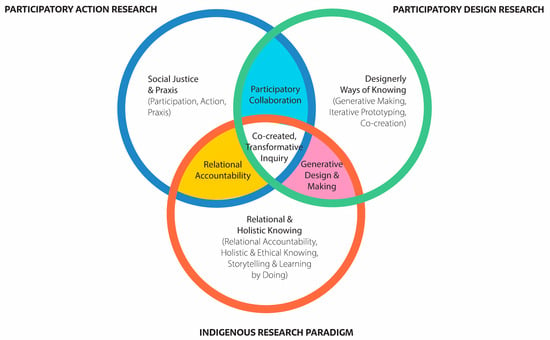
This study is situated at the intersection of Participatory Action Research (PAR) and Participatory Design Research (PDR) informed by Indigenous research paradigms of relational accountability. PAR emphasizes collective inquiry led by those most affected by the issues [11,12], while PDR extends this participation into designerly processes of ideation, prototyping, and co-creation [13,14]. Informed by Indigenous epistemologies of relationship, reciprocity, and respect [15,16], this research positions design as both a method and a mode of inquiry for imagining more just and inclusive futures. This layered methodological foundation, illustrated later in Figure 1, frames the study as not only designing with participants but also acting with them to address inequities and reimagine intercultural relationships.
Figure 1.
Flow of methodological integration: Participatory Action Research as foundation, enriched by Indigenous Paradigms, informing Participatory Design Research. These approaches highlight shared commitments to collaboration, reflexivity, and relational accountability.
Expanding earlier participatory design research that uses design thinking to provoke social justice-oriented inquiry [16], this paper argues that critical design thinking can support a shift from othering to understanding through relational and empathetic approaches to co-creation. While design thinking has gained wide traction in education, early scholarship largely emphasized creativity and innovation within formal learning settings [17,18]. More recent work, however, calls attention to the social and political dimensions of design, questioning whose knowledge is valued and how power and culture shape participation [19,20]. Building on this shift toward critical design thinking, this paper contributes to emerging conversations that reimagine design as a relational, reflexive, and equity-oriented practice, one that engages underrepresented youth as co-designers rather than subjects of study.
The study engaged Indigenous and newcomer immigrant youth in Edmonton, Alberta; these participants are young people who share urban spaces yet remain disconnected due to settler colonial histories, racialized narratives, and structural marginalization. Through a series of design circles, youth used visual communication and participatory design tools to create artefacts expressing their lived experiences and relationships to one another. A central concern guiding this work is the concept of othering, the process through which groups are constructed as distant or outside dominant norms [21,22]. In design contexts, this often manifests through the abstraction or simplification of users, rather than recognizing them as equal co-creators.
Drawing from critical and cultural pedagogy1 [23,24,25], this work positions design as a site of learning and meaning-making, where relational ethics and reflective praxis can challenge dominant narratives and open space for counter-hegemonic understandings. These dynamics are reflected in the stereotypes and assumptions that shape how youth perceive themselves and others. Participatory design offers possibilities for countering these dynamics [26], inviting participants to move beyond confrontation toward shared authorship, empathy, and mutual understanding.
Reflexivity in participatory design operates on dual levels: for designers, it requires an awareness of one’s positionality and power within the co-design space; for participants, particularly those from marginalized communities, it creates space to reflect on lived experiences and their roles in shaping the design process [26,27]. In this paper, I also draw from my own reflexive practice as a racialized immigrant facilitator working within settler-colonial contexts. This positionality shapes how I understand the relational, ethical, and pedagogical dimensions of the design process.
In this study, design thinking process operates as both a reflective practice of understanding the self and a relational practice of understanding others. These dimensions are not separate but mutually reinforcing: by surfacing one’s own assumptions, values, and cultural positionings, participants are better able to engage ethically and empathetically with the lived experiences of others. Conversely, collaborative meaning-making with others feeds back into self-understanding through moments of tension, recognition, and shared insight. Clarifying this reciprocal relationship is essential in intercultural contexts where power, identity, and lived experience shape how young people encounter one another, imagine possibilities, and participate in co-design. It is from within this reciprocal interplay of self- and other-understanding that this study approaches participatory design as both method and mode of inquiry.
In this paper, I examine how a reflexive, participatory design process, grounded in PAR, PDR, and Indigenous research paradigms, can support a movement from othering to understanding among Indigenous and newcomer youth. The analysis draws on three interconnected forms of data: youth-generated artefacts, participant reflections, and my own reflexive fieldnotes. Together, these materials show how co-creation, critical design thinking, and relational engagement can unsettle dominant narratives and open possibilities for more inclusive, equitable forms of intercultural understanding.
2. Background and Context
2.1. Multiculturality to Intercultural Understanding
Canadian multiculturalism has often been presented as a unifying state policy, yet critical scholarship has revealed its limitations and unintended consequences. Day [28] argues that multiculturalism is a state-driven strategy to manage “minority identities” under a national ideal of “unity in diversity,” which ultimately entrenches social hierarchies. Scholars such as Légaré [29] and Galabuzi [30] note how this model racializes ethnic and Indigenous communities as “others,” reinforcing marginalization rather than promoting equity. Rather than fostering meaningful inclusion, multiculturalism frequently takes symbolic forms, such as cultural festivals and heritage days, that obscure deep-rooted structural inequalities [31,32,33]. Sarah Ahmed [34], in her studies on race and culture, cautions that institutional invocations of “diversity” often reproduce, rather than disrupt, systems of exclusion. Moreover, the rise in right-wing extremism in Canada has further exposed the fragility of multiculturalism, as diversity is increasingly framed as a threat to national identity [35]. Multiculturalism has also failed to address Indigenous sovereignty. Chazan et al. [36] argue that Indigenous peoples were only belatedly incorporated into Canada’s multicultural narrative, undermining their status as sovereign Nations. The Truth and Reconciliation Commission of Canada [37] emphasizes that reconciliation demands more than symbolic inclusion; it requires structural change and Indigenous-led engagement grounded in justice.
Moving beyond multiculturalism’s emphasis on coexistence and recognition of difference, interculturalism has emerged as a more participatory and action-oriented framework. It emphasizes dialogue, meaningful interactions, and reciprocal relationships across cultural boundaries [33,38]. The focus shifts from mere tolerance to the co-negotiation of meaning, values, and understanding between individuals and communities. This is particularly crucial in urban settings where intercultural disconnection among Indigenous and newcomer youth persists [39,40]. Scholars working at the intersection of urban studies, sociology, and decolonial thought, Ghorayshi [41] and Gyepi-Garbrah et al. [42], illustrate how Indigenous-led initiatives, such as Winnipeg’s Ka Ni Kanichihk (KNK), model decolonial approaches to intercultural urbanism by fostering intercultural relationships grounded in mutual respect. With over 26.5% of Canadians now identifying as visible minorities and Indigenous youth among the fastest-growing urban populations [43,44], cities are critical spaces for intercultural engagement.
To move toward meaningful inclusion, we must also interrogate how dominant narratives construct certain groups as different, deficient, or outside the norm—as outsiders. The next section explores the concepts of others, othering and their role in shaping intercultural disconnection in the thick of multiculturalism.
2.2. Others and Othering
The concept of the other refers to the process by which individuals or groups are constructed as fundamentally different, often in opposition to a perceived norm. Edward Said [22], in his foundational work Orientalism, describes “othering” as a means through which dominant cultures define themselves against marginalized groups, often to assert cultural, political, or racial superiority. In this process, the other is not simply different but made to embody difference in a way that renders them outside the boundaries of belonging. Spivak [45] argues that othering is not just a representational act but a form of epistemic violence that denies voice, agency, and subjectivity to marginalized groups. Homi Bhabha [46] extends this notion, showing how the other is not fixed but ambivalently positioned, shaped through repeated acts of stereotyping and mimicry that reinforce colonial power structures. This dynamic of othering is not only ideological but also institutional, shaping policy, media, and education systems that inform who is seen as “us” and who is “them.” Grant and Brueck’s [47] explanation of the othering deepens this analysis by illustrating how the construction of “the other” is shaped by environmental relationships, positionality, power, and past experiences. They explain how insider/outsider categories are not innate but constructed, producing perceptions of the other as feared, invisible, or unknown. These perceptions lead to distancing, stereotyping based on ignorance, and exclusion, which ultimately render the other as inferior, misunderstood, or abnormal. Intergroup and interpersonal communication is severely impacted by this construction process, fostering disconnection rather than empathy, especially within culturally diverse yet socially fragmented urban spaces. Together, all these perspectives illuminate how othering is an active process of differentiation that upholds hierarchies of race, culture, and belonging.
Such constructions are not merely rhetorical; rather, they shape institutional policies, curricula, and everyday social interactions. In Canadian urban centres like Edmonton, shared assimilationist policies historically grouped Indigenous and immigrant communities together, erasing Indigenous sovereignty while flattening immigrant identities [48]. These policies fostered artificial similarities and entrenched divides, laying the groundwork for social disconnection and mutual stereotyping. Most cities here, shaped by rapid demographic shifts and deep colonial histories, exemplify how these dynamics persist today. Although Indigenous and newcomer immigrant youth often occupy the same urban spaces (schools, malls, hospitals, workplaces) their relationships remain fragmented, shaped by settler colonial legacies, systemic racism, and economic marginalization [37,42,47]. Studies show that mutual ignorance and stereotyping continue to hinder intercultural connection, reinforced by dominant narratives and media portrayals that obscure shared experiences of exclusion and racialization [41,49,50]. These disconnections, while deeply rooted, are not inevitable; they are structurally produced and therefore open to intentional, transformative disruption through critically reflective and participatory practices that foster deeper intercultural understanding.
Against this backdrop, understanding the relational dynamics of self and other becomes critical in design processes, specifically in a participatory design process. The categories of self and other, or insider and outsider, are not limited to abstract theory; rather, they are lived realities shaped by socio-cultural and political relationships. Strickfaden [51] draws from continental philosophy to argue that we encounter the other from the standpoint of self/inside, and that this encounter is often a confrontation with unfamiliarity. Individuals tend to identify with those who resemble them and regard the unfamiliar with discomfort or detachment. She observes that designers often hold users at an abstract distance, rarely engaging deeply with those whose lived experiences differ from their own. This echoes wider social practices in which the other is engaged not relationally, but symbolically, often through systems of stereotyping or idealization [34].
As design researchers, recognizing the constructed nature of the “other” invites us to ask what it would take to move beyond these divisions, toward genuine connection, empathy, and transformation. In this context, understanding becomes more than mere tolerance or surface-level recognition; it entails a deeper engagement with difference that is relational, situated, and reflexive. This study seeks to show, such understanding is not a fixed endpoint but a co-created, evolving process grounded in dialogue, shared experience, and mutual recognition. The following subsection briefly explores what is meant by understanding here and how it functions as a critical counterpoint to the processes of othering outlined above.
2.3. Understanding and Transformation
Building from critiques of multiculturalism and the dynamics of othering, this study positions understanding not as a destination but as a generative, ongoing process, which is a mode of relational engagement that disrupts fixed categories and challenges normalized boundaries between self and other. Postcolonial scholars like Edward Said and Homi Bhabha have shown that the ‘other’ is socially and historically constructed; this recognition compels us to ask how design might help transcend these divisions and enable genuine connection, empathy, and transformation. In this context, understanding is not reducible to passive tolerance or abstract recognition; it entails a situated, reflexive, and dialogic engagement with difference [52].
Philosophical traditions of hermeneutics (e.g., Gadamer’s “fusion of horizons”) emphasize that understanding is shaped by one’s historical and cultural positioning and is only achieved through open, reciprocal dialogue. Intercultural theorists similarly call for a decentering of the self to recognize and validate the lived experiences of others [53,54]. This relational mode of engagement can also be distinguished as I–Thou rather than I–It, affirming the subjectivity and humanity of the other [55]. In this sense, understanding is not about achieving consensus or collapsing difference but about cultivating mutual recognition through ethical relation and critical self-reflection.
In this study, understanding is both a methodological orientation and an emergent outcome. The central goal was to explore how reflective participatory design processes could foster intercultural understanding between Indigenous and newcomer immigrant youth. These youth participated in a workshop process called design circles, a facilitated adaptation of the design thinking cycle (define–ideate–prototype), where they co-created visual artefacts such as posters and icons to express their lived experiences and perspectives. Through these acts of co-creation, youth disrupted dominant narratives of separation and engaged in moments of relational openness across cultural boundaries. The design process thus became a space not only for representation but also for dialogue, trust-building, and reflexivity, qualities central to critical design thinking [5,8] and design justice [20].
Through this lens, transformation refers not only to interpersonal shifts but to a broader epistemological and methodological reframing of how design can operate within and against systems that produce othering. Building on the participatory action principles, infused with reflexivity and ethics, the study process engaged youth as co-inquirers to interrogate their own assumptions, reposition themselves in relation to others, and imagine alternative futures. This movement, from constructed separation to dialogic understanding, demonstrates how design can serve as a critical tool for social inquiry, cultural exchange, and transformative learning [56].
Ultimately, by weaving reflexivity into participatory design, this study contributes to growing scholarship on inclusive, ethical approaches to intercultural engagement. The study illustrates how design, when grounded in relational ethics and critical pedagogy, can transcend disciplinary boundaries to inform curriculum development, educational practice, and broader efforts to foster equity and connection in culturally diverse urban contexts.
3. Enacting Participatory Design Research
In this study, Participatory Design Research (PDR) was enacted as both a methodological framework and a practice of relational inquiry. Building on its intersections with Participatory Action Research (PAR) and Indigenous research paradigms, the following sections explain how collaborative, reflexive, and community-engaged approaches shaped every stage of this study, from conceptual grounding to workshop facilitation and reflection. Consistent with participatory design and participatory action research traditions, this study adopts a Participatory Design Research approach in which first-person narrative and reflexive accounts are treated as situated methodological evidence of design processes and decision-making, supporting transparency and relational accountability within community-engaged research [13,57].
3.1. Linking Participatory Action Research to Participatory Design Research
Participatory Action Research (PAR) provides a critical foundation for understanding Participatory Design Research (PDR) as employed in this study. Rooted in the participatory inquiry paradigm, PAR is both a methodological and philosophical approach premised on the belief that meaningful knowledge emerges when those most affected by an issue are actively involved in examining and addressing it [58,59]. Unlike traditional, researcher-driven modes of inquiry, PAR advances a democratic, collaborative process where participants are positioned as co-researchers who contribute to defining problems, generating knowledge, and identifying pathways for action. This orientation challenges hierarchical research structures, reframing inquiry as a shared endeavour directed toward social transformation [60,61].
At its core, PAR integrates three interdependent elements: participation, action, and research. Participation ensures that those most affected by the research are directly engaged in decision-making processes, thereby decentralizing the authority of the researcher and valuing the epistemic contributions of participants [57,58]. Action emphasizes the transformative intent of PAR, aligning with Freire’s concept of praxis, which involves an iterative cycle of reflection and purposeful action aimed at addressing structural inequities. Research within PAR is conceived as a dialogical, co-creative process, privileging relational, experiential, and practice-led ways of knowing over detached observation. This epistemological stance resonates strongly with Indigenous research paradigms, which conceptualize knowledge as relational, holistic, and grounded in ethical responsibilities toward participants, communities, and the land [14].
In Indigenous paradigms, knowledge is understood as relational [15]. Holistic knowing acknowledges the interconnectedness of emotional, spiritual, physical, and intellectual dimensions of experience, while ethical knowing emphasizes reciprocity and responsibility within these relationships. Both paradigms, participatory and Indigenous, share an emphasis on relational accountability, respect, and co-creation, challenging extractive research practices by foregrounding knowledge as a collective and transformative undertaking [62].
This conceptual grounding directly informs PDR. As an evolution of participatory practices within design research, PDR adopts PAR’s emphasis on collaboration, reflexivity, and action but situates these within the iterative, creative processes of design [26,57]. Where PAR seeks to provoke critical reflection and collective action, PDR extends this by leveraging “designerly ways of knowing” [63] to co-create artifacts, prototypes, and systems that make abstract ideas tangible, enabling participants to envision and interrogate possibilities for change [64]. In Figure 1, this layered methodological approach is illustrated showing how PAR serves as a foundation enriched by Indigenous paradigms, informing the iterative, creative processes of PDR.
In combination with Indigenous methodologies, participatory and relational approaches create space for learning-by-doing, sharing stories of lived experiences, and aesthetic expression, practices long valued in Indigenous knowledge systems as pathways for dialogue, healing, and cultural continuity [65]. Principles of relational accountability, reflexivity, and co-creation guide this work, challenging dominant narratives, amplifying marginalized voices, and fostering equitable, socially engaged design practices [5,9]. Accordingly, PDR can be understood as a transdisciplinary enactment of PAR principles, enriched by Indigenous epistemologies and the critical, reflexive orientation of critical design thinking. Figure 1 synthesizes these relationships, mapping how PAR, PDR, and Indigenous research paradigms intersect to support relational, collaborative, and transformative knowledge creation. Within this study, these intertwined principles shaped how design activities such as making, storytelling, and ideation, not simply as design exercises, but as relational and reflective practices. Ideation and prototyping, for instance, became a form of collective sense-making, where creating and sharing artefacts functioned less as producing outcomes and more as rituals of dialogue, witnessing, and mutual recognition.
The study herein, grounded in PAR and enriched with Indigenous epistemologies, approached PDR not only as a method for collaboration but as a relational practice of ethical and holistic knowing, where making together became a mode of reflection, dialogue and collective healing. In the following subsection, I outline how these principles of PAR, adapted through PDR, were operationalized within the design and implementation of this research project.
3.2. The PDR Process in Practice—“As It Happened”
Building on the conceptual foundation of Participatory Action Research and its intersections with Participatory Design Research and Indigenous research paradigms outlined earlier, this section describes how the guiding principles were enacted in practice. These principles informed the design process, shaping how participants engaged, how activities unfolded, and how knowledge was co-created throughout the study. As many design researchers note [13,58,66] participatory processes rarely follow neat, linear sequences. They evolve through unexpected turns, shaped by context, relationships, and emergent needs. This dynamic was evident in study project, where community-based realities such as youth participants’ availability, institutional timelines, and commitments to relational accountability required ongoing flexibility and reflexivity. As an academic researcher with a background in community service and social innovation, my role continually expanded to include facilitation, negotiation, and project management. In participatory and community-engaged studies, such adaptability is essential to maintain a mindful balance between facilitating participants’ involvement through the design process and preserving their autonomy to foster meaningful collaboration [67].
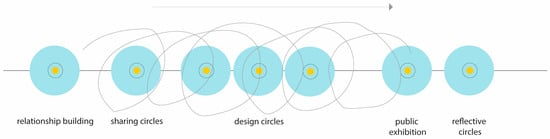
Figure 2 presents the initial structure of the participatory design research process as envisioned at the onset of the study. Inspired by the logic of design thinking and participatory action, the plan involved a series of six sequential phases: (I) relationship-building and community engagement, (II) sharing circles to surface lived experiences, (III) co-creation through design workshops, (IV) public exhibition of artefacts, and (V) reflective circles for collective meaning-making. These phases were intended to build progressively toward collaborative insight and action, with each “circle” or session type representing a distinct mode of engagement.
Figure 2.
PDR study map—as visualized at the beginning of the process [16] (p. 145).
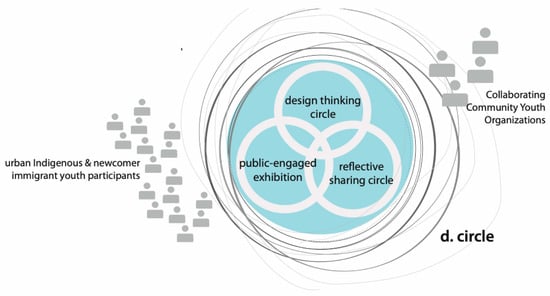
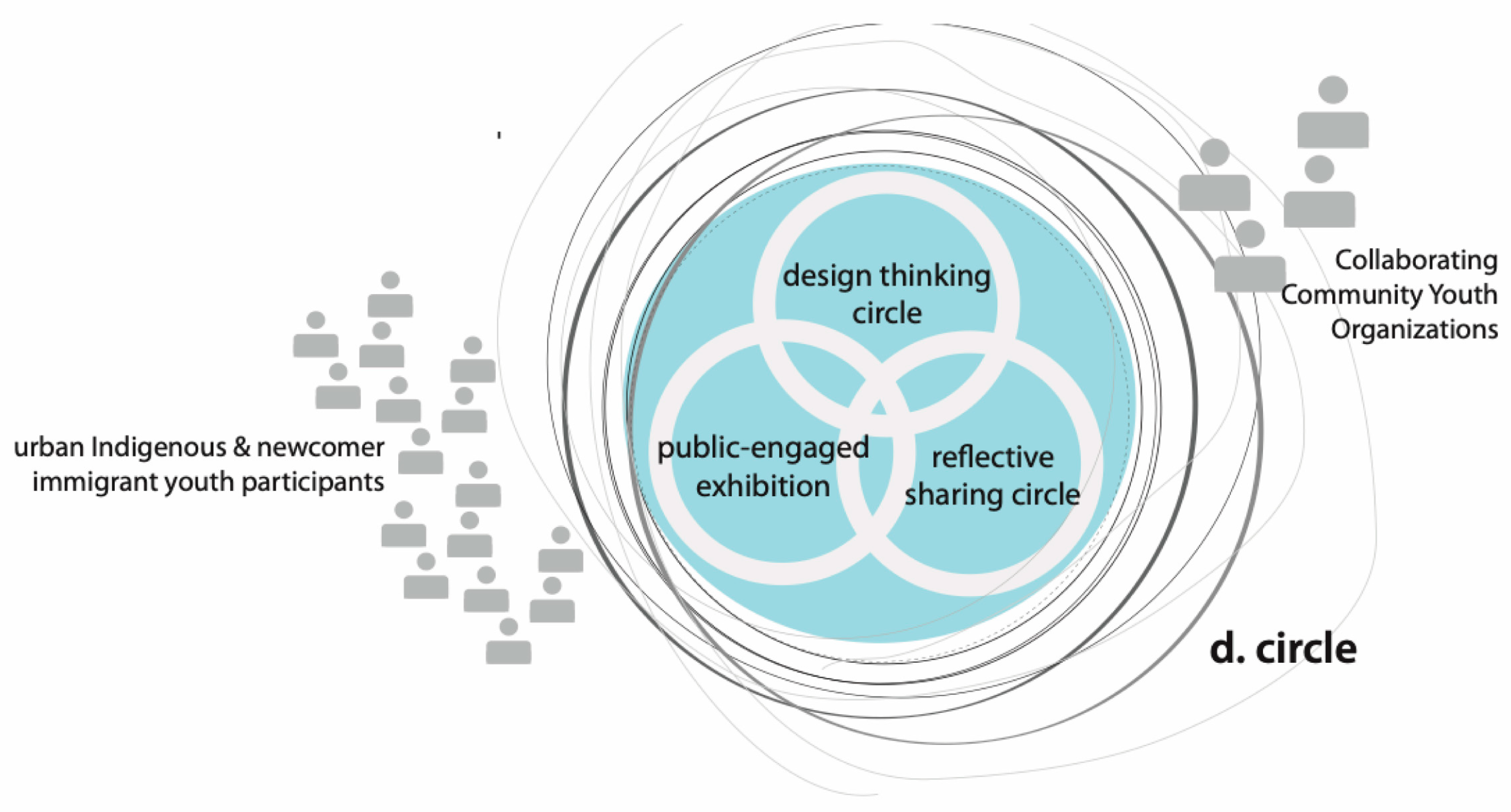
In practice, however, the neatly sequenced framework evolved in response to the lived realities of community-based work with youth from diverse backgrounds. The fluid and emergent quality of the process is captured in Figure 3, which visually contrasts the initial plan with the actualized process. As the study progressed, the originally discrete phases became more iterative, overlapping, and context-responsive. Rather than unfolding step-by-step, modes of engagement (sharing, designing, public-engaged exhibition, and reflective sharing) became interwoven, merged within a single participatory event: a 2.5-h design sprint-style workshop, referred to throughout this study as a design circle (d.circle).
Figure 3.
Iterations in the PDR process in response to community-engaged experiences, illustrating the development of a single day d.circle. Infographic adapted from [16] (p. 155).
Within this adapted format, the “circles” were not fixed phases but relational spaces of co-creation. Storytelling, prototyping, and reflection occurred simultaneously, guided by participant energy and collective agency. The circular metaphor thus remained meaningful—not only as a spatial configuration but as an ethical and relational practice embodying equity, safety, and shared authorship. Figure 3 depicts this transformation, illustrating how the process became cyclical rather than sequential, grounded in iterative meaning-making and intercultural dialogue.
Owing to the nature of participatory inquiry, this community-based study journey went through many unexpected turns and valleys. Maintaining relational accountability meant adapting to emerging circumstances without losing coherence. In the following narrative, I describe how the PDR process unfolded, highlighting the realities of participant recruitment, facilitation, and the lived complexity of working with newcomer immigrant and urban Indigenous youth in Edmonton.
3.2.1. Community Partnership and Relational Engagement
Building trustful relationships with community partners and Indigenous Knowledge Keepers/Elders formed the ethical and relational foundation for this participatory design inquiry. Those early consultations were not only critical for refining the project’s focus but also for grounding it in community-defined priorities, a core principle of both participatory and Indigenous research paradigms [14,15,62]. Collaborating and networking with community organization representatives helped me anticipate potential barriers to youth participation and co-plan the research process in ways that honoured local contexts and values [68]. Importantly, this engagement was not a one-time effort; it required ongoing communication and maintaining relationships throughout the project. Community partners continued to be involved in shaping the design circles, offering input on logistics, timing, and facilitation to ensure the process remained culturally responsive and community-informed.
This initial engagement also laid the groundwork for ethical and culturally responsive practices, including seeking guidance from Elders, involving youth leaders in recruitment, and ensuring that participation was voluntary and meaningful. Yet, these steps also revealed the gatekeeping roles of some organizations [69], which introduced bureaucratic and relational complexities that slowed down recruitment and planning. These realities, while challenging, provided valuable insights into how power, trust, and collaboration intersect in community-engaged design research.
Early relationship-building revealed both the promise and the precarity of participatory engagement. I learned that partnership often meant navigating invisible politics of access, authority, and timing. Some organizations acted as allies; others as gatekeepers shaped by institutional pressures and funding competition. These realities tested my adaptability and reinforced Ellsworth’s [70] notion of ethics of responsibility, which recognize that authentic collaboration unfolds at the pace of trust, not institutional deadlines. Alongside these partnerships, a comprehensive ethics protocol was established and approved through the university’s research ethics board.
3.2.2. Participants, Settings and Adaptive Workshop Design
A total of forty-five youth between the ages of fourteen and twenty-four were recruited through community service organizations, with input from Indigenous Knowledge Keepers and youth leaders. Participants represented both urban Indigenous (including Cree, Blackfoot, Métis, and Saulteaux) and newcomer immigrant communities (including Ethiopian, Somali, Sudanese, Iraqi, Pakistani, Afghan, and Jamaican), with a balanced mix of male and female participants across sessions. Group sizes varied from as few as four to as many as sixteen participants, reflecting the logistical and relational realities of working with unstructured community groups. This diversity provided a rich context for examining intercultural understanding through participatory design.
To ensure inclusive participation, the workshop format evolved from an initial multi-day plan to single, two-and-a-half-hour design circles (d.circles) integrating storytelling, making, and reflection. This adaptation exemplified PDR’s iterative ethos while remaining grounded in PAR’s collaborative intent. Youth were invited through their community programs, supported by youth leaders, Elders, and community workers. d.circles were framed as opportunities to share lived experiences, connect across cultures, and co-create artefacts exploring issues such as racism, belonging, and intercultural understanding.
Participation was voluntary and non-transactional. Instead of material incentives, youth received certificates of participation jointly issued by the host organizations and myself as researcher-facilitator, acknowledging their contributions to the co-design process. Light refreshments were occasionally provided, but engagement centred on shared purpose rather than compensation. Importantly, the invitation to participate was framed not as a transactional exchange but as a voluntary opportunity to engage in meaningful, youth-led dialogue and expression. For some youth, the idea of being part of a dialogue and public exhibition was particularly motivating. For others, the appeal lay in the creative, art-based nature of the workshops or the chance to engage with peers in a safe, affirming space. The youth understood that the purpose of the workshop was not simply to respond to predetermined questions, but to co-create visual artefacts and prototypes that could contribute to broader community dialogue. This framing, co-developed with community leaders, helped align the workshops with participants’ interests, motivations, and lived realities.
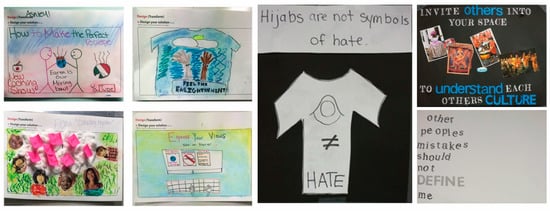
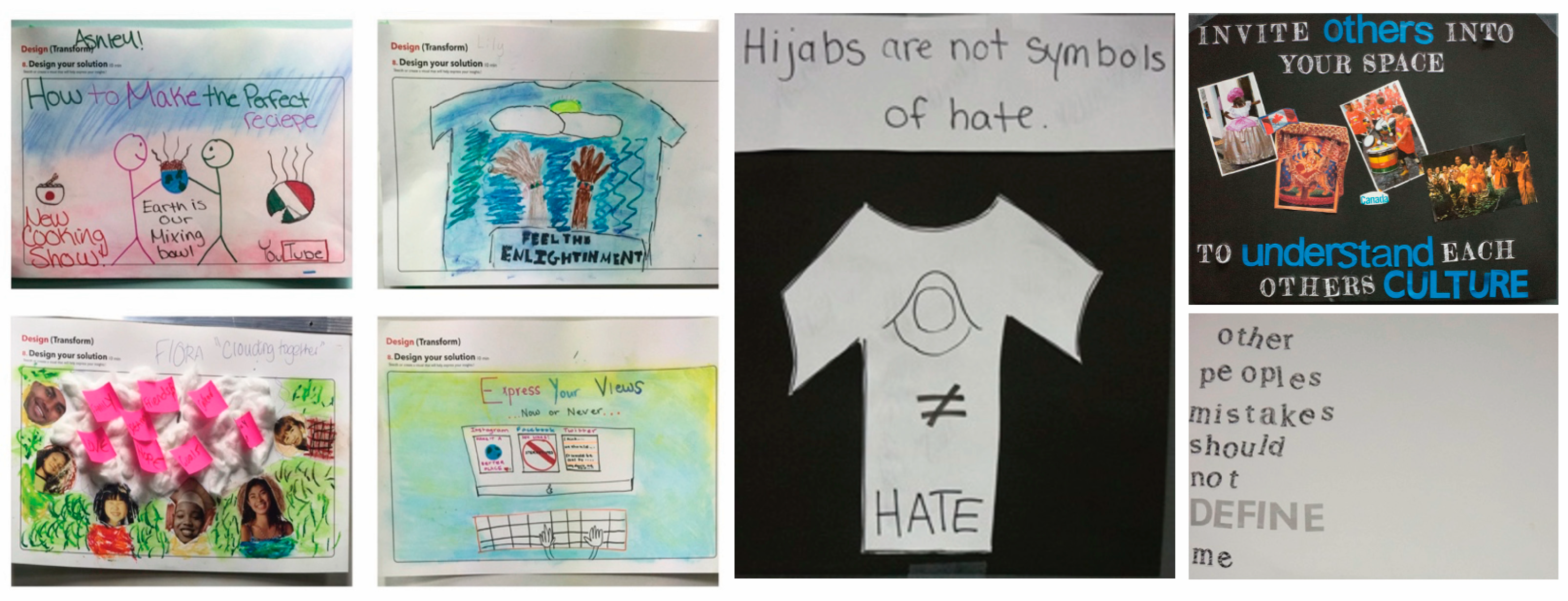
Each session was fast-paced yet flexible, structured to accommodate the lived realities of youth participants while fostering meaningful creative engagement. The resulting artefacts (posters, icons, and campaign concepts) became visual entry points into complex questions of identity and connection. Photos in Figure 4 showcase examples of these youth-designed artefacts, highlighting how the creative process made intercultural understanding visible through collectively produced visual forms. Together, Figure 3, Figure 4 and Figure 5 trace the evolution of the PDR process demonstrating how iterative reflection and adaptation translated into meaningful design engagement.
Figure 4.
Images of outcomes of d.circles (youth-designed artefacts) [16] (pp. 187–248).
Figure 5.
Stages of youth engagement: from goal-setting, problem framing to idea generation, and collective reflection [16] (pp. 161–163).
Working with youth from two marginalized communities presented challenges beyond logistics. Despite initial commitments from partner organizations, participation fluctuated; sometimes only a handful of youth arrived for sessions planned for larger groups. These moments required quick adaptation to ensure those who attended still experienced value. Bringing together Indigenous and newcomer youth also revealed how historical mistrust and structural inequities shaped interaction. These experiences heightened my reflexive awareness of positionality as a racialized immigrant researcher and reaffirmed the importance of relational accountability in sustaining participation.
4. Reflections and Insights: Towards Understanding
The reflections and insights presented in this section draw on audio-recorded dialogues from the d.circles, researcher fieldnotes, youth-created artefacts, and photographic documentation. This integrated dataset supports an analysis of how participatory design processes foster intercultural understanding and how the d.circles unfolded as spaces of negotiation, transformation, and collective meaning-making.
4.1. Reflexivity, Positionality, and the Emergence of Critical Design Thinking
Adopting a Participatory Design Research methodology for this study brought not only methodological challenges but also opportunities to reflect deeply on my positionality as both a design researcher and a co-participant in the process. This dual role, design researcher and co-participant or an insider/outsider, was central to how the work evolved into what I now understand as an emergent form of critical design thinking: a designerly way of knowing that is reflexive, socially accountable, and oriented toward challenging inequities in education and community practice.
Engaging with youth from marginalized Indigenous and newcomer communities, I experienced firsthand the epistemological struggle of balancing control and collaboration, facilitation and learning, academic rigour and community responsiveness. The “messiness” often described in participatory design processes [71,72] became a site of generative learning. Rather than a limitation, it served as a reminder that meaningful knowledge emerges from negotiating complex, nonlinear processes, what Freire calls praxis, the iterative movement between reflection and action. In this context, unlearning became as important as learning. By unlearning, I mean the deliberate unsettling of ingrained habits, disciplinary assumptions, and professional certainties in order to remain open to perspectives that may challenge or even contradict my own. This required a willingness to “let go” of expertise as authority and instead position knowledge as relational and co-created.
This orientation also aligns with Schön’s [73] notion of reflection-in-action, the capacity to think on one’s feet, surface tacit knowledge, and reframe a situation while still immersed in it. In the context of this study reflection-in-action was not abstract; it materialized in the practical adjustments required throughout the d.circles. For example, when participants arrived with varying levels of comfort or when attendance fluctuated significantly, I revised activities in real time, shifted from structured exercises to open dialogue, I went back to the community organizations to discuss ways to improve participation so as to align the offerings of d.circles with prospective youth participants’ interests and availability. These improvisational moves were guided by Freirean ideas of praxis, the continual movement between action and reflection, and underscored how critical design thinking emerges through relational and situational responsiveness rather than predetermined technique. Taken together, these practices of unlearning and reflection-in-action formed the foundation of a design (early) engagement that was both reflexive and transformative. Taken together, these practices of unlearning and reflection-in-action underpin critical design thinking as a situated praxis shaped by the evolving dynamics of trust, uncertainty, and relational accountability—one that unfolded through the motivations, hesitations, and creative negotiations that shaped the d.circles, explored in the following subsection.
4.2. Motivations, Misconceptions, and Making in the D.circles
Youth participants came into the d.circles with a mix of curiosity, uncertainity, and cautious interest. While they knew they were joining a creative workshop on intercultural communication, some admitted to feeling unsure or even wary about interacting with peers from unfamiliar cultural backgrounds. As one participant later reflected, “In the beginning, we were all very hesitant to learn about different cultures… We shouldn’t be scared. We should be able to ask our questions respectfully.” Initial warmup activities like the cultural guessing game and peer interviews to get to know each other at the beginging surfaced initial discomfort but gradually opened space for humour, honesty, and relational connection. As assumptions gave way to shared stories, participants began naming common experiences of marginalization and misunderstanding. During an early group exchange, one participant acknowledged candidly, “We stereotyped. We assumed a lot of stuff.” Another participant added, “When we are talking together, we understand and we are understood,” highlighting how dialogue itself was beginning to unsettle some assumptions.
Within this emerging relational safety, the idea of creating posters and informational artefacts evolved organically. Youth generated their own design problem statements, such as “We need to hear voices of urban Indigenous youth” or “Hijabs are not symbols of hate”, which became the basis for visual messages and prototype concepts. In the process, they didn’t hesitate to visualize also some systems-level design solutions, from YouTube channels and transit poster campaigns to fashion education tags and intercultural summer camps. For many, this creative work held personal significance. A participant, Chelsea (pseudonym) described it as a “healing” process. “We all have a voice… this d.circle feels democratic. It’s not one person lecturing, everyone’s ideas matter.” Mason (pseudonym) echoed her sentiment, saying, “It’s healing because we get to know about each other. We’re learning the missing pieces.”
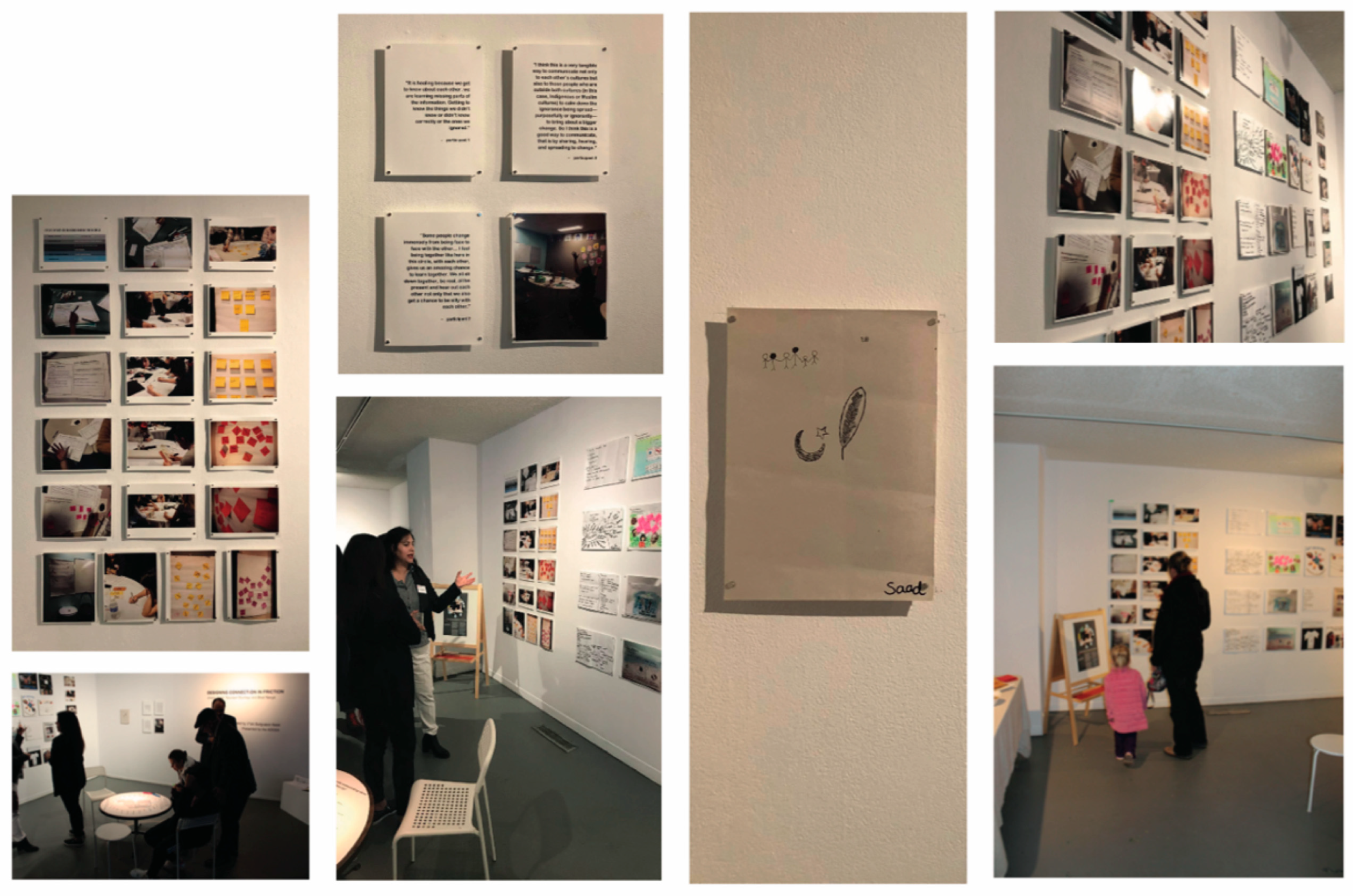
What unfolded in the d.circles was not only meaning-making but also a form of collective re-imagining. Youth frequently expressed a desire for their work to extend beyond the workshop space and inform broader public dialogue. Several emphasized that schools, media, and community institutions should hear directly from youth about their lived experiences. This aspiration motivated the public exhibition of the outcomes of those d.circles in a curated display in Designing Connection in Friction at Harcourt House Gallery, where youth artefacts and process documentation were displayed. The exhibition drew educators, government representatives, and community members, offering a rare opportunity for audiences to encounter youth perspectives in their own words and visual expressions.
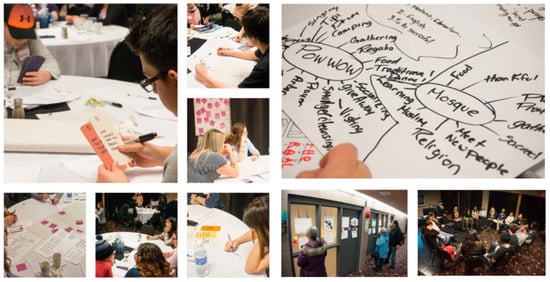
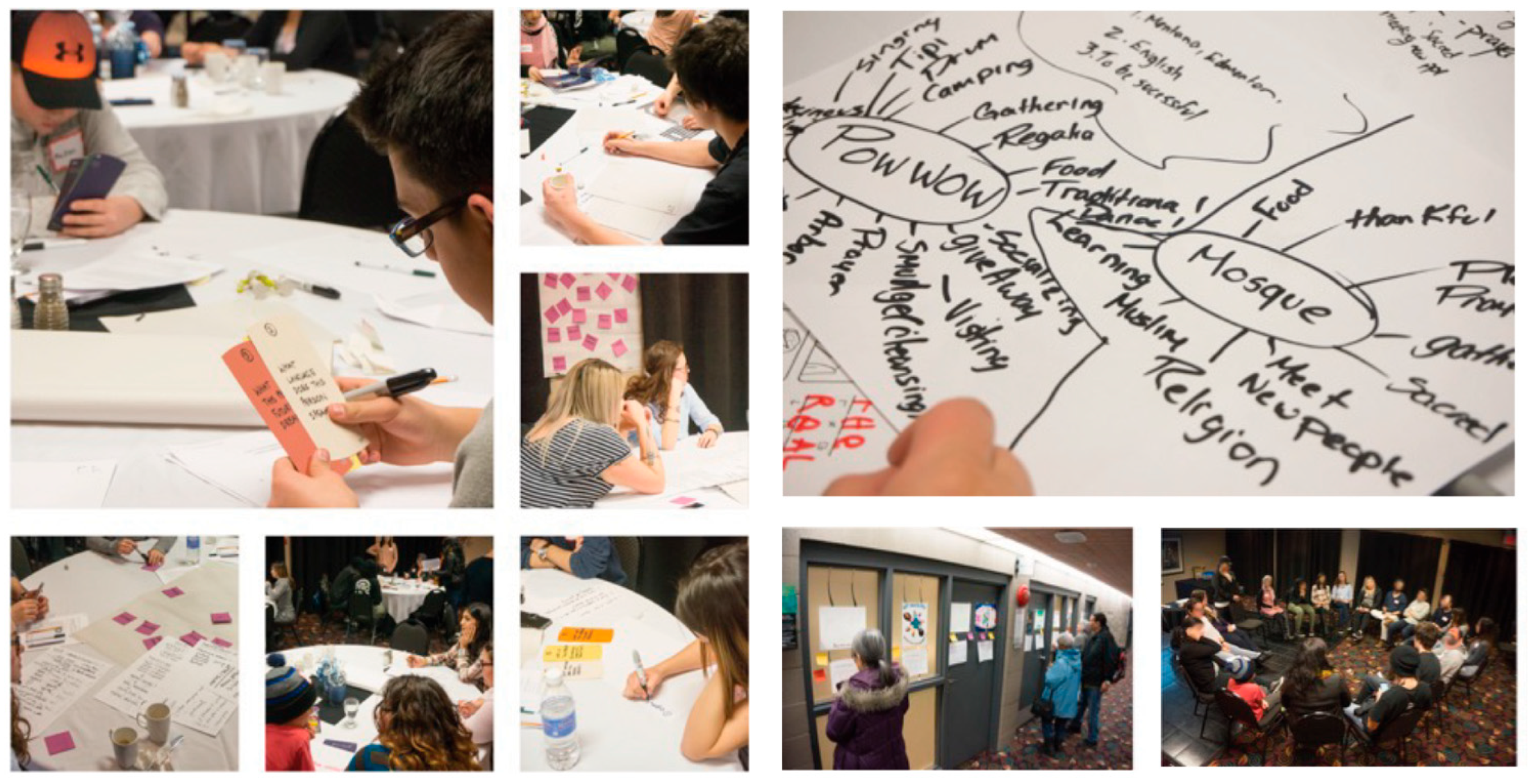
Figure 5 and Figure 6 highlight both the process and its outcomes. Figure 4 presents selected artefacts created by participants, visual messages that challenge stereotypes, invite cultural sharing, and articulate youth-led strategies for understanding. Figure 6 includes photographs capturing the embodied and relational dimensions of the d.circles: collaborative making, dialogue, prototyping, and reflection. Together, these images illustrate how the workshops became spaces of negotiation, creativity, and transformation, where misunderstandings were confronted, assumptions were unlearned, and new possibilities for intercultural connection were co-created.
Figure 6.
Photographs from the d.circles, showing youth engagement in design activities, co-creation processes, and selected artefacts exhibited at Designing Connection in Friction, Harcourt House, Edmonton, AB. Canada [74].
4.3. Navigating Complexity and Building Trust
Conducting participatory design research with youth from marginalized Indigenous and newcomer communities required engaging with complexity at multiple levels (relational, ethical, institutional, and interpersonal). My role often shifted beyond that of an academic researcher to facilitator, negotiator, and at times connector between diverse communities with distinct cultural histories. Working in these intercultural spaces meant that building trust could not be achieved through procedural ethics alone; it required sustained relational work grounded in humility, transparency, and accountability [62].
Humility became essential as I learned to control my instinct, shaped by years of design teaching, to lead or direct the process. Entering community spaces as a racialized immigrant researcher and an outsider to Indigenous knowledge traditions required ongoing unlearning. This meant listening before proposing, letting youth shape the pace and direction of activities, and recognizing the limits of my own worldview. Evidence of this emerged in the early months of the project, when community partners repeatedly asked for clarity about the process or adapting the sessions to the reality of community timelines; changes that slowed the academic timeline but were necessary to build the trust required for youth engagement. Accepting and adapting to these shifts became part of practicing humility in action.
Transparency was equally foundational. Over two years of relationship-building prior to the d.circles, I consistently clarified the project’s aims, how the youth’s contributions would be used, and what forms of co-ownership they would retain over their artefacts they produced. Before each workshop and often within the sessions themselves, I explained my role, not as a design expert delivering instruction but as a facilitator learning alongside participants. Youth workers and Elders2 [75] were included in these conversations so expectations and boundaries were mutually understood. This openness helped counter concerns about extractive research, particularly among Indigenous collaborators who had expressed wariness based on past experiences.
Relational accountability also guided how I responded to the unpredictability inherent in community-based work. Elders and youth workers remained present to support participants when sensitive issues surfaced. When only a few youths arrived for sessions planned for larger groups, workshops were redesigned on the spot so that those present felt their time and contributions mattered. These real-time decisions signaled that youth needs, including emotional safety, took precedence over adhering rigidly to the research plan.
As an insider–outsider, belonging to one of the communities yet situated within the academic world, I continually interrogated how power operated through my presence and decisions. This reflexive stance shaped how I facilitated dialogue, when I stepped back to allow youth-led direction, and how I interpreted emerging insights. Over time, this relational orientation transformed the d.circles from structured workshop sessions into ethical, creative spaces where youth felt able to take risks, assert their voices, and challenge deficit-based narratives about their communities. In this sense, navigating complexity and building trust was not a preliminary step but an ongoing praxis. It required adaptability, relational accountability, and a willingness to let youth reshape activities as their confidence and agency grew. Trust-building and complexity management thus became inseparable from the design process itself, shaping not only what was created but how knowledge was collectively formed.
4.4. Intercultural Design as Healing and Transformation
One of the most profound insights came from participants themselves, who repeatedly described the process as “healing.” While healing was not an explicit goal of the project, their reflections suggest that participatory design process, when rooted in respect, empathy, and intercultural dialogue, can begin to repair some of the harms of socio-cultural segregations sometimes perpetuated by the prevalent cultural pedagogy. Importantly, healing here did not mean the erasure of pain or the resolution of all tensions; rather, it referred to moments of recognition, validation, and relational accountability that made space for new ways of being together.
For instance, one participant explained that the circles allowed them to “feel heard for the first time in a school setting,” while another described the process as “a chance to understand myself better by listening to others’ stories.” These accounts show that what was experienced as healing was deeply connected to unlearning stereotypes, sharing across cultural differences, and seeing oneself reflected in community. The design process thus became a space of intercultural connection and repair, where youth could both confront and re-narrate their realities. Participants’ creative choices, whether designing posters that invited others into their cultures or challenging dominant media narratives, were acts of re-imagining the conditions under which understanding could take place.
As the workshops unfolded, participants increasingly shaped the direction of the process by deciding which issues to explore, what stories to tell, and how their design artefacts would circulate. What began as facilitator-led sessions gradually shifted toward co-direction, as youth redefined activities around their own intentions and priorities. This shift in power balance, where facilitation gave way to co-direction, and participants became the primary authors of the project’s meaning. In this sense, the outcomes were not pre-determined but emerged through a participatory dynamic that continues as artefacts are interpreted, adapted, and re-contextualized by those who engage with them [63]. Here, design extended beyond workshop boundaries, as the youth’s creations continued to provoke dialogue, learning, and belonging within their communities.
The participants’ growing agency and the evolving process reinforce that critical design thinking is not solely a problem-solving approach; it is also a relational and ethical practice. In this context, critical design thinking functioned as space, where difference was neither minimized nor overcome but approached with curiosity, humility, and a commitment to staying in meaningful relation.
4.5. From Methods to Critical Design Thinking as Praxis
The iterative cycles of participatory design research in this study (sharing circles, design circles, prototyping, and reflective dialogue) were never just methodological steps. They became sites where tacit knowledge surfaced, and where participants began to question the narratives shaping how they are seen. For example, one Indigenous youth participant challenged assumptions of visibility, stating, “We need to hear voices of Urban Indigenous youth; people don’t even know we exist in the city.” A newcomer participant reflected, “I unlearned many of the negative stereotypes I had… today was a good opportunity to unlearn most of those misplaced ideas.” These moments reveal how the process encouraged participants to youth to interrogate dominant narratives and articulate alternative understandings of themselves and others.
In addition to participants’ verbal reflections, the design activities themselves acted as catalysts for re-narrating experience and constructing shared meaning. During the initial identity mapping exercise, youth used symbols, metaphors, and visual arrangements to express how migration, language, family, or faith shaped their sense of belonging. These mappings became touchpoints within the d.circle, prompting questions, sparking dialogue, and allowing participants to build connections across cultural differences. What emerged was not only self-expression but a relational practice of making oneself known, and of encountering others with curiosity rather than assumption.
Another example comes from the activities focusing on designing collaborative future scenarios, where mixed-group pairs imagined messages for inclusive public spaces centered on safety, visibility, and belonging. As youth negotiated features of these imagined environments, their conversations revealed how cultural assumptions shaped design decisions. Through iterative feedback, they navigated differences and arrived at co-created visions reflecting a broadened understanding of one another’s experiences. These processes show how design became a mode of inquiry that facilitated empathy, negotiation, and critical engagement.
Embedding reflexivity into these processes revealed that the methods could transcend disciplinary boundaries. They became tools for imagining new possibilities not only in terms of the artefacts produced, but in how participants envisioned design ideas as a mode of learning and social intervention. For instance, youth created posters with messages such as “Don’t judge, talk to someone, you could learn a lot,” which reframed design as a vehicle for peer-to-peer pedagogy and intercultural dialogue. In another case, a group proposed design concepts that countered media stereotypes, positioning their work as a youth-led contribution to broader social debates. These creative interventions highlight that participatory methods can extend beyond visual communication to open pedagogical possibilities, inform curriculum development, and foster socially engaged design practices rooted in lived experience.
At the same time, the process revealed tensions, such as gatekeeping, time constraints in community settings, and small group sizes, that I initially read as methodological obstacles. Over time, however, these challenges became integral to shaping a critical design thinking praxis. They required embracing uncertainty, renegotiating power, and prioritizing relationships over outputs. In this way, methods became praxis, which was a reflexive, ethical stance that positioned me as both researcher and co-learner. This praxis unsettles conventional notions of design as solution-driven and instead foregrounds it as an ongoing negotiation of power, positionality, and responsibility.
4.6. Bringing Together and Shifting from Othering to Understanding
The d.circle process, as it unfolded, moved beyond a methodological engagement to become what Freire [23] calls a dialogical encounter, where learning occurs not through transmission but through co-existence, mutual recognition, and exchange. What emerged was not only a process of making artefacts but a collective effort to unmake dominant narratives: to unlearn internalized stereotypes, to challenge simplistic binaries of “us” versus “them,” and to create space for intercultural knowing grounded in respect and reflexive engagement.
In the latter part of the d.circle, for many participants, this shift surfaced through small, sometimes uncomfortable recognitions. One participant echoed a similar realization voiced earlier, noting, “we stereotype more than we notice.” Another youth added, “I unlearned many of the negative stereotypes I had… I think today has been a good opportunity to unlearn most of those misplaced ideas.” These reflections were not isolated; they were embedded within a design process that foregrounded storytelling, critical inquiry, and making as collaborative acts of meaning-making. The iterative structure of the d.circles in moving from assumptions to insights, from conversation to visualization, invited participants to reflect on their positionalities and reimagine their relations with others. In this way, the project not only documented intercultural tension but became a site of intercultural connection.
The design artefacts played a central role in this shift. Participants chose to visualize messages that invited others into their cultures, challenged dominant media narratives, and proposed alternative, youth-led strategies for communication. Their posters and design concepts centered on messages like “Don’t judge, talk to someone, you could learn a lot,” or “We need to hear voices of Urban Indigenous youth”, materialized the move from othering to understanding. These artefacts were not representations of cultures; they functioned as interventions into the conditions that obscure genuine understanding.
Importantly, the work also moved outward into public contexts. The display of youth artefacts and the photo documentation of the d.circle process at the public exhibition, Designing Connection in Friction, made youth perspectives visible to educators, community members, and policy actors, positioning their insights within broader conversations about curriculum, equity, and intercultural education. By foregrounding youth voices in civic spaces, the project invited institutions to listen and respond differently.
Bringing together these diverse trajectories of design, dialogue, and reflection, the project highlights how shifting from othering to understanding is not a singular event but a slow, recursive process. Through co-creation, the youth developed new frameworks for seeing, questioning, and honouring one another’s stories. In doing so, they enacted what Ahmed [76] describes as a politics of encounter; approaching difference with curiosity, humility, and a willingness to remain in relation.
5. From Othering to Understanding: Critical Design Thinking as Relational and Reflexive Practice
Engaging with youth through a reflexive, participatory design process revealed the depth of transformation that can unfold when design is practiced not as a method of problem-solving but as a space for co-learning, relational accountability, and shared meaning-making. What began as a response to intercultural disconnect became something more layered, a process of unlearning othering, together.
Throughout the d.circles, I witnessed how critical design thinking, when rooted in lived experience and relational ethics, can support a shift from fear and misrecognition toward mutual understanding. The artefacts created by youth participants were not just expressions of identity; they were interventions, youth-generated critiques of stereotypes, systemic exclusions, and educational erasures. Their design responses, simple in form but profound in meaning, invite others to listen differently and to encounter difference with curiosity and care rather than defensiveness.
What stayed with me most was the relational process through which this works unfolded. Trust was built slowly. Reflexivity was not a theoretical concept but a necessity that was something practiced in moments of facilitation, in every conversation that required me to examine my own assumptions, and in each decision that asked for accountability to the youth and the communities we belonged to. Reflecting on this work affirmed that intercultural understanding cannot be scripted in policy or captured in curriculum alone. It must be practiced iteratively, imperfectly, and relationally. Through shared acts of making, questioning, and reflecting, possibilities for connection began to emerge. In those moments, design became less a toolkit and more a pedagogy for holding complexity, making space for other ways of knowing, and staying in dialogue.
What I observed in the d.circles aligns closely with how the emerging scholarship describes as critical design thinking; design process, which, in addition to provocations, also interrogates values, assumptions, and embedded power structures. When reflexivity is integrated into participatory action research, design thinking becomes more than a toolkit; it becomes a method for re-narrating experiences, for shifting the gaze, and for challenging dominant knowledge systems. These were not abstract ideas in this project, but they were practices that the youth participants themselves enacted and articulated through their dialogue, their choices, and the design outputs they created.
It was through triangulation (of artefacts, participant narratives, and facilitation observations) that I saw youth participants move from being positioned as subjects of intervention to becoming designers of meaning. Their artefacts were more than just responses to exclusion; they were generative sites of intercultural dialogue and counter-narrative making. Several posters and design concepts went beyond describing experience; for instance, statements such as “Hijabs are not symbols of hate!” or invitations to “normalize diversity” and “invite others into your space.” These articulated youth-led reframing of how they wished to be seen and understood. As one participant, Umar, summarized in the final d.circle, the process enabled them to “share, hear, and spread the change”. In these generative acts, youth were doing two things simultaneously: one, reflecting upon how they had been othered, and secondly recognizing how they themselves might reproduce othering in relation to others.
Reflecting on this work made clear that unpacking othering cannot be treated as an abstract construct. It unfolded in embodied encounters, iterative acts of making, and moments of shared vulnerability. From within those encounters emerged small but significant interruptions of marginalization, youth-led counter-narratives, symbolic redesigns, and reflective conversations that held identity, difference, and connection side by side. These moments, subtle yet powerful, signaled a shift from othering to understanding: not as a scripted outcome, but as an emergent, relational possibility made visible through the participatory design process.
These observations resonate with Grant and Brueck’s [47] framing, which positions “othering” as not only diagnostic but also generative. When reflected upon, it becomes a guide to understand how marginalization operates and where it can be interrupted. In this project, those interruptions took shape through the youth-led acts of making in which identity, difference, and connection were held side by side. And in that space, the shift from othering to understanding became visible, and deeply felt by the participants in d.circles.
Ultimately, this study affirms the central argument introduced at the outset: critical design thinking, when practiced relationally and reflexively, can support transformative forms of intercultural understanding. It demonstrates how participatory design can function as an ethical and pedagogical practice, opening space for young people to co-create knowledge, challenge dominant narratives, and build connective possibilities across lines of difference. In doing so, the work contributes to ongoing conversations in design, education, and curriculum studies that seek more inclusive, accountable, and culturally grounded approaches to engaging social complexity.
Funding
This community-based research was supported by an APIRG Grant for Community-Based Research at the University of Alberta, with d.circles involving Indigenous youth and youth from Muslim immigrant families administered through the Alberta Friendship Centres Association (ANFCA), Edmonton, Alberta, Canada, and in-kind support provided by Alberta Friendship Centres in Edmonton.
Institutional Review Board Statement
This article presents post-study analysis only and does not involve new data collection or direct engagement with human participants. The initial study was conducted in accordance with the ethics of participatory research with humans and approved by the Research Ethics Office (REB), University of Alberta, Edmonton, AB, Canada.
Informed Consent Statement
Not applicable.
Data Availability Statement
No new data were created or analyzed in this study. Data sharing is not applicable to this article.
Conflicts of Interest
The author declares no conflicts of interest. The funders had no role in the design of the study; in the collection, analyses, or interpretation of data; in the writing of the manuscript; or in the decision to publish the results.
Notes
| 1 | Cultural pedagogy refers to the ways in which culture, including media, design, and everyday social practices, acts as a form of education. It shapes how individuals come to understand themselves, others, and the world. Critical pedagogy scholars [23,24] emphasize that cultural production is never neutral and that engaging with it reflexively is key to challenging hegemonic narratives and fostering more just ways of knowing. |
| 2 | The term Indigenous Knowledge Keepers or Elders refers to respected members of Indigenous communities who hold and share cultural, spiritual, ecological, and historical knowledge through oral traditions, ceremony, and lived experience. In Cree contexts, Elders are recognized not solely by age but by their lived commitment to community, humility, and the responsibility to pass on teachings through relational and reciprocal ways of knowing [75]. Their knowledge is land-based, intergenerational, and integral to processes of healing, governance, education, and research. |
References
- Rosner, D.K. Critical Fabulations: Reworking the Methods and Margins of Design; MIT Press: Cambridge, MA, USA, 2018. [Google Scholar]
- Malpass, M. Critical Design Practice: Theoretical Perspectives and Methods of Engagement. Des. J. 2016, 19, 473–489. [Google Scholar] [CrossRef] [Scilit]
- Brown, T.; Wyatt, J. Design Thinking for Social Innovation. Annu. Rev. Policy Des. 2015, 3, 1–10. [Google Scholar] [CrossRef] [Scilit]
- Loewe, S. Toward a Critical Design Thinking: Propositions to Rewrite the Design Thinking Process. Dialectic 2019, 2, 127–150. [Google Scholar] [CrossRef] [Scilit]
- Bardzell, J.; Bardzell, S. What Is “Critical” about Critical Design? In Proceedings of the SIGCHI Conference on Human Factors in Computing Systems; ACM: New York, NY, USA, 2013; pp. 3297–3306. [Google Scholar] [CrossRef] [Scilit]
- Light, A.; Akama, Y. Structuring Future Social Relations: The Politics of Care in Participatory Practice. Des. Issues 2014, 30, 16–27. [Google Scholar] [CrossRef] [Scilit]
- Kuntz, A.M. Representing Representation: The Ethics of Autoethnography in Educational Research. Int. J. Qual. Stud. Educ. 2010, 23, 405–420. [Google Scholar] [CrossRef] [Scilit]
- Tonkinwise, C. A Taste for Practices: Unrepressing Style in Design Thinking. Des. Stud. 2011, 32, 533–545. [Google Scholar] [CrossRef] [Scilit]
- DiSalvo, C. Design and the Construction of Publics. Des. Issues 2009, 25, 48–63. [Google Scholar] [CrossRef] [Scilit]
- Dunne, A.; Raby, F. Speculative Everything: Design, Fiction, and Social Dreaming; MIT Press: Cambridge, MA, USA, 2013. [Google Scholar]
- Reason, P.; Bradbury, H.; Razzouk, R.; Shute, V. (Eds.) The SAGE Handbook of Action Research: Participatory Inquiry and Practice; SAGE: London, UK, 2008. [Google Scholar]
- Kemmis, S.; McTaggart, R. Participatory action research: Communicative action and the public sphere. In Strategies for Qualitative Inquiry, 3rd ed.; Denzin, N., Lincoln, Y., Eds.; SAGE: London, UK, 2005; pp. 271–330. [Google Scholar]
- Sanders, E.B.-N.; Stappers, P.J. Co-creation and the new landscapes of design. CoDesign 2008, 4, 5–18. [Google Scholar] [CrossRef] [Scilit]
- Kovach, M. Indigenous Methodologies: Characteristics, Conversations, and Contexts; University of Toronto Press: Toronto, ON, Canada, 2009. [Google Scholar]
- Wilson, S. Research Is Ceremony: Indigenous Research Methods; Fernwood Publishing: Black Point, NS, Canada, 2008. [Google Scholar]
- Mumtaz, N. Towards a Pedagogy of Intercultural Understanding: Participatory Design Research with Urban Indigenous and Newcomer Immigrant Youth. Doctoral Dissertation, University of Alberta Education and Research Archive, Edmonton, AB, Canada, 2019. [Google Scholar]
- Razzouk, R.; Shute, V. What Is Design Thinking and Why Is It Important? Rev. Educ. Res. 2012, 82, 330–348. [Google Scholar] [CrossRef] [Scilit]
- Henriksen, D.; Richardson, C.; Mehta, R. Design thinking: A creative approach to educational problems. Think. Ski. Creat. 2017, 26, 140–153. [Google Scholar] [CrossRef] [Scilit]
- Noel, L.A. Design Social Change: Take Action, Work Toward Equity, and Challenge the Status Quo; Ten Speed Press: New York, NY, USA, 2023. [Google Scholar]
- Costanza-Chock, S. Design Justice: Community-Led Practices to Build the Worlds We Need; MIT Press: Cambridge, MA, USA, 2020. [Google Scholar]
- Irwin, T. The Emerging Transition Design Approach. Des. Issues 2018, 34, 31–45. [Google Scholar] [CrossRef] [Scilit]
- Said, E.W. Orientalism; Pantheon Books: New York, NY, USA, 1978. [Google Scholar]
- Freire, P. Pedagogy of the Oppressed; Continuum: New York, NY, USA, 2000. [Google Scholar]
- Giroux, H.A. Cultural Studies and the Politics of Public Pedagogy: Making the Political More Pedagogical. Parallax 2004, 10, 73–89. [Google Scholar] [CrossRef] [Scilit]
- Kincheloe, J.; McLaren, P. Rethinking Critical Theory and Qualitative Research. In The Landscape of Qualitative Research; Denzin, N.K., Lincoln, Y.S., Eds.; SAGE: Thousand Oaks, CA, USA, 2008; pp. 403–455. [Google Scholar]
- Sanders, E.B.-N.; Stappers, P.J. Convivial Toolbox: Generative Research for the Front End of Design; BIS: Amsterdam, The Netherlands, 2012. [Google Scholar]
- San Pedro, T.; Kinloch, V. Toward Projects in Humanization: Research on Co-Creating and Sustaining Dialogic Relationships. Am. Educ. Res. J. 2017, 54, 373–394. [Google Scholar] [CrossRef] [Scilit]
- Day, R. Multiculturalism and the History of Canadian Diversity; University of Toronto Press: Toronto, ON, Canada, 2000. [Google Scholar]
- Légaré, E.I. Canadian Multiculturalism and Aboriginal People: Negotiating a Place in the Nation. Identities Glob. Stud. Cult. Power 1995, 1, 347–366. [Google Scholar] [CrossRef] [Scilit]
- Galabuzi, G. Hegemonies, Continuities, and Discontinuities of Multiculturalism and the Anglo-Franco Conformity Order. In Home and Native Land: Unsettling Multiculturalism in Canada; Chazan, M., Helps, L., Stanley, A., Thakkar, S., Eds.; Between the Lines: Toronto, ON, Canada, 2011; pp. 58–82. [Google Scholar]
- Fleras, A.; Nelson, A. Social Problems in Canada: Conditions, Constructions, and Challenges, 3rd ed.; Prentice Hall: Toronto, ON, Canada, 2001. [Google Scholar]
- Haque, E. Multiculturalism Within a Bilingual Framework: Language, Race, and Belonging in Canada; UBC Press: Vancouver, BC, Canada, 2020. [Google Scholar]
- Portera, A. Intercultural and Multicultural Education: Epistemological and Semantic Aspects. In Intercultural and Multicultural Education: Enhancing Global Interconnectedness; Grant, C.A., Portera, A., Eds.; Routledge: New York, NY, USA, 2011; pp. 12–32. [Google Scholar]
- Ahmed, S. Complaint! Duke University Press: Durham, NC, USA, 2021. [Google Scholar]
- Perry, B.; Scrivens, R. Right-Wing Extremism in Canada; Springer: Cham, Switzerland, 2022. [Google Scholar]
- Chazan, M.; Helps, L.; Stanley, A.; Thakkar, S. Home and Native Land: Unsettling Multiculturalism in Canada; Between the Lines: Toronto, ON, Canada, 2011. [Google Scholar]
- Truth and Reconciliation Commission of Canada. Honouring the Truth, Reconciling for the Future: Summary of the Final Report of the Truth and Reconciliation Commission of Canada; Truth and Reconciliation Commission of Canada: Ottawa, ON, Canada, 2015. Available online: https://publications.gc.ca/collections/collection_2015/trc/IR4-7-2015-eng.pdf (accessed on 15 September 2025).
- Bouchard, G. What Is Interculturalism? McGill Law J. 2011, 56, 435–468. [Google Scholar]
- Kymlicka, W. Multicultural States and Intercultural Citizens. Theory Res. Educ. 2003, 1, 147–169. [Google Scholar] [CrossRef] [Scilit]
- Mathur, A.; Dewar, J.; De Gagné, M. (Eds.) Cultivating Canada: Reconciliation Through the Lens of Cultural Diversity; Aboriginal Healing Foundation: Ottawa, ON, Canada, 2011. [Google Scholar]
- Ghorayshi, P. Diversity and Interculturalism: Learning from Winnipeg’s Inner City. Can. J. Urban Res. 2010, 19, 89–104. Available online: http://www.jstor.org/stable/44320870 (accessed on 15 August 2025).
- Gyepi-Garbrah, J.; Walker, R.; Garcea, J. Indigeneity, Immigrant Newcomers, and Interculturalism in Winnipeg, Canada. Urban Stud. 2013, 50, 1795–1811. [Google Scholar] [CrossRef] [Scilit]
- Statistics Canada. Portrait of Canada’s Population in 2021: Population Growth and Age and Sex Structure; Catalogue No. 98-200-X; Statistics Canada: Ottawa, ON, Canada, 2022. Available online: https://www12.statcan.gc.ca/census-recensement/2021/as-sa/98-200-x/2021001/98-200-x2021001-eng.cfm (accessed on 15 September 2025).
- Statistics Canada. Indigenous Population Continues to Grow and Is Younger Than the Non-Indigenous Population; Catalogue No. 11-627-M; Statistics Canada: Ottawa, ON, Canada, 2023. Available online: https://www150.statcan.gc.ca/n1/pub/11-627-m/11-627-m2023010-eng.htm (accessed on 15 September 2025).
- Spivak, G. Can the Subaltern Speak? In Marxism and the Interpretation of Culture; Nelson, C., Grossberg, L., Eds.; University of Illinois Press: Urbana, IL, USA, 1988; pp. 271–316. [Google Scholar]
- Bhabha, H.K. The Location of Culture; Routledge: New York, NY, USA, 1994. [Google Scholar]
- Grant, C.A.; Brueck, S. A Global Invitation: Towards the Expansion of Dialogue, Reflection, and Creative Engagement for Intercultural and Multicultural Education. In Intercultural and Multicultural Education: Enhancing Global Interconnectedness; Grant, C.A., Portera, A., Eds.; Routledge: New York, NY, USA, 2011; pp. 3–11. [Google Scholar]
- Bohaker, H.; Iacovetta, F. Making Aboriginal People “Immigrants Too”: A Comparison of Citizenship Programs for Newcomers and Indigenous Peoples in Postwar Canada, 1940s–1960s. Can. Hist. Rev. 2009, 90, 427–461. [Google Scholar] [CrossRef]
- Suleman, Z. Vancouver Dialogues: First Nations, Urban Aboriginals and Immigrant Communities; Social Policy, City of Vancouver: Vancouver, BC, Canada, 2011. Available online: https://vancouver.ca/files/cov/dialogues-project-book.pdf (accessed on 14 August 2025).
- Dhillon, J. Indigenous Youth Decolonizing Education: Peer Research in Practice; UBC Press: Vancouver, BC, Canada, 2022. [Google Scholar]
- Strickfaden, M.; Heylighen, A. Who Are They? Student Voices about “the Other”. In Include 2009 Conference Proceedings, London, UK, 5–8 April 2009; K.U. Leuven: Leuven, Belgium, 2009. [Google Scholar]
- Gadamer, H.-G. Truth and Method; Continuum: New York, NY, USA, 1997. [Google Scholar]
- Kim, Y.Y. Becoming Intercultural: An Integrative Theory of Communication and Cross-Cultural Adaptation; Sage: Thousand Oaks, CA, USA, 2001. [Google Scholar]
- Andreotti, V. Soft versus Critical Global Citizenship Education. Policy Pract. A Dev. Educ. Rev. 2006, 3, 40–51. Available online: https://www.developmenteducationreview.com/issue/issue-3/soft-versus-critical-global-citizenship-education (accessed on 10 August 2025).
- Buber, M. I and Thou; Kaufmann, W., Translator; Charles Scribner’s Sons: New York, NY, USA, 1970. [Google Scholar]
- Otto, T.; Smith, R. Design Anthropology: A Distinct Style of Knowing. In Design Anthropology: Theory and Practice; Gunn, W., Otto, T., Smith, R.C., Eds.; Bloomsbury: London, UK, 2013; pp. 1–29. [Google Scholar]
- Spinuzzi, C. The Methodology of Participatory Design. Tech. Commun. 2005, 52, 163–174. [Google Scholar]
- Rahman, A.M. Some Trends in the Praxis of Participatory Action Research. In The SAGE Handbook of Action Research; Reason, P., Bradbury, H., Eds.; SAGE: Thousand Oaks, CA, USA, 2008; pp. 13–24. [Google Scholar]
- Heron, J.; Reason, P. A Participatory Inquiry Paradigm. Qual. Inq. 1997, 3, 274–294. [Google Scholar] [CrossRef] [Scilit]
- Hall, B. In from the Cold? Reflections on Participatory Research from 1970–2005. Convergence 2005, 38, 5–24. [Google Scholar]
- McTaggart, R. Issues for Participatory Action Researchers. In New Directions in Action Research; Zuber-Skerritt, O., Ed.; Falmer Press: London, UK, 1996; pp. 203–213. [Google Scholar]
- Smith, L.T. Decolonizing Methodologies: Research and Indigenous Peoples, 2nd ed.; Zed Books: London, UK, 2012. [Google Scholar]
- Cross, N. Designerly Ways of Knowing; Springer: London, UK, 2007. [Google Scholar]
- Manzini, E. Viewpoint: New Design Knowledge. Des. Stud. 2009, 30, 4–12. [Google Scholar] [CrossRef] [Scilit]
- Kovach, M. Emerging from the Margins: Indigenous Methodologies. In Research as Resistance: Critical, Indigenous, and Anti-Oppressive Approaches; Brown, L., Strega, S., Eds.; Canadian Scholars’ Press: Toronto, ON, Canada, 2005; pp. 19–36. [Google Scholar]
- Simonsen, J.; Robertson, T. (Eds.) Routledge International Handbook of Participatory Design; Routledge: New York, NY, USA, 2013. [Google Scholar]
- Leavy, P. Research Design: Quantitative, Qualitative, Mixed Methods, Arts-Based, and Community-Based Participatory Research Approaches; Guilford Press: New York, NY, USA, 2017. [Google Scholar]
- Grant, J.; Nelson, G.; Mitchell, T. Negotiating the Challenges of Participatory Action Research: Relationships, Power, Participation, Change, and Credibility. In The SAGE Handbook of Action Research; Reason, P., Bradbury, H., Eds.; SAGE: Thousand Oaks, CA, USA, 2008; pp. 588–601. [Google Scholar] [CrossRef] [Scilit]
- Minkler, M. Ethical Challenges for the “Outside” Researcher in Community-Based Participatory Research. Health Educ. Behav. 2004, 31, 684–697. [Google Scholar] [CrossRef] [Scilit]
- Ellsworth, E.A. Places of Learning: Media, Architecture, Pedagogy; Routledge: New York, NY, USA, 2005. [Google Scholar]
- Brandes, U. Nothing Fixed: An Essay on Fluidity in Design Research. In Design as Research: Positions, Arguments, Perspectives; Joost, G., Christensen, M., Conradi, F., Unteidig, A., Eds.; Birkhäuser: Basel, Switzerland, 2016; pp. 77–82. [Google Scholar]
- Maguire, P. Challenges, Contradictions, and Celebrations: Attempting Participatory Research as a Doctoral Student. In Voices of Change: Participatory Research in the United States and Canada; Park, P., Bryon-Miller, M., Hall, B., Jackson, T., Eds.; Bergin & Garvey: Westport, CT, USA, 1993; pp. 157–176. [Google Scholar]
- Schön, D.A. The Reflective Practitioner: How Professionals Think in Action; Basic Books: New York, NY, USA, 1983. [Google Scholar]
- Mumtaz, N. Towards a pedagogy of intercultural understanding: Participatory design research with urban Indigenous and newcomer immigrant youth [Mixed Media Installation]. In Designing Connections in Friction (Exhibition); Kwon, V.S.-Y., Curator, Eds.; Harcourt House Artist Run Centre: Edmonton, AB, Canada, 2018. [Google Scholar]
- Cardinal, H. The Wisdom of Elders: Native Spirituality in Native Hands; University of Alberta Press: Edmonton, AB, Canada, 2001. [Google Scholar]
- Ahmed, S. On Being Included: Racism and Diversity in Institutional Life; Duke University Press: Durham, NC, USA, 2012. [Google Scholar]
Disclaimer/Publisher’s Note: The statements, opinions and data contained in all publications are solely those of the individual author(s) and contributor(s) and not of MDPI and/or the editor(s). MDPI and/or the editor(s) disclaim responsibility for any injury to people or property resulting from any ideas, methods, instructions or products referred to in the content. |
© 2026 by the author. Licensee MDPI, Basel, Switzerland. This article is an open access article distributed under the terms and conditions of the Creative Commons Attribution (CC BY) license.