Article

Boosting Employee Creativity in SMEs: Double Mediation of Knowledge Management and Competitive Work Environment

by
Ni Putu Santi Suryantini
1,
I Wayan Edi Arsawan
2,
Viktor Koval
3,*,
Siyka Demirova
4,
Amiril Azizah
5 and
Viktoriia Udovychenko
6
1
Faculty of Economics and Business, Universitas Udayana, Bali 80361, Indonesia
2
Department of Business Administration, Politeknik Negeri Bali, Bali 80364, Indonesia
3
Department of Business and Tourism Management, Izmail State University of Humanities, 68601 Izmail, Ukraine
4
Department of Industrial Management, Technical University of Varna, 9010 Varna, Bulgaria
5
Department of Business Administration, Politeknik Negeri Samarinda, Samarinda 75242, Indonesia
6
Physical Geography and Geoecology Department, Faculty of Geography, Taras Shevchenko National University of Kyiv, 01601 Kyiv, Ukraine
*
Author to whom correspondence should be addressed.
Societies 2026, 16(1), 33; https://doi.org/10.3390/soc16010033
Submission received: 5 November 2025 / Revised: 9 January 2026 / Accepted: 12 January 2026 / Published: 16 January 2026

Abstract

Despite existing studies on creativity, examining human resource management practices alongside knowledge management models for constructing creativity remains lacking. This study investigates employee creativity in small and medium enterprises (SMEs) in Indonesia, using data from 508 respondents within a 254-sample frame and employing partial least squares structural equation modeling (PLS-SEM). The results indicate that human resource management practices and technological innovation significantly influence knowledge management and cultivate competitive work environments that foster creativity. The PLS-SEM model confirmed that human resource management practices and technological innovation have a significant direct effect on employee creativity, as well as indirect effects through knowledge management and competitive work environments. Knowledge management and competitive work environment served as double mediators in the mediation mechanism tested in this model. The findings provide practical insights for managers seeking to optimize human resources and technological innovation to enhance knowledge management and create competitive work environments that boost creativity.

1. Introduction

In a vigorous and complex business landscape, tech-driven innovation is an indispensable prerequisite for driving organizational competitive advantage [1,2,3]. Moreover, in a knowledge-based economy, knowledge, ideas, and creativity are considered the main drivers of growth, catalysts for change, and strategic flexibility [4,5,6]. The literature reveals that innovation is crucial in building performance and long-term survival [7]; nevertheless, engaging with the foundation of innovation, i.e., employee creativity, is an underlying rationale for understanding the blueprint of an organization achieving competitiveness [6,8]. Employee creativity demonstrates proficiency in thinking about the latest processes, procedures, and solutions to overcome organizational problems [5,9]. Creativity fosters the advancement of innovative services and solutions that enhance employee and organizational performance [10,11].
Although scholars have identified predictors of employee creativity, its formation remains a subject of debate. The literature reveals that HRMP is an important driver of knowledge management, encouraging employees to share knowledge to support problem-solving in routine activities [8,12]. In addition, HRMP is a critical foundation for recruiting personnel with the knowledge and skills required for internal alignment, continuous improvement, and organizational strategy development [13,14]. Within the SME industry, particularly in emerging economies, the understanding of effective HRM conventions has not been studied in depth due to limited resources and financial constraints [15]. There is an inadequate of comprehensive explanations of how knowledge-driven HRM can enhance employee creativity through knowledge-sharing mechanisms and reduce withholding of knowledge [16,17]. Thus, these knowledge gaps provide opportunities for further investigation.
In addition, the highlight of technological advancement in driving the productivity and competitiveness of SMEs has been noted in prior studies [18,19]; nevertheless, how SMEs can adopt and utilize technology remains understudied [20]. At the individual level, the significance of technological innovation in fostering a competitive professional environment that encourages employee creativity remain limited [21]. How technological innovation can strengthen or weaken employee creativity in a complex work environment, and the dynamic interaction between technological innovation and a competitive environment, have not been explored in depth within SMEs. Therefore, further investigation is needed to determine how to balance competitive pressure with technological innovation to encourage employee creativity and innovative behavior, and to enhance SME competitiveness [22,23].
Thus, exploring the roles of knowledge management and competitive work environment as mediators of the linkage between HRMP and technological innovation on employee creativity, an area that remains unexplored in prior studies is expected to offer a comprehensive framework and structured mechanisms to encourage employee creativity. It is crucial for enhancing dynamic capabilities and its significance on the performance and competitiveness of SMEs [24,25]. Therefore, by examining the mediating role, this study responds to the latest study call to enhance understanding of: (1) the contribution of HRMP in improving knowledge management [18] to elevate innovation and organizational performance; and (2) how SMEs improve dynamic capabilities through the role of technological innovation towards sustainable innovation [19,26].
Currently, we used two theories, i.e., the dynamic capability theory [27,28] and the knowledge-based view [29], to frame the framework. Given the current business turbulence, dynamic capability is interpreted as the ability to respond to business developments by utilizing internal and external opportunities to make strategic decisions, reconfigure, and optimize potential and sources [30,31]. Unfortunately, empirical investigations have not yet identified or examined the internal dynamic capabilities of SMEs to enhance their employees’ knowledge and creativity. Therefore, whether and how HRMP and technological innovation encourage the implementation of knowledge management and competitive work environment that promote employee creativity in an integrated approach has not yet been studied.
The knowledge-based view, as concluded by experts, claims that knowledge is a strategic asset in shaping competitive advantage [32] through the optimization of formal and experimental knowledge (experience, skill sets, and individual expertise) contained within its human resources [33,34,35]. The dearth of studies and insight into the dynamic capabilities for transforming and adopting knowledge within SME industry [36]. This research gaps can hinder our understanding of how HRMP and technological innovation are structured, combined, and used to promote knowledge management and competitive work environment, thus enhancing employee creativity. Therefore, the purpose of this study is to answer three research questions (RQs):
  • RQ1. Do HRMP and knowledge management promote employee creativity in SMEs?
  • RQ2. Do technological innovation and competitive work environment promote employee creativity in SMEs?
  • RQ3. Do knowledge management and competitive work environment mediate the impact of HRMP and technological innovation on employee creativity in SMEs?
Motivated by the knowledge gaps outlined above, this study was conducted in Indonesia’s SME sector for following subsequent considerations. First, Indonesia is an emerging economy with 64.5 million growing and developing SMEs, requiring strategic efforts to maintain business performance and competitive advantage [26,37]. Furthermore, SMEs have the potential to absorb labor, reduce unemployment, and contribute positively to economic growth, which has been dominated by the mining and tourism sectors. SMEs can be a driving force for other sectors by acting as suppliers and vendors of products and services [38]. Second, following data from the Global Competitiveness Index, Indonesia ranks 31st out of 137 countries in innovation. Hence, it needs to improve the quality of its knowledge management to become more creative and innovative. As a country with a relatively large population, SMEs contribute to job creation and absorb a creative and innovative workforce by improving the human development index, namely by enhancing education, knowledge, and a supportive entrepreneurial climate [39]. Finally, SMEs are required to increase creativity and innovation to remain competitive and sustain productivity, performance, and competitive advantage amid market dynamics and increasingly fierce competition [15]. Therefore, testing employee creativity with predictors of human resource management practices, technological innovation, knowledge management, and competitive work environment is reasonable.

2. Theoretical Foundation and Hypotheses Development

2.1. Dynamic Capability Theory and Knowledge-Based View

To achieve sustainable competitive advantage, integrating dynamic capability theory and the knowledge-based view (KBV) requires understanding the important roles of each. Dynamic capability theory accentuates the capacity of organizations to deliberately adapt, rebuild, and reconfigure the sources and competencies in dynamic environments [37]. The three core processes in this theory are sensing, which is the process of detecting opportunities and threats [40]; seizing, which is the process of taking advantage of opportunities through strategic actions [41]; and transforming, which is the reform of organizational assets and processes to remain relevant [11,42].
Dynamic capability is considered a key foundation for implementing a sustainable organizational capability development process [43,44]. It is a planned, structured, and systematic effort to build and strengthen core competencies and align resources to increase effectiveness, efficiency, and competitiveness [35,45]. Furthermore, dynamic capability reconfigures internal and external competencies to address rapid environmental change and plays a key role in organizational development [46,47]. Given the increasingly competitive business landscape, organizations that view dynamic capability as a key issue in capability development will focus on building flexible structures, encouraging experimentation, creating a culture and feedback that encourages learning that triggers internal change, and training their workforce to develop managerial cognition sensitive to change signals and capable of leading transformation [31,41,48].
Meanwhile, the KBV highlights the importance of knowledge as a valuable, difficult to imitate, and irreplaceable resource that underpins competitive advantage [29]. KBV highlights knowledge management as the development, retention, distribution, and use of knowledge across the organizational value chain [13]. The incorporating of the theories, in addition to having valuable knowledge resources, an organization must also have the strategic ability to continuously update, absorb, adapt, and allocate knowledge resources efficiently in a competitive environment. In SMEs, dynamic capabilities function as a mechanism that enables organizations to utilize knowledge resources in an adaptive, relevant, and innovative manner [11,31] and thus they can maintain sustainable competitive advantage [19,49,50]. Meanwhile, the knowledge-based view provides a strong foundation of knowledge and resources to continue innovating and maintaining the incremental value and uniqueness of the organization [22,23].
Furthermore, KBV leverage resources beyond HR by emphasizing how individual knowledge, knowledge embedded in procedures, processes, systems, and physical assets, can be explored, combined, and applied cross-functionally [51,52,53]. Additionally, an organization’s ability to accelerate knowledge will result in superior products and services [29,54]. This theory also recognizes the importance of collaborating with knowledge sources external to the organization, such as supply chains [55,56], patent licensing, and partnerships with universities [18,57]. Thus, organizations that adopt KBV have better processes and cultures to capture, refine, and integrate knowledge from these external partners into internal processes.
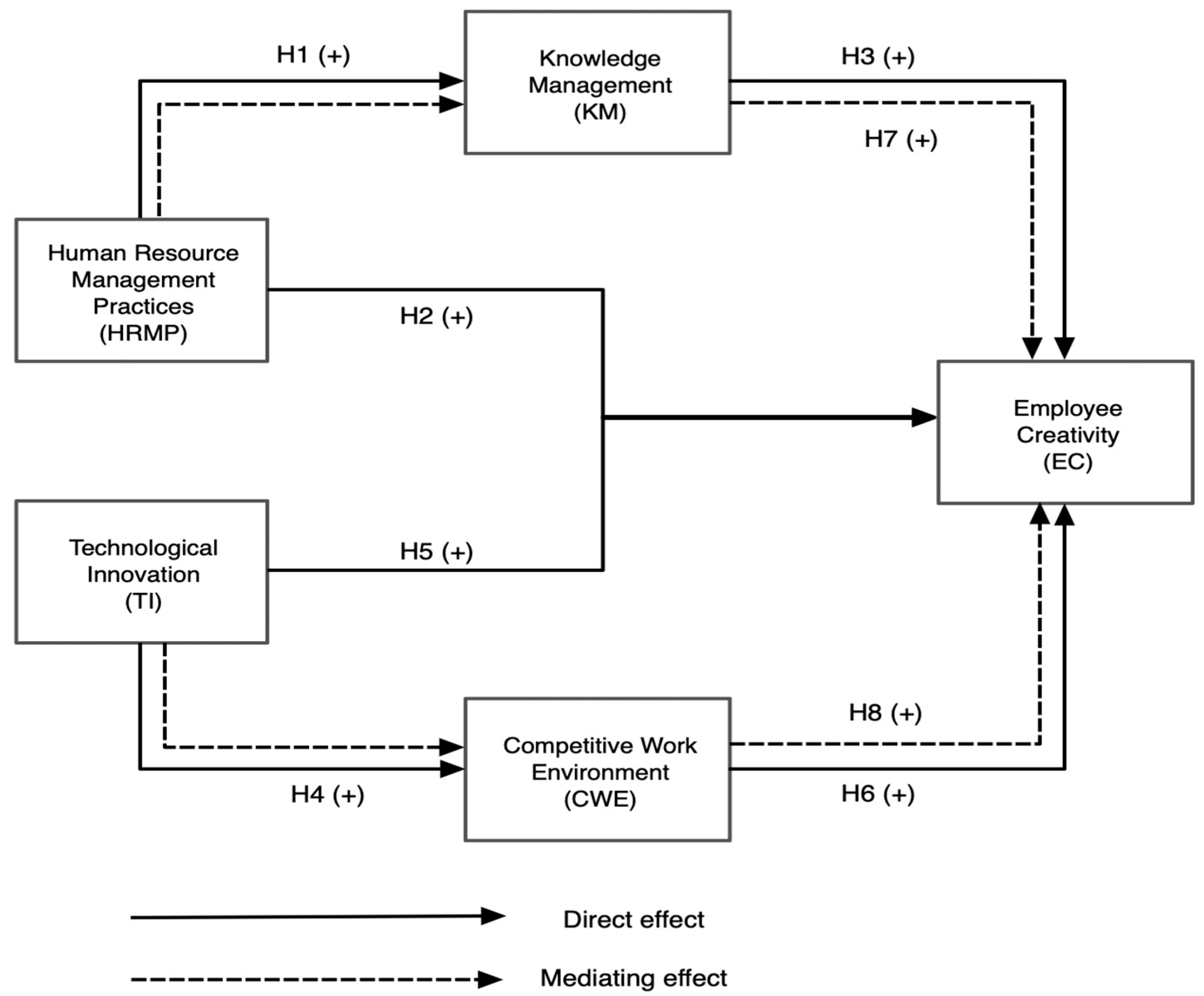
Several studies have used dynamic capabilities theory [28] and knowledge-based view [29] separately or in conjunction with other frameworks. However, there is insufficient empirical support integrating these two theories. In a dynamic business environment, dynamic capabilities and knowledge drive organizations to be more agile and flexible [58,59]. This study incorporating dynamic capabilities and the KBV to examine how SMEs leverage knowledge and resources to build competitive work environment that encourages employee creativity. The conceptual framework in Figure 1 shows the linkage among the constructs studied.

2.2. HRMP, KM, and Creativity

Empirical evidence investigating the direct linkage between HRMP and KM remains rare, even though HRMP’s operational function is crucial for maximizing human resource potential to achieve organizational goals [15]. By focusing on knowledge development through integrated selection programs, training, and career development, and on a knowledge-based compensation system, a climate that stimulates of knowledge exchange and acquisition will be fostered, and knowledge transfer will be improved [60,61]. HRM shapes an organizational learning culture that supports continuous learning [19,62]. In this case, HRMP serves as a catalyst for building a culture and infrastructure for sharing experience and knowledge across organizational elements [63,64], through procurement functions with transparent recruitment processes, advanced training, objective performance management, and structured and fair compensation [14,65]. These HRM practices directly support the strategic objectives of knowledge management in creating, storing, and applying knowledge to boosting creativity, innovation, and competitive advantage [18,66].
HRMP organizes training and development programs to ensure employees have the knowledge and skills needed to create and use new knowledge [4,67]. In addition, by designing knowledge-based incentive and reward systems, HRMP can maximize talent to manage formal and experimental knowledge, providing a foundation of knowledge, resources, and an environment that stimulates new ideas [13,68]. With an effective KM system, employees can more easily access information, collaborate, and engage their knowledge; hence, increasing their personal capacity for creativity and innovation and developing various alternatives and new solutions [13,18]. Hence, the hypotheses are:
H1. 
HRMP significantly affects knowledge management.
H2. 
HRMP significantly affects employee creativity.
H3. 
KM significantly affects employee creativity.

2.3. Technological Innovation, CWE, and Creativity

Technological innovation provides a range of new methods, processes, techniques, tools, and solutions that stimulate creative ideas, making it easier for employees to complete their tasks and responsibilities. Technology (such as knowledge management platforms, big data analytics, and simulation tools) provides employees with access to a broad and diverse knowledge base that serves as the raw material for generating creative ideas [69,70]. Furthermore, technology facilitates cross-functional collaboration and communication, stimulating creativity through group interactions and brainstorming with diverse perspectives [71,72]. Adopting technology allows employees to test, visualize, and prototype new ideas quickly and at a lower cost [73,74].
A competitive, comfortable, and supportive work environment, including aspects, i.e., as facilities, lighting, privacy, supervision, and organizational climate, encourages employees to increase productivity, creativity, and innovation [75,76]. Supportive internal competition serves as a powerful extrinsic motivator. Employees are motivated to work and think harder to outperform their colleagues [75,76]. Awareness of intense market competition encourages employees to quickly find out-of-the-box solutions, forcing them to step outside their comfort zones [8,21]. However, a competitive environment also brings pressure, where overly aggressive competition triggers anxiety and fear of failure, while creativity requires a safe psychological space [77]. Furthermore, employees may withhold or hide their ideas and knowledge for fear that colleagues will exploit them, directly hindering collaboration, a key ingredient in creativity [78]. When the work environment facilitates teamwork, collaboration, appreciation, and good communication, employee creativity will increase because they are motivated, committed, and feel valued [79]. In an intense competition, employee creativity is the key to helping organizations stay ahead through continuous innovation [4]. Thus, technological innovation and a good work environment reinforce each other, creating competitive conditions that foster employee creativity. Hence, the hypotheses are:
H4. 
Technological innovation is significant in a competitive work environment.
H5. 
Technological innovation is significant to employee creativity.
H6. 
Competitive work environment is significant to employee creativity.

2.4. Mediating Role of Knowledge Management

Implementing human resource management practices (e.g., transparent selection, high-quality training, professional performance evaluation, and a fair reward system) will increase employees’ capability and enthusiasm for innovation. These practices foster a work environment conducive to exploring new ideas, implementing knowledge, and solving problems creatively [13,15]. Effective implementation of HRMP provides human resource management benefits and encourages the establishment of a viable knowledge management practice [80]. For example, by organizing training focused on knowledge-sharing practices, inter-team collaboration, and information technology, organizations have documented improvements in the work experience and systematically increased the availability and quality of organizational knowledge [81,82].
Knowledge management provides access to tacit and explicit knowledge as a foundation for creativity [8,83]. With easily accessible information, knowledge, and experience, employees can combine old ideas in new ways to produce innovative solutions [5,10]. Knowledge management also encourages employees to cultivate a learning-oriented and sharing climate that drives innovation capabilities [9]. Knowledge management mediates the linkage between HRMP and creativity because HRMP’s influence on creativity is both direct and indirect, through improvements in knowledge management processes. HRMP builds organizations’ dynamic capabilities to gather, share, and manage knowledge, ultimately strengthening employee creativity. Accordingly, the hypothesis is:
H7. 
KM mediates the linkage between HRMP and employee creativity.

2.5. Mediating Role of CWE

The provision of new tools, procedures, systems, and technologies facilitate employees to access insights and to experiment with ideas to make better decisions [84]. This creative exploration opens new opportunities, accelerates the innovation process, and encourages critical and flexible thinking, as well as productivity in completing tasks [85]. New technological innovations trigger competitive drives among employees and teams to develop superior skills, expertise, and performance [86,87]. The positive effects include a more competitive work environment, a challenging work atmosphere, and increased motivation due to higher work standards, faster pace, and higher-quality results [21,88].
In addition, a competitive work climate stimulates employees’ internal drive to think creatively, agilely, and innovatively in order to perform excellently and contribute optimally. Creating healthy competition has implications for work ethic [89], a focus on solution quality and innovation and the exploration of new ideas to meet competitive demands. A competitive work situation can indirectly increase the effect of technological innovation on employee creativity by stimulating competition, driving competition, and motivating employees [90]. Thus, technological innovation encourages the creation of a competitive work setting, which ultimately activates the creative potential of employees in responding to challenges and strengthening innovation. Therefore, the hypothesis is:
H8. 
CWE mediates the linkage between technological innovation and employee creativity.
The direct and indirect linkages between HRMP, technological innovation, knowledge management, competitive work environment, and employee creativity are presented in Figure 1.

3. Methodology

3.1. Sampling Method

The study involves SMEs, known as the pillars of a growing nation and can potentially absorb labor while contributing positively to Indonesia’s GDP growth [22,37]. To obtain the preliminary example, we benefited the Bali Provincial Government archive to identify SMEs to include in the study. The population encompassed 750 SMEs in Bali Province, Indonesia, organized into four clusters: woodcraft, weaving, metal, and export (Table 1). These four SME sectors were selected based on various reasons. First, SMEs that produce distinctive and superior products [15] that have global target market around Europe, America, and Asia. Second, employees’ creativity and innovation are the main strengths of these SMEs in developing competitive, unique, and high-value products [8]. Third, these SMEs have the potential to absorb labor and contribute positively to Indonesia’s GDP growth [15]. Fourth, the sample frame was designated using the simple random sampling approach, a lottery sampling method with single selection, implies that every individual in the population has an equal probability of being selected exactly once. The number of sample frames was established from expert formula, resulting 254 SMEs participants [91]. The 254 participating SMEs comprised four main sectors: woodcraft, weaving, metal, and export. These four sectors cater to international markets, requiring high-quality, innovative, and unique products. Therefore, employee creativity is a crucial factor. After obtaining a sample frame, we identified the respondents, namely employees that directly involved in routine activities, which was considered ideal for the study objectives. Data were collected in three phases, every two months from February to July 2025, through email and Google Forms, after first sending an email notification about the study agenda. Finally, we obtained 508 responses for analysis, thus achieving the study objectives.

3.2. Measurements

All constructs in this study were adopted from established studies. HRMP was measured using five dimensions: assortment and employment, instructing and advancement, performing assessment, compensation, and HR planning, adopted from studies [15,92]. Meanwhile, technological innovation is evaluated benefitting four indicators from studies [21,88]. Knowledge management is measured across four dimensions: knowledge management transfer (3 indicators), knowledge management storage (3 indicators), knowledge management application (3 indicators), and knowledge management creation (3 indicators) [15,93]. CWE is measured using 5 indicators [78], and employee creativity is measured using 6 indicators [39].
A 5-point Likert scale from “1: strongly disagree” to “5: strongly agree” was used to evaluate the constructs. Before use, to ensure intelligibility of the directions and statements, the Indonesian-language questionnaire was pilot-tested with 30 employees. As a result, slight alterations were performed to the wording of the questionnaire instructions and statements. Partial least squares based on variance (PLS-SEM) was used to test the initiated employee creativity model and evaluate the direct and indirect linkages among variables. For this purpose, this study used SmartPLS 3.2.9 software.
Thus, to assess the validity and reliability of the constructs, as suggested by experts [94], this study appraised the measurement model. Further, to examine the hypothesis about the linkage between variables, the study evaluated the structural model. Thus, the use of PLS-SEM was appropriate since the study aimed to validate the dynamic capabilities and KBV theories in constructing an employee creativity model [95].

3.3. Common Method Bias (CMB)

To avoid common method bias, we used three approaches. First, considering the academic purpose of the present study, we assured potential respondents of the anonymity of their responses, stating that all answers were for research purposes only. Second, we explained to respondents that the study results had no right or wrong answers to each question and advised them to answer each question based on their knowledge, not their feelings [96]. Finally, after data collection, we used Harman’s single-factor test, which explained only 27% of the total variance, indicating that CMB was not a concern [96].

4. Result

4.1. Respondents’ Profile

This study involved 508 employees from 254 SMEs that manufacture high-value artistic products for the international market. Table 2 presents the demographic composition of the respondents.

4.2. Outer Model

The measurement model assessment was used to examine construct reliability and validity. Construct reliability was evaluated using Cronbach’s alpha (α) and composite reliability (CR) (Table 3). Cronbach’s alpha (α) and CR readings above 0.700 indicate acceptable results [95]. In this study, Cronbach’s alpha (α) and CR readings were greater than, indicating reasonable internal consistency reliability. After that, convergent validity was determined using factor item loadings, CR, and average variance extracted (AVE). Table 3 also shows that all indicators have factor loadings higher than 0.6. The CR values exceed 0.7, and the AVE values exceed the recommended level of 0.5. Data analysis showed that the AVE square roots are greater than the construct correlations, suggesting that the discriminant validity requirements are met. The indicators indicate that the validity requirements and construct reliability are met [95]. The VIF values range from 1.494 to 3.537 (below the recommended level of 5), indicating that the data are not exhibiting problems associated with standard method variance [94].
Discriminant validity (Table 4) was measured using the Heterotrait/Monotrait ratio correlation method following the recommendations of expert [97]. Discriminant validity for this study was achieved because there was no shared variance between constructs with values greater than 0.85 (between 0.176 and 0.447).

4.3. Inner Model

The study employs the bootstrap method with 5000 subsamples to assess the significance of indicators and path coefficients [98], resulting in 0.675 as a model goodness-of-fit (GoF). It suggests high model fitness and implies that the intended employee creativity model applies to the SME sector. In addition, examining the standard residual root mean square (SRMR) and the normed fit index (NFI) shows that the SRMR is 0.065 and the NFI is 0.687, signifying a good fit [99]. The R2 reveals that HRMP, technological innovation, knowledge management, and competitive work environment account for 0.243 (24.3%) of the variance in employee creativity, suggesting that new constructs can be included in the future. Finally, Q2 have positive values (0.3562), indicating that all variables are highly predictive [98].

4.4. Hypothesis Testing

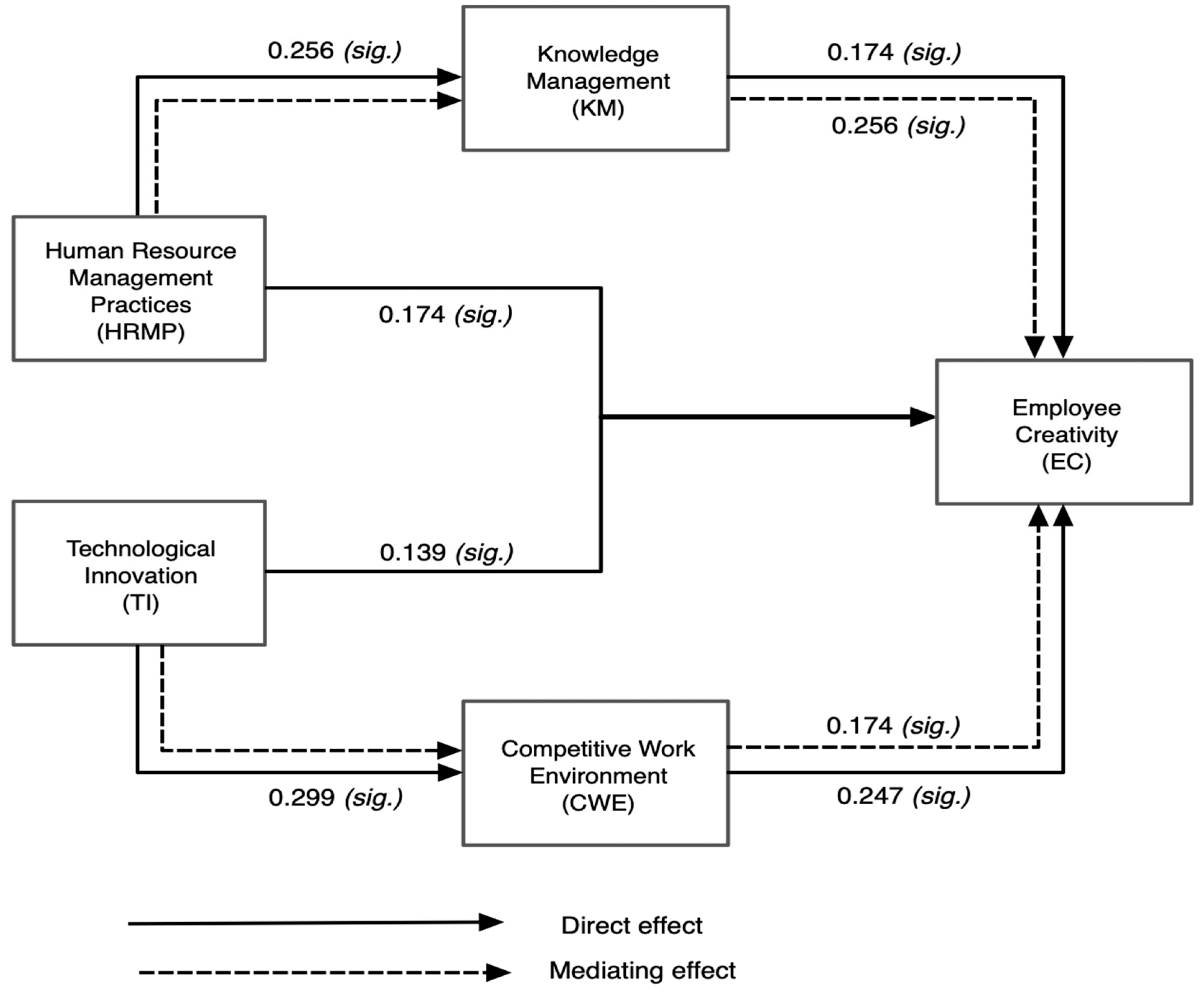
Structural model evaluation was conducted to test the aimed hypotheses utilizing bootstrapping with 5000 subsamples. At this stage, path coefficients (β) were reported as suggested by expert [100]. Table 5 presents the analysis of each hypothesis. The linkages between HRMP and knowledge management (β = 0.239, t-statistic = 4.092, p < 0.000) and between HRMP and employee creativity (β = 0.174, t-statistic = 3.187, p < 0.002) are significant, thus supporting H1 and H2.
Meanwhile, knowledge management and employee creativity are significant (β = 0.174, t statistic 2.918, p < 0.004), thus H3 is accepted.
Further, the linkages between technological innovation and competitive work environment (β = 0.299, t-statistic = 5.181, p < 0.000) and between technological innovation and employee creativity (β = 0.139, t-statistic = 2.413, p < 0.016) are significant, supporting H4 and H5. Meanwhile, competitive work environment significantly affects employee creativity (β = 0.247, t-statistic = 4.054, p < 0.000), thus supporting H6.
Subsequently, two mediation mechanisms were tested in this study. First, knowledge management mediated the linkage between HRMP and employee creativity (β = 0.256, t-statistic = 4.092, p < 0.000), thus supporting H7 (Table 6). Second, competitive work behavior mediates the linkage between technological innovation and employee creativity (β = 0.174, t-statistic = 3.187, p < 0.002), supporting H8. The results are illustrated in Figure 2.

5. Discussion

The study examines the antecedents of the creativity model in the SME industry. The positive linkage between HRMP and knowledge management (H1) shows that effective HRMP (procurement, training and development, performance appraisal, compensation, and HR planning) in improving employee capabilities and strengthens a series of mechanisms for the creation, storage, and dissemination of knowledge at the individual and organizational basis [13,32,74]. They indicate the important role of HRMP in preparing employees capable of building a knowledge-sharing culture [84], making them individual and collective assets for building the organization’s knowledge base [101,102]. Specifically, the key role of HRMP in screening employees to have knowledge management is carried out in all processes.
First, the HRMP’s role is crucial in recruiting prospective employees who possess the hard skills, willingness, and ability to share knowledge and engage in learning agility [21,81]. Thus, the HRMP ensures that the organization has the right intellectual capital from the outset as a foundation for creativity and innovation [103,104]. Second, the role of the HRMP is to design advanced training programs focused on developing knowledge-sharing skills (e.g., mentoring programs, coaching, facilitating knowledge transfer, reducing knowledge hiding, and utilizing knowledge management platforms) to fulfill skill and knowledge gaps among employees [4,105,106]. Thus, the HRMP functions to formalize and transfer tacit knowledge into explicit knowledge through a series of training sessions, advance training, and documentation [57,66]. Third, considering that the employee appraisal process, which demands objectivity and transparency, the HRMP plays a crucial role by including knowledge sharing and contributions to the knowledge base as indicators of employee performance [13,66,68]. Employees who actively share and voluntarily transfer knowledge add value to the performance appraisal process [36,107]. Thus, the HRMP will formally emphasize that knowledge sharing is part of the job responsibilities. Fourth, in terms of compensation, the role of HRMP is to provide salaries, incentives, bonuses, awards, or recognition to employees who actively and qualitatively share knowledge or innovate related to their knowledge [13,85,108]. This serves as a driving force for employee knowledge contribution to continuous knowledge sharing, which impacts work completion, innovative work behavior, and performance [6,109]. Thus, HRMP encourages motivation and a knowledge-sharing culture by providing rewards and recognition. Finally, HR planning helps organizations forecast knowledge bases, analyzing future strategic business objectives and determining what new skills and knowledge the workforce will need [18,19,110]. The analysis directly inform managers which aspects should be acquired, developed, or created [21,111,112]. Furthermore, HR planning triggers necessary knowledge management actions, such as projecting formal mentoring programs before knowledge holders leave, documenting complex, experience-based Standard Operating Procedures, and creating communities of practice to transfer knowledge between generations [13,25].
HRMP has a substantial influence on employee creativity (H2), supporting the argument that HRMP (procurement, training and development, performance appraisal, compensation, and HR planning) encourages creativity and innovative behavior among employees [113,114]. When employees feel that they receive support, attention, training, and opportunities for development, they tend to have affective commitment and reciprocate with creative behavior [107,115]. The HRMP dimension drives creativity in various ways. First, in the recruitment and selection process, the focus is on identifying prerequisites for recruiting individuals with characteristics that support creativity, such as curiosity, openness to new things and experiences, and the courage to take risks in a systematic and measured manner [8,116]. HR serves as an assessment tool to measure employees’ cognitive and personality potential, as well as their technical skills.
This enriches the diversity of perspectives that fuel creativity [76,117]. Second, in terms of training and development, HRMP provides training to enhance technical and soft skills to foster creativity, such as problem-solving, embracing change, and critical thinking towards cross-functional collaboration [85,118]. HR also organizes design thinking workshops and facilitates job rotations to expose employees [61] to different knowledge domains, thus sparking new ideas [119,120]. Third, performance appraisal give primary consideration which employees are evaluated not only on output, quantity, or adherence to procedures, but also on their contribution to new ideas, creativity, innovativeness, and willingness to try new methods [121,122]. Thus, a pro-creativity performance management system will provide space for learning from failure, growth, and continuous learning [123,124]. This can eliminate the fear of failure and punishment, which are major inhibitors of creativity [125,126]. Fourth, HRMP provides fair incentives to encourage creative behavior through financial rewards for successfully implemented ideas, or non-financial rewards such as public recognition and time off for personal projects [126,127]. Thus, by supporting creativity, rewards serve as a transformational mechanism for recognizing creative efforts and innovation, ultimately motivating employees to continue experimenting. Finally, HR planning provides a strategic and long-term mandate to foster creativity. It not only ensures workforce availability but also ensures that the organization has the appropriate intellectual capacity to generate new ideas and future innovations [61], acting as a bridge between the company’s business strategy and the need for a creative workforce [121,128,129]. Thus, HRMP fosters a culture of psychological safety and intrinsic motivation, two key factors in generating creative ideas in the workplace [6,130].
The significant linkage between KM and employee creativity (H3) proves that knowledge is a strategic resource in creating creativity-based competitive advantage. When knowledge is managed effectively (acquisition, sharing, and utilization), employees have the fuel to generate new ideas and innovations [13,102,131]. Considering its crucial role, knowledge management is considered a solid foundation [13,66], and creativity is the driving force that leverages that foundation to build an organization’s innovation structure [20,132]. The creative employees are those who possess the capabilities and skills to access, process, and integrate diverse knowledge [18,133]. Thus, creativity is the output of developing employee capabilities through the management of an organized knowledge system within the organization [13,25,80].
We also found a significant linkage between technological innovation and competitive work environment (H4). It indicates that adopting technological innovation fosters a competitive work environment. With innovative technology, SMEs can create and develop new products or services [134,135], increase market share, and optimize business processes [19,136]. In addition, innovative technology facilitates SMEs to respond quickly to market demand while retaining the best talent [18]. Consequently, these findings reinforce the role of technology in changing the social dynamics and work structure of organizations. When technology is implemented holistically, differences in adaptability among employees create competitive differentiation that can foster healthy competition while increasing motivation to achieve [8].
A significant linkage was found between technological innovation and employee creativity (H5). This finding underscores technological innovation as a catalyst for employee creativity. The implementation and assistance of new technologies expand methods and ways of thinking, enabling employees to explore more efficient solutions [12]. Given that technological innovation requires a strong skill set, SMEs need to provide training, knowledge sharing, opportunities for participation, and creative freedom for employees [2,74,87]. Our following finding is a significant linkage between competitive work environment and employee creativity (H6).
This finding explains how competitive work environment is a major driver of creative behavior in SMEs. A conducive work environment fosters healthy competition [137], motivating employees to be problem- and solution-oriented, and innovative, which, in turn, impacts individual and team performance [90,138,139].
In the mediation linkage, knowledge management was found to mediate the linkage between HRMP and employee creativity (H7). It occurs because knowledge-based HRM procedures encourage knowledge sharing and the generation of new ideas, which ultimately enhance employee creativity. Effective knowledge management, i.e., processes for sharing, using, storing, and discovering new knowledge, encourages employees to be creative in completing their work [32,140]. Further, knowledge-based HRMP facilitates knowledge exchange and management, thereby triggering new ideas and creative solutions [8,13]. In SMEs, these findings indicate that good knowledge management enhances creativity and HRMP evaluation. By carrying out the HRMP dimension process objectively and professionally, SME managers will obtain manpower who are willing to share knowledge [13,66], encourage innovative behavior [141,142], problem solving and experimentation which ultimately strengthens creativity [143]. Thus, organizations that implement an HRMP focused on knowledge management can effectively enhance employee creativity by improving knowledge-sharing and utilization processes.
Finally, competitive work environment mediates in the linkage between technological innovation and employee creativity (H8). In a competitive work environment, employees are encouraged to learn and adopt technological innovations effectively to develop more creative processes and mechanisms for completing their tasks. Competitive work environment stimulates internal motivation to innovate and create to be ahead of competitors [89,144]. Technological innovation provides tools, technologies, and resources that support creativity [145]. Simultaneously, competition in the work environment also encourages employees to use these technologies more innovatively [72,146]. Employees are fostered to explore and implement novel ideas and creative solutions to meet competitive demands through healthy competition. Thus, in a competitive work environment, technological innovation serves as a tool that fosters a competitive atmosphere, intensifying employee creativity.

5.1. Theoretical Implications

First, the model’s accuracy indicates that integrating dynamic capability theory and the knowledge-based view produces a practical construct for comprehending employee creativity in the SME sector. Dynamic capability theory emphasizes the ability of organizations to deliberately acclimate, rebuild, and redesign their sources and competencies to navigate a dynamic, rapidly evolving environment [37]. Further, the KBV, which explores how knowledge optimization within organizations influences creativity [29], refines the model by providing valuable insights into strategic efforts to enhance employee creativity. Empirical evidence supports this integrated approach, showing that HMRP and technological innovation significantly improve knowledge management and competitive work environment, thereby promoting creativity. Thus, this model effectively describes the inherent complexity of enhancing the creativity of SME employees by integrating managerial factors, knowledge, the work environment, and technological innovation, which are fundamentally disregarded in the literature.
Second, the study expands the HR literature by examining the interconnections between HRMP, technological innovation, knowledge management, competitive work environment, and employee creativity. Although previous studies have explored these constructs separately, such as the significant impact of HRMP on knowledge management [15], the impact of technological innovation on competitive work environment [147], and the positive impact of knowledge management on employee creativity [8], this study clarifies their combined effects. The findings reveal that knowledge management and competitive work environment serve as crucial mediating mechanisms between HRMP and technological innovation in enhancing employee creativity. These insights provide a more holistic comprehension of how various aspects interrelate to foster employee creativity in SMEs and address gaps in previous studies.
Third, knowledge management and competitive work environment are double mediators of the linkage between HRMP and technological innovation towards employee creativity. This path is highly strategic in increasing creativity, with a focus on implementing HRMP across procurement, training and development, performance appraisal, reward systems, and HR planning. On the other hand, adopting technological innovation will make it easier for employees to explore new ideas and methods, enabling them to develop alternative solutions for routine activities. These findings reveal that building employee creativity drive from three perspectives. First, SMEs are expected to build supportive organizational systems and cultures because creativity no longer depends on individual talent, but is driven by systems and structured processes. Second, resource-based synergy by optimizing the use of tangible and intangible assets (i.e., human resources, knowledge, and technology) to achieve high-value output, namely creativity at the individual, team, and organizational levels. Third, responsiveness to competitive market needs. Considering the increasingly dynamic business landscape, creativity also produces organizational agility and flexibility that encourage resilience to rapid change [4,105,106]. Thus, these important findings indicate that employee creativity is the result of a strategically designed environment, an environment where people are supported by transparent and professional HRMP, facilitated by the adoption of relevant technology, and motivated to learn rapidly through the core values of knowledge management to respond to market pressures and the competitive environment.
Fourth, this study contributes to the comprehension of HRMP in the SME sector by identifying five main dimensions: recruitment and selection, training, performance appraisal, rewards, and HR planning. Given the limited understanding of HRMP in this context, these findings offer valuable insights into how HRMP drives knowledge management. Using a hierarchical model, this study reveals that performance appraisal is the most significant factor in shaping HRMP, particularly in improving strategic planning to optimize SMEs’ dynamic capabilities. Performance appraisal reflects a systematic evaluation of employees’ abilities, attitudes, and performance over a specific period [148,149]. This assessment covers the suitability of inputs, processes, objectives, strengths, and weaknesses of employees as a basis for career development, salary increases, promotions, or corrective actions [6,85]. Our results validate the practicality of this hierarchical method in understanding the prominence of respective dimensions [150]. Given the importance of encouraging employee creativity, HRMP can effectively facilitate the implementation of knowledge-based guidelines and approaches [151].

5.2. Managerial Implications

This study extends valuable comprehensions for SME managers to enhance employee creativity. First, SME managers must prioritize transparent, accountable HRMP mechanisms to attract the best talent, ensuring they have employees with superior knowledge and creativity [152,153]. By implementing a transparent and accountable HRMP, SMEs can improve KM, respond effectively to changes in the business landscape, drive innovation, position themselves at the forefront of long-term competitiveness, and strengthen their competitiveness. For example, a transparent and professional selection and recruitment process allows SMEs to acquire new employees with fresh ideas, new perspectives, and strong knowledge, enabling them to adapt quickly and perform at a high level.
Second, technological innovation has emerged as an important driver of CWE and employee creativity. Thus, SME managers must focus on adopting technological innovations and building a competitive work environment. The literature shows that SMEs that adopt technological innovation tend to have employees with innovative behavior [107,115]. For instance, by investing in the latest technology, these SMEs can encourage employee engagement and creative behavior and commit to organizational performance. Specifically, the technological innovation implemented by SMEs focuses on the adoption of affordable cloud-based solutions and the integration of digital platforms such as e-commerce and social medias. This enhances process and services innovation, marketing innovation, and the transition to a technology-driven business model. Thus, technology significantly impacts transaction speed, provides real-time data, and enables faster tactical decision-making.
Third, employee creativity requires strong organizational support. Therefore, SME managers must integrate HRMP and KM into routine activities and enhance employees’ skills and knowledge in these areas. Given the changing business environment and intense competition, long-term planning for creativity and sustainable innovation is essential. Therefore, managers must encourage the adoption of technological innovations, foster a competitive work culture, and integrate knowledge into daily operational activities.

6. Conclusions

Three pivotal conclusions can be depicted from this study. First, HRMP is crucial in shaping knowledge management and employee creativity. HRPM is the foundation of the knowledge transformation process, specifically encouraging creativity and innovation and promoting value chains and important ideas. This study concludes that SMEs that implement HRMP efficiently will have quality knowledge that can stimulate creativity. Second, knowledge management and competitive work environment act as mediators between HRMP, technological innovation, and employee creativity. This mediating role underscores the importance of knowledge-oriented strategies in linking HRMP and technological innovation to employee creativity. Finally, this study successfully incorporates dynamic capability theory and the knowledge-based view by proposing a new, more comprehensive model for examining employee creativity in SMEs.

Limitations and Further Recommendations

The study offers conceptual and applied provisions. Nevertheless, several limitations remain to be considered as references for potential future investigations. First, this study uses self-assessment reports to assess constructs based on respondents’ cognitive views, interpretations, and memories, making them susceptible to social desirability bias. Therefore, future research should use multi-source data, temporal separation, and common method variance (CMV) marker variables or common latent factors (CLFs) in structural equation modeling (SEM) to explicitly model and control for CMB. Further, we used PLS-SEM to test the model and draw conclusions. Based on this, future studies can implement a qualitative approach or mix method approach to gain a comprehensive comprehension of technological innovation and its effects on employee creativity. Second, the study did not include control variables; we therefore suggest including demographic variables (i.e., age, gender, and job position) to test their moderating effects on the linkage between technological innovation and employee creativity. Third, this study used a limited sample of 9 cities in one province in Indonesia because of time and cost constrictions. Although the findings are significant, they are not generalizable to all geographic areas of SMEs in Indonesia.
In addition, the unique challenges faced by Indonesian SMEs, such as innovation, technology, or digital transformation, need attention so that research findings can be generalized. Therefore, future studies should use a broader sample and conduct comparative tests across countries to generalize the results. Furthermore, considering that each region or country has its own unique culture and beliefs, future studies could expand this framework by integrating characteristics such as entrepreneurial leadership, values, and norms. Thus, future research will yield comprehensive findings, particularly in a cross-cultural context.

Author Contributions

Conceptualization, N.P.S.S. and I.W.E.A.; methodology, N.P.S.S. and V.K.; software, I.W.E.A.; validation, V.K., A.A. and S.D.; formal analysis, N.P.S.S. and A.A.; investigation, I.W.E.A. and V.U.; resources, I.W.E.A., V.U. and S.D.; data curation, I.W.E.A. and N.P.S.S.; writing—original draft preparation, N.P.S.S. and I.W.E.A.; writing—review and editing, V.K.; visualization, N.P.S.S. and A.A.; supervision, V.K. and V.U.; project administration, N.P.S.S. and S.D.; funding acquisition, I.W.E.A. All authors have read and agreed to the published version of the manuscript.

Funding

This research received no external funding.

Institutional Review Board Statement

The study was conducted in accordance with the Declaration of Helsinki, and approved by Politeknik Negeri Bali Committee of Academic Integrity (protocol code No: 10473/PL8/AL.04/2025 and 28 April 2025).

Informed Consent Statement

Informed consent was obtained from all subjects involved in the study.

Data Availability Statement

The data presented in this study are available on request from the corresponding author.

Acknowledgments

We would like to thank the reviewer(s) for their constructive and valuable comments that significantly enhanced the paper.

Conflicts of Interest

The authors declare no conflicts of interest.

References

  1. Muisyo, P.K.; Qin, S.; Ho, T.H.; Julius, M.M. The Effect of Green HRM Practices on Green Competitive Advantage of Manufacturing Firms. J. Manuf. Technol. Manag. 2022, 33, 22–40. [Google Scholar] [CrossRef]
  2. Arsawan, I.W.E.; ssy De Hariyanti, N.K.; Atmaja, I.M.A.D.S.; Suhartanto, D.; Koval, V. Developing Organizational Agility in SMEs: An Investigation of Innovation’s Roles and Strategic Flexibility. J. Open Innov. Technol. Mark. Complex. 2022, 8, 149. [Google Scholar] [CrossRef]
  3. Khan, A.N.; Mehmood, K.; Kwan, H.K. Green Knowledge Management: A Key Driver of Green Technology Innovation and Sustainable Performance in the Construction Organizations. J. Innov. Knowl. 2024, 9, 100455. [Google Scholar] [CrossRef]
  4. Chaubey, A.; Sahoo, C.K.; Das, K.C. Examining the Effect of Training and Employee Creativity on Organizational Innovation: A Moderated Mediation Analysis. Int. J. Organ. Anal. 2021, 30, 499–524. [Google Scholar] [CrossRef]
  5. Bhatti, S.H.; Vorobyev, D.; Zakariya, R.; Christofi, M. Social Capital, Knowledge Sharing, Work Meaningfulness and Creativity: Evidence from the Pakistani Pharmaceutical Industry. J. Intellect. Cap. 2021, 22, 243–259. [Google Scholar] [CrossRef]
  6. K, J.; Ranjit, G. Explicating Intrinsic Motivation’s Impact on Job Performance: Employee Creativity as a Mediator. J. Strategy Manag. 2022, 15, 647–664. [Google Scholar] [CrossRef]
  7. Mokbel Al Koliby, I.S.; Abdullah, H.H.; Mohd Suki, N. Linking Entrepreneurial Competencies, Innovation and Sustainable Performance of Manufacturing SMEs. Asia-Pac. J. Bus. Adm. 2024, 16, 21–40. [Google Scholar] [CrossRef]
  8. Arsawan, I.W.E.; Koval, V.; Suhartanto, D.; Harbar, Z.; Maslennikov, Y. Employee-Driven Innovation Capability: The Role of Knowledge, Creativity, and Time Sufficiency. Intellect. Econ. 2022, 16, 138–165. [Google Scholar]
  9. Zhao, S.; Jiang, Y.; Peng, X.; Hong, J. Knowledge Sharing Direction and Innovation Performance in Organizations: Do Absorptive Capacity and Individual Creativity Matter? Eur. J. Innov. Manag. 2020, 24, 371–394. [Google Scholar] [CrossRef]
  10. de Carvalho Botega, L.F.; da Silva, J.C. An Artificial Intelligence Approach to Support Knowledge Management on the Selection of Creativity and Innovation Techniques. J. Knowl. Manag. 2020, 24, 1107–1130. [Google Scholar] [CrossRef]
  11. Ferreira, J.; Coelho, A.; Moutinho, L. Dynamic Capabilities, Creativity and Innovation Capability and Their Impact on Competitive Advantage and Firm Performance: The Moderating Role of Entrepreneurial Orientation. Technovation 2020, 92–93, 102061. [Google Scholar] [CrossRef]
  12. Valaei, N.; Rezaei, S. Does Web 2.0 Utilisation Lead to Knowledge Quality, Improvisational Creativity, Compositional Creativity, and Innovation in Small and Medium-Sized Enterprises? A Sense-Making Perspective. Technol. Anal. Strateg. Manag. 2017, 29, 381–394. [Google Scholar] [CrossRef]
  13. Le, P.B. Applying Knowledge-Based Human Resource Management to Drive Innovation: The Roles of Knowledge Sharing and Competitive Intensity. Manag. Res. Rev. 2024, 47, 602–621. [Google Scholar]
  14. Roy, S.K.; Dey, B.L.; Brown, D.M.; Abid, A.; Apostolidis, C.; Christofi, M.; Tarba, S. Business Model Innovation through AI Adaptation: The Role of Strategic Human Resources Management. Br. J. Manag. 2025, 36, 546–559. [Google Scholar] [CrossRef]
  15. Parwita, G.B.S.; Arsawan, I.W.E.; Koval, V.; Hrinchenko, R.; Bogdanova, N.; Tamosiuniene, R. Organizational Innovation Capability: Integrating Human Resource Management Practice, Knowledge Management and Individual Creativity. Intellect. Econ. 2021, 15, 22–45. [Google Scholar]
  16. Bari, M.W.; Ghaffar, M.; Ahmad, B. Knowledge-Hiding Behaviors and Employees ’ Silence: Mediating Role of Psychological Contract Breach. J. Knowl. Manag. 2020, 24, 2171–2194. [Google Scholar] [CrossRef]
  17. Fong, P.S.W.; Men, C.; Luo, J.; Jia, R. Knowledge Hiding and Team Creativity: The Contingent Role of Task Interdependence. Manag. Decis. 2018, 56, 329–343. [Google Scholar] [CrossRef]
  18. Al Halbusi, H.; Al-Sulaiti, K.I.; Alalwan, A.A.; Al-Busaidi, A.S. AI Capability and Green Innovation Impact on Sustainable Performance: Moderating Role of Big Data and Knowledge Management. Technol. Forecast. Soc. Change 2025, 210, 123897. [Google Scholar] [CrossRef]
  19. Zhang, X.; Chu, Z.; Ren, L.; Xing, J. Open Innovation and Sustainable Competitive Advantage: The Role of Organizational Learning. Technol. Forecast. Soc. Change 2023, 186, 122114. [Google Scholar] [CrossRef]
  20. León-Gómez, A.; Santos-Jaén, J.M.; Palacios-Manzano, M.; Garza-Sánchez, H.H. Unlocking Sustainable Competitive Advantage: Exploring the Impact of Technological Innovations on Performance in Mexican SMEs within the Tourism Sector. Environ. Dev. Sustain. 2025, 27, 3481–3511. [Google Scholar] [CrossRef]
  21. Zahoor, N.; Donbesuur, F.; Christofi, M.; Miri, D. Technological Innovation and Employee Psychological Well-Being: The Moderating Role of Employee Learning Orientation and Perceived Organizational Support. Technol. Forecast. Soc. Change 2022, 179, 121610. [Google Scholar] [CrossRef]
  22. Suryantini, N.P.S.; Moeljadi, M.; Aisjah, S.; Ratnawati, K. The Sustainable Competitive Advantage of SMEs Towards Intellectual Capital: The Role of Technology Adoption and Strategic Flexibility. Intellect. Econ. 2023, 17, 30–56. [Google Scholar] [CrossRef]
  23. Mady, K.; Abdul Halim, M.A.S.; Omar, K. Drivers of Multiple Eco-Innovation and the Impact on Sustainable Competitive Advantage: Evidence from Manufacturing SMEs in Egypt. Int. J. Innov. Sci. 2022, 14, 40–61. [Google Scholar] [CrossRef]
  24. Gorondutse, A.H.; Arshad, D.; Alshuaibi, A.S. Driving Sustainability in SMEs’ Performance: The Effect of Strategic Flexibility. J. Strategy Manag. 2020, 14, 64–81. [Google Scholar]
  25. Asif, M.U.; Bakar, L.J.A. Green Strategic Orientation and Sustainable Performance of SMEs: Moderating Role of Environmental Turbulence. J. Knowl. Econ. 2025, 16, 17517–17545. [Google Scholar] [CrossRef]
  26. Ratnawati, K.; Koval, V.; Arsawan, I.W.E.; Kazancoglu, Y.; Lomachynska, I.; Skyba, H. Leveraging Financial Literacy into Sustainable Business Performance: A Mediated-Moderated Model. Bus. Manag. Econ. Eng. 2024, 22, 333–356. [Google Scholar] [CrossRef]
  27. Castro-Lopez, A.; Iglesias, V.; Santos-Vijande, M.L. Organizational Capabilities and Institutional Pressures in the Adoption of Circular Economy. J. Bus. Res. 2023, 161, 113823. [Google Scholar] [CrossRef]
  28. Teece, D.J.; Pisano, G.; Shuen, A. Dynamic Capabilities and Strategic Management. Knowl. Strategy 2009, 18, 77–116. [Google Scholar] [CrossRef]
  29. Flöthmann, C.; Hoberg, K.; Gammelgaard, B. Disentangling Supply Chain Management Competencies and Their Impact on Performance: A Knowledge-Based View. Int. J. Phys. Distrib. Logist. Manag. 2018, 48, 630–655. [Google Scholar] [CrossRef]
  30. Arsawan, I.W.E.; Kartikasari, A.; Suhartanto, D.; Choirisa, S.F. Transitioning Towards Circular Economy Practices: The Role of Organizational Capabilities and Environmental Dynamism—Evidence From Indonesia. Bus. Strategy Environ. 2025, 35, 18–35. [Google Scholar] [CrossRef]
  31. Weaven, S.; Quach, S.; Thaichon, P.; Frazer, L.; Billot, K.; Grace, D. Surviving an Economic Downturn: Dynamic Capabilities of SMEs. J. Bus. Res. 2021, 128, 109–123. [Google Scholar] [CrossRef]
  32. Singh, S.K.; Mazzucchelli, A.; Vessal, S.R.; Solidoro, A. Knowledge-Based HRM Practices and Innovation Performance: Role of Social Capital and Knowledge Sharing. J. Int. Manag. 2021, 27, 100830. [Google Scholar] [CrossRef]
  33. Stoian, M.C.; Dimitratos, P.; Plakoyiannaki, E. SME Internationalization beyond Exporting: A Knowledge-Based Perspective across Managers and Advisers. J. World Bus. 2018, 53, 768–779. [Google Scholar] [CrossRef]
  34. Noopur, N.; Dhar, R.L. Knowledge-Based HRM Practices as an Antecedent to Service Innovative Behavior: A Multilevel Study. Benchmarking 2019, 27, 41–58. [Google Scholar] [CrossRef]
  35. Permatasari, A.; Dhewanto, W.; Dellyana, D. The Role of Traditional Knowledge-Based Dynamic Capabilities to Improve the Sustainable Performance of Weaving Craft in Indonesia. J. Enterprising Communities 2022, 17, 664–683. [Google Scholar] [CrossRef]
  36. Tsai, F.S.; Cabrilo, S.; Chou, H.H.; Hu, F.; Tang, A.D. Open Innovation and SME Performance: The Roles of Reverse Knowledge Sharing and Stakeholder Relationships. J. Bus. Res. 2022, 148, 433–443. [Google Scholar] [CrossRef]
  37. Aisjah, S.; Arsawan, I.W.E.; Suhartanto, D. Predicting SME’s Business Performance: Integrating Stakeholder Theory and Performance Based Innovation Model. J. Open Innov. Technol. Mark. Complex. 2023, 9, 100122. [Google Scholar] [CrossRef]
  38. Arsawan, I.W.E.; Suhartanto, D.; Koval, V.; Tralo, I.; Demenko, V.; Azizah, A. Enhancing the Circular Economy Business Model towards Sustainable Business Performance: Moderating the Role of Environmental Dynamism. J. Infrastruct. Policy Dev. 2024, 8, 3321. [Google Scholar] [CrossRef]
  39. Maria, A.D.; Yulianto, H.; Palupiningtyas, D.; Usodo, H. Relationship between Transformational Leadership, Proactive Personality, Creative Self-Efficacy and Employee Creativity at Food Processing SMEs in Indonesia. Evid.-Based HRM Glob. Forum Empir. Scholarsh. 2022, 10, 257–274. [Google Scholar] [CrossRef]
  40. Khan, O.; Daddi, T.; Iraldo, F. Sensing, Seizing, and Reconfiguring: Key Capabilities and Organizational Routines for Circular Economy Implementation. J. Clean. Prod. 2021, 287, 125565. [Google Scholar] [CrossRef]
  41. Kazmi, S.W.; Ahmed, W. Understanding Dynamic Distribution Capabilities to Enhance Supply Chain Performance: A Dynamic Capability View. Benchmarking Int. J. 2021, 29, 2822–2841. [Google Scholar] [CrossRef]
  42. Lin, H.; Hsu, I.; Wenhsin, A.; Chung, H. Creating competitive advantages: Interactions between Ambidextrous Diversi Fi Cation Strategy and Contextual Factors from a Dynamic Capability Perspective. Technol. Forecast. Soc. Change 2020, 154, 119952. [Google Scholar] [CrossRef]
  43. De Angelis, R.; Morgan, R.; De Luca, L.M. Open Strategy and Dynamic Capabilities: A Framework for Circular Economy Business Models Research. Bus. Strategy Environ. 2023, 32, 4861–4873. [Google Scholar] [CrossRef]
  44. Al-Khatib, A.W. The Impact of Dynamic Capabilities on Circular Economy: The Mediating Effect of the Industrial Internet of Things. J. Manuf. Technol. Manag. 2023, 34, 873–895. [Google Scholar] [CrossRef]
  45. Alsaad, A.; Selem, K.M.; Alam, M.M.; Melhim, L.K.B. Linking Business Intelligence with the Performance of New Service Products: Insight from a Dynamic Capabilities Perspective. J. Innov. Knowl. 2022, 7, 100262. [Google Scholar] [CrossRef]
  46. Singh, S.K.; Del Giudice, M.; Chiappetta Jabbour, C.J.; Latan, H.; Sohal, A.S. Stakeholder Pressure, Green Innovation, and Performance in Small and Medium-Sized Enterprises: The Role of Green Dynamic Capabilities. Bus. Strategy Environ. 2022, 31, 500–514. [Google Scholar] [CrossRef]
  47. Al-Shami, S.; Rashid, N. A Holistic Model of Dynamic Capabilities and Environment Management System towards Eco-Product Innovation and Sustainability in Automobile Firms. J. Bus. Ind. Mark. 2022, 37, 402–416. [Google Scholar] [CrossRef]
  48. Viswanathan, R.; Telukdarie, A. A Systems Dynamics Approach to SME Digitalization. Procedia Comput. Sci. 2021, 180, 816–824. [Google Scholar] [CrossRef]
  49. Lu, Y.; Li, G.; Luo, Z.; Anwar, M.; Zhang, Y. Does Intellectual Capital Spur Sustainable Competitive Advantage and Sustainable Growth?: A Study of Chinese and Pakistani Firms. Sage Open 2021, 11, 2158244021996702. [Google Scholar] [CrossRef]
  50. Yang, M.; Wang, J.; Zhang, X. Boundary-Spanning Search and Sustainable Competitive Advantage: The Mediating Roles of Exploratory and Exploitative Innovations. J. Bus. Res. 2021, 127, 290–299. [Google Scholar] [CrossRef]
  51. Cavaliere, V.; Lombardi, S.; Giustiniano, L. Knowledge Sharing in Knowledge-Intensive Manufacturing Firms. An Empirical Study of Its Enablers. J. Knowl. Manag. 2015, 19, 1124–1145. [Google Scholar] [CrossRef]
  52. Razzaq, S.; Shujahat, M.; Hussain, S.; Nawaz, F.; Wang, M.; Ali, M.; Tehseen, S. Knowledge Management, Organizational Commitment and Knowledge-Worker Performance: The Neglected Role of Knowledge Management in the Public Sector. Bus. Process Manag. J. 2019, 25, 923–947. [Google Scholar] [CrossRef]
  53. Meng, F.; Zhang, X.; Liu, L.; Ren, C. Converting Readers to Patients? From Free to Paid Knowledge-Sharing in Online Health Communities. Inf. Process Manag. 2021, 58, 102490. [Google Scholar] [CrossRef]
  54. Arsawan, I.W.E.; Rajiani, I.; Suryantini, N.P.S. Investigating Knowledge Transfer Mechanism in Five Star Hotels. Pol. J. Manag. Stud. 2018, 18, 22–32. [Google Scholar] [CrossRef]
  55. Attia, A.; Essam Eldin, I. Organizational Learning, Knowledge Management Capability and Supply Chain Management Practices in the Saudi Food Industry. J. Knowl. Manag. 2018, 22, 1217–1242. [Google Scholar] [CrossRef]
  56. Wang, C.; Hu, Q. Knowledge Sharing in Supply Chain Networks: Effects of Collaborative Innovation Activities and Capability on Innovation Performance. Technovation 2020, 94, 102010. [Google Scholar] [CrossRef]
  57. Kumar, S.; Kumar, V.; Chaudhuri, R.; Chatterjee, S.; Vrontis, D. AI Capability and Environmental Sustainability Performance: Moderating Role of Green Knowledge Management. Technol. Soc. 2025, 81, 102870. [Google Scholar] [CrossRef]
  58. Harsch, K.; Festing, M. Dynamic Talent Management Capabilities and Organizational Agility—A Qualitative Exploration. Hum. Resour. Manag. 2020, 59, 43–61. [Google Scholar] [CrossRef]
  59. Miroshnychenko, I.; Strobl, A.; Matzler, K.; De Massis, A. Absorptive Capacity, Strategic Flexibility, and Business Model Innovation: Empirical Evidence from Italian SMEs. J. Bus. Res. 2021, 130, 670–682. [Google Scholar] [CrossRef]
  60. Arsawan, I.W.E.; Sanjaya, I.B.; Putra, I.K.M.; Sukarta, I.W. The Effect of Expatriate Knowledge Transfer on Subsidiaries’ Performance: A Moderating Role of Absorptive Capacity. J. Phys. Conf. Ser. 2018, 953, 012082. [Google Scholar]
  61. Khan, M.S.; Ahmad, Z.; Khan, F. The Effects of Green Human Resource Management Practices on Sustainable Performance: The Mediating Role of Green Climat and Green Employee Empowerment. Turk. Online J. Qual. Inq. 2021, 12, 1381–1397. [Google Scholar]
  62. Ghasemzadeh, P.; Nazari, J.A.; Farzaneh, M.; Mehralian, G. Moderating Role of Innovation Culture in the Relationship between Organizational Learning and Innovation Performance. Learn. Organ. 2019, 26, 289–303. [Google Scholar] [CrossRef]
  63. Abbas, J.; Khan, S.M. Green Knowledge Management and Organizational Green Culture: An Interaction for Organizational Green Innovation and Green Performance. J. Knowl. Manag. 2023, 27, 1852–1870. [Google Scholar] [CrossRef]
  64. Isensee, C.; Teuteberg, F.; Griese, K.-M.; Topi, C. The Relationship between Organizational Culture, Sustainability, and Digitalization in SMEs: A Systematic Review. J. Clean. Prod. 2020, 275, 122944. [Google Scholar] [CrossRef]
  65. Diaz-Fernandez, M.; Pasamar-Reyes, S.; Valle-Cabrera, R. Human Capital and Human Resource Management to Achieve Ambidextrous Learning: A Structural Perspective. BRQ Bus. Res. Q. 2017, 20, 63–77. [Google Scholar] [CrossRef]
  66. Zairbani, A.; Senthil Kumar, J.P. How Does Green Knowledge Sharing Improve Sustainable Business Performance? Knowl. Process Manag. 2025, 32, 42–53. [Google Scholar] [CrossRef]
  67. Kwon, K. The Long-Term Effect of Training and Development Investment on Financial Performance in Korean Companies. Int. J. Manpow. 2019, 40, 1092–1109. [Google Scholar] [CrossRef]
  68. Arsawan, W.E.; Koval, V.; Suhartanto, D.; Babachenko, L.; Kapranova, L.; Suryantini, N.P.S. Invigorating Supply Chain Performance in Small Medium Enterprises: Exploring Knowledge Sharing as Moderator. Bus. Manag. Econ. Eng. 2023, 21, 1–18. [Google Scholar] [CrossRef]
  69. Panda, S.; Rath, S.K. Information Technology Capability, Knowledge Management Capability, and Organizational Agility: The Role of Environmental Factors. J. Manag. Organ. 2021, 27, 148–174. [Google Scholar] [CrossRef]
  70. Stadler, C.; Helfat, C.E.; Verona, G. Transferring Knowledge by Transferring Individuals: Innovative Technology Use and Organizational Performance in Multiunit Firms. Organ. Sci. 2022, 33, 253–274. [Google Scholar] [CrossRef]
  71. Jimenez-Jimenez, D.; Martínez-Costa, M.; Sanchez Rodriguez, C. The Mediating Role of Supply Chain Collaboration on the Relationship between Information Technology and Innovation. J. Knowl. Manag. 2019, 23, 548–567. [Google Scholar] [CrossRef]
  72. Mardani, A.; Nikoosokhan, S.; Moradi, M.; Doustar, M. The Relationship Between Knowledge Management and Innovation Performance. J. High Technol. Manag. Res. 2018, 29, 12–26. [Google Scholar] [CrossRef]
  73. Ali, A.; Bahadur, W.; Wang, N.; Luqman, A.; Khan, A.N. Improving Team Innovation Performance: Role of Social Media and Team Knowledge Management Capabilities. Technol. Soc. 2020, 61, 101259. [Google Scholar] [CrossRef]
  74. Lam, L.; Nguyen, P.; Le, N.; Tran, K. The Relation among Organizational Culture, Knowledge Management, and Innovation Capability: Its Implication for Open Innovation. J. Open Innov. Technol. Mark. Complex. 2021, 7, 66. [Google Scholar] [CrossRef]
  75. Kim, J.; Jung, H.S. The Effect of Employee Competency and Organizational Culture on Employees’ Perceived Stress for Better Workplace. Int. J. Environ. Res. Public Health 2022, 19, 4428. [Google Scholar] [CrossRef]
  76. Al-Hawari, M.A.; Quratulain, S.; Melhem, S.B. How and When Frontline Employees’ Environmental Values Influence Their Green Creativity? Examining the Role of Perceived Work Meaningfulness and Green HRM Practices. J. Clean. Prod. 2021, 310, 127598. [Google Scholar] [CrossRef]
  77. Yadegaridehkordi, E.; Foroughi, B.; Iranmanesh, M.; Nilashi, M.; Ghobakhloo, M. Determinants of Environmental, Financial, and Social Sustainable Performance of Manufacturing SMEs in Malaysia. Sustain. Prod. Consum. 2023, 35, 129–140. [Google Scholar] [CrossRef]
  78. Oubrich, M.; Hakmaoui, A.; Benhayoun, L.; Söilen, K.S.; Abdulkader, B. Impacts of Leadership Style, Organizational Design and HRM Practices on Knowledge Hiding: The Indirect Roles of Organizational Justice and Competitive Work Environment. J. Bus. Res. 2021, 137, 488–499. [Google Scholar] [CrossRef]
  79. Luo, C.; Lan, Y.; Luo, X.; Li, H. The Effect of Commitment on Knowledge Sharing: An Empirical Study of Virtual Communities. Technol. Forecast. Soc. Change 2021, 163, 120438. [Google Scholar] [CrossRef]
  80. Ngoc Huynh, H.T.; Thanh Nguyen, N.T.; Y Vo, N.N. The Influence of Knowledge Management, Green Transformational Leadership, Green Organizational Culture on Green Innovation and Sustainable Performance: The Case of Vietnam. J. Open Innov. Technol. Mark. Complex. 2024, 10, 100436. [Google Scholar] [CrossRef]
  81. Waheed, M.; Klobas, J.E.; Ain, N.U. Unveiling Knowledge Quality, Researcher Satisfaction, Learning, and Loyalty: A Model of Academic Social Media Success. Inf. Technol. People 2021, 34, 204–227. [Google Scholar] [CrossRef]
  82. Yoo, D.K. Substructures of Perceived Knowledge Quality and Interactions with Knowledge Sharing and Innovativeness: A Sensemaking Perspective. J. Knowl. Manag. 2014, 18, 523–537. [Google Scholar] [CrossRef]
  83. Zeb, A.; Abdullah, N.H.; Hussain, A.; Safi, A. Authentic Leadership, Knowledge Sharing, and Employees’ Creativity. Manag. Res. Rev. 2019, 43, 669–690. [Google Scholar] [CrossRef]
  84. De Clercq, D.; Pereira, R. Knowledge-Sharing Efforts and Employee Creative Behavior: The Invigorating Roles of Passion for Work, Time Sufficiency and Procedural Justice. J. Knowl. Manag. 2020, 24, 1131–1155. [Google Scholar] [CrossRef]
  85. Tran Huy, P. How Does High-Performance Work System Influence Employees’ Creativity? The Role of Critical Reflection and Human Resource Management Attribution. Int. J. Emerg. Mark. 2025, 20, 638–659. [Google Scholar]
  86. Dziallas, M.; Blind, K. Technovation Innovation Indicators throughout the Innovation Process: An Extensive Literature Analysis. Technovation 2019, 80–81, 3–29. [Google Scholar] [CrossRef]
  87. Verbano, C.; Crema, M. Linking Technology Innovation Strategy, Intellectual Capital and Technology Innovation Performance in Manufacturing SMEs. Technol. Anal. Strateg. Manag. 2016, 28, 524–540. [Google Scholar] [CrossRef]
  88. Bagheri, M.; Mitchelmore, S.; Bamiatzi, V.; Nikolopoulos, K. Internationalization Orientation in SMEs: The Mediating Role of Technological Innovation. J. Int. Manag. 2019, 25, 121–139. [Google Scholar] [CrossRef]
  89. Afsar, B.; Umrani, W.A. Transformational Leadership and Innovative Work Behavior: The Role of Motivation to Learn, Task Complexity and Innovation Climate. Eur. J. Innov. Manag. 2019, 23, 402–428. [Google Scholar] [CrossRef]
  90. Miller, L.; Miller, A.F. Innovative Work Behavior through High-Quality Leadership. Int. J. Innov. Sci. 2020, 12, 219–236. [Google Scholar] [CrossRef]
  91. Krejcie, R.V.; Morgan, D.W. Determining Sample Size for Research Activities. Educ. Psychol. Meas. 1970, 30, 607–610. [Google Scholar] [CrossRef]
  92. Li, S.; Rees, C.J. Determinants of the Formalization of Human Resource Management Practices: An Empirical Study in SMEs in Eastern and Western China. J. Small Bus. Manag. 2021, 59, 735–755. [Google Scholar]
  93. Donate, M.J.; Sánchez de Pablo, J.D. The Role of Knowledge-Oriented Leadership in Knowledge Management Practices and Innovation. J. Bus. Res. 2015, 68, 360–370. [Google Scholar] [CrossRef]
  94. Hair, J.F.; Hult, G.; Tomas, M.; Ringle, C.M.; Sarstedt, M. A Primer on Partial Least Squares Structural Equation Modeling (PLS-SEM); Sage Publications: Thousand Oaks, CA, USA, 2016. [Google Scholar]
  95. Hair, J.F., Jr.; Matthews, L.M.; Matthews, R.L.; Sarstedt, M. PLS-SEM or CB-SEM: Updated Guidelines on Which Method to Use. Int. J. Multivar. Data Anal. 2017, 1, 107–123. [Google Scholar]
  96. Podsakoff, P.M.; MacKenzie, S.B.; Lee, J.Y.; Podsakoff, N.P. Common Method Biases in Behavioral Research: A Critical Review of the Literature and Recommended Remedies. J. Appl. Psychol. 2003, 88, 879–903. [Google Scholar] [CrossRef]
  97. Henseler, J.; Fassott, G. Testing Moderating Effects in PLS Path Models: An Illustration of Available Procedures. In Handbook of Partial Least Squares; Springer: Berlin/Heidelberg, Germany, 2010; pp. 713–735. [Google Scholar]
  98. Chin, W.W. How to Write Up and Report PLS Analyses. In Handbook of Partial Least Squares; Springer: Berlin/Heidelberg, Germany, 2010; pp. 655–690. [Google Scholar]
  99. Tenenhaus, M.; Vinzi, V.E.; Chatelin, Y.-M.; Lauro, C. PLS Path Modeling. Comput. Stat. Data Anal. 2005, 48, 159–205. [Google Scholar] [CrossRef]
  100. Guenther, P.; Guenther, M.; Ringle, C.M.; Zaefarian, G.; Cartwright, S. Improving PLS-SEM Use for Business Marketing Research. Ind. Mark. Manag. 2023, 111, 127–142. [Google Scholar] [CrossRef]
  101. Abbas, Y.; Martinetti, A.; Moerman, J.-J.; Hamberg, T.; van Dongen, L.A.M. Do You Have Confidence in How Your Rolling Stock Has Been Maintained? A Blockchain-Led Knowledge-Sharing Platform for Building Trust between Stakeholders. Int. J. Inf. Manag. 2020, 55, 102228. [Google Scholar] [CrossRef]
  102. Hameed, W.U.; Nisar, Q.A.; Wu, H.C. Relationships between External Knowledge, Internal Innovation, Firms’ Open Innovation Performance, Service Innovation and Business Performance in the Pakistani Hotel Industry. Int. J. Hosp. Manag. 2021, 92, 102745. [Google Scholar] [CrossRef]
  103. Bouton, E.; Tal, S.B.; Asterhan, C.S.C. Students, Social Network Technology and Learning in Higher Education: Visions of Collaborative Knowledge Construction vs. the Reality of Knowledge Sharing. Internet High. Educ. 2021, 49, 100787. [Google Scholar] [CrossRef]
  104. Kumar, V.; Jabarzadeh, Y.; Jeihouni, P.; Garza-Reyes, J.A. Learning Orientation and Innovation Performance: The Mediating Role of Operations Strategy and Supply Chain Integration. Supply Chain Manag. 2020, 25, 457–474. [Google Scholar] [CrossRef]
  105. Chinedu, C.C.; Saleem, A.; Wan Muda, W.H.N. Teaching and Learning Approaches: Curriculum Framework for Sustainability Literacy for Technical and Vocational Teacher Training Programmes in Malaysia. Sustainability 2023, 15, 2543. [Google Scholar] [CrossRef]
  106. Susanty, A.I.; Yuningsih, Y.; Anggadwita, G. Knowledge Management Practices and Innovation Performance: A Study at Indonesian Government Apparatus Research and Training Center. J. Sci. Technol. Policy Manag. 2019, 10, 301–318. [Google Scholar] [CrossRef]
  107. Arsawan, I.W.E.; Kariati, N.M.; Shchokina, Y.; Prayustika, P.A.; Rustiarini, N.W.; Koval, V. Invigorating Employee ’ S Innovative Work Behavior: Exploring The Sequential Mediating Role Of Organizational Commitment And Knowledge Sharing. Bus. Theory Pract. 2022, 23, 117–130. [Google Scholar]
  108. Obeidat, S.M.; Abdalla, S.; Al Bakri, A.A.K. Integrating Green Human Resource Management and Circular Economy to Enhance Sustainable Performance: An Empirical Study from the Qatari Service Sector. Empl. Relat. 2023, 45, 535–563. [Google Scholar] [CrossRef]
  109. Sun, H.; Mulindwa Bahizire, G.; Bernard Pea-Assounga, J.B.; Chen, T. Enhancing Employee Green Performance through Green Training: The Mediating Influence of Organizational Green Culture and Work Ethic in the Mining Sector. J. Clean. Prod. 2024, 449, 141105. [Google Scholar] [CrossRef]
  110. AlQershi, N.; Saufi, R.B.A.; Ismail, N.A.; Mohamad, M.R.B.; Ramayah, T.; Muhammad, N.M.N.; Yusoff, M.N.H. Bin The Moderating Role of Market Turbulence beyond the Covid-19 Pandemic and Russia-Ukraine Crisis on the Relationship between Intellectual Capital and Business Sustainability. Technol. Forecast. Soc. Change 2023, 186, 122081. [Google Scholar] [CrossRef]
  111. Denicolai, S.; Zucchella, A.; Magnani, G. Internationalization, Digitalization, and Sustainability: Are SMEs Ready? A Survey on Synergies and Substituting Effects among Growth Paths. Technol. Forecast. Soc. Change 2021, 166, 120650. [Google Scholar] [CrossRef]
  112. Carmona-Lavado, A.; Cuevas-Rodríguez, G.; Cabello-Medina, C.; Fedriani, E.M. Does Open Innovation Always Work? The Role of Complementary Assets. Technol. Forecast. Soc. Change 2021, 162, 120316. [Google Scholar] [CrossRef]
  113. Al Wali, J.; Muthuveloo, R.; Teoh, A.P. Unravelling the Nexus between Creative Self-Efficacy, Humble Leadership, Innovative Work Behaviour and Job Performance amongst Physicians in Public Hospitals. Asia-Pac. J. Bus. Adm. 2022, 14, 706–726. [Google Scholar] [CrossRef]
  114. Anser, M.K.; Yousaf, Z.; Khan, A.; Usman, M. Towards Innovative Work Behavior through Knowledge Management Infrastructure Capabilities: Mediating Role of Functional Flexibility and Knowledge Sharing. Eur. J. Innov. Manag. 2020, 24, 461–480. [Google Scholar] [CrossRef]
  115. Arain, G.A.; Bhatti, Z.A.; Hameed, I.; Fang, Y.H. Top-down Knowledge Hiding and Innovative Work Behavior (IWB): A Three-Way Moderated-Mediation Analysis of Self-Efficacy and Local/Foreign Status. J. Knowl. Manag. 2019, 24, 127–149. [Google Scholar] [CrossRef]
  116. Karaboga, T.; Erdal, N.; Karaboga, H.A.; Tatoglu, E. Creativity as a Mediator between Personal Accomplishment and Task Performance: A Multigroup Analysis Based on Gender during the COVID-19 Pandemic. Curr. Psychol. 2022, 42, 12517–12529. [Google Scholar] [CrossRef]
  117. Farooq, R.; Zhang, Z.; Talwar, S.; Dhir, A. Do Green Human Resource Management and Self-Efficacy Facilitate Green Creativity? A Study of Luxury Hotels and Resorts. J. Sustain. Tour. 2021, 30, 824–845. [Google Scholar] [CrossRef]
  118. Khurana, S.; Haleem, A.; Luthra, S.; Mannan, B. Evaluating Critical Factors to Implement Sustainable Oriented Innovation Practices: An Analysis of Micro, Small, and Medium Manufacturing Enterprises. J. Clean. Prod. 2021, 285, 125377. [Google Scholar] [CrossRef]
  119. Kwan, L.Y.Y.; Leung, A.K.-Y.; Liou, S. Culture, Creativity, and Innovation. J. Cross Cult. Psychol. 2018, 49, 165–170. [Google Scholar] [CrossRef]
  120. Stojcic, N.; Hashi, I.; Orlic, E. Creativity, Innovation Effectiveness and Productive Efficiency in the UK. Eur. J. Innov. Manag. 2018, 21, 564–580. [Google Scholar] [CrossRef]
  121. Liu, D.; Gong, Y.; Zhou, J.; Huang, J.C. Human Resource Systems, Employee Creativity, and Firm Innovation: The Moderating Role of Firm Ownership. Acad. Manag. J. 2017, 60, 1164–1188. [Google Scholar] [CrossRef]
  122. Nguyen, V.T.; Siengthai, S.; Swierczek, F.; Bamel, U.K. The Effects of Organizational Culture and Commitment on Employee Innovation: Evidence from Vietnam’s IT Industry. J. Asia Bus. Stud. 2019, 13, 719–742. [Google Scholar] [CrossRef]
  123. Sook, H.; Ae, S. Factors Affecting Hospital Employees ’ Knowledge Sharing Intention and Behavior, and Innovation Behavior. Osong Public Health Res. Perspect. 2014, 5, 148–155. [Google Scholar] [CrossRef]
  124. Ko, Y.J.; Choi, J.N. Overtime Work as the Antecedent of Employee Satisfaction, Firm Productivity, and Innovation. J. Organ. Behav. 2019, 40, 282–295. [Google Scholar] [CrossRef]
  125. Akram, T.; Lei, S.; Haider, M.J.; Hussain, S.T. The Impact of Organizational Justice on Employee Innovative Work Behavior: Mediating Role of Knowledge Sharing. J. Innov. Knowl. 2020, 5, 117–129. [Google Scholar] [CrossRef]
  126. Khaola, P.; Coldwell, D. Explaining How Leadership and Justice Influence Employee Innovative Behaviours. Eur. J. Innov. Manag. 2019, 22, 193–212. [Google Scholar] [CrossRef]
  127. Eriksson, T.; Qin, Z.; Wang, W. Firm-Level Innovation Activity, Employee Turnover and HRM Practices—Evidence from Chinese Firms. China Econ. Rev. 2014, 30, 583–597. [Google Scholar] [CrossRef]
  128. Jiang, W.; Gu, Q. A Moderated Mediation Examination of Proactive Personality on Employee Creativity. J. Organ. Change Manag. 2015, 28, 393–410. [Google Scholar]
  129. Joo, B.-K.; Yang, B.; McLean, G.N. Employee Creativity: The Effects of Perceived Learning Culture, Leader–Member Exchange Quality, Job Autonomy, and Proactivity. Hum. Resour. Dev. Int. 2014, 17, 297–317. [Google Scholar] [CrossRef]
  130. Yin, J.; Ma, Z.; Yu, H.; Jia, M.; Liao, G. Transformational Leadership and Employee Knowledge Sharing: Explore the Mediating Roles of Psychological Safety and Team Efficacy. J. Knowl. Manag. 2019, 24, 150–171. [Google Scholar] [CrossRef]
  131. Alassaf, D.; Dabić, M.; Shifrer, D.; Daim, T. The Impact of Open-Border Organization Culture and Employees’ Knowledge, Attitudes, and Rewards with Regards to Open Innovation: An Empirical Study. J. Knowl. Manag. 2020, 24, 2273–2297. [Google Scholar] [CrossRef]
  132. Perotti, F.A.; Troise, C.; Ferraris, A.; Hirwani Wan Hussain, W.M. Bridging Innovation Management and Circular Economy: An Empirical Assessment of Green Innovation and Open Innovation. Creat. Innov. Manag. 2025, 34, 466–485. [Google Scholar] [CrossRef]
  133. Koval, V.; Abramović, N.; Đurović, S.; Crvenica, D.; Arsawan, I.W.E. Fostering Technology Adoption and Management Advancements in Environmental Performance: Mediation of Circular Economy and Sustainability-Oriented Innovation. Sustainability 2025, 17, 1848. [Google Scholar] [CrossRef]
  134. Liu, L.; Jiang, Z. Influence of Technological Innovation Capabilities on Product Competitiveness. Industrial Management and Data Systems 2016, 116, 883–902. [Google Scholar] [CrossRef]
  135. Leckel, A.; Veilleux, S.; Dana, L.P. Local Open Innovation: A Means for Public Policy to Increase Collaboration for Innovation in SMEs. Technol. Forecast. Soc. Change 2020, 153, 119891. [Google Scholar] [CrossRef]
  136. Falahat, M.; Ramayah, T.; Soto-Acosta, P.; Lee, Y.Y. SMEs Internationalization: The Role of Product Innovation, Market Intelligence, Pricing and Marketing Communication Capabilities as Drivers of SMEs’ International Performance. Technol. Forecast. Soc. Change 2020, 152, 119908. [Google Scholar] [CrossRef]
  137. Khan, S.Z.; Yang, Q.; Waheed, A. Investment in Intangible Resources and Capabilities Spurs Sustainable Competitive Advantage and Firm Performance. Corp. Soc. Responsib. Environ. Manag. 2019, 26, 285–295. [Google Scholar] [CrossRef]
  138. Anning-Dorson, T.; Nyamekye, M.B. Be Flexible: Turning Innovativeness into Competitive Advantage in Hospitality Firms. Int. J. Contemp. Hosp. Manag. 2020, 32, 605–624. [Google Scholar] [CrossRef]
  139. Martínez-Román, J.A.; Gamero, J.; Delgado-González, M.d.L.; Tamayo, J.A. Innovativeness and Internationalization in SMEs: An Empirical Analysis in European Countries. Technol. Forecast. Soc. Change 2019, 148, 119716. [Google Scholar] [CrossRef]
  140. Kianto, A.; Sáenz, J.; Aramburu, N. Knowledge-Based Human Resource Management Practices, Intellectual Capital and Innovation. J. Bus. Res. 2017, 81, 11–20. [Google Scholar] [CrossRef]
  141. Akhavan, P.; Hosseini, S.M.; Abbasi, M.; Manteghi, M. Knowledge-Sharing Determinants, Behaviors, and Innovative Work Behaviors: An Integrated Theoretical View and Empirical Examination. Aslib J. Inf. Manag. 2015, 67, 562–591. [Google Scholar] [CrossRef]
  142. Hakimian, F.; Farid, H.; Ismail, M.N.; Nair, P.K. Importance of Commitment in Encouraging Employees’ Innovative Behaviour. Asia-Pac. J. Bus. Adm. 2016, 8, 70–83. [Google Scholar] [CrossRef]
  143. Amankwaa, A.; Gyensare, M.A.; Susomrith, P. Transformational Leadership with Innovative Behaviour: Examining Multiple Mediating Paths with PLS-SEM. Leadersh. Organ. Dev. J. 2019, 40, 402–420. [Google Scholar] [CrossRef]
  144. Lin, C.Y.Y.; Liu, F.C. A Cross-Level Analysis of Organizational Creativity Climate and Perceived Innovation: The Mediating Effect of Work Motivation. Eur. J. Innov. Manag. 2012, 15, 55–76. [Google Scholar] [CrossRef]
  145. Cepeda, J.; Arias-Pérez, J. Information Technology Capabilities and Organizational Agility: The Mediating Effects of Open Innovation Capabilities. Multinatl. Bus. Rev. 2019, 27, 198–216. [Google Scholar] [CrossRef]
  146. Lai, J.Y.; Wang, J.; Ulhas, K.R.; Chang, C.H. Aligning Strategy with Knowledge Management System for Improving Innovation and Business Performance. Technol. Anal. Strateg. Manag. 2022, 34, 474–487. [Google Scholar] [CrossRef]
  147. Singh, D.; Khamba, J.S.; Nanda, T. Influence of Technological Innovation on Performance of Small Manufacturing Companies. Int. J. Product. Perform. Manag. 2017, 66, 838–856. [Google Scholar] [CrossRef]
  148. Husin, N.H.; Gungkang, A.S. High Performance Work Systems and Employee Job Performance: Evidence From Banking Sector In Malaysia. J. Glob. Bus. Soc. Entrep. 2017, 1, 62–74. Available online: http://gbse.my/v1no3jan17/Paper-45-.pdf (accessed on 1 December 2025).
  149. Pattnaik, S.C.; Sahoo, R. Employee Engagement, Creativity and Task Performance: Role of Perceived Workplace Autonomy. South Asian J. Bus. Stud. 2020, 10, 227–241. [Google Scholar] [CrossRef]
  150. Ogunmokun, O.A.; Eluwole, K.K.; Avci, T.; Lasisi, T.T.; Ikhide, J.E. Propensity to Trust and Knowledge Sharing Behavior: An Evaluation of Importance-Performance Analysis among Nigerian Restaurant Employees. Tour. Manag. Perspect. 2020, 33, 100590. [Google Scholar] [CrossRef]
  151. Rita, M.; Randa Payangan, O.; Rante, Y.; Tuhumena, R.; Erari, A. Moderating Effect of Organizational Citizenship Behavior on the Effect of Organizational Commitment, Transformational Leadership and Work Motivation on Employee Performance. Int. J. Law Manag. 2018, 60, 953–964. [Google Scholar] [CrossRef]
  152. Frumkina, A.; Suryantini, N.P.S.; Azizah, A. An Interconnected Human Resources Model Development of Intercultural Competence in the Educational Activities of a Manager. Econ. Ecol. Socium 2024, 8, 62–72. [Google Scholar] [CrossRef]
  153. Furxhiu, N.K.; Mulita, R.; Luchaninova, O.; Harbar, Z. Assessment of Soft Skills and Development of Human Resource Management in The Labour Market Competitiveness. Econ. Ecol. Socium 2025, 9, 138–152. [Google Scholar] [CrossRef]
Figure 1. Employee creativity model.
Societies 16 00033 g001
Figure 2. Output analysis.
Societies 16 00033 g002
Table 1. Population, Sample, and Respondents.
NoFields (1)Total Population (2)Percentage of Population (3)Sample Frame/Unit (4)Respondents (5)
1Woodcraft20727.670140
2Weaving33144.1112224
3Metal14319.14998
4Export699.22346
Total750100254508
Table 2. Respondent profiles (n = 508).
CriteriaClassificationAmountPercentage
FieldsWoodcraft14027
Weaving22445
Metal 9819
Export469
GenderMale32764
Female15336
Age21–3020240
31–4016432
41–5010721
51–60357
Educational levelDiploma17434
Bachelor32364
Master112
Experiences<56914
6–1018937
11–1516733
16–207214
>21112
UnitHR12424
Production10621
Marketing15731
Finance12124
Table 3. Measurement Model.
Constructs/DimensionsLoading Factorαrho-ACRAVE
Human Resource Management Practices (HRMP) 0.9680.9680.9700.553
Selection and recruitment 0.9100.9110.9330.736
(1) Recruit competent people.0.860
(2) Attracting qualified candidates0.866
(3) Invests many person-hours to recruit people. 0.874
(4) Finding the right employees0.871
Training and development 0.8740.8740.9140.726
(1) Provide adequate training opportunities0.844
(2) Useful training program0.859
(3) Career development program0.859
(4) Career path according to performance0.845
Performance appraisal 0.8970.8970.9210.660
(1) Performance objectives0.781
(2) Constructive performance feedback0.840
(3) Performance-appropriate rewards0.825
(4) Performance-based promotions0.797
(5) Convey information about errors or failures0.798
(6) Provide assistance and direction0.833
Compensation 0.8880.8890.9150.642
(1) Fair compensation0.809
(2) Competitive compensation0.802
(3) Benefits that suit needs0.823
(4) Benefits that suit expectations0.805
(5) Clear rewards program0.805
(6) Transparent rewards program0.761
HR Planning 0.8980.8990.9240.710
(1) Complete tasks according to established standards0.799
(2) Master the field of work0.876
(3) Results meet the target0.868
(4) Be on time for work0.842
(5) Carry out tasks according to the rules0.826
Technological innovation 0.8110.8200.8750.637
(1) Continues to develop a range of products.0.744
(2) Replace products that become obsolete0.834
(3) Embraces emerging technologies 0.816
(4) Incorporates management to minimize expenses 0.767
Knowledge management 0.9370.9380.9450.590
Knowledge acquisitions 0.8120.8150.8890.728
(1) Acquire knowledge through teamwork0.878
(2) Uncover the source of information required0.872
(3) Gain knowledge from consultancy reports0.808
Knowledge transfer 0.8140.8170.8900.730
(1) Generate helpful ideas0.839
(2) Brainstorm to generate helpful ideas0.889
(3) Conduct research for organization 0.833
Knowledge application 0.8600.8630.9150.782
(1) Perform consistent meetings to interchange involvements0.902
(2) Review concerns with qualified fellowships 0.883
(3) Exchange information with stakeholders0.867
Knowledge storage 0.8150.8160.8900.730
(1) System for retrieving information0.874
(2) Access information online 0.842
(3) Update our knowledge databases 0.847
Competitive work environment 0.8330.8370.8820.600
(1) Inducements to high-performing co-workers0.744
(2) More work prospects for decent performers 0.809
(3) Recognition of accomplishments0.790
(4) High status to high-performing co-workers 0.773
(5) Recognition urged by high-performing determinations0.756
Employee creativity 0.8950.8960.9190.655
(1) Discuss work-related idea0.806
(2) Always support my new ideas0.808
(3) Useful feedback for my job0.807
(4) Support unpopular idea0.812
(5) Ideas concerning workplace0.829
(6) Support solution at work0.795
Table 4. Heterotrait/Monotrait Ratio.
CWEECHRMPKMTI
CWE
EC0.407
HRMP0.2390.339
KM0.1760.3390.269
TI0.3530.3900.3590.447
Table 5. Hypotheses testing.
HypothesesβSample Mean (M)Standard Deviation (STDEV)T Statistics (|O/STDEV|)p ValuesRemarks
H1HRMP → Knowledge Management0.2560.2540.0634.0920.000Sig.
H2HRMP → Employee Creativity0.1740.1700.0553.1870.002Sig.
H3Knowledge Management → Employee Creativity0.1740.1750.0602.9180.004Sig.
H4Technological Innovation → Competitive Work Environment 0.2990.2990.0585.1810.000Sig.
H5Technological Innovation → Employee Creativity0.1390.1400.0582.4130.016Sig.
H6Competitive Work Environment → Employee Creativity0.2470.2490.0614.0540.000Sig.
Table 6. Mediation testing.
HypothesesβSample Mean (M)Standard Deviation (STDEV)T Statistics (|O/STDEV|)p ValuesRemarks
H7HRMP → knowledge Management → employee creativity0.2560.2540.0634.0920.000Sig.
H8Technological innovation → CWE → Employee Creativity0.1740.1700.0553.1870.002Sig.
Disclaimer/Publisher’s Note: The statements, opinions and data contained in all publications are solely those of the individual author(s) and contributor(s) and not of MDPI and/or the editor(s). MDPI and/or the editor(s) disclaim responsibility for any injury to people or property resulting from any ideas, methods, instructions or products referred to in the content.